Visual artist working in the UK.
UCA Farnham, Interior Design MA.
Canterbury School of Architecture, Spatial Practices MA.
University of Southampton, Visual Fine Art BA hons.
Epsom School of Art and Design, Ceramics HSND.
Amongst Lightness and The Reverberation of Material.
Ceramic installation in white cube space.
Open Pit Firing, Shards, Ash, Ceramic Pieces, Low Table, White Cloth, Human Outline
We maybe more sophisticated in material ways, but we have not advanced spiritually beyond the axial age, and because of our suppression of mythos, we may even have regressed.
The history of myth is the history of humanity, our stories and beliefs, our curiosity and attempts to understand the world, link us to our ancestors and each other.
A Short History of Myth.
Karen Armstrong. 2005
Rollright Stones, Oxfordshire.
Stone Circle, Storytelling, King Stone, Whispering Knights, Witch,
A Summer’s Work.
Odyssey/Beauty/Struggle.
The Material Acts.
Summer 1994 : Artist’s Studio.
The viewers nevertheless allow themselves to be drawn into his game, in order to ‘see’ as though for the first time the pure existence of things.
Presentation/Ritual/Repetition.
Art is contemplation and must act upon our consciousness.
Objects/Things are part of the artist’s immediate existence.
Contemplative experiences become truly meaningful when they occur in everyday life and when nirvana or the state of superior awareness blurs into samsara or ordered time.
For Tapies, repetition is above all else a perpetual questioning or a perpetual becoming.
A working process that is additive, which incorporates changes and accidents and as such his methods are hardly erasing anything that is already present on the canvas.
A Summer’s Work, Antoni Tapies.
The Embodiment of Minimal Gesture.
The Solitude and Discipline of Firing.
Heja Chong.
Drawing from the philosophy and traditions of Bizen, she has undeniably developed her own aesthetic identity, embracing the raw materials of her new world, the pots and firing responding to the evolving nature of her life and environment. Adhering to the principle of Bizen, she is conscious that her level of involvement within this tradition, may not always be recognised or understood by others.
Viewpoint/Distance/Synthesise Forms.
Framing a Figure in Space.
Drawing is not the form, it is the way of seeing the form.
Edgar Degas.
The foreignness of the intimate or the violence and charity of perception.
R. Bruce Elder.
Raveningham.
The Autonomy of The Natural Environment.
Sculpture/Playing with the existence of things.
Field Studies : Pathways around the Sun.
Drawing : Assemblage of Lightness and Weight.
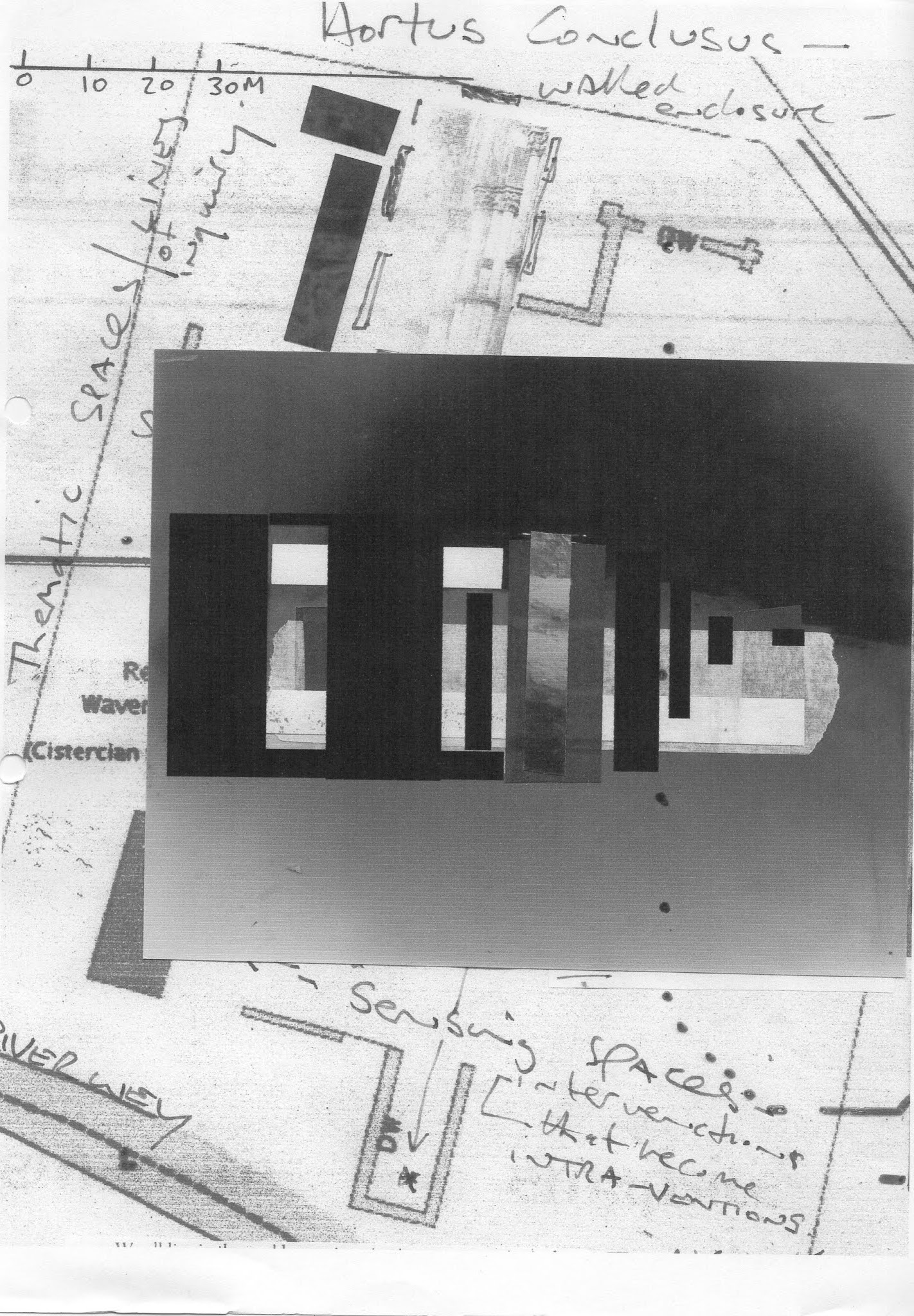
Enmeshed Space : Working Drawing with Handwritten Notes.
Lawn Deliberation/Mappings of Human Agency/Space/Time.
Space projected from the body is biased towards the front and right.
The future is ahead and ‘up.’
The past is behind and ‘below.’
Time as a structure/place to observe things in constant motion/relation.
Ground Pegs/Labels/Text Markings/Archival Information
Points becoming lines, Tim Ingold.
Spatial Construct : mediated space anticipating a destination, as seen through the fragmented myths, movie locations or souvenirs that vanguard the real place, access to places through their likenesses.
The workshop proposes strategies to confront our bodies with the multiplicity, unpredictability, directness and autonomy of the natural environment. The aim is to explore and develop consciousness of the body itself being an ever evolving landscape within a greater surrounding landscape.
Body/Landscape
Frank van de Ven.
The Psychology of Time.
Temporal Perspectives.
Relative Orientations/Past/Present/Future.
Time is often referred to as ‘the tacit dimension’ within psychology because unlike other types of perception, it is not directly available to any sensory organ but can only be apprehended through change and the dynamic flow of environmental events. And yet despite its ephemeral nature, time is a dimension that has a significant impact upon a wide variety of psychological behaviour.
From a cognitive perspective, it can be demonstrated that the orderly nature of one’s environment stems, in part, from the fact that events’ spatial characteristics are structured in and over time. Music, speech, body movements and walking gaits are among the many events in which the sequence of notes, words, or actions unfold with a characteristic rhythm and tempo over a given time span. The particular arrangement of this spatial-temporal structure not only influences how an event is perceived and remembered, but also the overall accuracy with which the event’s velocity and total duration are subsequently judged.
Different cultures have different conceptualizations of time which can be reflected in the types of metaphors that are used to describe time as well as the overall pace of life.
Curriculum Making.
The Enactment of Dwelling in Places.
An Ontology of Dwelling.
The dwelling ontology we want to describe rejects any possibility of living in the world through mental schemas of the world, and insists that the material-relational world is the only world in which we live, the only source of our capacities to communicate and learn, the only world in which our activities take effect, and the only world in which meaning inheres.
Greg Mannion, Hamish Ross.
Tim Ingold is an anthropologist who has looked at the interface between people and the environment. In The Perception of the Environment, he argues that ecological psychology and the philosophical writings of Heidegger and Merleau-Ponty share the view that the world becomes meaningful through active inhabitation, or ‘dwelling’, rather than cognitive representation.
Re-registering Overlapping Spaces #2
Public intimacies, personal dialogues in social spaces.
‘Blocking In’ of a private studio space of creative inquiry into the public realm as a permeable intervention.
Haptic Seeing/moving over the surface of the sociological subject.
Frottage, life drawings with involuntary textures and marks derived from their particular locality and working methods, concrete floors, wooden floorboards, graphite sticks, charcoal, pencil and wax crayons.
The body and its nakedness becomes the instrument of our emotions and our sensuality.
The Psychology of Nakedness.
Naked to Nude, Life Drawing in the Twentieth Century.
Bringing things back to life, to switch our perspective from the endless shuttling back and forth from image to object and from object to image, that is such a pronounced feature of academic writing in the fields of anthropology, archaeology, art and architecture, to the material flows and currents of sensory awareness in which images and objects reciprocally take shape.
Diffraction, understood as a material-discursive phenomenon that makes the effects of different differences evident.
Karen Barad.
Troubleyn Laboratorium, Jan Fabre.
The Empty Space, Peter Brook.
Verb List Compilation/Actions to relate to oneself, Richard Serra.
Ceramics.
Slab built architectural forms and crucible raku bowls.
Raku bowls thrown and turned in a coarse clay with wide flat rims inspired by crucible forms for melting materials.
Architectural slab built pieces investigate ceramics as a dwelling place or a model for a building construction.
Undercroft Exhibition Norwich.
Anglian Potters.
Notion of a moment of impeding transposition.
Transformation of derelict buildings into newly evocative spatial experiences.
Building Cuts/Physical Alteration to a space is a revelation of a particular response.
The Body To The Building.
Social Activism/Mindful Lawlessness.
Gordon Matta-Clark.
Performativity, subject and object do not pre-exist as such, but merge through intra-actions.
Karen Barad.
Architectural Body/The Organism That Persons.
Madeline Gins and Arakawa.
You cannot see me from where I look at myself.
Francesca Woodman.
Thinking Bodies/Becoming Woman.
Images that created a sense of confinement, a temporal identity for herself, a place for a personal resonance/self inquiry.
The body as architecture itself as the support that constitutes the spatial agency of photography.
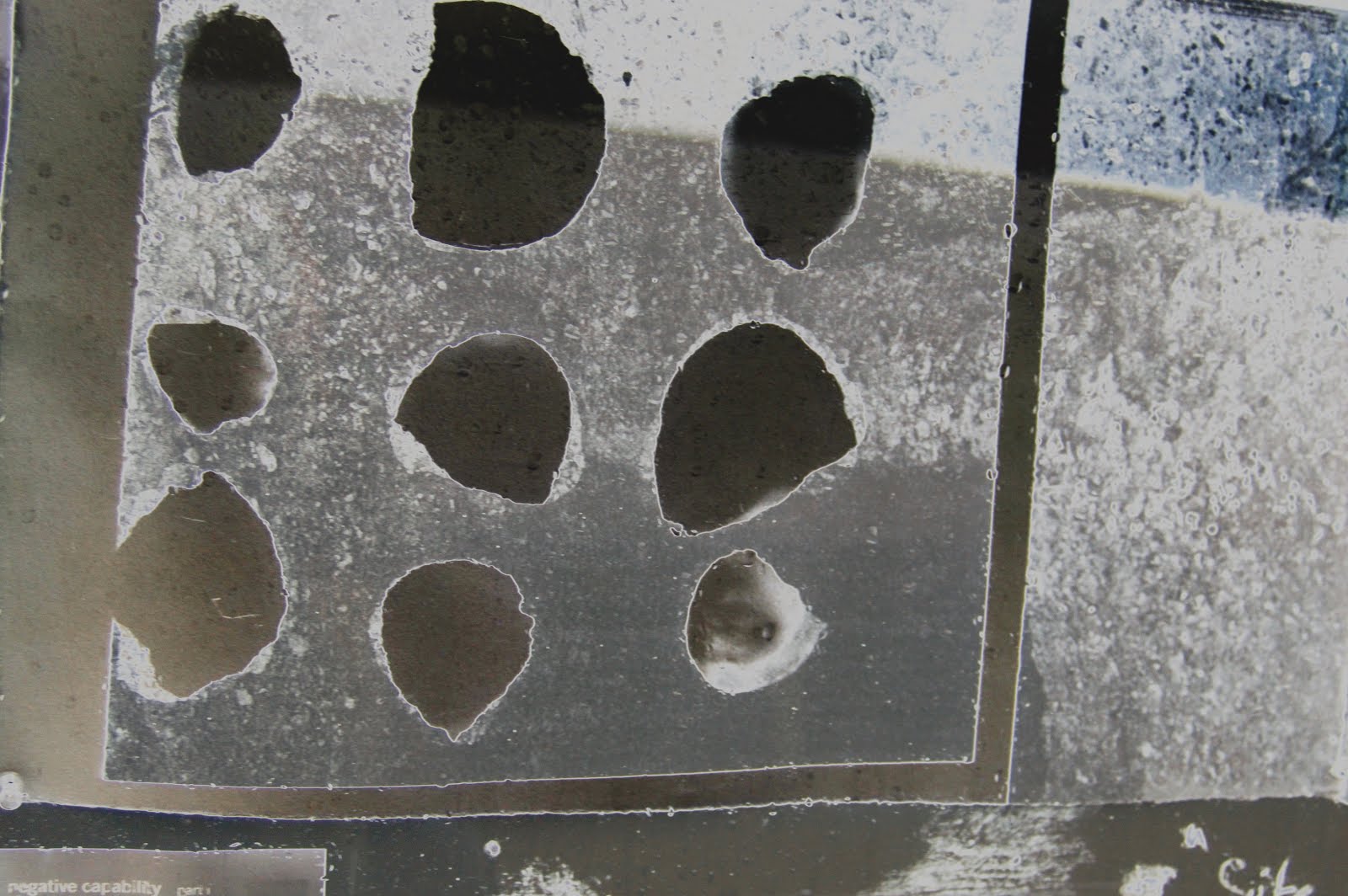
Negative Capability.
The Link Gallery, Winchester.2013.
Morn Hill Winchester.
Site of the corporation or the master, brethren and sisters of the blessed Mary Magdalene hospital near Winchester erected in 1148 and demolished in 1772.
Founded on the eastern hill in remote antiquity for lepers.
The Hospital of St. Mary Magdalene.
Raymond Elliott. 1994.
Becoming Decay.
Clemintina and Francesca.
Domestic Liminality, a psychological, neurological, or metaphysical subjective conscious state of being on the threshold of or between two different existential planes.
Places where we make new domestic worlds, where we reconstitute family.
Carol Mavor.
Figurative Drawings and Sculptural Reliefs.
Matters of Form/Construction.
Manuel Neri.
Norton Star Atlas
Map 1
Epoch 2000.0
Stellar Magnitudes
Double or Multiple Stars
Variable Stars
Novae.
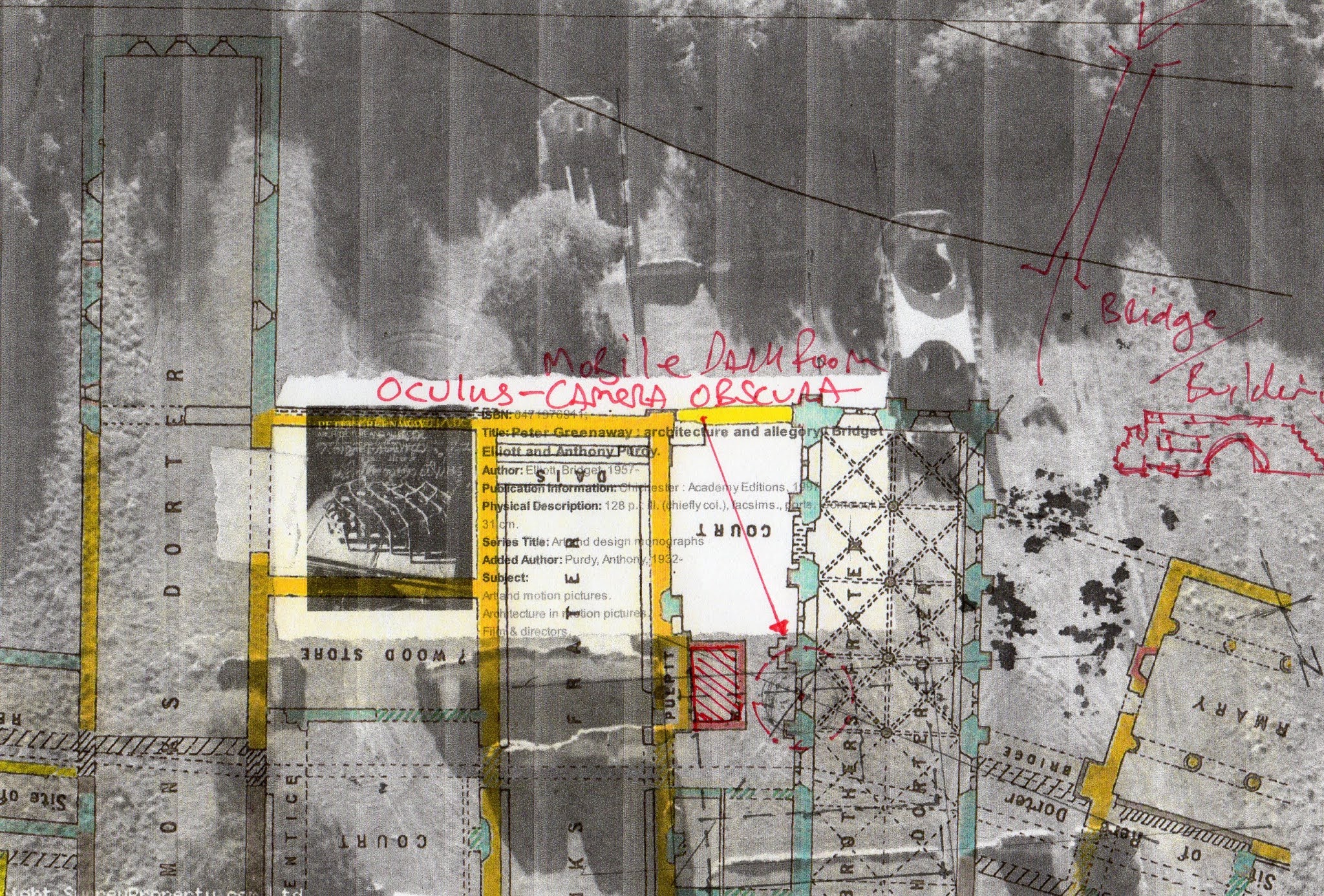
Alternative Darkroom Photography
Corporeal/Astronomical
Body/Cosmos/Imagination
Scale/Proximity/Vastness
spatial practice, alternative photography, fine art, ceramics,making,Russell Moreton,
Drawing away from descriptive depictions that illustrate preconceptions/aesthetics.
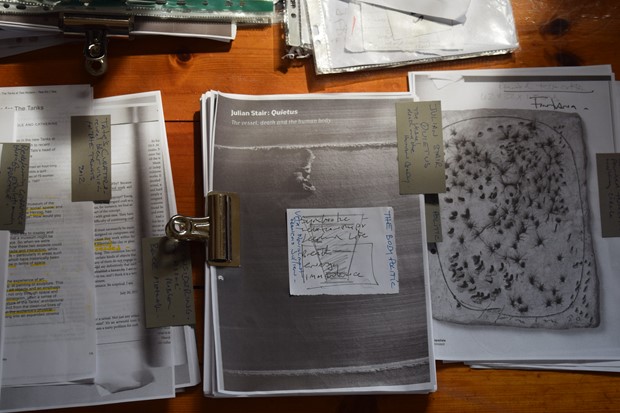
Julian Stair.
Quietus. 2012.
The Vessel.
Death and The Human Body.
There is an alchemy to making ceramics. We take an inert material, fashion it, dry it and expose it to heat and flame. The practice of cremation, of exposing the body to fire, going through an alchemical change, echoes and parallels the process of firing.
Julian Stair.
The materials he works, lead and clay are dense, both physically and emotionally. But Stair’s use of these materials is not representational. These objects do not depict or illustrate, instead they enact and embody.
Stair’s achievement in this cyclical exhibition is to have expressed both the universality and the specificity of death, each as an aspect of the other.
The great hand-thrown jars that stand at the heart of the exhibition exemplify this doubleness. Though completely abstract, they exist at the scale of the body. They invite a tactile response, visitors might stroke the ridges circumscribing the jars or tap them, or even give them a gentle hug.
Glenn Adamson.
Life drawing on the psychology of nakedness and the human body in contemporary art.
Life-Class/Anatomy/Pathology.
The practical and theoretical problems of the confrontation with the human form.
Georg Eisler.
Herbert Boeckl.
His nudes speak a physical language, interpreting life and death in terms of human bodies, of functioning muscle and bone and the tactile aspects of flesh, and the knowledge of what lies beneath/behind it.
Alfred Hrdlicka.
A Group. 1973.
Proximity does not read as intimacy, the entangled naked bodies convey a sense of insecurity.
The Posed/Nakedness/Social Scrutiny.
The Life-Class.
Isabel Bradshaw/Michael Grimshaw
Drawings/Sculpted lines that bring sensations onto the surface of the paper.
Lines of Movement/Vectors
Lines of Static Forms/Boundaries
Mark-making, rendering the spatialities of the human form.
Form-Movement
Mass-Volume
Skin-Surface
Line is only the visual interpretation of an extremity of a volume. Mark-making on a drawing becomes a conduit for a sensation of seeing others.
The concept of anthropomorphism is central to the identity of pottery. We use bodily terms such as a neck, shoulder, hip and foot to describe the constituent parts of a pot. And the very nature of the vessel as a container, a holder of things, is analogous to the idea of the body as physical container for the soul or spirit.
Drawing, depicting something found through the process of making visible.
The Luminescence Of Space.
An Archaeological Inquiry Into Drawing.
Correspondences/Reclaiming the drawings.
The Affect and Memory of Drawing.
To interrogate ways of seeing/looking, John Berger.
The world of the creative practitioner promotes conditions, gestures and responses that articulate social, political and other theoretical findings which are all ‘present’ at the inception of the work.
Colin Renfrew.
The Myth of Butades.
Figure/Ground Relationships.
Theoretical Thought : Diagram and map.
Neo-Sumerian temple plan on clay tablet from c. 2100BC.
The drawing/work may take the form of the result of an act or action carried out at a specific time but which itself does not persist.
Art can be the expression in the material world of a concept, or the transformation into one material form of a structure that exists in another.
Drawing/Substance/Memory/Display.
The artist’s creative act, is of a self amongst others.
Material/Thinking Matter.
Drawings mediated by the distance of memory.
Art Works, subtle embodiments, visual markers both spatial and sociological.
Life/Drawing/Figuring It Out.
The Luminescent Dematerialization Of The Subject.
Expressions Of Both Figuration And Abstraction.
Phenomenological approaches to Drawing/Looking/Others.
Demarcation/drawing boundaries/wayfaring/paths on the land, re The Making of Space.
Walking/Movement is quiet literally what made us human.
The walk is a ‘mark’ laid upon thousands of other layers of human and geographical history on the surface of the land. Bipedalism is the precursor to the evolution of a large brain, creative intelligence and language.
Richard Long/Colin Renfrew.
Charles Mausson.
Walking Man, No. 3. 1990.
Oil, crayon, 203.0 x 137.0 cm.
Starting from a subject or a simple figurative form, Charles Maussion sets of like an explorer, in search of unexplored lands, looking for something spiritual. It is through walking/drawing/thinking that one can remain human even while seeking out, and without even knowing it, finding it, or finding yourself in lands which are thousands of light years from our society, whilst nevertheless being very close to it. A calm, a loudness, that is extreme, beautiful.
Robert Combas. 1993.
The simple presence of a figure is sufficient to suggest the unity of the individual in a universe which is patiently observed and precisely apprehended. There is a complete absence of any compositional device suggested within the canvas, all that emanates is a climate of strangeness, serenity and disquiet.
Sophie Dupont. 1995.
The blurring of the conventional distinction between the figure and the ground, so as to capture an atmospheric effect, which sought to approximate the murkiness of visual perception.
The legibility of the photographic image was denied by the process of blurring the image.
Paintings, abstract identities of surface and material, introducing content via a dematerialization, so as to engage in a process of pure vision, pure silence, reincarnated, vibrant, alive.
William Jeffett. 1995.
Drawing on the consciousness and corporeality of others, of figural dissolution of the traditional figure/ground relationships, and fragmentation/blurring of the human form. The contemporary body and its environments are experientially brought into abstracted absences, corporeal traces of visual matter, movement and dissolving/reappearing forms.
Figural Expressions.
Figural dissolution of a nude descending a staircase, Marcel Duchamp.
Stop-motion photography of the human body in motion, Etienne Marey.
Figural, paintings/drawings not as representations of tangible subjects, but as registers of a more abstract range of emotions, as a series of studies, always incomplete and never finished, a work in progress. The nude/ the human body has become mediated by the mechanical effects of photography and the distance/blindness of memory.
Bringing back vibrant matter into a world cluttered by images that are standing in for the redundancy of that experiential experience.
Research as a discursive activity gathering new forms of expression. Duration, Steven Holl
Building/Uncertainties into the explorations of making. Rem Koolhaas.
.
REVIEW into INTERIORS MA UCA 2013-15 Research into new forms of translation/transmission
MAKING vibrant gaps/assemblages between the texts/images/objects and everyday things LANDSCAPES OF AFFECTIVE AESTHETIC ATTRACTION
MATERIALS THEMSELVES become the TOOLS of PERCEPTION
Enchantment from the potential of things.
The Fabric of thoughts
The invisible within the visible (energy,magic,causality)
RELATEDNESS, connected to the Place and Function of Things within a Field.
Texts, form their own contexts/reflexivity, breaking down phenomena into meaning, conclusions and critique, they render phenomena and its psychic information redundant.
We think we know how we should feel sociologically, yet in doing so we deny ourselves the direct affectiveness of people and objects that can provide different perceptual relationships.
EMBODIED KNOWLEDGE=ECOLOGY Lygia Clark : A Space open to time. Cornelia H. Butler
The World is a Collage
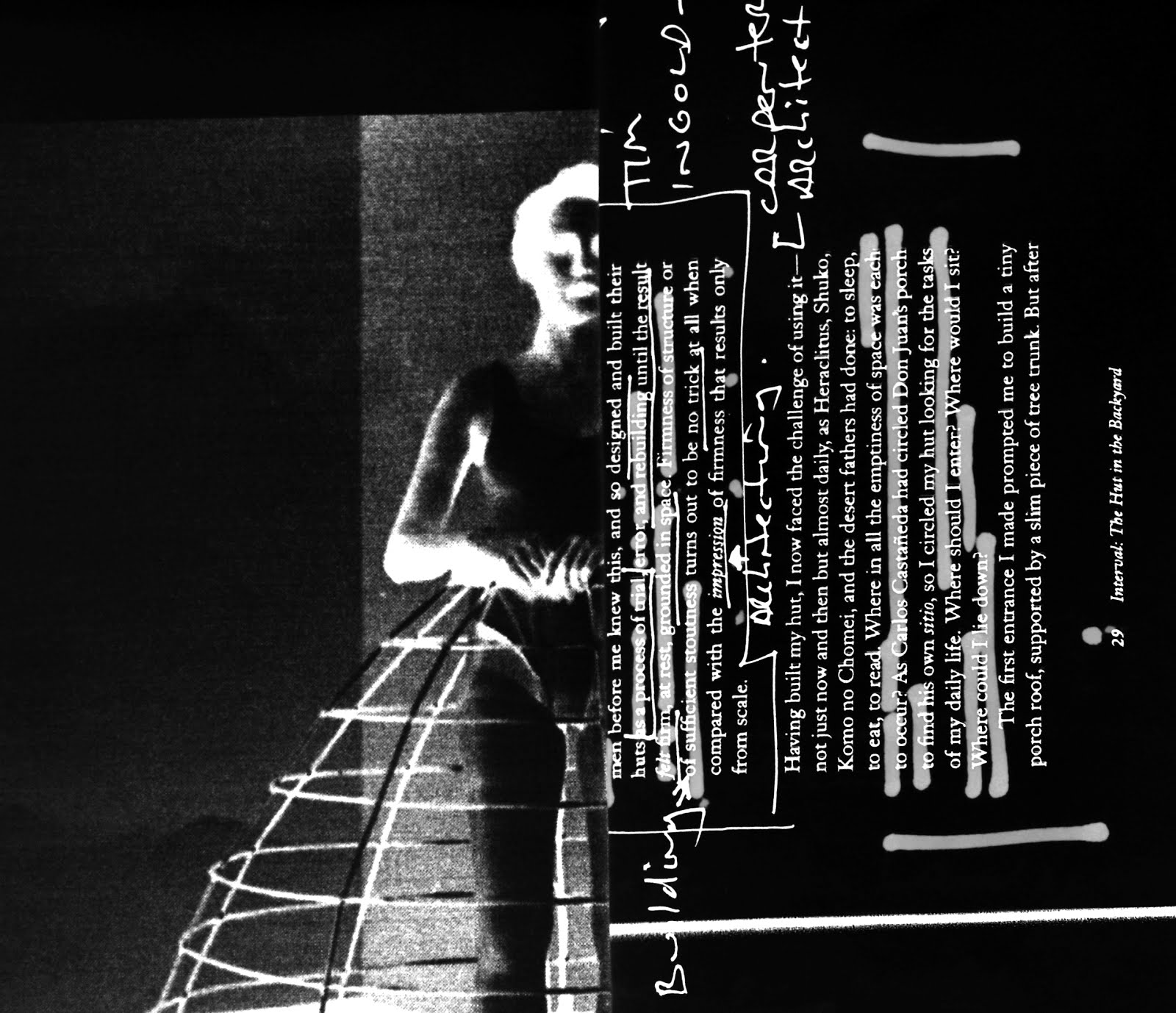
Collage and montage are quintessential techniques in modem and contemporary art and filmmaking. Collage combines pictorial motifs and fragments from disconnected origins into a new synthetic entity which casts new roles and meanings to the parts. It suggests new narratives, dialogues, juxtapositions and temporal durations. Its elements lead double-lives; the collaged ingredients are suspended between their originary essences and the new roles assigned to them by the poetic ensemble.
Juhani Pallasmaa
Hapticity and Time
Notes on a fragile Architecture
The Perception of the Environment Essay in Livelihood, dwelling and skill Tim Ingold
See Yourself Sensing Redefining Human Perception Madeline Schwartzman
STILLNESS IN A MOBILE WORLD Bissell, Fuller
ECOLOGICAL approaches/affordances to aesthetic perception ART and AESTHETIC PATTERNS : into an ecology of mind.
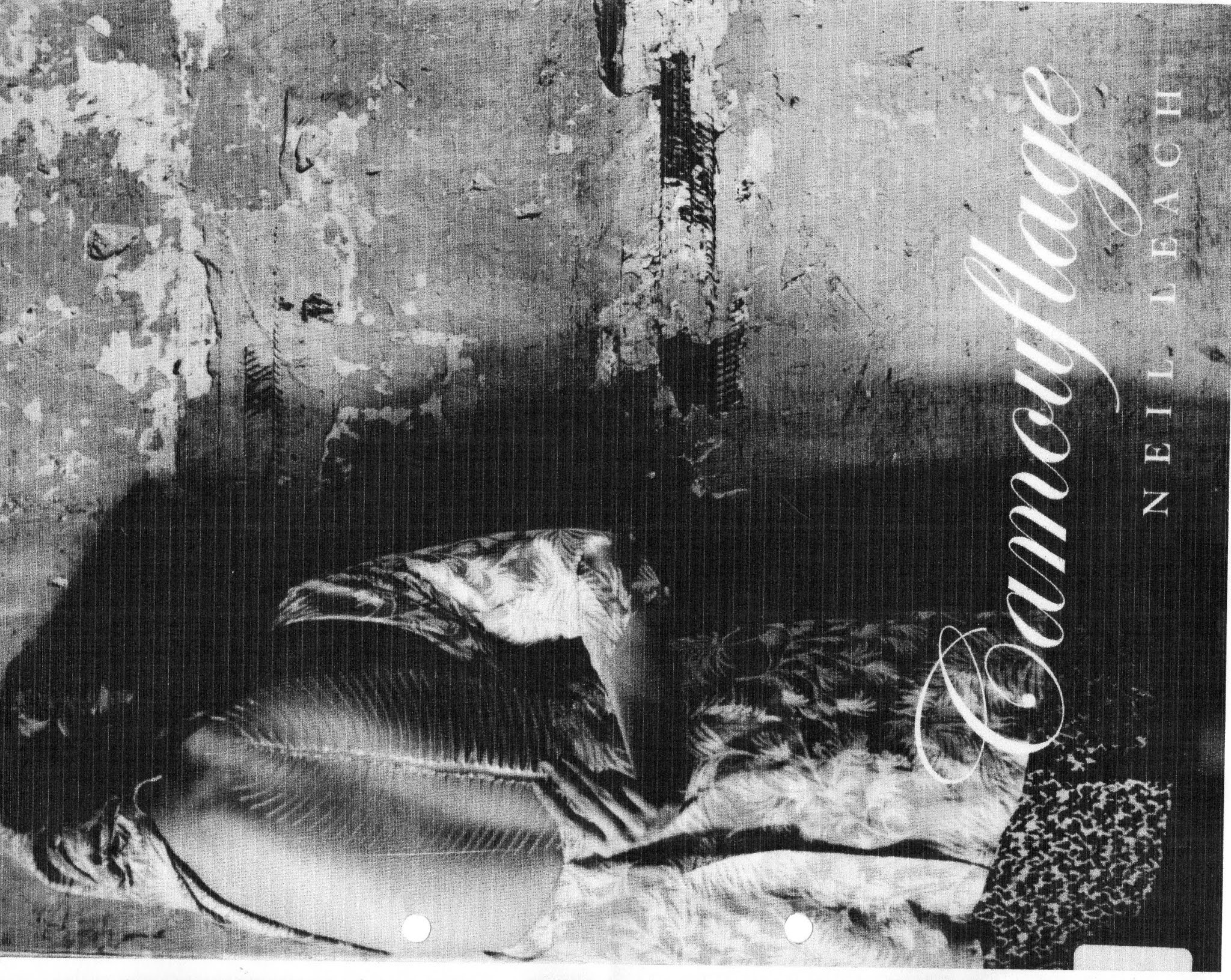
Going beyond what it may represent into the important psychic information that it contains. Camouflage is addressed, perhaps, less to architecture itself than to the subjective processes by which
human beings experience architecture. Illustrated by the photographic practice of Francesca Woodman, we see her seemingly absorbed by her environment in way that shows a desire to both identify with, and become part of her surroundings.
A desire/transgression met and mediated through a certain sensitivity and openness to the environment, fostering a sense of connectivity between human beings and their environment.
Neil Leach
EXISTENCE, SPACE and ARCHITECTURE Christian Norberg-Schulz
A child ‘concretizes’ its existential space.
Developing the idea that architectural space may be understood as a concretization of environmental schemata or images, which form a necessary part of man’s general orientation or ‘being in the world.’
SUBSTANCES guide the kinds of practical actions that the organism senses from elements of the environment, creating affordances/utilities for the human body.
SURFACES separate substances from medium, the wall and roof of my house afford comfort by separating me from water and too much air.
AFFORDANCES as aesthetic sensations determined both by the environment and qualities we impose through observation, sensation and perception.
Without arousal of perception, no aesthetic experience is possible. The rational organization of society has its own Aesthetic Attraction
Symmetrical Patteming/redundancy : provides for the observing mind a maximum of insight with a minimum of intellectual effort.
Colour Light Time
Quintessentially relational phenomena in which location, background, density will provide for different perceptual relations.
Bringing back vibrant matter into a world cluttered by images that are standing in for the redundancy of that experiential experience.
WORKING TEXT: 16/May/2020 The R Value in Academia
Reading/Reflexivity/Research with precision and indeterminacy
Research Material : Studio/Archive 2004-2020
The Language of Specitivity/Places of Inquiry Extradisciplinary Investigations
Social Utilities/Contemporary Art Practices imported from Political Philosophy
The return of limited and ancillary projects where the human being is the fulcrum and the fire of research in replacement of the medium and the instrument.
A whole range of materials and topics that do not fit, that can create an eclectic synthesis of knowledge fields.
Arte Povera, an aesthetic-philosophical movement, artists that chose to live with direct experience and feel the necessity of leaving intact the value of the existence of things. An art that asks only for the essential information, that refuses the dialogue with the social and cultural system, and aspires to present itself as something sudden and unforeseen.
Germano Celant 1940-2020
Developing discursive reading
WORKING DOCUMENT/LANDSCAPE LANDSCAPES/Thinking Spaces
Concepts of space-time/Ecologies, embodiments through identity, individuality and environments. Our universe is evolving in time as our views are evolving
RIVERS/Eddies and husbandry
(in/with the phenomena of water, thinking with the fish in mind)
Research as a discursive activity gathering new forms of expression. Duration, Steven Holl
Time is only understood in relation to a process or a phenomenon.
The duration of human beings alive in one time and place is a relational notion.
The time of one’s being is provisional; it is a circumstance with an adopted aim for the time being. SPACE-and ARCHITECTURE-exceeds the provisional
Spatial Practice, Culture, Creativity and Environment
Diffractive erotics of the body in her speculative post studio practice
Asperities of flesh, dirt and the built environment
Neil Leach, Camouflage, F Woodman
The Enchantment of Modem Life.
Attachments, Crossing and Ethics
The performativity of social representations
When I gather together the animals, arguments, molecules, suggestions, forces, interpretations, sounds, people, and images of this study, one theme emerges. The modern story of disenchantment leaves out important things, and it neglects crucial sources of ethical generosity in doing so. Without modes of enchantment, we might not have the energy and inspiration to enact ecological projects, or to contest ugly and unjust modes of commercialization, or to respond generously to humans and nonhumans that challenge our settled identities. These enchantments are already in and around us.
Jane Bennett
Be not inhospitable to strangers lest they be angels in disguise
Jackie Leven, The Dent In The Fender And The Wheel Of Fate David Childers, Heart In My Soul
Spatial Practice Interior Design
Building a precision/working praxis that is both aesthetic and technical that can give an intimate understanding of the material and its situation.
Subjectivities interwoven through light and media Asperities of fabric and texture : White Collaged Postcards
CREATING AN ANTHROPOLOGY TOR BEING IN THE LANDSCAPE DEVELOPING MATTER AND DESIRE IN ART BASED ACTIVITIES
WORKING NOTES, 24 October 2018
SETTING UP THE CRITICAL DISTANCE / DISCURSIVE FIELDS OF ANALYSIS MEASURING AFFECT
PERFORMATIVITY ITS EXPERIENTIAL QUALITIES/PSYCHIC IMPACT RESEARCH IN LANDSCAPE AND ENVIRONMENTAL DESIGN Visiting the Archive : Exploratory Workshop
September 1, 2018. W&BA Harleston
CREATING THE FEEDBACK LOOP
BLURRING THE BOUNDARIES BETWEEN PARTICAPANTS AND ARTISTS RADICAL INTERVENTIONS INTO THE EVERYDAY
Walking and Making with Clay, Brockwood, Speculative Learning Program
‘ the clay itself seemed to absorb them into a wandering relation with the landscape’ A Field Guide To Getting Lost, Rebecca Solnit.
In this investigation into loss, losing and being lost, Rebecca Solnit explores the challenges of living with uncertainty.
Tracks Across The Landscape
Setting up a critical spatial practice within the walking landscape of the everyday. Edward Thomas, Paths
John Piper, Covehithe, South Bank Show, painting/drawing both on site and in the studio.
Watts Gallery, analysis and audit of activities from which to develop visitor programs and the experiential circulation of those who visit.
Melancholy and The Landscape, Jacky Bowring.
Locating Sadness, Memory and Reflection in the Landscape. Investigation into the creative membership and activities of W&BA.
From newsletter to art themed walks, Historic Culture/Landscape and Tourism Plotting points of social interactions, asking Why Here, Why Not There?
What directs events, governs outcomes? Success and failures?
Management and event led, members as audience? MA Arts Management
New Cultural Diversities
10 Days at the Laundry, Winchester 2009.
Group of creatives based in and around Winchester School of Art, use of fallow site in which to respond and to create for 10 days a contemporary arts festival. This original event ‘fused’ new creative partnerships that went on to produce other groups and exhibitions. The follow-up event 10 Days in the City, was funded, had more prestigious venues, but lacked the cohesion and community of the first site.
Supplementary content, resources, dossier outlining the inquiry of which the work is a part. MOVING THE CULTURE
DISCURSIVE FIELDS FOR NEW TYPOLOGIES/OPERATIONS AND TACTICS CONCRETE POETRIES
LOWER GREEN, NORWICH
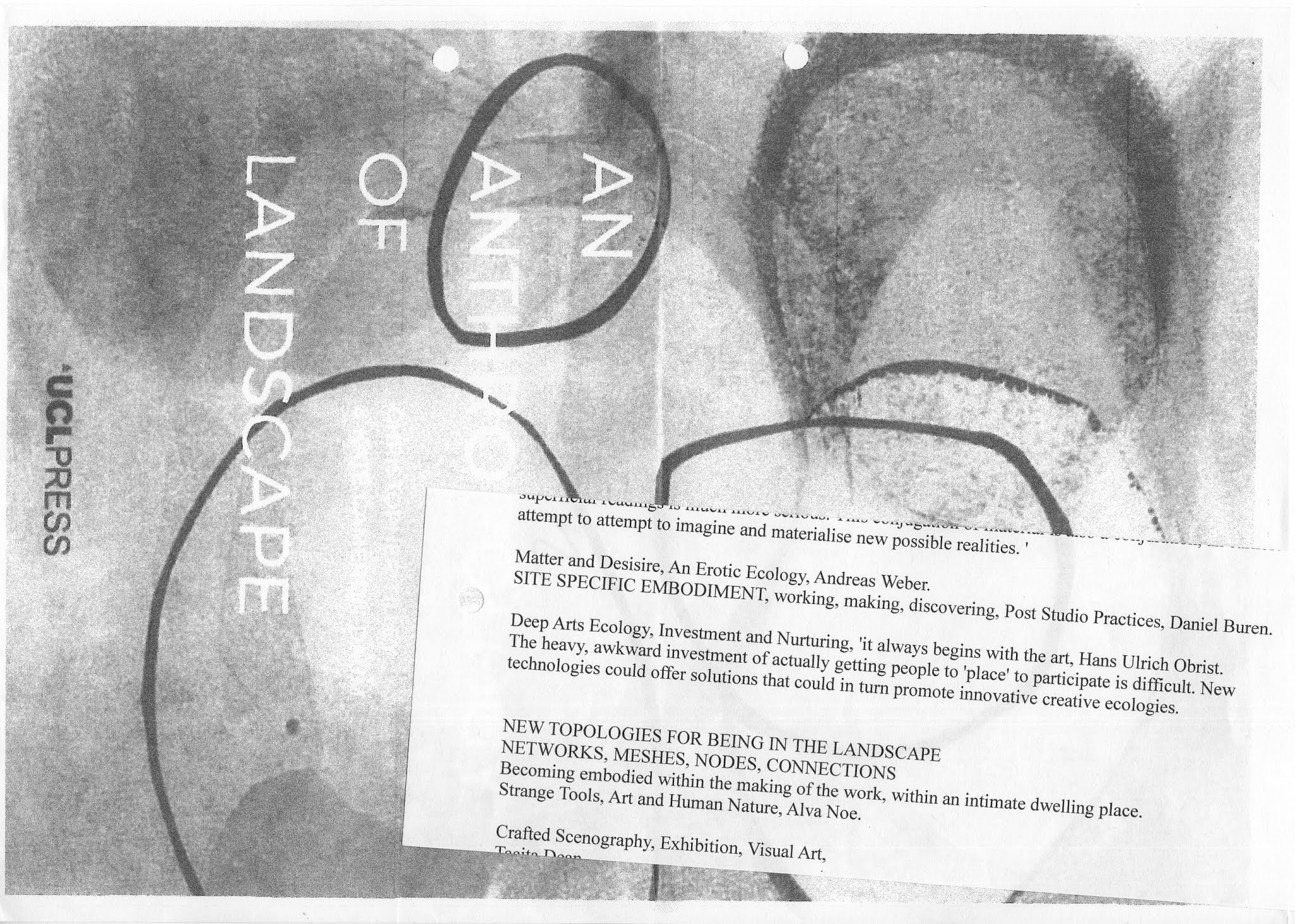
‘ At the surface, the gorgeous materiality of Okon’s work is seductive but her intention to breach superficial readings is much more serious. This conjugation of material is also a conjuration, an earnest attempt to attempt to imagine and materialise new possible realities.’
Matter and Desire, An Erotic Ecology, Andreas Weber.
SITE SPECIFIC EMBODIMENT, working, making, discovering. Post Studio Practices, Daniel Buren. Deep Arts Ecology Investment and Nurturing, ‘it always begins with the art, Hans Ulrich Obrist.
The heavy, awkward investment of actually getting people to ‘place’ to participate is difficult. New technologies could offer solutions that could in turn promote innovative creative ecologies.
NEW TOPOLOGIES FOR BEING IN THE LANDSCAPE NETWORKS, MESHES, NODES, CONNECTIONS
Becoming embodied within the making of the work, within an intimate dwelling place. Strange Tools, Art and Human Nature, Alva Noe.
Crafted Scenography,
Exhibition,
Visual Art, Tacita Dean
Shadowcatchers
OUTPOST
STUDIO as a discursive site for un-doing and re-making relations/aesthetics between objects/the social/the everyday.
STUDIO ANALYSIS 2018-2020 21 September 2018-19 August 2020
Art School Spaces Outpost Studio Spaces Urban Fallow Institutional Buildings
Open Plan Office Spaces
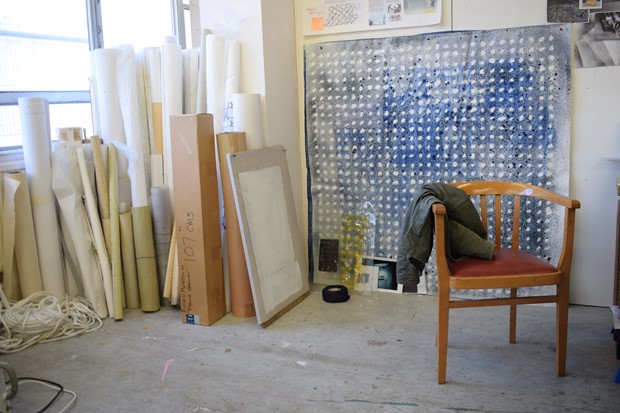
Studio 3.16, Central Norwich, nearby parking, Floor area/footprint 5.0mx5.0m, wall spaces 2×2.4mx5.0m, well lit, open plan, large making table 1.2mx2.4m. Electricity, small heater, lighting, running water WC, access 24/7.
Projects/Contexts bought into the studio space
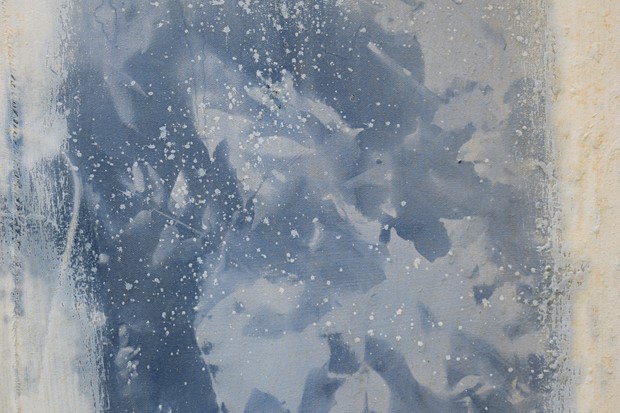
Drawings/Southampton roof rubbing, drawings/art works as sociological shelters/habitats Immaterial Paintings/Cyanotype, layered papers
Raveningham sculpture elements from intervention Cley, sketch books and paintings
Re-presentation of drawings/collages with new research material/contexts
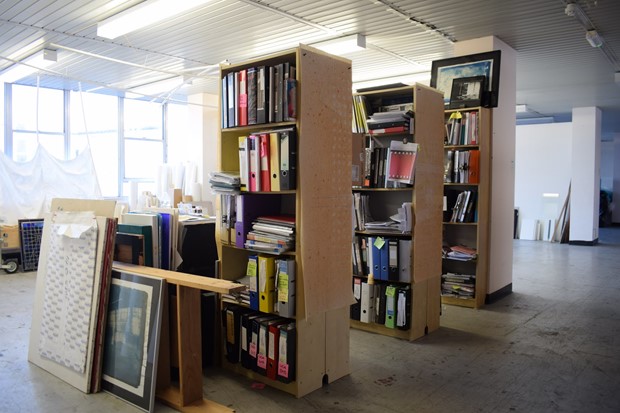
Paintings displayed with large analogue phonographic images and collages Architectural concerns, coloured glass, aesthetic surfaces, paintings with raw materials Installation of research bookcases as diffractive elements/spatial practice within the studio White paintings, used layers of paper texts, meshes and cloth
Ceramic objects on field paintings/grounds
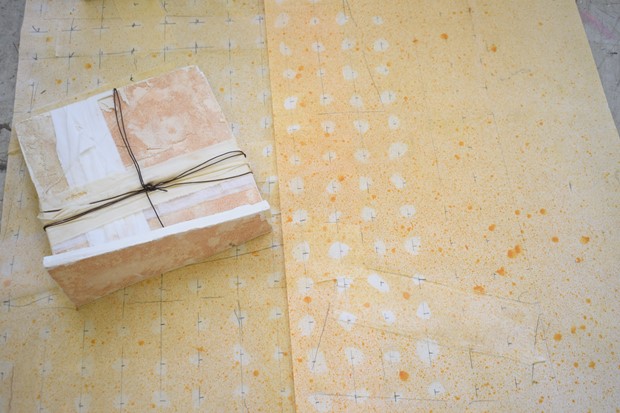
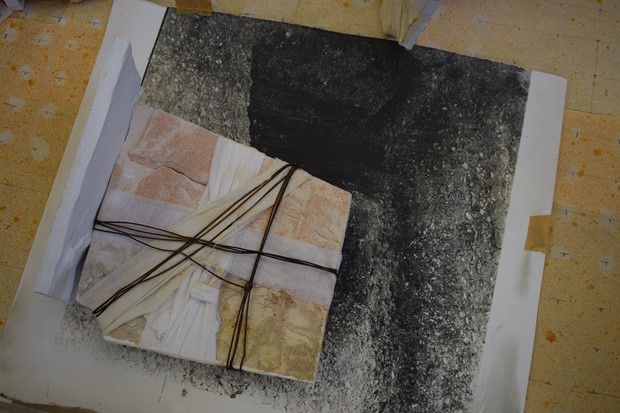
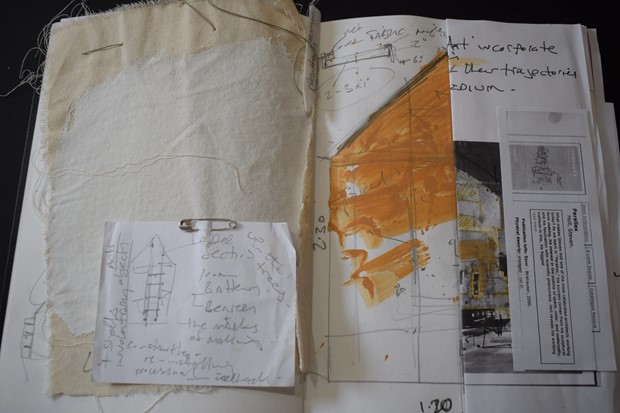
Research material, folders, wrapped ceramics with fabric, yellow ochre on paper
Research as a discursive activity gathering new forms of expression.
Duration, Steven Holl
Time is only understood in relation to a process or a phenomenon.
The duration of human beings alive in one time and place is a relational notion.
The time of one’s being is provisional; it is a circumstance with an adopted aim for the time being.
SPACE-and ARCHITECTURE-exceeds the provisional
The Enchantment of Modern Life.
Attachments, Crossing and Ethics
The performativity of social representations
When I gather together the animals, arguments, molecules, suggestions, forces, interpretations, sounds, people, and images of this study, one theme emerges. The modern story of disenchantment leaves out important things, and it neglects crucial sources of ethical generosity in doing so. Without modes of enchantment, we might not have the energy and inspiration to enact ecological projects, or to contest ugly and unjust modes of commercialization, or to respond generously to humans and nonhumans that challenge our settled identities. These enchantments are already in and around us.
Jane Bennett
Be not inhospitable to strangers
lest they be angels in disguise
Jackie Leven, The Dent In The Fender And The Wheel Of Fate
David Childers, Heart In My Soul
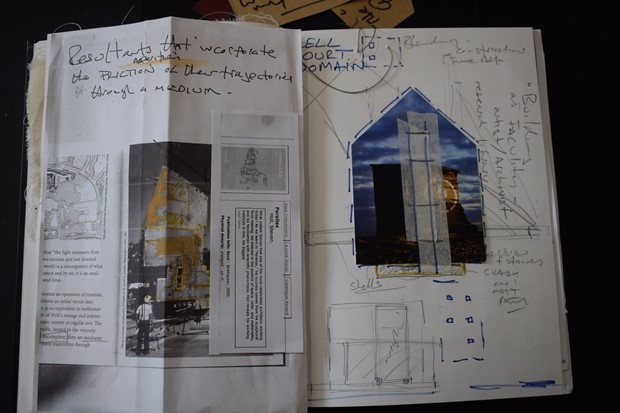
Collage Works : Architectural Studies. Outpost Studios, Norwich.
Studio Works : Praxis between theory and practice. Outpost 2020.
photographic surface, asperity, poetics of process, studio
Palimpsest/Surface Sprays : Spaces Between Objects
Site based inquiry for sculpture trail at Raveningham
collage, research, spatiality, art practice, alternative photography,
drawing, architectural, intervention, visual fine art, craft
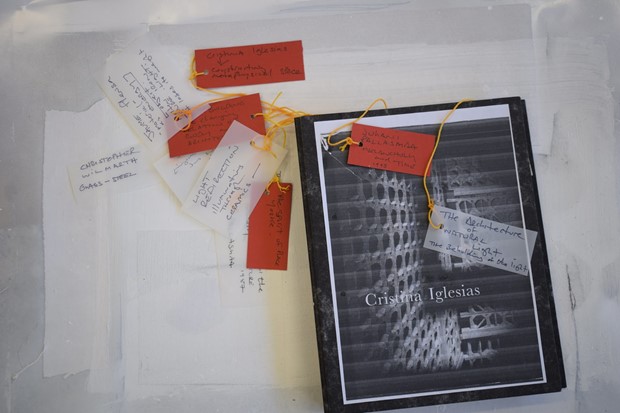
studio, metaphysical space, collage, Palimpsest, Cristina Iglesias, Steven Holl, Jackie Leven, Tim Ingold, Julian Stair, drawing, sprays, Jane Bennett, Russell Moreton, Lucio Fontana,
Conduits of inquiry into the sacred and the secular, the spirit and the body.
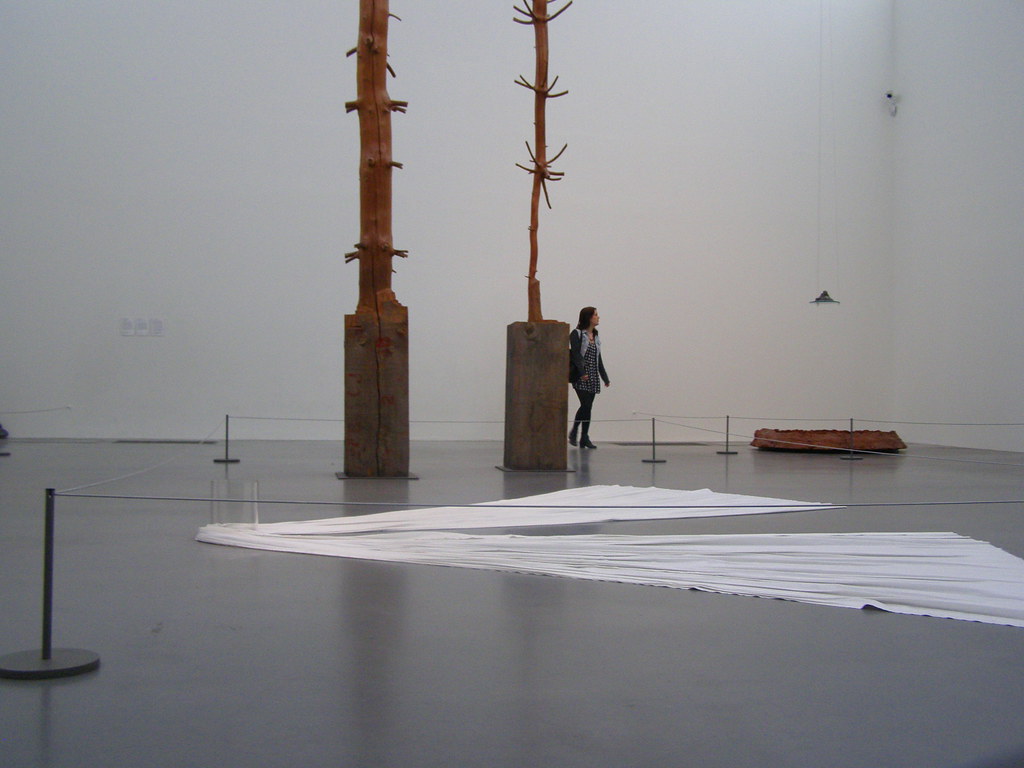
Cleansing Vessels.
Piscina/Niche/Wall/Building
Art/Archaeology
Ritual/Display
Corporeal/Spiritual
Beuys, was involved in questions of form, material processes and social sculpture, he believed that art and the insight gained through art becomes a formative influence on life. He wanted a situation where life and art become one. Academicians sense that in this ideal state, an Academy would be superfluous.
Raw materials/substances/tools all used as symbols with their own unique properties and qualities.
Beuys brought things into forms, in which the material and the forms are really in accord with each other, and are satisfied and want to keep on living. He was constantly moving material between two opposed poles, undetermined chaos (a blob of melted fat) and determined order (a box of things).
Selected Research.
Being mindful that material can lead the way.
Beuys/Cragg on matter and materials beyond the hylomorphic model.
Gaston Bachelard, on intimate, watery spaces and the imagination.
Poetics Of Space.
Juhani Pallasmaa, on reading and experiencing architectural spaces at The Hungate.
The Eyes Of The Skin, Architecture And The Senses.
Proposals into working practice/ideas.
Returning to direct site based experiential drawings/templates/mappings/rubbings.
Fluidity between surfaces and things, of dampness, stains and porous plaster.
The molecular interstitial spaces of light, air and water.
Sacred water washing the soul (the font), secular water washing the body (the bath)
Bonnard, domicile paintings of body,water and the baptism of light.
Displacement of things (body/rituals) in vessels of water (bath/font).
The architectural interior, a historical place of shelter for beliefs.
The membrane, screen, between the cleansing nakedness of water.
Atmospheric ecologies/architecting through situated learning.
Is there still an aesthetic illusion? And if not, a path to an “aesthetic” illusion, the radical illusion of secret, seduction and magic? Is there still, on the edges of hypervisibility, of virtuality, room for an image?
— Jean Baudrillard, The Conspiracy of Art, 2005
Jana Sterbak
Remote Control 1989
A heuristic technique (/hjᵿˈrɪstᵻk/; Ancient Greek: εὑρίσκω, “find” or “discover”), often called simply a heuristic, is any approach to problem solving, learning, or discovery that employs a practical method not guaranteed to be optimal or perfect, but sufficient for the immediate goals.
.jpg)

.jpg)


.jpg)
.jpg)
.jpg)

.jpg)
.jpg)
.jpg)



.jpg)














.jpg)

 russellmoreton.com