
The ceramic body becomes a site: pierced, withdrawn and opened to the circulation of light, matter and possible inhabitation.
Eartha~Ceramic
clay → shelter → volume → piercing → light → interior → unknowability
The constructed body becomes an environment in miniature.
Russell Moreton
Making~Environment(s)~Artist Statement. 2025
Makers work in a world that does not stand still.
Tim Ingold, 2010.
The Studio is no longer a retreat but it now integrates. It is all exterior.
Ways of Curating, Hans Ulrich Obrist.
Ceramic Shelters : Transitional Zones between Thinking and Making.
Russell Moreton : A visual fine artist working with clay is exploring themes around ‘Making’ involving the imprint of the artist, and metaphysical immersive nature of contemporary art practices and architecture. He is Interested in developing speculative making spaces where craft, theory, art and architecture can come together.
Moreton’s site-based practices using clay as his principle material further develops his inquiry into a site based speculative learning, and with it creative propositions for knowledge production through his ceramic objects. He finds in ceramics an analogy with architecture, in particular a resonance of a spatial structure in which the the drama of the building has now ceased.
His practice investigates the interconnectedness of making interior spaces. These works in clay are processual in nature, developed by a need to demarcate and fold material into spatial forms and volumes. The act and gesture of drawing further adds ephemeral marks of process amongst the materiality of the built spaces. Clay slips and other incised marks on both sides of the clay are all interwoven into his spatial forms.
Category
Making / Materiality
This is the strongest of the three for Making / Materiality.
It is almost a foundational statement for the ceramic spatial practice that follows: Making~Environment(s), ceramic shelters, speculative learning, clay as architectural analogy, spatial interiors, drawing, piercings, circulation of light, firing, coatings, unknowability and the ceramic body as a gathering of research and reading.
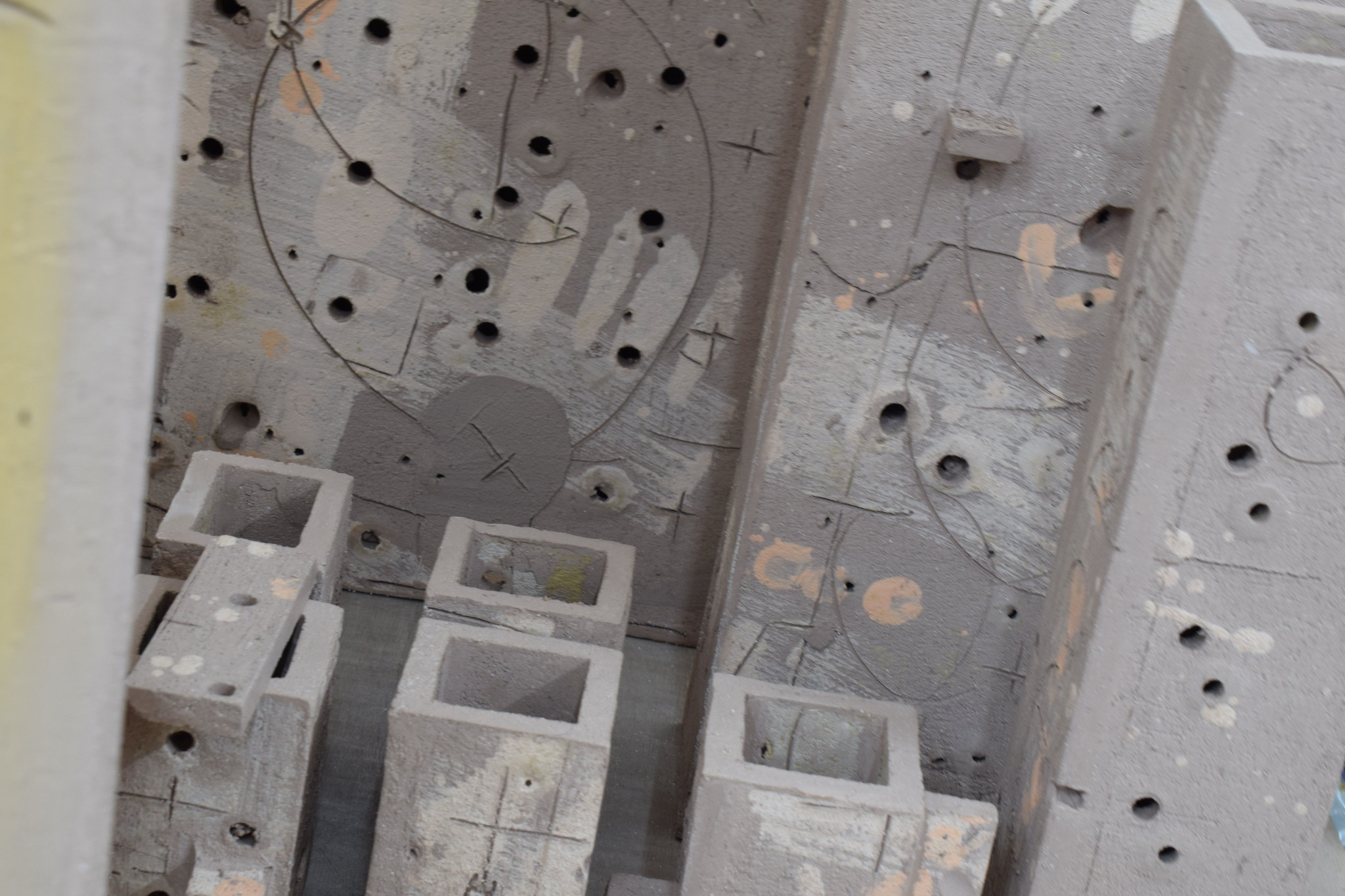
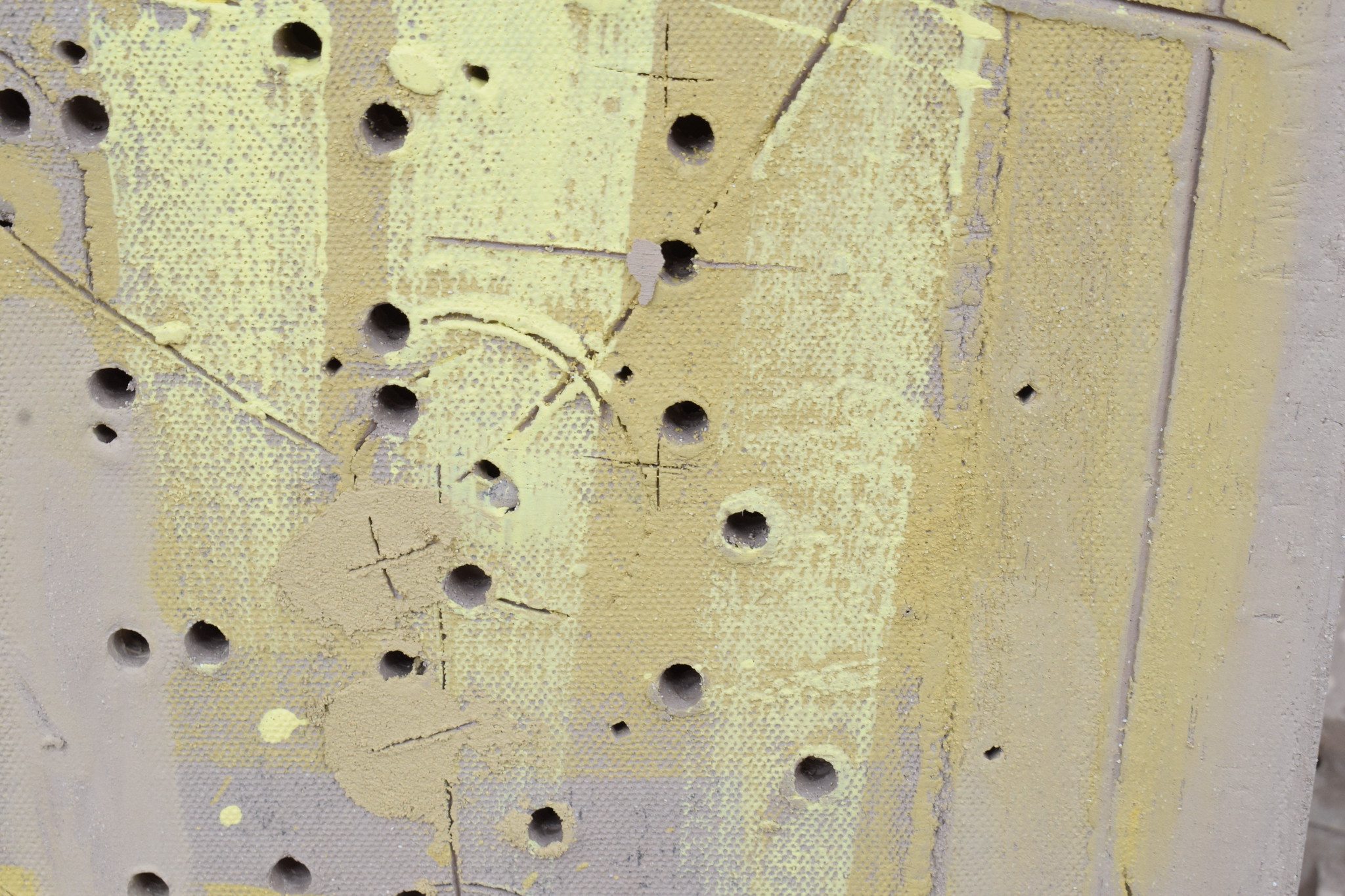
Assemble forms are then divided into several spatial interiors, in which the use of piercings are used through the surface to set up a circulation for light to enter into the interiors. Further firings and more ceramic coatings are applied to further investigate the involuntary relationships that have emerged. These objects are unknowable as they are extracted from the kiln, and as such they act as forms that can take on a theoretical nature, gathering his discursive researches and readings into a performative ceramic body.
For Moreton ceramics help to facilitate the essential auditory experience of silence, as experience by architecture as tranquillity. He is drawn by the solitudes of libraries and the sounds of construction, of pounding on materials, of making and constructing space. Architecture also presents this drama of construction silenced into matter, space and time. His finished fired constructions could become a museum for a waiting, patient silence. The silence of architecture, like that of clay is a responsive, remembering and meditative gathering, a correspondence of matter(s).
https://russellmoreton.blogspot.com
Eartha~Ceramic → Morn Hill
This is perhaps the most interesting correspondence because it isn’t chronological.
The site and the ceramic body begin to behave similarly.
Morn Hill is:
layered, excavated, partial, withdrawn, marked by traces.
Eartha~Ceramic is:
layered, constructed, perforated, partially withdrawn, marked by gestures.
So the ceramic becomes almost a portable site.
Or:
The archaeological site becomes a way of thinking the ceramic body: layered, excavated, perforated and inhabited by traces.
And conversely:
The ceramic becomes a site in which the spatial memory of excavation, construction and dwelling can be materially re-entered.
That feels very close to your developing anarchive.
reading the site → making the dwelling → inhabiting the ceramic
Or perhaps:
trace → construction → aperture
And together they make:
Site → dwelling → ceramic body
but also:
trace → proposition → aperture
And perhaps most importantly:
place → site → body → interior → correspondence
That is a very strong little anarchival gathering within the archive.


Leave a Reply