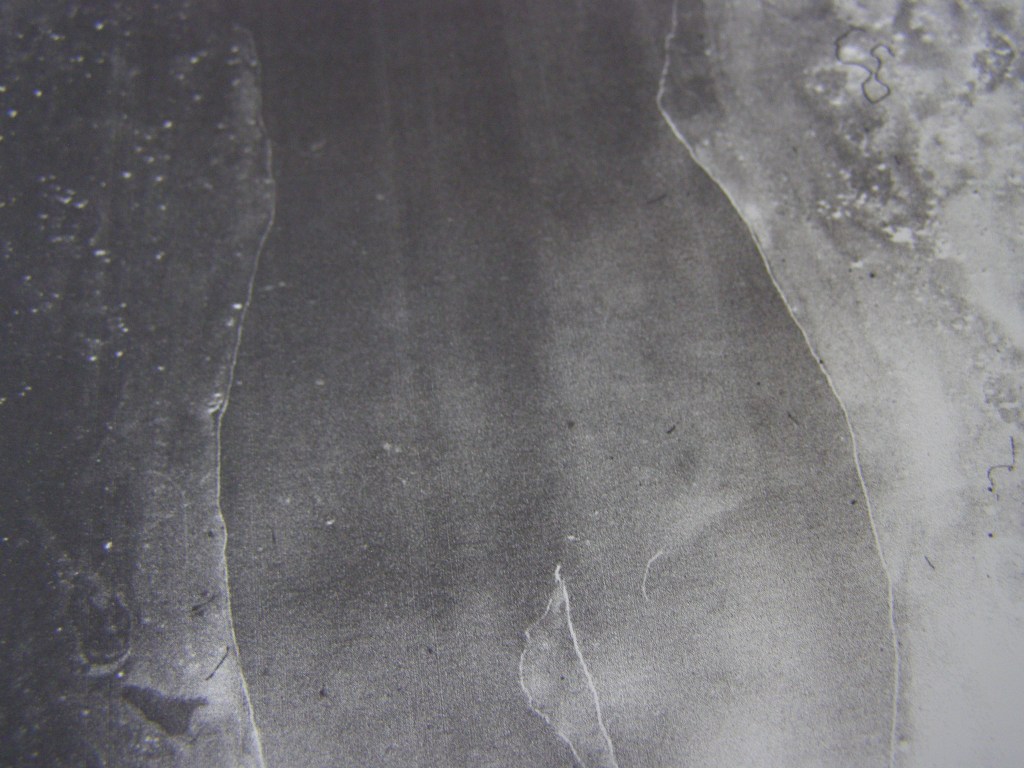
Drawing The Body/The Luminescence Of Space.
Outpost 230323
Drawing, depicting something found through the process of making visible.
The body begins to disappear into the space around it. Drawing no longer holds figure and ground securely apart; light, gesture, surface and movement begin to pass between them. The body becomes something sensed through its surroundings, while space acquires the traces of bodily presence. Luminescence is therefore not simply light upon a figure. It is a condition in which body and space become perceptible through one another.
Archival / Anarchival
Archival — important connective archive.
I would preserve this primarily as a Drawing / Image post rather than allowing it to drift into Spatial Practice. Its importance now lies in the way drawing becomes a means of producing spatial sensation rather than simply depicting the figure.
Migration entry
The drawn body begins to dissolve into spatial atmosphere.
This is an important step in the genealogy because the body is no longer simply the thing represented. Drawing allows the body to become entangled with light, space, surface, movement and figure~ground relations.
Anarchival note
Its future value lies in the word luminescence.
The body begins to become perceptible through what surrounds it. The spatial field is not background. It participates in the body’s becoming visible.
That creates a useful line into your current ceramic work:
body → surface → light → aperture → atmosphere
The later ceramic perforation can therefore be read not merely as a formal device, but as another way in which the body becomes spatially and atmospherically available.
The Luminescence Of Space.
An Archaeological Inquiry Into Drawing.
Correspondences/Reclaiming the drawings.
The Affect and Memory of Drawing.
To interrogate ways of seeing/looking, John Berger.
The world of the creative practitioner promotes conditions, gestures and responses that articulate social, political and other theoretical findings which are all ‘present’ at the inception of the work.
Colin Renfrew.
The Myth of Butades.
Figure/Ground Relationships.
Theoretical Thought : Diagram and map.
Neo-Sumerian temple plan on clay tablet from c. 2100BC.
The drawing/work may take the form of the result of an act or action carried out at a specific time but which itself does not persist.
Art can be the expression in the material world of a concept, or the transformation into one material form of a structure that exists in another.
Drawing/Substance/Memory/Display.
The artist’s creative act, is of a self amongst others.
Material/Thinking Matter.
Drawings mediated by the distance of memory.
Art Works, subtle embodiments, visual markers both spatial and sociological.
Life/Drawing/Figuring It Out.
The Luminescent Dematerialization Of The Subject.
Expressions Of Both Figuration And Abstraction.
Phenomenological approaches to Drawing/Looking/Others.
Demarcation/drawing boundaries/wayfaring/paths on the land, re The Making of Space.
Walking/Movement is quiet literally what made us human.
The walk is a ‘mark’ laid upon thousands of other layers of human and geographical history on the surface of the land. Bipedalism is the precursor to the evolution of a large brain, creative intelligence and language.
Richard Long/Colin Renfrew.
Charles Mausson.
Walking Man, No. 3. 1990.
Oil, crayon, 203.0 x 137.0 cm.
Starting from a subject or a simple figurative form, Charles Maussion sets of like an explorer, in search of unexplored lands, looking for something spiritual. It is through walking/drawing/thinking that one can remain human even while seeking out, and without even knowing it, finding it, or finding yourself in lands which are thousands of light years from our society, whilst nevertheless being very close to it. A calm, a loudness, that is extreme, beautiful.
Robert Combas. 1993.
The simple presence of a figure is sufficient to suggest the unity of the individual in a universe which is patiently observed and precisely apprehended. There is a complete absence of any compositional device suggested within the canvas, all that emanates is a climate of strangeness, serenity and disquiet.
Sophie Dupont. 1995.
The blurring of the conventional distinction between the figure and the ground, so as to capture an atmospheric effect, which sought to approximate the murkiness of visual perception.
The legibility of the photographic image was denied by the process of blurring the image.
Paintings, abstract identities of surface and material, introducing content via a dematerialization, so as to engage in a process of pure vision, pure silence, reincarnated, vibrant, alive.
William Jeffett. 1995.
Drawing on the consciousness and corporeality of others, of figural dissolution of the traditional figure/ground relationships, and fragmentation/blurring of the human form. The contemporary body and its environments are experientially brought into abstracted absences, corporeal traces of visual matter, movement and dissolving/reappearing forms.
Figural Expressions.
Figural dissolution of a nude descending a staircase, Marcel Duchamp.
Stop-motion photography of the human body in motion, Etienne Marey.
Figural, paintings/drawings not as representations of tangible subjects, but as registers of a more abstract range of emotions, as a series of studies, always incomplete and never finished, a work in progress. The nude/ the human body has become mediated by the mechanical effects of photography and the distance/blindness of memory.
Notations.
Contemporary Drawing as Idea and Process.
Fred Sandback.
The Drawing Room.
The Secret Theory of Drawing.
Jim Dine.
Figure Drawings, 1975-79.
The Drawings of Richard Diebenkorn.
John Eldenfield.
Manuel Neri.
Drawings/Relief Sculptures.
Naked To Nude.
Life Drawing in the Twentieth Century.
Georg Eisler.
Less theoretically central than Confronting The Human Body, but very useful for establishing the transition from body as figure to body as spatial and atmospheric event.
The body as a body of relations — the body is encountered through gaze, screen, drawing, surface, movement and spatial intertwining rather than as a stable subject.
Looking as sensation — seeing becomes embodied and material; drawing registers movement, volume, skin, surface and the sensation of encountering another body.
The ceramic vessel enters this same bodily vocabulary through neck, shoulder, hip, foot, containment and touch.
Drawing the body / luminescence of space — figure and ground begin to dissolve; drawing becomes a way of registering movement, memory, atmosphere and corporeal traces rather than depicting a fixed body.
Situated surfaces — the haptic, peripheral and sensual become ways of knowing. The surface isn’t merely something seen; it becomes something encountered through the body.
Enchantment — this perhaps gives the cluster its unexpected affective charge. Wonder, sensual engagement, the periphery, the disappearance of boundaries, material transformation and an “enmeshed world” all begin to move away from the body as an isolated human subject.
I think the cluster is really about the body becoming porous.


Russell Moreton art, Charles Mausson, Colin Renfrew, drawing, figural, Georg Eisler, human body, life drawing, naked to nude, Richard Long


Leave a Reply