Russell Moreton : Matter(s) in Correspondence

Spatial practices of clay, ceramic, drawing, bodies, places and making.

Spatial Practice

Architecture, sites, spatial situations, bodies, inhabitation, installations, spatial propositions.

Ceramic Bodies

Clay, ceramic sculpture, vessels, apertures, surfaces, firing, ceramic interiors, ceramic atmospheres.

Drawing / Image

Drawing, cyanotype, photography, diagram, mapping, collage, visual experiments.

Interiority / Atmosphere

Bachelard, refuge, reverie, innerness, thresholds, chambers, light, shadow, atmosphere, sensing.

Making / Materiality

Studio practice, making, material resistance, gesture, process, firing, construction, surface, force.

Research / Working Texts

Reading, theoretical writing, notes, research propositions, older texts being re-entered, speculative learning.

  • Art and Architecture : a place between, Jane Rendell, Peter Greenaway, Intertextuality/Transparency

    Art and Architecture : a place between, Jane Rendell, Peter Greenaway, Intertextuality/Transparency

     OPEN TEXTS.

    Allow readers to have multiple interpretations, they allow for the possibility of  “determinations”.

    Intertextuality fundamental concept “that no text much as it might like to appear so, is original and unique in itself. Rather it is a tissue of the inevitable , and to an extent unwittingly references to and quotation from other texts.”
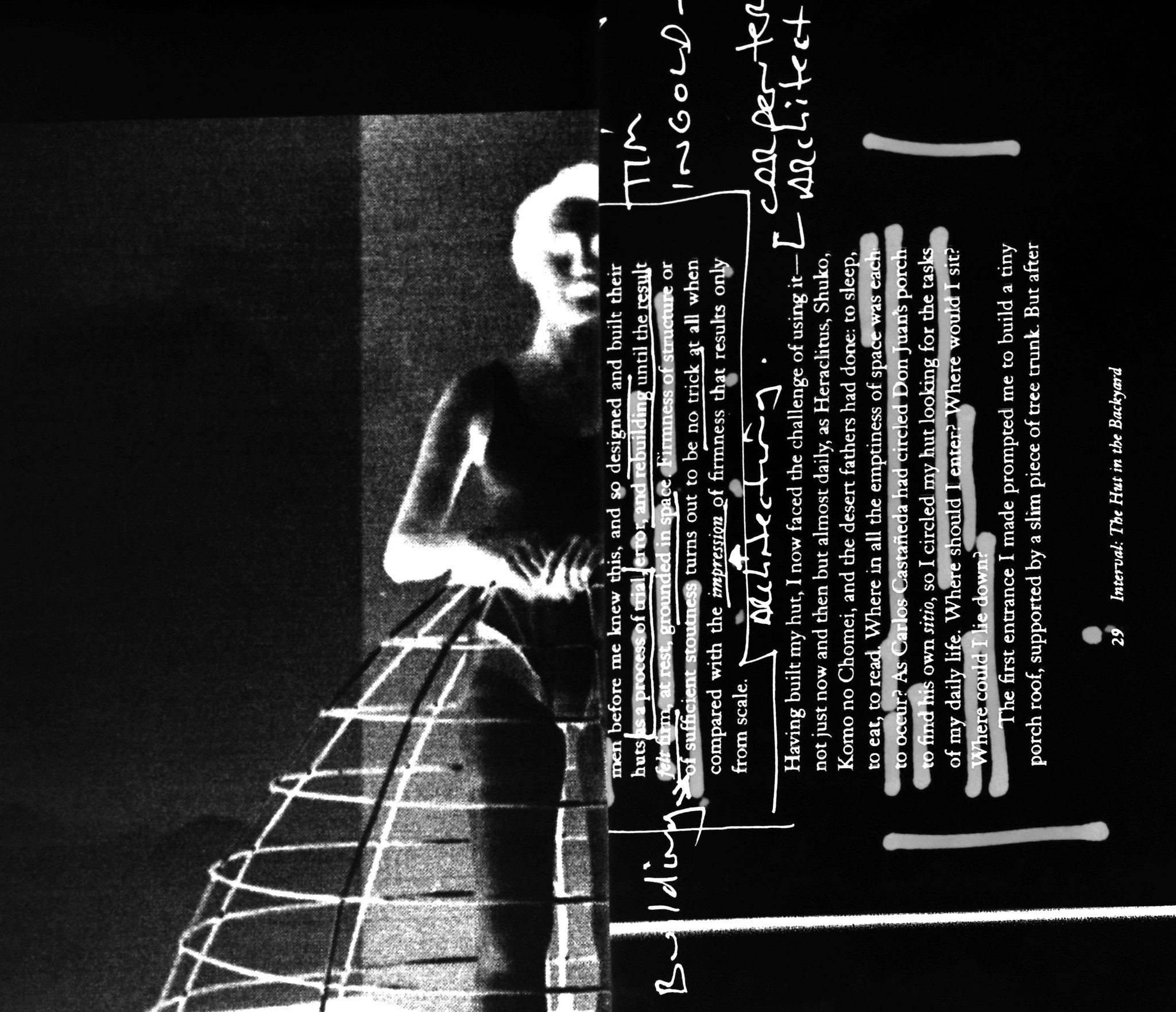
    SELECTED BIBLIOGRAPHY AND REFERENCES

    Edward S. Casey, The Fate of Place (Berkley: University of California Press, 1998 )

    Juhani Pallasmaa, Eyes of the Skin, Architecture and the Senses (Chichester: Wiley, 2005 )

    Peter Greenaway, The Physical Self (Rotterdam: Boymans-van Beuningen Museum, 1992)

    Henri Lefebvre, The Production of Space (Oxford: Blackwell, 2000)

    J. G. Ballard, High Rise (London: Jonathan Cape, 1967)

    David Wood, The Deconstruction of Time (Evanston: Northwestern University Press, 2001 )

    Ian Buchanan, Deleuze and Space (Edinburgh: Edinburgh University Press, 2006)

    Vilem Flusser, Towards a Philosophy of Photography (London: Reaktion, 2000 )

    Robert Cooper, Peripheral Vision: Relationality (London: Sage Publishing, 2005)

    Jonathan Murdoch, Post Structuralist Geography ( London: Sage Publishing, 2006)

    Markus Miessen, Did Someone Say Participate, an atlas of Spatial Practice (Cambridge, Massachusetts: MIT Press, 2006)

    Russell Ferguson, Francis Alys, Politics of Rehearsal (Los Angeles: Hammer Museum, 2008)

    Elizabeth Grosz, Space, Time, and Perversion (London: Routledge, 1996)

    Tracey Wan, The Artists Body (London: Phaidon Press, 2000)

    Francois Dagonet, Etienne-jules Marey: a passion for the trace ( New York: Zonebooks, 1992 )

    Colin Rowe, Transparency ( Basel: Birkhauser, 1997)

    Avis Newman, The Stage of Drawing, Gesture and Act (London: The Tate Drawing Centre, 2001)

    Giuseppe Penone, The Eroded Steps (Halifax: HMST, 1989)

    Glen Onwin, The Recovery of dissolved substances ( Halifax: HMST, 1992)

    Carolyn Bakargiev, Arte Povera (London: Phaiden Press, 2003)

    David Green, Stillness and Time, Photography and the moving image ( Brighton: Photoworks, 2006)

    Catherine Lupton, Chris Marker, memories of the future (London: Reaktion, 2004 )

    Martin Amis, Times Arrow (London: Jonathan Cape, 1991)

    Yve Lomax, Sounding the Event: escapades in the dialogue and matters of art, nature and time (London: I. B. Tauris, 2005 )

    John Wood, The Virtual Embodied, presence, practice, technology (London: Routledge, 1998)

    Lucy Bullivant, Responsive Environments, Architecture Art and Design { London: V&A, 2005)

    Gaston Bachelard, The Poetics of Space (Boston: Beacon Press, 1994)

    Italo Calvino, Six Memos for the next millennium (London: Jonathan Cape, 1992)

    Douwe Draaisma Metaphors of Memory (Cambridge: Cambridge University Press, 2000)

    Paul St George, Sequences: Contemporary chronophotography and experimental digital art ( London: Wallflower, 2008)

    Hans Christian von Baeyer Information, The new language of Science (London: Weidenfeld and Nicolson, 2003)

    Andrey Tarkovsky, Sculpting in Time (Austin: University of Texas Press, 1986)

    Susan Broadhurst, Liminal Acts ,a critical review of contemporary performance and theory ( London: Cassell, 1999)

    Eduardo Cadava, Words of Light (New Jersey: Princetown University Press, 1997)

    Giuliana Bruno, Public Intimacy ( London: MIT press, 2007 )

    Jeanette Winterson, Written on the body (London: Jonathan Cape, 1992)

    Jane Rendell, Art and Architecture, a place between (London: I. B. Tauris, 2006 )

    Thierry de Duve, The Definitively unfinished Marcel Duchamp ( Cambridge, mass: MIT Press, 1991 )

    Always fascinated by the “return shelves” in a library, its like a barometer of specific activity, it holds within it occurrences and possibilities that are un-calculable to predict It concurs traits of other events/projects happening outside, it reflects those items of the libraries resource have been selected and those not. It is perhaps the curiosity, the reading between what is presented that prompts speculation and ultimately one forms/registers a subjectivity and an opinion based around ones own particular space of time. These shelves “sample” my potentialities amid a on-going field of relations of which I am part as my “returns” configure a new abstraction of data.

    RESEARCH METHODOLOGIES:

    Fluctuating networks of existential events.

    Emergent state of continguences that create materials for relationality.
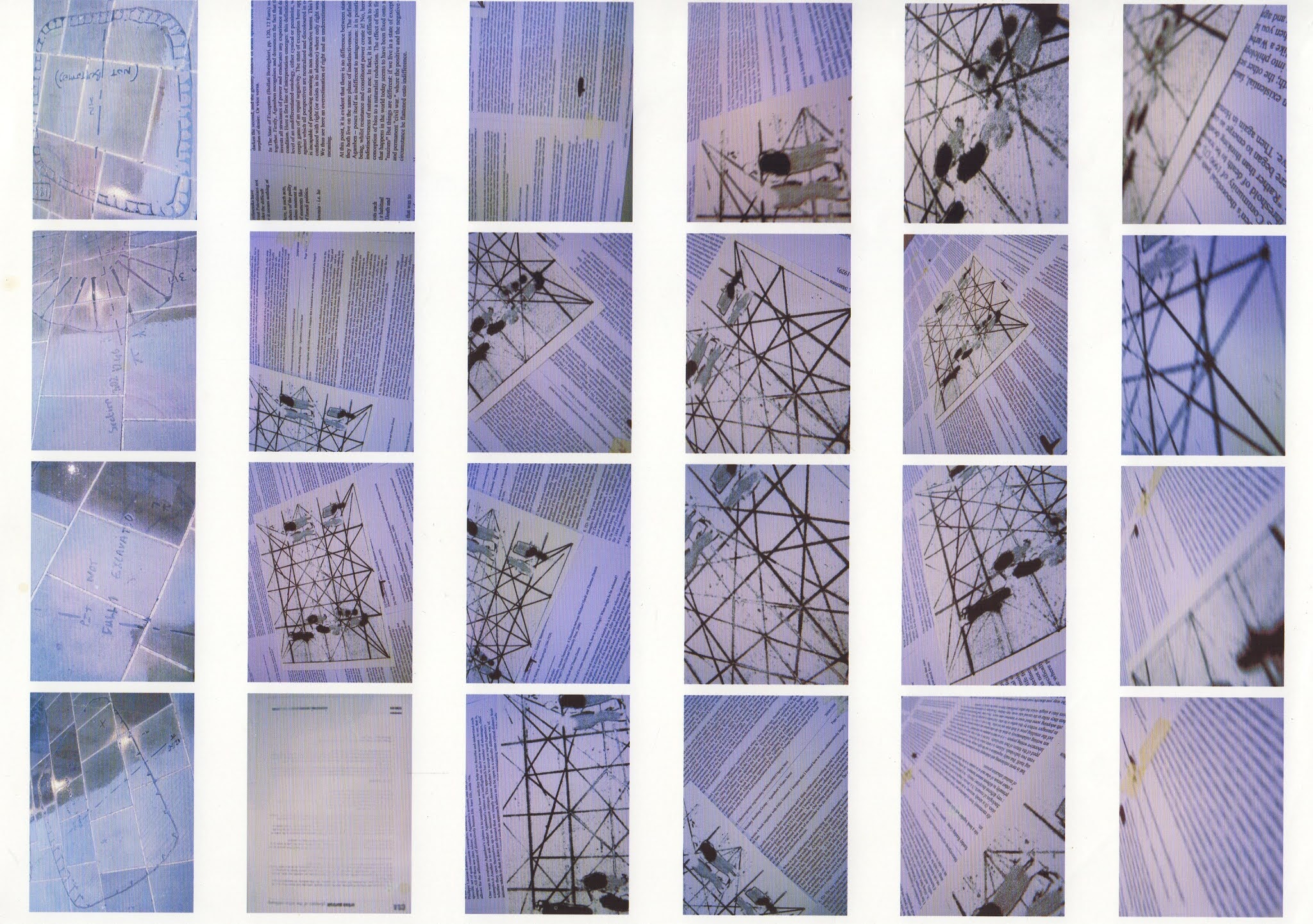
    TRANSPARENCY: LITERAL AND PHENOMENAL. COLIN ROWE AND ROBERT SLUTZKY.

    Space-time, simultaneity, interpenetration, superimposition, ambivalence. Transparency has a material condition that is pervious to light and air. Together with an “intellectual imperative” this has an “inherent demand for that which should de easily detected, perfectly evident, and free from dissimulation.”1 Transparency allows things to interpenetrate. Things can become masked and ambivalent by this superimposition but the things themselves remain authentic and unabridged.

    Transparency can grant us a “simultaneous perception of different spatial locations.” These values of being able to interpenetrate simultaneously and thus create a potential threshold that is in a state of in-betweeness.

    Transparency by its very nature confronts us with the contradiction of spatial dimensions. Contradictions that might require the physicality of the body to authenticate. There are also Contradictions centred on a linguistic transparency.

    Transparency could become a site or form of temporal phenomena, granting some sort of deconstruction when viewed as a simultaneous multiplicity.

    The interesting proprieties of transparency is its ability to have the quality of a substance ( glass, plastics, film, water) together with qualities we ascribe to it when we use it in the context of organisational systems. It is this literal and phenomenal spatiality that is infinitely relational. This relation allows us to invest transparency with a literal depth so as we can assume the phenomenal substance beyond it.

    This sense of a spatial transparency is exploited as a filmic phenomenon, film directors by moving in and out of the framic reference of the camera, create within the mind of the viewer an illusion of a spatiality that is both transparent and virtual.

    The use of transparency as a device to aid the spatial organisation of place in architecture is under investigation. Notions that “worksites” could be “assigned directional systems” which could help to engender relations of human enterprise and encounter.

    The organizational transparency of the figure ground relation in architectural mapping creates a differentiation to the integral ordering of space. This opens up the possibilities of investigative ideas around poche (a drawing method showing material structure and space in relation to each other) poche is related to transparency by precise inversion (material and space).

    Transparency can be used as a method of creating multiplicities through the device of superimposition.In so doing it creates surfaces that have mutuality by the nature of being able to be visually overwritten.

    1.Colin Rowe and Robert Slutzky, Transparency: Literal and Phenomenal (Berlin: Birkhauser Basel, 1998),page 22.

    ALLEGORY, MONTAGE AND DIALECTICAL IMAGE, JANE RENDELL.

    This chapter, in Jane Rendell’s Art and Architecture, A Place Between, offers a number of possibilities for the interpretation of my current investigative research. In particular, her analysis of Walter Benjamin’s discussion on the temporal aspects of allegorical and montage techniques in works of art.1

    Rendell cites Benjamin’s The Origin of German Tragic Drama,2 as having a particular form of a baroque theatre, where the temporal, and the corporeal body, meet the transcendental. Within the structure of these there plays a sadness of life represented as a “nature petrified in the form of fragments of death.”3

    This notion of using objects as allegorical devices within the duration and place of an event, interests me.

    This allegorical device within “Place” is further elaborated by Benjamin himself when he remarks, “allegories are, in the realm of thoughts, what ruins are in the realm of things”.4

    This relationship with time and allegory could be performative and immersive. Benjamin notes baroque allegory to be “an appreciation of the transience of things, as well as an expression of sadness over the futility of attempting to save for eternity those things that are transient.”5 This expression could be rendered as a work of art. Joseph Beuys has used the device of vitrines that suggest the collection of relics from a museum. His work Sweeping Up 1972/85 is a vitrine containing contents originated from an “action” performed by Beuys. In this work the contents were collected after a political parade in Berlin. This work, on view in Tate Modem, has a sensibility of indexical residues suffused with almost alchemeric properties. The notion of a vitrine being able to carry a visual joke or pun is perhaps Duchampian. Peter Greenaway’s curated exhibition, The Physical Self6 explores these notions further, through static displays of both objects and human bodies presented in the context of a museum. Greenaway has in effect, attempted to use a museum setting to amplify the sense of retrospectective contemplation of our own temporality.

    Rendell remarks on Benjamin’s interest in the dialectical image, explained as an image whose “moment where the past is recognized in the present as a ruin that was once desired.”7 The interesting thing is that Benjamin’s dialectical image is an “attempt to capture dialectical contradiction in an instant, as a visual image or object.”8 It is this dialectical threshold the “point at which thesis and antithesis converged”9 that could be utilized as a physical possibility (intervention) within a place. The clarification of ideas through interactions and contradictions through a performative exploration with an immersion with site might be made to occur. The uses, as noted by Rendell, of montage and Dadaist artwork in film, was admired by Benjamin for its shock tactics and are also  associative with the notion of interventions whose purpose is to “interrupt the context into which it is inserted.”10 This idea of an intervention, could work as an emergent phenomena that sets up a sense of temporal dynamics in a location or place.

    A number of contemporary artists have used a wide range of physical interventions with their particular dialogues with place. Jane Prophets, Conductor 2000 was a site specific response to Wapping Hydraulic Pumping station. Prophet utilized water and electro luminescent cables in her installation. Glen Onwins, As Above So Below 1991, was again a site specific intervention, utilizing black and white dyed brine, gypsum and coal with green light, all installed at Square Chapel, Halifax. Graham Gussin, Spill 1999, was a filmic work of a situation in which a disused commercial building was infiltrated by “fog” (dry ice).
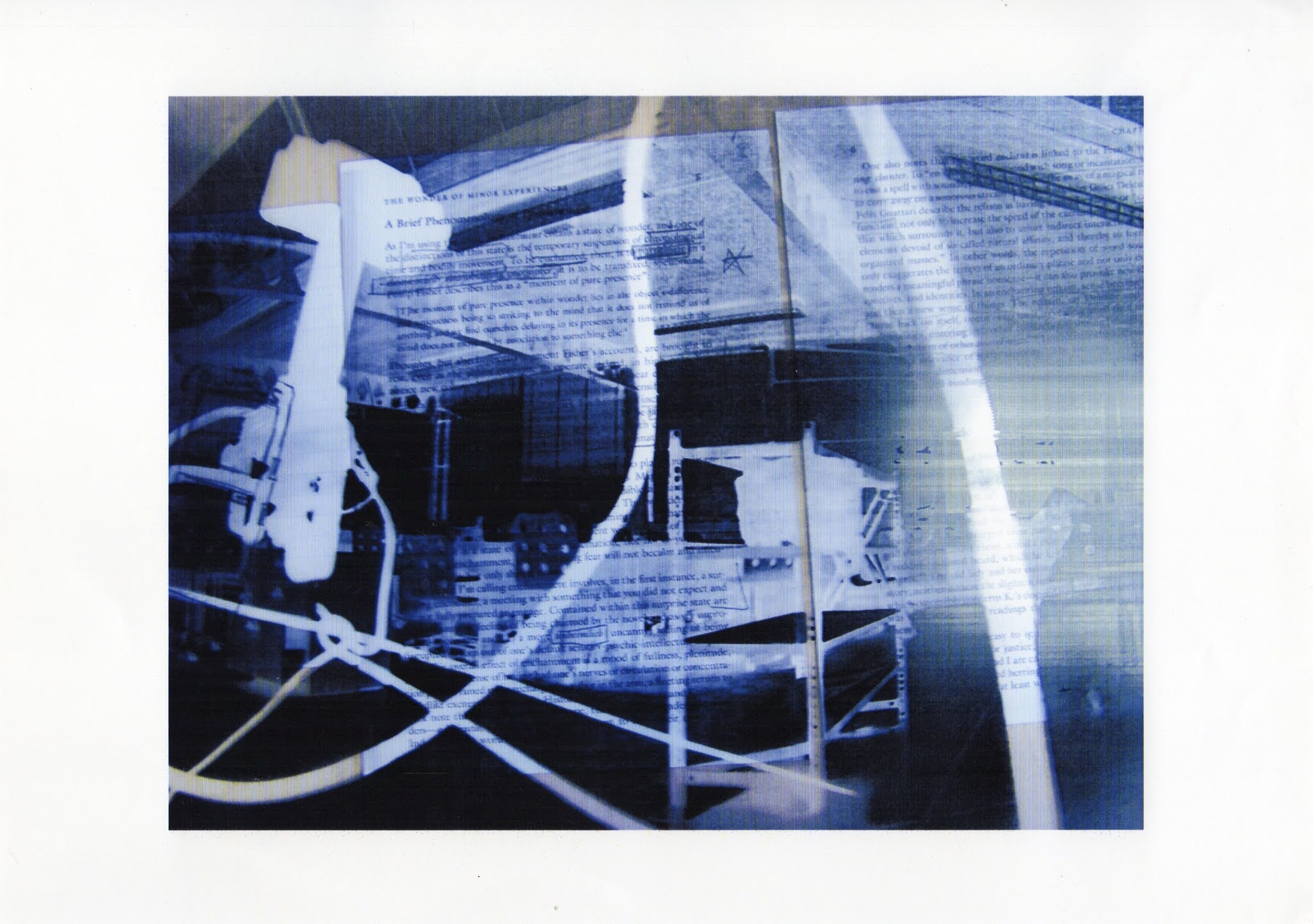
    The architect Rem Koolhaas has used an intervention device in the initial design, which produces an architectural structure that is inherently “weak”, then requiring a major structural intervention to be made to stabilize the building. This in turn re-scripts the building through chance and change and produces innovative and creative possibilities through contingences now made apparent.

    To bring about some sense of conclusion regarding Benjamin’s dialectical image or rather its device of using “dialectics at a standstill” that create an intervention of retrospective contemplation, is Jane Rendell’s suggestion, taken from Howard Caygill, that Benjamin’s writing was part of the “speculative effort to discover and invent new forms.”11 This speculative nature promotes “moments where the viewer is required to act as critic and to engage in a slower time.”12 The interlocutor into a site could be said to be given the dialectical task of synthesizing/theorizing what has been “present”, with what has become emergent with their own encounter .This notion of both site specificity and open text is of interest.

    Further potentials within “place” for an immersive engagement that might foster an “open reading”. This scripting of ones presence as an interlocutor amongst others could create a performative gesture. Like a drawing whose informative mark is just a starting point amongst others unknowable until the intimacy of the unfamiliar is breached, so the “place “ is inscribed or known by its initial un-familiarity.

    1  .Jane Rendell, Art and Architecture: A place Between (London: I. B. Tauris,2006), page75.

    2  .Benjamin, Origin of German Tragic Drama, translated by John Osborne (London: Verso, 1977).

    3  .Ibid., page 178.

    4  .Ibid., page 178.

    5  .Benjamin, Origin of German Tragic Drama, translated by John Osborne (London: Verso, 1977),page223.

    6  .Peter Greenaway, The Physical Self (Rotterdam: Museum Boymans-van Beuningen,1992).

    7  .Jane Rendell, Art and Architecture: A Place Between, (London: I. B. Tauris,2006), page 77.

    8  .Ibid., page 77.

    9  .Ibid., page 77.

    l0  .Jane Rendell, Art and Architecture: A Place Between (London: I. B. Tauris, 2006),page 78.

    11 .Howard Caygill, The Colour of Experience (London: Routledge, 1998),page74-75.

    12 .Jane Rendell, Art and Architecture: A Place Between (London: I. B. Tauris, 2006), pagel43.

    Mise-en abyme “Play within a Play”

    “A play within a play alludes to and explicates the plot of a larger play within which it is staged”

    THE PHYSICAL SELF: PETER GREENAWAY,

    MUSEUM BOYMANS-VAN BEUNINGEN ROTTERDAM.

    Peter Greenaway’s work interests me with its playful and investigative attitudes to the visualization of dialogues around what he himself calls “the physical human predicament.”

    His exhibition is centred on the interactions on the issue of “the physical human predicament” and the available “contents” of the place of its presentation. The situation and contents of the display of historical artefacts and naked human beings in glass cases are relational attempts to illustrate Greenaway’s sense of the dissimilarities between objects and human existence.

    This work touches the territory of the allegorical. Walter Benjamin has said of the allegorical “allegories are, in the realm of thoughts, what ruins are in the realm of things.”1 This relation is embodied by the physical display of living human beings being firstly dislocated/annexed and then displayed as “an equivalent”, along side with that of the artefacts objectivity.

    This shared proximity prompts, as does allegory notions of the transcendental, as to what of “the human”, remains from this objectivity. This presentation is not so dissimilar from a theatrical showcase, with elements of “baroque theatre” and objects from a personal taxonomy drawn mostly with haptic associations. Artefacts could be said to be “orphans” taken out of the ruins of place.

    The museum becomes their adopted orphanage, a repositoiy, where they can be viewed scrutinized. Greenaway makes this comment about the inclusion of the human, “to put an unclothed body in a glass case, to load it with the expectations and connotations of a museum object, to be deliberately contemplated, is to make particular demands on a viewer to look and see, compare and adjudicate the sensitivities of the physical self.”2

    MOTHER AND CHILD

    AGE

    MAN AND WOMAN

    MAN

    WOMAN

    TOUCH

    FEET

    HANDS

    NARCISSISM

    1  Benjamin, The Origin of German Tragic Drama, translated by John Osborne (London: Verso, 1977), page 178.

    2 Peter Greenaway, The Physical Self (Rotterdam: Museum Boymans-van Beuingen, 1992), page 13.


    OPEN TEXTS.  Allow readers to have multiple interpretations, they allow for the possibility of  “determinations”. Intertextuality fundament…

    Source: Art and Architecture : a place between, Jane Rendell, Peter Greenaway, Intertextuality/Transparency

    Re-entering / 2026 — What was once imagined through transparency, montage and intervention now begins to surface materially through permeability, aperture and the ceramic body.

    The place between has become a material condition: chamber, aperture, surface, body.

    Archival / Anarchival note

    Archival:
    This is a substantial theoretical archive of your earlier spatial practice. The post gathers Rendell, Benjamin, Greenaway, Colin Rowe and others around the question of how art and architecture can occupy a place between. Its key concerns are remarkably consistent: open texts, intertextuality, transparency, superimposition, montage, allegory, temporal multiplicity, intervention and the body encountering place. The post explicitly considers transparency as something that allows spatial conditions to interpenetrate and produce thresholds of in-betweeness.

    I would therefore not categorise it as Research / Working Texts, despite its extensive theoretical material. Its real subject is the production and experience of spatial relations.

    Anarchival:
    This is one of the stronger examples of an older post that can now be re-entered without needing to be corrected.

    What is particularly interesting from the present position is that several ideas already operating here have subsequently become materially embodied:

    transparency → permeability
    superimposition → correspondence
    intervention → minor gesture
    open text → proposition
    dialectical threshold → aperture
    trace → ceramic trace
    place → site
    object / body → spatial body

    The post’s idea of an intervention that interrupts a context and generates new temporal relations feels especially close to your current understanding of the hole/aperture as a minor material event. The later ceramic body does something that this earlier spatial inquiry was already imagining: it doesn’t simply occupy a place; it changes the conditions through which place can be encountered.
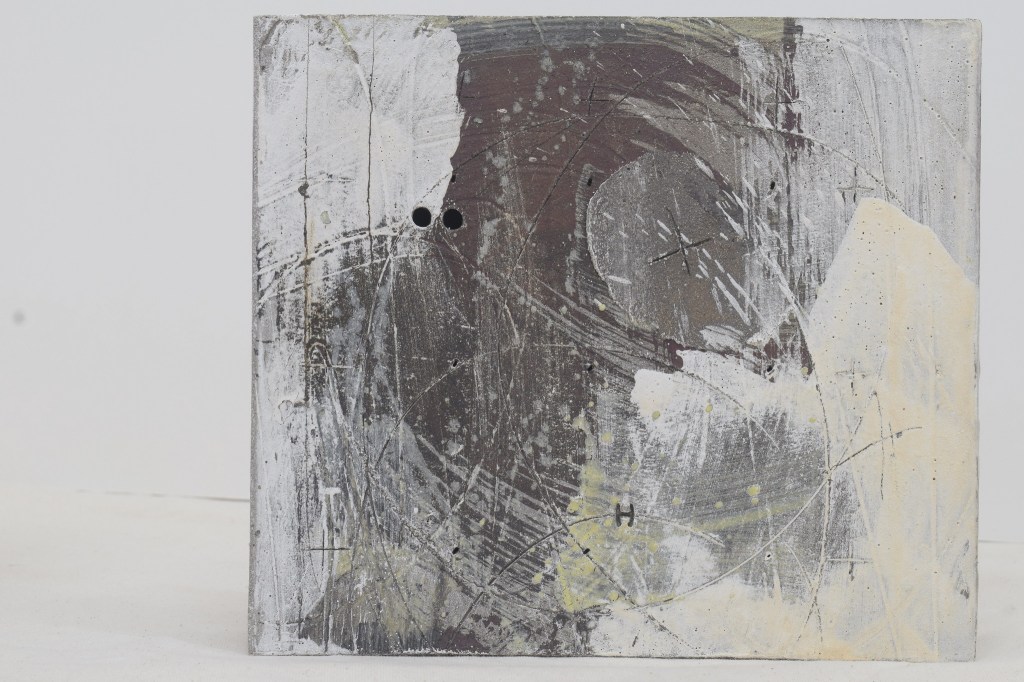
  • Ceramics a spatial sensitivity, forms governed by their vessel and void.

    Hans Coper : Pots that are ‘Worlding’ in that that they situate a certain fidelity, a willingness to survive and endure.

    Hans Coper : Potter, “the experience of existence”
    CRAFTS STUDY CENTRE.
    FARNHAM, SURREY. UK
    RUSSELL MORETON
    2014.
    “I become part of the process, I am learning to operate a sensitive instrument which may be resonant to my experience of existence now.”
    Hans Coper, Artist Statement 1969.
    Hans Coper’s iconic assembled ceramics frame the later part of the twentieth century with an ambivalence of both alienation and reconciliation. His pots reveal differences that have resisted the homogenizing effects of the culture of the time. They embody and are a physical testament to what the potter himself has reflected on his life, “endure your own destiny”1 within the space and time of the human condition.
    Born in 1920 into a prosperous middle class background, his childhood years were spent in the small town of Reichenbach in Germany. In 1935 his father Julius, is singled out like many other Jewish businessmen for harassment and ridicule under National Socialist Party. This would result in the Coper family moving frequently to escape the attention of the Nazis. Tragically in 1936 Julius takes his own life in an attempt to safeguard the future of his family. The remaining family, Erna Coper and her two sons return to Dresden. In 1939 Hans at the age of 18 leaves Germany for England, the following year he is arrested in London and interned as an enemy alien. He spends the next three years first in Canada then returns to England by volunteering to enrol in the Pioneer Corps. In 1946 a meeting with William Ohly who ran an art gallery near to Berkeley Square, brought about an opportunity for a job in a small workshop run by Lucie Rie, a refugee potter from Vienna. Hans Coper now began earnestly through his engagement with ceramics to reveal a continental modernity “whose work seemed uncomfortably abrasive to the traditionalists.”2
    Hans Coper and Lucie Rie worked together at Albion Mews for 13 years forming a friendship and a working relationship that was mutually reciprocated through practical concerns, innovation and experimentation. There is a creative synergy in place through their mutual sharing of process and experimentation within the practicalities of the studio space. A documented instance of this reciprocal inventiveness is in the appropriation of the technique of “Sgraffito” which Lucie Rie employs after being inspired by some Bronze Age pottery at Avebury Museum bearing incised patterns, which are displayed with some bird bones, which may have been used as tools to incise the pottery. These “dark bowls of Avebury”3 are transposed through the use of manganese engobe and a steel needle into Lucie Rie’s ceramics, Hans Coper although not present appropriates the bird bone for the engineered steel of a pointed needle file and uses the action of an abrasive hand tool to remove layers of the manganese engobe. In this way Coper is enacting onto the surfaces of his ceramics, the very agencies that Modernism was acting out in the realms of architectural space and surface treatment of materials. In 1959 a move to Digwell Arts Trust would bring to a close his working relationship with Lucie Rie. Coper now became involved with a number of architecturally based projects through the Digswell Group of architects and building professionals. Coper’s engagement with the Digwell Group was not without problems and creative frustrations, but seen in retrospect it became an experimental period where Coper was strengthening his ability to bring his pottery into a spatial communion with the modernist architectural sensibilities of the time.  However it was a wartime friend Howard Mason who introduced Coper’s work to Basil Spence, from this introduction Hans Coper was commissioned to design the candlesticks for the new modernist cathedral at Coventry. The Six Coventry Candlesticks completed in 1962 explicitly reveal a sensitive and progressive spatial awareness to the architectonics of built spaces. The candlesticks delicately tapered and waisted are made in sections and assembled on site onto rods set into the architectural interior. These assembled thrown and fired towering forms seem to be more about a presence than their actual physicality. They appear to paradoxically transcend the monumentality of their setting through their very immateriality, their slight of form being perfectly balanced to accommodate a single candle and its temporal flame.
    As a maker of pots he was in constant touch with his working process, an analogue process, a creative membrane that surrounded the agency of making and thinking. He was able to pursue his vocation “My concern is with extracting essence rather than with the experiment and exploration”4 His resultant works reflect what might be termed a “machining in” of a creative durability that is both ancient and modern that contains both tensions and fragility, and that above all seems to exist in a state of timelessness.His assembled “pots” are constructed from thrown components, “throwing” as a process that he remarks on “I become part of the process, I am learning to operate a sensitive instrument, which may be resonant to my experience of existence now”. It is through the wheel, the body and the interplay between clay and air that the inner space that defines the form is created. Adam Gopnik writing about the art of Edmund de Waal describes what I might be termed a spatial sensibility “the pot-ancient as it is, is the first instance of pure innerness, of something made from the inside out.”5 Hans Coper further adds sensuality to this “innerness” when he encloses it in a skin that appears archaic through a deeply physical surface treatment of engobes, incised grooves and scratching of the raw pot; then when finally once fired the dry vitreous surface is further machined and abraded to give a graphite-like sheen.
    Hans Coper’s pots speak in silence of this interior “architectonic” space that is itself reverberated through an almost archaic modernity. He seems to be able to tune the interior, to load its mass, its void.
    There is a strong sense of the vessel, the concrete with the emptiness, even an analogy to corporality set in motion by his treatment of the surface and interiors of his pots. The pots themselves belong to ever extended families, to new familiarities created by the subtle interlays between the negative spaces created through the spatial awareness that has been crafted into their very making. The pots through proximity with each other are in a spatial communion, they act to define particular spaces by defining boundaries and creating thresholds between exterior surfaces and space. These pots are themselves are “encounters” they ask us to be attentive to the responsive sensory inner space set up in residence by the permeable world of the ceramic vessel.1 Birks, Tony. 1983. Hans Coper. London. William Collins Publishers : p75.
    2 Birks, Tony. 1983. Hans Coper. London. William Collins Publishers : p22.
    3 Birks, Tony. 2009. Lucie Rie. Catrine. Stenlake Publishing ltd: p44.
    4 The Essential Potness. Hans Cper and Lucie Rie 2014. Collingwood and Coper Exhibition 1969. Victoria and Albert Museum.
    5 Gopnic,Adam. 2013. The Great Glass Case of Beautiful Things : About the Art of Edmund de Waal. New York; Gagosian Gallery : p6-7.

    Selected Bibliography.
    Birks, T. 1976.Art Of The Modern Potter.London: Country life Books.
    Birks, T. 1983. Hans Coper. London: William Collins Publishers.
    Birks, T. 2009. Lucie Rie. Catrine : Stenlake Publishing ltd.
    Coatts, M. 2008. Lucie Rie and Hans Coper, Potters in Parallel. London:
    Graves, A.2005. Hans Coper: Sculpture in Architecture. Interpreting Ceramics Issue
    Gopnic, A. 2013. The Great Glass Case of Beautiful Things: About the Art of
    Jones, J.2005. Keeping Quiet and Finding a Voice : Ceramics and the Art of Silence. London: Interpreting Ceramics Issue 5.
    Edmund de Waal. New York : Gagosian Gallery.
    Whiting, D.1996. Coper at Coventry. London: Studio Pottery no 20.
    2014.The Essential Potness, Hans Coper and Lucie Rie.


    Social apparatuses and agents that explore the possibilities of space. Other Worlds : Insistent moments of mark making/subjectivity.

    Source: Hans Coper : Pots that are ‘Worlding’ that situate a certain fidelity, a willingness to survive and endure.

    Category:
    Interiority / Atmosphere

    Archival / Anarchival note

    Archival:
    This is an important early interiority document. The central concern is the vessel as something produced through its inner space: Coper’s forms are understood through the relationship between mass and void, surface and interior, body and architectural space. The post moves from Coper’s biography and making process towards the idea that ceramic forms can create thresholds and define spaces through their proximity to one another.

    The existing tags on the original post are much thinner — fine art, Making, ceramics, abraded, dark pots, endure, fidelity, Hans Coper, Lucie Rie, T Material, Worlding — so I think this is a good case for allowing the migration to make the latent spatial vocabulary much more visible.

    Anarchival:
    This post is particularly significant now because innerness has subsequently become one of the ways you think about ceramic interiority, but the newer practice has shifted the question.

    The earlier formulation asks what happens when the vessel contains a void. Your present work increasingly asks how an interior can become a living spatial passage — punctured, atmospheric, permeable and available to other bodies.

    So I would see this post as a strong predecessor to:

    vessel → chamber → aperture → atmosphere → correspondence

    The Coper material also opens directly into your current thinking about withdrawal. The ceramic interior is present precisely because it cannot be reduced to its exterior surface. The later language of the withdrawn ceramic body can therefore surface here without imposing it retrospectively.

    A possible anarchival insertion:

    Re-entering / 2026 — The vessel’s innerness now begins to appear less as a contained void than as a spatial condition: a chamber through which surface, atmosphere, light and body can enter into correspondence.

    And perhaps an even shorter puncture:

    The void has become a passage.

    That second sentence feels particularly useful because it creates a direct line from this older Coper research towards your present A Living Spatial Passage proposition.

    I would definitely keep this one in the migration. It is one of the clearest archival links between your earlier Coper/interiority research and the current idea of the ceramic body as chamber, threshold and passage.

  • Seeing Dark Things : Chemical Photography/Images from the darkroom.

    Seeing Dark Things : Chemical Photography/Images from the darkroom.


    Re-entering / 2026 — The darkroom now feels close to the kiln: both are chambers of withdrawal in which encounters disappear from immediate view and return materially transformed.

    Or, more tentatively:

    Perhaps the darkroom was already a chamber of correspondence. Darkness did not conceal the image; it allowed another form of appearance.

    I particularly like the second because it doesn’t force the old photography work to become a precursor to ceramics. It simply opens a correspondence that wasn’t necessarily visible then.


    Concept of a ‘Filtow’

    A filtered radiance emanating from a vessel not an object interrupting a beam of light.

    Seeing Dark Things.

    Roy Sorensen.


    The thing contained is not the thing contained.

    The spherical intersection space was also crafted in curved thin wood layers.

    Steven Holl.


    The Representation of Deep Time.

    The Mutability of Colour Relationships.

    Unleashed Colour World.

    Manifestations of Unhindered Radiance.

    Albers, yellow square.

    Monrian, square of yellow in its field of white.

    For both Mondrian and Winifred Nicholson, colour concentrates light and transforms the world.


    Flowers were sparks of light.

    I used flowers as chalices of light to make my own pictures.

    My Cibachrome darkroom has been as much a domestic space as the Alber’s basement and Winifred Nicholson’s farmhouse kitchen. They are places where ideas about the emotional range of a yellow square can exist as naturally as reflections and shadows cast by the sun and moon.

    In this new colour world of mine, the circle became nature, and the square became thought.

    The circle and square together embody what I think of as human nature.

    Dark Room, Garry Fabian Miller.


    Generating an Aura.

    Fusing and Pulsating Pigment.


    Raveningham.

    Site Cyanotypes/Drawings/Intermediaries

    Spatial Collages Reconfigured.


    spatial practice, alternative photography, fine art, ceramics,making,Russell Moreton,

    Source: Seeing Dark Things : Chemical Photography/Images from the darkroom.


    Archival / Anarchival note

    Archival:
    This belongs clearly within Drawing / Image. The post sits within your long-running photographic practice, but importantly it is not simply a documentation of photography. The darkroom is treated as a spatial and material condition in which darkness, light, exposure, chemistry and image-making become entangled. The existing archive places it within photography, and the migration sheet already identifies it as a strong candidate for Drawing / Image.

    What makes it especially useful in the migration is its proximity to the later ceramic vocabulary. The darkroom and the ceramic kiln have an unexpected correspondence: both are spaces in which something enters a condition of partial withdrawal and emerges transformed.

    Anarchival:
    I think this is one of the posts where we should avoid simply adding “ceramics” to the tags. Its importance is more subtle.

    The darkroom gives you an earlier material logic for thinking about:

    light → exposure → withdrawal → transformation → emergence

    That has become increasingly important in the ceramic work, where the kiln similarly takes the material away from direct perception. What emerges cannot simply be understood as a transparent record of what went into it.

    So there is a useful correspondence:

    darkroom ~ kiln
    exposure ~ firing
    chemical transformation ~ material transformation
    image ~ ceramic surface
    negative/absence ~ interior/withdrawal

    This connects strongly with your present idea of productive forgetting: an encounter enters a material process, becomes partially unavailable, and returns altered rather than preserved intact. That is exactly how your newer Material Reciprocity text describes the movement of gathered encounters through clay and ceramic.

  • Exploring the Connection Between Ceramics and Space

    The Trace and its Connector/Ceramics, drawing and walking/wayfaring with things.

     Outpost 040523

    Anecdote of the Jar
     I placed a jar in Tennessee,
     And round it was, upon a hill.
     It made the slovenly wilderness
     Surround that hill.
     The wilderness rose up to it,
     And sprawled around, no longer wild.
     The jar was round upon the ground
     And tall and of a port in air.
     It took dominion everywhere.
     The jar was gray and bare.
     It did not give of bird or bush,
     Like nothing else in Tennessee.
    Wallace Stevens

    Making Visible.

    Walking The Drawing.

    The co-existence of overlaying fragments of construction, by selective excavation and creative demolition.

    Castelvecchio an attitude to history. Carlo Scarpa.

    There is no stage at which humankind does not demarcate, beacon or sign their space, leaving traces that are both symbolic and practical.

    The Production of Space.

    Lefebrve.

    Kairos : The movement and its moment

    Being Alive.

    Up, Across and Along.

    The trace and the connector.

    Tim Ingold.

    Jannis Kounellis.

    Lefebvre acknowledges that geographical space created through the body, through routes which were inscribed by means of simple linear markings. These first markings, paths and tracks drawn into the landscape would become the pores through which without colliding would produce the establishment of places and localities made special for one reason or another.

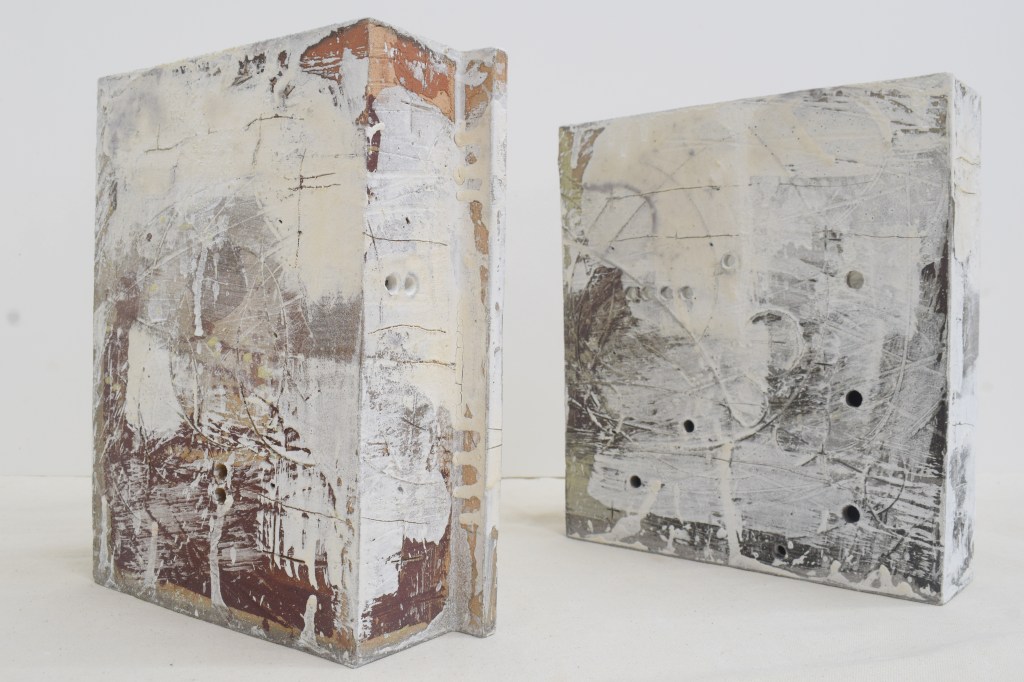
    Hand Built, Slab Ceramics.

    Oxide washes, incised lines and piercings undertaken to the raw clay forms.

    Architectural Facades/Camera Obscura.

    Darkroom’s Erasure.

    One day , we will understand that darkrooms were one of the last pools of darkness, where a pure form of thought was made visible. In the darkness at its heart, photography enabled us to see ourselves and the world more clearly, it was a place of truth and visions.

    Dark Room, Garry Fabian Miller.

    “The Pot, ancient as it is, is the first instance of pure innerness, of something made from the inside out.”

    Adam Gopnik 2014

    Richard Batterham

    In 1981 he provided a rare statement: “The main work is not to make pots, but to allow them to come, to allow them to grow, to allow them to be alive, and to communicate warmth and life in that uncannily direct and undemanding way that true and naked work can, vulnerable as it is. To make this possible, I feel that it is necessary to use our skills and materials with humility and respect. This requires a certain quietness of living.”

    A Vessel Defines Emptiness As Presence : Craft, Studio Practice /Theory and Analysis on Hans Coper, Edmund De Waal, Martin Heidegger

    STUDIO PRACTICE, THEORY AND ANALYSIS.

    MA SCHOOL OF CRAFTS AND DESIGN.

    Working Notes : Brockwood Granary 2014

    Theory and Analysis Documents, UCA Farnham

    “A predynastic Egyptian pot, roughly egg-shaped, the size of my hand : made thousands of years ago it has survived in more than one sense. A humble, passive, somewhat absurd object, yet potent, mysterious, sensuous. It conveys no comment, no self-expression, but seems to contain and reflect its maker and the human world it inhabits, to contribute its minute quantum of energy.”

    Hans Coper, 1969

    Jean Vacher acknowledges Hans Coper’s links with Modernism and that his pots possess an “innerness” that might be profoundly biographical in nature stemming from “the profound displacements that occurred to him and his family as a result of the upheavals in Europe.” (Personal e-mail correspondence CSC 28 March 2014)

     Re-entering / 2026 — The trace is no longer only something left behind. Through the aperture it becomes a connector: a small material event through which space, light, body and interior begin to correspond.

    Or perhaps the even tighter version:

    The trace became a hole. The hole became a passage.

    I really like that as an anarchival intervention because it doesn’t explain the old post. It opens it.

    spatial practice, alternative photography, fine art, ceramics,making,Russell Moreton,

    Source: The Trace and its Connector/Ceramics, drawing and walking/wayfaring with things.

    Archival / Anarchival note

    Archival:
    This is a particularly important bridge post and I think the category should now definitely be Spatial Practice, rather than Ceramic Bodies.

    The post brings together an unusually broad constellation: Wallace Stevens’ Anecdote of the Jar, Carlo Scarpa, Lefebvre’s production of space, Ingold’s trace and connector, walking and wayfaring, hand-built slab ceramics, incised lines and piercings, architectural facades, camera obscura, the darkroom, and the vessel as innerness.

    What makes it significant is that ceramics isn’t isolated as a medium. It is already operating within a spatial ecology of drawing, walking, construction, excavation, photography and architecture.

    The existing WordPress archive has it sitting simultaneously in several old categories — architecture, art, building, construction, cyanotype, diagram, drawing, mapping, photography, site specific, spatial practices, traces and Uncategorized.

    That makes it almost a perfect example of why the new taxonomy is useful.

    One principal category: Spatial Practice.
    The other identities become tags.

    Anarchival

    This feels like one of the key posts in the whole migration because it contains so many of the later relations in embryonic form.

    The title asks about the connection between ceramics and space, but the deeper question seems to be:

    How does a trace become spatial?

    The post moves through:

    walking → drawing → trace → connector → place → architecture → ceramic → aperture → interior

    That is remarkably close to the trajectory we have subsequently been describing through the ceramic body.

    The idea of the connector is particularly interesting now. Ingold’s trace isn’t simply a mark left behind; it is a line generated through movement and relation. Your later holes, incisions and apertures can be understood similarly—not simply as marks on ceramic, but as material events that connect bodies, interiors, light and atmosphere.

    And then the camera obscura becomes important. The aperture is simultaneously:

    a hole,
    a threshold,
    a connector,
    a means of seeing,
    a producer of interiority.

    That gives us a very strong correspondence with your current thinking about the hole as an interior produced by action.

    I would mark this as a high-priority archival post. It is one of the places where your current spatial practice can be seen already beginning to form—not as a theory imposed upon ceramics, but through the actual convergence of walking, drawing, architecture, photography, vessel, trace and material making.

  • Ceramics and Architecture : Making Things, Perception/Thought/Action


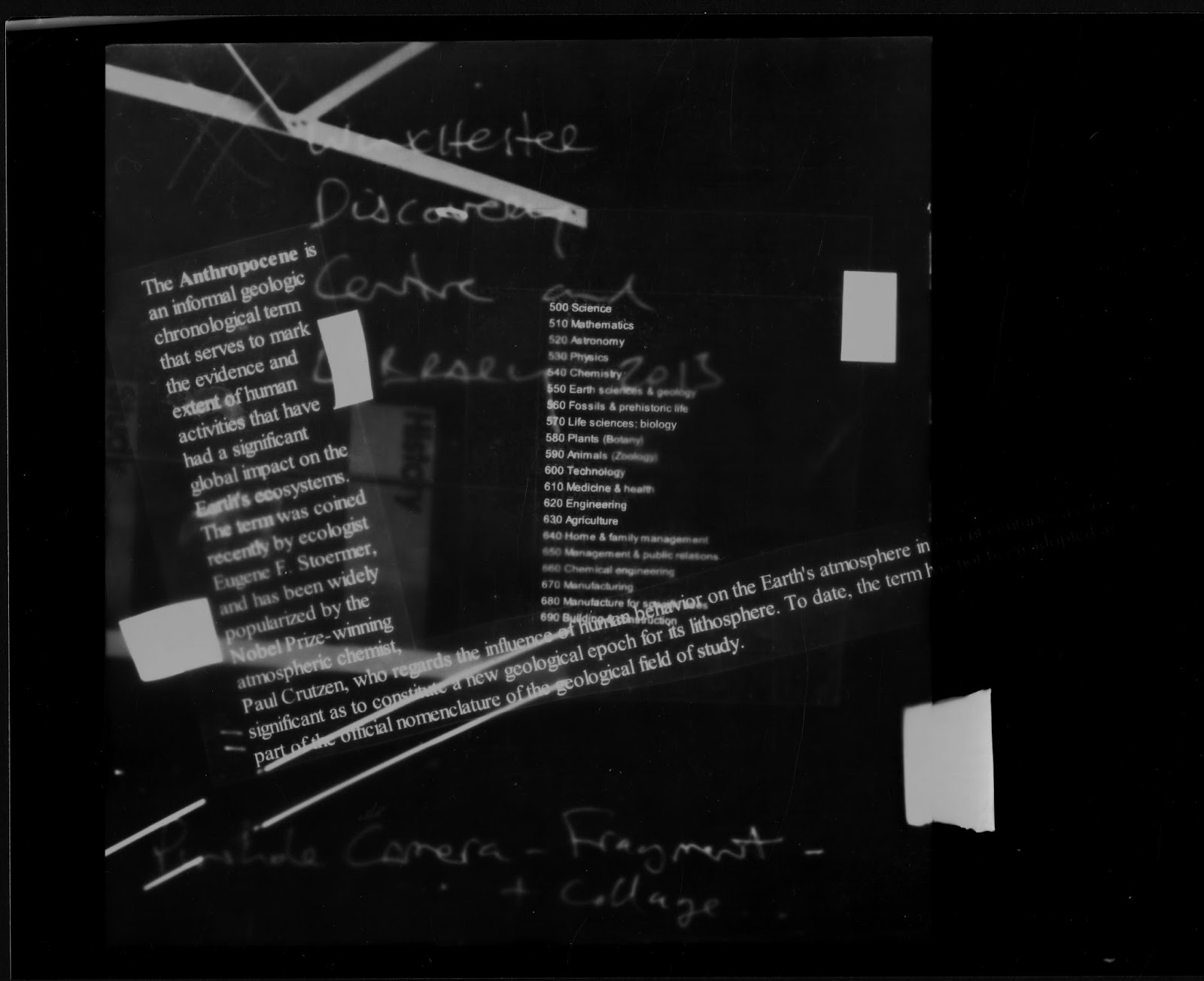
    Anthropocene Aesthetics : Ceramics and Environmental Engagement

    Urbanism : Fossil Futures~Anthropocene

    Ceramics Following Resonances : Interiors in fired clay.

    Ruins · Jozef van Wissem · Zola Jesus

    When Shall This Bright Day Begin

    ℗ 2016 Jozef van Wissem and Zola Jesus

    Released on: 2016-02-05

    Mixer: Jozef van Wissem

    Producer: Jozef van Wissem

    Composer: Jozef van Wissem

    Music  Publisher: Wissem Music

    Lyricist: Zola Jesus

    Architecting and its ecologies/matters of concern.

    The body’s participation in explorations, engagements and its care in attending to the values of immediacy, vulnerability, fragility, improvisation, performance, movement, multiplicity and becoming.

    Apparatuses and their ecologies for learning.

    The choreographic object/agent.

    The role of the body is scored through a shifting agency and the power of techniques of things.

    Theorial objects of things which do theory without us imposing it, on them.

    Oren Lieberman. 2013.

    The Production of The Unexpected.

    The Joy of Speculative Play.

    Perception/Thought/Action

    A caring curiosity that wants to know and understand and explore relations.

    Projective Speculations.

    Ecologies/Locations.

    Questioning/Research.

    Processual learning occurs in movements, gestures, postures, expressions and exchanges with other bodies and things.

    Landscapes Of Actions.

    Modalities Of Intravention

    Constitutive Qualities Of Dance.

    Ephemerality

    Corporeality

    Precariousness

    Scoring

    Performativity

    If we start by moving, by thinking through moving, and by living through moving. We’ll arrive to that disturbing vision : that the predicament of dance is to be an art of erasure. Dance always vanishes in front of our eyes in order to create a new past. The dance exists ultimately as a mnemonic ghost of what had just lived there.

    Lepecki. 1996.

    Bodily interactions highlight the entanglement of material through a process/processual understanding and situated analysis.

    The Archive.

    Matters of Concern.

    Terms of Engagement.

    Interrogate with descriptors and new issues of practice.

    Bringing Things to Life.

    Starting conditions for responsible and curiosity driven engagements with the world.

    Place-Refreshed.

    New-Agencies

    The Interconnectedness of Places.

    For Ingold, congealed places become relationships/connections for lines of occupation.

    Curriculum making/experience as the enactment of dwelling in places.

    Landscape Constructions/Observatory/Garden.

    Raveningham, drawing,mapping, landmarking paths, wayfinding, territories.

    Ceramics and  Architecture

    Marking The Line.

    In response to Sir John Soane.

    Joanna Bird. 2013

    Arranging the physical space/circulation to receive forms/intraventions.

    Christie Brown, her practice engages with mythology and narrative and the parellels between psychoanalysis and archaeology through figurative work, which references archaic collections and the significance of inanimate objects in human lives.

    Carina Ciscato, relocated to London in 1999, where she worked in the studio of Julian Stair and Edmund de Waal. The move, the contrast in culture and in attitudes to ceramics, has seen her work grow in confidence and move in exciting new architectural directions.

    Nicholas Rena, his art is concerned with reconciling the domestic and the sacred, through the medium of the vessel, a form that reveals in a single look an exterior, the figure- and an interior – the inner life. Rena’s strong , expressionist forms make explicit this duality, this communion and tension between our inner and outer life. His intensity and feeling for interior space imbues his work with immense presence and stillness.

    Clare Twomey is an advocate for craft as commensurable to the wider visual arts. Her practice can be understood as ‘post studio ceramics’ as her work engages with clay yet often at a critical distance. Twomey’s work negotiates the realms of performance, serial production, and transience, and often involves site-specific installations. She is especially concerned with the affective relations that bind people with things, and how objects can enable a dialogue with a viewer.

    Joanna Bird Pottery

    Director of the Joanna Bird Foundation. London.

    Ceramic Forms and Paintings.

    Materials/Substances on a drawn and constructed surface.

    Drawings, wax and yellow ochre on layered canvas and paper.

    Water : A Phenomenal Lens.

    The transformative properties of the substance.

    The ‘void space’ water gardens and the interior ceilings of the adjacent apartments are connected by reflected light from the ponds. These ‘void spaces’, three inches of water over black smooth stones from Ise, are analogous to a sacred space within the every day world of domestic urban life.

    An attention to phenomenal properties of the transformation of light through material can present poetic tools for making spaces of exhilarating perceptions.

    Imaginative metaphysics shows that man becomes all things by not understanding them- for when he does not understand he- becomes them by transformation himself into/with them.

    Refraction/Reflection/Spatial Reversal Phenomena.

    Time : Duration and Perception.

    Duration as a multiplicity of secession, fusion, and organisation.

    Henri Bergson.

    One’s perception modifies consciousness, attention is broadened, time is distended, just as in the density of language.

    Thus when I measure time, I measure impressions, modifications of consciousness.

    Saint Augustin.

    Time conceived as the analog between architecture and cinema, passing time was measured and observed in a precise strip of sunlight which slowly formed different reflections as it passed across the glossy lack floor.

    The physical and perceptual experience of architecture is not a scattering or dispersion, but a concentration of energy. This physically experienced ‘lived time’ is measured in the memory and the soul in contrast to the dismemberment of fragmented messages of media..

    Steven Holl.

    Outpost 100223

    Hungate, Norwich. 

    Anglian Potters

    Undercroft, Norwich. 2023

    Helgate Proposal

    Exploratory Ceramic Practice.

    Clay Making. 

    Plaster Work.

    Commissioning of Gas Kiln for large scale works.

    Glass Tech Kiln.

  • Transactive Memory : INFORMATION/MOVEMENT differentiated/integrated.


    MAKING : Spatial Agency/ Mutual Knowledge/ Discursive Consciousness. Social apparatuses and agents that explore the possibilities of space. 

    Re-entering / 2026 — What was once considered as the organisation of information between bodies now returns as a question of movement: how knowledge travels, gathers and changes through bodies, materials and space.

    Transactive Memory : INFORMATION/MOVEMENT differentiated/integrated

    Archival / Anarchival

    This is a useful research archive rather than a finished proposition. It brings together transactive memory, virtual teams, Laban’s Choreutics, movement psychology, embodied knowledge and landscape.

    The important thing now is the connection between information and movement. The post asks how knowledge is not simply stored inside an individual but distributed across bodies, relations, locations and systems. Laban then provides a spatial vocabulary through which movement itself becomes a form of thinking: force, space, time and flow.

    This makes it significant to the later development of your practice because it shifts the question from what does a body know? towards how does knowing move between bodies, materials and spaces?

    It also connects strongly with your current thinking around correspondence and the body as a threshold of exchange. The ceramic body could eventually be understood in a similar way: not as a container of information, but as a material site where traces, forces, movements and encounters become differentiated and re-integrated.

    The post’s original framing as “MAKING : Spatial Agency / Mutual Knowledge / Discursive Consciousness” is particularly worth retaining.

     
    Research Outpost Norwich #1

    Transactive Memory
    Systems Virtual Teams
    The Body
    Minds and Metaphors
    Laban-CHOREUTICS

    The Mind In The Cave
    David Lewis-Williams

    The Matter of The World
    Minds and metaphors
    Cathedrals of Intelligence
    The ‘Looking mind’

    Information Processing and Performance in Traditional and Virtual Teams
    The Role of Transactive Memory
    Terri Griffith, Margaret A. Neale

    Acquisition/Sharing of Implicit and Explicit Information

    Organisations increasingly rely on teams to do much of the work traditionally accomplished by individuals.
    Successful groups are those who are able to create synergies in the form of information aggregation and innovation that is beyond the ability of any single member.

    Nascent Knowledge
    Information Diversity
    Task Conflict

    The knowledge and perspectives of group members from the same social networks may be more redundant than diversified. However a total diversity among work group members is not desirable; some ‘redundancy’ (agreement in perspective) among group members is necessary to ensure enough common ground to facilitate successful group interaction.

    Transactive Memory : Knowing and Accessing What We Know

    For teams to have synergy they must be able to access their information, it is important to know who does what.
    Wegner 1987; 1995)

    RELATIONAL DEVELOPMENT
    TIME
    Synchronous/ Asynchronous
    COMMUNICATION

    Transactive Memory : A Contemporary Analysis of the Group Mind
    Daniel M. Wegner

    The study of transactive memory is concerned with the prediction of group (and individual) behaviour through an understanding of the manner in which groups process and structure information.

    Individual Memory
    Information is entered into memory at the encoding  stage, it resides in memory during a storage stage, and is bought back during the retrieval stage.

    Organisation : differentiated/integrated
    Label
    Location

    THE LABAN SOURCEBOOK
    Dick McCaw

    Rudolf Laban (1879-1958) was a pioneer in dance and movement, who found a extraordinary range of application for his ideas; from industry to drama, education to therapy. Laban believed that you can understand about human beings by observing how they move, and devised two complimentary methods of notating the shape and quality of movements.

    Diagram : Three Planes of Movement from Choreography
    Inner and Outer Tension : Inner and Outer Form

    CHOREUTICS : Principles of Dynamic Space and Movement

    Choreutics presents the grammar and syntax of spatial form in movement and the nature of movement’s harmonic content.

    Effort
    Exertion of Power, Physical or/and Mental

    Force
    Space
    Time
    Flight

    Indulging/Contending
    SPACE Flexible/Direct
    WEIGHT Light/Strong
    TIME Sustained/Quick
    FLOW Free/Bound

    Shadow Moves
    An acute observer of Shadow Movement of a person in different situations and at different times will show the consistency of that individual’s basic attitude and personality.

    Effort and Recovery
    Movement Psychology
    Thinking
    Intuiting
    Sensing
    Feeling

    Flickr

    Source: Transactive Memory : INFORMATION/MOVEMENT differentiated/integrated

    Category: Research / Working Texts

    I would keep this in Research / Working Texts, rather than Spatial Practice. Its importance is less the spatial project it describes than the conceptual machinery it contributes to your emerging ontology of making. It is one of those older research chambers that becomes newly legible when read through your current concern with bodies, thresholds, correspondence and material exchange.

  • Research as a discursive activity gathering new forms of expression.

    Duration, Steven Holl

    Time is only understood in relation to a process or a phenomenon.

    The duration of human beings alive in one time and place is a relational notion.

    The time of one’s being is provisional; it is a circumstance with an adopted aim for the time being.

    SPACE-and ARCHITECTURE-exceeds the provisional

    Concrete/Abstract Painting : Areas of Grisaille. Outpost Studios, Norwich.

    We are not in the presence of a passively representative image, but a vector of subjectivation.

    Guattari, 1995 :25

    Cyanotype is a photographic printing process that produces a cyan-blue print. Engineers used the process well into the 20th century as a simple and low-cost process to produce copies of drawings, referred to as blueprints. The process uses two chemicals: ammonium iron(III) citrate and potassium ferricyanide.

    The English scientist and astronomer Sir John Herschel discovered the procedure in 1842.[1] Though the process was developed by Herschel, he considered it as mainly a means of reproducing notes and diagrams, as in blueprints.[2] It was Anna Atkins who brought this to photography. She created a limited series of cyanotype books that documented ferns and other plant life from her extensive seaweed collection.[3] Atkins placed specimens directly onto coated paper, allowing the action of light to create a silhouette effect. By using this photogram process, Anna Atkins is regarded as the first female photographer.[4]

    From Wikipedia, the free encyclopedia

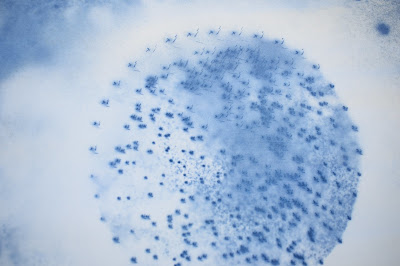
    Blue Spaces Of Everyday Enchantments : White Absences #2. Silence/Void : Gap/Reveal

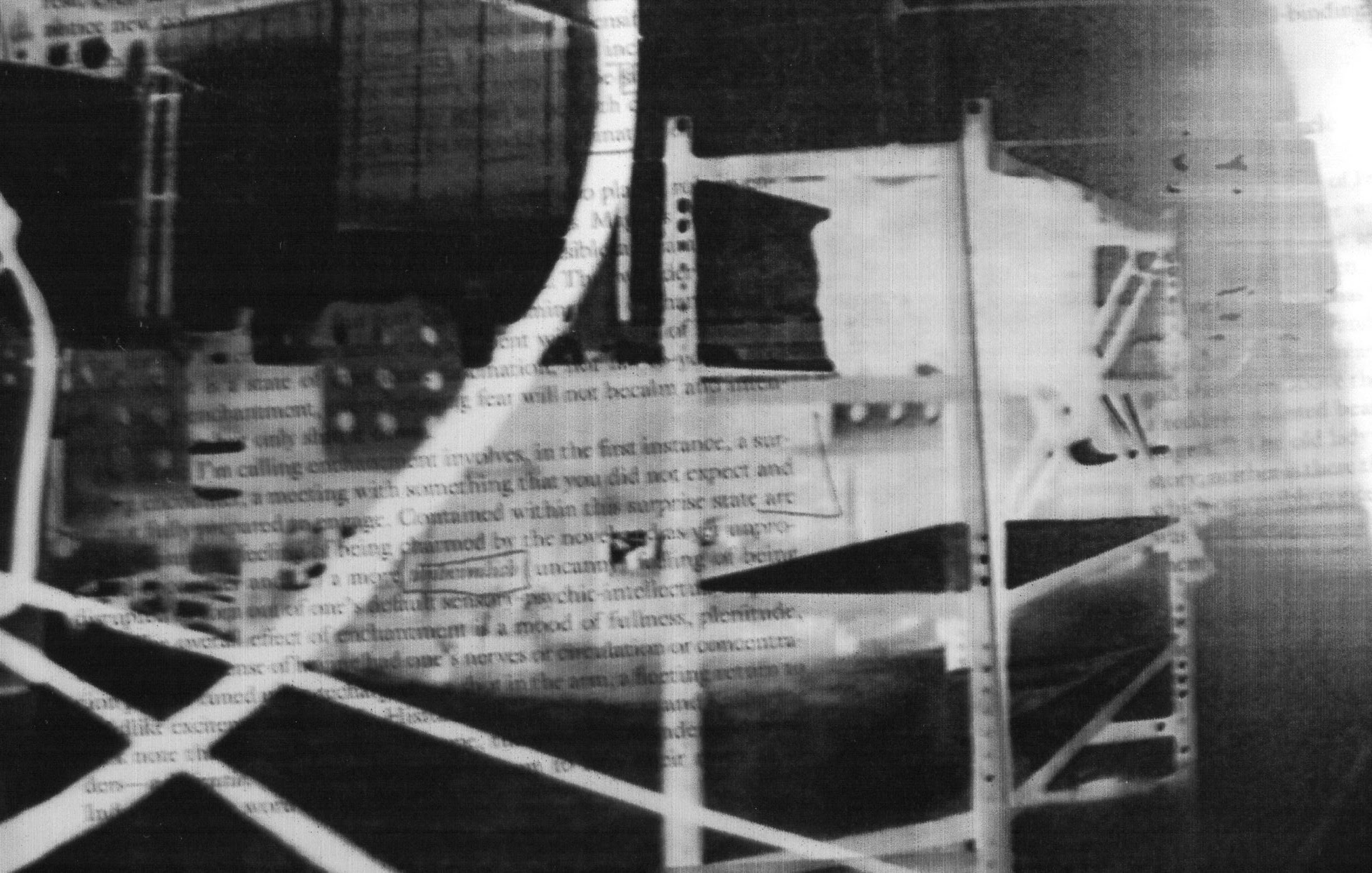
    The Enchantment of Modern Life.

    Attachments, Crossing and Ethics

    The performativity of social representations

    When I gather together the animals, arguments, molecules, suggestions, forces, interpretations, sounds, people, and images of this study, one theme emerges. The modern story of disenchantment leaves out important things, and it neglects crucial sources of ethical generosity in doing so. Without modes of enchantment, we might not have the energy and inspiration to enact ecological projects, or to contest ugly and unjust modes of commercialization, or to respond generously to humans and nonhumans that challenge our settled identities. These enchantments are already in and around us.

    Jane Bennett

    Tracing Light : Petworth House, West Sussex 2000
    David Alan Mellor, Garry Fabian Miller.

    Light And The Genius Loci
    For Derrida, the sun not only marks the beginning of metaphoricity but it is also an inescapable reminder of the solar system and oscillations, hidings and occultrations, inherent in ‘a certain history of the relationships; earth/sun in the system of perception’.

    Mutations Of Light
    Petworth Window, 6 July 1999

    Light’s Windows And Rooms
    Passing towards the Invisible.
    The prospect of some metaphysical realm beyond the blue end of the spectrum and beyond material things illuminated to carnal sight, was a recurrent  theme in William Henry Fox Talbot’s early speculations.

    BROUGHT TO LIGHT
    PHOTOGRAPHY AND THE INVISIBLE 1840-1900

    Sight Unseen
    Picturing The Universe
    Corey Keller
    Invisible objects, penciled by nature’s own hand.
    In his introduction to the exhibition catalogue Iconoclash: Beyond the Image Wars in Science, Religion, and Art, the historian of science Bruno Latour argues that scientific pictures are powerfully affective because they more than mere images; they are, as he puts it, the ‘world itself’.

    The Social
    Photographic Eye
    Jennifer Tucker
    Nineteenth century science was characterized by both the appeal to visual evidence and the need for confirmation by the testimony of eyewitnesses. The latter explains why scientists pursued public viewings of their photographs by means of illustrated slide lectures, exhibitions, and reproduction in newspapers and magazines.
    An understanding of the social boundaries of nineteenth century science helps make sense of a certain paradox within contemporary attitudes towards photography of the invisible. The ideal of mechanical objectivity in documenting visual knowledge demanded the elimination of the artist-observer and all of the subjectivity implicit in drawing by hand.

    Invisible Worlds
    Visible Media
    Tom Gunning
    William Henry Fox Talbot, Slice of horse chestnut, seen through the solar microscope, 1840, salt print 18.6×22.5 cm.

    Techniques Of The Observer
    On Vision And Modernity In The Nineteenth Century
    Jonathan Crary

    The Camera Obscura and its Subject
    Above all it indicates the appearance of a new model of subjectivity, the hegemony of a new subject-effect. First of all the camera obscura performs an operation of individuation; that is, it necessarily defines an observer as isolated, enclosed, and autonomous within its dark confines. It impels a kind of askesis, or withdrawal from the world, in order to regulate and purify one’s relation to the manifold contents of the now ‘exterior’ world.

    UNDER THE SUN
    By The Light Of The Fertile Observer

    Metaphors of illumination in the photography of Christopher Bucklow, Susan Derges, Garry Fabian Miller, and Adam Fuss.

    An Epiphany Of Light
    David Alan Mellor

    Bookmark and Share

    Posted by Russell Moreton at Tuesday, September 02, 2025 No comments:  

    Email ThisBlogThis!Share to XShare to FacebookShare to Pinterest

    Labels: #alternative photography#russell moretoncamera obscuraDavid Alan MellorDerridaGarry Fabian MillerInvisible WorldsJennifer TuckerJonathan CraryModernityPetworthThe SocialTom Gunning

    Sunday, 31 August 2025

  • Drawing Projects/Architecture is a verb : Blueprints for thinking and making.

     Outpost 111023

    What we have to remember is that what we observe is not nature itself, but nature exposed to our means of questioning it.

    Werner Heisenberg.

    Fields of Care.

    The metaphor of the container and the contained that has guided Western thought with its vocabulary of inert matter, fragmentation, and frozen and petrified movement has crippled the architectural imagination for over two millennia.

    Architecture Is A Verb, Sarah Robinson. 2021

    Drawing around the body, 2010 Pencil,cyanotype and ink on paper with astronomical data.

    Drawing Projects.

    An exploration of the language of drawing.

    Mike Maslen, Jack Southern. 2011

    The Eye That Feels.

    We must learn to think with our feelings and feel with our thoughts.

    Towards A Feeling Response.

    Human beings are lumps of perceptions in a state of flux, and ‘being’ is a constantly changing state of infinite variety. Drawings are made by human beings and like their makers, they can be complex, somewhat vulnerable, unresolved, and imperfect. Equally, they can be confident, measured, controlled, well understood and decisive.

    A drawing is a lexis of marks that represent and describe what our eyes see, and to some extent what our minds/bodies know and feel. It is made by the co-ordination of the eye/brain/hand/medium, and arranged in an organised and cohesive way to form a visual description/illusion. It is a trail of contained energy, incorporating the history of its own making, and recorded through a passage of time. It is an approximate attempt at depicting a perceived truth, and will have been made in either a confident, cautious, well seen, well understood, generalised, decisive, indecisive, ‘right’, or ‘wrong’way.  

    We live in an age when computer generated reprographic processes provide us with a world of ‘technological perfection’ and ‘high definition’.Three-dimensional imagery offers limited, but enhanced and often ‘super-real’,virtual reality. It is a time in which the large flat TV screen is providing our children with replacement substitutes for what might to a previous generation have been exposed to, and an active involvement with, an experience of rich sensory pre-verbal childhood play. It is more important than ever that, in this world of ‘perfect reproduction’, our children do not literally get ‘out of touch’ with their senses, and that a drawing retains its value as a unique, hand-made object, which contains and expresses qualities that are as individual and special  as its creator.

    The Body/Corporeality of Drawing.

    Seeing/Becoming/Situatedness

    The process of making is a magical act, organic and physiological.

    The drive to create a cosmos originated in the magic structure of consciousness.

    All basic physical and mechanical laws, such as leverage, traction, bearing, adhesion, all constructions such as the labyrinth, the vault, all such technical achievements or discoveries are pre-given to us. Every invention is primarily a rediscovery and an imitative construction of the organic and physiological.

    The Ever Present Origin, Jean Gebser. 1984

    All arts we must remember, are phases of the social mind. We are in the habit of thinking of them in terms of art products that we forget that the arts themselves are groups of ideas and acquisitions of skill, that exist in the minds, muscles and nerves of living human beings.

    Franklin Henry Giddings. 1914

    The earliest buildings are grown, they are woven structures. Borne of gathering around a fire and weaving walls.

    Understanding Building as Weaving.

    Gottfried Semper.

    Architecture is a verb outlines an approach that shifts the fundamental premises of architectural design and practice. 

    It acknowledges the centrality of the human organism as an active participant interdependent in its environment.

    It understands human actions in terms of radical embodiment, grounding the range of human activities traditionally attributed to mind and cognition, imagining, thinking, remembering, in the body. 

    It asks what a building does, that is it extends the performative functional interpretation of design to interrogate how buildings move and in turn move us, and how they shape thought and action. 

    It is committed to articulating concrete situations by developing a taxonomy of human building interactions.

    Sarah Robinson. 2021

    Homo Faber.

    Architecture shapes ideas, ideas are born through the act of forming.

    Thinking and making have traditionally been relegated to two different domains and like architecture and building the former is privileged over the latter. 

    Seldom do we consider the act of making as a method of knowing. For Tim Ingold, both the maker and the theorist are engaged in processes of knowledge, with the important difference that the craftsman thinks through making, while the theorist imposes thought on matter. 

    The temple at once embodied the interdependent arising of craft and community, and replaced the caves and sacred  groves of earlier divine appearances, to become a place apart. 

    A crafted place where divinity was revealed. The world appeared for the first time through something people made. Through building the temple, cosmos was discovered through making.

    The top-down abstract knowing of the theorist verses the bottom-up embodied knowing of the craftsman has come to define our hierarchy on the valuation of knowledge.

    The Origins of Architecture in Weaving.

    They Wove Their Walls.

    Vitruvius.

    Tim Ingold comments that just as baskets are woven, so buildings are grown, not built. Their form, and its usefulness emerges from the process of growth rather than from the mandates of a preconceived design on formless raw material.

    Materials are not understood in terms of their component parts, but in terms of what they do.

    Making is not a matter of imposition, but of intervening in the fields of force and flows of material.

    Cyanotype processing of architectural drawings.

    Blackboard/Whiteboard Fragments.

    Organism/Person/Environment.

    DSC_2068 Structured Modalities : Rules/Individual Resources

    Braking down research.

    Radical pedagogy transduces rather than transmits.

    Re-combinent poetics/praxis.

    The Architectural Scriptorium

    The Photographic Darkroom.

    Bookmark and Share

    Posted by Russell Moreton at Wednesday, October 11, 2023

    Labels: architectureblueprintsdrawingFranklin Henry GiddingsGottfried SemperHomo FaberJack SouthernJean GebserMike MaslenSarah RobinsonTim IngoldWerner Heisenberg