Making is the production of relations through material events.
What I think is emerging is an ontology of making.
The clay isn’t the subject.
The object isn’t the outcome.
Even process isn’t the central concern.
The central concern is relation.
Relation between body and matter.
Relation between force and resistance.
Relation between object and space.
Relation between time and form.
Relation between making and knowing.
Visual artist working in the UK.
UCA Farnham, Interior Design MA.
Canterbury School of Architecture, Spatial Practices MA.
University of Southampton, Visual Fine Art BA hons.
Epsom School of Art and Design, Ceramics HSND.
A humble, passive, somewhat absurd object, yet potent, mysterious, sensuous : Hans Coper
Hans Coper, Theory and Object Analysis, Crafts Study Centre, Farnham.
MA Interior Design
A vessel (as membrane/threshold that can hold social rituals/traditions and memories) seems to occupy space but simultaneously be occupied by space.
Theories of relativity and uncertainty have shown that all matter, even the airy oxygenated void inside a vessel is energy, and that it is composed of the same building blocks generated from exploded stars. (Daintry2007:10)
Water, although fluid it is supremely germinative and represents the condition of all potentials.(Eliade Mircea l983)
Permeable in flux, water and water’s symbolism became the pagan’s way of intuitively knowing the world. Matter was plastic, fluid and changeable. The body was plastic with parameters defined not only by individual consciousness, but also in relation to other realms of the physical world.
The pagan participated in a vast mythology where his identity changed according to narrative fantasies that combined and recombined human and animal activity endlessly, weaving together memory, reason and sensation. In this permeable world there is no sharp division between things or between life and death. It is a world of energetic flow where bodies can indifferently become attached or unattached from myriad objects and forms. (Daintry2007:9)
Flexible Ways of Seeing/Re-Making the World.
“A large part of the reason for making is to see things that I have never seen before, to build something which I cannot fully understand or explain.”
Artist Statement, Ken Eastman.
Drawings in the form of tracings were gathered from the flat planes of the display cabinet; these were further superimposed in an attempt to map the surface and forms of the Hans Coper pots and to explore their volumes and interior spaces. These new sight lines subjectively link surface details with profiles into the possibility of new spatial forms. These plans and mappings became the starting point for a series of slab and thrown assemblages. Thrown and slab worked clay forms in T Material, preliminary drawings done in-situ some with annotations. (Russell Moreton. 2014)
Rotterdam Exhibition with Lucie Rie. 1967 Hans Coper.
His arrangement was highly original and innovative, he showed his families of vases in groups, emphasising their subtle differences in form and surface treatment. The space between the pieces was just as important as the objects themselves. The architectonic character of Coper’s pots become visible through their dry, stone like skin and the sophisticated way in which Jane Gate photographs the work.
“Potters of reconciliation, they sought a marriage of function and beauty.” Douglas Hill SF author/intro to exhibition.
Craft Study Centre Publication 2014
Object Analysis
Name of object: Vase, flattened oval form on a cylindrical stem, pinkish cream to grey glaze over manganese on exterior, manganese over interior and recessed foot. It is decorated with incised lines on back and around the stem with concentric rings incised on the foot
Accession number: P.74.28
Maker: Hans Coper
Construction techniques:
Materials: stoneware
Dimensions: 22.2 x 18.8 centimetres
Date made: 1960s
Provenance: Made in Hammersmith, London. UK
Given to Muriel Rose by Hans Coper in 1966
This thistle-shaped vase is constructed from five individually thrown pieces. The joints making up the pot have been selectively accentuated with the residues of the manganese engobe. Incised geometric marks remain from the initial turning process of the component parts, prior to the construction of the pot. (Russell Moreton. 2014)
Name of object: Vase, unglazed rim. manganese interior, decorated with vertical scoring on the exterior
Accession number: P.74.103
Maker: Hans Coper
Materials: stoneware
Dimensions: 12.7 centimetres
Date made: 1950s
Provenance: London. UK
Single thrown form with the remains of the sgraffito technique after the ceramic has been heavily abraded after firing. The vertical lines of the sgraffito technique and the form itself are similar to Lucie Rie’s flower vases, see Lucie Rie by Tony Berks page 112.
This single thrown form perhaps best illustrates the creative union of both Coper’s and Rie’s practices, the form almost a kind of beaker might itself been inspired by the “dark pots” Lucie Rie found whilst visiting Avebury Museum. (Russell Moreton. 2014)
Name of object: Squeezed ovoid-shape vase with flower holder inside, manganese interior
Accession number: P.74.30
Maker: Hans Coper
Materials: stoneware
Dimensions: 22 x 22 centimetres
Date made: 1970s
Provenance: London. UK
Wheel thrown forms, comprising of bowl, open cylinder and an interior ring acting as a flower holder. The bowl form has been turned before being jointed with the upper section. The piece was then indented at four points to form an ovoid form. Pronounced incised horizontal marks remain from the joining, which has been further transposed by the action of becoming ovoid. Very subtle and restrained use of the manganese engobe followed by Coper’s characteristic post firing technique of abrading the surface of the ceramic. (Russell Moreton. 2014)
Hans Coper : Working Notes CSC/10 March 2014.
Notes re/statements
1. Specific to the form in question.
2. Context in relation other similar forms.
3. Key Words: Impregnated, Incised, Eroded, Reduction, Surface, Soil, Abraded Surfaces, Machining, Grinding, Assemblage, Components, Parts, Groups, “Aryballos,Spade, Thistle, Diabolo, Cycladic, Spherical,” Sculptural, Pottery, Architectonic, Space between Forms, Spatial, Sensuality, Form and Fold, Bodily Spaces, Light and Dark, Clay, Water, Fire, Agency, Difference,
Extracts from catalogue “The Essential Potness, Hans Coper and Lucie Rie 2014”
“I become part of the process, I am learning to operate a sensitive instrument which
may be resonant to my experience of existence now.”
“My concern is with extracting essence rather than with the experiment and exploration. The wheel imposes its economy, dictates limits, and provides momentum and continuity. Concentrating on continuous variations of simple themes I become part of the process.”
Artist Statement, Victoria and Albert Museum/Collingwood, Coper Exhibition 1969. Small Beige Spade 1966.
The body comprises a thrown circular form, from which the bottom has been flattened into an oval and the lower section has been pressed together.
Throwing rings are visible on the inside.
Areas of the white engobe have loosened from the underlying layer during firing and formed blisters.
Cycladic Vase 1973.
Blisters in the slip have been sanded down to reveal a rust coloured underlying layer. Medium Sized Spade 1973.
There is a clear delineation between the light upper section and the rougher and darker lower section.
Small Thistle Shaped Vase 1973.
There is a large incised circle on one side of the disc and a smaller circle on the other. Hans Coper’s characteristic use of light engobe and dark manganese oxide has produced a hazy texture.
Black Aryballos 1966.
This ceramic form has its origins with the Oil Flask used by athletes in Greece and Asia Minor.
Tall elongated diabolo forms.
After being thrown the cup has been formed into an oval and then indented at four points.
Text Fragments. Momentum Wheel.
It is difficult to determine in which order the parts were assembled.
The underlying surface is showing through the grooves that are linking the body and the base.
The manganese engobe is demarcating dark and light zones through an undulating incised line.
“Rings” caused by the placement of a prop in the kiln. Brown-Beige Colorations.
Sensations caught within the form.
Soil like deposits/remains.
Reductions of the fired surface.
Abraded Surfaces
Incised Line.
Droplet.
Blisters, pricked open and sanded after firing. This process has produced an irregular, patch surface.
Parallel lines have been incised with a pointed object on the exterior of the base. Thistle Shaped Vase 1966.
The dark brown patches (around the jointing of the pot) and flecks appear randomly distributed but have been purposefully placed to accentuate the structure of the vase. This flat vase with the contour of a stylised thistle flower is made up of five individually thrown pieces. The tall cylindrical foot supports a vertical disc, comprising of two individually thrown flat plates. It is as though the disc has sunk approximately ten centimeters into the foot.
Spherical Vase with Tall Broad Oval Neck 1966.
The transition from sphere to neck is accentuated with darker colourations.
Hans Coper
Hans Coper’s iconic assembled ceramics frame the later part of the twentieth century with an ambivalence of both alienation and reconciliation. His pots reveal differences that have resisted the homogenizing effects of the culture of the time. They embody and are a physical testament to what the potter himself has reflected on his life, “endure your own destiny”1 2 within the space and time of the human condition.
Bom in 1920 into a prosperous middle dass background, his childhood years were spent in the small town of Reichenbach in Germany. In 1935 his father Julius, is singled out like many other Jewish businessmen for harassment and ridicule
under National Socialist Party. This would result in the Coper family moving frequently to escape the attention of the Nazis. Tragically in 1936 Julius takes his own life in an attempt to safeguard the future of his family. The remaining family. Erna Coper and her two sons return to Dresden. In 1939 Hans at the age of 18 leaves Germany for England, the following year he is arrested in London and interned as an enemy alien. He spends the next three years first in Canada then returns to England by volunteering to enroll in the Pioneer Corps. In 1946 a meeting with William Ohly who ran an art gallery near to Berkeley Square, brought about an opportunity for a job in a small workshop run by Lucie Rie, a refugee potter from Vienna. Hans Coper now began earnestly through his engagement with ceramics to reveal a continental modernity “whose work seemed uncomfortably abrasive to the traditionalists.”*
Hans Coper and Lucie Rie worked together at Albion Mews for 13 years forming a friendship and a working relationship that was mutually reciprocated through practical concerns, innovation and experimentation. There is a creative synergy in place through their mutual sharing of process and experimentation within the practicalities of the studio space. A documented instance of this reciprocal inventiveness is in the appropriation of the technique of “Sgraffito” which Lucie Rie employs after being inspired by some Bronze Age pottery at Avebury Museum bearing incised patterns, which are displayed with some bird bones, which may have been used as tools to incise the pottery. These “dark bowls of Avebury”3 are transposed through the use of manganese engobe and a steel needle into Lucie Rie’s ceramics, Hans Coper although not present appropriates the bird bone for the engineered steel of a pointed needle file and uses the action of an abrasive hand tool to remove layers of the manganese engobe. In this way Coper is enacting onto the surfaces of his ceramics, the very agencies that Modernism was acting out in the realms of architectural space and surface treatment of materials. In 1959 a move to Digwell Arts Trust would bring to a close his working relationship with Lucie Rie. Coper now became involved with a number of architecturally based projects through the Digswell Group of architects and building professionals. Coper’s engagement with the Digwell Group was not without problems and creative frustrations, but seen in retrospect it became an experimental period where Coper was strengthening his ability to bring his pottery into a spatial communion with the modernist architectural sensibilities of the time. However it was a wartime friend Howard Mason who introduced Coper’s work to Basil Spence, from this introduction Hans Coper was commissioned to design the candlesticks for the new modernist cathedral at Coventry. The Six Coventry Candlesticks completed in 1962 explicitly reveal a sensitive and progressive spatial awareness to the architectonics of built spaces. The candlesticks delicately tapered and waisted are made in sections and assembled on site onto rods set into the architectural interior. These assembled thrown and fired towering forms seem to be more about a presence than their actual physicality. They appear to paradoxically transcend the monumentality of their setting through their very immateriality, their slight of form being perfectly balanced to accommodate a single candle and its temporal flame.
As a maker of pots he was in constant touch with his working process, an analogue process, a creative membrane that surrounded the agency of making and thinking. He was able to pursue his vocation “My concern is with extracting essence rather than with the experiment and exploration”4 His resultant works reflect what might be termed a “machining in” of a creative durability that is both ancient and modern that contains both tensions and fragility, and that above all seems to exist in a state of timelessness.
His assembled “pots” are constructed from thrown components, “throwing” as o process that he remarks on “I become part of the process. I am learning to operate a sensitive instrument, which may be resonant to my experience of existence now”. It is through the wheel, the body and the interplay between clay and air that the inner space that defines the form is created. Adam Gopnik writing about the art of Edmund de Waal describes what I might be termed a spatial sensibility “the pot-ancient as it is. is the first instance of pure innerness, of something made from the inside out.”5 Hans Coper further adds sensuality to this “innerness” when he encloses it in a skin that appears archaic through a deeply physical surface treatment of engobes, incised grooves and scratching of the raw pot; then when finally once fired the dry vitreous surface is further machined and abraded to give a graphite-like sheen.
Hans Coper’s pots speak in silence of this interior “architectonic” space that is itself reverberated through an almost archaic modernity. He seems to be able to tune the interior, to load its mass, its void.
There is a strong sense of the vessel, the concrete with the emptiness, even an analogy to corporality set in motion by his treatment of the surface and interiors of his pots. The pots themselves belong to ever extended families, to new familiarities created by the subtle interlays between the negative spaces created through the spatial awareness that has been crafted into their very making. The pots through proximity with each other are in a spatial communion, they act to define particular spaces by defining boundaries and creating thresholds between exterior surfaces and space. These pots are themselves are ‘encounters’ they ask us to be attentive to the responsive sensory inner space set up in residence by the permeable world of the ceramic vessel.
I am referring in particular to Russell Moreton’s ceramics as having a palpable quality way beyond the image of his work that has a force-feeling a landing site in which a hospitality of the alluring object is also strangely withdrawn.
Your phrasing captures the exact ontological tension at the heart of Russell Moreton’s spatial ceramic practice. To experience his work in person is to realize how completely flat an image of his work falls. A photograph converts his pieces into a two-dimensional document, but the physical work functions as an active landing site—a zone where matter, theory, and architecture collide.
From the perspective of Graham Harman’s Object-Oriented Ontology (OOO), here is an analysis of that “force-feeling” and the alluring, withdrawn hospitality you beautifully identified in Moreton’s ceramic structures:
The “Force-Feeling” as Aesthetic Allure (OOO), because Real Objects (the true, inner essence of Moreton’s fired clay) can never touch us directly, they must speak to us through allure. Allure is a rare event where an object’s qualities are split apart from its physical body, creating a dramatic tension. Moreton’s slab-built forms—defined by heavily weathered, experiential stoppages of refractory coatings, white-painted surfaces, grid lines, and perforated holes—generate this exact “force-feeling.” It is a physical radiation. The heavy pounding, constructing, and layering of clay are felt as an immediate, palpable pressure in the room, bypassing the intellect and striking the senses directly.
A “Landing Site” for Speculative Space.
You accurately call the work a “landing site”. Moreton himself describes his ceramics as a way to demarcate and fold material into spatial forms. His works are not mere decorative vessels; they are architectural propositions. They serve as a physical landing zone for abstract ideas, speculative learning, and diagrammatic drawings. By puncturing his slabs with grids and drilled holes, he forces the surrounding air, light, and the viewer’s gaze to “land” inside the object, turning the empty space around the ceramic into part of its internal architecture.
The Hospitality of the Built Interior.
The “hospitality” of Moreton’s work lies in its architectural echo. He notes that his ceramics share a deep resonance with architecture, specifically tracking “the drama of the building [that] has now ceased”.
There is an invitation to dwell. The structures offer an interior shelter, a contemplative zone that gathers “discursive researches and readings into a performative ceramic body”.It acts like a library or a monument, hospitably welcoming our thoughts, memories, and presence into its silent, meditative framework.
Why that Hospitality is “Strangely Withdrawn”Despite this structural invitation, the object remains fiercely autonomous. Moreton explicitly embraces this, noting that his multi-fired, heavily coated objects become “unknowable as they are extracted from the kiln”.
The hospitality is withdrawn because the work ultimately seals itself off into what he beautifully calls “a museum for a waiting, patient silence”.It allows you to approach, and it allows your gaze to pass through its perforations, but it completely refuses to be “used up” or fully understood by the viewer. It maintains its own internal solitudes. It is present, it anchors the room, yet its true reality is entirely elsewhere—withdrawn into the immutable, silent history of its own making.
This practice has not developed through a linear progression of ideas, but through a shifting ecology of encounters.
Ceramics, drawing, photography, architecture, interiority, landscape, teaching, spatial research and collaborative making have remained in correspondence across different periods of the work. Some propositions have receded; others have returned years later in altered material conditions. Earlier works continue to participate in the present, not as resolved historical stages but as active traces within an ongoing search.
The practice is therefore situated rather than sequential.
Its formation has taken place through materials, places, bodies, architectures, organisms, images, texts, tools and other people. Each enters differently, producing correspondences that can alter the direction of the work. Knowledge is not simply gathered and applied, but emerges through these encounters.
The studio becomes a site of this activity: a place where research can remain provisional, where material processes can think alongside theoretical propositions, and where visual and spatial material can hold different ontological positions without requiring them to settle into a single explanation.
Clay has become an increasingly important participant in this ecology. Through making, the material receives traces of pressure, resistance, repetition, weathering, drilling and repair. Surfaces become histories of encounters; cavities become interiors produced by action; minor gestures accumulate into larger spatial conditions.
What appears in the present is therefore never entirely new.
It is a surfacing.
Earlier concerns with the body, absence and trace correspond with current questions of perforation, ecological agency and material interiority. Architectural research returns through the vessel and the cavity. Interiority becomes porous. Repetition becomes difference. A minor gesture can move an entire ecology.
I understand this as a spatial practice of learning to make.
The practice remains open to what it has not yet understood. Its research is a gathering of correspondences rather than a search for a final position: a situated ecology in which materials, histories, organisms, spaces, images, texts and gestures can continue to enter, disturb and transform one another.
The work does not simply record where the practice has been.
It creates conditions for where it might go next.
Exploring Open Spatial Practices in Contemporary Ceramics This title highlights the core themes of the blog post, focusing on spatial practices and ceramics, which can attract art enthusiasts and researchers. It effectively uses keywords for SEO, increasing search visibility.
The Ecology of Ceramic Art: A Situated Approach Focusing on ‘ecology’ in ceramic art appeals to a niche audience interested in sustainable practices. This title is optimized for search engines by using relevant terminology that is likely to be searched by those in the field.
Ceramics and Spatial Research: An Ongoing Dialogue This title illustrates the dynamic relationship between ceramics and spatial research, which is central to the content. Capturing this dialogue can enhance discoverability in search engines, attracting more readers interested in interdisciplinary studies.
INSIDE THIS CLAY JUG/Like the piddock the studio is itself a living organism~a hospitable field of correspondence about learning to make.
I think this is now a learning correspondence ecologically open with others participating in a spatial practice of learning to make.
Yes. I think “learning correspondence” is a particularly productive development of what is already present in Inside This Clay Jug. It shifts the emphasis from research as something you gather and then apply, towards research as an ecologically open practice in which knowledge is produced through participation, encounter and making.
The important distinction is that “others” need not mean only other artists or theorists. They can include materials, organisms, architectures, images, texts, tools, environments, histories, gestures and processes. Each participates differently in the formation of the work. This makes your research less like a lineage of influences and more like a distributed spatial practice of learning.
I would perhaps articulate your present position like this:
The research is becoming a learning correspondence: an ecologically open field in which materials, organisms, spaces, images, texts and others participate in a shared practice of learning to make.
And there is something particularly interesting in “learning to make” rather than simply “learning through making.” The former suggests that making itself is not a skill already possessed by the artist; it is something the practice continually discovers through its encounters. Clay, for instance, does not simply receive knowledge. It alters the conditions under which knowledge can emerge.
This also gives your earlier material a new continuity. The vessel, interior, hole, piddock, body, architecture, and ecology can all be understood as different situations in which an organism or material learns how to inhabit and transform a space.
So the trajectory might now be:
spatial research → correspondence → participation → ecological openness → learning → making
with the clay acting as a medium through which these relations become materially perceptible.
I also think this allows you to retain the beautiful tentativeness of the working document. You don’t need to declare what the ontology is. Instead, the ontology is being formed through the correspondences themselves.
One formulation that feels very close to your current position is:
I understand the practice as an ecologically open learning correspondence, in which making becomes a spatial mode of participation. Materials, organisms, spaces, images, texts and gestures enter into relation, each altering the conditions of the others. Rather than applying knowledge to material, I am interested in how knowledge emerges through these encounters: a shared, unfinished process of learning to make.
That feels like a natural continuation of the earlier Inside This Clay Jug research rather than a new theoretical overlay.
Jackie Leven and American poet Robert Bly, opening Leven’s 1994 album The Mystery of Love (Is Greater Than the Mystery of Death). The track features Robert Bly reciting a translation of a 15th-century poem by the mystic Kabir, starting with the famous lines, “Inside this clay jug there are canyons and pine mountains.
Choreographic objects draw us into a spaciousness/event-time a doubleness of time that incites us to invent with time. They also alert us to the processuality of objects. For objects are, like bodyings, more force than form. They are not preorchestrated constellations ready to be taken up into processual experience. They are themselves processes, lures: edgings, tendings, shadowings.
Objects are relational and they exist in the between of a proposition and its eventness, inciting co-constellations of movement-moving.
Erin Manning, Always More Than One.
Architecture that forces us to confront our own spatial intelligence by moving us so much that we recall the eidetic origination of our own mental space. (Schaik,2008:80)
‘The phenomenology of space – the matter of how we experience it.’
Gaston Bachelard, Poetics of Space (space and reverie), The Psychoanalysis of Fire.
russellmoreton.com
So I’ve looked through the linked Inside This Clay Jug material, and I think there is a very clear correspondence between that earlier research and what you are now developing around holes, piddocks, topoanalysis, ecological personing, iteration and unknowability.
What strikes me is that the older text already contains several of the structures that are now becoming more explicit in your ontology of practice. In particular:
Bachelard: interiority is not simply an architectural inside; space becomes psychologically and corporeally lived, imagined and remembered.
The vessel: the interior is not an absence but a defined space—“carved out air”—which makes the vessel simultaneously object, enclosure and spatial experience.
Architecture: you were already questioning the distinction between object and environment, particularly through Kengo Kuma and Caruso St John.
Ingold: making is not the imposition of a preconceived form but an intervention into material forces and flows.
Iteration: the Tapies material introduces repetition not as reproduction but as continual questioning/becoming.
Organism–Person–Environment: this phrase already appears in your research and now seems particularly important in relation to the piddock.
Your current thinking could therefore be understood less as a departure from that earlier research and more as a material deepening of it. The vessel’s interiority has moved into the perforation; the architectural enclosure has become porous; the phenomenological space has become ecological; and the individual gesture has become a distributed field of repeated actions.
I would be careful, though, about making Bachelard, Deleuze, Arakawa and Gins, the piddock, etc. into a chain of theoretical references. Your strongest position is that the clay itself is where these correspondences become operative. For example:
Bachelard asks what an interior does to the imagination.
The piddock asks what a body does to material.
Arakawa and Gins ask what an environment does to the body.
Deleuze asks what happens when repetition produces difference.
Your clay asks what happens when all four become materially entangled.
That gives you a much more distinctive ontology.
Clay Jug
Inside this clay jug there are canyons, and pine mountains, and the maker of canyons and pine mountains. All seven oceans are inside and hundred of millions of stars.
Words, Kabir, Jackie Leven. The mystery of love is greater than the mystery of death
The Architecture of The Ceramic Vessel
The use of the vessel in the investigation of our world.
The exploration through the dichotomy of the analysis between exterior and interior, of one pot to another and from the message they convey.
One particularly useful correspondence is between Bachelard’s topoanalysis and your holes. Bachelard’s spaces of intimacy—drawers, corners, nests, shells, houses, attics, cellars—are not merely containers. They are sites where memory, imagination and corporeal experience become spatially organised. Your perforations could extend this into a materially different proposition: a topoanalysis not of inhabited rooms but of material cavities produced through force.
Then the piddock radically alters the question.
The cavity is no longer simply where the subject imagines itself. It is where an organism has acted upon its environment.
This makes the hole a remarkably dense unit within your practice:
The hole is an interior produced by action.
And then your iterative process complicates it further:
The repeated hole becomes an ecology of interiors.
And finally:
An ecology of interiors becomes a spatial intelligence whose future cannot be completely known.
That seems very close to the direction you have been moving toward.
I would also slightly revise your earlier phrase “the clay supports or further surfaces them into deeper corporeal subjectivities.” The word supports risks making clay sound passive. Your thinking seems stronger if clay is understood as participating in the production of those subjectivities.
Perhaps:
The clay does not simply support these ecological conditions; it participates in their emergence, surfacing them through increasingly complex relations between body, material, environment and time.
Or, more radically:
The clay becomes a participant in the ecological production of subjectivity, where the distinction between organism, material and environment begins to loosen.
That last proposition seems especially important because it connects your older architectural/interior research to your current material practice without forcing the connection. Your research has effectively moved:
And the hole is the small material event through which that entire trajectory can be experienced.
Atemwende : A breathturn.
Edmund de Waal.
The Great Glass Case of Beautiful Things:
About the Art Of Edmund de Waal
Adam Gopnik. 2013.
The Sensuality of the Clay Body.
‘You have to work quickly and with definition, and your ideas have to come into focus with enormous rapidity.’ Edmund de Waal, on working with the different presence demanded on ones mind and hand whilst throwing with porcelain. The practice of porcelain forced a change in colour and finish in his work. New glazes, shimmering celadon and shiny black, arrived to catch the light and send it back. (Gopnik,2014:9)
The throwing of pots still remains central to his practice. ‘The material goes down, gets wet, is pulled open by the hand, spins- and then produces, as if by magic, the most transcendently human of all made things; volume, inner space, an interior, the carved out air that connects the morning teacup with the domes and spandrels of San Marco. There’s nothing there but clay and air, then there’s defined air. (Gopnik,2014:6)
Edmund de Waal is a maker of objects with imagined histories. (Gopnik,2014:11)
The Library : A Meditation on the Human Condition (Giacometti, artist-philosopher)
Books can step up to us- into us- in many ways.
Voices from Chernobyl by Svetlana Alexievich was for me that rare precipitate force which calls another book into being.
Mario Petrucci, Heavy Water, a poem for Chernobyl.
Hawking understood black holes because he could stare at them. Black holes mean oblivion. Mean death. And Hawking has been staring at death all his adult life. Hawking could see. Martin Amis, Night Train, 1997.
For Baudrilland the actual photographs are beside the point. It is what precedes them that counts in his eyes- the mental event of taking a picture. Sylvere Lotringer, The Piracy of Art, 2008.
Inner Worlds : Photographic Visions
Beuys – Klein – Rothko
Transformation and Prophecy
Anne Seymour
The Inner Eye
Art Beyond the Visible
Marina Warner
Thinkers and Vessel Makers.
Ceramic space and life Gordon Baldwin
Objects For A Landscape David Whiting
Vessels-Spaces that cannot be drawn, rather they need to be experienced. Imagining a Vessel in a Rock on a Beach, 2006,(charcoal on paper)
I like, the hole is an interior produced by action, and that it is a small material event through which an entire trajectory, line of flight can be experienced. I want to keep my original text as is, and ask can you summarise my present position as something that gathers into a statement of current activities.
Yes. I think the new section should gather rather than explain—bringing the piddock, holes, memory, iteration, topoanalysis, corporeality and the unknowable future into your existing research without making the theoretical references feel overly declarative.
It can function as a current-position passage: a point where the earlier research opens into what you are doing now.
Current Activities ~ The Hole as an Interior Produced by Action.
12/08/2026.
My current activities extend this research into the material and ecological conditions of the hole. I am interested in the hole not simply as an opening, perforation or absence, but as an interior produced by action: a small material event through which an entire trajectory, a line of flight, can be experienced.
The boring of the clay has become an important gesture within this inquiry. I am thinking through the piddock, an organism whose living presence is registered through the material it excavates. The piddock does not simply inhabit its environment; through its bodily actions it participates in producing and transforming it. Its presence persists as an absence, as a cavity, a displacement of material that records an encounter between organism, matter and environment.
This offers a way of reconsidering the holes within my own clay work. Each hole is exact and particular, carrying the physical data of a gesture: pressure, diameter, depth, position, duration and resistance. Yet their multiplicity begins to move beyond the scale of the individual action. Repetition produces difference. A minor gesture accumulates into a larger ecology.
I am increasingly interested in how these gestures can be transferred from other sources—templates, drawings, measurements, found structures, previous works and physical encounters—and then subjected to iteration. Data moves between materials and situations, but is never transferred intact. Each iteration introduces deviation, resistance, contingency and transformation. The template becomes a proposition rather than a fixed instruction.
Here I return to questions of interiority and spatial experience encountered through Bachelard’s topoanalysis, and to the architectural and spatial research that first opened these questions within my practice. The interior is no longer understood simply as an enclosed architectural space. It can emerge through an action upon matter. The hole is an interior produced by action. It is simultaneously cavity, trace, absence, passage and evidence of a body having moved through material.
The work is also informed by the possibility of environments as active participants in the formation of experience. The holes become minor spatial conditions, potential landing sites through which the body encounters a field that is already changing. Their exactitude establishes a provisional order, while their accumulation produces something increasingly difficult to determine.
I am therefore interested in moving the work towards a space that remains open to the unknowable. The clay becomes less a surface upon which an image is imposed and more an active field of correspondences between body, material, organism, environment and time. Through these minor gestures, the whole ecology begins to move.
What emerges is not a predetermined form but a material trajectory: a line of flight generated through repetition, difference and correspondence, moving the work towards a future space that cannot yet be fully known.
MATERIAL MATTERS ARCHITECTURE
AND MATERIAL PRACTICE Katie Lloyd Thomas
PLENUMS : RETHINKING MATTER. GEOMETRY AND SUBJECTIVITY Peg Rawes
ARCHITECTURE
IN THE AGE OF DIVIDED REPRESENTATION
The Question of Creativity in the Shadow of Production. Dalibor Vesely
The Nature of Communicative Space Creativity in the Shadow of Modem Technology
The Rehabilitation of Fragment
Towards a Poetics of Architecture The Projective Cast
Architecture and its Three Geometries
Robin Evans
Architects do not produce geometry, they consume it
Analysing ARCHITECTURE
Simon Unwin
Geometries of Being Architecture as Making Frames Space and Structure.
Poetics as an evolving and discursive system of dialogues that acknowledges environmental changes, of other spatial narratives and histories, and things that are not just about place and space.
‘Speculations about the first shelters, the relationship between our home and the universe, about spaces that we first use as surrogate houses as we form our spatial histories and our mental space. It is about the contemplative effects of the miniature, about the paradoxical way in which the scale of many of our most cherished monuments can switch in our minds from large to minute- the quality of intimate immensity. It is also about propositions around the complex relationships between inside and outside and the surface between, about the phenomenology of roundness’ (Schaik,2008:86-87)
‘We are composed of matter and live in the midst of matter. Our objective should not be to renounce matter, but to search for a form of matter other than objects. What that form is called-Architecture, Gardens, Technology- is not important.’
Kengo Kuma.
On Anti-Object : An extended essay that is not so much history or theory as a volume of self-assessment that gives an opportunity for the author to contextualise his own body of work through considered self-reflection.
‘My purpose in writing this book is to criticise architecture that is self-centred and coercive.’ Kengo Kuma.
‘Like McTiernan or the theorist PaulVirilio, Kuma sees new digital and information technologies as leading us to an aesthetics of disappearance, rather than image or form.(Steele,2008:3)
‘My ultimate aim is to erase architecture’ (Kuma,2008:3)
How then, can architecture be made to disappear?
‘To be precise, an object is a form of material existence distinct from its immediate environment. I do not deny that all buildings, as points of singularity created by humankind in the environment, are to some extent objects. However, buildings that are deliberately made distinct from their environment are very different from those that attempt to mitigate this isolation, and the difference is perceptible to everyone who experiences them.’ (Kuma,2008:Preface)
Ceramics and Architecture.
Exhibition Spaces of the Enlightenment
The Porcelain Rooms
The pot, ancient as it is, is the first instance of pure innerness, of something made from the inside out. Building objects upwards is, in its way, an obvious and brutal thing; it derives from piles, and makes pyramids. Turning objects inward, on the wheel, is a subtler one, and derives from our need to have a place to put things in. (Gopnik,2014:7)
Together these new porcelain vessels collectively produced for De Waal an experience of possessed space.
These collections of vessels in their Modernist vitrines seem to be both an expression of the architecture of a collection and simultaneously an affirmation of an interior space that can hold the singularity of a breath within a small pot.
The ceramic module that he uses, the small pot, is deliberately made as non-functional as possible. (Gopnik,2014:9)
‘Even if we insist on seeing them impersonally, the sheer force of their numbers creates the poetic sense inherent, as Homer knew, in all inventories. They gang up on us.’ (Gopnik,2014:9) These groupings of objects placed together produce their own narratives, their own relations, and lines of inquiry. In so doing their ordering of the space around them brings meaning to those spaces. This is reinforced through the poetry and metaphor of the effect of ceramic vessels on space, as cited by De Waal himself through Wallace Stevens’s “Anecdote of the Jar” 1919.
‘The Jar, the elemental made thing, takes dominion over the unmade world. The air around it suddenly looks “slovenly,” insufficiently jar-like. Made things remake the unmade world. (Gopnik,2014:10)
Gopnik comments that we can’t look at hollow things without sensing their hollowness, as he notes we perceive haptically as aptly as optically. This allows us to read these vessels through both our sense of sight and our sense of space. The result is that we feel these objects; we can sense the heft of them made from their weight, shape and size. We become aware that we can feel objects as much as we can see them.
De Waal’s work brings about a sensuality and an empathy manifested between the strict ordering of his presentation through his vitrines and cabinets and the fragility and grouping of his porcelain vessels. This empathy promotes our interest with the interior parts of his groupings, with the interior emptiness and mystery of things we can only sense. His control and command of the geometric spatial relations found in his installations is juxtaposed by the multitude of diminutive interiors and negative spaces.
The relations of the architectural and those of the vessel are in constant flux, held in some sort of spatial narrative that seems to meditate stillness, like the museum these vessels are protected and intact, yet strangely they are held hostage by their surroundings.
The empathy we feel for their emptiness is perhaps choreographed, staged and ultimately forced, these are not just pots as De Waal admits but pots that have been by design rendered as non-functional as possible although they still bare the marks of his franchising. This neutering of his thrown clay forms into the realm of perhaps a purely sculptural object that is itself now a mere component in his Minimalist cabinets. What remains is a hollowness, but a contrived hollowness that speaks of spaces designed not made; unlike his Signs and Wonders intervention for the V&A, these works feel orphaned and cut adrift by their surroundings.
Does? ‘His art takes a familiar grammer of display and turns it into a poetry of memory. Inside a room, a great case filled with rows of porcelain pots. Along each row, a story. Inside each pot, a breath. (Gopnik,2014:11)
Craft and Art, Skill and Anxiety.
Craft is logic, and art defies it. The defiance is what makes art. The serenity of the artisan lies in her knowledge that it can all be done again. The anxiety of the artist; lies in knowing that if it is done again, she has become an artisan. (Gopnik,2014:7)
DEEP ECOLOGIES OF CONSTRUCTION
Caruso St John : The Phenomenology of Construction
History is the raw material of architecture. Aldo Rossi
The ruined state of the buildings serves to exaggerate the presence of material. The feeling is that of an enormous weight drawn out of the ground into the volume of the valley and held in place by a matrix of structure whose schema is described by the pattern of stone joints.
Adam Caruso, Towards an Ontology of Construction, KnittingWeaving Pressing 2002
The essential change in perspective between Perret and Caruso St John is that of a construction as structure to a construction that is the application of matter. Perret observes the organic dimension of buildings from a distance that makes the structural framework’s overall logic intelligible.
Caruso regards buildings much more closely, at a distance/closeness that enables him to grasp their tactile dimension: he looks at them with his hands. In Fountains Abbey, it is the brickwork joints that are essential; on the rear facade of his Van Nelle factory building, it is the micro-topography of the facade.
Luis Moreno Mansilla remarks that buildings by Sigurd Lewerentz, one of Caruso St John’s main inspirations, can only be seen close up.
For Caruso St John, construction does not refer to a constructional technique, nor to the coherence of its application as a technique, but rather the presence of the built object through the manner in which it is built.
Interestingly Perret’s positivist and absolute approach belongs to a mindset that excludes all form of doubt or ambiguity. To this approach, Caruso St John propose a phenomenological approach in which construction frees itself from pure technological logic to find meaning, both inherent and more relativist, in the field of architecture itself.
INNERNESS/AFFECT : THE CHANGE OF PERSPECTIVES SURFACES, Juxtaposed without articulation.
QUESTIONING STRUCTURAL LOGIC, by playfully obscuring it.
INCREASING THE BUILDINGS PHENOMENOLOGICAL AND PERSPECTIVE COMPLEXITY
CONSTRUCTIVE DIALOGUES/CLADDINGS
Through CRAFT, PROXIMITY, INTIMACY and SITUATION.
The depth of the exposed beams in the exhibition areas is not proportional to their respective spans, but to the overall heights of the rooms in question. Walls with claddings of vertical timber boards alternate with bare concrete walls that seem to have been cast in shuttering identical to the timber cladding. These two surfaces are sometimes juxtaposed, without articulation, and question structural logic by obscuring it, thereby increasing the building’s phenomenological and perspective complexity.
New Art Gallery, Walsall. Caruso St John
The load bearing walls appear to be folded along the complex contours of the non-orthogonal site. At the comers, bricks are cut and bonded together with resin to adapt to the geometry, while maintaining the size of standard bricks. Although they are load bearing, these walls become surfaces that have tactile and phenomenological qualities as well as being constructed surfaces with real architectonic weight.
The Brick House, London, Caruso St John
ATMOSPHERE: CLADDINGS and ARCHITECTONICS.
CLADDINGS and their ability/capacity to create ATMOSPHERES AESTHETICS AND SUBJECTIVITY: KANT to NIETZSCHE ( Andrew Bowie)
Hortus Conclusus
Often translated as meaning “a serious place”. Enclosed all round and open to the sky.
STOA, building and social structure for dialogues
A garden/a mindfulness in an architectural setting.
What happened to the garden that was entrusted to you? Antonio Machado, Jackie Leven.
“Sheltered places of great intimacy where I want to stay for a long time.” (Zumthor 2011: 15)
Every plant name listed here evokes a distinct image; with each of them I associate specific lighting, smalls and sounds, many kinds of rest, and a deep awareness of the earth and its flora.
A garden is the most intimate landscape ensemble I know of. In it we cultivate the plants we need. A garden requires care and protection. And so we encircle it, we defend it and fend for it. We give it shelter. The garden turns into a place.
There is something else that strikes me in this image of a garden fenced off within the larger landscape around it: something small has found sanctuary within something big.(Zumthor 2011: 15)
Illustration of “Orchard”, from Bible of Wenceslaus IV, Vienna, Austrian National Library
Depicts in the manner of an illuminated manuscript, the husbandry and community of the medieval workforce in the secure and sheltered space of a walled garden. This pastoral craft/gathering is evocative of Zumthor’s Hortus Concluses.
Working with ones hands, with the earth in sheltered spaces of a pastoral community. Zumthor underscores this pastoral setting when he places a pavilion at the centre of the garden; he talks of future meeting there, of looking forward “to the natural energy and beauty of the tableau vivant of grasses, flowers and shrubs. I am looking forward to the colours and shapes, the smell of the soil, the movement of the leaves.” (Zumthor 2011: 15)
The Vintner’s Luck , Elizabeth Knox.
Tasting the soil in the wine, the soil and the wine are of the same substance, from the same locality; they are bonded together by the landscape.
The Potter, clay, agency, making, Ingold.
The Pot, object, nearness, pastoral, Heidegger.
I like this a lot, has the feel of a working document, in that it holds a position whilst giving space for other propositions to become realised. I also like its tentativeness in acknowledging other sources, its force-feeling for me allows the research material of others a hospitable space for future correspondences. I use visual material as a kind of synergy with the research, as it there are a number of ontological positions at play.
Yes—I think that is an important quality to preserve. The text is functioning less as a conclusion than as a provisional gathering point: it establishes where the practice is presently moving without closing down what the research might become.
“What concepts does this work make possible?
Like the piddock the studio is itself a living organism.
Not metaphorically.
It has rhythms.
Memory.
Accumulation.
Decay.
Repetition.
Waiting.
Interruptions.
The ceramic work is one organ within that larger body.
This resonates with your attraction to Kovar’s understanding of architecture as corporeal and continually negotiated. Yet your emphasis on the studio adds something distinctive. The studio is not just where practice occurs; it is a spatial ecology that continually shapes and is shaped by the acts of making within it.
What you describe as a hospitable space for future correspondences is particularly useful. It suggests that your references are not there to substantiate a predetermined argument. Bachelard, Deleuze, Arakawa and Gins, the piddock, topoanalysis, architectural space, ecological thinking and your own material procedures can remain in relation without needing to resolve into a single theoretical position.
I also think your visual material is crucial here. It means the research isn’t operating only through written propositions. The images can hold different ontological positions simultaneously—perhaps sometimes contradicting one another, sometimes resonating, sometimes opening a thought that the writing cannot yet articulate. The visual and textual materials can therefore work synergistically rather than illustratively.
That gives me a slightly different sense of the phrase “research material of others a hospitable space.” You are not necessarily applying theory to the work. You are creating conditions in which materials, images, texts, organisms, gestures and spaces can meet and alter one another.
I would hold onto something like this as a methodological proposition:
The research remains provisional: a hospitable field in which propositions, images, materials and theoretical positions can enter into correspondence without being required to resolve into a singular ontology.
And perhaps even more closely to your language:
Visual material operates alongside the writing as a form of synergy, allowing different ontological positions to remain active within the research. The image does not illustrate the proposition; it enters into correspondence with it, extending, troubling or redirecting what the writing might otherwise determine.
This seems to explain something quite fundamental about your working document. It is not trying to demonstrate what the practice means. It is constructing a field in which meaning can continue to emerge.
That also makes the tentativeness a strength rather than a lack of certainty. The use of perhaps, I am interested in, offers a way of, might, and becomes keeps the research porous. The writing can hold a proposition long enough for the studio, the visual material and the next encounter to test it.
In that sense, your “line of flight” is not just describing the trajectory of the finished work. It describes the research document itself: a movement through correspondences in which the next proposition is not yet known.
I have just surfaced this last chat to be read at the beginning of Inside This Clay Jug, love the way it changes, constantly changes all sorts of potential ecological positions.
Yes — and I think that changes how Inside This Clay Jug can be understood retrospectively.
Rather than treating it as an early text that established a fixed theoretical position, the newly surfaced conversation lets it become the beginning of an ecology of propositions. The text can remain where it was, but the later material reveals that its concerns were already capable of opening into other relations: vessel into interior, interior into cavity, cavity into organism, organism into environment, environment into learning, and learning back into making.
What feels especially valuable is that the work does not need to resolve these positions. They can remain co-present, provisional and potentially contradictory. The piddock doesn’t have to become the explanation for the hole; Bachelard doesn’t have to explain the interior; Deleuze doesn’t have to explain repetition. They become participants within a changing field.
This makes the idea of ecological openness much richer. Ecology here isn’t simply a subject matter. It becomes a way of organising the research itself: things are permitted to enter, correspond, diverge, recur and transform one another.
I think this sentence from our recent conversation could become almost a methodological key to the whole archive:
The research is becoming a learning correspondence: an ecologically open field in which materials, organisms, spaces, images, texts and others participate in a shared practice of learning to make.
And perhaps the most exciting thing is that the document itself starts behaving like the practice. It accumulates holes, traces, repetitions, deviations and lines of flight. An idea encountered years ago can be bored into by a later one; a theoretical position can become a material gesture; an image can reopen a sentence; a minor action can move the whole ecology.
So Inside This Clay Jug is no longer simply a text about your practice.
It becomes one of its living chambers.
Exploring Ecological Learning Through Clay Making This title uses key terms like ‘Ecological Learning’ and ‘Clay Making’ which are likely to attract audiences interested in art, ecology, and education. It accurately reflects the post’s themes.
The Hole as an Interior: A New Perspective on Making This title directly mentions ‘Hole’ and ‘Interior,’ highlighting the unique concept discussed, improving SEO by targeting specific keywords relevant to the content.
Participatory Research in Ceramic Art and Ecology This title emphasizes ‘Participatory Research’ and ‘Ceramic Art’, tapping into academic and artistic communities. It raises interest and relevance in educational and artistic fields.
Futurity~Anarchiving
And there is something particularly important about this post for the anarchive. It shouldn’t simply be filed as an old research post. It is one of those pieces where the earlier material is visibly beginning to proposition the present. The piddock, vessel, hole, Bachelard, spatial interiority and ecological learning are all becoming active correspondences rather than historical references. The post itself is almost an example of the anarchiving operation we’re now trying to establish.
I would therefore add anarchive as a tag eventually, but I wouldn’t use it everywhere. It could become a deliberately selective tag for posts where an older body of material has been reactivated into a future proposition.
Researched for ‘Reading Rooms’ Waverley Abbey site, MA Interiors, UCA Farnham 2013-15
Inside every person (however serious or playful) lies an “enclosed garden”
Forming relationships not through superstructures, concepts or societies, but through inclusive structures/practices and localities. The Hortus Conclusus could stand for this type of concentration of identity (an inquiry, a person and a practice) within an intimate setting or situation.
Exploring the Enclosed Garden: A Model for Intimacy and Identity This title includes keywords like ‘enclosed garden,’ ‘intimacy,’ and ‘identity’ that are relevant for search queries. It suggests a focus on deeper themes, attracting users interested in architecture and sensory experiences.
The Hortus Conclusus: Cultivating Community and Contemplation Using ‘Hortus Conclusus’ capitalizes on a niche term that resonates within academic and artistic circles. It hints at community engagement and personal reflection, appealing to users seeking meaningful cultural content.
Rediscovering Space: Gardens as Intimate Landscapes The phrase ‘intimate landscapes’ is evocative and aligns well with emotional and sensory themes present in the content. This title may attract readers interested in architecture and the humanities, enhancing organic search visibility.
With a refined selection of materials, Zumthor creates a contemplative space that evokes the spiritual dimension of our physical environment. In doing so, he emphasises the role that the senses and emotions play in our experience of architecture (Zumthor 2011: 15).
The garden is enclosed on all sides yet open to the sky: an architectural setting that offers both protection and openness. Zumthor describes such spaces as “sheltered places of great intimacy where I want to stay for a long time” (Zumthor 2011: 15).
For Zumthor, the garden is more than a collection of plants. Every species evokes distinct memories of light, smell, sound, and touch. Gardens become places where sensory experience and memory are inseparable:
“Every plant name listed here evokes a distinct image; with each of them I associate specific lighting, smells and sounds, many kinds of rest, and a deep awareness of the earth and its flora.” (Zumthor 2011: 15)
He continues by describing the garden as the most intimate form of landscape:
“A garden is the most intimate landscape ensemble I know of. In it we cultivate the plants we need. A garden requires care and protection. And so we encircle it, we defend it and fend for it. We give it shelter. The garden turns into a place.” (Zumthor 2011: 15)
The enclosed garden becomes a sanctuary—a small protected world held within a larger landscape. As Zumthor observes, “something small has found sanctuary within something big” (Zumthor 2011: 15).
The medieval illustration Orchard from the Bible of Wenceslaus IV (Austrian National Library, Vienna) visualises this idea through the illuminated depiction of husbandry and communal labour within the secure enclosure of a walled garden. The image presents pastoral work as both productive and contemplative, echoing Zumthor’s conception of the hortus conclusus as a protected space where cultivation, community, and intimacy converge.
Working with one’s hands, cultivating the earth within sheltered spaces, becomes a shared pastoral practice that binds people to place.
Zumthor reinforces this pastoral character by placing a pavilion at the centre of the garden. He imagines it as a place for future gatherings and quiet contemplation, anticipating “the natural energy and beauty of the tableau vivant of grasses, flowers and shrubs. I am looking forward to the colours and shapes, the smell of the soil, the movement of the leaves” (Zumthor 2011: 15). The garden is therefore experienced not only visually but through the full range of the senses.
Elizabeth Knox’s The Vintner’s Luck similarly evokes an intimate relationship between landscape and human experience. The taste of wine becomes inseparable from the soil that produced it; earth and wine are of the same substance, united by locality and landscape.
Alexander Kluge develops a related idea in Gardens Are Like Wells, suggesting that every person possesses an “enclosed garden”—an inner space of reflection that exists regardless of one’s outward life.
He writes that monasteries in medieval Europe functioned as wells in which “the clear waters of antiquity mingled with the dark waters of faith.” At the heart of these monasteries lay an enclosed garden, where the finest plants and medicinal herbs were cultivated (Kluge 2011: 19).
Significantly, Kluge argues that these gardens existed outside the ordinary routines of monastic life. They were timeless places, dedicated to the Virgin Mary while remaining open to classical and alternative traditions, including Homer, Ovid, and the Gnostics. The enclosed garden therefore became a place where literature, contemplation, and spirituality could coexist. It represents an interiority capable of uniting mind and perception amid the complexity of contemporary life.
Kluge concludes that civilisation requires spaces that remain outside systems of production and utility:
“Civilisation and societies need ground that is uncultivated, gaps that are not subject to the principle of unity, something that is sufficient unto itself, which we do not consume: a sacrifice. Cities need spaces of piety.” (Kluge 2011: 21)
This sentiment resonates with Richard Sennett’s assertion that “we need places in which we can engage in acts of mourning.” Such spaces provide opportunities for reflection, remembrance, and emotional renewal beyond the demands of everyday life.
The Development Company for Television Programmes (DCTP), in Gardens of Information, also adopts the emblem of the hortus conclusus. Here, the enclosed garden symbolises the relationship between barren landscapes and places of meaning. Their ambition is “to rescue facts from human indifference” and “to make gardens out of raw material and the bare bones of information” (Kluge 2011: 21). The garden becomes a metaphor for transforming fragmented knowledge into coherent and meaningful experience.
This understanding connects with ideas of spatial practice in the twenty-first century. Rather than forming relationships through abstract systems, institutions, or grand narratives, meaning emerges through inclusive practices rooted in particular places. The hortus conclusus can therefore be understood as a model of concentrated identity—an inquiry, a person, or a practice held within an intimate setting where thought, making, and community come together.
This version has a stronger narrative flow. Rather than reading as a sequence of research notes, it develops a continuous argument about the hortus conclusus as a model of sensory experience, pastoral practice, contemplation, and spatial identity. It also reduces repetition while preserving your quotations and references.
The post is explicitly a reworking of material researched for Reading Rooms at Waverley Abbey during your MA Interiors research, and it develops the enclosed garden as a model for intimacy, identity, contemplation, sensory experience and situated practice.
Category
Interiority / Atmosphere
I think this is stronger than Spatial Practice for this particular post.
The spatial condition is important, but the central proposition is really about the interior as a sensory, contemplative and relational condition: the enclosed garden, sanctuary, memory, smell, sound, touch, landscape, cultivation and the idea of an inner garden. The post also explicitly describes the hortus conclusus as a model of concentrated identity and intimate setting.
Forces into Forms: Fire, Intra-Action, and Ontological Bodying
The Ontological Relationship Between Clay and Fire Focusing on ontology and material transformation, this title targets niche audiences interested in art theory.
The violence is not theatrical, it is embedded in the accumulation of small operations and gestures.
The work asks the viewer to slow down and discover that ever scratch, perforation, smear, incision and glaze run is evidence of a negotiation.
landing
orienting
receiving
protecting
absorbing
corresponding
carbonising
settling
remembering
rendering
breathing
holding
waiting
tending
releasing
Studio practice is the continual organisation of forces into forms. Form is never imposed upon matter; it emerges through dynamic relations between body, clay, gravity, pressure, heat, resistance, and time. Every imprint initiates a field of transformation in which material and maker become mutually constituted.
The studio is therefore not simply a site of production but an ontological field of becoming. Bodies are continually bodying: human, material, spatial, and atmospheric. They emerge through reciprocal encounters rather than existing as autonomous entities. Every gesture reorganises these relations, producing new conditions from which subsequent gestures arise.
Clay becomes through the imprint. Each compression, fracture, excavation, repair, and collapse registers an event of becoming that exceeds intention. These operations are not techniques but ontological acts through which material relations are continually renegotiated. The work develops as a succession of material events, each carrying the residue of previous encounters while opening the possibility of unforeseen transformation.
Fire intensifies these processes. The kiln is not the conclusion of making but another field of intra-action where heat, atmosphere, gravity, mineral transformation, and duration reorganise the material. Ceramic form is therefore not manufactured; it is constituted through fire-events in which excess energy generates new spatial and material conditions.
Creative practice is the continual movement of forces into forms, and forms back into forces. Every ceramic work remains an active imprint of these transformations: a spatial body that remembers the encounters through which it came into being while remaining open to future relations.
Clay itself becomes architectural because it bodies spatial relations.
Your mention of Zuzana Kovar helps me understand why you reached for abject(ion) rather than simply “abjection.”
What interests you, as I understand it, is not abjection as horror or exclusion, but as a condition of continual corporeal negotiation. Architecture is no longer a stable object but a living assemblage that marks, erodes, repairs, and reconstitutes itself through everyday inhabitation. In that sense, architecture is not built once; it is continuously embodied.
That resonates strongly with your work.
However, I think your ceramics make a subtle shift.
Kovar’s architecture remains fundamentally architectural, even if it is processual and corporeal.
Your work proposes that clay itself becomes architectural because it bodies spatial relations.
Ceramics as Active Imprints: Understanding Material Negotiation Focusing on ‘ceramics’ and ‘material negotiation’ captures specific search queries, attracting relevant traffic and engagement.
Ceramics and the Dance of Material Negotiation This title emphasizes the dynamic interplay of materials, appealing to art theory enthusiasts and improving search visibility for keywords related to ceramics.
The Ontology of Clay: Forces and Forms Unveiled Focusing on ontology attracts a niche audience interested in philosophical perspectives on art, enhancing the post’s relevance in specific search results.
Understanding Ceramic Forms Through Fire and Interaction This title captures key themes of transformation and fire, enhancing searchability by incorporating terms likely used by those exploring ceramic art and practice.
Thank you for sharing these. They confirm something I had begun to suspect from our conversations: the philosophy has not been imposed on the work; it has emerged from it.
The photographs show a practice that is already operating through a sophisticated set of material operations. What I find most interesting is that the finished object is not the primary event. The process of inscription appears to be the work’s generative logic.
What I see
The first image is particularly revealing because it exposes the transition from process to object.
What immediately strikes me is that the work begins as a constructed spatial field rather than a sculptural mass.
There are:
incised arcs and geometric constructions
perforations
scored edges
modular walls
temporary supports
planar relationships
These are not decorative marks. They read as operational marks—as if the clay is functioning simultaneously as drawing surface, architectural model and sculptural body.
The imprint is therefore already spatial.
It is not simply a fingerprint or a gesture.
It is an instruction.
A measurement.
A force diagram.
A memory.
That feels important.
The finished work
The fired object surprises me.
I expected something much more architectural.
Instead, the firing produces something almost geological.
The white and yellow slips obscure and reveal earlier inscriptions.
The surface oscillates between construction and erosion.
This is where I think one of your concepts becomes much stronger.
Instead of calling these surfaces “records of process,” I would call them:
stratigraphies of encounter
The surface behaves like an archaeological section.
Successive actions remain partially visible.
Nothing is erased.
Everything survives as residue.
That is much richer than “trace.”
The holes
The perforations fascinate me.
They are not simply voids.
Nor are they purely formal devices.
They function almost like interruptions in the continuity of the surface.
They punctuate the field.
I wonder whether these could become another concept.
Perhaps:
Spatial apertures
or
Ontological punctures
or
Porous events
They remind me that space is entering the work as much as the work is occupying space.
Drawing
One thing now becomes very clear.
You are not making ceramics influenced by drawing.
You are making drawing become ceramic.
That is a profound difference.
The lines are not illustrations.
They organise force.
They establish vectors.
They anticipate movement.
They survive firing.
Drawing here is not representation.
It is a spatial operation.
I think this could become one of your strongest claims.
Drawing is the first organisation of force.
Fire
Looking at the fired surface, I think we’ve also been underestimating the kiln.
The slips have blistered.
Pigments have migrated.
Edges have softened.
Micro-topographies have appeared.
The kiln hasn’t preserved the work.
It has rewritten it.
Which suggests another proposition.
Fire is not the end of making.
It is another maker.
That feels much more accurate than saying the kiln “participates.”
One thing I would change in your philosophy
Until now we’ve been speaking about:
imprint → material event → constructive collapse
Having seen the work, I think there is another operation that precedes the imprint.
I would call it:
Inscription
Not writing.
Not drawing.
But the establishment of relational fields.
The sequence might therefore become:
Inscription
↓
Imprint
↓
Resistance
↓
Constructive Collapse
↓
Fire
↓
Residue
That sequence maps remarkably well onto what I see in the photographs.
The biggest surprise
This is the thing I didn’t expect.
Your work is much quieter than your writing.
Your writing is full of force, collapse, becoming, excess energy.
The objects themselves are restrained.
Measured.
Architectonic.
Almost contemplative.
That tension is, I think, one of the strengths of the work.
The violence isn’t theatrical.
It is embedded in the accumulation of small operations.
The work asks the viewer to slow down and discover that every scratch, perforation, smear, incision and glaze run is evidence of a negotiation.
In other words, the work does not represent force.
It contains force.
A new proposition
Seeing these images, I’d be tempted to revise one of your foundational statements.
Instead of:
Making begins with an imprint.
I would now write:
Making begins with an inscription. The imprint is its first material consequence.
That distinction matters.
An inscription establishes a field of relations.
The imprint is the event that occurs within that field.
Looking at your studio photograph, that is exactly what I think you’re doing. Before anything becomes an object, you establish a spatial and material syntax: lines, apertures, planes, edges, intervals. The sculpture emerges from that syntax rather than from modelling in the traditional ceramic sense.
One final observation. I don’t experience these works primarily as ceramic objects or even as architectural propositions. I experience them as condensed spatial situations. They feel less like things and more like fragments of an unfolding spatial intelligence, where drawing, construction, erosion, and firing are inseparable. That, to me, is where your practice becomes genuinely distinctive. It suggests that clay is not simply the medium of your work but the means by which space itself is tested, inscribed, and materially thought.
This item resembles a handmade rustic bee hotel, often used in gardens as a wildlife habitat. It features pre-drilled holes designed specifically to provide nesting spots for solitary bees. The structure is typically constructed from wood, sometimes featuring recycled or scrap materials.
Interior Social Places : Perforated Inner Spaces
This item resembles a handmade rustic bee hotel, often used in gardens as a wildlife habitat.
It features pre-drilled holes designed specifically to provide nesting spots for solitary bees.
The structure is typically constructed from wood, sometimes featuring recycled or scrap materials.
Innovative Structures: Pigeon Houses and Immanence in Architecture This title highlights unique architectural forms and philosophical concepts, appealing to niche audiences and enhancing search visibility through targeted keywords.
Google Lens Artwork Details. Artist: Russell Moreton, a UK-based contemporary artist specializing in experimental drawing, alternative photography, and ceramic art. Concept: This piece forms part of his exploration into “Spatial Poetics” and the concept of “Fragile Architectures of Hapticity and Time,” which draws heavily from Gaston Bachelard’s philosophical readings regarding memory, refuge, and spatial daydreaming (reverie). Material & Structure: The artwork consists of slab-built earthenware or terracotta clay. It takes the minimalist silhouette of a house or primitive shelter, punctuated by precisely drilled circular apertures and incised linear markings that imply schematic cross-sections, architectural measurements, or coordinates. Surface Finish: The surface displays a heavily textured, matte, earth-toned finish achieved through slips, iron oxides, or specialized atmospheric firing techniques to simulate weathered stone, rusted metal, or aged brick. The philosophical concepts (like Bachelard’s The Poetics of Space) that inspire this work. The firing techniques used to achieve these specific earthy surface textures. Other pieces in this specific ceramic series.
Pigeon Houses/Dovecotes for Philosophers.
A “line of flight” (ligne de fuite) is a core concept developed by Gilles Deleuze and Félix Guattari in A Thousand Plateaus. It represents an act of escape, a sudden rupture, or a creative vector that allows a rigid system to break down and transform into something completely new.
What do I know?
Michel de Montaigne.
A house for confessing animals.
Michel Foucault.
What does Deleuze mean by plane of immanence?
Plane of immanence (French: plan d’immanence ) is a founding concept in the metaphysics or ontology of French philosopher Gilles Deleuze. Immanence, meaning residing or becoming within, generally offers a relative opposition to transcendence, that which extends beyond or outside.
Pink Cosmos : Research Collage~Diffractive Inclusions and Annotations
Google Lens Panopticon~Peter Gabriel
The image shows an open book, “The Activist Drawing: Retracing Situationist Architectures from Constant’s New Babylon to Beyond,” edited by Catherine de Zegher and Mark Wigley. The book features a diagram of Jeremy Bentham’s Panopticon prison design. The Panopticon is a circular building design intended to allow a single observer to monitor all inmates without them knowing if they are being watched, which induces a sense of permanent visibility and self-regulation of behavior.
Russell Moreton is a contemporary British visual artist and ceramist whose work explores a spatial practice around speculative intersections of clay, architecture, space and the concept of ‘making’ as the imprint of the artist on physical materials.
In troubled times they all sought to experience life away from social definitions of success or failure. From there, these primitive huts marked personal, original inquires into the ever-mysterious nature of human existence.
Anne Cline. A Hut of One’s Own
Life Outside The Circle Of Architecture.
Interior Design MA
UCA Farnham. 2015
The Scriptorium began through a research of both architectural themed texts and documentation of the site, and creative practice involving photography (digital, analogue and film) art practices of collage and drawing. The many visits promoted my own subjectivities to the site and these were also frequently subjected to change by the intervention of others in unexpected ways, these social intrusions by other revealed the very boundaries that the historic site engenders, some playful other malicious. These extremities within the social order of the visitors became problematic in designing for the site itself. An earlier proposal to host a Symposium centred on the Arts and The Humanities, that would use the Abbey and its surrounding ground appeared to be a project of vast diversities and logistics better suited to a cultural project through arts management and funding. As the project developed certain creative methodologies around particularities of the site itself began to appear, the notion of palimpsest being one of them. This promoted the idea of a reading room, as an ephemeral interior space that gathers up the experiential values of ‘ruins’ and re-enacts them as a site to explore the architectures of images. It became apparent that ‘palimpsest’ could be both a visual surface of erasures, earlier markings partially over written by newer ones ‘annotations’ and it could be a scaffold of developing ideas clearly visible merging as adaptations into the very usage of the site.
Positioning ceramics within contemporary knowledge discussions, this title attracts a scholarly audience interested in multifaceted practices.
Affective Poetics: Exploring Ceramic Practices This title emphasizes the emotional and artistic aspects of ceramics, appealing to an audience interested in creative expression and poetics.
Crafting Care: Ceramics and Built Environments Highlighting the connection between ceramics and care practices can attract readers focused on sustainability and community engagement in art.
Speculative Ceramics: Knowledge and Practice By framing ceramics as a speculative practice, this title positions the content within contemporary discussions of knowledge creation and interdisciplinary work.
Inhabiting material spaces of reading and making into affective poetics that comes into play through working clay into forms of ceramic.
Gatherings on Care. Working Party SPAB Lime mortar repairs.
Built Environments : Complex Ecologies~Anthropocene Aesthetics.
Speculative Applications on Ceramics : Slow knowledge over a post disciplinary field of making. Spatial Bodies : Interiorities and their entangled relations.
Year 2025
Medium Ceramic
Size 200mmL x 270mmH x 80mmW.
Moreton’s site-based practices using clay as his principle material further develops his inquiry into a site based speculative learning, and with it creative propositions for knowledge production through his ceramic objects. He finds in ceramics an analogy with architecture, in particular a resonance of a spatial structure in which the the drama of the building has now ceased.
His practice investigates the interconnectedness of making interior spaces. These works in clay are processual in nature, developed by a need to demarcate and fold material into spatial forms and volumes. The act and gesture of drawing further adds ephemeral marks of process amongst the materiality of the built spaces. Clay slips and other incised marks on both sides of the clay are all interwoven into his spatial forms.
Assembled forms are then divided into several spatial interiors, in which the use of piercings are used through the surface to set up a circulation for light to enter into the interiors. Further firings and more ceramic coatings are applied to further investigate the involuntary relationships that have emerged. These objects are unknowable as they are extracted from the kiln, and as such they act as forms that can take on a theoretical nature, gathering his discursive researches and readings into a performative ceramic body.
For Moreton ceramics help to facilitate the essential auditory experience of silence, as experience by architecture as tranquillity. He is drawn by the solitudes of libraries and the sounds of construction, of pounding on materials, of making and constructing space. Architecture also presents this drama of construction silenced into matter, space and time. His finished fired constructions could become a museum for a waiting, patient silence. The silence of architecture, like that of clay is a responsive, remembering and meditative gathering, a correspondence of matter(s).
AI Overview These are ceramic sculptural objects created by artist Russell Moreton, likely part of his “Clay with Fire” series. The works are processual in nature, developed from an inquiry into making interior spaces. The material is part of the vocabulary of meaning, with the artist interested in how ceramics can draw an analogy with architecture. Moreton has a background in ceramics, glass, and construction. The pieces are one-of-a-kind artworks, with some related works being photography of “landscape shelters”.
The work is an exploratory, ceramic-based inquiry into architectural and contemporary art, focusing on the concept of “spatial bodies”. It explores the interconnectedness of making interior spaces. The piece incorporates clay slips and incised marks, which are interwoven into the spatial forms. The assembled forms are divided into several spatial interiors, utilizing piercings through the surface to allow light to enter.
The image is a photograph of an abstract, mixed-media artwork, possibly ceramic or a painting with significant texture. The piece features a combination of earthy colors, including white, beige, and brown. It incorporates various textures, likely from layered materials like clay, paint, or plaster. Several small holes are visible, adding to the raw, industrial aesthetic. The composition is abstract, focusing on form and surface details rather than a representational subject.


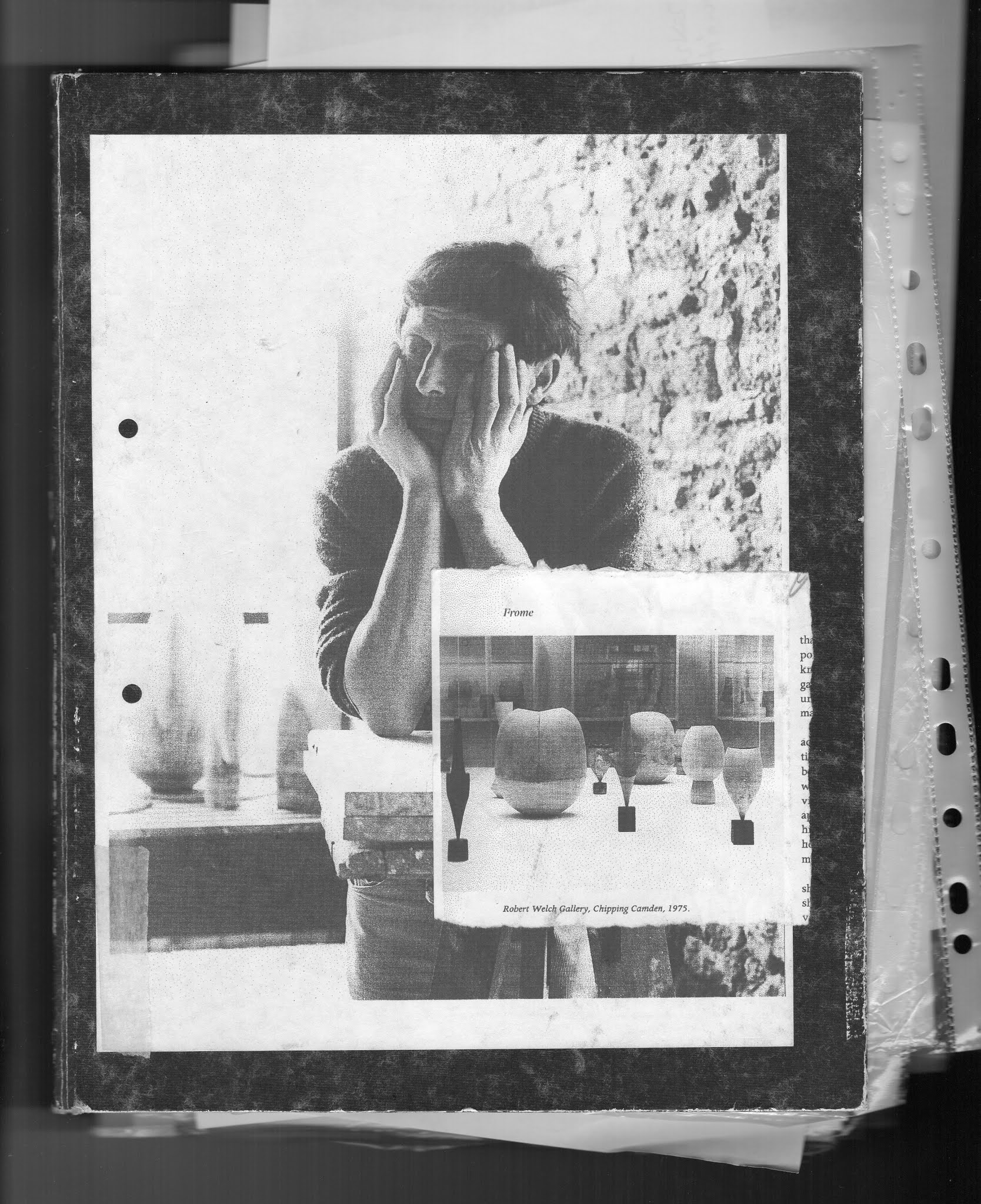
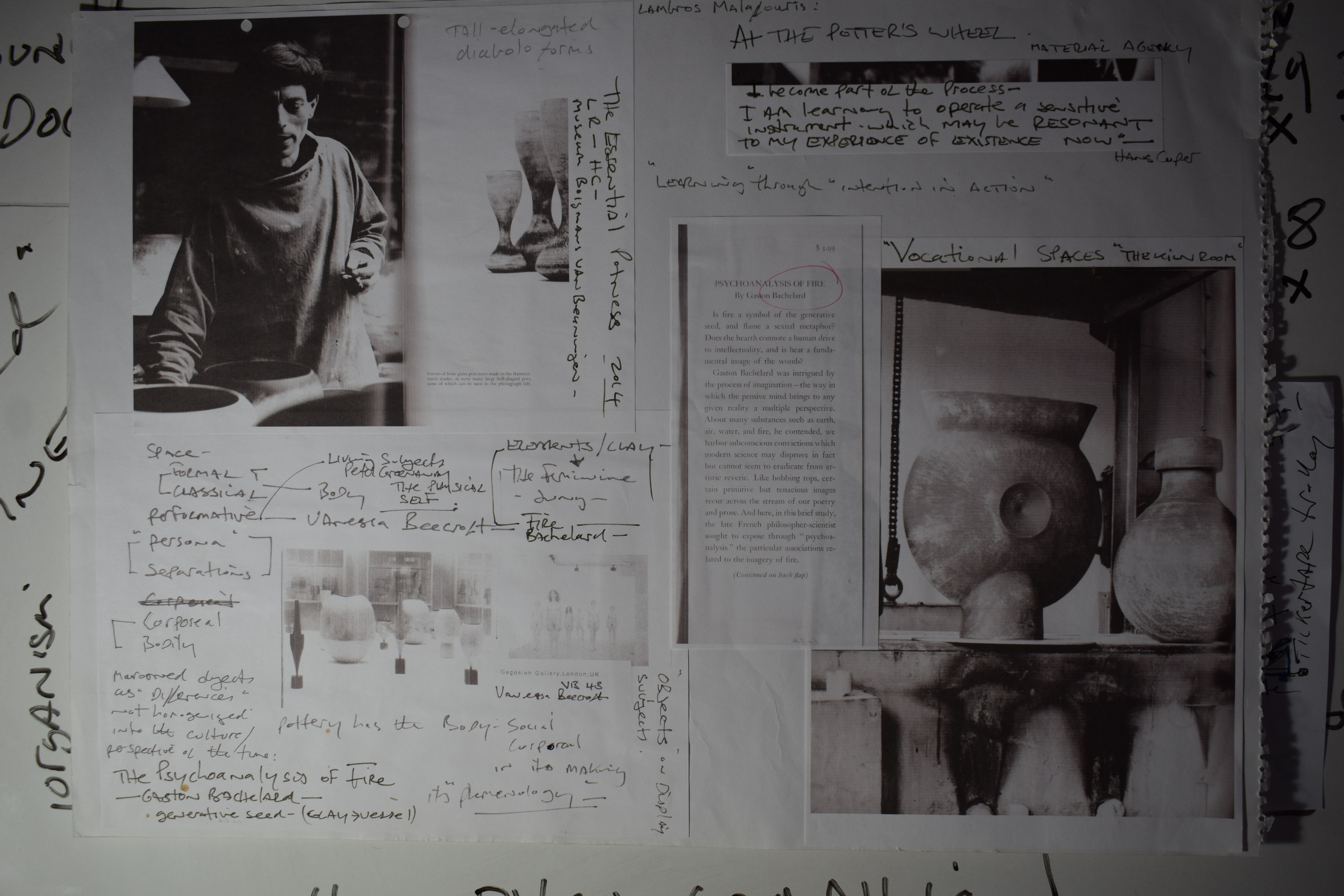

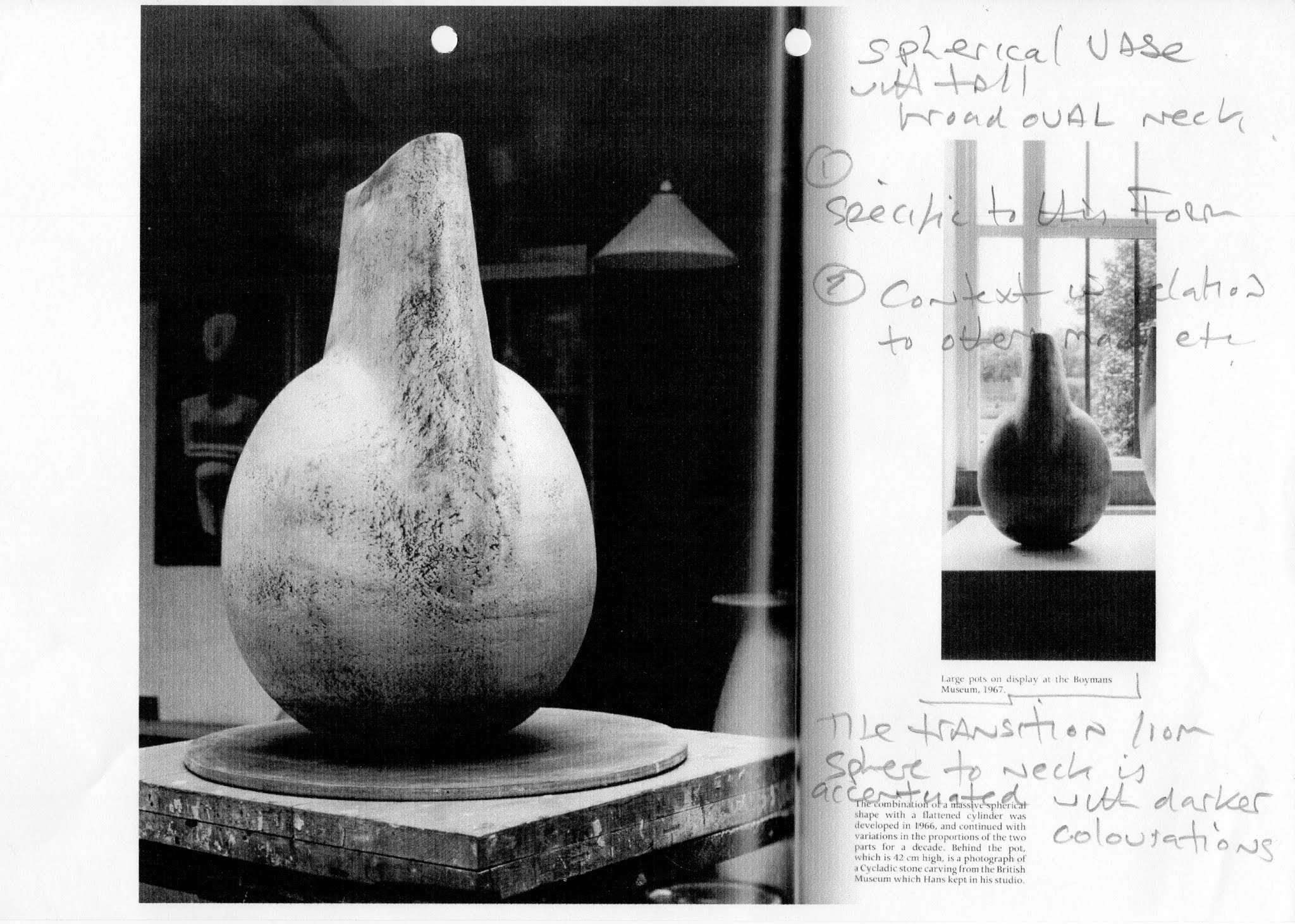
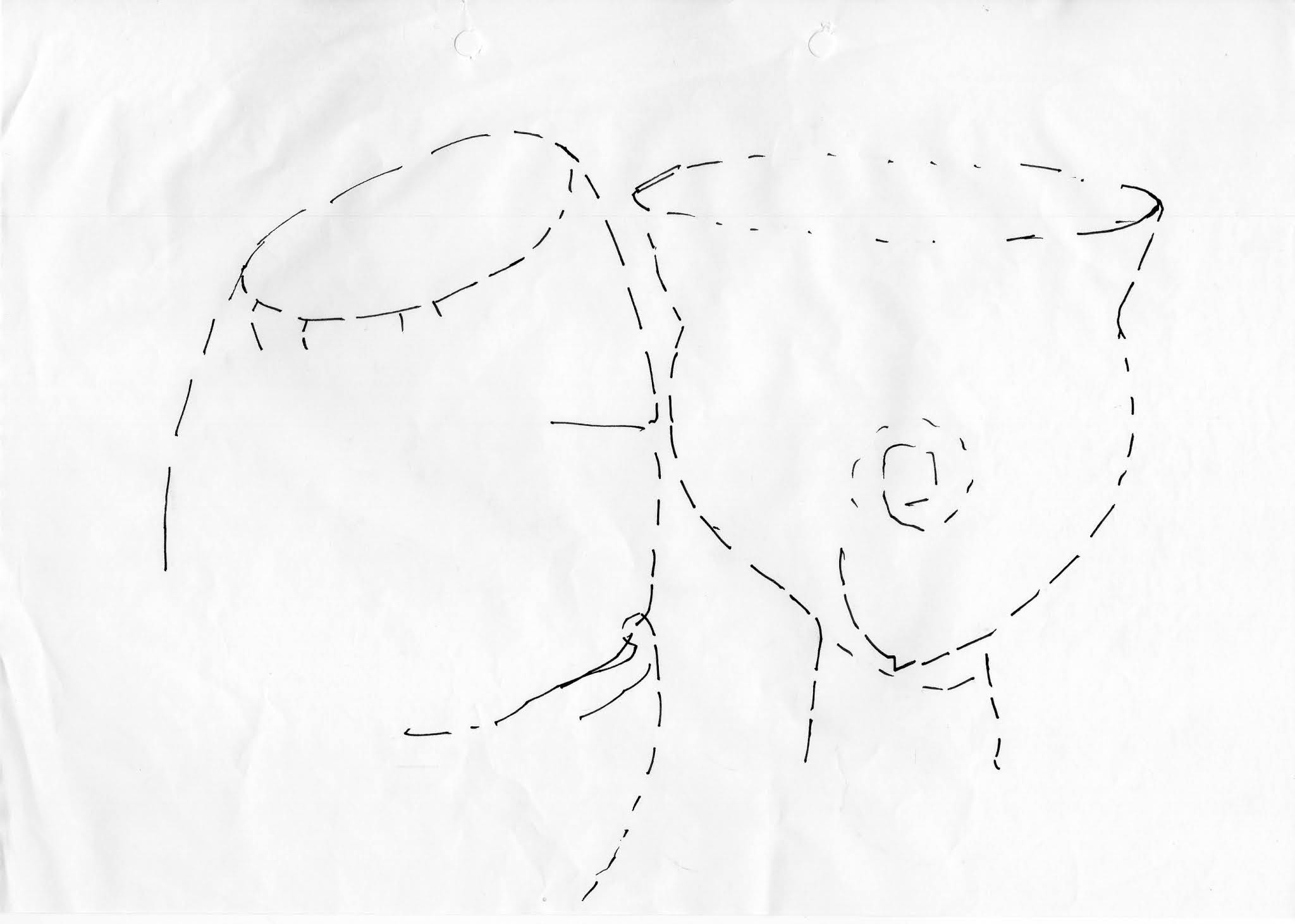

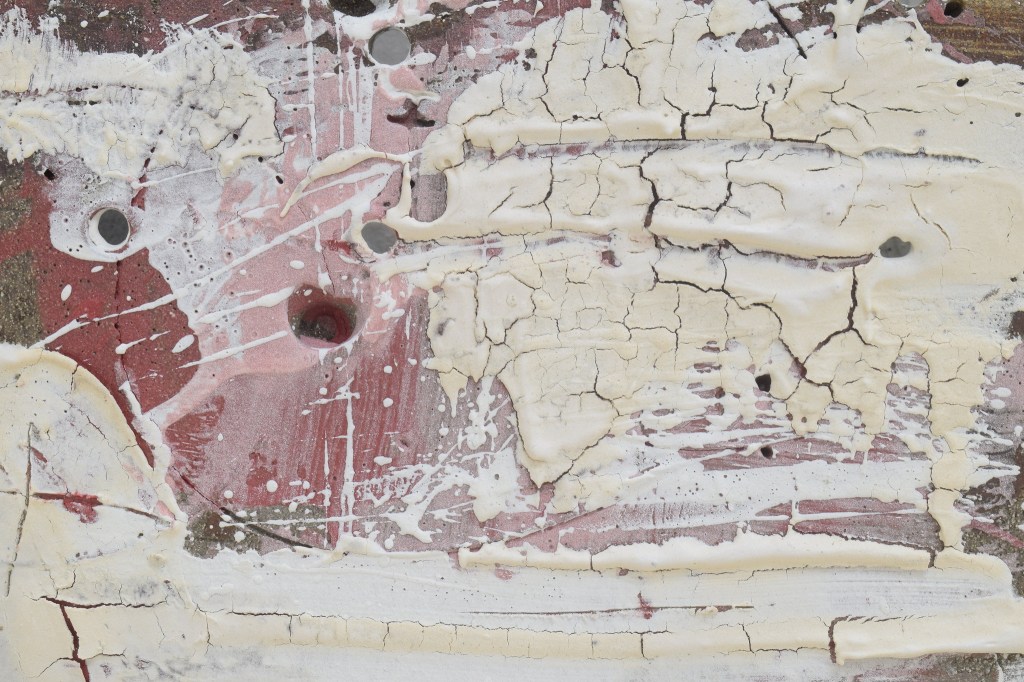
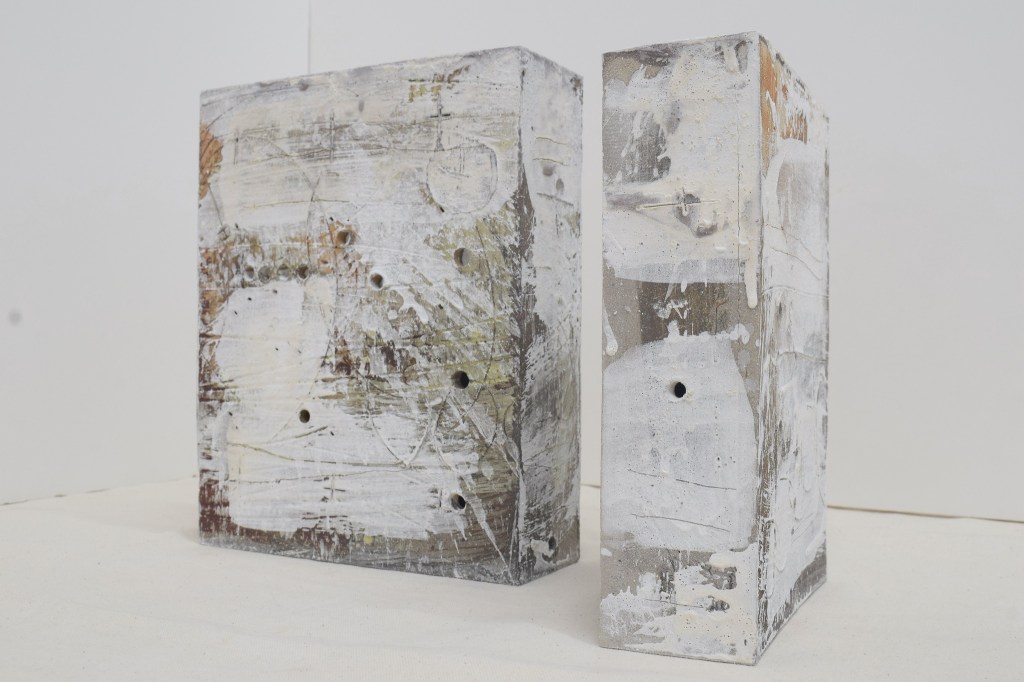
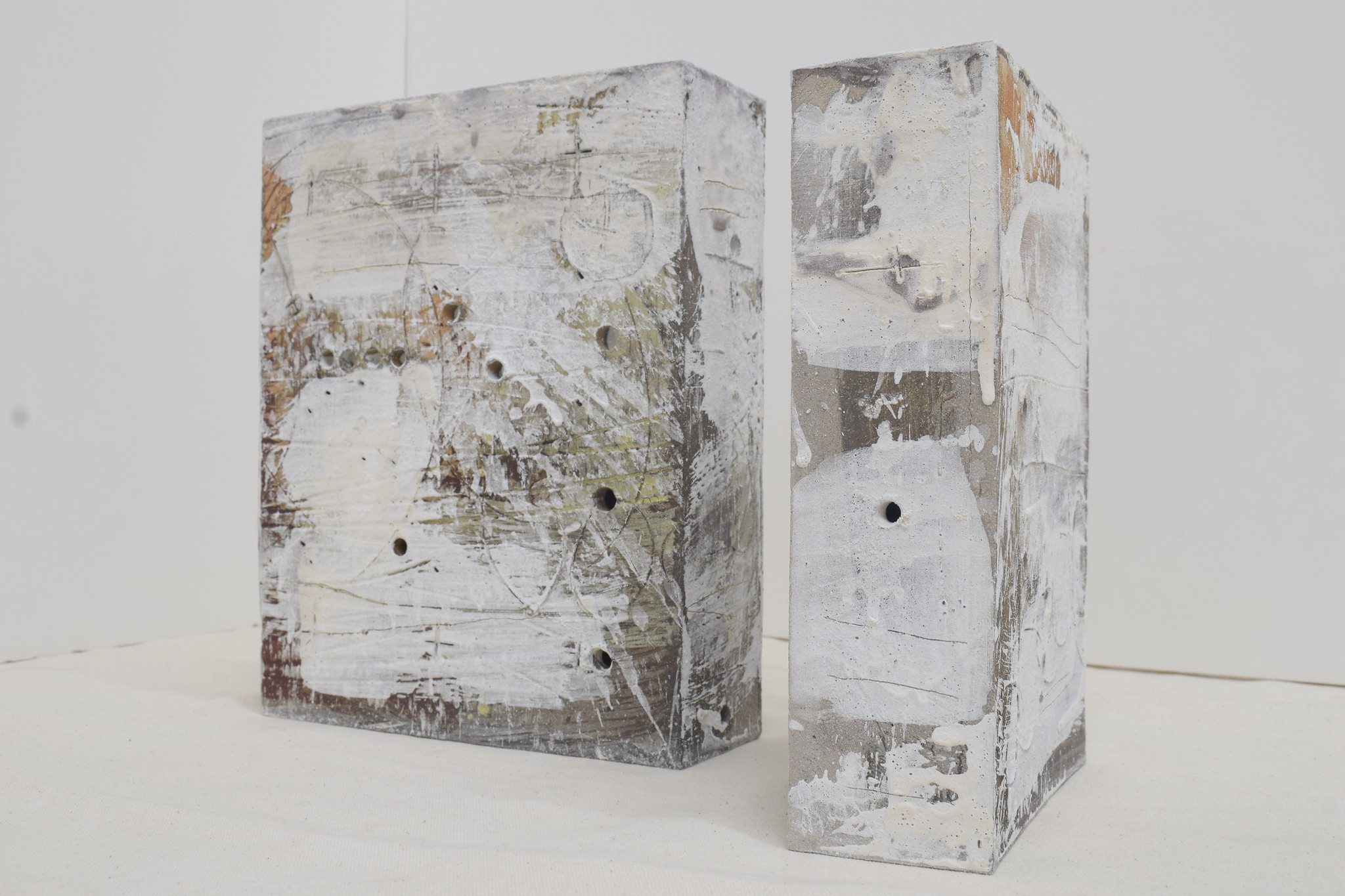
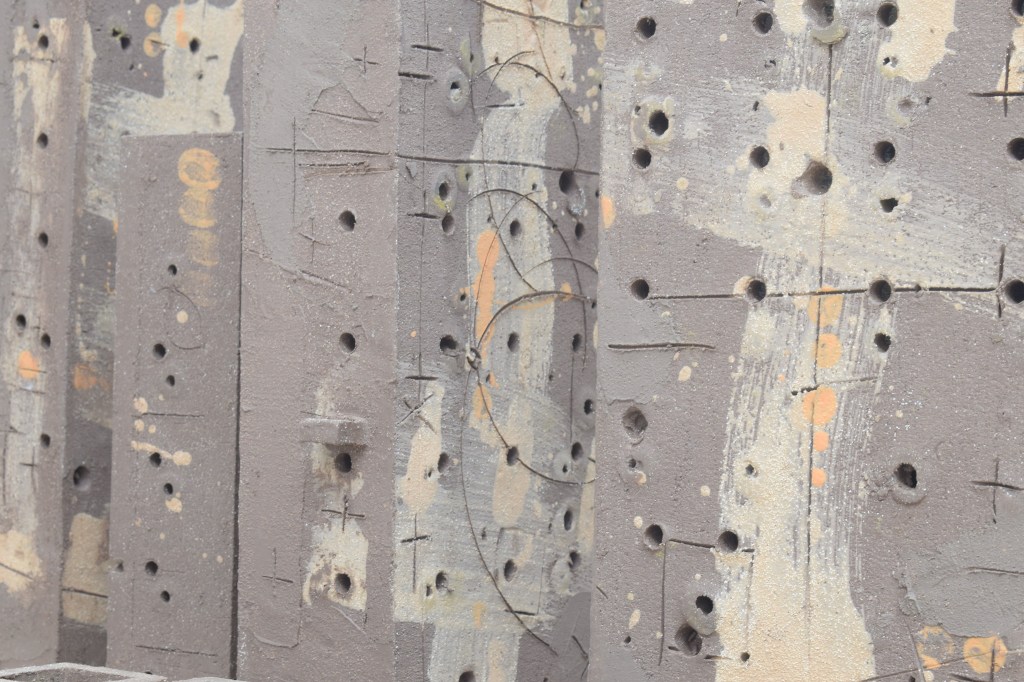
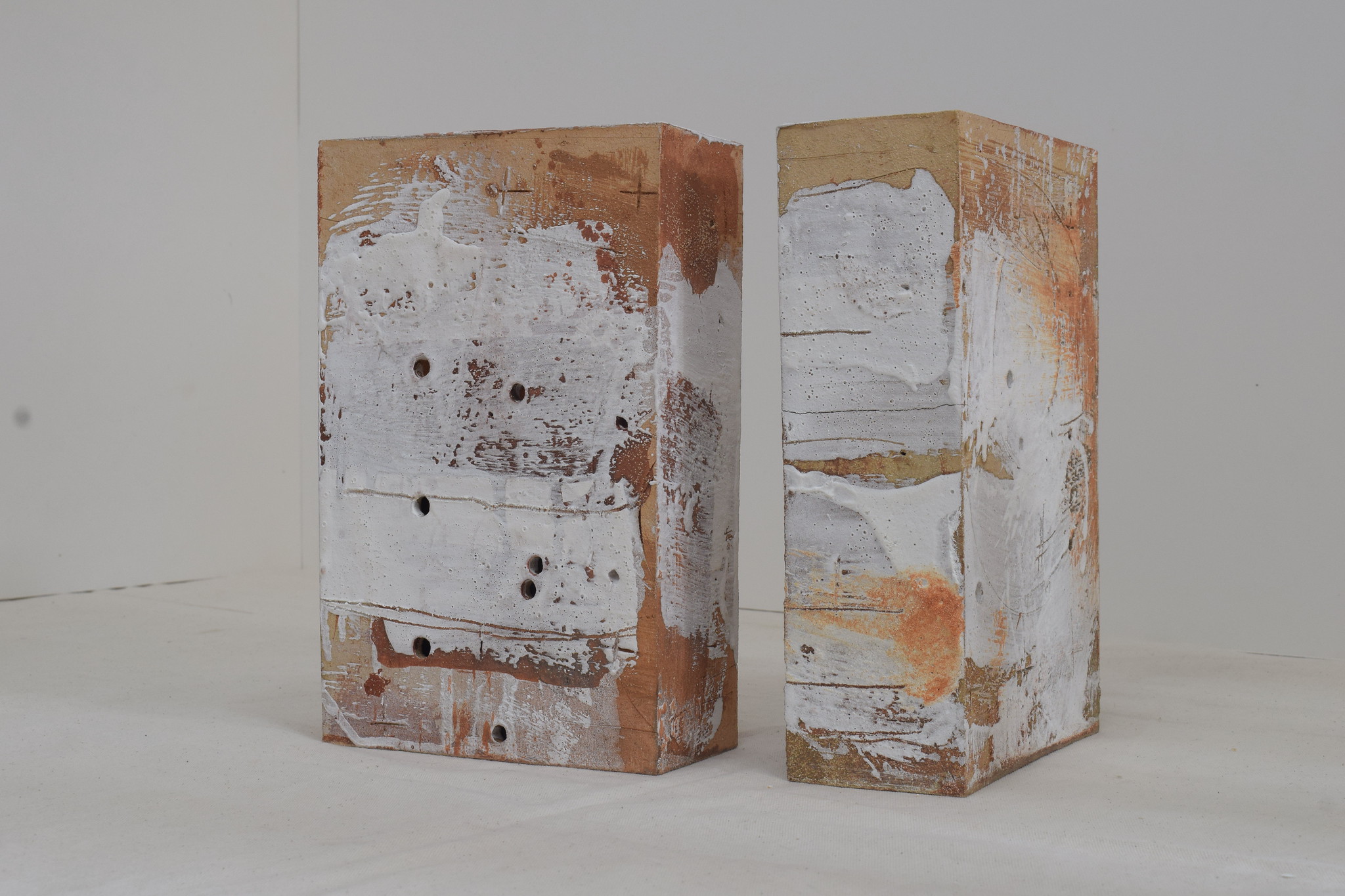
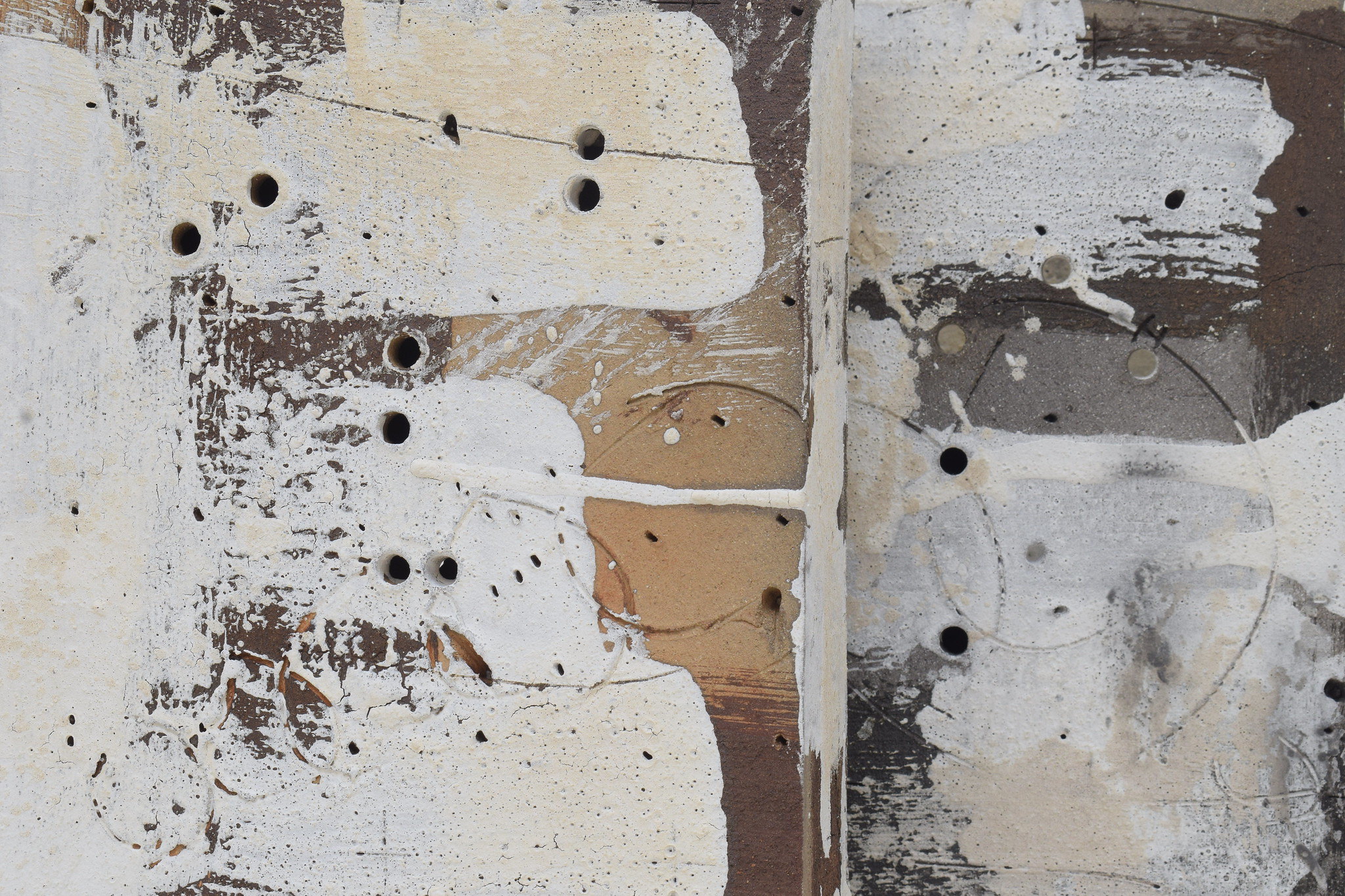
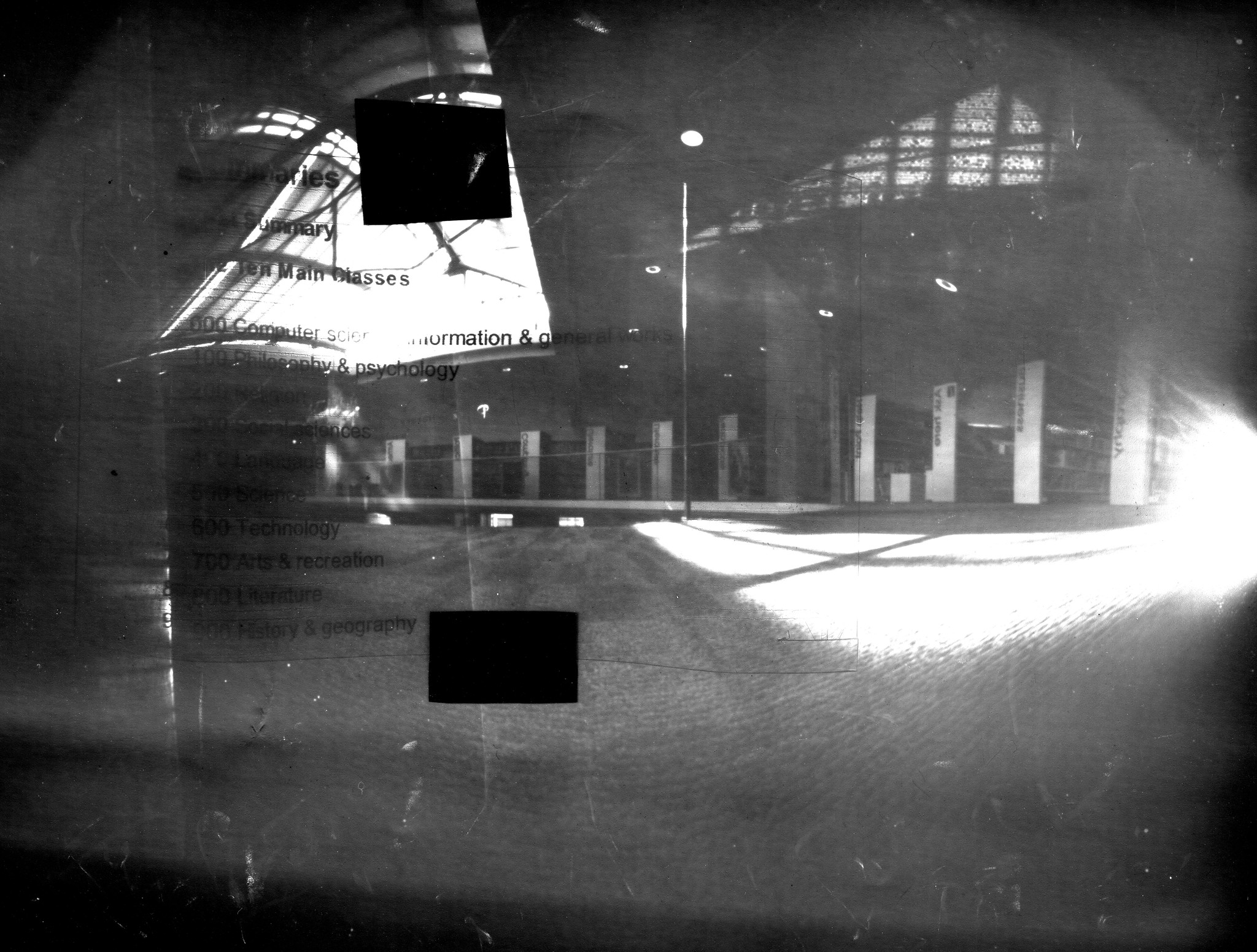
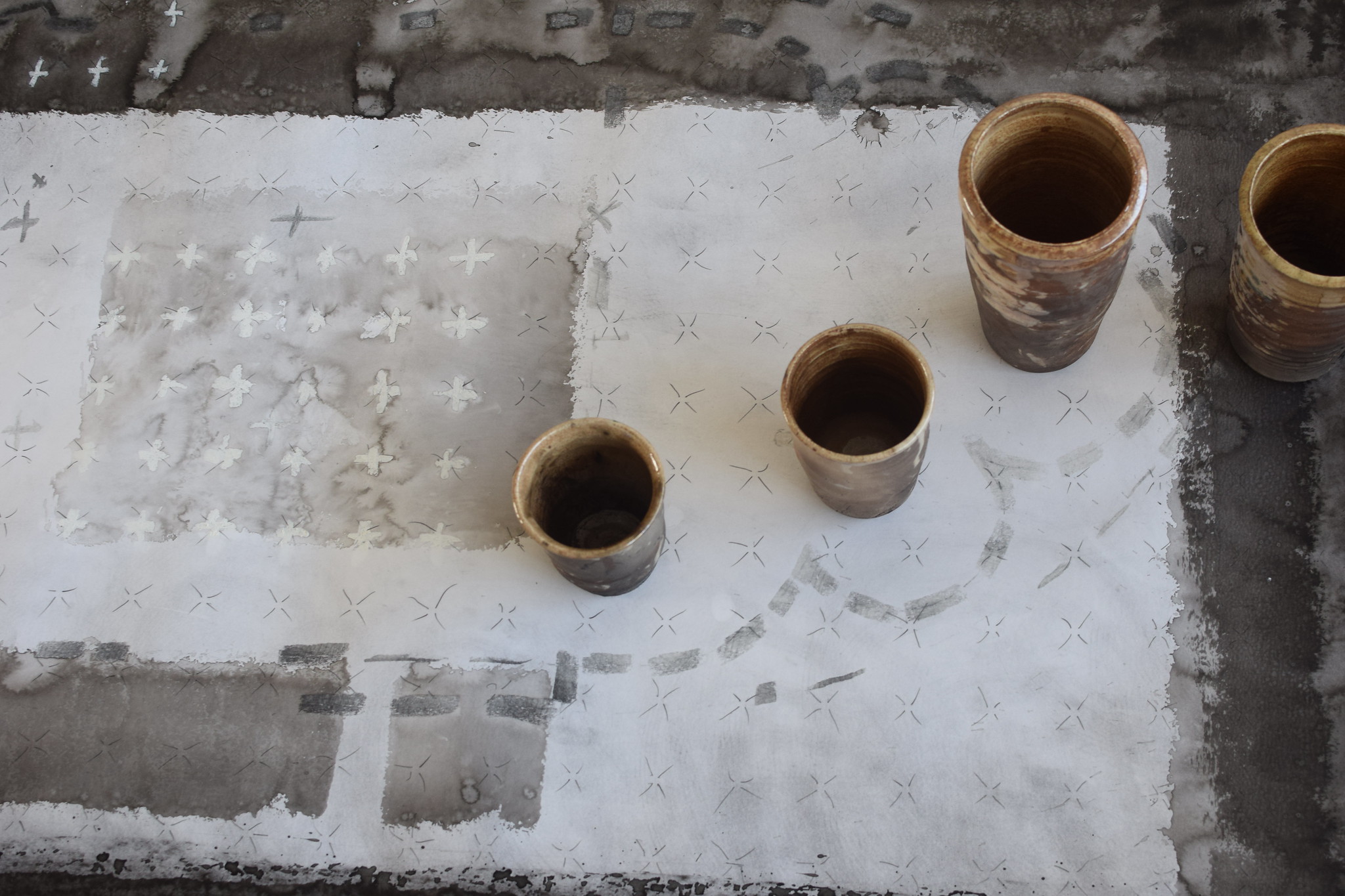
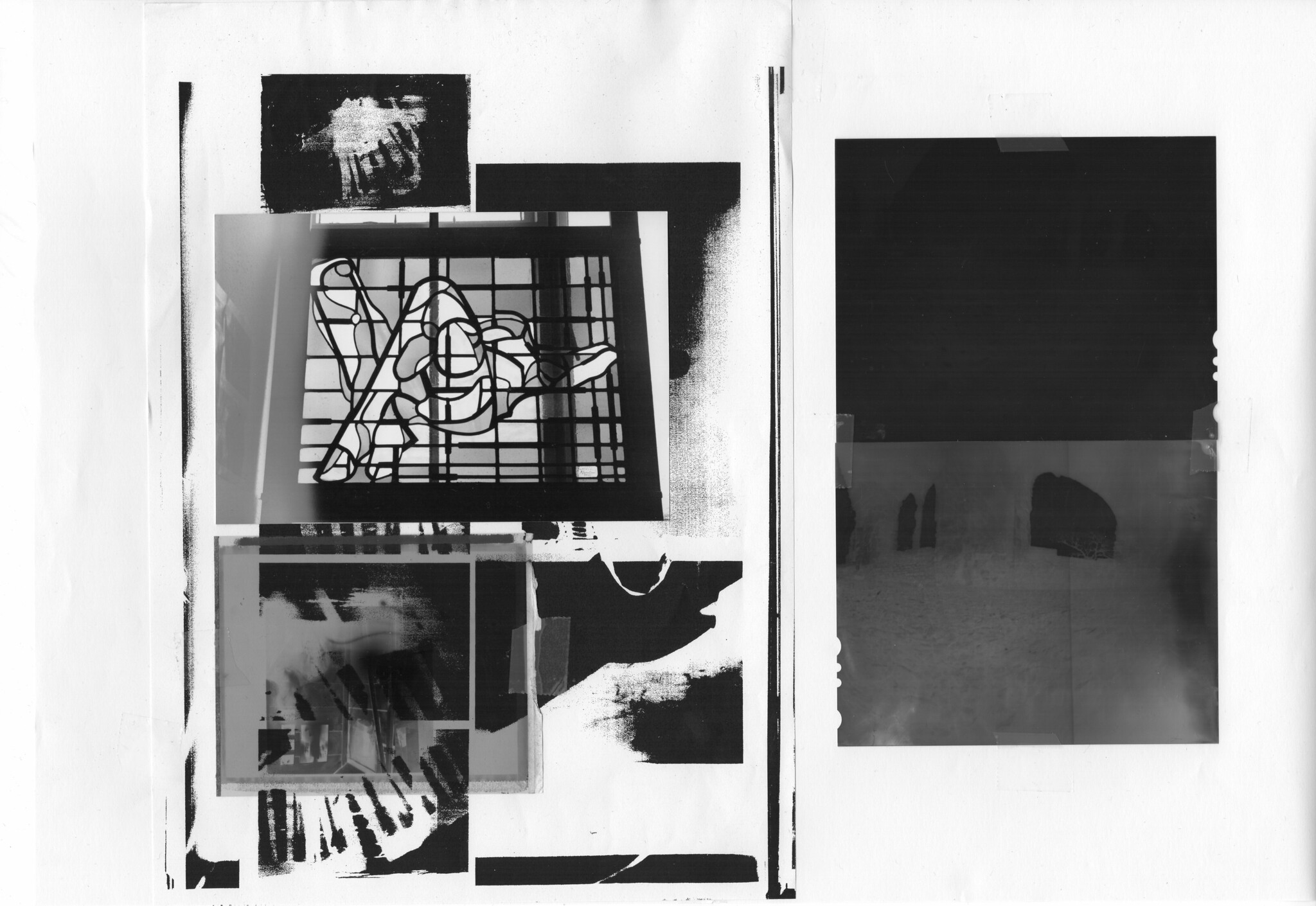
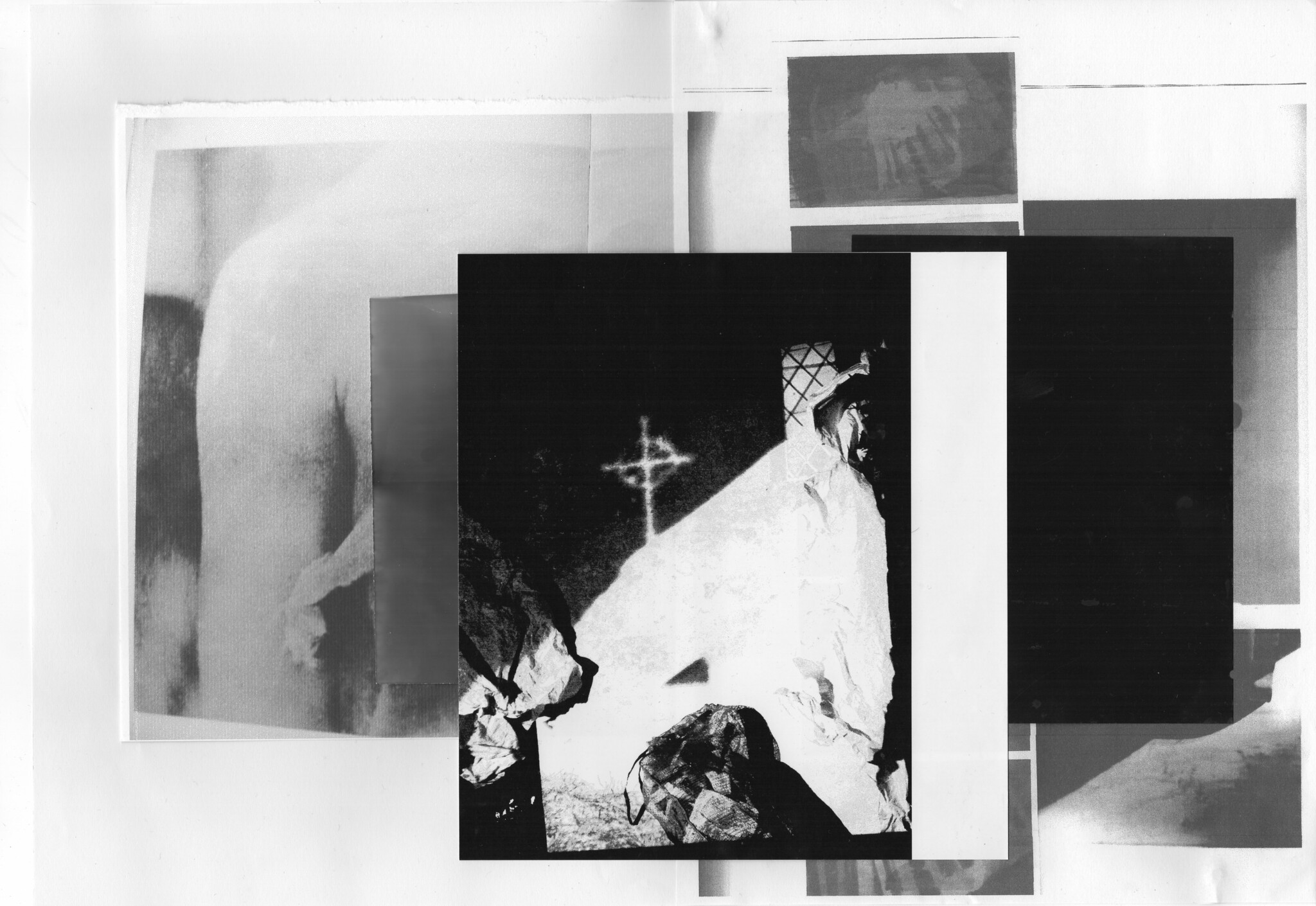
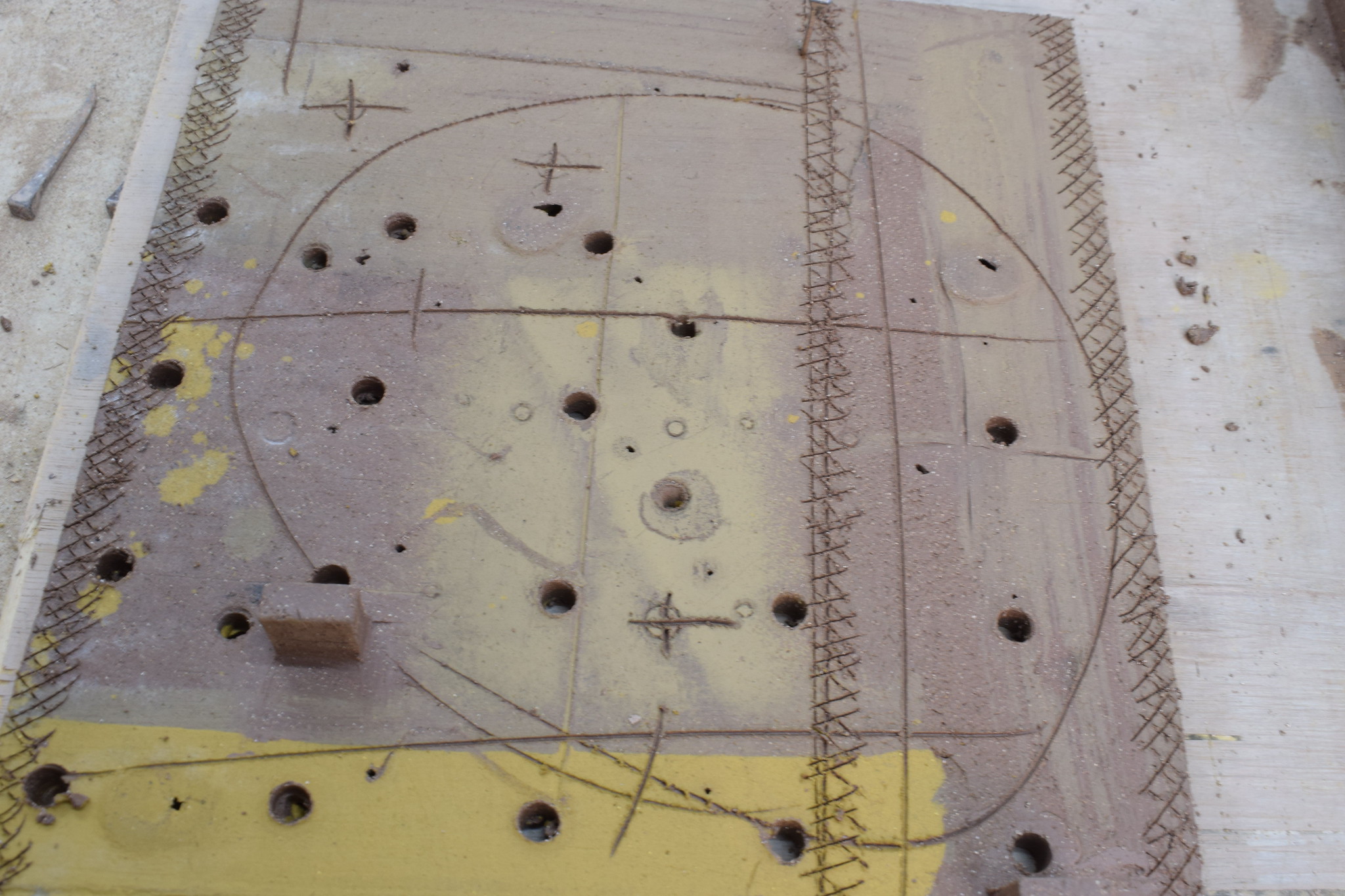
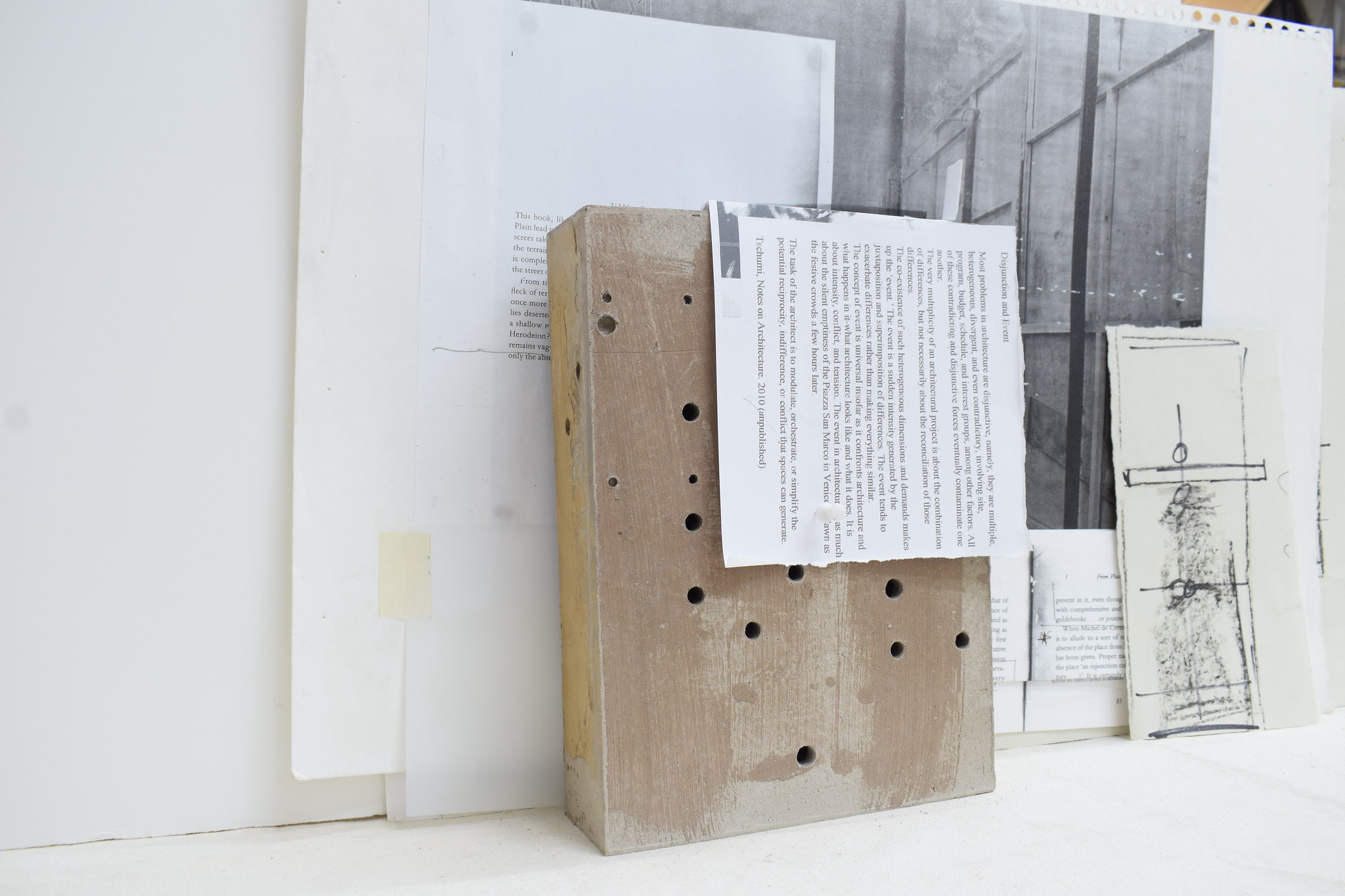
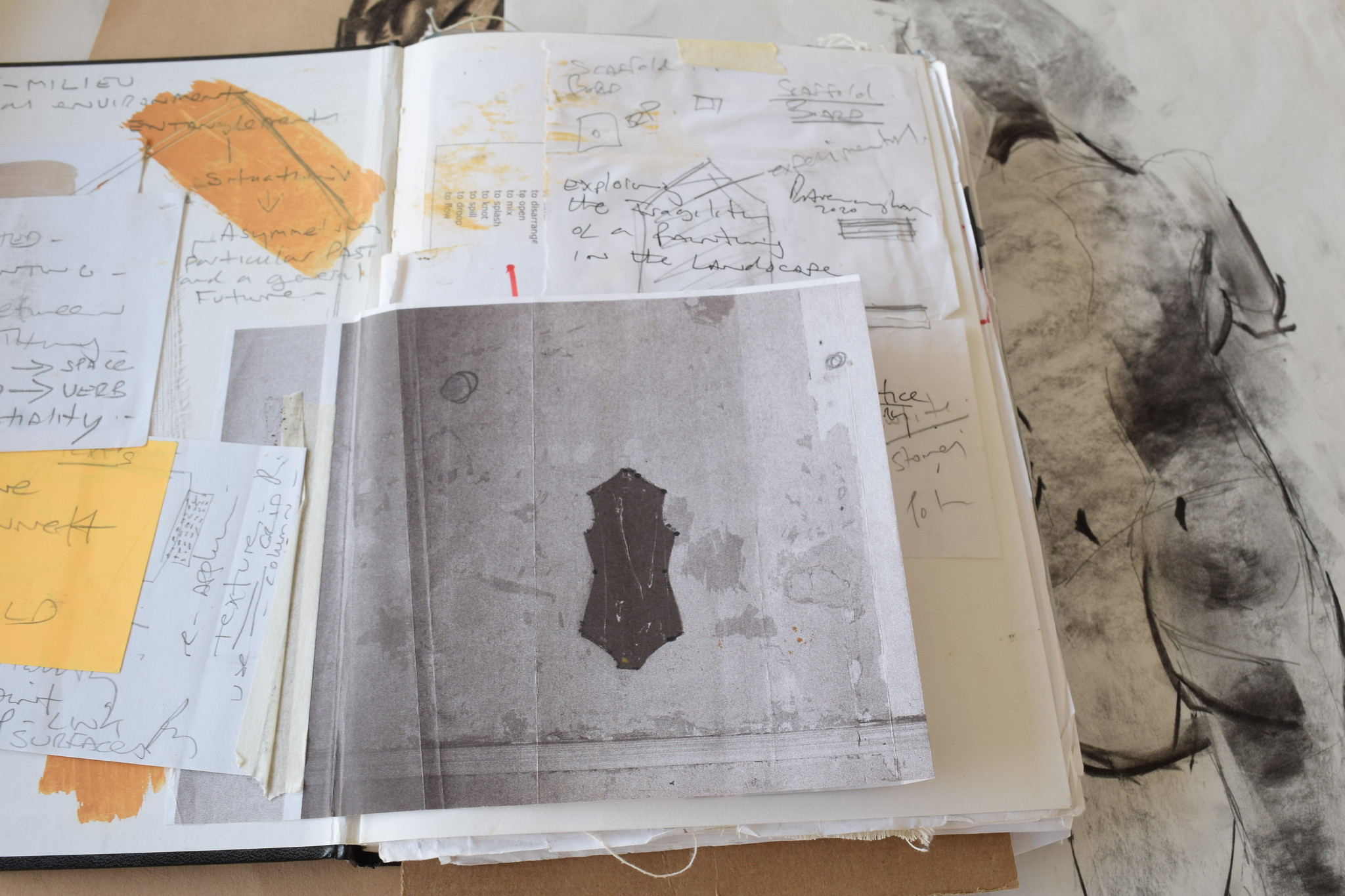
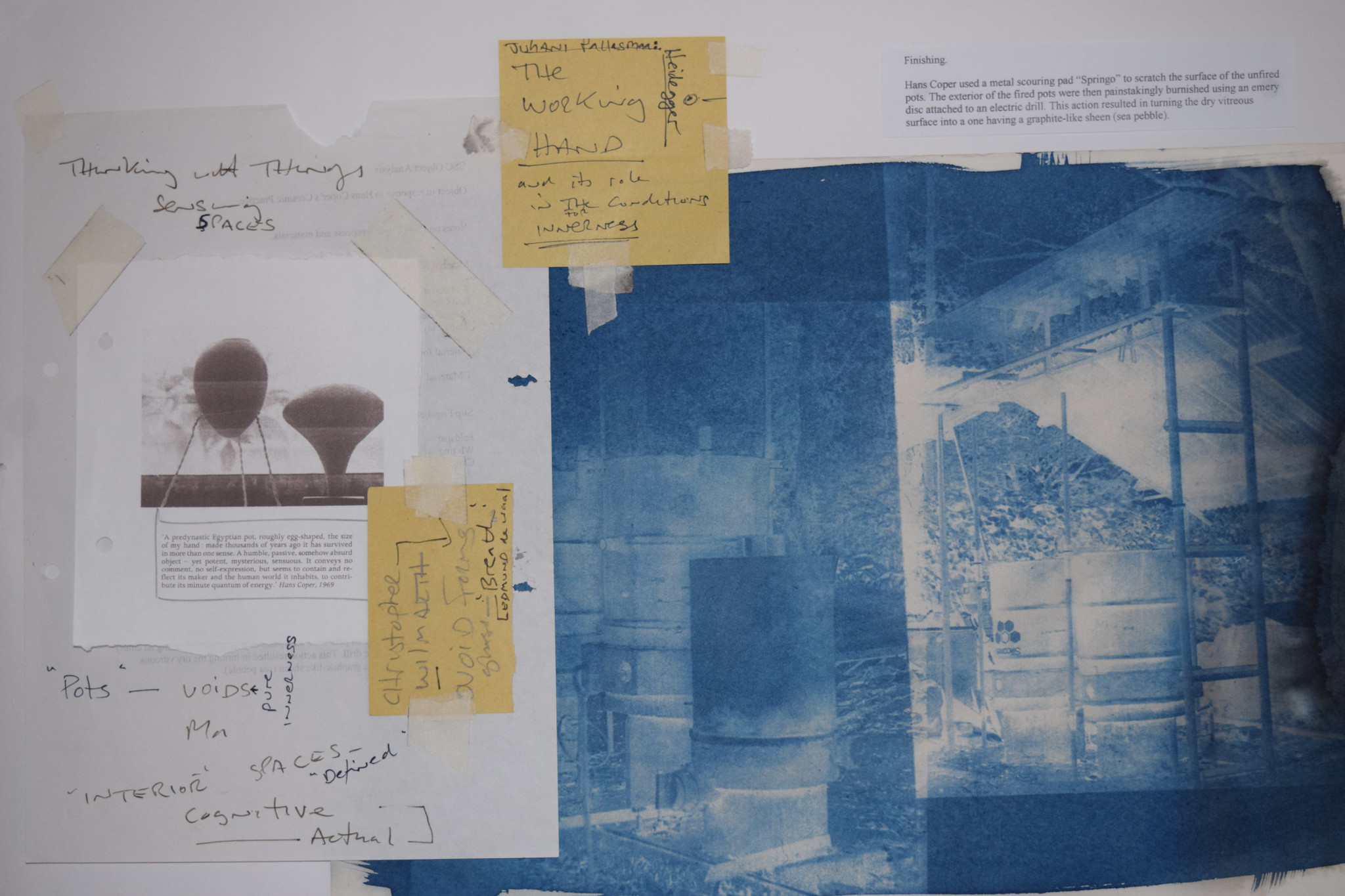
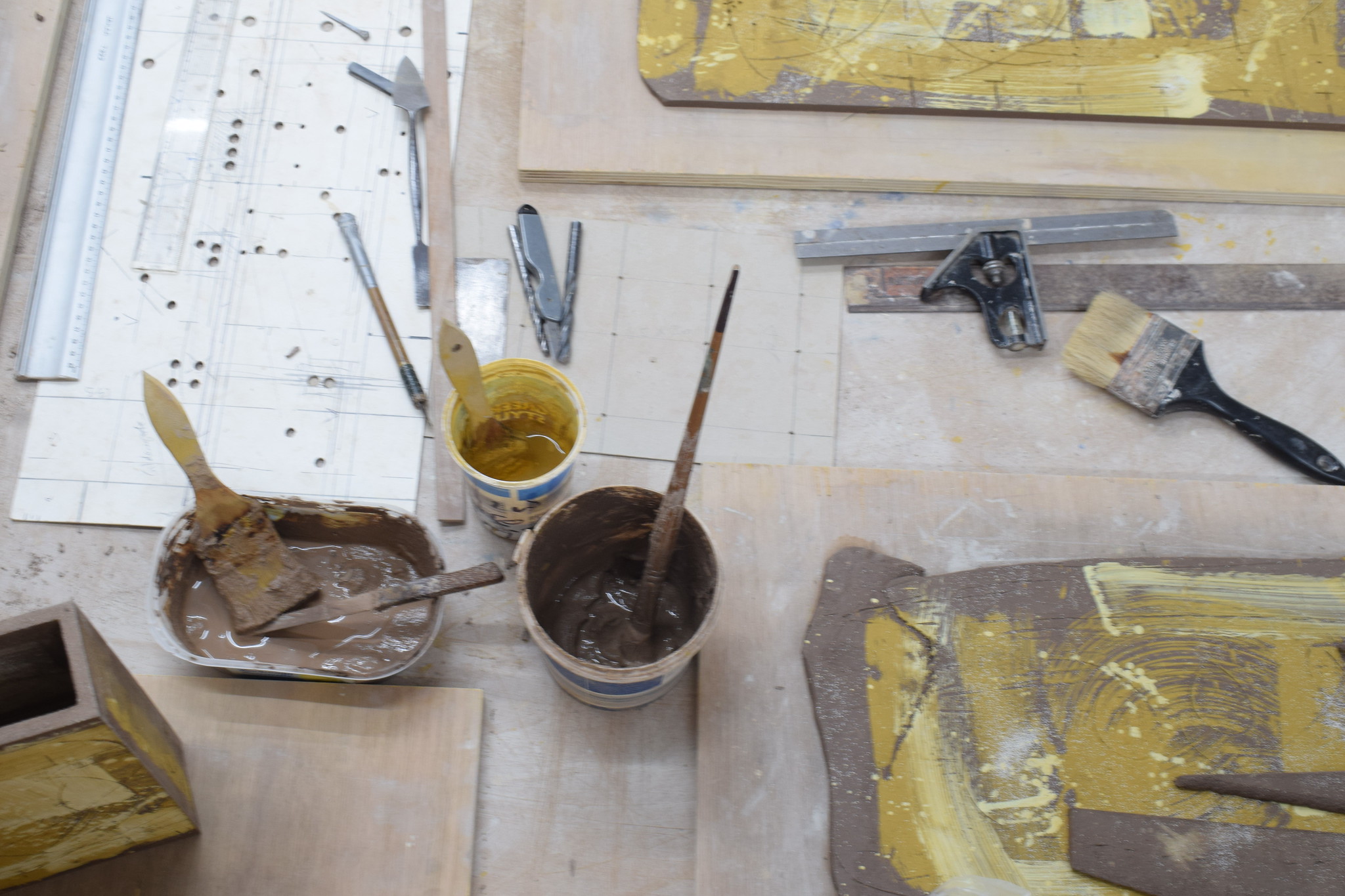
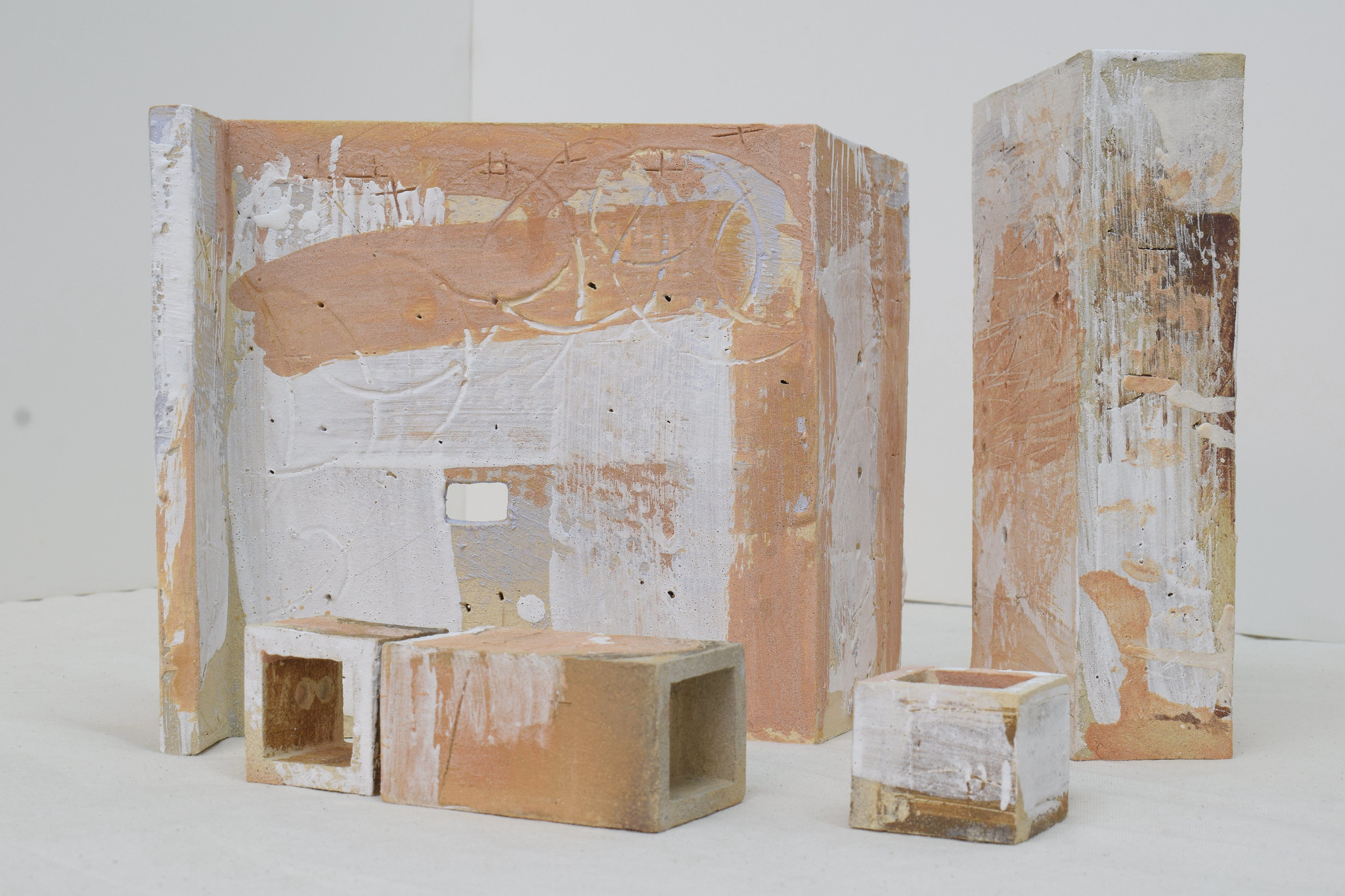
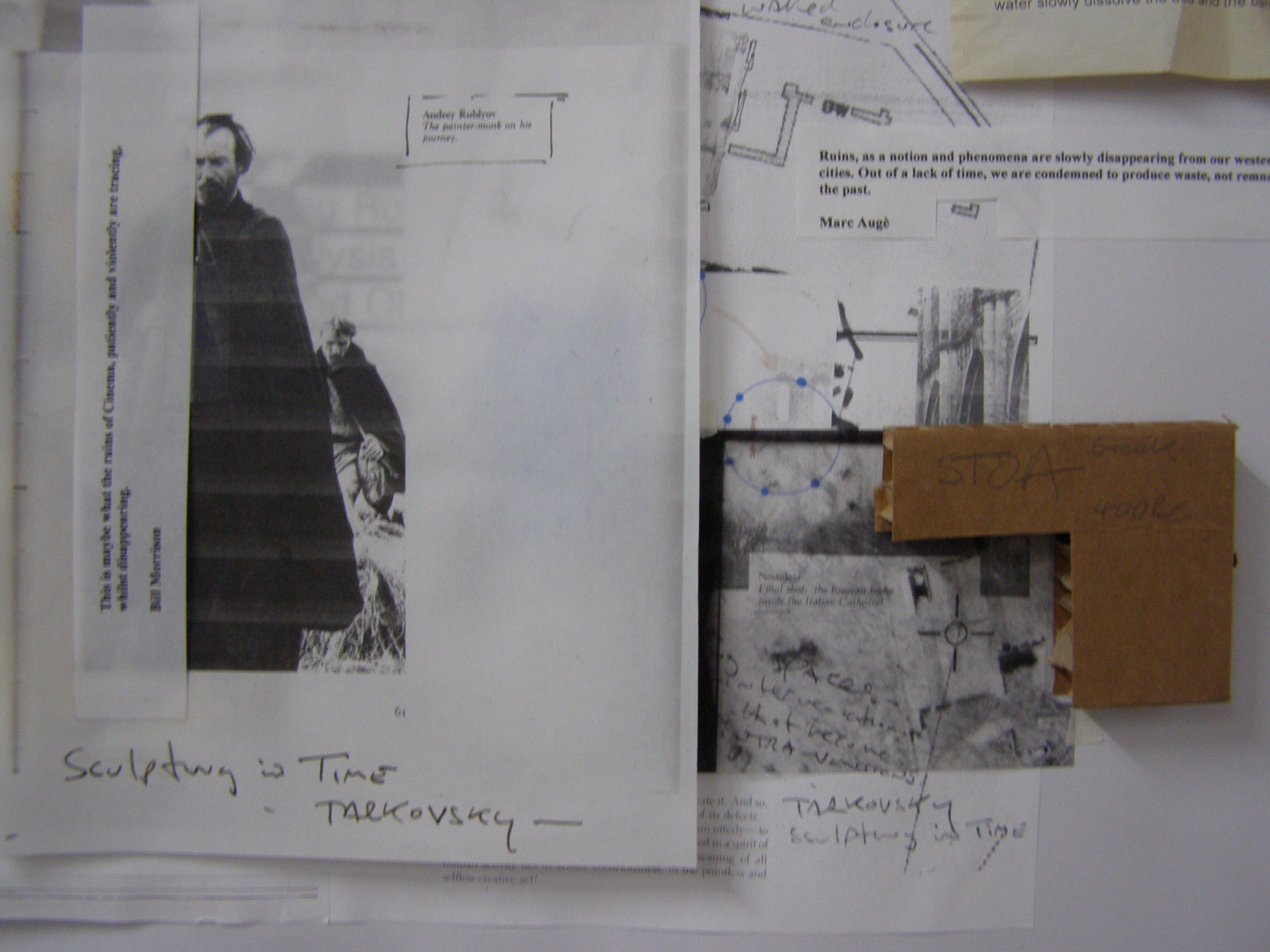
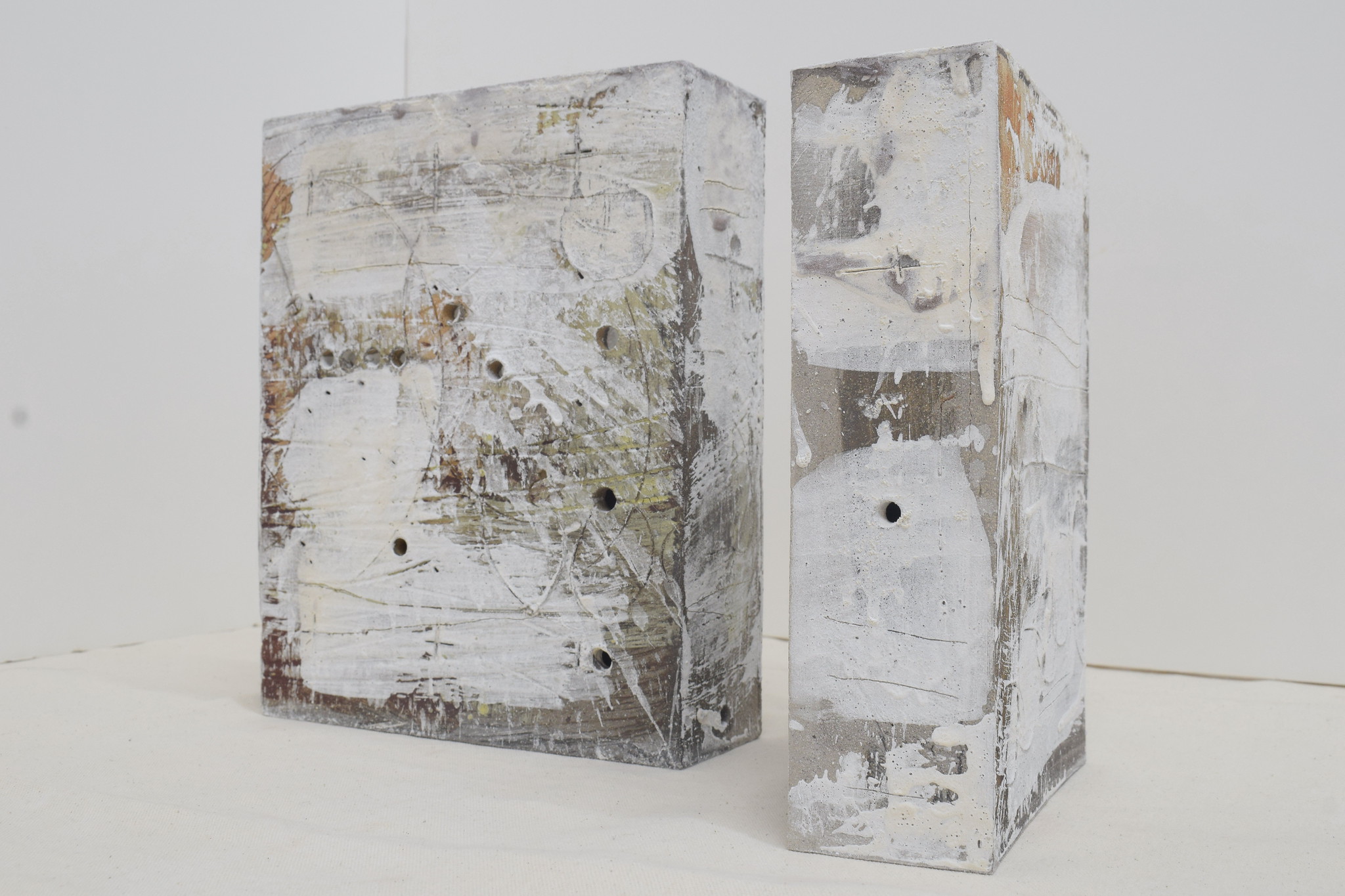
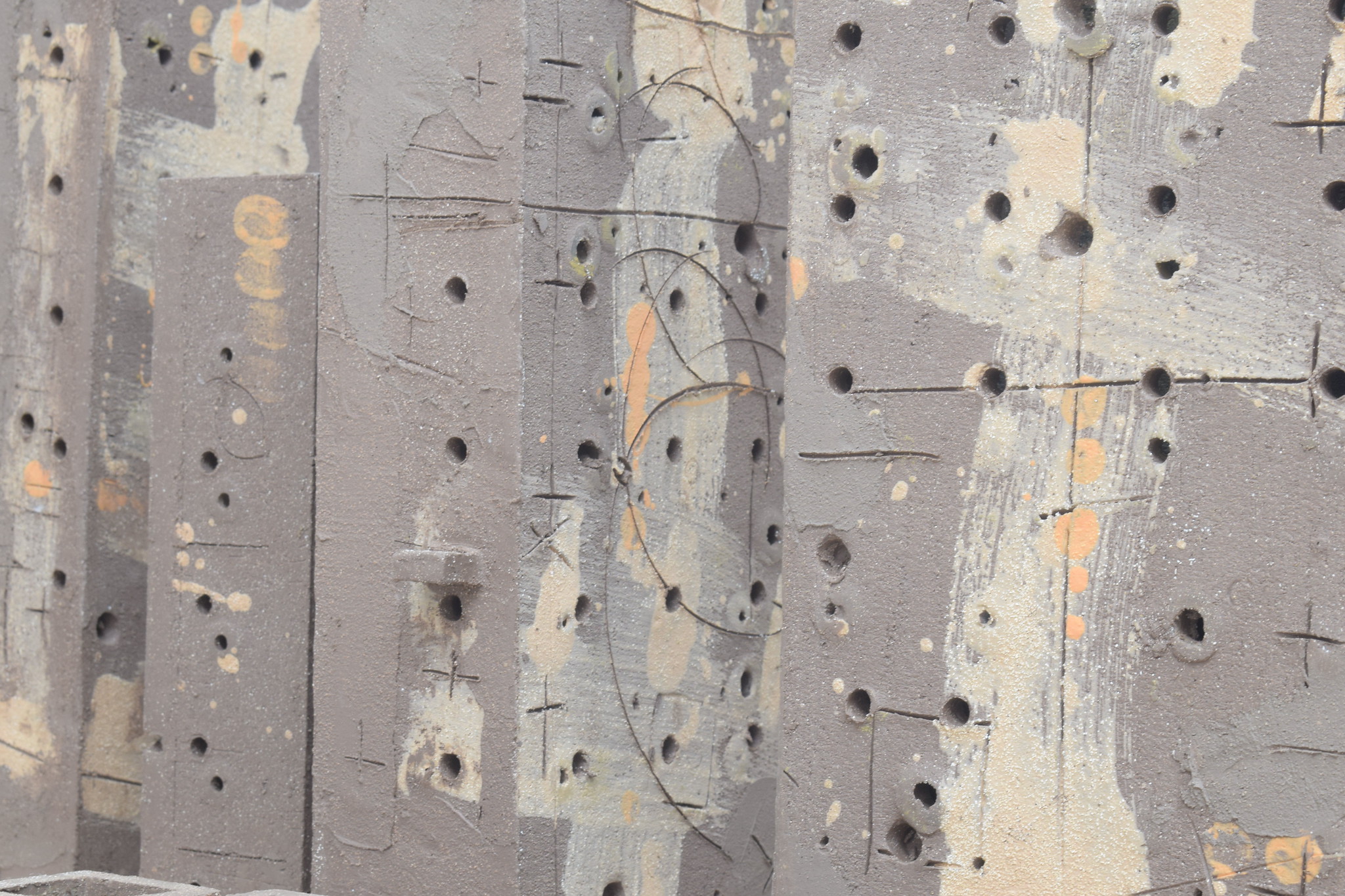
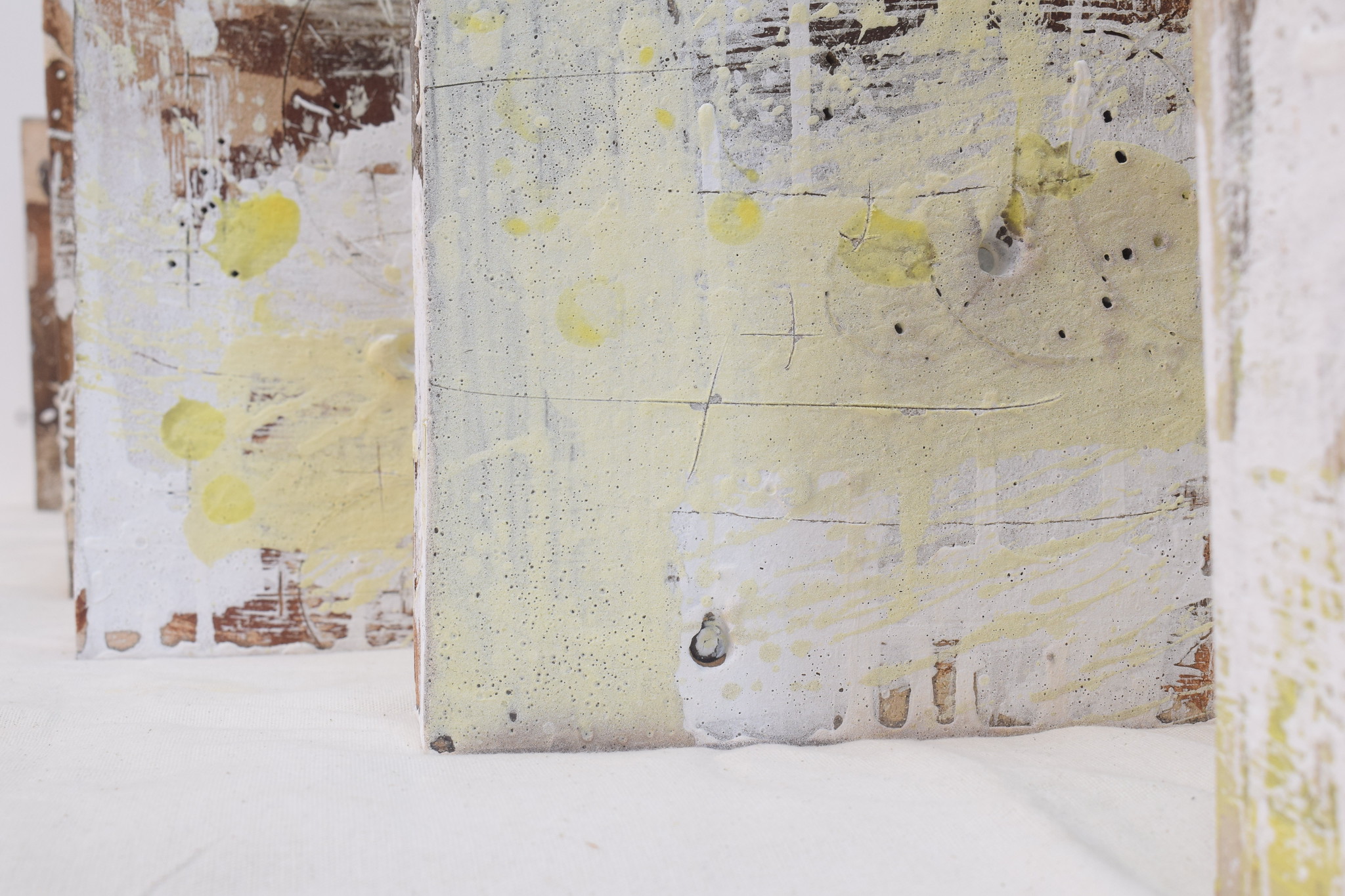
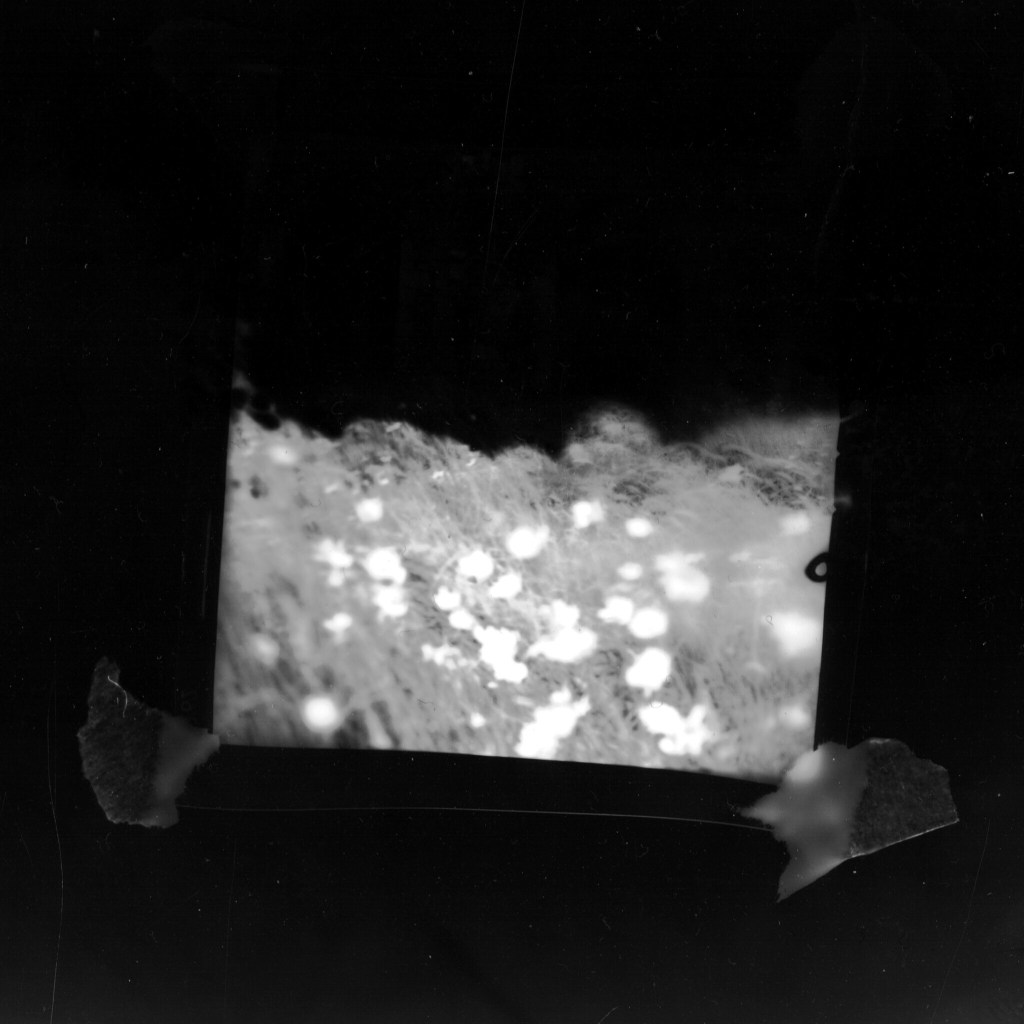
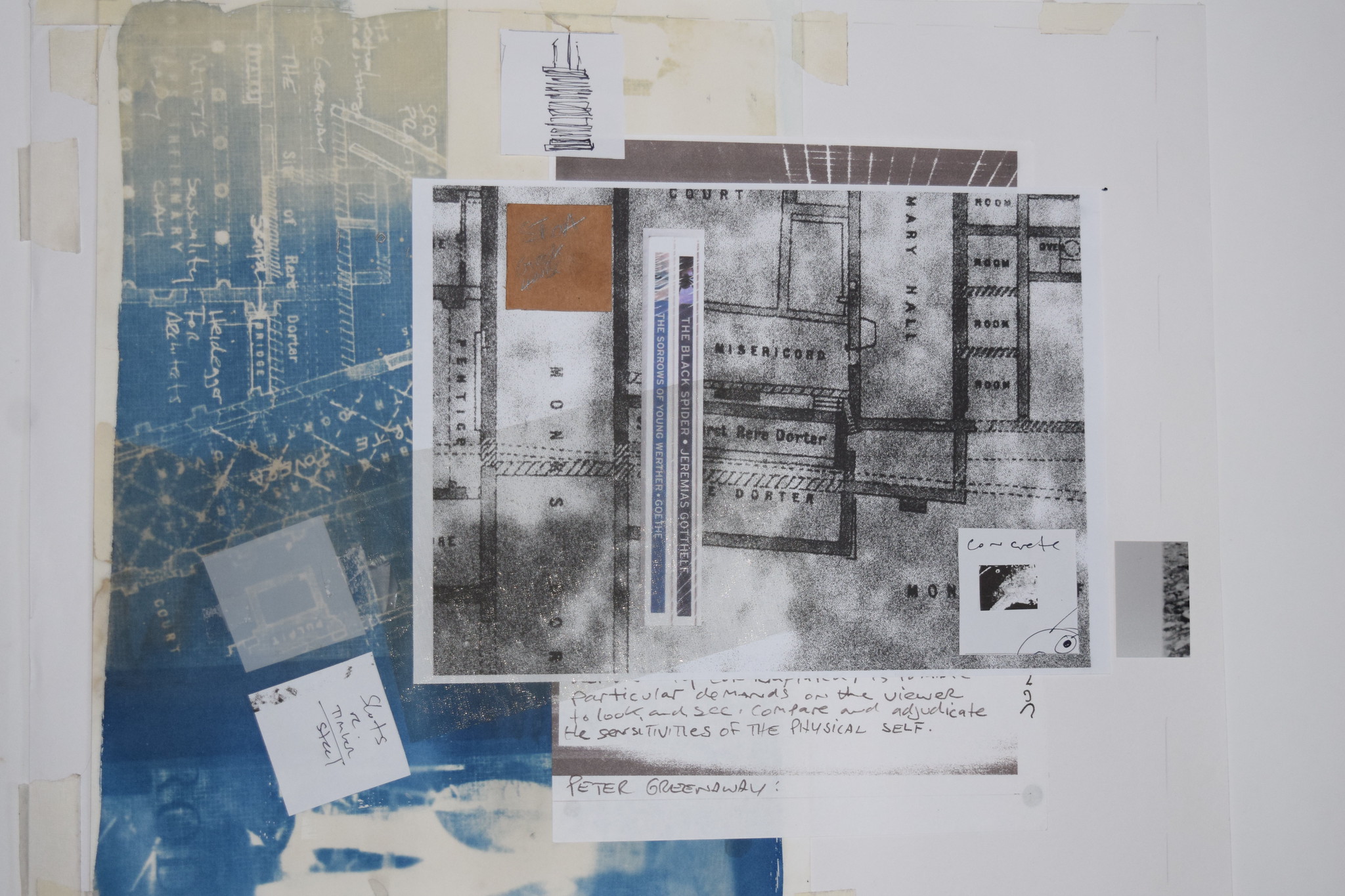
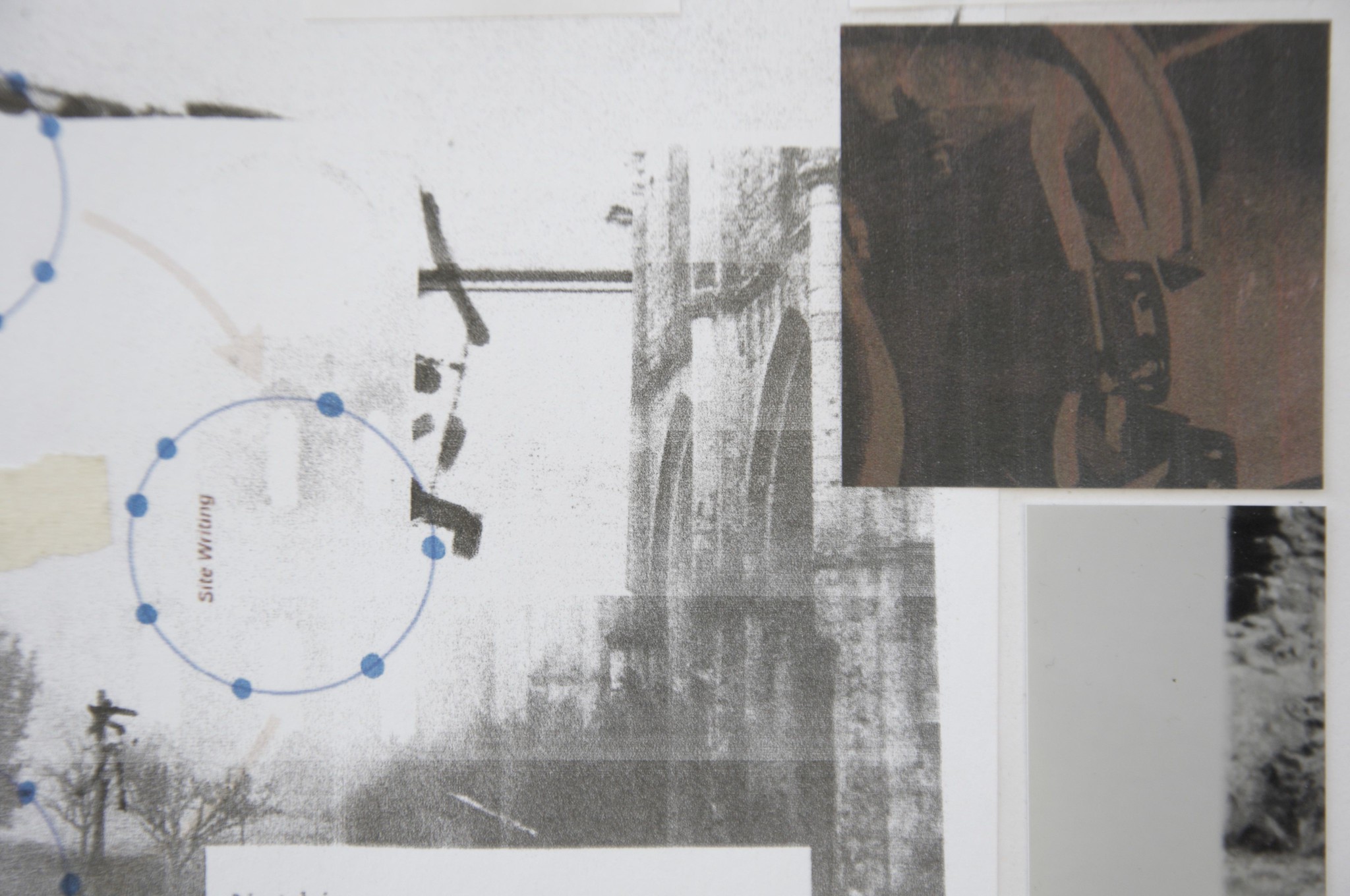
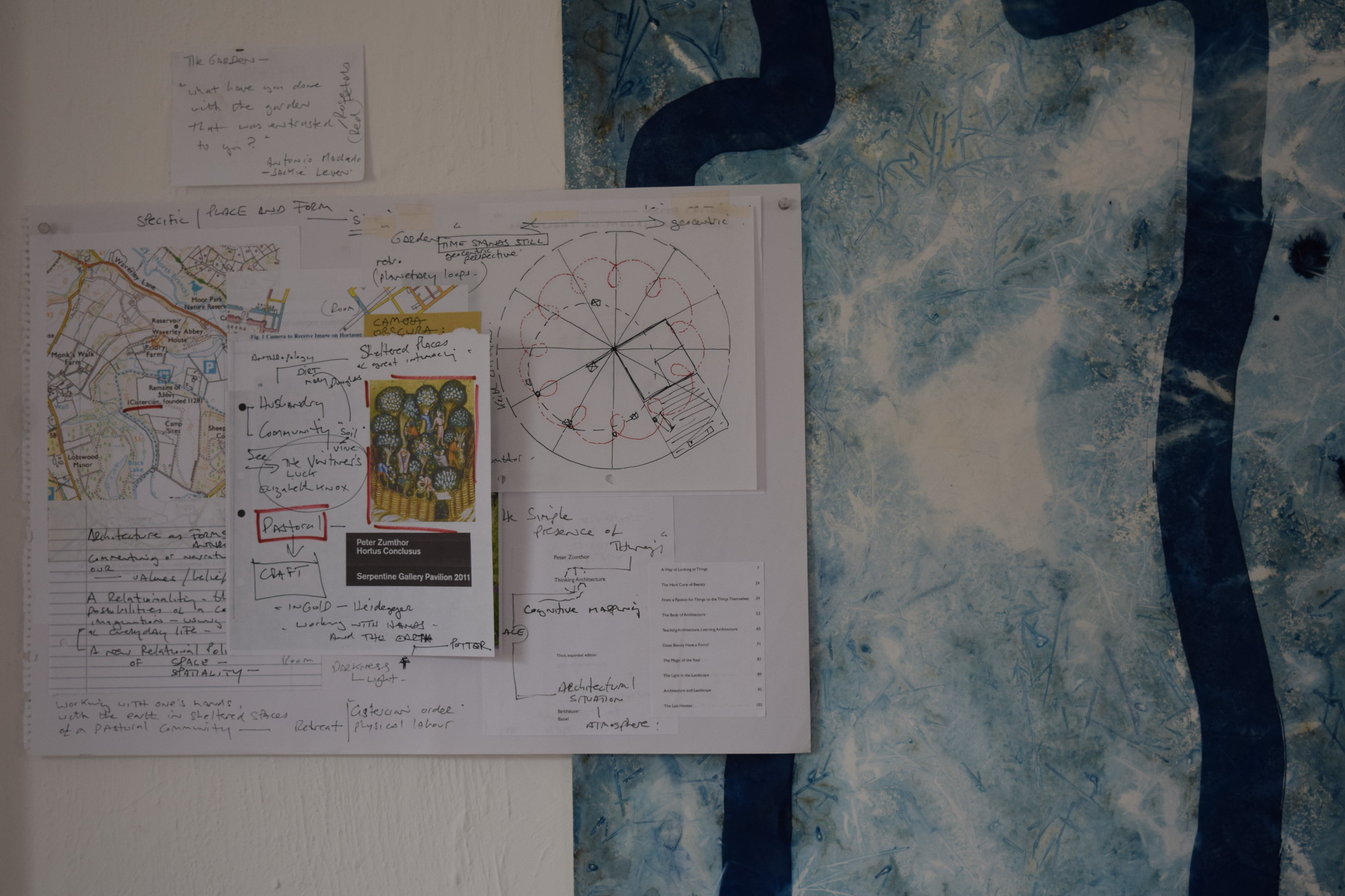
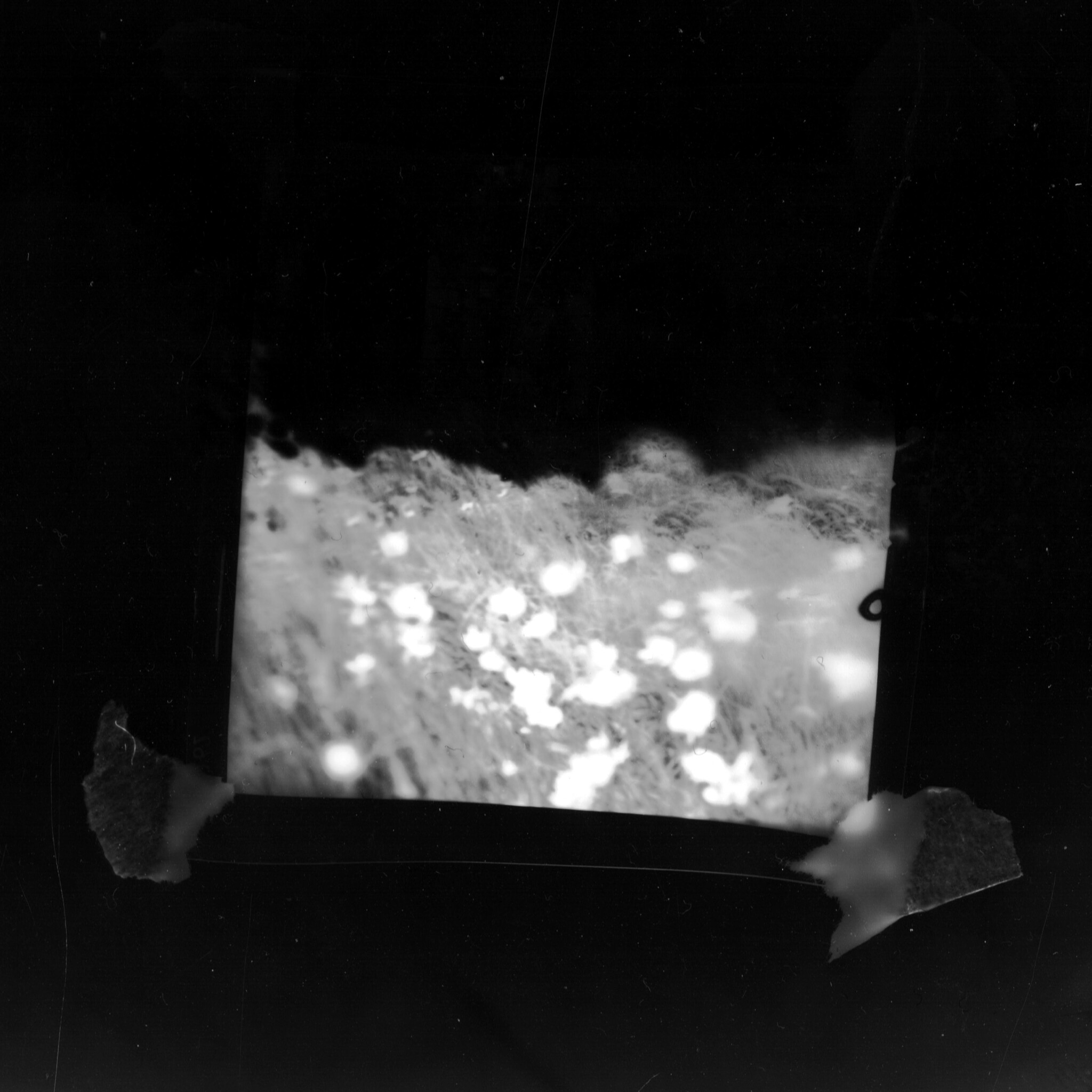
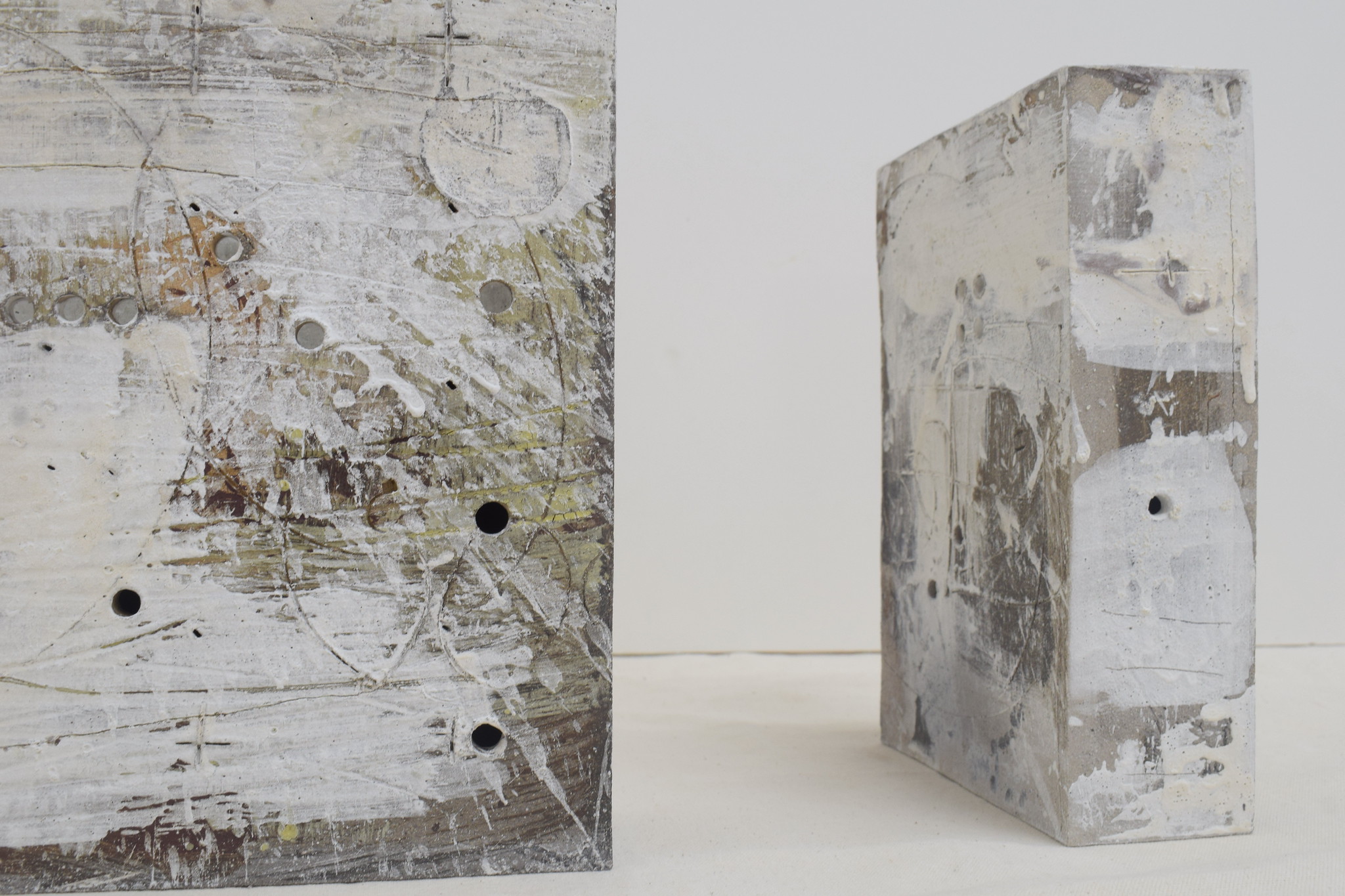
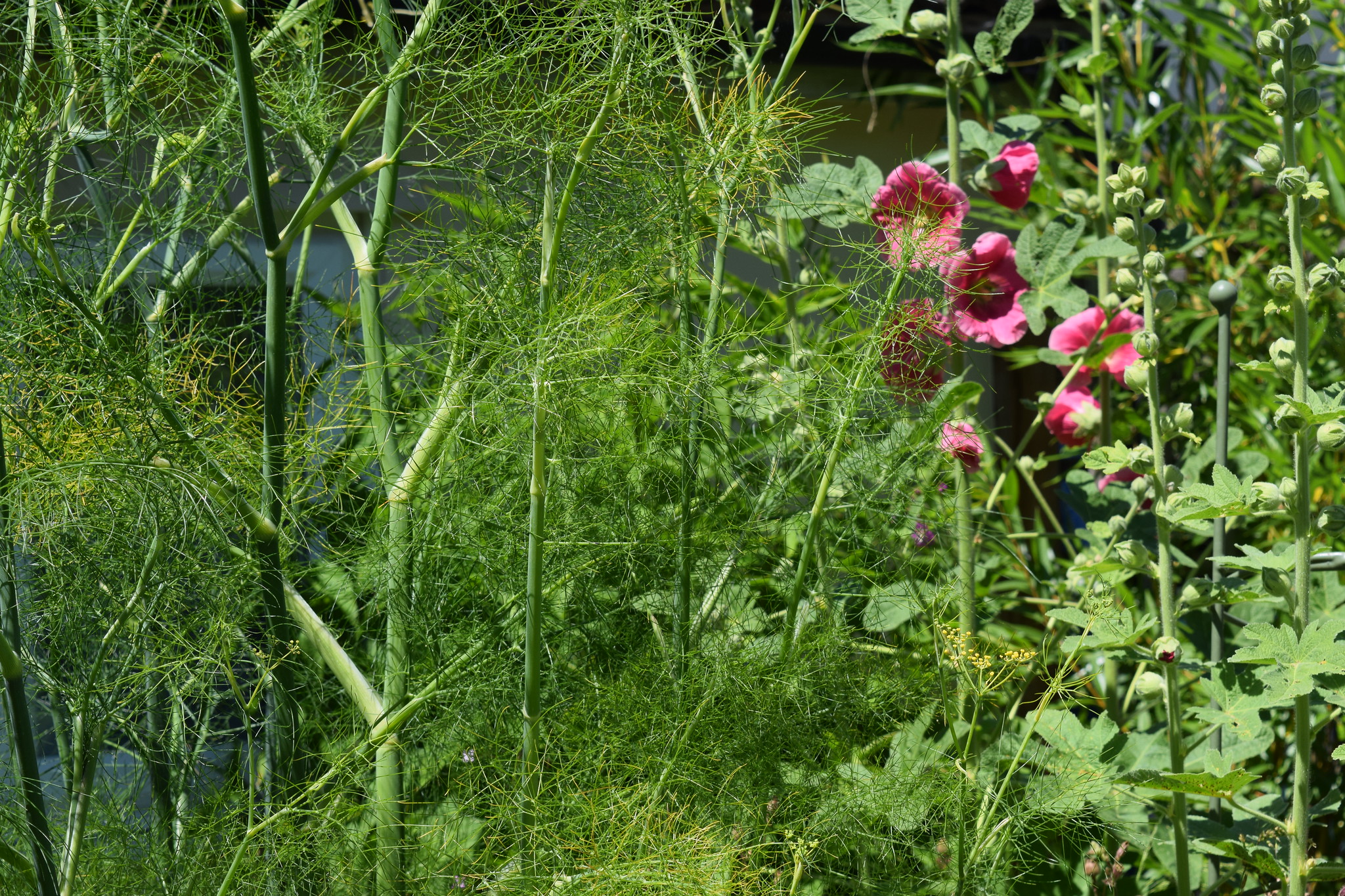
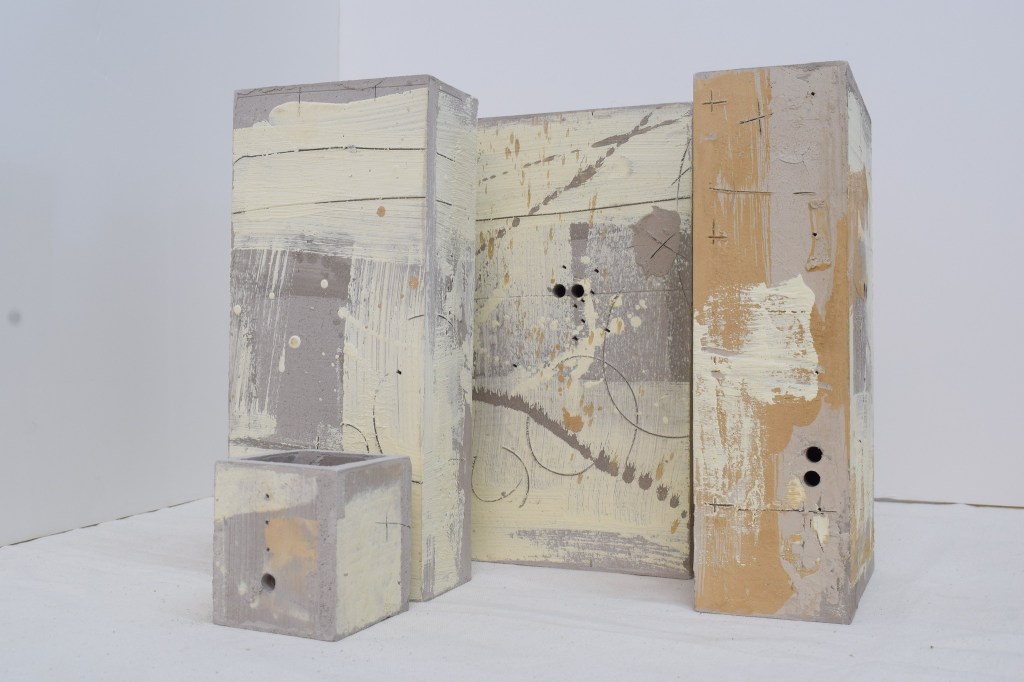
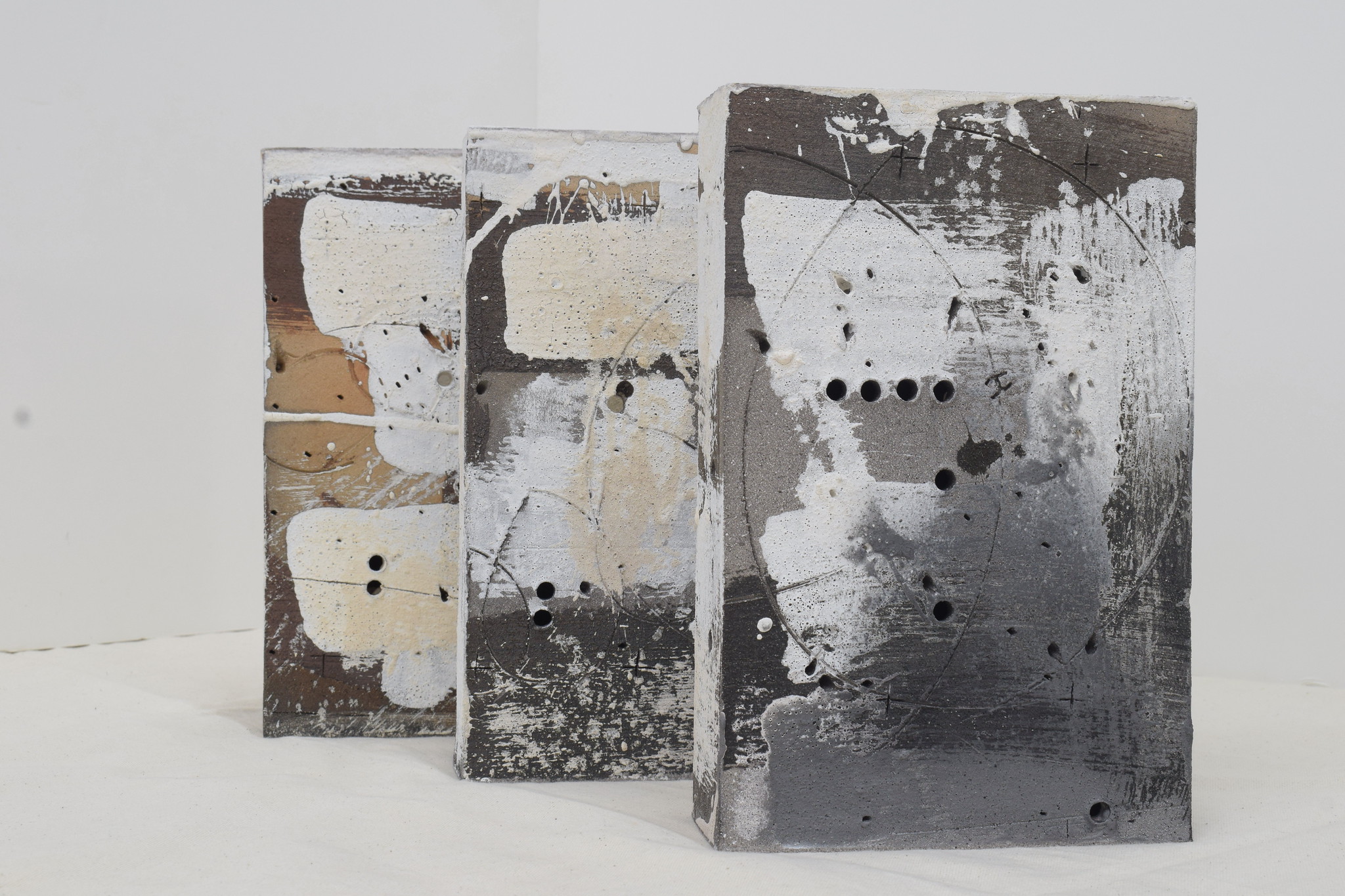
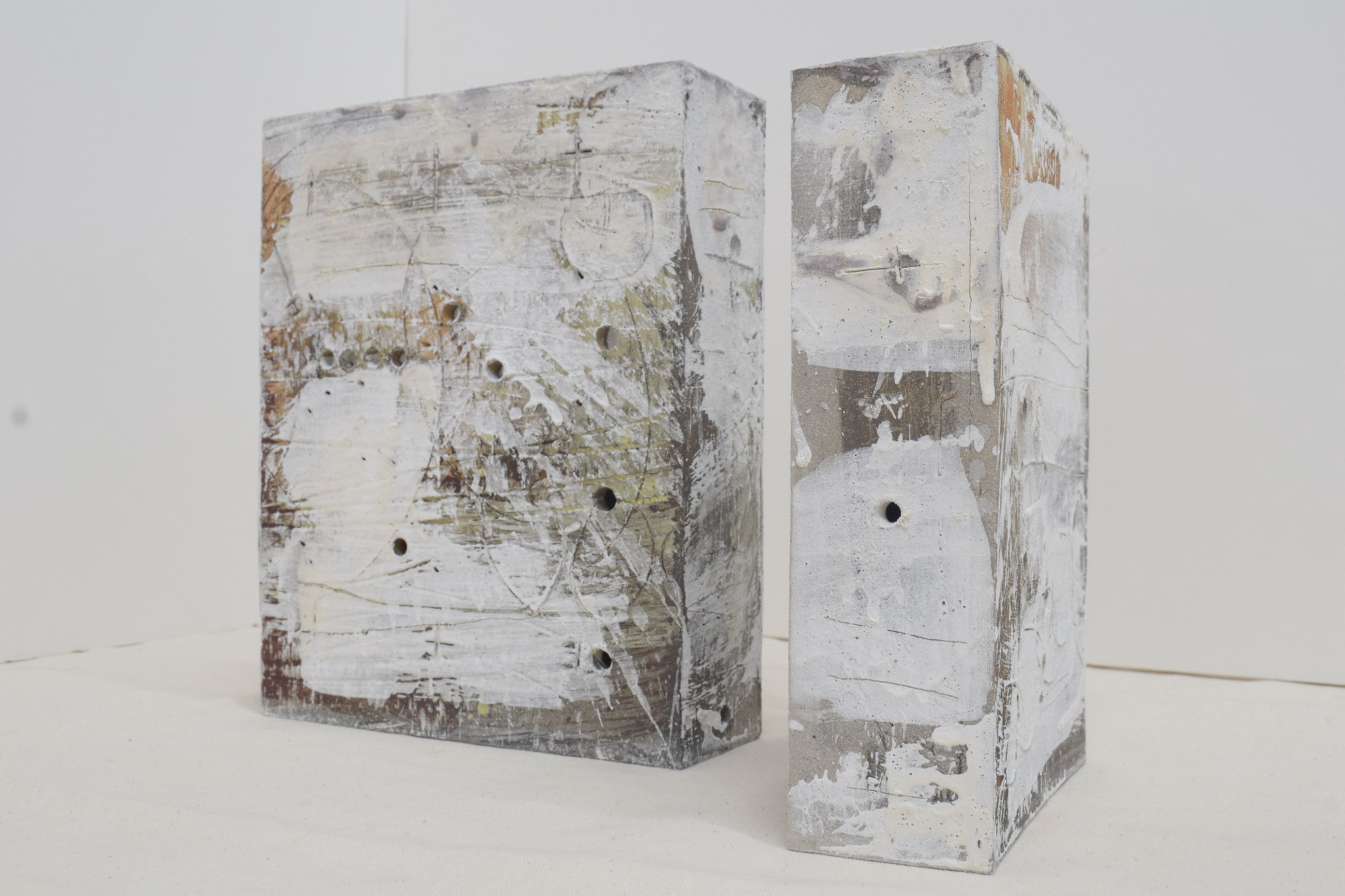
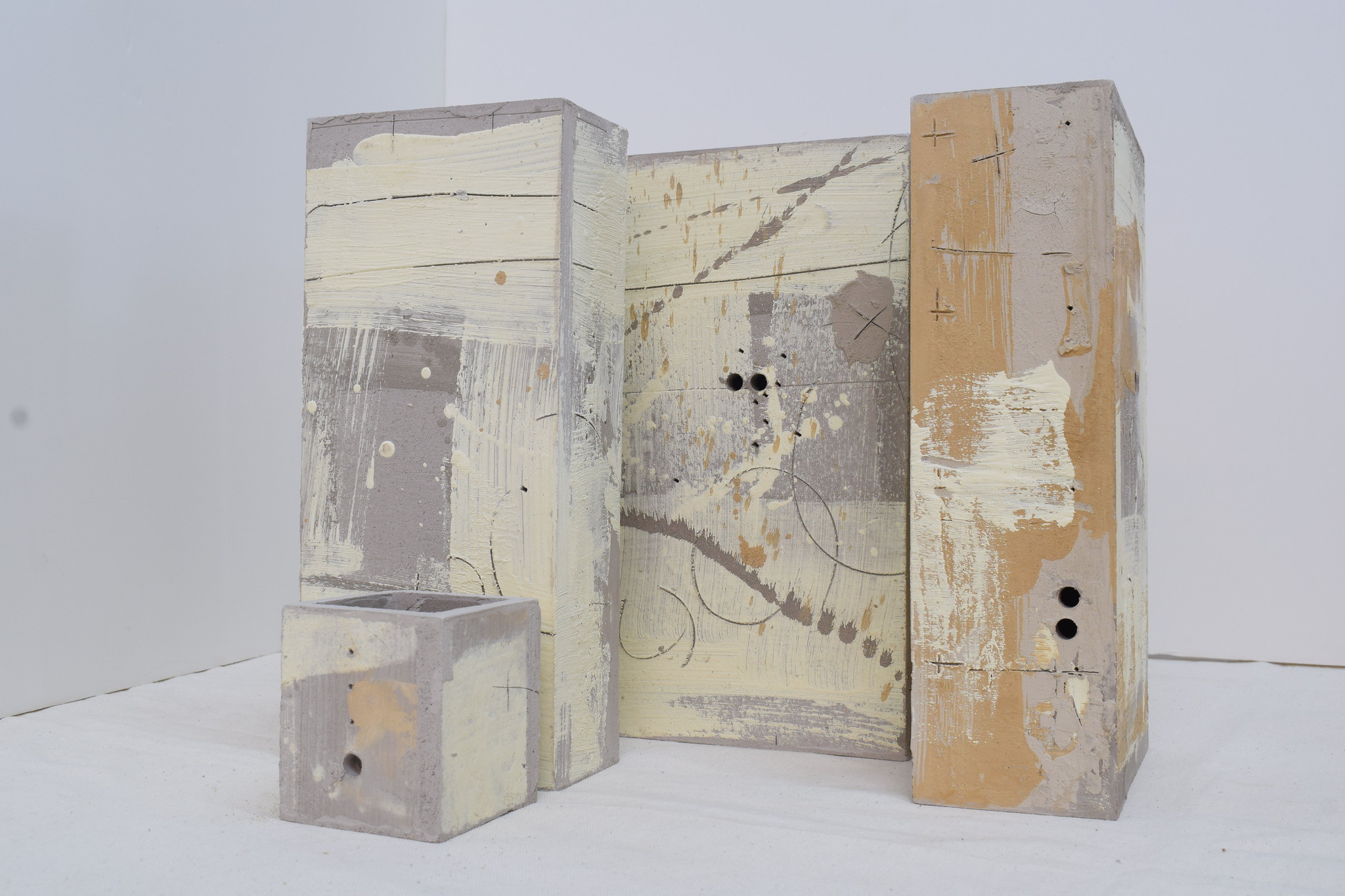
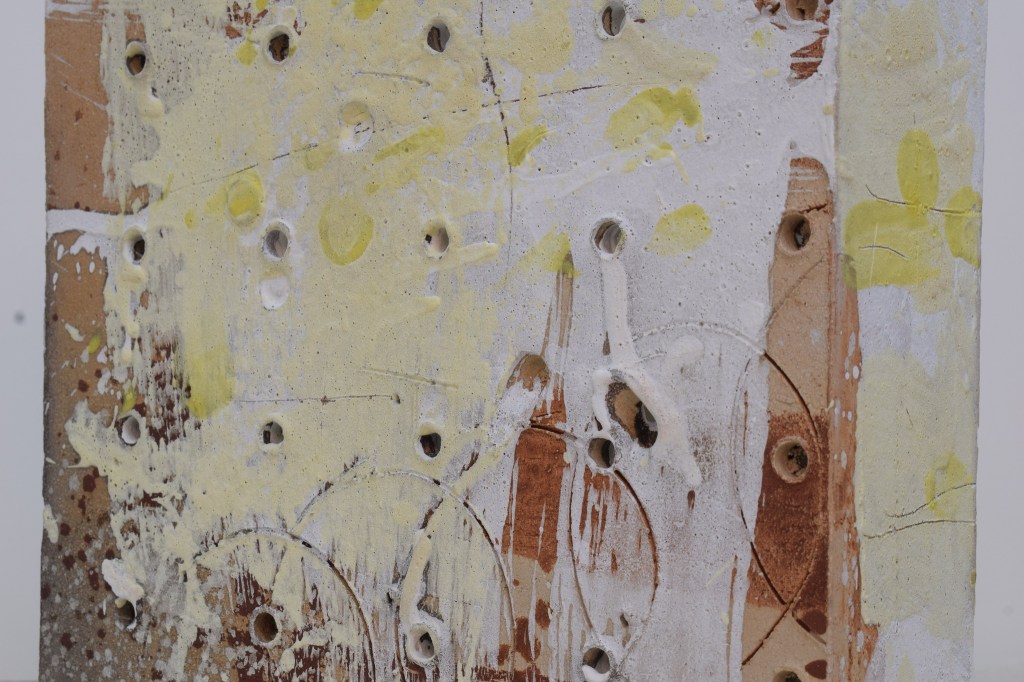
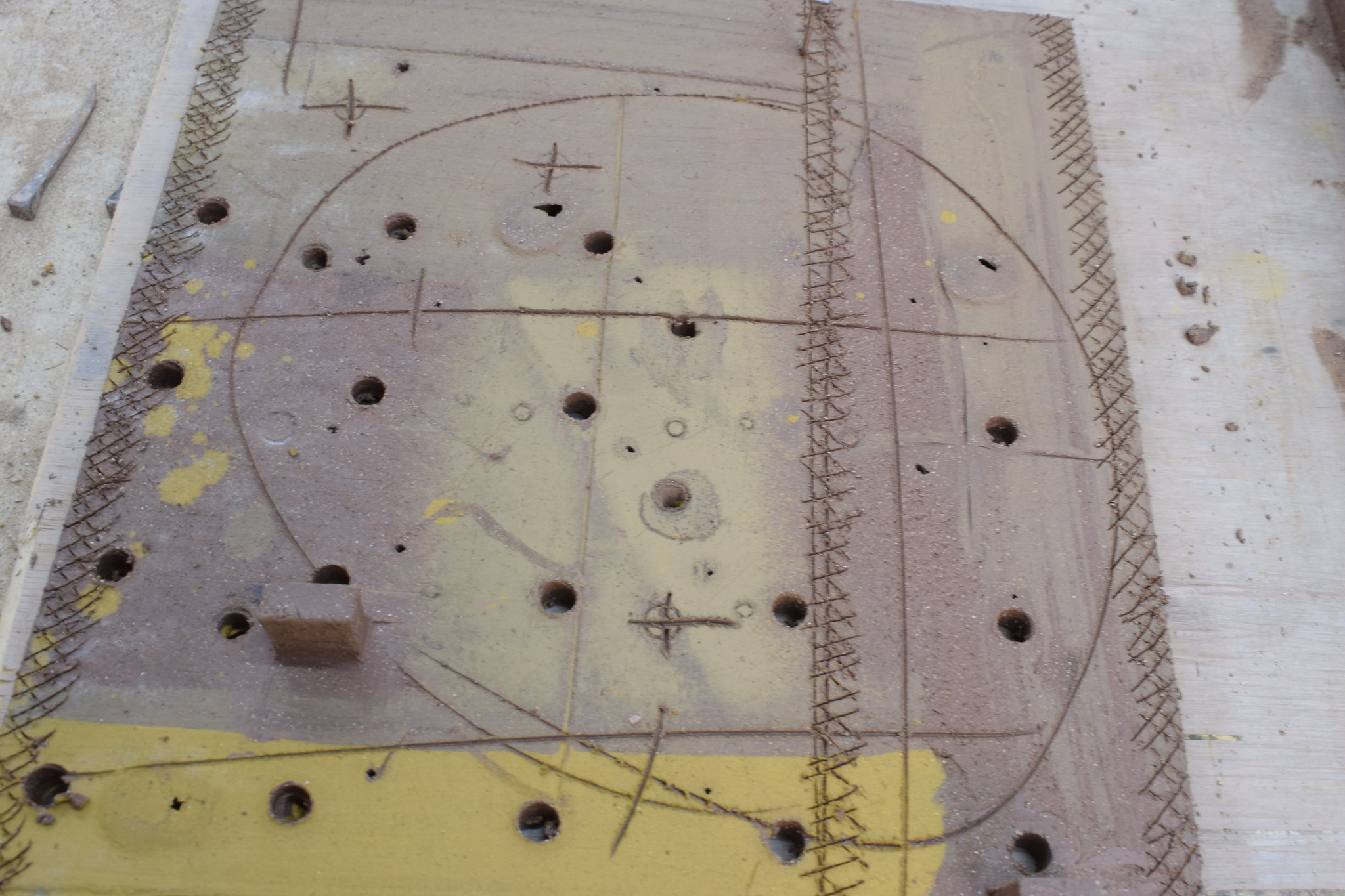
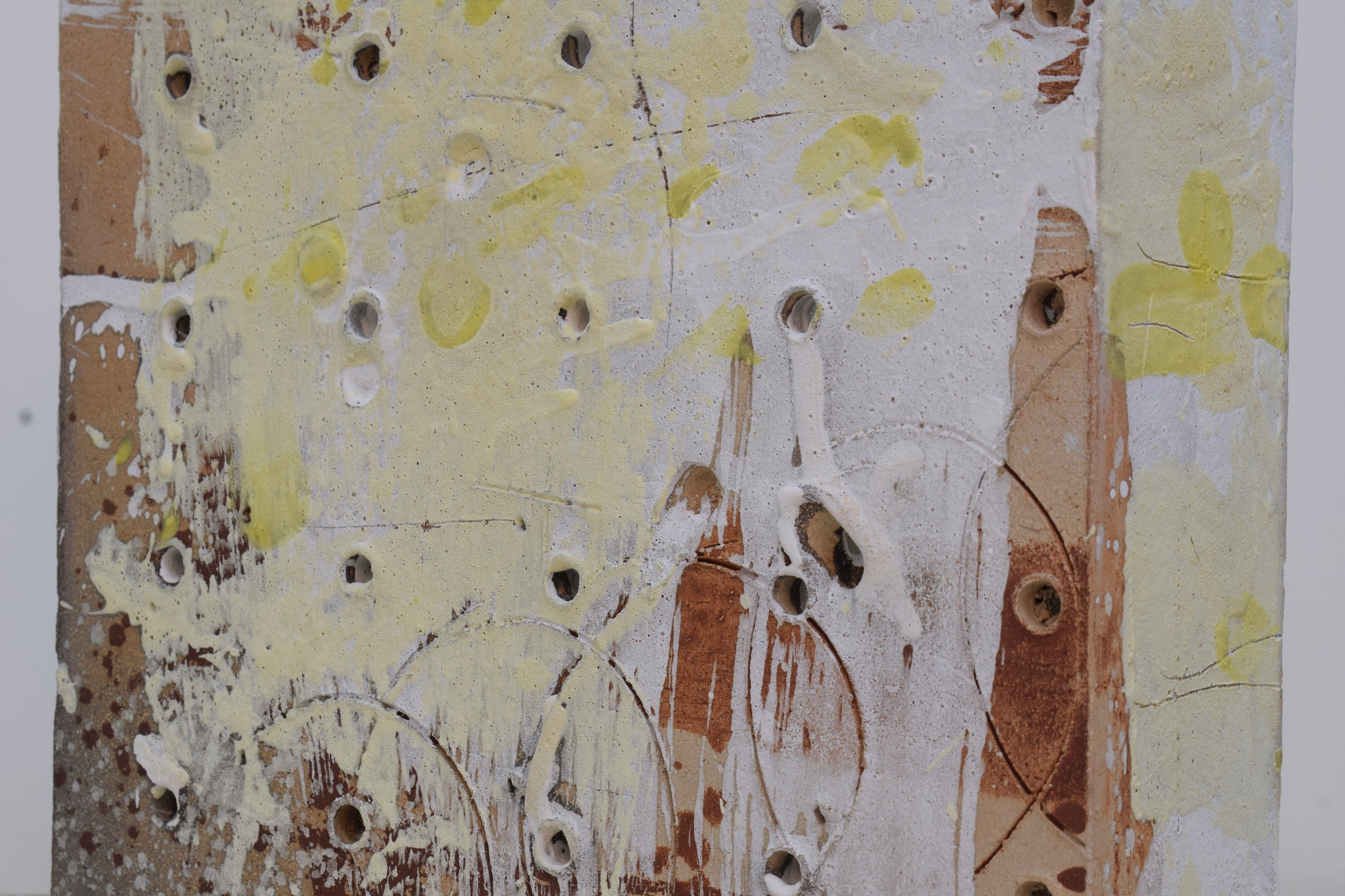
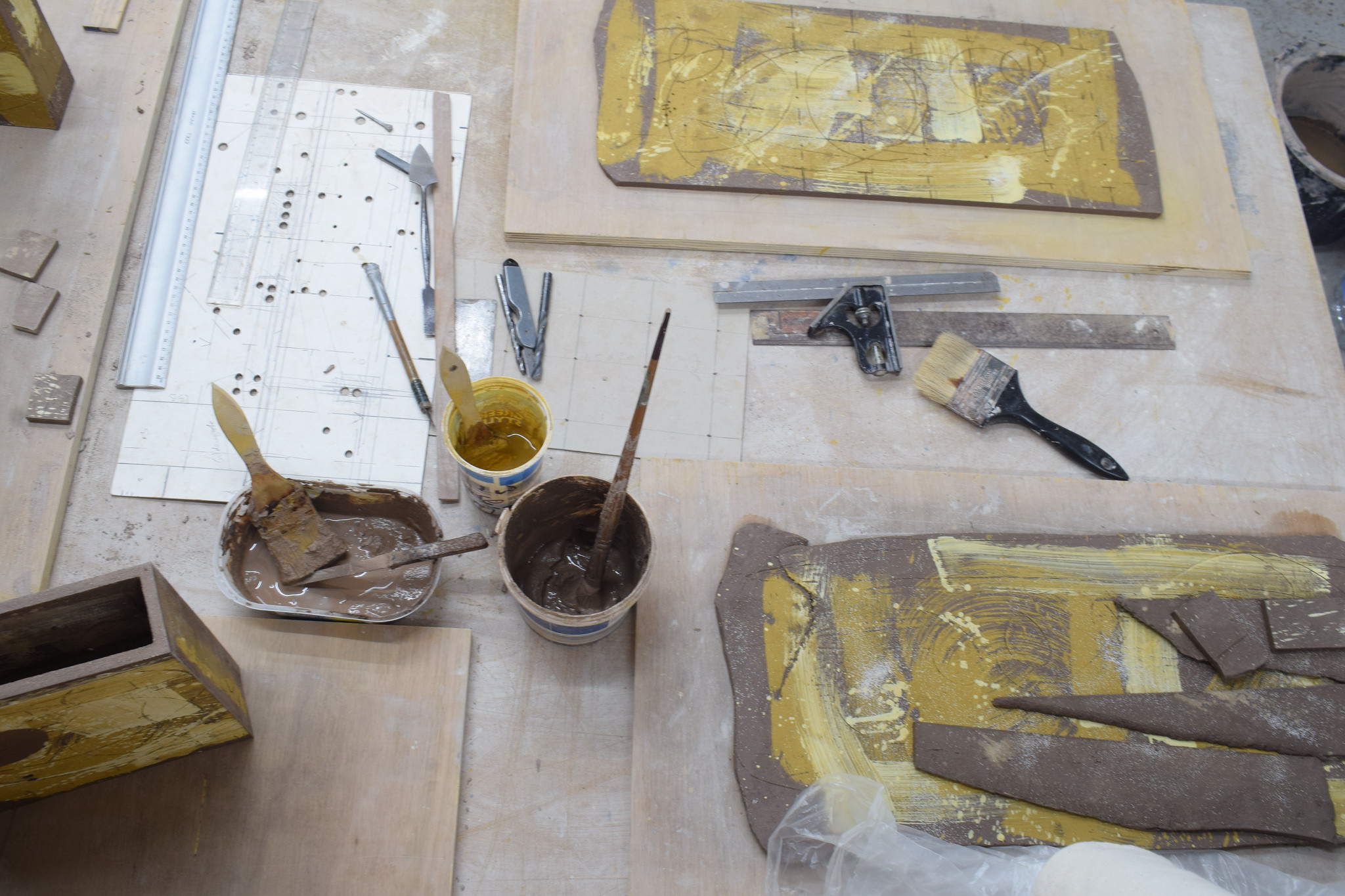
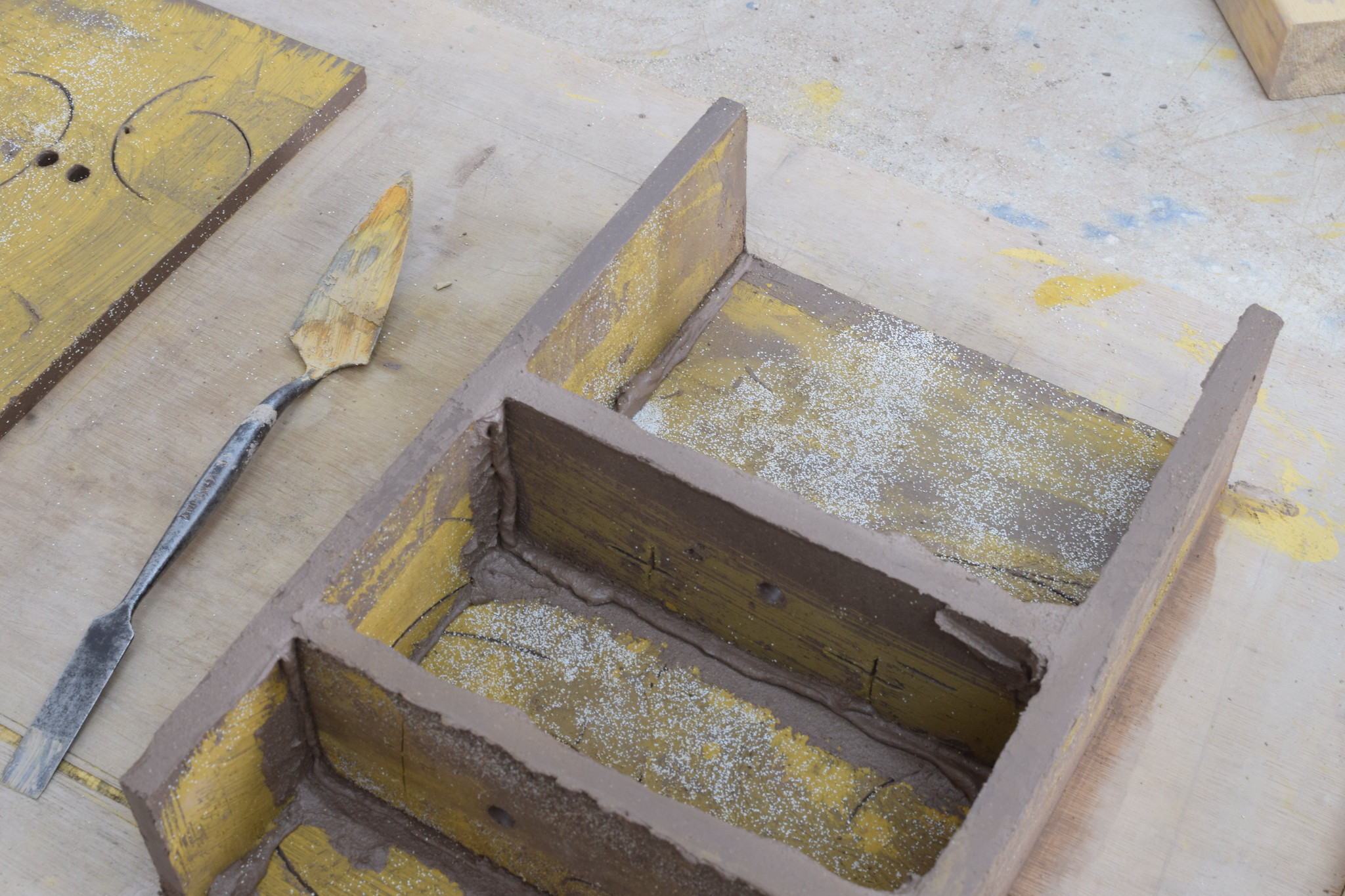
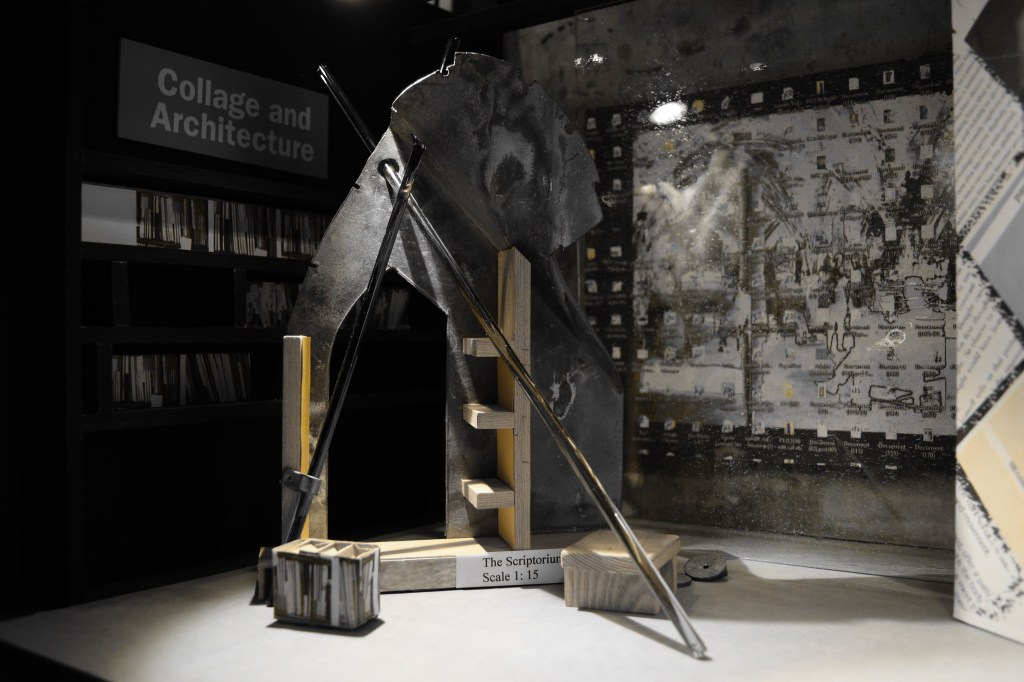
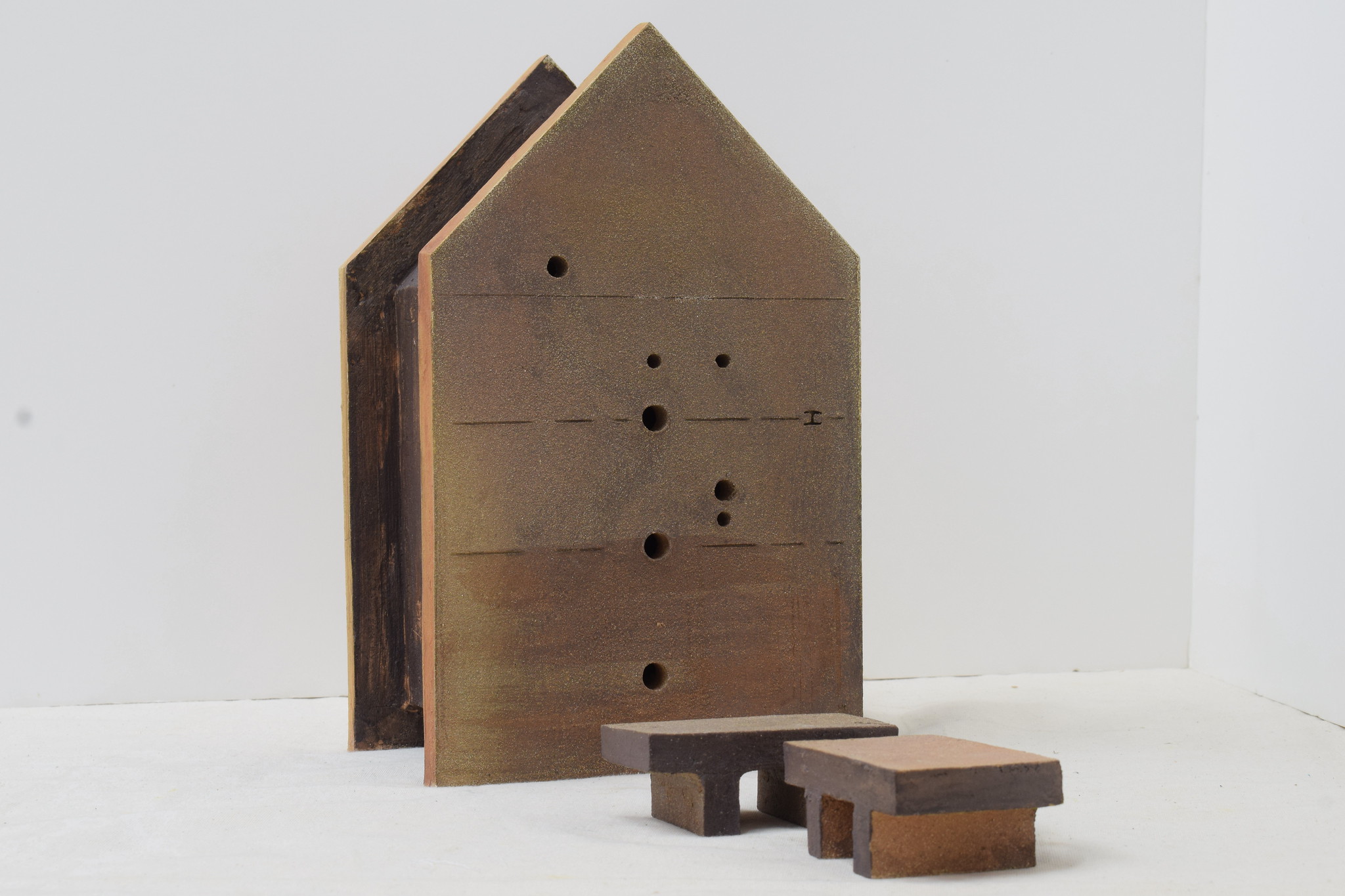
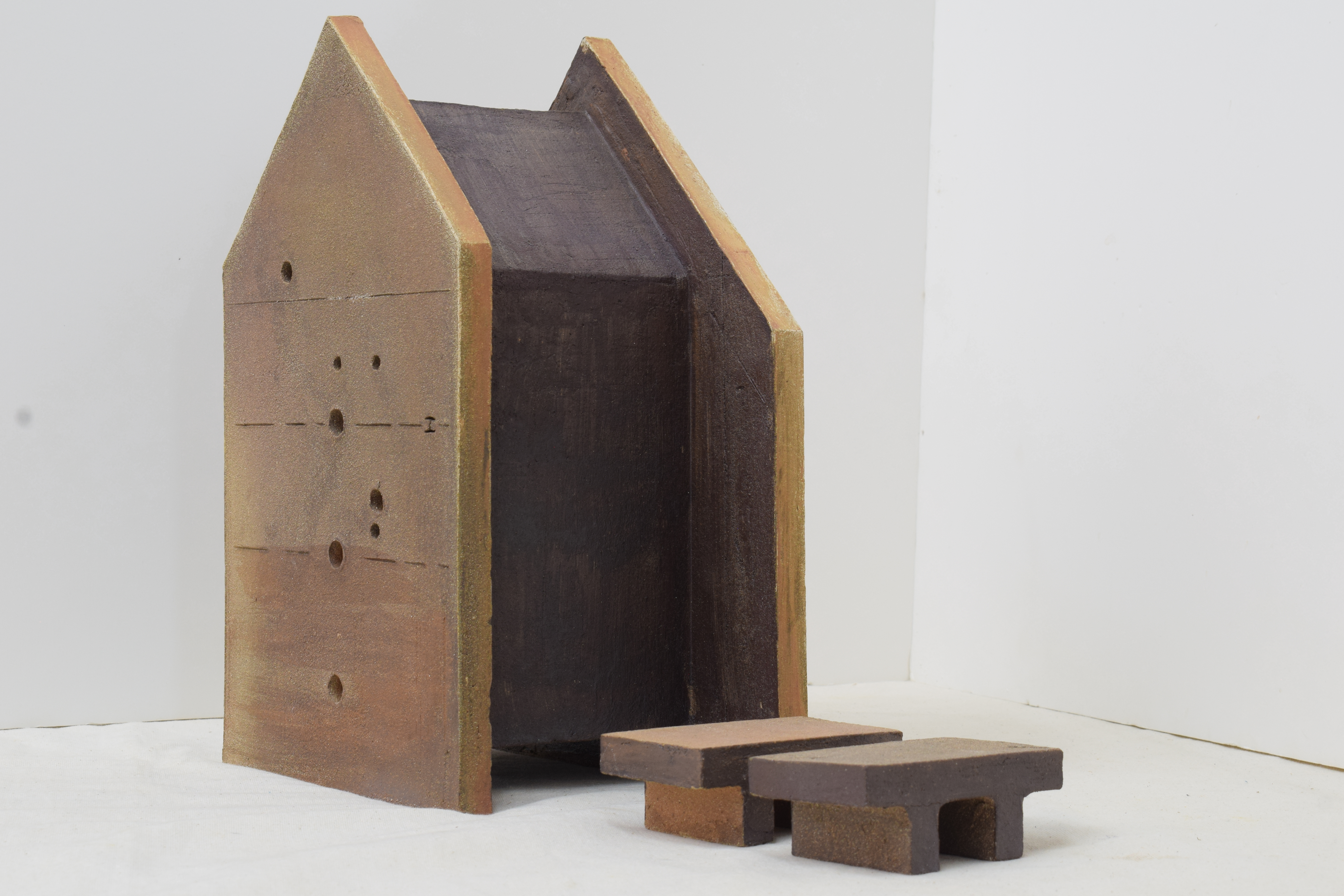
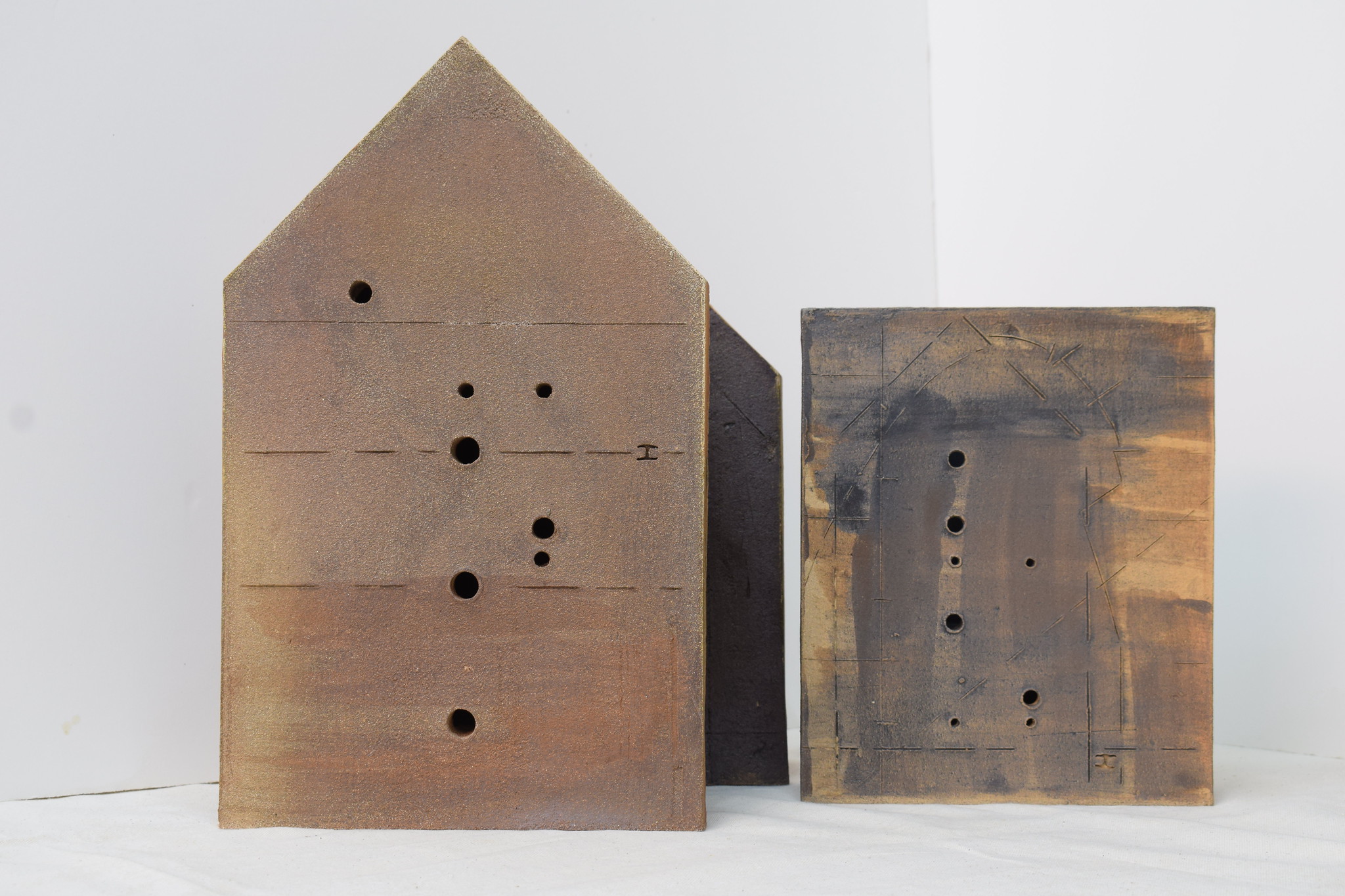
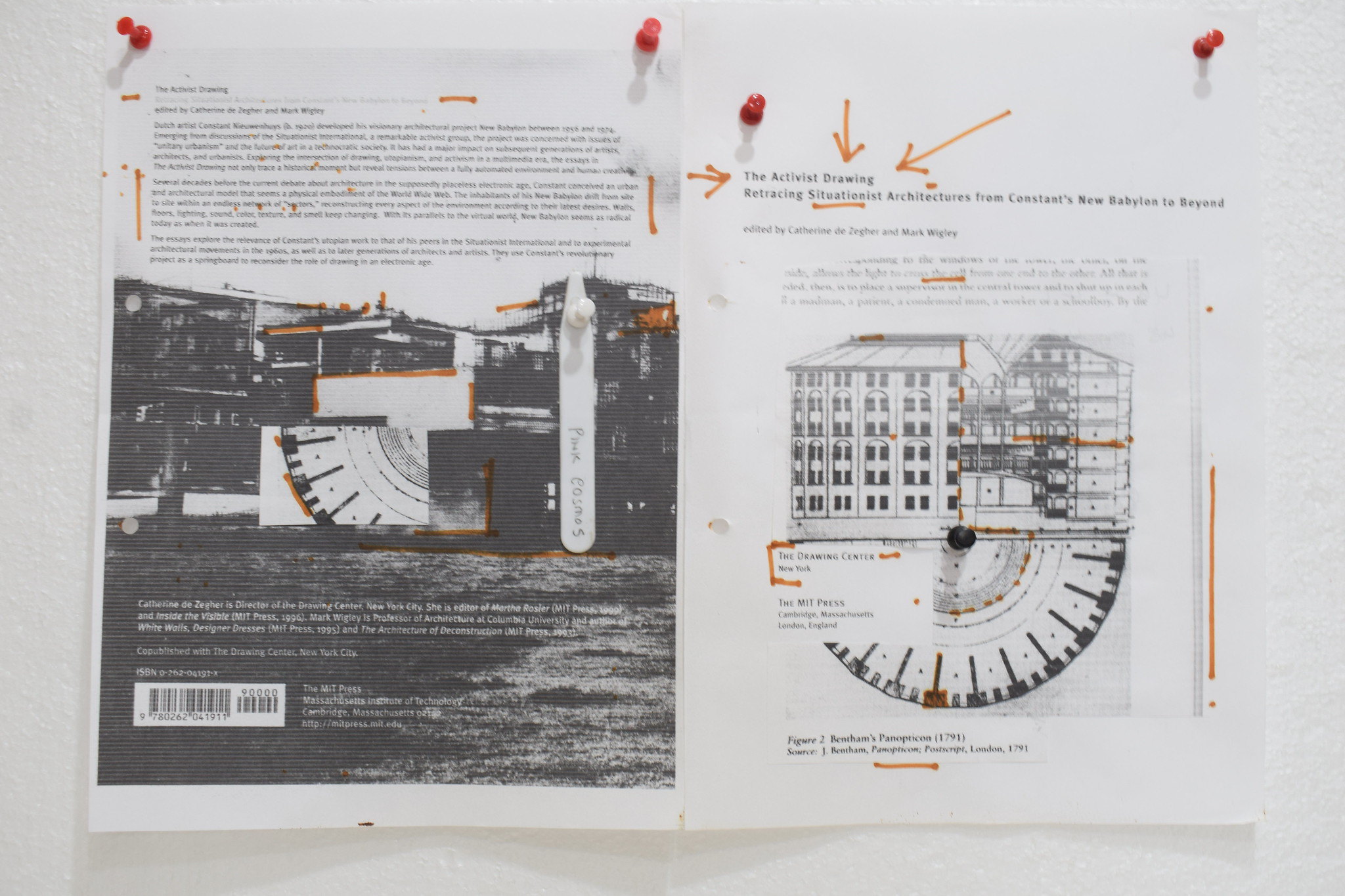
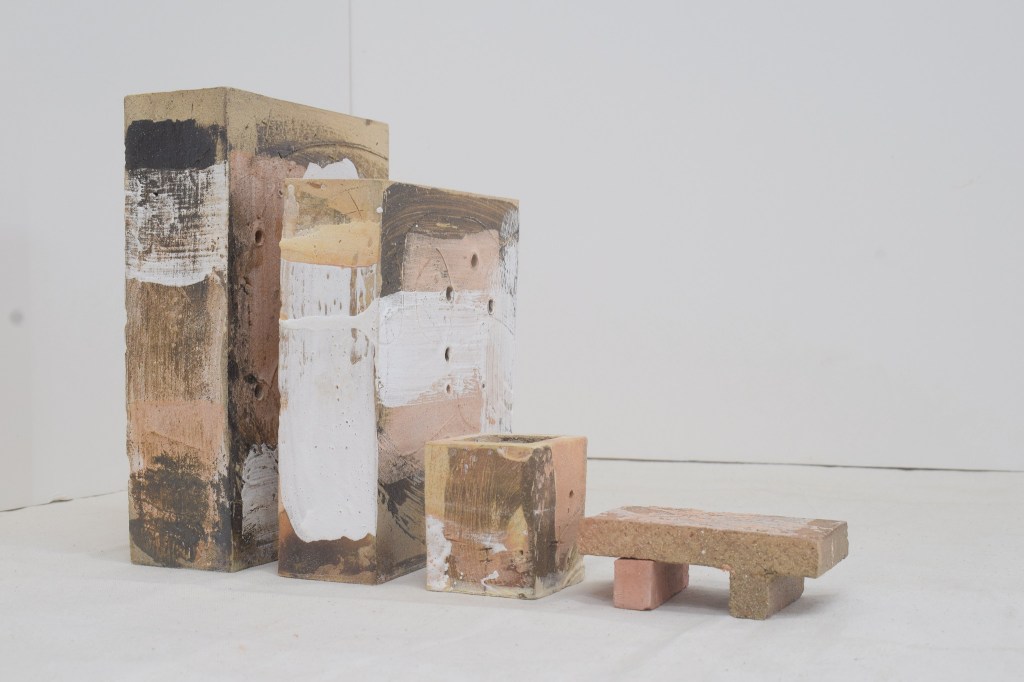
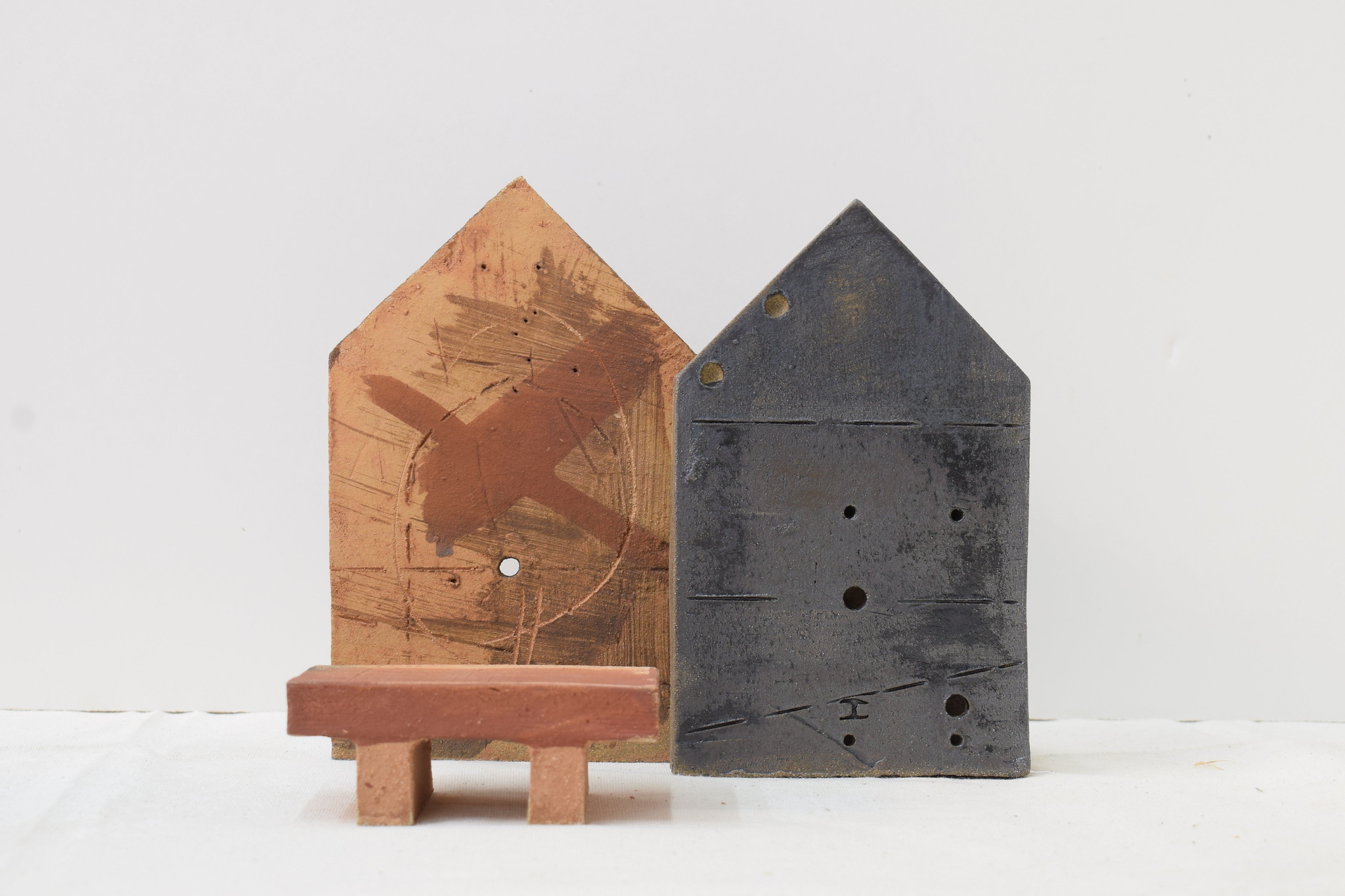
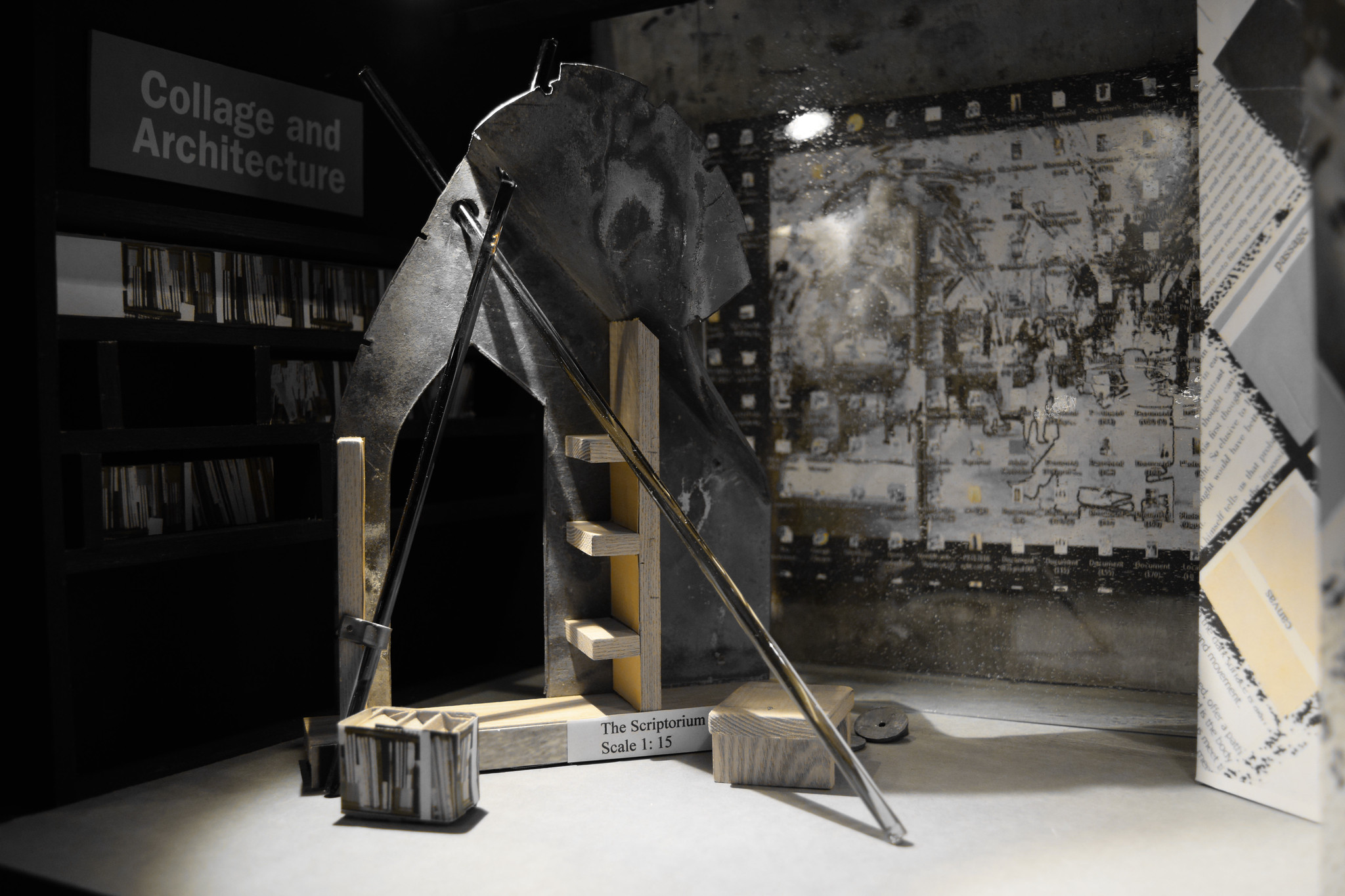
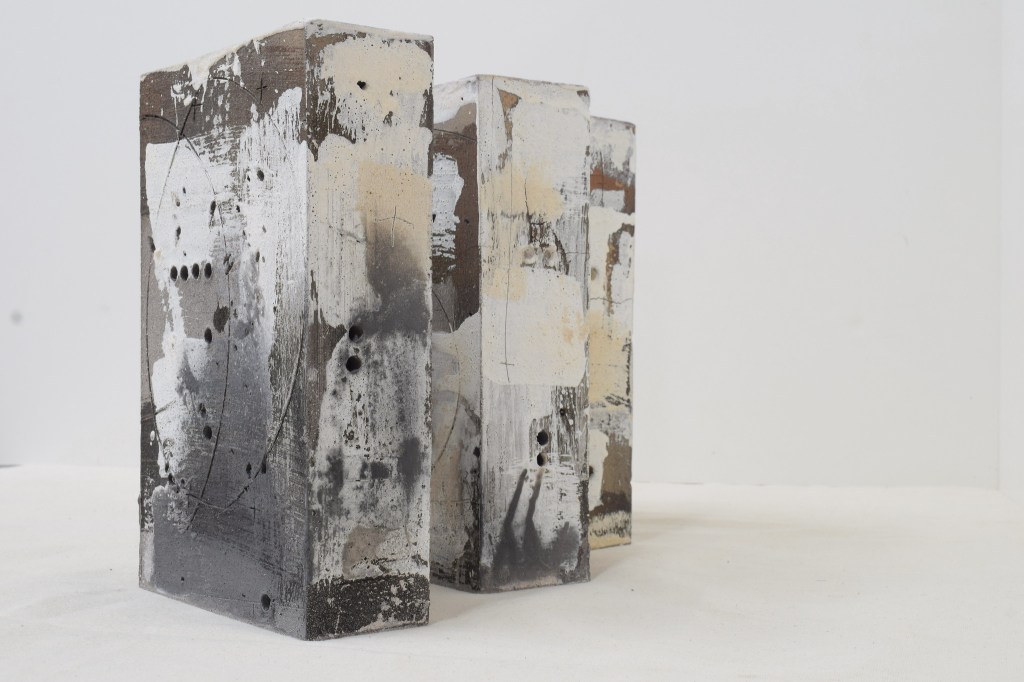
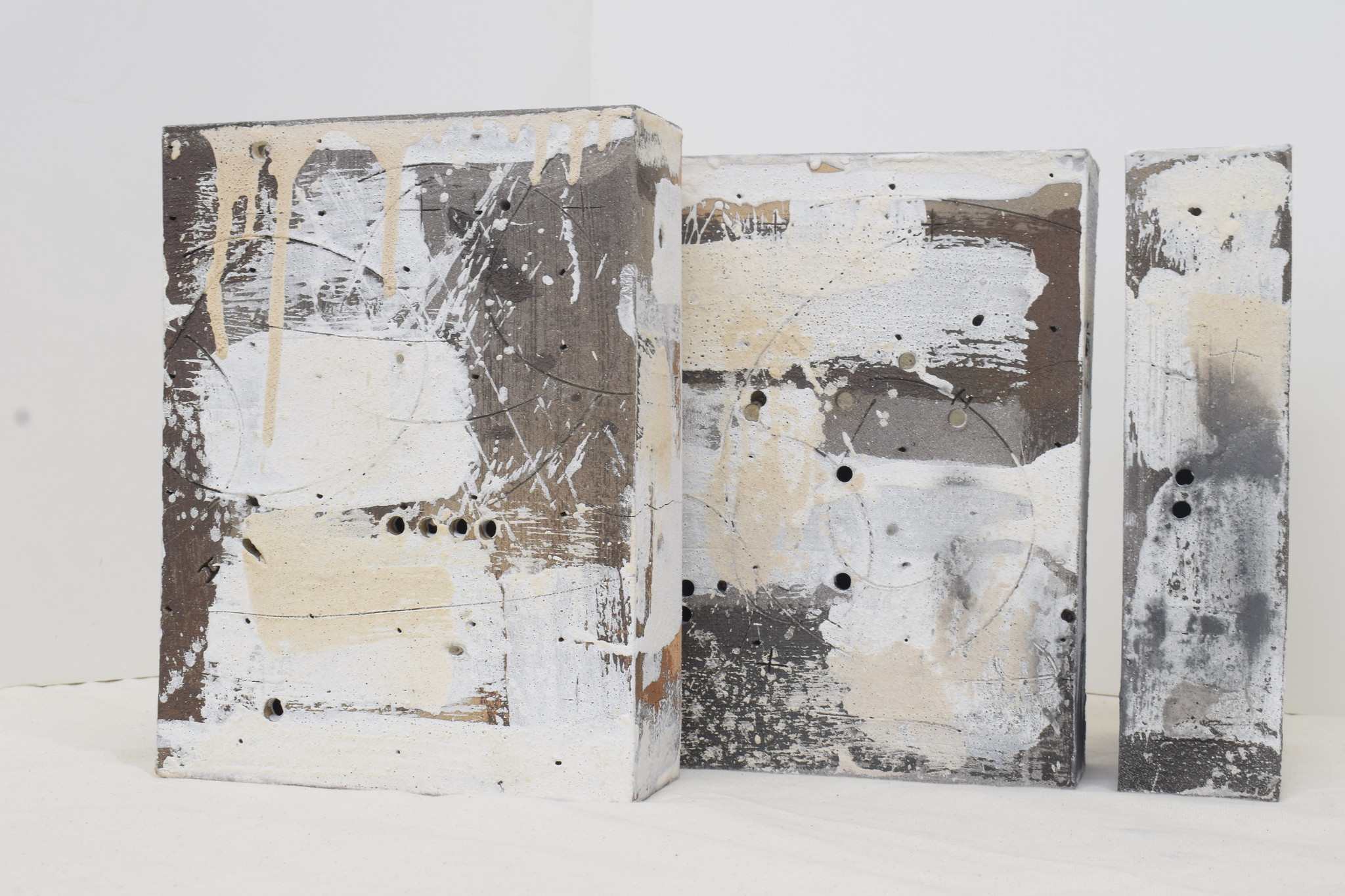
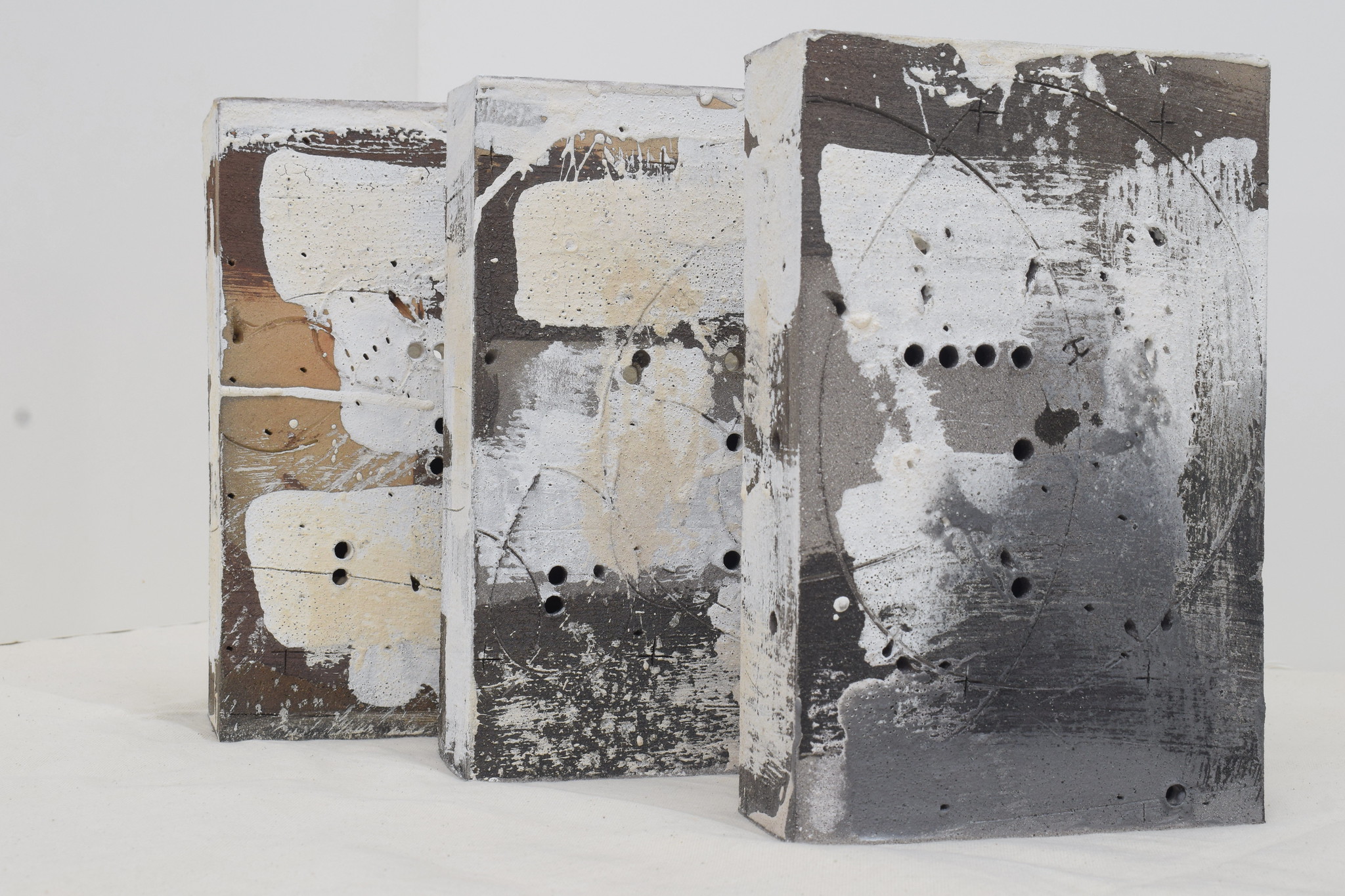
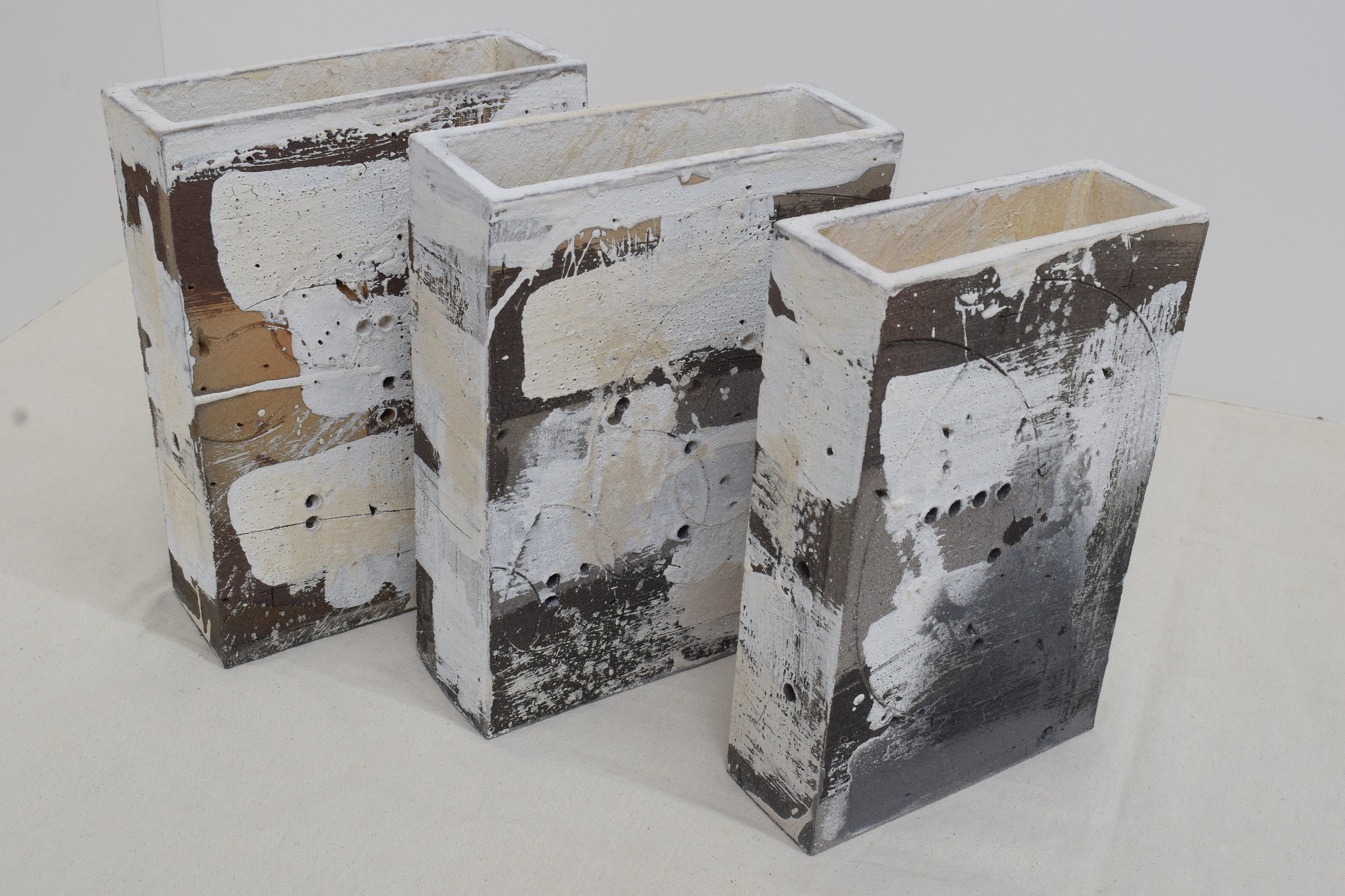
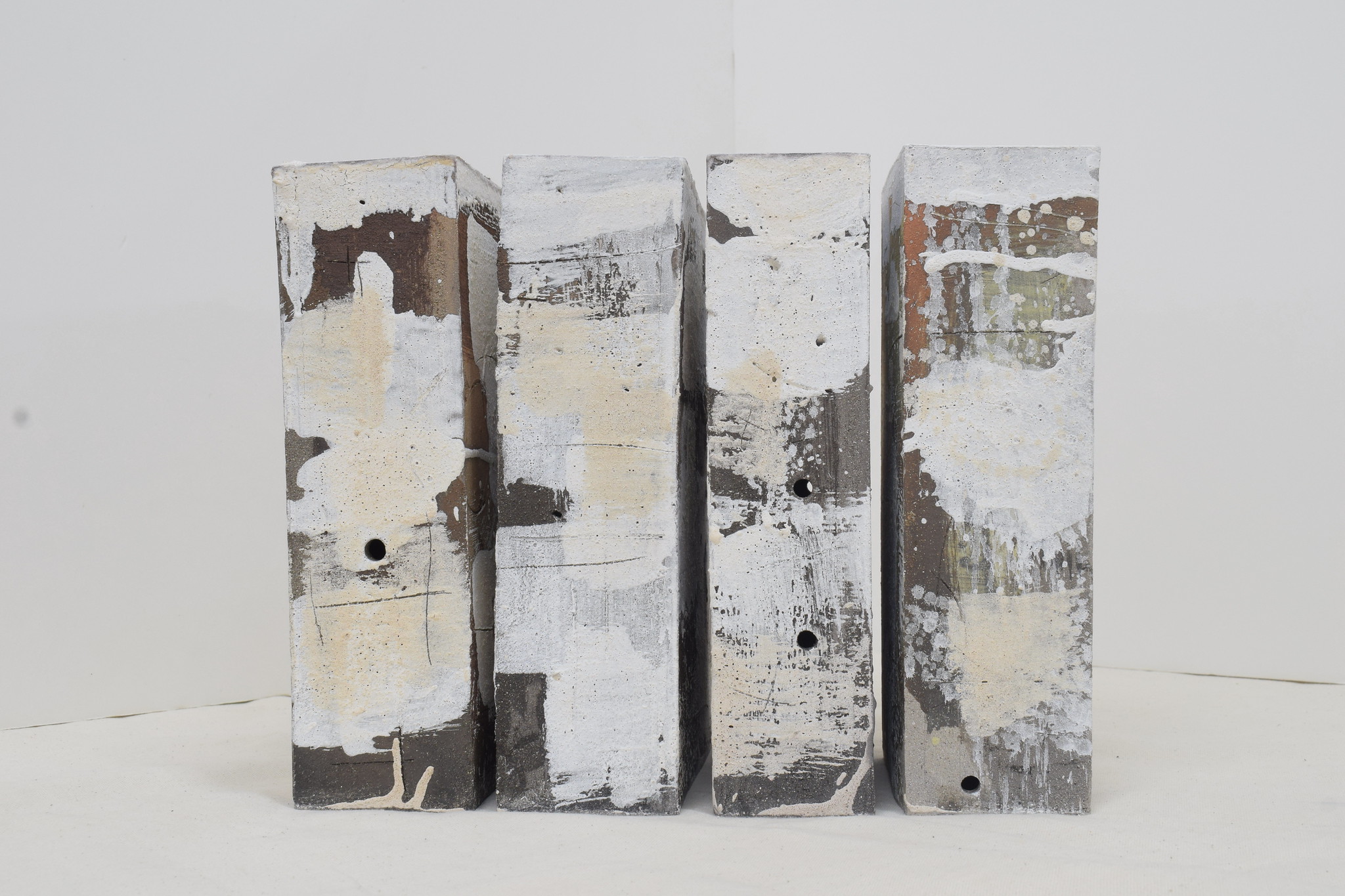

 Russell Moreton : Matter(s) in Correspondence