Reading Apparatus.
Bodies gather differently in each image.
Ceramic surfaces turn, separate, approach and withdraw. Apertures open towards other bodies and towards the spaces around them. Architectural intervals become active: sometimes holding a body apart, sometimes drawing bodies into proximity, sometimes making room for a body that is absent, remembered or imagined.
The images therefore do not simply document ceramic objects. They hold particular spatial encounters in suspension.
A change of viewpoint produces another proposition. A change of distance produces another relation. Surface, light, architecture and proximity begin to participate with the ceramic body, allowing the spatial to emerge between things rather than reside within them.
What remains across these changing arrangements is not an identical installation, but the possibility of correspondence.
The ceramic body persists.
The spatial body changes.
What kind of relation can remain in play when the bodies, the architecture and the viewpoint change?
Body → Threshold → Gathering → Body
A body becomes spatial through what passes between bodies.
Perhaps the ceramic does not carry a spatial proposition from one place to another. Perhaps it carries the capacity for another encounter. A surface, an aperture, an interval, a photograph, a remembered body, a change of light: each can alter what the work becomes.
Here, in~place begins to loosen into in~play. The spatial proposition is no longer something held by the object, or secured by intention, but something that must remain active between bodies.
What remains is not sameness but correspondence.
The ceramic persists.
The architecture changes.
The bodies remain different.
Something remains open.
And perhaps this is where a spatial practice begins to touch futurity: not in knowing what the work will become, but in keeping open the conditions through which it might become something else.
Force~~Feeling~Spatial~Temporal~Notation~Interiorities
Body ~ Threshold ~ Gathering
Within this spatial practice, Body ~ Threshold ~ Gathering can therefore be understood not as three categories but as three mutually implicated conditions.
Body identifies the material and corporeal presence through which spatial relations become perceptible.
Threshold identifies the interval through which bodies encounter, affect and become perceptible to one another.
Gathering identifies the accumulation and continuation of those encounters: traces, memories, surfaces, images, places, forces and other bodies entering into provisional correspondence.
Two bodies.
An interval.
Surface turns towards surface. An aperture opens. Another body remains just beyond what can be seen.
The architecture does not disappear behind the ceramic. It enters the arrangement: wall, floor, distance, light, viewpoint, proximity.
The image holds the encounter long enough for these relations to become perceptible.
Perhaps this is where the spatial proposition begins — not in the ceramic alone, but in what gathers between bodies.
The same body can turn towards another space.
The same architecture can produce another encounter.
The photograph can carry the trace of one proposition towards another.
What remains in play when the arrangement changes?
.jpg)
The terms bleed into one another.
Body becomes threshold.
Threshold becomes gathering.
Gathering becomes another body.
Relations in~play~
ceramic → architecture → bodies → proposition → correspondence → In~~Touching → futurity
This is a form of corporeality in which force~feelings move through encounters and exchanges with and between bodies.
Clay becomes particularly significant because it does not simply receive these forces. It participates in their transformation.
Pressure becomes surface.
Resistance becomes form.
Aperture becomes interior.
Fire becomes transformation.
Ceramic becomes persistence.
The spatial proposition therefore does not sit outside the material process. It emerges through it.


Relations Remaining in Play
An Attentiveness within the Spatial Practice of Russell Moreton
Russell Moreton’s spatial practice increasingly attends to relations that remain in~play.
This attentiveness begins with a distinction between the physical persistence of a work and the persistence of the spatial proposition through which that work becomes active. A ceramic body may remain materially unchanged while its spatial proposition alters significantly according to the architecture, orientation, proximity, viewpoint, atmosphere and bodies through which it is encountered.
The work therefore cannot be understood solely through its material identity.
A ceramic body is one condition.
Its spatial proposition is another.
The two remain related, but they are not equivalent.
Same ceramic body does not necessarily mean the same spatial body.
This distinction becomes particularly important when a work moves between sites. A work initially developed and documented within a particular architectural situation may contain a complex set of relations: its position within the architecture, the distance between bodies, the direction from which it is approached, the interval it produces, the light surrounding it, the scale of the room, and the movements of those encountering it.
These relations are not simply supplementary to the work.
They are part of what makes the work spatial.
In~place / In~play
Moreton’s practice consequently distinguishes between a proposition being in~place and being in~play.
To be in~place might suggest that a spatial proposition can be transferred from one situation to another while remaining essentially intact. To be in~play suggests something more active: the proposition must continue to be enacted through relations.
The spatial proposition is therefore not a fixed meaning attached to an object.
It is a condition that becomes perceptible through encounter.
Architecture changes it.
Bodies change it.
Viewpoints change it.
Light changes it.
Proximity changes it.
Memory changes it.
The work changes as these relations change.
Spatial Intercessors~Other Bodies : Spaces for Francesca (Woodman).
.jpg)

This does not mean that every new installation produces an entirely different work. Rather, it recognises that the spatial dimension of the work is relationally contingent.
The ceramic persists.
The proposition is reactivated.
Or it may not be.
This distinction creates an important attentiveness within Moreton’s practice: what relations need to remain active for a spatial proposition to remain in~play?
From Intention to Relation
This attentiveness also shifts the practice away from understanding artistic intention as the primary carrier of meaning.
A curator, viewer or writer may interpret, describe or paraphrase what a work appears to propose. Such language can be valuable, but it does not necessarily reproduce the spatial relations through which the proposition originally became perceptible.
An intention can be described.
A relation has to be enacted.
A feeling can be named.
The conditions through which that feeling emerges have to remain available.
This is where Moreton’s developing vocabulary of force~feelings becomes significant.
Force is not treated as an abstract property imposed upon material. It becomes perceptible through pressure, resistance, proximity, movement, weight, touch, withdrawal and exchange.
Feeling emerges through these relations.
The spatial proposition therefore resides neither entirely in the object nor entirely in the intention of the maker.
It emerges between bodies.
The Photograph as Spatial Evidence
Within this practice, photographic documentation can consequently have a role beyond conventional recording.
A photograph of a work situated within a particular architectural environment may preserve aspects of the spatial proposition that a verbal description cannot.
It can gather:
the ceramic body’s orientation;
its relationship to architecture;
the interval between bodies;
the implied position of the viewer;
light and atmosphere;
scale;
proximity and distance;
concealment and revelation.
The photograph becomes evidence of a proposition in~play.
It does not replace the spatial encounter, but it can carry something of its relational configuration forward.
This gives the photograph an anarchive-like function within the practice. It does not simply preserve what happened. It becomes a material from which another proposition might later be re-entered, reconsidered or re-enacted.
The image therefore becomes another body in correspondence with the ceramic.
Re-enactment Rather Than Replication.
A spatial proposition cannot necessarily be reproduced by replicating the object’s position alone.
Nor can it necessarily be transferred through explanatory text.
What is required is a re-enactment of relations.
Re-enactment here does not mean theatrical reconstruction. It means attending to the conditions through which the work becomes spatially active again.
The question becomes:
What needs to happen between the bodies for the proposition to come into play?
This might involve orientation, interval, scale, light, proximity, architecture or movement.
It might also involve allowing the new site to alter the proposition rather than attempting to reproduce the previous situation exactly.
This is important because Moreton’s spatial practice is not concerned with preserving a single ideal installation.
It is concerned with maintaining the capacity for correspondence.
The new site should therefore not simply receive the work.
It should enter into relation with it.
The Same Body, Another Proposition(ing)
This understanding has become particularly visible through Moreton’s recent arrangements of ceramic bodies.
Spatial Intercessors~Other Bodies : Spaces for Francesca (Woodman) and The Tentative Trace ~ From Living Body to Ceramic Body originate through relations with the same architectural body, yet different viewpoints and arrangements produce different spatial propositions.
The ceramic bodies remain materially related.
The architectural environment remains continuous.
Yet the spatial situation changes.
In one arrangement, separation and orientation produce an interval through which another body—remembered, imagined or withdrawn—can become perceptible.
In another, proximity, surface, aperture and trace produce a more intimate correspondence between living body, image, architecture and ceramic.
The distinction demonstrates that:
The same architectural body can become many spatial propositions through different bodily encounters.
And equally:
The same ceramic body can become many spatial bodies through changes in relation.
This is not a problem to resolve.
It is a condition to attend to.
The Ceramic as Spatial Intercessor
The ceramic therefore operates as more than an object placed within architecture.
It can become a spatial intercessor.
It may make an interval perceptible.
It may draw attention towards an overlooked surface.
It may produce a threshold.
It may gather bodies.
It may establish a chamber without enclosing one.
It may make another architecture perceptible within an existing architectural body.
The ceramic does not simply occupy architecture. It makes another architecture perceptible.
This proposition is central to Moreton’s emerging spatial practice.
The “another” is important.
It does not describe a replacement architecture.
It describes a difference that becomes perceptible through the encounter between existing architecture, ceramic, bodies and atmosphere.
Body ~ Threshold ~ Gathering
This is also where The Entangled Body ~ Threshold ~ Gathering becomes more than a descriptor for a group of works.
It becomes a way of attending to relational activity.
Body is the material and corporeal presence through which encounter begins.
Threshold is the interval in which relations become active.
Gathering is the accumulation and continuation of those relations.
The terms bleed into one another.
Body becomes threshold.
Threshold becomes gathering.
Gathering becomes another body.
This produces a corporeality of clay in which force~feelings move through encounters and exchanges with other bodies.
The ceramic body is consequently not simply a finished material entity.
It is a body that continues to participate.
Relations That Remain.
The attentiveness to relations that remain in~play is therefore not an additional methodology imposed upon Moreton’s practice.
It is becoming a condition of the practice itself.
The work asks not simply:
What is this object?
but:
What relations does this body make possible?
Not:
What did the artist intend?
but:
What becomes perceptible through the encounter?
Not:
Can the work be transferred unchanged?
but:
What must remain in play for its spatial proposition to continue?
These questions keep the practice open.
They also create a particular understanding of futurity.
The future of the work does not lie in predicting its next form.
It lies in its capacity to enter another relation.
The ceramic persists.
The architecture changes.
The bodies move.
The proposition is reactivated.
Something else becomes possible.


A Practice of Correspondence
Moreton’s spatial practice can therefore be understood increasingly as a practice of correspondence.
Bodies remain distinct.
Relations remain active.
Differences are not resolved.
The work is not required to arrive at a final spatial meaning.
Instead, the practice attends to what happens when bodies, materials, architectures, images, memories and ideas remain sufficiently open to affect one another.
This is the condition of In~~Touching.
Touch does not require literal contact.
A body can touch through an interval.
An image can touch a ceramic.
Architecture can touch a memory.
Language can touch material.
Francesca Woodman, Blueprint for a Temple (II), 1980. Collage of diazotype elements and gelatin silver prints. Gagosian, New York, 2024; via Woodman Family Foundation.
Klein Blue Yves Klein.
Donna Huanca. Surrogate Painteen @ Peres Projects, Berlin
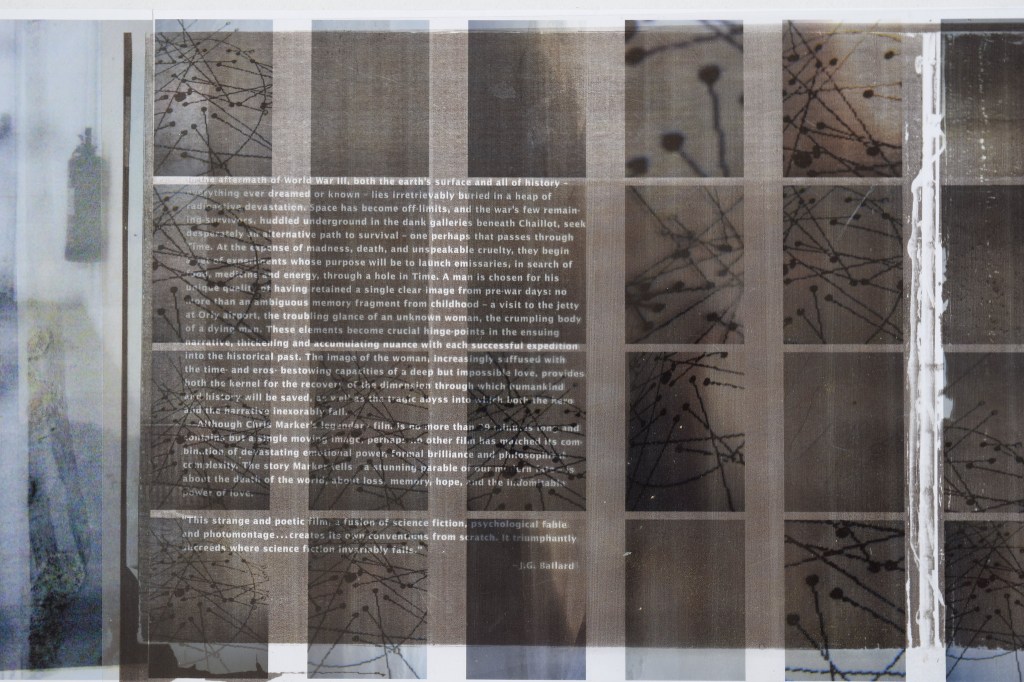
Chris Marker/J. G. Ballard
Formal Brilliance/Philosophical Complexity. La Jette
A previous installation can touch a future one.
A spatial proposition can survive not by remaining identical, but by remaining capable of being re-entered.
The work therefore becomes a body waiting~in~correspondence.
Its material persistence does not close it.
Its spatial proposition remains in~play.
And this may be one of the central attentivenesses of Moreton’s developing spatial practice:
To remain attentive to the relations through which a body becomes spatial, and to the conditions through which those relations can continue to move.
.jpg)
The ceramic remains.
The architecture remains.
The bodies remain different.
The proposition remains open.
In~place becomes in~play.
And what remains in play can continue to reverberate.
A spatial practice does not preserve a relation by keeping it unchanged. It preserves its possibility by keeping the relation in play.
Keywords
Body~Threshold~Gathering, ceramic bodies, spatial practice, spatial bodies, spatial intercessors, body~space, threshold, gathering, correspondence, in~place / in~play, spatial proposition, relations in play, material encounter, force~feelings, interiority, permeability, aperture, atmosphere, photographic evidence, re-enactment, futurity, In~~Touching


Leave a comment