Russell Moreton’s Spatial Practice and the Ethical Apparatus of the Leper Grave
Abstract
This essay examines Russell Moreton’s Painting/Photography: Leper Grave series, developed through Negative Capability Part I, a 2017 exhibition responding to the University of Winchester’s Magdalen Hill Archaeological Research Project (MHARP). Drawing upon Moreton’s framework of Spatial Practice and his methodology of “attentiveness as a sensate heuristic inquiry,” the text analyzes how the introduction of physical archaeological excavation disrupts baseline formal landscape relations. By cross-mapping Moreton’s vocabulary onto an evolutionary ethical matrix—comprising Excavation, Trace, Negative Capability, and Inhuman Correspondence—the essay leverages Karen Barad’s agential realism and Jacques Derrida’s philosophy of hospitality. It argues that the hybrid intersection of photographic registration and painterly intervention serves as a performative spatial matrix. Rather than forcing the historical subject into an economy of conditional empirical recognition, the work deploys negative capability to preserve opacity, hosting the haunting trace of the historically excluded body without claiming possession of its history or demanding its surrender to contemporary mastery.
Part I: The Sensate Inquiry of Matter(s) in Correspondence.
In the artistic vocabulary of Russell Moreton, a site is never encountered as an empty, neutral container awaiting representation. It is understood instead as an active, pre-existing web of historical, atmospheric, and bodily relations. Within this framework, Spatial Practice operates not as a passive documentation of topography, but as what Moreton terms “attentiveness as a sensate heuristic inquiry.” Knowledge of a place is not gathered from a detached distance; it is produced through a body’s deep, visceral, and participatory engagement with a material situation. Mediums such as painting, photography, and drawing are not treated as separate, siloed disciplines. They function as diverse “spatial bodies” designed to gather the raw impressions and physical impacts of a specific encounter.
This methodology underpins the initial, formal layer of Painting/Photography: Leper Grave. Approached as a surface, the image functions as a sensate record of a physical force and gesture. The camera registers the physical space of the earth through an intense attentiveness to light, surface texture, and relative distance. Here, the artist’s eye mirrors the tactile sensitivity of a hand moving over a surface, translating the physical characteristics of the ground into a shared visual accord. This is Moreton’s concept of “Matter(s) in Correspondence”—an ecological approach where materials, places, images, and the artist’s own body enter into an open alignment, wayfaring together to map the visual and formal coordinates of a landscape. The resulting artwork becomes a structured field where the horizontal plane of the ground and the vertical intervention of the frame establish a legible, aesthetic equilibrium.
Part II: The Archaeological Rupture at Magdalen Hill.
This formal, balanced reading undergoes a profound and destabilising disruption when confronted with the specific context of the work’s production. The images did not emerge from a neutral studio practice or a generalized landscape study; they were generated through Negative Capability Part I, a 2017 exhibition of visual and written responses to the University of Winchester’s Magdalen Hill Archaeological Research Project (MHARP). This project placed artists in direct, prolonged observation of an active excavation team working on the site of a medieval leprosarium outside Winchester, later presenting these visual works in a gallery where writers were invited to offer their own textual responses. The primary photograph itself is explicitly anchored in time, dated 18 July 2017 and uploaded to Flickr on 25 July 2017.
This specific context forces a radical re-evaluation of the work’s spatial coordinates. The “space” caught within the frame is unmasked as an active archaeological apparatus cutting violently and systematically into the earth. The matter entering into correspondence is no longer abstract landscape or neutral studio clay; it is soil packed with historical exclusion, biomolecular traces of trauma, and the literal skeletal remains of segregated medieval bodies. Magdalen Hill was historically a space of quarantine, physical suffering, and spiritual transition. By entering this space, the artistic inquiry is dragged out of the realm of pure aesthetics and thrust into an encounter already heavily charged by the archaeological situation: excavation, bodily remains, material traces, and the stark limits of what can be recovered about lives that are no longer present. The body in these works cannot be read as an abstract figure through which to discuss generalized alienation or uncertain boundaries. It is an emergence produced by a physical cut into the earth, disrupting Moreton’s baseline ecological harmony with a profound historical and material rupture.
Part III: The Matrix Inversion and Detailed Visual Analysis.
This archaeological pressure forces a complete conceptual inversion of Moreton’s spatial vocabulary. His established terminology—focused on site-responsiveness, surface records, and sensate inquiry—reaches an evolutionary breaking point. It must be mapped onto a secondary, deeper movement: Excavation ~ Trace ~ Negative Capability ~ Inhuman Correspondence.
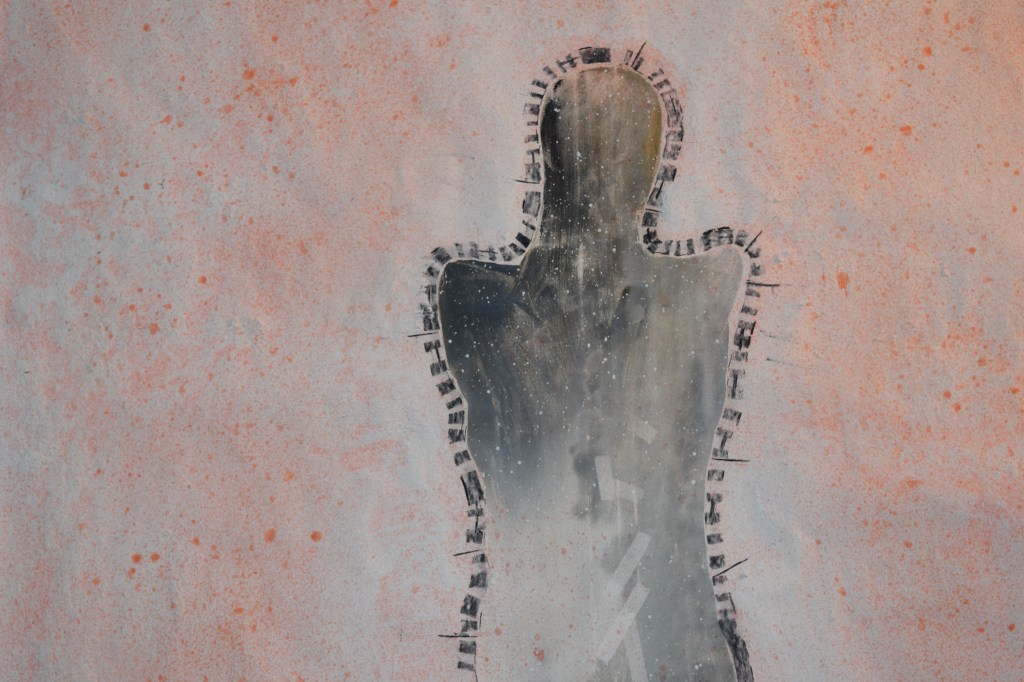
To fully understand how this ethical framework manifests, we must ground these conceptual terms in the specific visual mechanics of the two Leper Grave images. In the first work (image_m1lo_2.png), the upper torso and head of a human silhouette do not exist as a clear, anatomical or indexical record. Instead, they emerge from a misty, highly granular background composed of coral-pink and pale ash-grey textures, applied via an expressive, atmospheric spray technique. This silhouette is strictly bounded by a dark, segmented, dashed perimeter composed of short, vertical painterly black marks. This perimeter performs an intentional dual role: it references the precision lines of an archaeological trench or survey plot, while simultaneously evoking a porous, leaking, and unstable cell boundary. Within the body itself, a deep translucent charcoal wash is speckled with fine white flecks, mimicking starlight, chemical photographic silver halide clusters, or ancestral bone dust. The figure is captured in the absolute act of dissolving into its environmental container.
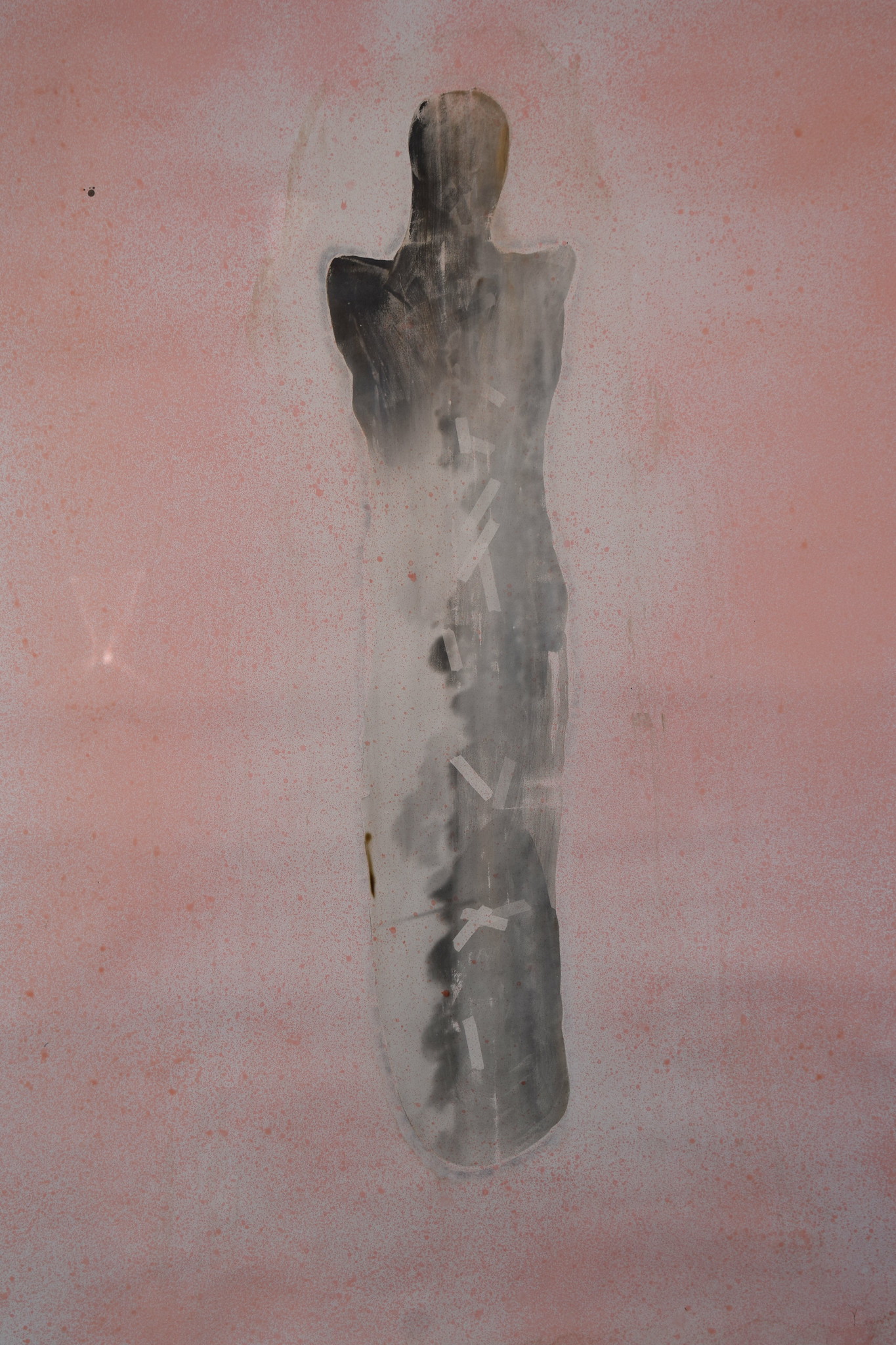
In the second work (image_kmNn_p.png), the full-length figure is drastically elongated, echoing the verticality of a liturgical monument or an unearthed shroud. Here, the torso is a dense, smoky wash of ink-like black-grey tones that gradually thins as it descends. The underlying skeletal armature is completely subverted; rather than drawing anatomically accurate bones, Moreton suggests the spinal column, rib cages, and limbs through white, fragmented, tape-like strips and graphic marks. These strips are layered beneath a milky, semi-translucent glaze that locks them away behind a permanent aesthetic film. The painterly interventions in both works serve as a deliberate deployment of Negative Capability. By layering opacity, raw texture, and graphic abstraction directly over the photographic registration, the hand of the artist disrupts the absolute clarity of the lens. The image ceases to be a transparent record of an unburied skeleton and becomes an architectural threshold that fiercely guards its own historical clarity.
Part III: The Matrix Inversion
This archaeological pressure forces a complete conceptual inversion of Moreton’s spatial vocabulary. His established terminology—focused on site-responsiveness, surface records, and sensate inquiry—reaches an evolutionary breaking point. It must be mapped onto a secondary, deeper movement: Excavation ~ Trace ~ Negative Capability ~ Inhuman Correspondence.
To understand how this ethical framework complicates and deepens the original spatial practice, we can map Moreton’s core concepts directly onto this new movement:
| Moreton’s Spatial Practice Vocabulary | The Evolutionary Ethical Matrix | The Conceptual Shift in the Text |
|---|---|---|
| The Site as Material Relations The space already constituted through historical, atmospheric, and bodily relations. | Excavation The physical cut into the earth that brings remains into a present encounter without making the past fully available. | The site is no longer just a space to be entered or inhabited; it is actively split open, exposing an unbridgeable temporal distance. |
| The Record / Surface The surface acting as a sensate record of a physical force or gesture. | Trace A persistence of bodily or material presence that cannot be equated with the person who has passed. | The indexical mark of the photograph or paint layer stops being an aesthetic record and becomes a haunting fragment of an absent life. |
| The Material Gesture / Process The painterly or graphic mark interwoven as an ephemeral trace of process. | Negative Capability The deliberate holding open of uncertainty, allowing doubt to remain active. | The painterly intervention is re-read as an ethical shield. It actively blocks the camera’s claim of absolute documentation, protecting the subject from historical mastery. |
| Matter(s) in Correspondence How materials, places, images, and bodies enter into accord and wayfare together. | Inhuman Correspondence The acknowledgment that soil, chemical grain, bone, and apparatus all participate in how the past surfaces. | Correspondence shifts from a benign artistic harmony to a radical posthuman assemblage where the non-human elements dictate the limits of human interpretation. |
Through this inversion, the hybrid nature of Painting/Photography: Leper Grave ceases to be a merely formal dialogue between two mediums. The title itself places two distinct modes of making in immediate proximity, signaling that the image must be approached as a friction between photographic registration and painterly intervention rather than a transparent record of an excavation. The painterly mark layered over the photographic registration is the literal execution of Negative Capability. By physically interacting with the photographic surface, the paint introduces doubt, opacity, and abstraction into the indexical clarity of the camera lens. It actively prevents the viewer from resolving the encounter into a definitive historical or psychological account. The artistic gesture shifts from an act of aesthetic mark-making to a rigorous exercise in archival humility.
Part IV: Inhuman Correspondence and the Ethics of Hospitality.
By framing this counter-matrix through Karen Barad’s agential realism, the encounter between the contemporary viewer and the medieval past is revealed as an intra-active phenomenon. The absent body is not a static object waiting to be recovered or salvaged by the camera. Instead, the entire encounter is actively produced through the shifting relations between what remains, what is documented, what is materially altered, and what can no longer be known. The apparatus of the excavation site and the apparatus of the gallery collapse the vast time gap between 2017 and the medieval period, pulling both into a shared, ongoing moment of material becoming.
This posthuman alignment demands a radical redefinition of Moreton’s “correspondence,” shifting it into an inhuman correspondence. Here, human interpretation is stripped of its authority. The soil, the ancient skeletal remains, the chemical grain of the photograph, the wet stroke of paint, the gallery walls, and the responding texts all participate as equal, active agencies in determining how the past becomes perceptible. The human viewer is no longer a detached observer decoding a passive object; they are entangled within a flat ontology where the non-human elements themselves dictate the absolute limits of human understanding.
This material entanglement brings the text to its ultimate ethical crux, raising fundamental questions about memory, representation, and care: How does one receive the trace of another body without claiming possession of its history? How can a material encounter remain attentive to an absent life without turning that life into an object of explanation?
To answer these questions, we must turn to Jacques Derrida’s formulation of hospitality. Derrida draws a sharp, agonizing distinction between conditional hospitality—which is governed by laws, borders, and the mastery of a host who demands that the stranger identify themselves—and absolute, unconditional hospitality. Absolute hospitality requires the host to open their home to the unknown guest (the arrivant) without requiring a name, an origin, or a passport, exposing the host to the radical vulnerability of the unexpected encounter.
The historical reality of Magdalen Hill was a site of the most violent form of conditional hospitality. The medieval leprosarium was an institution built on borders; it hosted the sick only on the condition of their absolute segregation and civic death. The leper was taken in, but their identity was systematically reduced to their pathology, contained physically by the boundary walls of the hospital and socially by their exclusion from Winchester.
The spatial and ethical force of Moreton’s Leper Grave images lies in their radical inversion of this historical economy. The work acts as a visual and material performance of unconditional hospitality. By refusing to render a transparent, anatomically precise skeleton, the artwork performs a profound act of archival care. The camera’s inherent drive toward conditional hospitality—its demand to clear away the mud, expose the bone, document the dimensions, and force the dead body to identify itself as a historical specimen—is actively intercepted by the painterly intervention. The paint serves as a protective threshold. It creates an opacity that shields the deceased from our contemporary gaze.
To receive a trace hospitably in a Derridean sense means resisting the urge to “decode” the leper’s body or turn their historical suffering into a neat contemporary allegory. A careless contemporary reading that seeks to fully explain or aestheticize these remains commits a second, archival exclusion, treating the subject as a conquered territory of knowledge.
Instead, Moreton’s images practice a rigorous humility. By utilizing Negative Capability to hold the image open and unresolved, the work hosts the ghost of the other as a ghost. It makes a material encounter possible while strictly preventing that encounter from becoming an assertion of masterly knowledge. The artwork does not demand that the arrivant surrender their history or explain their trauma to justify their presence in the present. It marks the exact spot where our contemporary comprehension fails, choosing to honor the absent life by leaving its secrets buried safely within the friction of the paint and the grain.
Part V: Conclusion — The Performative Spatial Matrix of Becoming.
The trajectory of Russell Moreton’s Spatial Practice culminates not in a static repository of objects, but in an active, open-ended orchestration of space, history, and matter. By introducing the archaeological realities of the Magdalen Hill Archaeological Research Project into the creative field, the work fractures the traditional boundaries of landscape representation, transforming it into a highly sophisticated, performative spatial matrix. This matrix operates through the intra-active collision of four core vectors: diffraction, hospitality, alienation, and atmosphere. Together, they form an analytical and material framework that does not merely illustrate an encounter with the past, but actively performs its ongoing, unresolved production.
Rather than relying on a reflective paradigm—which seeks to mirror or duplicate a pre-existing reality—Moreton’s practice adopts a diffractive methodology. In a Baradian sense, diffraction maps where effects appear and where lines of interference intersect. The hybrid status of Painting/Photography: Leper Grave is fundamentally diffractive: it allows the indexical registration of the camera, the tactile intervention of the painterly mark, the raw particulate matter of the soil, and the historical record of the leprosarium to pass through one another. The resulting images are physical records of these interference patterns. The silhouettes do not reflect a long-dead individual; instead, they capture the literal diffraction of light, pigment, and historical memory as they collide within the archaeological apparatus. This process ensures that the past is never encountered as an isolated, stable point in time, but as an ongoing material ripple that continues to alter the present.
This diffractive entanglement is what enables the work to perform its radical inversion of hospitality. By refusing to clear away the visual noise or provide a transparent, anatomically complete record of the skeletal remains, the performative matrix directly rejects the conditional hospitality of historical mastery. It does not force the ghost of the leper to identify itself, surrender its pathology, or be categorized by contemporary empirical science. Instead, through the deliberate preservation of opacity and shadow, the artwork enacts a pure, Derridean unconditional hospitality. The canvas and the photographic surface become an open threshold that hosts the trace of the absent body without claiming possession of its history, welcoming the arrivant precisely through a refusal to colonize its secrets.
Simultaneously, the matrix relies on a productive tension between alienation and atmosphere to sustain its ethical force. The spectral, elongated silhouettes operate as sites of profound estrangement. They do not allow for an easy, sentimental empathy; instead, they enforce a sharp sense of alienation that alerts the viewer to the vast, unbridgeable historical and physical distance between our present and the lived reality of medieval exile. Yet, this potential coldness is mediated by the dense, evocative atmosphere of the work—the granular, coral-pink and ash-grey fields, the misty spray-paints, and the translucent layers that evoke the damp, buried weight of the Hampshire earth. This atmosphere is not decorative; it is a sensate heuristic tool that envelops the viewer, pulling their body into a shared material attunement with the site. The atmosphere provides the visceral texture of a presence, while the alienation preserves the radical integrity of an absence.
Ultimately, Moreton’s performative spatial matrix achieves its power by refusing to resolve these conflicting forces. It functions as an ecology of persistent becoming, holding diffraction, hospitality, alienation, and atmosphere in a continuous, vibrant equilibrium. The work demonstrates that a material encounter can remain fiercely attentive to an absent life only by honoring the limits of what can be known. By staging this material humility, Painting/Photography: Leper Grave ceases to be a mere record of an excavation; it becomes a living site of ethical shelter, practicing a hospitality that remembers the excluded dead by leaving their traces beautifully, securely unresolved.
Appendix A: Gallery Exhibition Wall Text
Russell Moreton
Painting/Photography: Leper Grave, 2017
Mixed Media on Photographic Print
Developed in dialogue with the University of Winchester’s Magdalen Hill Archaeological Research Project (MHARP) for the exhibition ‘Negative Capability Part I’ (July 2017).
Moreton’s works enact what he calls ‘Spatial Practice’—an exploration of site not as an empty landscape, but as an ongoing correspondence of materials, temporal layers, and bodies. Emerging from direct observation of the excavation of a medieval leprosarium, these spectral silhouettes subvert the traditional camera’s drive to clear, identify, and empirically conquer the historical dead. Through spray texture, charcoal glazes, and fractured graphic armatures, Moreton invokes John Keats’s concept of Negative Capability: a deliberate holding open of doubt and uncertainty.
In a radical performance of what Jacques Derrida defined as unconditional hospitality, the painterly marks act as a protective threshold over the photographic trace. By preserving the opacity of the skeletal remains, the images host the presence of the historically excluded body without demanding its identity or transforming its historical trauma into an object of contemporary mastery. Here, bone, soil, chemical grain, and wet pigment wayfare together—refusing reflection in favor of a profound material diffraction.
Appendix B: Public Presentation / Symposium Script
[Slide 1: Title Slide – Painting/Photography: Leper Grave]
Good afternoon. Today I want to discuss a profound intersection of contemporary art, archaeological science, and critical theory found in Russell Moreton’s 2017 series, Painting/Photography: Leper Grave. This work emerged through Negative Capability Part I, an exhibition staged in July 2017 that directly responded to the University of Winchester’s Magdalen Hill Archaeological Research Project. Moreton’s methodology centers on Spatial Practice, defined as ‘attentiveness as a sensate heuristic inquiry.’ For Moreton, a site is never neutral; it is an active web of historical, atmospheric, and bodily relations. When the artistic body confronts the archaeological apparatus, the baseline harmony of artistic landscape mapping undergoes an ethical and material rupture.
[Slide 2: Image Breakdown – image_m1lo_2.png and image_kmNn_p.png]
Let us look directly at the visual mechanics of these two images. In the first slide, we see a silhouette emerging from a highly granular, coral-pink and ash-grey field. It is bordered by a heavy, dashed black perimeter. This perimeter mimics the strict grid lines of an archaeological trench, yet it functions as a leaking, unstable bodily boundary. The interior of the torso is a dark charcoal wash flecked with white starlight or bone dust. In the second work, the figure is drastically elongated, resembling a shroud. The spinal armature is suggested not by anatomical sketches, but by white, fragmented, tape-like strips sealed beneath a milky glaze. This hybrid technique introduces an essential friction: photography claims to document the indexical truth of ‘what was there,’ while the painterly mark introduces opacity, abstraction, and shadow.
[Slide 3: Theoretical Framework – Barad and Derrida]
To theoretically frame this intervention, we must move past simple representation and deploy a counter-matrix: Excavation ~ Trace ~ Negative Capability ~ Inhuman Correspondence. Following Karen Barad’s agential realism, the excavation is not a passive uncovering of the past; it is an active cutting into the earth that produces a new material configuration. Soil, bone, chemical grain, and paint enter into an ‘inhuman correspondence’ where human interpretation loses absolute authority. This brings us to Jacques Derrida’s ethics of hospitality. The historical leprosarium at Magdalen Hill practiced a severe, conditional hospitality: it hosted the sick only on the condition of absolute exile and civic death. Moreton’s spatial matrix radically inverts this economy. By utilizing Negative Capability to keep the figure unresolved, the artwork performs an unconditional hospitality. The painterly glaze acts as a protective shield, hosting the trace of the other without demanding its name, its passport, or its absolute surrender to contemporary historical explanation. The work honors the dead precisely by leaving their secrets safely buried within the paint. Thank you.
Selected Bibliography
Barad, Karen. Meeting the Universe Halfway: Quantum Physics and the Entanglement of Matter and Meaning. Durham: Duke University Press, 2007.
Derrida, Jacques, and Anne Dufourmantelle. Of Hospitality. Translated by Rachel Bowlby. Stanford: Stanford University Press, 2000.
Keats, John. ‘Letter to George and Thomas Keats (21, 27 December 1817).’ In The Letters of John Keats, edited by Maurice Buxton Forman. Oxford: Oxford University Press, 1935.
Moreton, Russell. ‘Spatial Practice and Matter(s) in Correspondence.’ Artist Research Statement and Portfolios. Accessed October 2026. https://russellmoreton.com/.
University of Winchester. Magdalen Hill Archaeological Research Project (MHARP). Department of Archaeology, Anthropology and Geography. Project archives and excavation reports (2017).
Winchester School of Art / Gallery Records. ‘Negative Capability Part I: Visual and Textual Responses to MHARP.’ Exhibition catalogue, hosted on Flickr (Exhibition run: 18 July 2017 – 25 July 2017).


Leave a Reply