Spatial Body Proposition : Body-as-site → body-as-host → hosting permeability
Permeability allows passage.
Hosting allows correspondence.
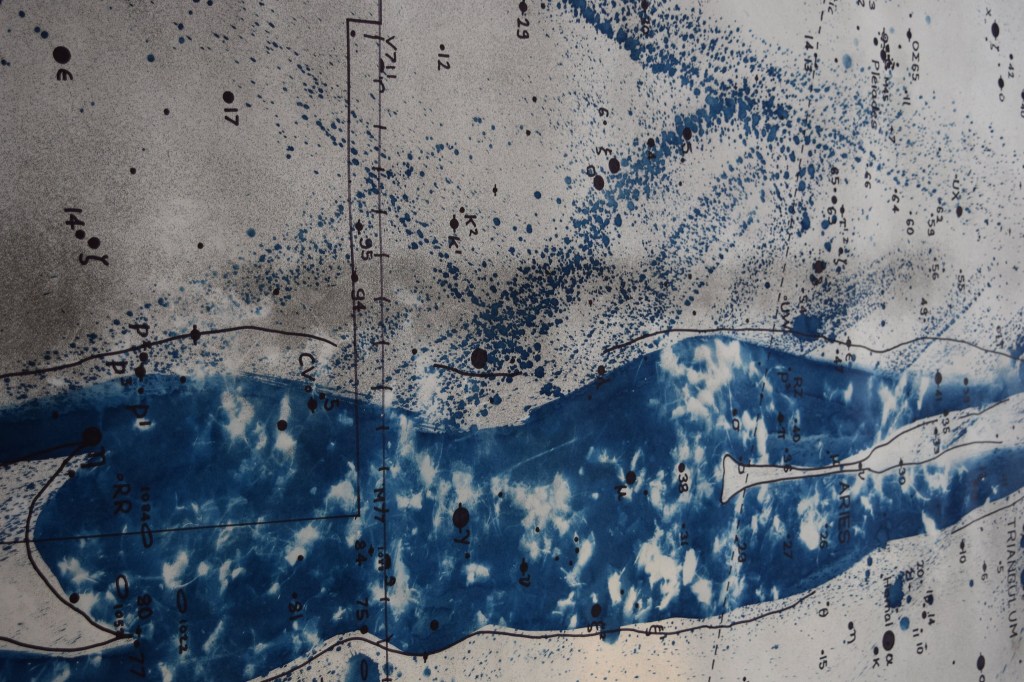
Panspermia begins with a body that cannot quite contain what passes through it. Cyanotype, botanical trace, hand-drawn line and celestial mapping gather upon the same fragile surface, each carrying a different temporality. The body becomes a host rather than a boundary: something is deposited, something seeps, something remains, something exceeds. Read through the present practice, the work begins to open onto permeability—the body as a threshold through which other bodies and traces can pass. What appears as an image of finality becomes, instead, a strangely persistent field of correspondence.
The trace begins as an indication of a body, but gradually becomes something else: a spatial body in its own right. Cyanotype, drawn mark, mapped surface and atmospheric residue gather until the figure can no longer be understood simply as an outline. The body begins to host what exceeds it.
What happens when a trace becomes capable of hosting other bodies?
The cyanotype does not merely register contact. It spreads, absorbs, pools and occupies. The surface becomes a field of movement in which body, image, material and atmosphere enter correspondence.
Perhaps permeability is not simply the capacity to let something through. Could it also be a capacity to receive what arrives?
The body becomes less a boundary than a threshold. It gathers without entirely containing. It allows other matter(s) to become perceptible without reducing their difference. Trace becomes atmosphere; atmosphere becomes spatial relation.
Body-as-site begins to become body-as-host.
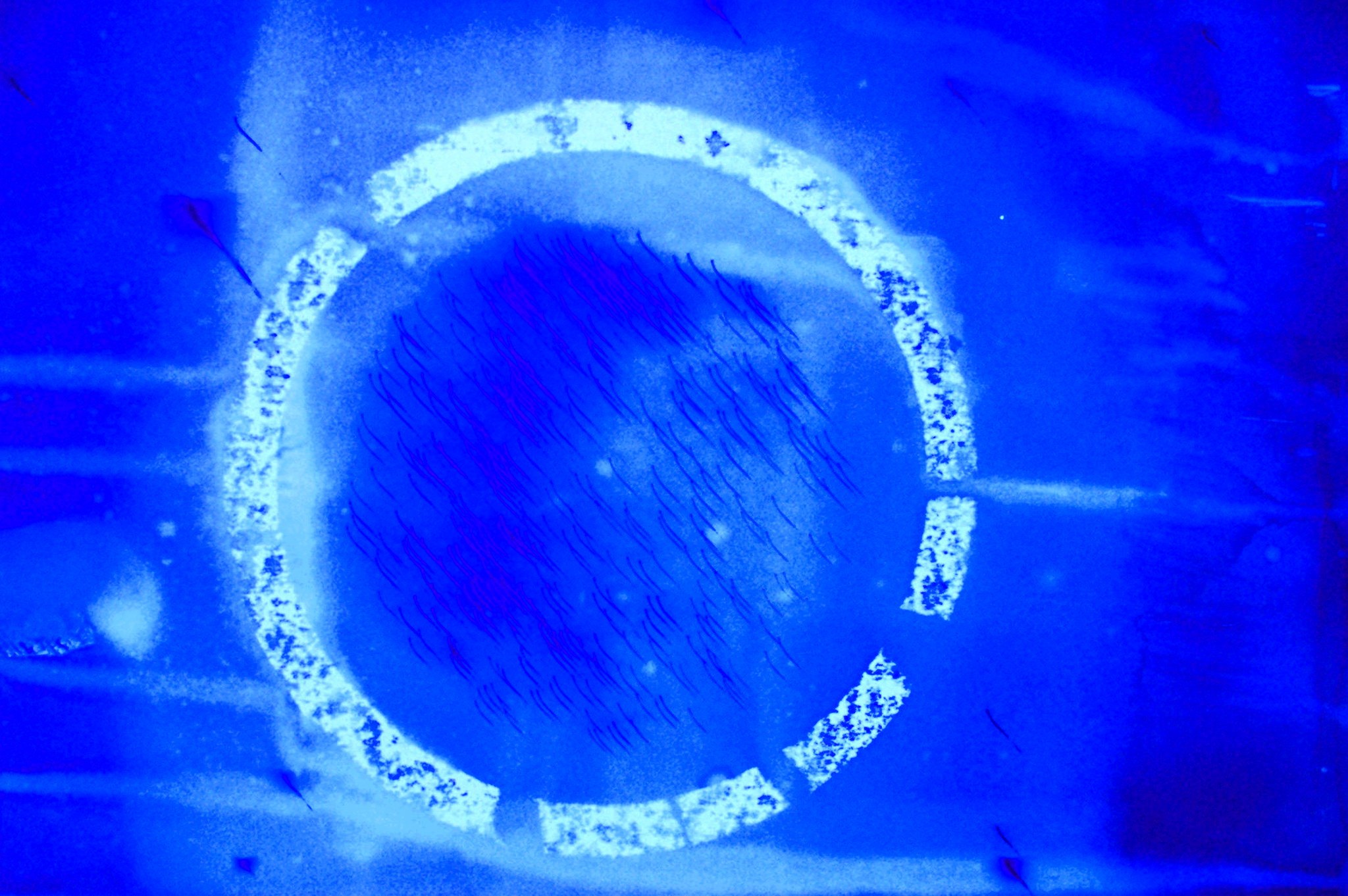
In the circular body, the boundary becomes particularly ambiguous. The marked perimeter establishes an enclosure while simultaneously opening onto an interior that seems to continue beyond the image. The drawn marks within it do not simply describe an interior; they activate it. The surface begins to feel like a chamber without walls.
Could the chamber begin before enclosure?
Could it emerge through the correspondence of bodies, surfaces, traces, pressures and atmospheres?
The spatial body is therefore not simply something represented within an image. It is produced through the relations gathered across the surface.
Trace → body → host → atmosphere → permeability.
What begins as an index of presence becomes a proposition for encounter: a body capable of receiving, carrying and transforming what comes into contact with it.
The spatial body does not contain its correspondences.
It hosts them.
What else might this body become capable of hosting?
Looking at Panspermia (2010) again alongside the recent work on Gathering Towards A Futurity through Clay, The Ceramic Body…Permeable Chamber, the frottages and In~~Touching, I think the original text contains something that is now much more important than it appeared at the time.
The work was initially described as a body containing traces, mappings and meanings. I think we can now see it differently: the body is itself a permeable host, a threshold through which different material and temporal bodies pass. The cyanotype does not simply occupy the drawn body; it exceeds it. The astronomical map does not simply describe the body; it passes through it. The date fixes the body while the cyanotype, botanical trace and celestial markings undo that fixity.
So I would retain much of the original thinking, but allow the vocabulary of trace, seepage, correspondence, permeability, host body, absent presence and futurity to become more active.
Panspermia : revised text 2026.
THE PHYSICAL
THE EMOTIONAL
THE CONCEPTUAL
First Intention (noun, medicine): the healing of a wound through the natural contact and joining of the parts involved.
Fecundity. Fertility. Creativity. Inventiveness. Fruitfulness. Productiveness.
What response within one’s subjectivity creates the desire—and perhaps the necessity—for something to become embodied, to be brought into the realm of things?
CREATIVE POST-MORTEM — 19.08.2010
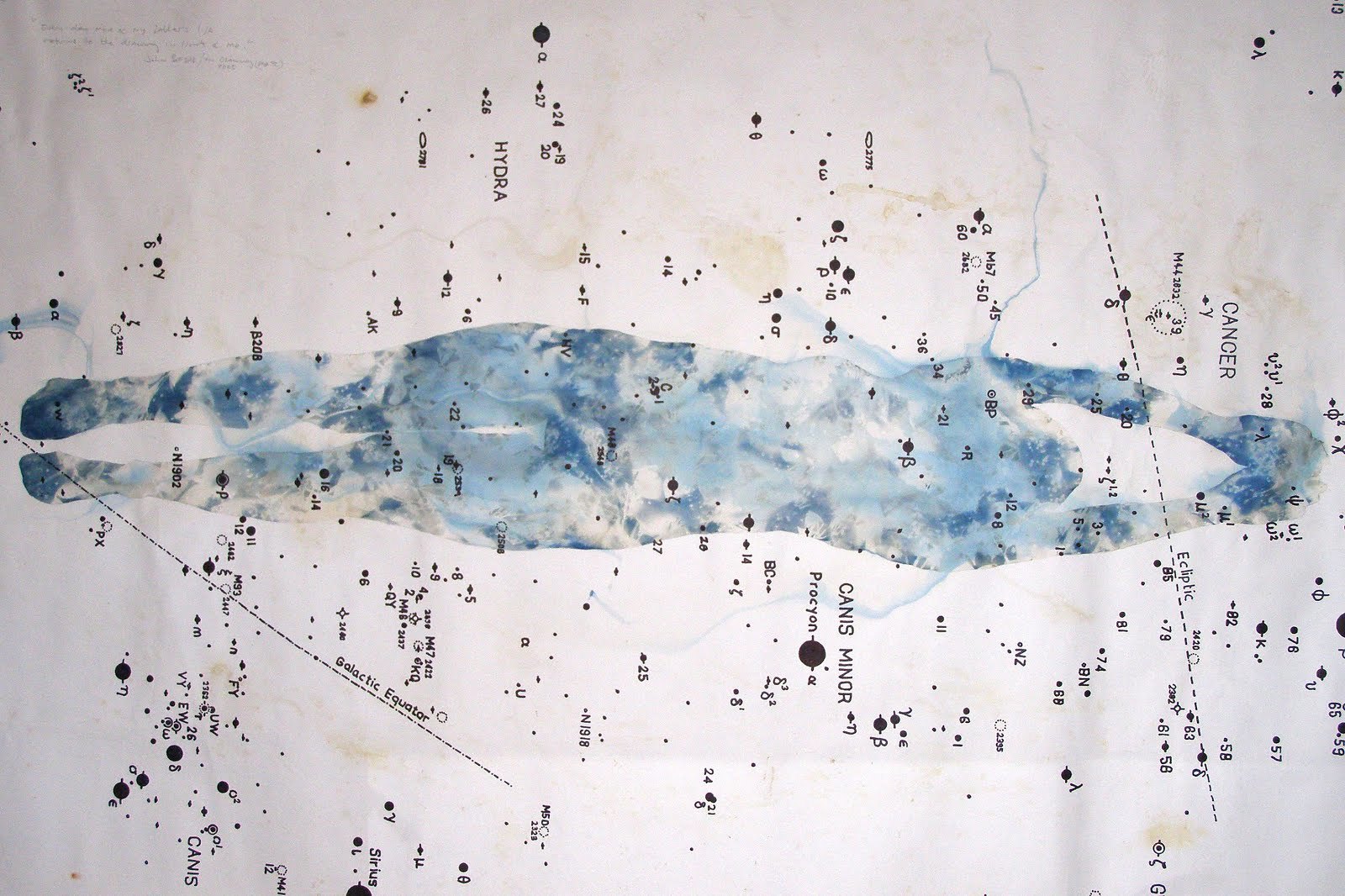
A life-size outline of a female body is drawn onto lightweight Chinese paper, positioned as if making passage through a fluid. The body is tensioned: arms extended and joined above the head, feet together, suspended between propulsion and descent. It seems caught within a moment that cannot quite decide whether it is moving forwards or sinking backwards.
The drawn body becomes a host for other matter(s).
Parts of the figure are occupied by the blue photographic material of cyanotype. Seed heads placed directly against the paper leave floral impressions through contact, displacement and exposure. The botanical traces do not simply fill the body. They interrupt it.
The cyanotype seeps.
Its fluidity encounters the absorbency of the paper and begins to exceed the territory established by the drawn trace. The boundary of the body therefore becomes unstable. What appears at first to be an outline becomes a permeable threshold through which another material body enters, spreads and withdraws.
Within the traced figure are areas untouched by the cyanotype. These apparently barren spaces become strangely active. They are not simply absences or empty ground, but intervals within which different temporalities remain perceptible. The cyanotype records an event of exposure and contact, while the drawn line appears to hold another kind of persistence.
Two registrations occupy the same surface.
One flows.
One fixes.
Neither completely contains the other.
The residues of the cyanotype gather into channels and collect towards a reservoir at the foot of the figure. Against this movement, the black marker line establishes a temporary permanence. Two backslashes interrupt the trace, marking the apparent closure of the performance, followed by the precise date: 19.08.2010.
The date appears almost forensic. It might recall the labelling of a mortuary body, fixing a moment after which the body can only remain as trace. Yet this fixing is immediately troubled by everything that continues to move across and through it.
The body is absent and present at once.
It survives as an index.
The astronomical markings intensify this condition. Visible only within the territory of the body, and apparently inscribed from the reverse side of the paper, they resemble tattoos, diagrams or another form of writing upon the body. They introduce a cartography that does not originate with the body itself.
The body becomes a host.
It carries information that exceeds its own authorship, its own duration and perhaps its own comprehension. The celestial markings pass through the traced figure as another body of knowledge, another temporality, another way of locating existence.
The human body is therefore no longer simply the subject of the image. It becomes a site of correspondence.
Terrestrial trace meets celestial mapping.
Botanical matter meets photographic chemistry.
Hand-drawn line meets fluid movement.
Presence meets absence.
Body meets cosmos.
The astronomical marks seem to extend the body beyond itself. They locate it within another field of relations, where the temporality of the individual body is only one duration among many.
This is where the title Panspermia begins to become significant.
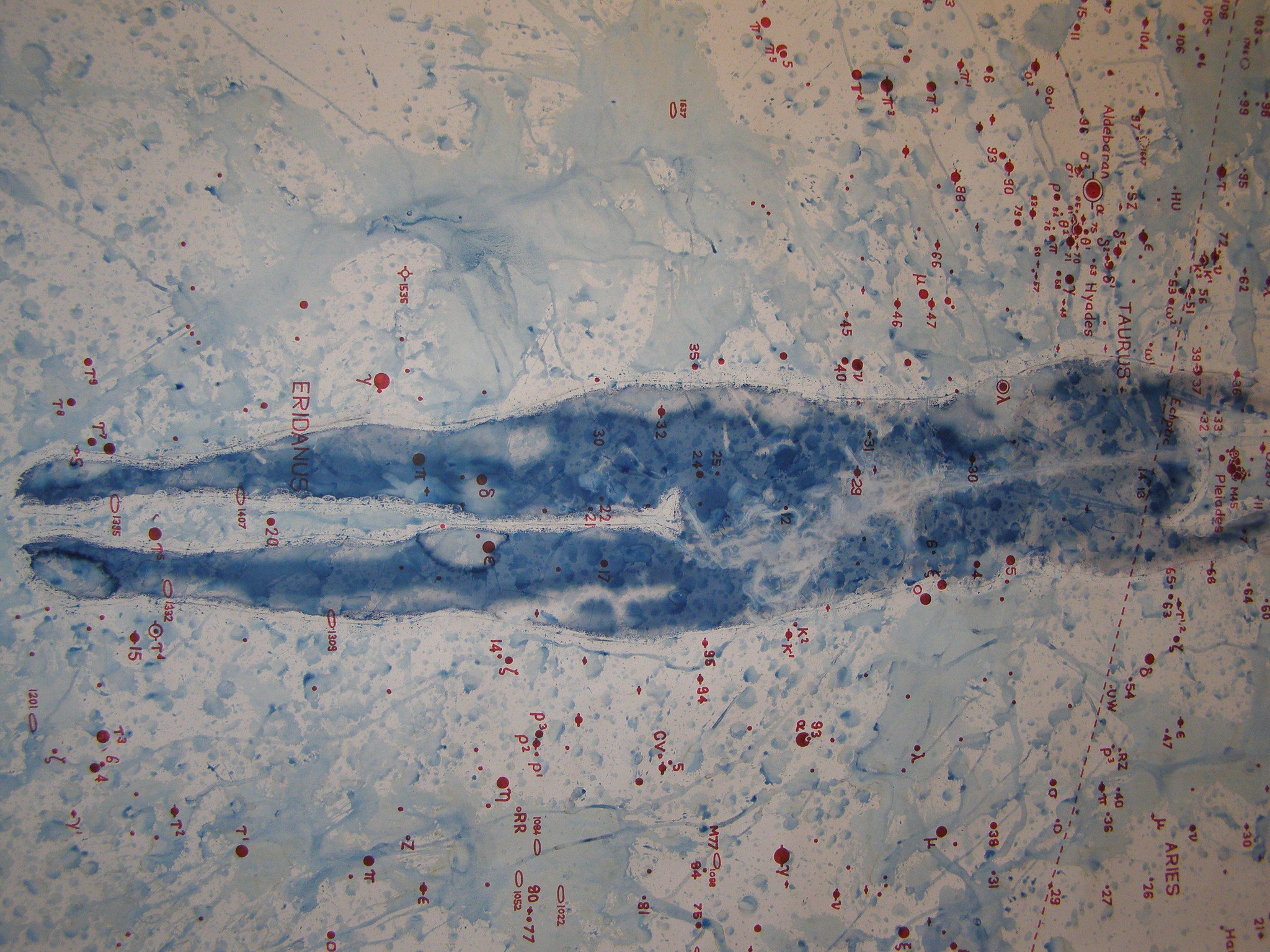
Rather than suggesting a simple transmission of life, the work can be approached as a proposition about the movement of matter, traces and possibilities between bodies. Something is carried. Something is deposited. Something exceeds its host. Something remains after the body that carried it has withdrawn.
The cyanotype is particularly important here because its movement is not entirely controllable. It registers contact, but also produces its own trajectory through the material conditions of paper, fluidity, absorption and drying. The botanical trace is therefore neither wholly imposed nor wholly received.
It is a correspondence.
The work’s fecundity lies within this instability.
What appears to be a fragile body becomes a field through which other bodies can pass.
The inherent finality of the human condition is therefore not simply measured and mapped. It is troubled by the persistence of other matter(s). The body may be finite, but the traces moving through it are not necessarily contained by that finitude.
The work resembles a shroud, but perhaps it is also an aperture.
A body marked by what has passed through it.
A surface carrying what it cannot entirely contain.
A host whose identity is continually altered by its correspondences.
The body becomes less a boundary than a permeable chamber: a temporary spatial condition where traces, materials, memories, mappings and temporalities gather without becoming one thing.
What is gathered is never simply contained.
It reverberates.
In Panspermia, the body is a host for traces. Here, the trace seems to have become increasingly spatialised. The cyanotype is no longer simply marking a body; it produces a field through which the body, diagram, atmosphere and surrounding space become difficult to separate. The circular image especially feels less like an image of an enclosed body than a spatial body with an active threshold.
A body appears, but it does not remain entirely its own. Botanical traces, photographic fluids, celestial markings and the drawn line gather across its fragile surface. The cyanotype seeps beyond the territory of the figure, while the astronomical markings seem to pass through it from another side. The body becomes a host for other bodies.
What happens when a boundary begins to host what exceeds it?
The question is not simply where the body ends, but what begins to happen when other matter(s) enter, pass through and alter its territory. The body becomes atmospheric: not an enclosure, but an immersive condition of correspondence.
Can an atmosphere be produced through the correspondence of bodies rather than exist around them?
Here, trace becomes more than registration. It becomes a movement between bodies—seed, paper, light, fluid, hand, image, celestial map, memory. Each leaves something behind while carrying something elsewhere.
The host does not simply contain. It is changed by what it hosts.
The figure is therefore neither wholly present nor absent. Its outline fixes a body even as the materials moving through it undo that fixity. What appears as a final marking becomes another opening.
Body-as-site becomes body-as-host.
And perhaps the host becomes something stranger still: an immersive atmosphere of corresponding bodies, a temporary spatialisation in which nothing is quite contained by the thing that carries it.
What is gathered is never simply contained. It reverberates.
body → trace → seepage → host → atmosphere → correspondence → question → opening → futurity
Why I think this is a significant re-entry into the work
There are three shifts here that seem particularly important to the current practice.
- From body-as-site → body-as-host
The original ending says:
“the body as a site.”
That remains useful, but the current work has moved further. The body is not simply a site upon which things are mapped. It hosts relations that alter it.
That connects directly to your present proposition:
The Ceramic Body is an actively Attentively~Troubling Permeable Chamber.
The Panspermia body is an early version of this proposition, although it is not yet ceramic.
- From trace-as-record → trace-as-active body
The cyanotype is not merely evidence of what happened. It has its own material agency. It seeps, accumulates, leaves residues and exceeds the drawn boundary.
That makes the work surprisingly close to your present understanding of clay troubling the gathering.
The seed head touches paper → the cyanotype registers contact → the fluid moves → the boundary is exceeded.
The later trajectory becomes:
frottage → collage → clay → firing → ceramic
Each stage asks what happens when one body encounters another.
- From finality → futurity
The original text is strongly concerned with mortality and the finality of the human body. I would not remove that. But I would allow another possibility to emerge alongside it.
The body is dated and apparently fixed.
Yet the material traces continue.
The astronomical markings exceed the body.
The botanical traces exceed the outline.
The cyanotype exceeds its intended territory.
So the work contains a small contradiction:
The body is finite, but what passes through the body may continue.
That is where I think futurity can enter the 2010 work without imposing the current practice upon it.
The work doesn’t need to be retrospectively declared a work about futurity. Rather, the current practice has discovered a futurity that was already latent in its material behaviour.
And that is exactly the kind of anarchival correspondence I think you are now looking for: not correcting the old work, but allowing it to become capable of touching the present.
 Russell Moreton : Matter(s) in Correspondence
Leave a comment