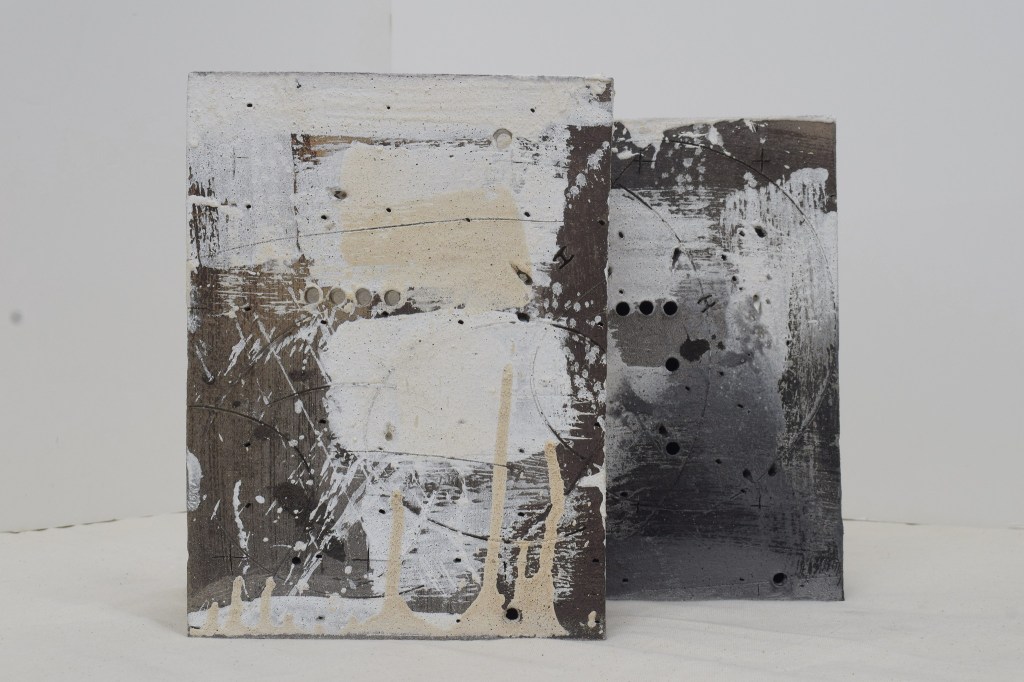
Towards an Elaborative Spatial Practice
For Moreton, the withdrawn ceramic body is not where the research ends. It is where the research acquires another capacity for futurity.
Moreton’s spatial practice has developed through an extended gathering of bodies: architectural, material, photographic, textual, remembered, imagined and lived. These bodies have emerged through different situations and periods of working, including interiority, landscape, drawing, walking, architectural research, teaching, image-making, reading and the exploratory use of clay. They do not form a linear research history. Rather, they remain as propositions capable of returning, entering new relations and becoming otherwise.
The practice therefore begins not from a singular question requiring resolution, but from a multiplicity of questions that remain active through making. Earlier speculative spatial practices are not treated as completed stages through which the ceramic practice has subsequently progressed. They remain research bodies. Their propositions continue to have a capacity for encounter.
The ceramic bodies have not arrived to resolve these earlier questions. They have arrived as another access point.
This access point is significant because clay introduces a particular material condition through which multiplicity can gather. The recent work with clay allows architectural propositions, spatial memories, images, readings, bodily experiences, surfaces, apertures and material encounters to enter the same field without requiring them to become equivalent. Clay does not reconcile their differences. It provides a hospitable condition in which their differences can remain active.
This hospitality is important to Moreton’s developing spatial practice. It is not hospitality as an invitation into a predetermined interior. It is a more unstable form of hosting in which the host itself is changed by what it receives. Clay receives pressure, touch, resistance, gesture, force, moisture, gravity and time, but it does not simply register these things passively. It transforms them. The material becomes an active correspondent within the making.
The clay body therefore becomes a meeting place for other bodies.
The architectural body can enter it through proportion, enclosure, aperture, threshold and spatial memory. The photographic body can enter through trace, viewpoint, absence and the persistence of an earlier encounter. The textual body can enter through propositions, questions and speculative language. The remembered body can enter without being represented. Landscape can enter through weather, erosion, surface and movement. Other theoretical and artistic bodies can enter as correspondents rather than authorities.
None of these bodies needs to be reduced to the ceramic.
They remain themselves.
This is where Moreton’s spatial practice begins to move towards a practice of correspondence. The ceramic body does not become a container for research. It becomes a material condition through which different research bodies can encounter one another.
Multiplicity becomes correspondence.
The distinction is important. Multiplicity describes the presence of many bodies; correspondence describes what becomes possible between them. The ceramic does not gather in order to produce unity. It gathers in order to produce relation.
This also changes the understanding of the ceramic object. The fired ceramic is materially withdrawn from the provisionality of clay, but this withdrawal should not be understood as closure. Firing changes the condition of the material. What was soft, responsive and unstable becomes persistent. The provisional relations of making become materially carried forward into another state.
Pressure becomes surface.
Resistance becomes form.
Aperture becomes interior.
Gesture becomes trace.
Fire becomes transformation.
Ceramic becomes persistence.
Yet what persists is not simply the object.
Something of the correspondence persists with it.
The withdrawn ceramic body therefore occupies an unusual position within the spatial practice. It is withdrawn from the immediate event of making, but not withdrawn from relation. It carries the consequences of previous encounters into situations that have not yet happened. Its persistence makes another encounter possible.
This is where futurity enters.
Futurity, within Moreton’s practice, is not the prediction of what the ceramic will become. Nor is it an image of an imagined future. It is the capacity of a materially persistent body to enter another relation.
The ceramic waits.
It waits for architecture, for light, for another body, for proximity, for movement, for an altered viewpoint, for memory, for an encounter that cannot yet be known.
The future therefore exists not as a destination but as an interval of possibility.
This understanding also extends Moreton’s distinction between inplace and inplay. A spatial proposition cannot simply be transferred intact from one situation to another. Its physical components may persist, but its spatial proposition emerges through changing relations between architecture, ceramic, bodies, light, proximity, movement and atmosphere. The work remains spatially active when these relations remain capable of being re-entered.
The ceramic body consequently becomes a form of spatial persistence without becoming a fixed spatial meaning.
The same ceramic body can become another spatial body.
The same architectural body can produce another spatial proposition.
The same research body can enter another material condition.
This is why earlier exploratory research can remain relevant without being retrospectively converted into a predetermined origin story. The Waverley project, interiority research, architectural investigations, drawing, photography, landscape, teaching and reading do not need to be explained as steps towards ceramics. They remain active bodies whose propositions can now be furthered through clay.
The ceramic does not rewrite them.
It gives them another access point.
This access point also makes possible a different understanding of the archive. Rather than preserving research as a chronology of completed ideas, Moreton’s archive becomes a field of potential correspondence. Earlier texts, images and projects can encounter later ceramic bodies, while later making can return to earlier propositions without needing to reproduce them.
The archive becomes anarchive.
What was once speculative can become material.
What was once architectural can become corporeal.
What was once an image can become a spatial interval.
What was once a question can become an aperture.
What was once unfinished can remain unfinished, but acquire another body through which to continue.
This is not a movement from immaterial thought towards material resolution. It is a continuing movement between bodies.
Here, making becomes a form of spatial thinking. Clay does not illustrate an idea already formed elsewhere. The material encounter produces further thought. Resistance changes the proposition. The hand changes the surface. The surface changes the perception of the body. The body changes the spatial proposition. Fire changes the material condition. The fired body then enters another spatial situation.
The process is therefore recursive rather than sequential:
gathering ~ making ~ correspondence ~ withdrawal ~ encounter ~ futurity ~ gathering again
Within this movement, the ceramic body becomes neither object nor conclusion. It becomes a withdrawn spatial~practising body: materially persistent, relationally open and capable of carrying multiple research bodies into future encounters.
The body withdraws.
The correspondence continues.
The research remainsinplay.
And perhaps this is the deeper proposition of Moreton’s spatial practice: that making does not necessarily produce knowledge by resolving what is unknown. It can produce the conditions through which the unknown remains capable of becoming something else.
The withdrawn ceramic body is therefore not where the research ends.
It is where the research acquires another capacity for futurity.
The ceramic persists, but it does not close.
The earlier bodies remain different.
The spatial propositions remain open.
And what has been gathered is never simply contained.
It reverberates.


Leave a comment