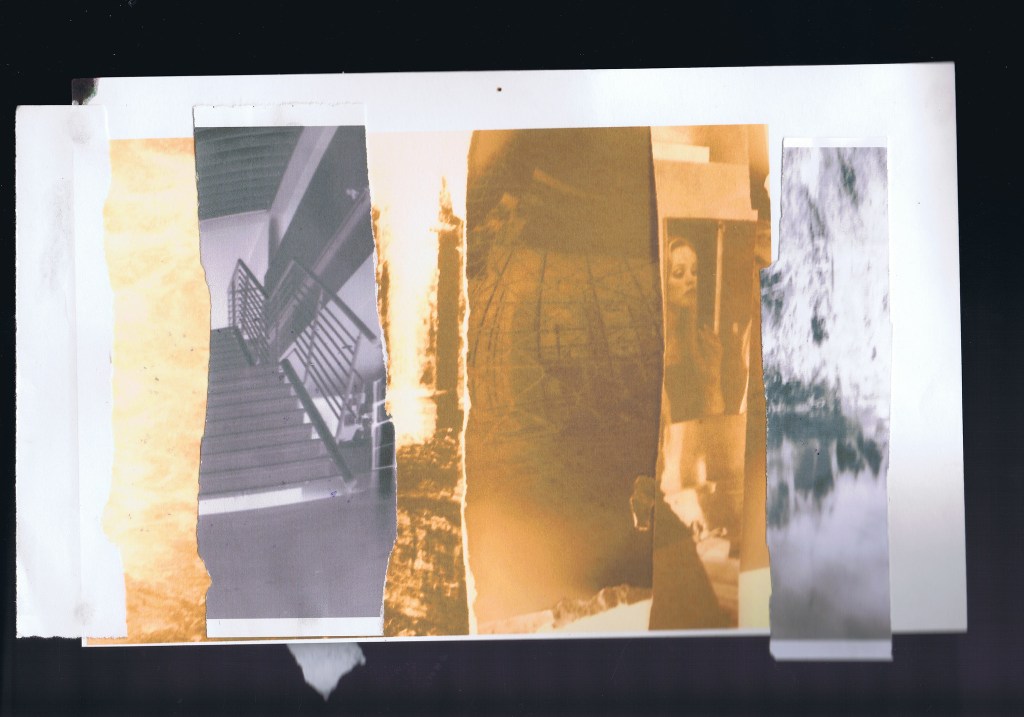
Enchantment and Sites of Sensual Engagement : Periphery/Boundaries and their limits.
Outpost 140323
Wonders On The Periphery Of living.
Archival / Anarchival
Archival — but particularly rich as an anarchival proposition.
This post is broader than the drawing cluster and should remain Spatial Practice. It already brings together enchantment, wonder, Merleau-Ponty’s intertwining, sensual engagement, material transformation, Raveningham, Ingold’s landscape without objects and a critique of hylomorphic thinking.
The crucial passage for the present practice is the idea that the body and world share the same flesh, followed by the movement towards “Sculptural Spacings/Bindings,” material transformation, movement, thought and body.
The clay/mould passage is also remarkably relevant now: clay and mould are described as communicating a resonating action rather than the mould simply imposing form upon passive matter.
Migration entry
From enchantment as experience towards correspondence between bodies, materials and worlds.
This post becomes a particularly strong precursor to In~~Touching because it already troubles the distinction between subject and environment.
Anarchival note
The important migration is not “enchantment → ceramic enchantment.”
It is:
wonder → attention → bodily intertwining → material reciprocity → correspondence.
The post’s “landscape without objects” is particularly productive now. It opens a way of thinking about the ceramic body without reducing it to an autonomous object.
The ceramic can participate in an ecology of bodies.


The Wonder Of Minor Experiences.
A Brief Phenomenology of Enchantment.
Enchantment entails a state of wonder, and one of the distinctions of this state is the temporary suspension of chronological time and bodily movement. To be enchanted, then, is to participate in a momentarily immobilizing encounter; it is to be transfixed, spellbound.
Jane Bennett.
The moment of pure presence within wonder lies in the object’s difference and uniqueness being so striking to the mind that it does not remind us of anything and we find ourselves delaying its presence for a time in which the mind does not move on by association to something else.
Philip Fisher.
The dialectical principle of the intertwining of the world and the self.
My body is made of the same flesh as the world, this flesh of my body is shared by the world and the flesh of the world or my own is a texture that returns to itself and confirms to itself.
The Intertwining-The Chiasm.
The Visible and the Invisible.
Merleau-Ponty.
The Concept Of Sculpting Invisible Materials.
Intervals/Sequences/Iterations : Between Drawings/Templates/Prototypes.
The Eyes Of The Skin.
Critics of Ocularcentrism.
Juhani Pallasmaa.
Merleau-Ponty speaks of the ontology of the flesh as the ultimate conclusion of his initial phenomenology of perception. This ontology implies that meaning is both within and without, subjective and objective, spiritual and material.
Richard Kearney.
Sculptural Spacings/Bindings.
Creativity, materials/matters of concern caught around the creative act of a self amongst others.
Temporal Interrelations.
Adaptive Bridging Strategies.
Playing with materials, to bring forth the synergies of thinking/making/imagination.
Working so as to form or ‘seed’ gaps amongst the process of exploration.
The display of agency, of un-learning perspectives, discontents, alterity and literal landscapes.
Sites of sensual engagement through alternative forms of individual and social participation.
Energies, entropic to living things.
Natures/Intellectual Spaces.
Indexical Traces/Flows of Energy.
Artists/Makers on the process of material transformation, mobility, thought, body, through an embodied/subjective/multisensory experience.
Raveningham, allows the thinking of the existential qualities of natures materials in an intimacy/nowness with the natural world. An enmeshed world, working on natures terms, of movement, change, life, growth, and decay.
For Olafur Eliasson, the practice sets out to examine the way an embodied sense of a place can be restructured as a function/site of a sculptural spacing that questions ideas around embodiment, perception, architectural programming.
The landscape without objects/without hylomorphic thinking.
Tim Ingold.
The Periphery.
Frontiers and their Disappearance.
Borders and Limits.
Wim Nijenhuis.
Individuation, the process of ‘becoming something’ and the ‘being there’ of ‘something.’
Modern information theory claims that both the clay and the mould are engaged with matter and form. The clay is in a metastable state that possesses potential energy, unevenly distributed, but capable of effecting a metamorphosis. This quality of the clay is the source of its form. The mould places a limit on the expanding form of the molecular organisation of the clay as it fills the mould. The mould does not form the clay passively, but communicates a resonating action throughout the clay that alters the clay’s molecular organisation.
Paul Virilio, distinguishes two orders around the frontier, that of place, characterised by a stability of form, and that of speed, characterised by the fading of form.
Primarily the city is formed and informed by heterogeneous speeds, by the difference between inertia and traffic, the form of the city is thus finally an unstable effect. The city exists through traffic in all its forms.
Keywords : Vectorisation, Distinctive Oppositions, Hylomorphic Schema, Form-Matter-Model, Place, Speed, Inertia, Traffic,
New Figure/Grounds.
Geometric marks, vectors across a surface that might suggest some opaque system of musical notation, of points/notes connected forming a constellation of lines and angles. Workings on and between that are synonymous with the field/environ of the canvas, in such a way as it is no longer possible to speak of the classical figure ground relationship.
The Luminescence of Space.
Towards a more delimited spatial conception, a loss of centre.
Charles Maussion.
Rethinking, gestural, expressionistic, lyrical abstractions, atmospheric figuration.
Enchantment begins at the periphery, where the certainty of boundaries starts to loosen. Body and world share a flesh; material and thought begin to move together. The site is not a background to experience but an active body within it. Clay enters this field as something capable of responding, resisting and transforming. To become attentive is therefore to become susceptible: to allow other bodies, materials, forces and atmospheres to alter the conditions of one’s own encounter.
Keywords : Colour Field Painting, Lucio Fontana, Mark Rothko, Orhon Mubin, Spatial Conception,
The body as a body of relations — the body is encountered through gaze, screen, drawing, surface, movement and spatial intertwining rather than as a stable subject.
Looking as sensation — seeing becomes embodied and material; drawing registers movement, volume, skin, surface and the sensation of encountering another body. The ceramic vessel enters this same bodily vocabulary through neck, shoulder, hip, foot, containment and touch.
Drawing the body / luminescence of space — figure and ground begin to dissolve; drawing becomes a way of registering movement, memory, atmosphere and corporeal traces rather than depicting a fixed body.
Situated surfaces — the haptic, peripheral and sensual become ways of knowing. The surface isn’t merely something seen; it becomes something encountered through the body.
Enchantment — this perhaps gives the cluster its unexpected affective charge. Wonder, sensual engagement, the periphery, the disappearance of boundaries, material transformation and an “enmeshed world” all begin to move away from the body as an isolated human subject.
I think the cluster is really about the body becoming porous
That feels important in relation to what you have just been saying about In~~Touching.
The earlier posts begin with something like:
the human body → the body of the other → the body of the image → the surface → the site → the material → the atmosphere
And eventually:
body ~ body ~ body ~ body
That is a very different trajectory from simply saying that you are interested in embodiment.
The body is progressively de-centred.
In Confronting the Human Body, you are already questioning the stability of the body through Lacan’s split between eye and gaze, then moving toward “palimpsest / involuntary surfaces,” “corporeal intertwining,” “bodyscapes / movements / materials.”
Then A Sensation of Looking takes this further: the line becomes an extremity of volume; drawing becomes a conduit for sensation; the vessel itself acquires bodily language.
And Enchantment almost releases the body from being exclusively human. Merleau-Ponty’s intertwining, the flesh of the world, sensual sites, material transformation, nature, clay, landscape and the disappearance of boundaries begin to produce an ecology of bodies.
That is very close to where you are now.
So I wouldn’t call this simply a “body cluster”
I’d perhaps call it:
Bodies in~~Touching
or, more quietly:
Other Bodies
But I think Bodies in~~Touching has something.
Because In~~Touching changes the proposition. It doesn’t mean that the artist touches an already-existing body. It suggests that bodies come into being through contact, proximity, sensation, resistance and exchange.
And this is where your current ceramic work can enter the older material.
The earlier drawing is already concerned with surfaces, traces, bodies, looking and movement. The enchantment text already speaks of material transformation and an “enmeshed world.” The situated-knowledge text brings hapticity and peripheral perception into spatial experience.
The ceramic body doesn’t abandon this history.
It gives it another body.
I think this could produce another “room” before the main text
And I would make this one slightly different from the opening In~~Touching passage you just developed.
Perhaps:
Other Bodies
In~~Touching begins where the body is no longer entirely its own.
A body encounters another body: through looking, drawing, surface, movement, proximity, pressure, atmosphere. What appears as a boundary becomes a place of exchange.
The body is not contained by its surface. The surface is where something passes between bodies.
A line touches a figure.
A figure enters a space.
A surface receives a trace.
A trace carries another body.
A body becomes atmosphere.
Drawing, looking and making become ways of sensing these passages. The human body begins to encounter other bodies—not as objects to be observed, but as presences with which it is already entangled.
Clay intensifies this condition.
Its plastic body receives pressure, gesture, incision, touch and resistance. Its surface becomes a record of encounters, while its interior opens another relation between inside and outside. Firing changes these relations without bringing them to rest.
The ceramic body becomes another body among bodies.
And perhaps enchantment begins here—not in the extraordinary, but in the moment when something ordinary becomes strangely present: a surface, a trace, a hole, a shadow, a movement of light, the pressure of one body against another.
Nothing is entirely outside.
Nothing is entirely contained.
This would be a beautiful companion to the first room.
The first says:
In~~Touching is an attentiveness to the world’s patternings and murmurings.
This second says:
In~~Touching begins where the body is no longer entirely its own.
And then the main text can enter between them.
That gives you something quite powerful structurally: the archive is no longer being organised according to subjects. It is being organised according to intensities and relations.
The 2023 posts aren’t “old research about drawing and the body” that you subsequently apply to ceramics. They become bodies within the present practice. Their ideas, images, sensations and questions have remained active and are now touching the ceramic work differently.
That seems much closer to what you have been describing as the archive becoming diffractive.
And there is one phrase from the enchantment post that I think is particularly important to this new cluster: “the landscape without objects / without hylomorphic thinking.”
That could become a quiet hinge between Other Bodies and the current ceramic work.
Because once the body is no longer a discrete object, neither is the ceramic.
It becomes one body among many.
And then your wonderful phrase from the previous discussion becomes much more consequential:
The ceramic body is a body of other bodies.
That, I think, is where this cluster really meets In~~Touching.
BODY → LOOKING → DRAWING → SURFACE → ENCHANTMENT
or, in the vocabulary that is now emerging:
body → sensation → trace → surface → correspondence → other bodies
And there is a particularly strong migration through them:
Confronting the Human Body
→ the body becomes relational
A Sensation of Looking
→ looking becomes sensation
Drawing the Body / Luminescence
→ the body becomes spatial/atmospheric
Drawing Surfaces / Situated Knowledges
→ surface becomes a site of encounter
Enchantment / Sites of Sensual Engagement
→ the encounter opens into a world of other bodies
That makes In~~Touching feel less like a newly invented concept and more like something that has been slowly surfacing through the archive.
And I think that is exactly the kind of migration we want: not retrospective correction, but latent correspondence becoming perceptible.
There is also a very beautiful route now emerging between this cluster and the ceramic work:
body → flesh → surface → touch → trace → clay → firing → ceramic body → atmosphere
That is probably where we should return later when we work with your fleshbloodbody of others through sensate materials. I would leave that proposition open for now rather than prematurely resolve it. The archive has given us enough material to know that something is there.
Social apparatuses and agents that explore the possibilities of space. Other Worlds : Insistent moments of mark making/subjectivity. Russell Moreton
Source: Enchantment and Sites of Sensual Engagement : Periphery/Boundaries and their limits.


Leave a Reply