Russell Moreton : Matter(s) in Correspondence

Spatial practices of clay, ceramic, drawing, bodies, places and making.

Spatial Practice

Architecture, sites, spatial situations, bodies, inhabitation, installations, spatial propositions.

Ceramic Bodies

Clay, ceramic sculpture, vessels, apertures, surfaces, firing, ceramic interiors, ceramic atmospheres.

Drawing / Image

Drawing, cyanotype, photography, diagram, mapping, collage, visual experiments.

Interiority / Atmosphere

Bachelard, refuge, reverie, innerness, thresholds, chambers, light, shadow, atmosphere, sensing.

Making / Materiality

Studio practice, making, material resistance, gesture, process, firing, construction, surface, force.

Research / Working Texts

Reading, theoretical writing, notes, research propositions, older texts being re-entered, speculative learning.

  • Diffractive Title/Things : The thing contained is not the thing contained.

    Diffractive Title/Things : The thing contained is not the thing contained.

     Outpost 240423

    The thing contained is not the thing contained.

    Manifesto for explorations of ‘IN’

    Steven Holl.

    You Are The Weather.

    Roni Horn.

    Rich Lyrical Motifs.

    Brilliant Trees.

    Within each lesson lies the price to learn.

    David Sylvian.

    Alternative Photography/Filtered Radiance

    Documents from research archive

    Seeing Dark Things

    Roy Sorensen. 2008

    Tracing Light : Petworth House, West Sussex 2000

    David Alan Mellor, Garry Fabian Miller.

    Light And The Genius Loci

    For Derrida, the sun not only marks the beginning of metaphoricity but it is also an inescapable reminder of the solar system and oscillations, hidings and occultrations, inherent in ‘a certain history of the relationships; earth/sun inthe system of perception’.

    Mutations Of Light

    Petworth Window, 6 July 1999

    Light’s Windows And Rooms

    Passing towards the Invisible.

    The prospect of some metaphysical realm beyond the blue end of the spectrum and beyond material things illuminated to carnal sight, was a recurrent  theme in William Henry Fox Talbot’s early speculations.

    CATCHING THE LIGHT

    The entangled history of light and mind

    Arthur Zajonc

    BROUGHT TO LIGHT

    PHOTOGRAPHY AND THE INVISIBLE 1840-1900

    Sight Unseen

    Picturing The Universe

    Corey Keller

    Invisible objects, penciled by nature’s own hand.

    In his introduction to the exhibition catalogue Iconoclash: Beyond the Image Wars in Science, Religion, and Art, the historian of science Bruno Latour argues that scientific pictures are powerfully affective because they more than mere images; they are, as he puts it, the ‘world itself’.

    The Social

    Photographic Eye

    Jennifer Tucker

    Nineteenth century science was characterized by both the appeal to visual evidence and the need for confirmation by the testimony of eyewitnesses. The latter explains why scientists pursued public viewings of their photographs by means of illustrated slide lectures, exhibitions, and reproduction in newspapers and magazines.

    An understanding of the social boundaries of nineteenth century science helps make sense of a certain paradox within contemporary attitudes towards photography of the invisible. The ideal of mechanical objectivity in documenting visual knowledge demanded the elimination of the artist-observer and all of the subjectivity implicit in drawing by hand.

    Invisible Worlds

    Visible Media

    Tom Gunning

    William Henry Fox Talbot, Slice of horse chestnut, seen through the solar microscope, 1840, salt print 18.6×22.5 cm.

    Techniques Of The Observer

    On Vision And Modernity In The Nineteenth Century

    Jonathan Crary

    The Camera Obscura and its Subject

    Above all it indicates the appearance of a new model of subjectivity, the hegemony of a new subject-effect. First of all the camera obscura performs an operation of individuation; that is, it necessarily defines an observer as isolated, enclosed, and autonomous within its dark confines. It impels a kind of askesis, or withdrawal from the world, in order to regulate and purify one’s relation to the manifold contents of the now ‘exterior’ world.

    UNDER THE SUN

    By The Light Of The Fertile Observer

    Metaphors of illumination in the photography of Christopher Bucklow, Susan Derges, Garry Fabian Miller, and Adam Fuss.

    An Epiphany Of Light

    David Alan Mellor

    Christopher Bucklow , Guests

    Jeanette Winterson, Gut Symmetries

    Matter is provisional and that includes me. If the physics is correct then we are neither alive or dead as we commonly understand it, but in different states of potentiality.

    Finding enlightenment in the ground beneath one’s feet.

    J. G. Bennett.

    Walking/Thinking with Ideas/Observations.

    Site Drawings and Observational Mappings.

    Cultivation Field.

    Artist’s Development.

    Planting Research

    Vital Nourishment.

    Raveningham Garden Project.

    Circle/Linear Time/Centred on objects.

    Spiral/Deep Time/Awareness between things.

    Architectural Ceramics.

    Inseminations/Sketchbooks

    Working Ideas/Proposals into Matter/Making

    Contents/Description/Instructions/Diagram/Drawing

    Curatorial.

    Spatial Practice.

    Practice/Display/Audience.


    Hungate.

    Julian 600.

    Cell/Seeds/Dispersal/Cloud

    Organism-Person-Environment

    Anglian Potters

    5 Years of membership/exhibition/making.

    Commissioning of 12 cu ft Gas Kiln.

    Kiln Craft Glass Kiln.

    Momentum Wheel, refurbish/rebuild.

    Drawing Confrontations of Flesh and Bone.

    From Models to Drawings.

    Figuring It Out.

    Anatomy/Art/Photography : Living/Deceased/Represented.

    The Body on Display.

    From Naked to Nude.

    The Impossible Nude.

    The Psychology of Nakedness.

    Confronting the human form both practically and theoretically.

    Vital Nourishment.

    Aesthetics in Western Art and Chinese Culture.

    Georg Eisler.

    Francois Jullien.


    spatial practice, alternative photography, fine art, ceramics,making,Russell Moreton,
    Source: Diffractive Title/Things : The thing contained is not the thing contained.

  • Exhibition/Intervention : The Sensitivities of The Physical Self

     Outpost 130423

    The Changing Culture of Display.

    How things work in museums.

    Body/Mind/Movement/Material/Craft

    Dynamics of Display inside The White Cube.

    Liminality of glass display cabinets, spatialities of object narratives, forms and materials.

    Artist as ‘interventionist’ in specific settings, such as collections and places of distinctive architecture.

    The more ‘aesthetic’ the installations, the fewer the objects and the emptier the surrounding walls, the more sacralized the museum space.

    A new generation of complex narratives and juxtapositions in museum displays has evolved as a challenge to the minimal installation.

    Civilizing Rituals.

    Inside Public Art Museums.

    Carol Duncan. 1995.

    The formal qualities of the ‘objects’ and their haptic qualities directly speak to the visitor.

    Julian Stair.

    Giving ‘Pots’ universal aims and characteristics/utilities.

    Ceramics.

    Philip Rawson.

    In this land we placed baptismal fonts

    And an infinite number were baptized

    Americo.

    Patti Smith.

    Refraction phenomena produce a particular magic in architecture that is adjacent to or incorporates water.

    Parallax.

    Steven Holl.

    Site specific artworks/research responding to themes initiated by Water.

    To explore ‘water’ as both a spiritual and corporeal source and vessel for artworks.

    Gathering research and responding to the historical site of St Peter Hungate.

    To further develop exploratory working ideas through site specific research using drawing, cyanotype printing, leaded glass, clay.

    Hungate, Norwich. 2023

    A child ‘concretizes’ its existential space.

    Existence-Space and Architecture.

    Christian Norberg-Schulz.

    Architectural Body.

    Organism/Person/Environment

    Gins and Arakawa.

    ‘Lever’ 1989-92

    Antony Gormley.

    Indios Verdes No 4 1980

    Manuel Neri.

    Figure 2. Upright human body, space and time. Space projected from the body is biased toward the front and right. The future is ahead and ‘up.’ The past is behind and ‘below.’

    These objects are moving through time and space.

    The temporal enactment/kinaesthetic relationship with how things operate/work through the body

    Key Words: Profane, Sacred, Past, Left, Right, Front, Back, Horizon, Future. Upright Human Body, Space, Time,

    Experiential Values.

    Responding to Quietus and the liminality that is created.

    The passage from life to death and the stillness and presence of the objects as generative of a particular kind of haptic and visual experience.

    Making art that is the pivot for human behaviour.

    Pots operate on so many levels.

    When we appreciate/apprehend objects, touch them, hold them in our hand, somehow its a material reinforcement of our physical selves as we negotiate our way through life, both physically and intellectually.

    Pots can become invisible, so familiar that they disappear.

    My interest in pots is in making an art that one engages with, an idea of art operating in a social context, in which the experience of the everyday is important. I have come to realise is that I want to make art that shapes human actions, and is also like an active narrative through the body.

    The Presence of Unglazed Clay.

    Seeing Raw Material.

    Working Vessels.

    Quietus, 12 years in the making.

    A ‘Well Conceived Idea’ an exhibition about pots and death.

    In the mechanics of appreciation there is both the optic and the haptic.

    I wanted to see if I could keep hold of that idea of a single stand-alone object that existed on its own, in its own space, form and surface colour, but on a larger architectural scale. So it was not just about holding a body, but about holding architectural space including outside areas.

    I didn’t even have an idea of what I was going to make. The making process is absolutely central to the evolution of the idea. If you sit down to work, in six months you can be in a totally different place, so that decisions are made in an incremental way.

    Critical thinking/theory is really empowering to me, equipping myself with knowledge has enabled me to chart my way through the present.

    Archaeology of an Exhibition.

    Quietus-Reviewed. 2013

    Julian Stair.


    spatial practice, alternative photography, fine art, ceramics,making,Russell Moreton,

    Source: Exhibition/Intervention : The Sensitivities of The Physical Self

  • The Social : Catching The Light/Architectural Apparatuses/Spatial Methodologies

    It would probably not be wrong to define the ex­treme phase of capitalist development in which we live as a massive accumulation and proliferation of apparatuses.

    To recapitulate, we have then two great classes: liv­ing beings (or substances) and apparatuses. And, be­ tween these two, as a third class, subjects. I call a sub­ject that which results from the relation and, so to speak, from the relentless fight between living beings and apparatuses. Naturally, the substances and the subjects, as in ancient metaphysics, seem to over­ lap, but not completely. In this sense, for example, the same individual, the same substance, can be the place of multiple processes of subjectification.­

    I shall call an apparatus literally anything that has in some way the capacity to capture, orient, determine, intercept, model, control, or secure the gestures, behaviors, opinions, or discourses of liv­ing beings.

    What Is an Apparatus? Giorgio Agamben 2009.

    Alternative Photography : Photography and Architectural Space.

    Photogram, a numinous construction, spaces amongst and within other spaces

    Catching The Light.

    The Entwined History of Light And Mind. Arthur Zajonc

    PROXIMITY OF SPACE

    INTIMACIES IN SOCIAL SPACES

    SCRIPTORIUM

    THREE STAGE METHODOLOGY (Kikutake) Mitsuo Taketani

    KA ‘ESSENCE’

    KATA ‘SUBSTANCE’

    KATACHI ‘PHENOMENON’

    Characteristics of an architect

    CHI ‘BLOOD’

    TACHI ‘TEMPERAMENT’

    KATACHI ‘EMBODIMENT’

    The Phenomenology of Reading. GLAS, Derrida Literature and Language.

    The Stride of The Mind

    Reading Rooms. Figuring Space. Text/Fumiture/Dwelling Reading with Paths

    The Production/use of Space into Places to engender Societies.

    A site specific induced inquiry into dwelling and building through/by way of an attentive awareness (anthropological) to people and place.

    ‘What I am post interested in now is inverting the structure of a culture that is centred around the city.’

    ‘The richness and strength of that (their) culture cannot be understood until one has worked with the people who live their- until one has eaten their food, drunk their sake, talked together with the craftsmen and made things with them.’

    Kengo Kuma, Complete Works, (preface) 2012

    Relativity/Relationality through Walking and Thinking. Subjectivity. Space – Politics – Affect

    Waverley Abbey. Cistercian Monastery

    The peculiarity of the ruin is defined in that it demythologises the impression of seamlessness and linearity. In the ruin, we are at once removed from dichotomised and levelled down space by entering a place at the threshold of experience. At the threshold, we return to the pre- spatial, if primordial, landscape, yet to submit to the suppression of space and site. Instead the place of ruin creates protrusions, which desolates the category of clean space.

    The Aesthetics of Decay, An Uncanny Place. Dylan Trigg

    Immaterial Architecture : The Glass Observatory

    Photograph (132) Cyanotype Alternative Photography

    Documents from research archive

    Tracing Light: Petworth House, West Sussex 2000 David Alan Mellor, Garry Fabian Miller.

    Light And The Genius Loci

    For Derrida, the sun not only marks the beginning of metaphoricity but it is also an inescapable reminder of the solar system and oscillations, hidings and occultrations, inherent in ‘a certain history of the relationships; earth/sun in the system of perception’.

    Mutations Of Light

    Petworth Window, 6 July 1999 Light’s Windows And Rooms

    Passing towards the Invisible.

    The prospect of some metaphysical realm beyond the blue end of the spectrum and beyond material things illuminated to carnal sight, was a recurrent theme in William Henry Fox Talbot’s early speculations.

    CATCHING THE LIGHT

    The entangled history of light and mind Arthur Zajonc

    BROUGHT TO LIGHT

    PHOTOGRAPHY AND THE INVISIBLE 1840-1900 Sight Unseen

    Picturing The Universe Corey Keller

    Invisible objects, penciled by nature’s own hand.

    In his introduction to the exhibition catalogue Iconoclash: Beyond the Image Wars in Science, Religion, and Art, the historian of science Bruno Latour argues that scientific pictures are powerfully affective because they more than mere images; they are, as he puts it, the ‘world itself.

    The Social Photographic Eye Jennifer Tucker

    Nineteenth century science was characterized by both the appeal to visual evidence and the need for confirmation by the testimony of eyewitnesses. The latter explains why scientists pursued public viewings of their photographs by means of illustrated slide lectures, exhibitions, and reproduction in newspapers and magazines.

    An understanding of the social boundaries of nineteenth century science helps make sense of a certain paradox within contemporary attitudes towards photography of the invisible. The ideal of mechanical objectivity in documenting visual knowledge demanded the elimination of the artist-observer and all of the subjectivity implicit in drawing by hand.

    Invisible Worlds Visible Media

    Tom Gunning

    William Henry Fox Talbot, Slice of horse chestnut, seen through the solar microscope, 1840, salt print 18.6×22.5 cm.

    Techniques Of The Observer

    On Vision And Modernity In The Nineteenth Century Jonathan Crary

    The Camera Obscura and its Subject

    Above all it indicates the appearance of a new model of subjectivity, the hegemony of a new subject­ effect. First of all the camera obscura performs an operation of individuation; that is, it necessarily defines an observer as isolated, enclosed, and autonomous within its dark confines. It impels a kind of askesis, or withdrawal from the world, in order to regulate and purify one’s relation to the manifold contents of the now ‘exterior’ world.

    UNDER THE SUN

    By The Light Of The Fertile Observer

    Metaphors of illumination in the photography of Christopher Bucklow, Susan Derges, Garry Fabian Miller, and Adam Fuss.

    An Epiphany Of Light

    David Alan Mellor

    Christopher Bucklow, Guests Jeanette Winterson, Gut Symmetries

    Matter is provisional and that includes me. If the physics is correct then we are neither alive or dead as we commonly understand it, but in different states of potentiality.

    From The Adamantine Land

    Variations on the art of Christopher Bucklow David Alan Mellor

    Etienne-Jules Marey

    A Passion For The Trace Francois Dagognet

    Painting, Photography, Film Laszlo Moholy-Nagy

    A Bauhaus Book

    L. MOHOLY-NAGY:

    DYNAMIC OF THE METROPOLIS SKETCH FOR A FILM

    ALSO TYPOPHOTO OSKAR SCHLEMMER

    MAN

    Interaction of Color Josef Albers

    The Elements of Color Johannes Itten

    Pedagogical Sketchbook Paul Klee

    The New Landscape in art and science Gyorgy Kepes

    The Colour of Time Garry Fabian Miller

    The Majesty of Darkness Adam Nicolson

    The Unmade

    The Pregnant

    The Half Erotically Unmade

    Camera Obscura of Ideology Sarah Kofman

    An optical instrument, which used in drawing, allows one to see at the same time the objects being drawn and the paper.

    I Am Not This Body

    Barbara Ess

    Working Collages

    Ann Wilde, Ulrike Meyer-Stump

    A German Tradition of Photographic Typology

    Collages made from contact prints from Blossfeldt’s negatives, showing the isolation of particular motifs. The working collages were an archive, not for the negatives but for motifs.

    The viewer is less interested in the subjects of the pictures, than in the effect created by the formal system subsuming them.

    His photographic archive of plant forms is not a finished work, but material awaiting processing.


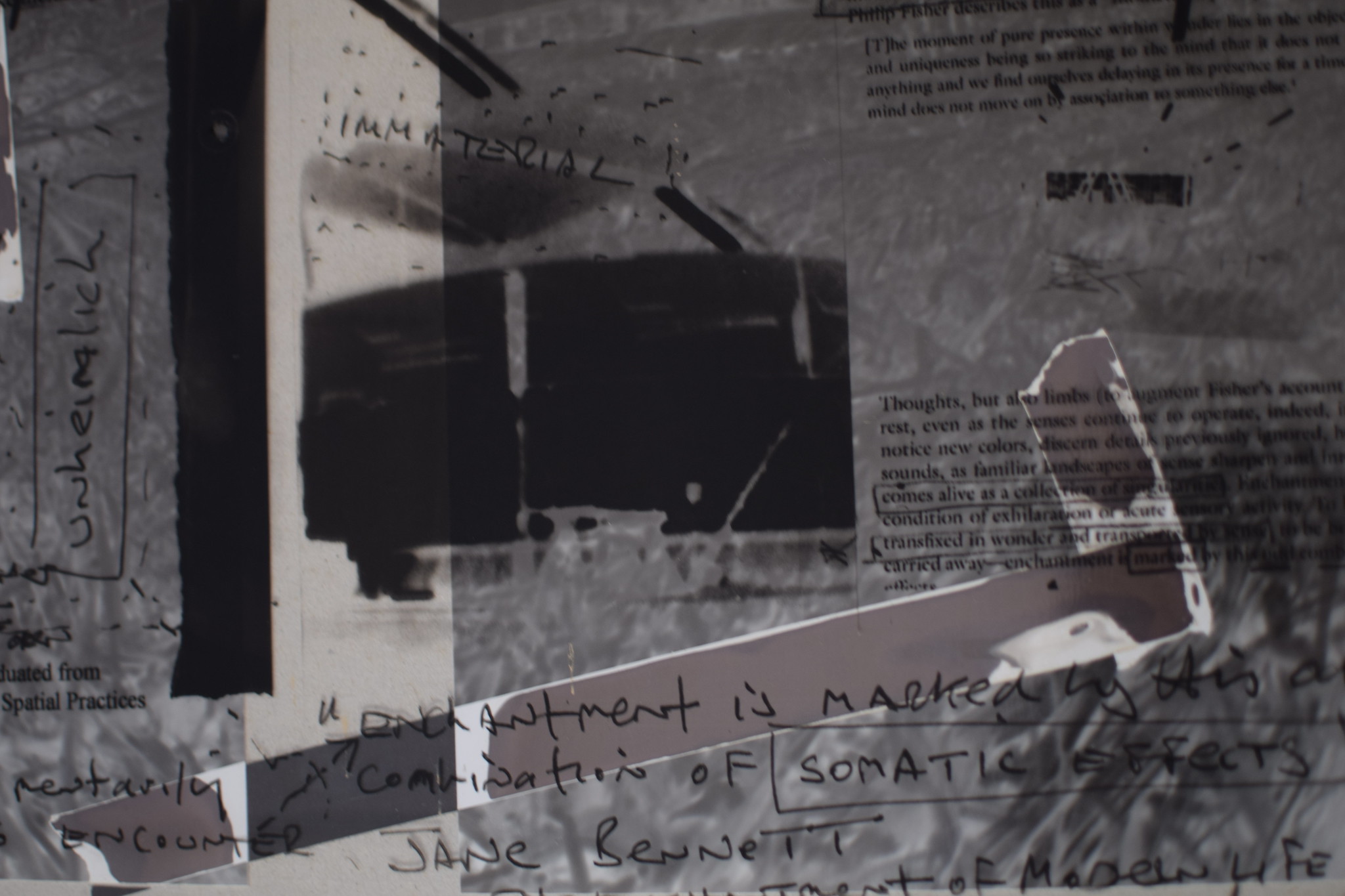
    Enchantments and Crossings : Somatic Effects

    Spatial Methodologies. Worlds and Thresholds.

    The Fanciful and The Scientific.

    The Playful and The Reverent.

    The Material and The Metaphysical.

    Tensions in built spaces.

    Between Evanescence and Substance.

    Between Illusion and Specificity.

    Between Slickness and Tactility.

    Today there is not even a single instant in which the life of individuals is not modeled, contaminated, or controlled by some apparatus, In what way, then, can we confront this situation, what strategy must we follow in our everyday hand-to-hand struggle with ap­paratuses?

    What Is an Apparatus? Giorgio Agamben 2009.

    Making Places where times and tastes, human fabrications and accidents of nature, all collide; in these situations under the shelter of a forming/becoming architecture these ‘spatial texts’ or ‘visual conversations’ of one sort or another are suggested and are manifested and explored through a praxis of inquiry and making.

    Facility and retreat for cross-disciplinary inquiry (Humanities and the Social Sciences).

    Repository and archive of artefacts, texts and objects.

    Exhibition and making spaces, workshops and residential living spaces. Walled garden complex containing a reading pavilion and library.

    Philosophy of Solitude, thresholds/spaces of serenity, a poetics of dwelling.

    Relationships between Art, Photography, Craft and Building. Expanded through Exhibition, Performance, Teaching and Making.

    Realized as a dialogue/delivery (Built Work) into Architectural Terms between Sites of Collection and Sites of Construction.

    Art as Spatial Practice.

    Catalyst Events/Situations to engender the experience of learning.

    West Dean, Singleton. Residential courses in the arts, both the grounds and the house are fully utilised in the social activity of learning.

    Kilquhanity,Scotland. Free School in country setting, used as a site for exploratory fine art practices(converted a pottery into a camera obscura and drew a garden from the movements of the sun across a specific terrain).

    Brockwood Park School, Bramdean. Re-imagining learning, conducted a walk across a landscape with clay, and hidden curriculum in the library with objects and texts centred around philosophy and architecture.

    Space folds : Containing “Spatialities around historicality and sociality”

    Perceptions now gathering at the end of the millennium. Spatiality, Robert T. Tally Jr. 2013

    “All that is solid melts into air”

    Karl Marx, Friedrich Engels,

    (Poetic observation concerning the constant revolutionizing of social conditions)


    spatial practice, alternative photography, fine art, ceramics,making,Russell Moreton,

    Source: The Social : Catching The Light/Architectural Apparatuses/Spatial Methodologies

  • Work : Filtered Light/Colour


    Brian Clarke
    The Art of Light/Paul Greenhalgh, 2018. Sainsbury Centre for Visual Arts
    Properties of Matter and Imagination
    FUSION OF PHYSICAL/METAPHYSICAL
    WORK : An Inquiry with Material Practice
    The poetics of glass as a super-cooled liquid. Molten Fluidity.
    An organic flux frozen for an instant.
    Chaos and order, flow and turbulence, pooling and shifting translucence.
    Chemistry becomes alchemy, the banality of the raw materials – sand, metal and minerals – turn into a magical universe of the imagination. Perhaps this is the key to Brian Clarke’s stained glass; it embodies the fusion of two things that normally don’t mingle; the physical and metaphysical.
    Botanical
    Cosmological
    Biographical
    The screens are an intense site of innovation and artistic consolidation. Some of the screens are principally about the organic flow of forms derived from nature; some of them deal with ideas that push into universal concepts and have a symbolist, otherworldly ambiance; and some yet their driving force incidents, memories and emotions that shaped the artist’s life.
    The Modern World (the artist’s attitudes to)
    Life
    Violence
    Mortality
    Many of the screens are highly specific to an incident or influence, the titles give us a clue to the complex symbology at work and the intertwining of the artist’s personal response with wider perceptions about place.
    Contrapuntal/Counterpoint music introduces multiple melodies that are equally important. Polyphony describes the use of overlapping melodies.
    For Clarke the concept of a screen as a vehicle of artistic expression is not a new concept, rather it clearly resonates back through his life, becoming part of his artistic consciousness virtually from the start of his work in glass.
    Literal and Phenomenal Transparency Layering of Planes/Layering of Spaces
    Rowe and Slutzky 1982
    What exactly is a screen and what does it mean in the context of modernity?
    A screen is simultaneously a physical object and a complex conceptual metaphor.
    We use screens to divide and to mask things off from each other, and as boundaries/barriers to hide behind.
    At the same time, the screen provides ways of looking at things/displaying; we screen films and we screen people.
    We look through them, and they can act as a catalyst that changes our vision of whatever is on the other side.
    In its usage in art, a screen is automatically a series of images – a diptych, triptych or polyptych – a sequence of free standing panels that allows the artist to develop a narrative and aesthetic theme.
    Screens divide up space and make it function differently.
    Alabaster windows before glass, contemporary windows by both Soulages/Sigmar Polke
    Iglesias,
    The Glass House
    The screen as emblematic of modernity.
    Conceptually, the sensibility at work in many early Modem buildings was one of space divided by screen walls and windows. In this sense, the giant windows at either end of Norman Foster’s seminal Sainsbury Centre building for example are light-screens.
    The nature of Brian Clarke’s architectural practice, in which his core practice is painting.
    It is through painting that I understand how to view architecture. It is through painting that I can appreciate the rhythm of the poem.
    It is through painting that I can appreciate and draw pleasure from the structure of a well-composed sentence. And it is through painting that the complexity of music makes itself understood to me. It is through painting, in fact, that I am.
    Brian Clarke, 1989.
    I do not identify mostly with painting, but I identify mostly with all other things because of painting. Brian Clarke, 2018.
    Clarke is gripped by the technology and engineering of how a building is made, but also by the psychological function and its emotional impact, he refers to himself as an architectural artist.
    The medium of glass in its modern form will only be seen when people have been sufficiently exposed to it.
    During the 20th century – the age of specialization – theorists and historians were obsessed with separating out the arts disciplines, positioning them in specific groups or classes, and then subjecting them to philosophical discourse as to why they belonged there.
    In short, the Anglo-Saxon world in particular artificially created the categories of art, design and craft, and then intellectually policed them. Stained glass was inevitably positioned as a craft, with all the confused cultural and economic consequences of this class allocation.
    Clarke with the complexity of his practice and interests has led to embrace the concept of gesamtkunstwerk (total works of art).
    A concept first championed by Richard Wagner, who perceived opera as a means of combining all of the arts, including music, and literature, in order to completely surround the spectator. In the visual arts, it is essentially about generating a complete art environment, in which all elements are orchestrated into an aesthetic whole.
    Charles Rennie Mackintosh, Frank Lloyd Wright, designers of the De Stijl movement.


    spatial practice, alternative photography, fine art, ceramics,making,Russell Moreton,

    Source: Work : Filtered Light/Colour

  • The Creative Act : Energy/Abstractions from a dialectic between the poetic and the systematic.

    The Creative Act : Energy/Abstractions from a dialectic between the poetic and the systematic.

    The creative act moves between what can be organised and what remains open. The poetic and the systematic are not necessarily opposites but different intensities of attention. Drawing becomes a place where gesture, structure, rhythm and intuition can meet, allowing thought to move before it becomes resolved. Perhaps creativity begins here—not with an idea imposed upon material, but with an energy passing between action and response, where something can be felt before it is fully known.

     Harleston 180423

    Drawings/Concepts/Constructions are forms/movements of thought.

    Being mindful that materials can lead the way.

    Tony Cragg.

    Diffractive Documents

    Matters of Interest/Concern

    Pots are fashioned from clay, but its the hollow that makes the pot work.

    Tao Lao-Tzu

    The Brain Needs Abstractions.

    The World is full of beautiful abstractions.

    Nick Cave.

    The creative act, the opposite of entropy, puts energy back into our world.

    Hungate, Norwich.

    Water/Corporeal/Spiritual.

    Clay/Vessel/Ritual/Body/Spirit.

    Gaston Bachelard, on intimate watery spaces.

    The reverie of light and space of an inspiring room.

    The Conduit of Water.

    Architecture of The Senses.

    The glossy surface of plaster against stone, or the flicker of sunlight on water are all abstract in essence.

    The idea that the mind needs abstraction to throw open the range of its thought capacity is fundamental to art and architecture.

    Killer Road.

    A Tribute to Nico.

    Soundwalk Collective with Jesse and Patti Smith.

    The Wind, Cd1

    P J Harvey.

    I can’t understand why people are frightened on new ideas.

    I’m frightened of the old ones.

    John Cage.

    Splitting.

    Gordon Matta-Clark.

    Site is the un-doing of place.

    Generative and provisional, site-specific investigations for sensing place.

    Clay Drawings/Constructions/Apparatuses.

    Undercroft/Observatory/Library.

    The Garden/Material of Forking Paths.

    Raveningham Sculpture Trail.

    Site Visit 160423

    Sculptural Spacings and Sensual Engagements.

    Showing Points/Lines/Vectors of Change/Movement.

    Dwelling Demarcations/markers of temporality and disappearance.

    A poetics derived/driven from both the systematic and the small wonders of the everyday.

    Circular Breathing/Cyclical Lines.

    The Peripheral Movement/Moment

    The Space/Time between things.

    The Concept of Sculpting Invisible Materials.

    The Array, a phonographic inquiry recording transits of the suns pathways across the sky.

    Wanderings, caught up in the wanderlust of stillness and slowtime.

    Paths of movement, paths of observation, paths of existential abstractions following daylight.

    The artist’s creative act of a self amongst others.

    A sculptural deliberation that engages with the experiences of working a site in the landscape.

    Body/Clay/Movement.

    Breath.

    Bodily Exhumations with Plastic Matter.

    Terracotta, Nature.

    Fontana/Penone.

    Drawing Into The Human Form.

    Its conceptual frameworks, aesthetics and contexts.

    Inclusions/Enclosures/Involuntary Mappings and Erasures.

    Figuring it out, sensuality through making the drawing heard.

    Drawing from a blindness, a memory of seeing.

    Derrida.

    Drawing into the perspectives and  sociological relationships of the Architectural Body, organism/person/environment.

    Gins and Arakawa.

    Explanations/Gestures of Looking and Mark Making.

    Scale/Proximity/Seeing Distance/Situatedness/Environment/Art Work.

    Haptic Seeing/moving over the surface of the sociological subject.

    Frottage, life drawings with involuntary textures and marks derived from their particular locality and working methods, concrete floors, wooden floorboards, graphite sticks, charcoal, pencil and wax crayons.

    The body and its nakedness becomes the instrument of our emotions and our sensuality.

    The Psychology of Nakedness.

    Naked to Nude, Life Drawing in the Twentieth Century.

    Georg Eisler.

    Invites the viewer to meditate on the intimate relationship between the clay vessel and the human body.

    Julian Stair.

    Art, Death and the Afterlife.

    Sainsbury Centre, Mezzanine Gallery. UEA.

    Marking Durations.

    Ground Mappings.

    Solar/Daylight Observed/Shadows Recorded

    Clay/Ceramic Multiples/Terracotta/Glazed/Unglazed.

    The Diagram/The Program/The Inquiry

    A Garden Observatory/Philosophy of Silence/Solitude.

    Upright Human Body.

    Space/Time/Situation/Agency.

    To build, dwell and explore the space of drawing through intuitive and abstract making.

    Like drawings, assemblages drawn and made showing the paths taken.

    Living Architectures/Narratives/Dwelling within the Ruinous.

    Tarkovsky.

    Bachelard.

    Landing Sites/Holding Places.

    Between The Body/Sensing Spaces/Voids.

    Perceptions, body, organism, environment,

    Mezzanines, lofts, basements, balconies, walkways, scaffolds, access platforms.

    Clouds and Clocks.

    The project arises between a dialectic between the poetic and the systematic.

    Between Science and Art.

    Stochastic thinking suggests an interconnected ecosystem of architecture together with all of the arts to achieve new levels of correlation.

    Light Laboratory.

    Camera Obscura/The Pottery Room.

    Free School/Out of The Archive, Kilquhanity.

    I could gather a leaf, place it in the head of the enlarger and allow it to make an image of itself by passing light through it, akin to Fox Talbot’s original pencil of nature experiments. I didn’t use a camera after that. I was free to originate my own visual language. I could walk unhindered, let the light into me, as if my own skin and brain were silvered. I could not create light. I only needed  to expose myself to it, by putting myself in its path.

    For six years this symbiosis between photography and photosynthesis felt like one of the most perfectly resolved working methods imaginable.

    Dark Room.

    Garry Fabian Miller.

    The internal mechanisms with which we see and experience visual and physical phenomena depend on a bottom-up approach. Building up from elements of abstraction, the opposite top-down approach of given figuration stifles necessary imagination.

    Curiosity, imagination and enthusiasm all hold a power in the mind to ignite the creative act.

    The Lake of The Mind.

    Steven Holl.

     Archival / Anarchival

    Drawing / Image.

    This feels like an early attempt to understand the creative act as a movement between apparently different modes of thinking: the poetic and the systematic. That distinction is useful, but I don’t think the archive should leave it as a simple opposition.

    Read through your current practice, the more interesting question is what happens between them.

    Drawing becomes a particularly useful site for this because it can carry gesture, intuition, structure, repetition and abstraction simultaneously. The creative act is not simply a decision made by the artist; it becomes an energetic field in which things are tested, displaced and returned.

    This also connects to your current force~feeling vocabulary. Energy here need not mean a metaphorical creative energy. It can be understood more materially: movement, pressure, rhythm, resistance and the changing relation between action and response.

    spatial practice, alternative photography, fine art, ceramics,making,Russell Moreton,

    Source: The Creative Act : Energy/Abstractions from a dialectic between the poetic and the systematic.

  • Re-registering Overlapping Spaces : Presentation/Ritual/Repetition.

    Re-registering Overlapping Spaces : Presentation/Ritual/Repetition.

    Anarchival note

    Re-entering / 2026 — Repetition does not reproduce the same space. Each encounter leaves another registration, another layer through which a body begins to remember its relations.

    Particularly useful for the surface vocabulary.

     Outpost 200423

    A4 Ruled Notebook.

    Blue/April 2012.

    Amongst Lightness and The Reverberation of Material.

    Ceramic installation in white cube space.

    Open Pit Firing, Shards, Ash, Ceramic Pieces, Low Table, White Cloth, Human Outline

    We maybe more sophisticated in material ways, but we have not advanced spiritually beyond the axial age, and because of our suppression of mythos, we may even have regressed.

    The history of myth is the history of humanity, our stories and beliefs, our curiosity and attempts to understand the world, link us to our ancestors and each other.

    A Short History of Myth.

    Karen Armstrong. 2005

    Rollright Stones, Oxfordshire.

    Stone Circle, Storytelling, King Stone, Whispering Knights, Witch,

    A Summer’s Work.

    Odyssey/Beauty/Struggle.

    The Material Acts.

    Summer 1994 : Artist’s Studio.

    The viewers nevertheless allow themselves to be drawn into his game, in order to ‘see’ as though for the first time the pure existence of things.

    Presentation/Ritual/Repetition.

    Art is contemplation and must act upon our consciousness.

    Objects/Things are part of the artist’s immediate existence.

    Contemplative experiences become truly meaningful when they occur in everyday life and when nirvana or the state of superior awareness blurs into samsara or ordered time.

    For Tapies, repetition is above all else a perpetual questioning or a perpetual becoming.

    A working process that is additive, which incorporates changes and accidents and as such his methods are hardly erasing anything that is already present on the canvas.

    A Summer’s Work, Antoni Tapies.

    The Embodiment of Minimal Gesture.

    The Solitude and Discipline of Firing.

    Heja Chong.

    Drawing from the philosophy and traditions of Bizen, she has undeniably developed her own aesthetic identity, embracing the raw materials of her new world, the pots and firing responding to the evolving nature of her life and environment. Adhering to the principle of Bizen, she is conscious  that her level of involvement within this tradition, may not always be recognised or understood by others.

    Viewpoint/Distance/Synthesise Forms.

    Framing a Figure in Space.

    Drawing is not the form, it is the way of seeing the form.

    Edgar Degas.

    The foreignness of the intimate or the violence and charity of perception.

    R. Bruce Elder.

    Raveningham.

    The Autonomy of The Natural Environment.

    Sculpture/Playing with the existence of things.

    Field Studies : Pathways around the Sun.

    Drawing : Assemblage of Lightness and Weight.

    Enmeshed Space : Working Drawing with Handwritten Notes.

    Lawn Deliberation/Mappings of Human Agency/Space/Time.

    Space projected from the body is biased towards the front and right.

    The future is ahead and ‘up.’

    The past is behind and ‘below.’

    Time as a structure/place to observe things in constant motion/relation.

    Drawing Site/Spiral Windings/Diagram/Spherical Markers

    Terracotta, lime wash/lamp black/blackboard paint/chalk/ink

    Ground Pegs/Labels/Text Markings/Archival Information

    Points becoming lines, Tim Ingold.

    Spatial Construct : mediated space anticipating a destination, as seen through the fragmented myths, movie locations or souvenirs that vanguard the real place, access to places through their likenesses.

    The workshop proposes strategies to confront our bodies with the multiplicity, unpredictability, directness and autonomy of the natural environment. The aim is to explore and develop consciousness of the body itself being an ever evolving landscape within a greater surrounding landscape.

    Body/Landscape

    Frank van de Ven.

    The Psychology of Time.

    Temporal Perspectives.

    Relative Orientations/Past/Present/Future.

    Time is  often referred to as ‘the tacit dimension’ within psychology because unlike other types of perception, it is not directly available to any sensory organ but can only be apprehended through change and the dynamic flow of environmental events. And yet despite its ephemeral nature, time is a dimension that has a significant impact upon a wide variety of psychological behaviour.

    From a cognitive perspective, it can be demonstrated that the orderly nature of one’s environment stems, in part, from the fact that events’ spatial characteristics are structured in and over time. Music, speech, body movements and walking gaits are among the many events in which the sequence of notes, words, or actions unfold with a characteristic rhythm and tempo over a given time span. The particular arrangement of this spatial-temporal structure not only influences how an event is perceived and remembered, but also the overall accuracy with which the event’s velocity and total duration are subsequently judged.

    Different cultures have different conceptualizations of time which can be reflected in the types of metaphors that are used to describe time as well as the overall pace of life.

    Curriculum Making.

    The Enactment of Dwelling in Places.

    An Ontology of Dwelling.

    The dwelling ontology we want to describe rejects any possibility of living in the world through mental schemas of the world, and insists that the material-relational world is the only world in which we live, the only source of our capacities to communicate and learn, the only world in which our activities take effect, and the only world in which meaning inheres.

    Greg Mannion, Hamish Ross.

    Tim Ingold is an anthropologist who has looked at the interface between people and the environment. In The Perception of the Environment, he argues that ecological psychology and the philosophical writings of Heidegger and Merleau-Ponty share the view that the world becomes  meaningful through active inhabitation, or ‘dwelling’, rather than cognitive representation.

    Re-registering Overlapping Spaces #2

    Public intimacies, personal dialogues in social spaces.

    ‘Blocking In’ of a private studio space of creative inquiry into the public realm as a permeable intervention.

    Main reception area, UCA Canterbury 2010

    Russell Moreton, Spatial Practices MA.


    spatial practice, alternative photography, fine art, ceramics,making,Russell Moreton,

    Source: Re-registering Overlapping Spaces : Presentation/Ritual/Repetition.

    Re-registering Overlapping Spaces

    Spaces are never encountered only once. Through presentation, ritual, repetition and movement, each encounter leaves another registration, another layer of memory and material presence. Space becomes something continually made and remade through bodies and their actions. Repetition does not reproduce the same situation; it alters it. The trace becomes a form of remembering, while the surface becomes a place where encounters accumulate. These overlapping registrations begin to suggest space as something lived, touched and continually becoming.

    Archival / Anarchival

    Spatial Practice.

    The key idea here is re-registration: space is not experienced once and then left behind. It is repeatedly enacted, marked, remembered and transformed through presentation, ritual and repetition.

    That gives this post a useful relationship to your current understanding of the ceramic surface.

    A ceramic surface is also a re-registration. Every drawing, incision, pressure, coating, firing, abrasion and correction adds another temporal layer. The body becomes a kind of palimpsest of encounters.

    So the older spatial work’s concern with ritual repetition and overlapping spaces can now be read materially through clay.

  • Drawing Into The Human Form/The Architectural Body

    Drawing Into The Human Form/The Architectural Body

    Anarchival note

    Re-entering / 2026 — Drawing becomes a way of entering the relation between bodies: the human body, the architectural body and the spaces that pass between them.

     Drawing Into The Human Form.

    Its conceptual frameworks, aesthetics and contexts.

    Inclusions/Enclosures/Involuntary Mappings and Erasures.

    Figuring it out, sensuality through making the drawing heard.

    Drawing from a blindness, a memory of seeing.

    Derrida.

    Drawing into the perspectives and  sociological relationships of the Architectural Body, organism/person/environment.

    Gins and Arakawa.

    Explanations/Gestures of Looking and Mark Making.

    Scale/Proximity/Seeing Distance/Situatedness/Environment/Art Work.

    Haptic Seeing/moving over the surface of the sociological subject.

    Frottage, life drawings with involuntary textures and marks derived from their particular locality and working methods, concrete floors, wooden floorboards, graphite sticks, charcoal, pencil and wax crayons.

    The body and its nakedness becomes the instrument of our emotions and our sensuality.

    The Psychology of Nakedness.

    Naked to Nude, Life Drawing in the Twentieth Century.

    Georg Eisler.

     Archival / Anarchival

    I would put this in Drawing / Image.

    The important thing is that drawing here isn’t simply a representation of an architectural body. It is a way of entering the relation between human body and spatial body.

    That makes it a useful precursor to your present understanding of drawing as something that can move between body, material and space, rather than simply producing an image.

    It also belongs with the Inside This Clay Jug post because both are concerned with a form of spatial intelligence that is bodily rather than purely geometric.

    In the migration, I would therefore retain this as a drawing-based ancestral chamber that feeds into the later ceramic body.

    Drawing Into the Human Form / The Architectural Body

    Drawing becomes a way of moving between bodies. The human body and the architectural body are not fixed forms but spaces of relation, scale, movement and inhabitation. Through drawing, gesture and trace, one body begins to enter another. The image becomes less a representation of space than an encounter with it—a way of sensing what happens between body, surface, interior and surrounding space. Drawing opens a spatial vocabulary that is tactile as much as visual.

    spatial practice, alternative photography, fine art, ceramics,making,Russell Moreton,

    Source: Drawing Into The Human Form/The Architectural Body

  • Another/Alternative Photography : Apparatuses/Pattern Making/Redundancy/Collage

     Outpost 060423

    https://www.flickr.com/photos/russellmoreton/

    Searching For Redundancy/Making Patterns Making.

    Time/Duration/Perception.

    What Is An Apparatus?

    Giorgio Agamben

    Bringing things back to life, to switch our perspective from the endless shuttling back and forth from image to object and from object to image, that is such a pronounced feature of academic writing in the fields of anthropology, archaeology, art and architecture, to the material flows and currents of sensory awareness in which images and objects reciprocally take shape.

    Tim Ingold.

    Immaterial Architecture/Creation/Contemplation/Artist/Architect.

    Diffraction, understood as a material-discursive phenomenon that makes the effects of different differences evident.

    Karen Barad.

    Troubleyn Laboratorium, Jan Fabre.

    The Empty Space, Peter Brook.

    Verb List Compilation/Actions to relate to oneself, Richard Serra.

    Ceramics.

    Slab built architectural forms and crucible raku bowls.

    Raku bowls thrown and turned in a coarse clay with wide flat rims inspired by crucible forms for melting materials.

    Architectural slab built pieces investigate ceramics as a dwelling place or a model for a building construction.

    Undercroft Exhibition Norwich.

    Anglian Potters.

    Notion of a moment of impeding transposition.

    Transformation of derelict buildings into newly evocative spatial experiences.

    Building Cuts/Physical Alteration to a space is a revelation of a particular response.

    The Body To The Building.

    Social Activism/Mindful Lawlessness.

    Gordon Matta-Clark.

    Performativity, subject and object do not pre-exist as such, but merge through intra-actions.

    Karen Barad.

    Architectural Body/The Organism That Persons.

    Madeline Gins and Arakawa.

    You cannot see me  from where I look at myself.

    Francesca Woodman.

    Thinking Bodies/Becoming Woman.

    Images that created a sense of confinement, a temporal identity for herself, a place for a personal resonance/self inquiry.

    The body as architecture itself as the support that constitutes the spatial agency of photography.

    Negative Capability.

    The Link Gallery, Winchester.2013.

    Morn Hill Winchester.

    Site of the corporation or the master, brethren and sisters of the blessed Mary Magdalene hospital near Winchester erected in 1148 and demolished in 1772.

    Founded on the eastern hill in remote antiquity for lepers.

    The Hospital of St. Mary Magdalene.

    Raymond Elliott. 1994.

    Becoming Decay.

    Clemintina and Francesca.

    Domestic Liminality, a psychological, neurological, or metaphysical subjective conscious state of being on the threshold of or between two different existential planes.

    Places where we make new domestic worlds, where we reconstitute family.

    Carol Mavor.

    Figurative Drawings and Sculptural Reliefs.

    Matters of Form/Construction.

    Manuel Neri.

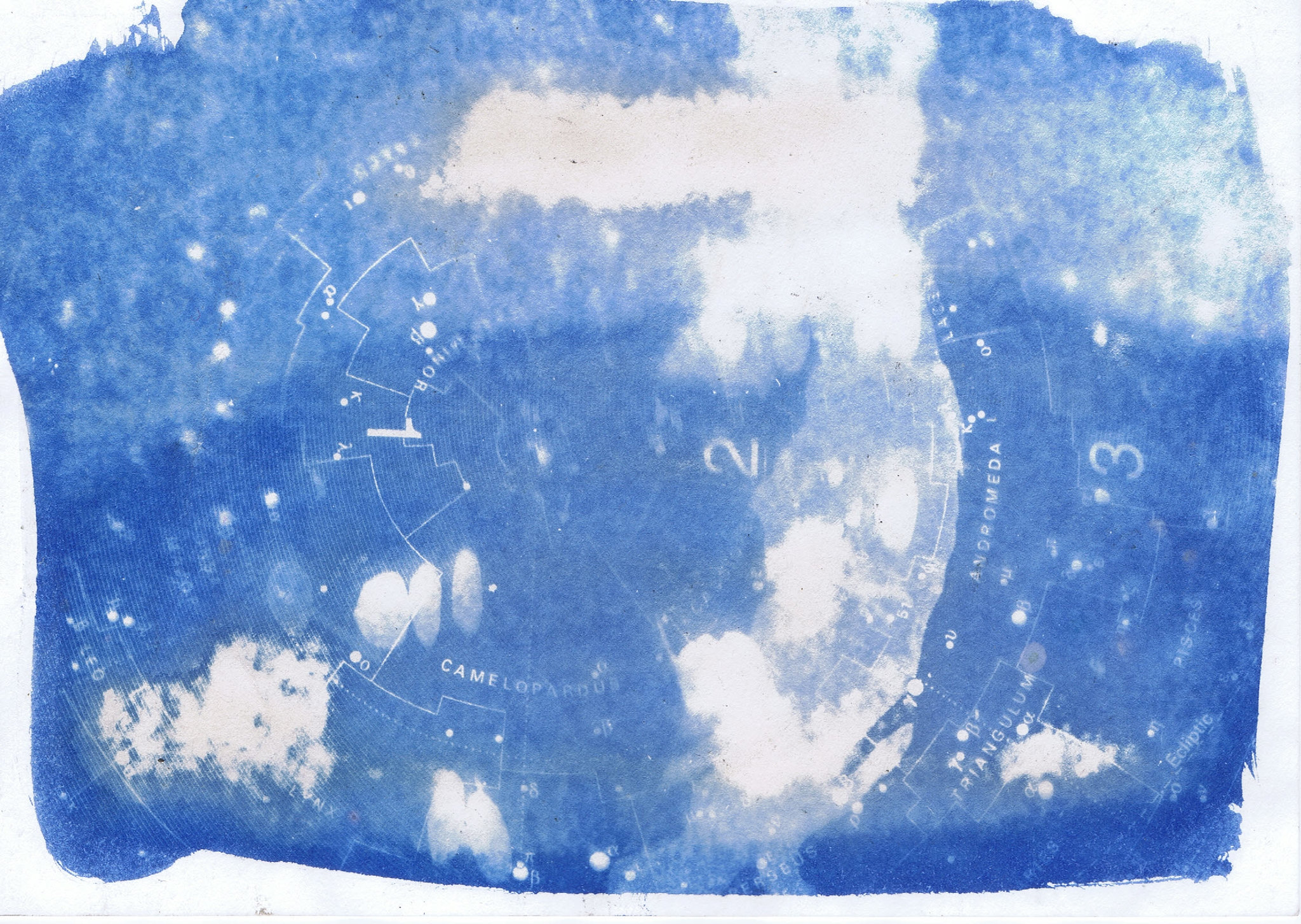
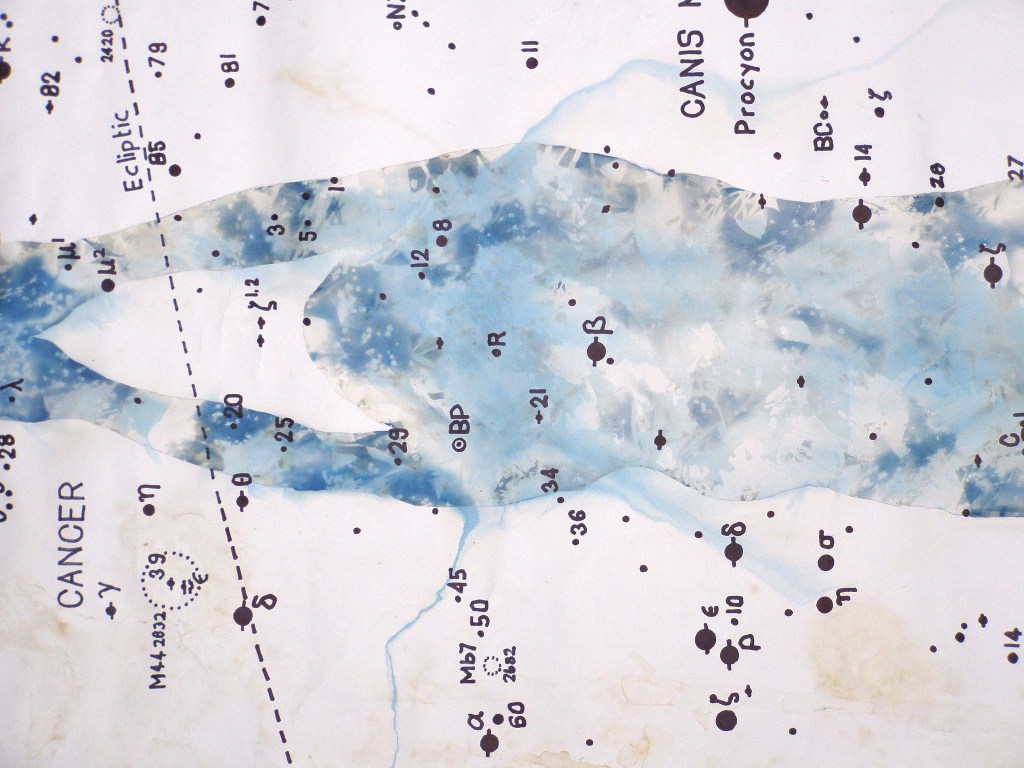
    Norton Star Atlas

    Map 1

    Epoch 2000.0

    Stellar Magnitudes

    Double or Multiple Stars

    Variable Stars

    Novae.

    Alternative Darkroom Photography

    Corporeal/Astronomical

    Body/Cosmos/Imagination

    Scale/Proximity/Vastness


    spatial practice, alternative photography, fine art, ceramics,making,Russell Moreton,

    Source: Another/Alternative Photography : Apparatuses/Pattern Making/Redundancy/Collage

  • A Sensation of Looking/Manifesting Seeing

    A Sensation of Looking/Manifesting Seeing

    Looking becomes sensation when the body can no longer be separated from the surface through which it is encountered. Line, volume, skin and gesture begin to occupy the same unstable field. The drawn body is not simply represented; it is sensed through the movement of the mark. The vessel enters this correspondence almost bodily, carrying neck, shoulder, hip, foot, interior and surface into another material register. Drawing and ceramics begin to touch before either has fully become the other.

    Archival / Anarchival

    Archival, with considerable anarchival potential.

    This is perhaps one of the most important posts in this cluster because the connection between life drawing and ceramics is already explicit.

    The post moves through drawing, contingency, sensing and seeing; Julian Stair’s Quietus; death and the human body; life drawing and anatomy; flesh, muscle and bone; and finally the movement towards “Form-Movement / Mass-Volume / Skin-Surface.” It then makes the crucial proposition that line is “only the visual interpretation of an extremity of a volume” and that mark-making becomes a conduit for a sensation of seeing others.

    It then directly connects anthropomorphic language in pottery—neck, shoulder, hip, foot—with the vessel as a bodily container.

     Outpost 310323

    A Sensation of Looking/Manifesting Seeing

    Matters of Concern/Fact.

    Drawing/Contingency/Sensing/Seeing

    Drawing away from descriptive depictions that illustrate preconceptions/aesthetics.

    Julian Stair.

    Quietus. 2012.

    The Vessel.

    Death and The Human Body.

    There is an alchemy to making ceramics. We take an inert material, fashion it, dry it and expose it to heat and flame. The practice of cremation, of exposing the body to fire, going through an alchemical change, echoes and parallels the process of firing.

    Julian Stair.

    The materials he works, lead and clay are dense, both physically and emotionally. But Stair’s use of these materials is not representational. These objects do not depict or illustrate, instead they enact and embody.

    Stair’s achievement in this cyclical exhibition is to have expressed both the universality and the specificity of death, each as an aspect of the other.

    The great hand-thrown jars that stand at the heart of the exhibition exemplify this doubleness. Though completely abstract, they exist at the scale of the body. They invite a tactile response, visitors might stroke the ridges circumscribing the jars or tap them, or even give them a gentle hug.

    Glenn Adamson.

    Life drawing on the psychology of  nakedness and the human body in contemporary art.

    Life-Class/Anatomy/Pathology.

    The practical and theoretical problems of the confrontation with the human form.

    Georg Eisler.

    Herbert Boeckl.

    His nudes speak a physical language, interpreting life and death in terms of human bodies, of functioning muscle and bone and the tactile aspects of flesh, and the knowledge of what lies beneath/behind it. 

    Alfred Hrdlicka. 

    A Group. 1973.

    Proximity does not read as intimacy, the entangled naked bodies convey a sense of insecurity.

    The Posed/Nakedness/Social Scrutiny.

    The Life-Class.

    Isabel Bradshaw/Michael Grimshaw

    Drawings/Sculpted lines that bring sensations onto the surface of the paper.

    Lines of Movement/Vectors

    Lines of Static Forms/Boundaries

    Mark-making, rendering the spatialities of the human form.

    Form-Movement

    Mass-Volume

    Skin-Surface

    Line is only the visual interpretation of an extremity of a volume. Mark-making on a drawing becomes a conduit for a sensation of seeing others.

    The concept of anthropomorphism is central to the identity of pottery. We use bodily terms such as a neck, shoulder, hip and foot to describe the constituent parts of a pot. And the very nature of the vessel as a container, a holder of things, is analogous to the idea of the body as physical container for the soul or spirit.

    Julian Stair.

    BODY → LOOKING → DRAWING → SURFACE → ENCHANTMENT

    or, in the vocabulary that is now emerging:

    body → sensation → trace → surface → correspondence → other bodies

    And there is a particularly strong migration through them:

    Confronting the Human Body
    → the body becomes relational

    A Sensation of Looking
    → looking becomes sensation

    Drawing the Body / Luminescence
    → the body becomes spatial/atmospheric

    Drawing Surfaces / Situated Knowledges
    → surface becomes a site of encounter

    Enchantment / Sites of Sensual Engagement
    → the encounter opens into a world of other bodies

    That makes In~~Touching feel less like a newly invented concept and more like something that has been slowly surfacing through the archive.

    And I think that is exactly the kind of migration we want: not retrospective correction, but latent correspondence becoming perceptible.

    There is also a very beautiful route now emerging between this cluster and the ceramic work:

    body → flesh → surface → touch → trace → clay → firing → ceramic body → atmosphere

    That is probably where we should return later when we work with your fleshbloodbody of others through sensate materials. I would leave that proposition open for now rather than prematurely resolve it. The archive has given us enough material to know that something is there.

    Migration entry

    From sensation of looking towards a material correspondence between bodies.

    This post is now much more important than its original “drawing/seeing” designation suggests. It already contains the movement:

    body → volume → surface → vessel → clay

    That makes it an important precursor to your current thinking about fleshbloodbody and sensate materials.

    Anarchival note

    The post can now be read less as an investigation into representation and more as an early attempt to understand how sensation becomes material.

    The phrase Skin-Surface is particularly important. It sits almost exactly at the threshold between the life-drawing body and your ceramic surfaces.

    Likewise, the vessel’s bodily vocabulary gives you an early route from the drawn body into the ceramic body.

    Bookmark and Share

    Posted by Russell Moreton  anthropologicalcyanotypesdrawingGeorg EislerGlenn AdamsonHerbert Boecklhuman bodyJulian Stairleper graveslife-classMorn HillpotteryQuietusrussell moretonvesselWinchester

  • Drawing The Body/The Luminescence Of Space.

    Drawing The Body/The Luminescence Of Space.

     Outpost 230323

    Drawing, depicting something found through the process of making visible.

    The body begins to disappear into the space around it. Drawing no longer holds figure and ground securely apart; light, gesture, surface and movement begin to pass between them. The body becomes something sensed through its surroundings, while space acquires the traces of bodily presence. Luminescence is therefore not simply light upon a figure. It is a condition in which body and space become perceptible through one another.

    Archival / Anarchival

    Archival — important connective archive.

    I would preserve this primarily as a Drawing / Image post rather than allowing it to drift into Spatial Practice. Its importance now lies in the way drawing becomes a means of producing spatial sensation rather than simply depicting the figure.

    Migration entry

    The drawn body begins to dissolve into spatial atmosphere.

    This is an important step in the genealogy because the body is no longer simply the thing represented. Drawing allows the body to become entangled with light, space, surface, movement and figure~ground relations.

    Anarchival note

    Its future value lies in the word luminescence.

    The body begins to become perceptible through what surrounds it. The spatial field is not background. It participates in the body’s becoming visible.

    That creates a useful line into your current ceramic work:

    body → surface → light → aperture → atmosphere

    The later ceramic perforation can therefore be read not merely as a formal device, but as another way in which the body becomes spatially and atmospherically available.

    The Luminescence Of Space.

    An Archaeological Inquiry Into Drawing.

    Correspondences/Reclaiming the drawings.

    The Affect and Memory of Drawing.

    To interrogate ways of seeing/looking, John Berger. 

    The world of the creative practitioner promotes conditions, gestures and responses that articulate social, political and other theoretical findings which are all ‘present’ at the inception of the work.

    Colin Renfrew.

    The Myth of Butades.

    Figure/Ground Relationships.

    Theoretical Thought : Diagram and map.

    Neo-Sumerian temple plan on clay tablet from c. 2100BC.

    The drawing/work may take the form of the result of an act or action carried out at a specific time but which itself does not persist.

    Art can be the expression in the material world of a concept, or the transformation into one material form of a structure that exists in another.

    Drawing/Substance/Memory/Display.

    The artist’s creative act, is of a self amongst others.

    Material/Thinking Matter.

    Drawings mediated by the distance of memory.

    Art Works, subtle embodiments, visual markers both spatial and sociological.

    Life/Drawing/Figuring It Out.

    The Luminescent Dematerialization Of The Subject.

    Expressions Of Both Figuration And Abstraction.

    Phenomenological approaches to Drawing/Looking/Others.

    Demarcation/drawing boundaries/wayfaring/paths on the land, re The Making of Space.

    Walking/Movement is quiet literally what made us human.

    The walk is a ‘mark’ laid upon thousands of other layers of human and geographical history on the surface of the land. Bipedalism is the precursor to the evolution of a large brain, creative intelligence and language.

    Richard Long/Colin Renfrew.

    Charles Mausson.

    Walking Man, No. 3. 1990.

    Oil, crayon, 203.0 x 137.0 cm.

    Starting from a subject or a simple figurative form, Charles Maussion sets of like an explorer, in search of unexplored lands, looking for something spiritual. It is through walking/drawing/thinking that one can remain human even while seeking out, and without even knowing it, finding it, or finding yourself in lands which are thousands of light years from our society, whilst nevertheless being very close to it. A calm, a loudness, that is extreme, beautiful.

    Robert Combas. 1993.

    The simple presence of a figure is sufficient to suggest the unity of the individual in a universe which is patiently observed and precisely apprehended. There is a complete absence of any compositional device suggested within the canvas, all that emanates is a climate of strangeness, serenity and disquiet. 

    Sophie Dupont. 1995.

    The blurring of the conventional distinction between the figure and the ground, so as to capture an atmospheric effect, which sought to approximate the murkiness of visual perception.

    The legibility of the photographic image was denied by the process of blurring the image.

    Paintings, abstract identities of surface and material, introducing content via a dematerialization, so as to engage in a process of pure vision, pure silence, reincarnated, vibrant, alive.

    William Jeffett. 1995. 

    Drawing on the consciousness and corporeality of others, of figural dissolution of the traditional figure/ground relationships, and fragmentation/blurring of the human form. The contemporary body and its environments are experientially brought into abstracted absences, corporeal traces of visual matter, movement and dissolving/reappearing forms.

    Figural Expressions.

    Figural dissolution of a nude descending a staircase, Marcel Duchamp.

    Stop-motion photography of the human body in motion, Etienne Marey.

    Figural, paintings/drawings not as representations of tangible subjects, but as registers of a more abstract range of emotions, as a series of studies, always incomplete and never finished, a work in progress. The nude/ the human body has become mediated by the mechanical effects of photography and the distance/blindness of memory.

    Notations.

    Contemporary Drawing as Idea and Process.

    Fred Sandback.

    The Drawing Room.

    The Secret Theory of Drawing.

    Jim Dine.

    Figure Drawings, 1975-79.

    The Drawings of Richard Diebenkorn.

    John Eldenfield.

    Manuel Neri.

    Drawings/Relief Sculptures.

    Naked To Nude.

    Life Drawing in the Twentieth Century.

    Georg Eisler.

    Less theoretically central than Confronting The Human Body, but very useful for establishing the transition from body as figure to body as spatial and atmospheric event.

    The body as a body of relations — the body is encountered through gaze, screen, drawing, surface, movement and spatial intertwining rather than as a stable subject.


    Looking as sensation — seeing becomes embodied and material; drawing registers movement, volume, skin, surface and the sensation of encountering another body.

    The ceramic vessel enters this same bodily vocabulary through neck, shoulder, hip, foot, containment and touch.


    Drawing the body / luminescence of space — figure and ground begin to dissolve; drawing becomes a way of registering movement, memory, atmosphere and corporeal traces rather than depicting a fixed body.


    Situated surfaces — the haptic, peripheral and sensual become ways of knowing. The surface isn’t merely something seen; it becomes something encountered through the body.


    Enchantment — this perhaps gives the cluster its unexpected affective charge. Wonder, sensual engagement, the periphery, the disappearance of boundaries, material transformation and an “enmeshed world” all begin to move away from the body as an isolated human subject.


    I think the cluster is really about the body becoming porous.

     Russell Moreton  artCharles MaussonColin RenfrewdrawingfiguralGeorg Eislerhuman bodylife drawingnaked to nudeRichard Long