FORMWORK/ ENCLOSURES / ITERATIONS / THINKING FORMS : Material Agency as Cognitive Scaffolding
spatial bodies → situations → scaffolding → diffractive relations → exploratory making
Formwork / Enclosures / Iterations brings the material, spatial and cognitive strands together. It is also one of the clearest places where your earlier architectural thinking begins to move towards the material agency that is now being carried by clay.
Re-entering / 2026 — The scaffold becomes material. What once organised space and perception through enclosure, mesh, membrane and formwork now returns through the clay body: a provisional condition in which touch, force, resistance and other bodies can begin to correspond.
Or, if we want to push towards your newer vocabulary:
Re-entering / 2026 — The scaffold does not determine what emerges. It holds a body in relation, allowing touch, force, resistance and other bodies to become perceptible.
I prefer the second. It doesn’t over-explain the trajectory and leaves the ceramic work to make the connection.
Archival / Anarchival
I would place this in Spatial Practice rather than Making / Materiality.
Although the post contains a substantial body of material thinking, its central concern is the production of spatial situations through provisional structures: formwork, grids, meshes, membranes, enclosures, filtered light, walking, landscape and iterative construction. The post describes “building scaffolds” and the “making of a proposition into space,” while repeatedly returning to the relationship between material, perception and spatial experience.
But there is another reason I think this is particularly important now.
The latter part of the post moves explicitly towards material agency and cognition. Malafouris and Renfrew’s argument that cognition should be understood as enacted through material engagement, rather than residing solely inside the maker’s mind, sits alongside your notes on “touching objects, feeling materials,” embodied wisdom and the thinking hand.
That is a very strong precursor to your present understanding of clay.
The important shift
What interests me now is that the scaffold is not simply architectural.
The earlier work asks how grids, mesh, fabric, gauze, formwork and enclosures might scaffold perception and thought. But read from the present, clay itself begins to take on this role.
The material doesn’t simply receive an idea. It helps generate the conditions through which the idea can emerge.
That makes this post particularly relevant to your recent realisation around:
clay → touch → force~feeling → response → other bodies → spatial relations.
The post already contains the language of touch, material engagement, affordance, perception, cognition and material agency. What has changed is where those relations are now being encountered.
They are no longer primarily being theorised through architectural structures.
They are being felt through the ceramic body.
Anarchival reading
This is where I think your idea of “arousal from the clay body” becomes particularly useful.
The earlier spatial work constructed scaffolds through which perception might become altered. The ceramic work now seems to discover that the clay body is itself a scaffold for thinking-feeling.
Not a cognitive scaffold in the instrumental sense, but a material condition through which other relations become possible.
The formwork doesn’t determine the building.
The ceramic body doesn’t determine the thought.
Both establish a provisional condition of encounter.
And that seems very close to what you mean by being In~Touch: attentive to what emerges through the encounter rather than imposing the encounter’s conclusion in advance.
IMMATERIAL / REPETITION / SINGULARITY
ENCLOSURES / ITERATIONS / THINKING FORMS
MINIMALIST SPACES / INTERVALS, tuning objects to construct environments
Mediating the experience of LANDSCAPE
SITE / COLLAGE COMPONENTS working/walking, developing a creative spatial syntax COLOUR AS CONDUIT / PERCEPTUAL ENVIRONS / CRAFT MEDIA / IMPROVISATION PIERCED DAPPLED NATURAL LIGHT
DIFFERENTIATED SHADOW / SURFACE
EXTRAORDINARY MATERIALS / TECTONICS AND TEXTILES INDEXICAL / GESTALT VISUAL PERCEPTION
NETWORKS / RESOURCES / AGENCY for the potential of BUILDING SCAFFOLDS / GAUZE / POCHE solids of a building/architectural plan ABSENCES / INTERSECTIONS / GRIDS / MESHES / SPRAYS / MOTIFS ACTUALITY


Getting Lost, Walking whilst deep in thought/embodiment in the environment Between PLACE and SITE
Walking creates its own feedback loop, The Journey, The Return,
The specific, Here and Now
Psychogeography, Dossier, Forensic Study, Inquiry.
Spatial Abstractions : Reflexivity on Reflection. Embodiment on Experiential Subjectivity
LANDSCAPES Constituted by creative practice
Walks as erasures, sedimentation, (Gardiner)
Quotidian/Everyday Interests, Complexities of Contemporary Life. Ambients, Phenomenas, Objects, Subjectivities,
Everyday aesthetics, heuristic practice,
RAVENINGHAM THEMES : Working Notes
The ‘exigencies’ of the situation at hand.
Tim Ingold, MAKING. Spatial Intelligence
New Futures for Architecture Leon van Schaik
Spatial intelligence builds our mental space. Sensing Spaces
Architecture Reimagined Oak-Framed Buildings
Rupert Newman Heidegger for Architects
Adam Sharr MAKING
ANTHROPOLOGY, ARCHAEOLOGY ART AND ARCHITECTURE
Tim Ingold
Touching objects, feeling materials
The Cathedral and the Laboratory
A Hut of One’s Own
Anne Cline
Solar Pavilion
Alison and Peter Smithson Architecture is not made with the brain
The Parallel of Art and Life
Aesthetics about Perception Poetics about Production
HERZOG & DEMEURON NATURAL HISTORY
My studio is a piece of architecture that is silent. Speculative Architecture
On The Aesthetics of Herzog & De Meuron
The Thinking Hand
Existential and Embodied Wisdom in Architecture
Juhani Pallasmaa
The Architecture of Natural Light Henry Plummer
Peter Zumthor
Hortus Conclusus Serpentine Gallery Pavilion
The Potentials of Spaces
The Theory and Practice of Scenography and Performance. Alison Oddey, Christine White
See Yourself Sensing Redefining Human Perception. Madeline Schwartzman
Collage and Architecture. Jennifer A. E. Shields
COLLAGE
Assembling Contemporary Art. Sally O’Reilly
Construction/Abstraction Body/Identity Environments/Geographies
Indexical
Absences
Actuality Immaterial Architectural Sensing Surfaces,
Textures
Dimensions, Sprays, Trace



Repetition, Empirical Experiences
Forms, Pavilion, Hut, Shelter, simple enclosure
Minimalist, tuning objects, sequences to construct/de-construct environments
Reflexive Surfaces into architectural presence
Art as indeterminate, able to arrest perceptions into different states/becomings
Site, undoing of place.
Gauze/Filtered Light/Phenomena
Gesture of the work, its situation,
Meshwork. The drawing grid, making of a proposition into space.
Cyan, Sky Blue, dappled light, membrane, responding to the weather/locality
AA Pavilion Project,
Its about learning through making, being involved in the process, the installation and its reception, dislocating contextual barriers.
Ephemeral Architectures, AA Document/Project, Prizeman
Immaterial Architecture : Waverley Pavilion Building The Drawing
The drawing as analogue allows more subtle relations, of technique, material and process, to develop between drawing and building.
Immaterial Architecture The Illegal Architect Jonathan Hill
Oak
Tree
Oil
Paper
Plaster
Rust
Sgratfito
Silence
Sound
Steel
Television
Weather
Frosted Light
Index of immaterial architectures
TRANSPARENCY : LITERAL AND PHENOMENAL Colin Rowe, Robert Slutzky
Interactions of the Abstract Body Josiah McElheny
Object Lesson
Interactive Abstract Body (Square) The Spatial Body (After Fontana)
Tracing Eisenman
Stan Allen
Indexical Characters FABRIC=MASS+ FORM
Alan Chandler
The interest in fabric formwork is in its deployment in a building process, which is faster than conventional formwork. Fabric formwork is inherently more sustainable due to the minimising of both concrete and shuttering, and more radically, allows the constructor to intervene in the process of casting even as the cast is taking place.
ANTI OBJECT Kengo Kuma
We are composed of matter and live in the midst of matter. Our objective should not be to renounce matter, but to search for a form of matter other than objects.
What that form is called- ARCHITECTURE, GARDENS< TECHNOLOGY is not important. ReThinking Matereriality
The engagement of mind with the material world. Elizabeth DeMarrais, Chris Gosden. Colin Renfrew
The Affordances of Things
Towards a Theory of Material Engagement Aesthetics, Intelligence and Emotions Relationality of Mind and Matter
Material Agency
Towards a Non-Anthropocentric Approach. Carl Knappett, Lambros Malafouris
At The Potter’s Wheel: An Argument for Material Agency
We should replace our view of cognition as residing inside the potter’s head, with that of cognition enacted at the potter’s wheel.
The Neglected Networks of Material Agency : Artefacts, Pictures and Texts
Material Agency as Cognitive Scaffolding
The Cognitive Life of Things

Material Engagement and the Extended Mind. Lambros Malafouris, Colin Renfrew
Minds, Things and Materiality Michael Wheeler
Communities of Things and Objects : A Spatial Perspective Carl Knappett
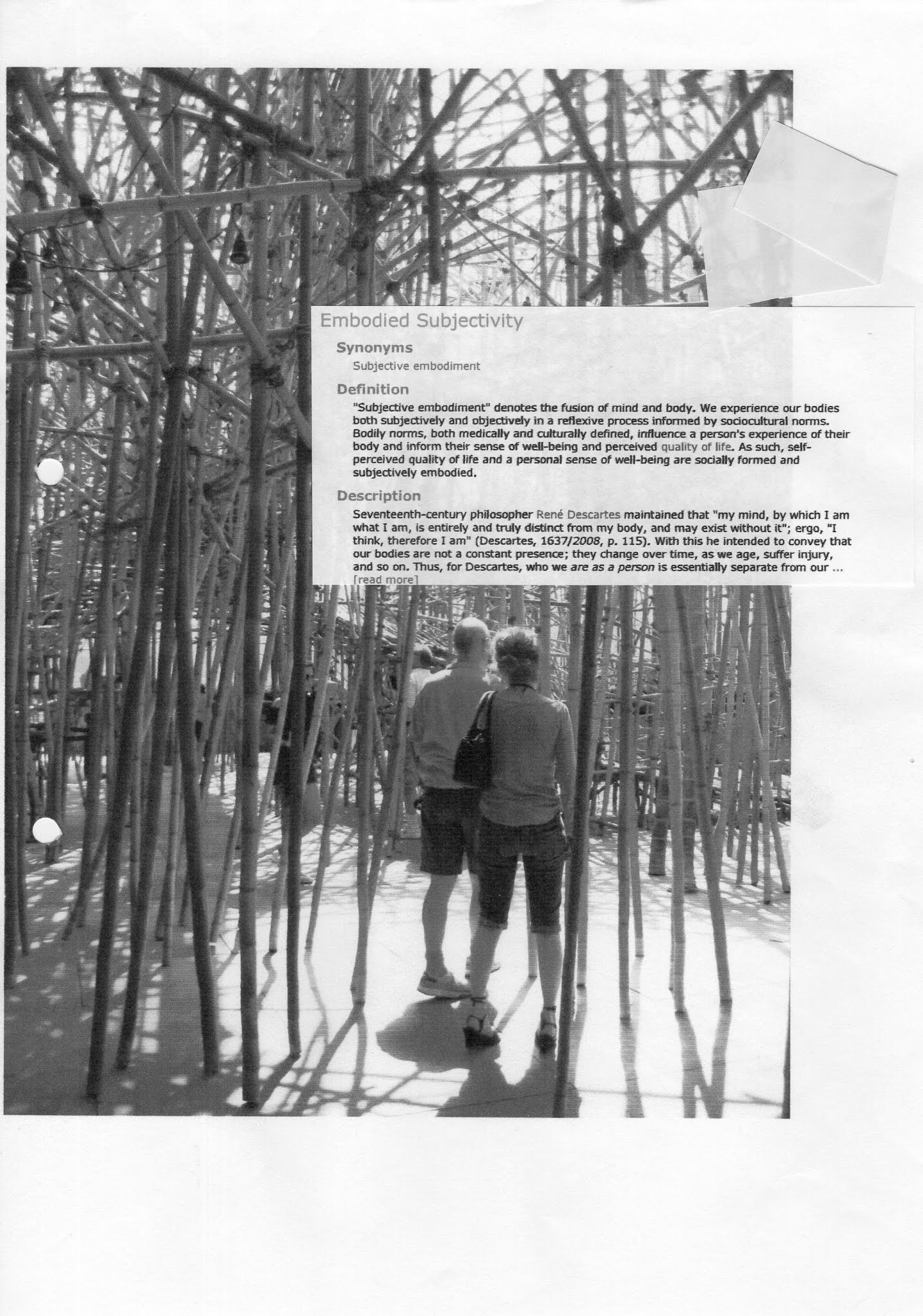
People make space, and space contains people
Imagining the Cognitive Life of Things Edwin Hutchins
Things and Their Embodied Environments Architectures for Perception
Structuring Perception through Material Artifacts Charles Goodwin
Leach Pottery, Studio and Museum A Potter’s Book
Bernard Leach
Adventures of the Fire, Vessels Through Time Ceramic Pavilion
Formwork / Enclosures / Iterations / Thinking Forms gives us perhaps the most direct precursor to your present material thinking. It connects enclosures, iterations, meshwork, grids, membranes, material agency, walking, perception and cognition, eventually arriving at the proposition that cognition is enacted through material engagement rather than simply residing inside the maker.
Migration judgement
Very high-value archive — retain as Spatial Practice.
And I think these four posts now form a particularly coherent ancestral constellation:
The Scriptorium
→ the spatial situation as vessel for experience, memory and inhabitation
Bricolage Processes
→ fragments and bodies of material brought into provisional relation
Spatial Practices / An Affective Intensity
→ bodies, affect, event, leakage and indeterminate relations
Formwork / Enclosures / Iterations
→ provisional spatial scaffolding through which material and perceptual relations can emerge
And then the present practice makes a significant turn:
The scaffold moves from architecture into clay.
Or perhaps even more precisely:
The spatial thinking becomes aroused from the clay body.
That seems to be the really powerful continuity you’ve uncovered through this migration. The earlier spatial work wasn’t a detour from ceramics. It was developing a vocabulary of bodies, situations, scaffolds, thresholds and relations that clay can now make tactile.
The difference is that clay brings touch into the centre. It gives the spatial vocabulary a body that can resist, receive, shed, fracture, fire, weather and transform. The spatial isn’t imposed upon this body; it emerges through its encounters.
That makes Formwork / Enclosures / Iterations a fitting place to finish this group—not as the end of the argument, but as a scaffold from which the next body of work can emerge.
Source: FORMWORK/ ENCLOSURES / ITERATIONS / THINKING FORMS : Material Agency as Cognitive Scaffolding

 Russell Moreton : Matter(s) in Correspondence
Leave a comment