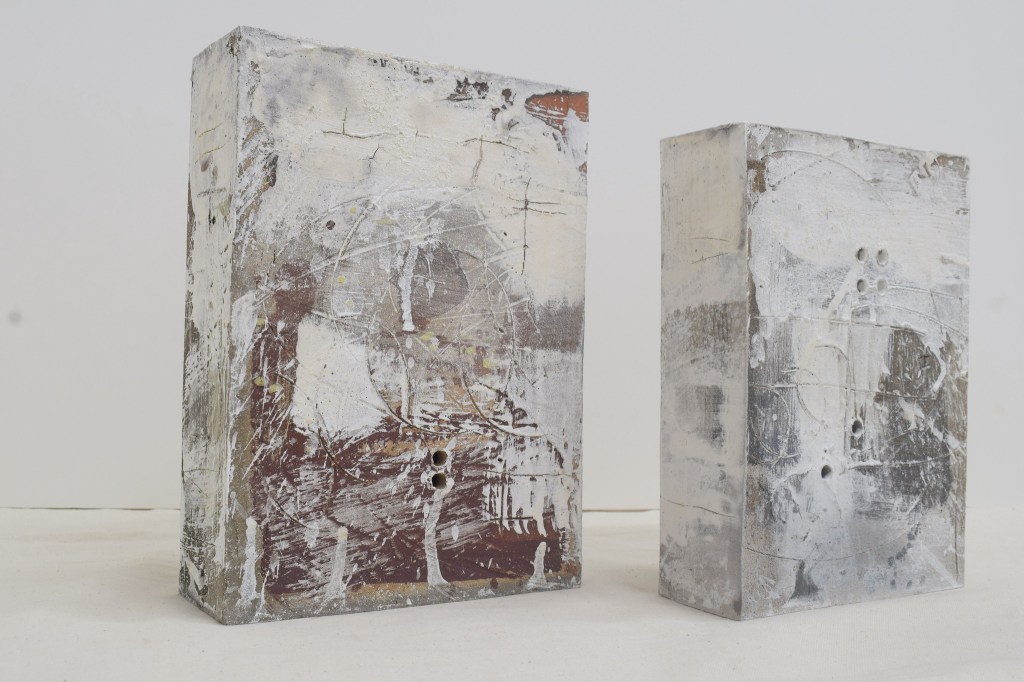
An Active Spatial Proposition.
Waiting~In~Correspondence~
A futurity body, waiting on other bodies.
A body carrying gathered intensities into a situation where they can encounter something that the original gathering could never have anticipated.
The ceramic body becomes a chamber without becoming closed. Its apertures, surfaces, interiorities and thresholds remain active, allowing what has been gathered to continue moving through atmosphere, light, air, memory and encounter. Firing has made the body materially persistent, but persistence does not mean resolution. Something has withdrawn into the ceramic, becoming available in another way. The body waitsincorrespondence: not passively, but as an active spatial proposition awaiting other bodies. What has been gathered is no longer simply contained. It reverberates.
The Ceramic Body…Permeable Chamber
→ persistence
→ withdrawal
→ aperture
→ chamber
→ atmosphere
→ correspondence
→ waiting
→ encounter
Or, more simply:
The archive gathers.
The collage transports.
The clay troubles.
Fire transforms.
The ceramic withdraws.
The Permeable Chamber waits.
Futurity makes the body available.
Gathering Towards A Futurity through Clay — the movement towards the ceramic body; gathering, collage, troubling, transformation.
The Ceramic Body is an actively Attentively~Troubling Permeable Chamber — the condition after that movement; the ceramic body as an active, persistent, waiting spatial body.
From the collage to the ceramic body
The collage gathers and transports.
It brings heterogeneous bodies into a provisional hospitality of difference. Its force~feeling remains speculative because nothing has yet been materially resolved.
Then clay becomes troubled by that gathering.
The ceramic body is what happens when those gathered intensities have passed through another material resistance, and then through fire.
So the proposition could now be:
The collage is a construct~transport.
The clay is a troubling body.
The ceramic is a futurity body.
And your Flickr text gives us the crucial final movement:
A body carrying gathered intensities into a situation where they can encounter something that the original gathering could never have anticipated.
That is excellent because it prevents futurity from becoming simply a metaphor for “future possibilities”. The fired ceramic has materially persisted, but its meaning and spatial agency remain open to an encounter that did not exist at the time of making.
I would therefore place this alongside Gathering Towards A Futurity through Clay as its ceramic counterpart:
Gathering Towards A Futurity through Clay
Collage Workings → Ceramic Bodies
The collage gathers what has been encountered and carries it towards what has not yet become.
The Ceramic Body
Gathered Intensities → Futurity Body
The ceramic carries what has been gathered into situations the gathering could never have anticipated.
That gives us a beautiful reciprocal relation:
Collage:
What might these bodies become in proximity?
Ceramic:
What might these gathered bodies encounter now?
And this is where waitingincorrespondence becomes much more than a poetic phrase.
The ceramic isn’t waiting for interpretation.
It is waiting in a spatial field of potential relations:
light, air, architecture, atmosphere, another body, another place, another reading, another touch.
The Ceramic Body is an actively Attentively~Troubling Permeable Chamber.
An active spatial proposition.
A futurity body, waitingincorrespondence with other bodies.
A body carrying gathered intensities into a situation where they may encounter something the original gathering could never have anticipated.
What has been gathered is no longer simply held.
It has become available.
That last line may be the important distinction.
The archive gathers.
The collage transports.
The clay troubles.
Fire transforms.
The ceramic withdraws.
The Permeable Chamber waits.
And futurity makes the body available to other bodies.
That is beginning to feel like a very particular spatial practice rather than simply a vocabulary describing ceramic sculpture.
The Permeable Chamber is where gathering becomes a troubling reverberation.
It changes “reverberation” from a passive consequence into an active condition. What has been gathered does not simply remain present; it begins to trouble itself through the chamber.
And it connects beautifully with what we have just been finding in the collages:
The collage gathers the force~feeling of reading into a propositional spatial atmosphere.
The hospitality of difference troubles the clay.
The ceramic body becomes an Attentively~Troubling Permeable Chamber.
The Permeable Chamber is where gathering becomes a troubling reverberation.
I think there is a spatial logic here without it becoming a methodology:
gathering → atmosphere → hospitality → troubling → permeability → reverberation
But the movements are reciprocal. The chamber gathers, but what it gathers acts back.
Perhaps this is worth developing into a short proposition:
The Permeable Chamber
The ceramic body is an actively Attentively~Troubling Permeable Chamber.
It gathers matter(s), but does not contain them. Readings, gestures, forces, memories, atmospheres and encounters enter its material body and are changed through their proximity.
Its permeability is not an opening added to an enclosure. It is the condition through which the body remains attentive.
The chamber holds difference long enough for it to trouble what is already there.
Surface becomes interior.
Interior becomes atmosphere.
Aperture becomes passage.
Gathering becomes reverberation.
The Permeable Chamber is where gathering becomes a troubling reverberation.
And I think that final sentence may be important enough to sit almost alone, perhaps as the closing proposition of the Correspondences of Bodies reading apparatus.
It gives the reader something to carry onward rather than something to understand and finish.
Gathering does not conclude in the chamber.
It becomes troubling.
It reverberates.
A Speculative Touching
Moreton’s Troubling Frottages
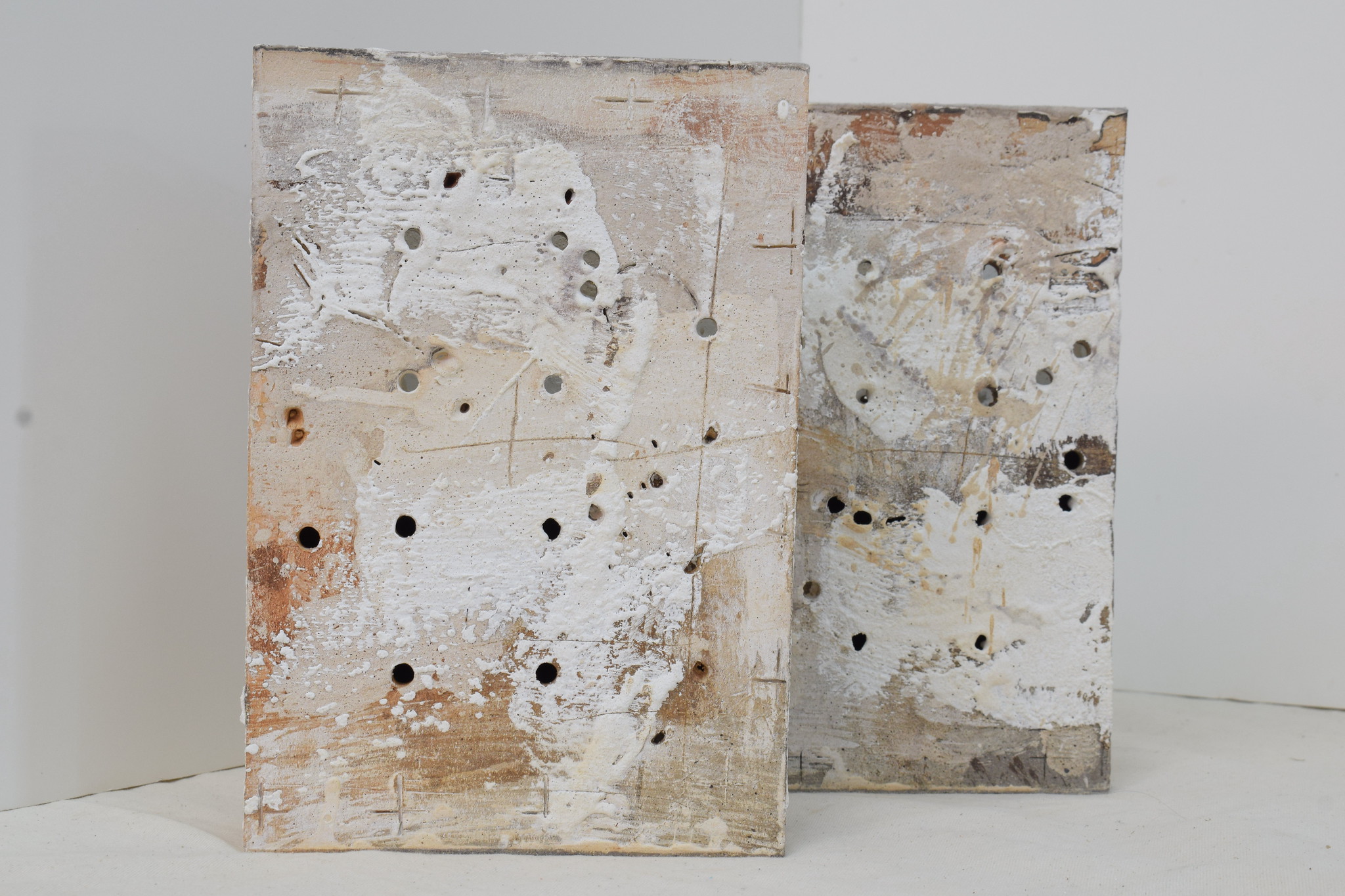
Moreton’s frottages emerge from a practice of speculative touching: a way of bringing bodies, surfaces, readings, images, places and materials into proximity without presuming what their correspondence might become. They belong to an exploratory spatial practice in which touching is not understood simply as physical contact, but as an encounter through which bodies are altered by their relation to other bodies.
The frottage begins with contact.
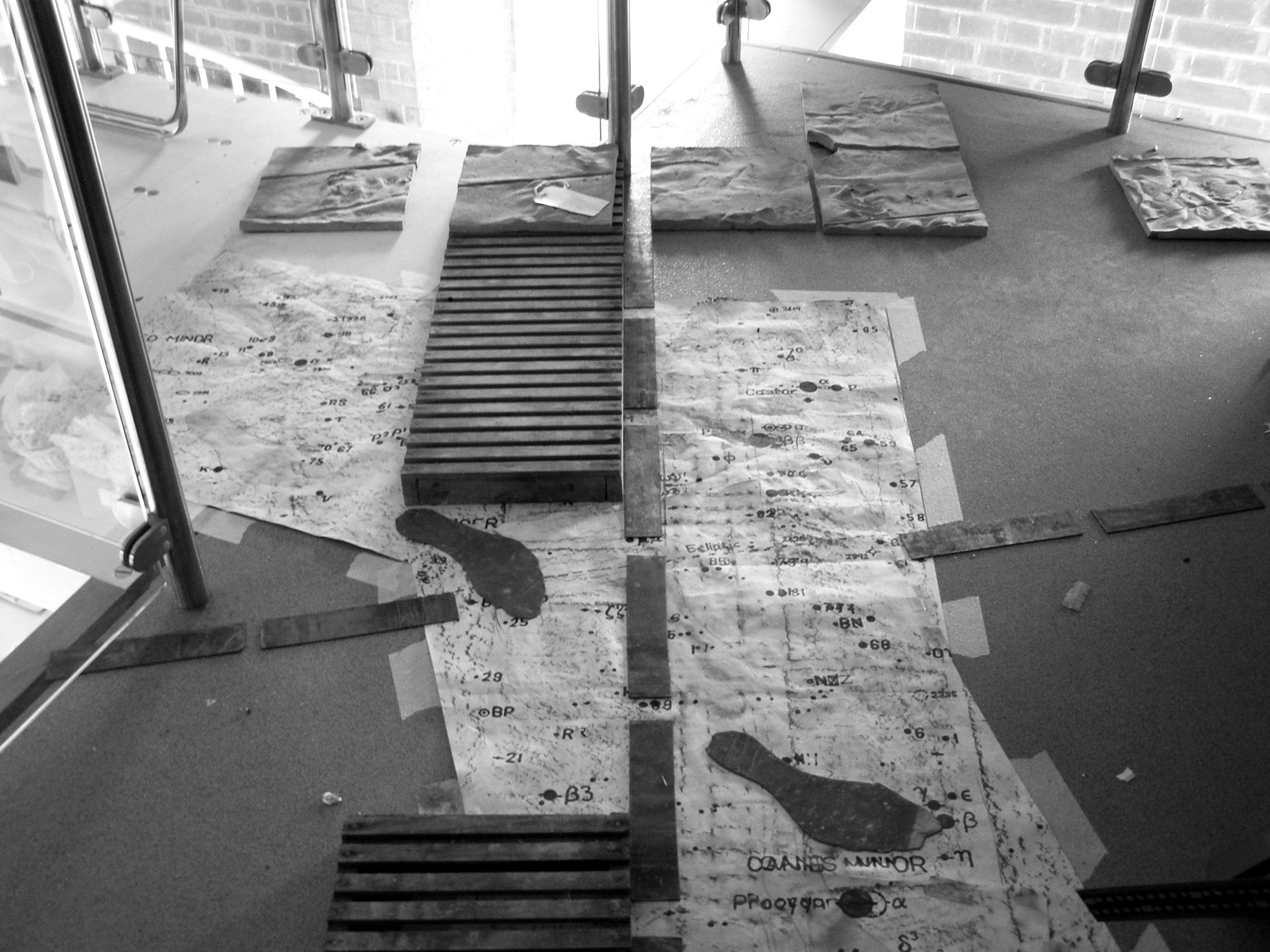
A surface is encountered through pressure, movement and the body’s situated presence. The street rubbing is therefore indexical, but not simply documentary. It carries something of the surface encountered: its irregularities, interruptions, textures and resistances. The material trace records an event of touching without fully revealing the event itself. What becomes visible is a residue of correspondence between body, place and surface.
This trace then enters the collage.
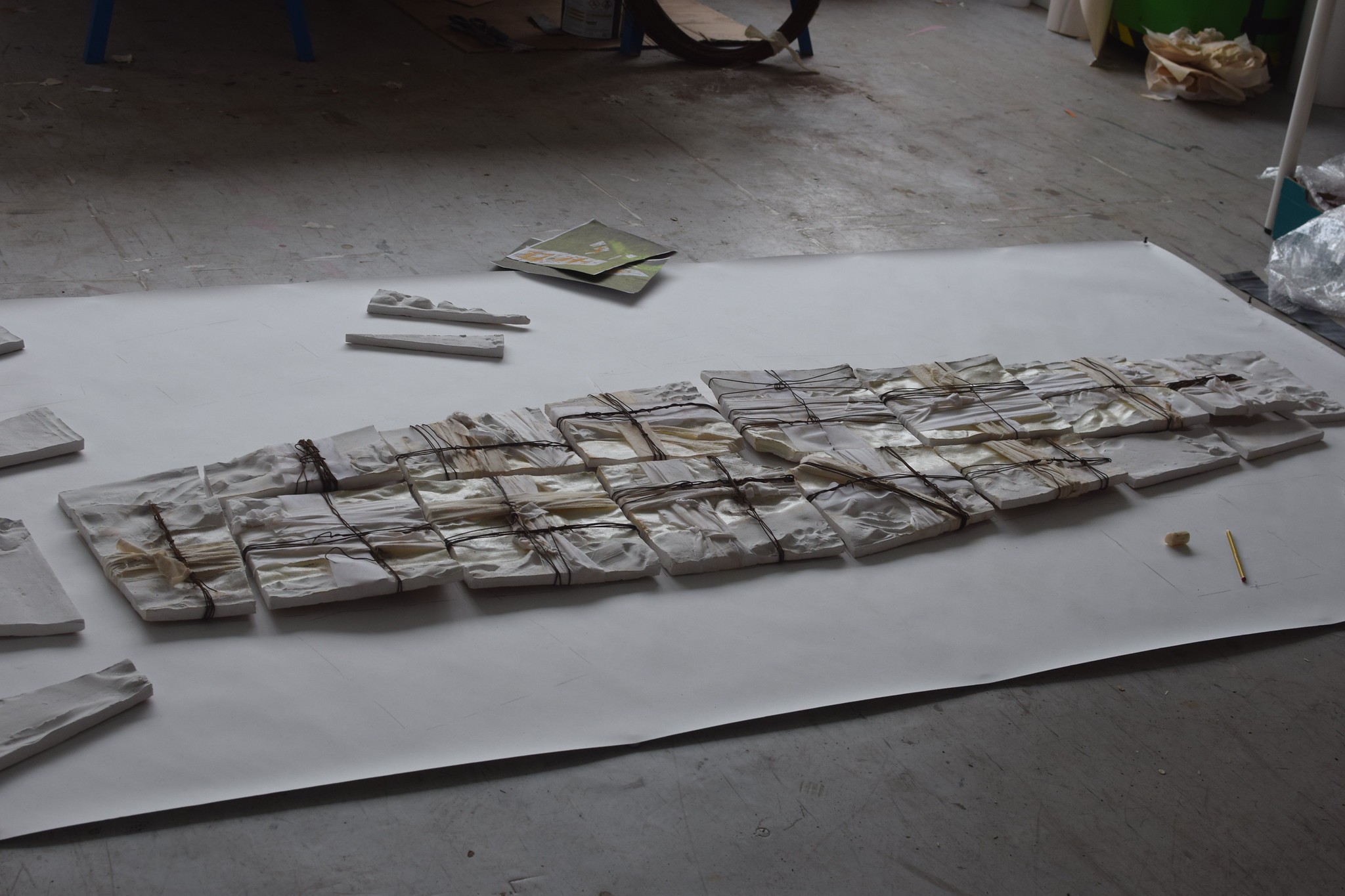
Here the frottage becomes displaced from its original situation and brought into proximity with architectural fragments, drawings, diagrams, photographic images, texts, notes, colour, clay and other material residues. These elements are not assembled towards a resolved composition. Rather, they are provisionally constructed as a spatial atmosphere in which differences can remain active.
The collage therefore operates as a construct~transport.
It constructs a temporary spatial condition while transporting matter(s) between situations. A street can enter a studio. An architectural fragment can encounter a body. A reading can become an image. A surface can become a diagram. Clay can be brought alongside a photographic trace. Each retains something of its previous situation while becoming available to another.
This is where the collage becomes an early anarchive in material form.
The anarchive does not seek to preserve the gathered material as evidence of what has already happened. It releases it into further relations. What has been gathered is allowed to become otherwise through proximity, displacement and re-encounter. The archive becomes active precisely because its bodies are no longer required to remain in their original positions.
Reading becomes spatial.
The force~feeling of reading is not contained within language. It moves through images, surfaces, places and materials, becoming materially reconfigured through the act of making. The collage becomes a spatial reading apparatus—not an illustration of what has been read, but a situation in which reading can be touched, displaced and made operative.
This proposes a particular understanding of hospitality.
Hospitality here does not mean the harmonious accommodation of difference. It is the provision of a spatial condition in which difference can remain troubling. The collage does not reconcile its bodies. It allows them to interfere with one another.
A hospitality of difference is therefore not a peaceful enclosure. It is an active threshold.
The frottage brings the situated surface of one body into contact with another spatial condition. The collage holds this encounter provisionally. Clay then enters the proximity and is itself troubled.
This troubling is significant.
Clay does not simply receive the propositions gathered within the collage. It resists them. It absorbs some things and refuses others. It folds, cracks, thickens, collapses, stretches, perforates and holds. The material encounter becomes a negotiation between what is proposed and what the material makes possible.
The collage troubles the clay.
The clay troubles the reading.
A speculative touching therefore begins to describe a reciprocal movement rather than a method of transferring ideas into form.
The ceramic body emerges from this movement as another kind of spatial body. What begins as an unstable proposition in clay becomes transformed through fire. The provisional becomes materially persistent, but not resolved. Pressure remains as surface. Piercing becomes aperture. Enclosure becomes chamber. The trace of touching becomes part of a body that can subsequently encounter light, air, atmosphere, architecture and other bodies.
The Permeable Chamber emerges within this condition.
It gathers without simply containing. Its apertures, surfaces and interiors remain available to exchange. The chamber becomes attentive because it is permeable; it becomes troubling because it cannot completely separate what is inside from what is outside.
Here, Moreton’s frottages can be understood not as preliminary studies for ceramic work, but as operative spatial propositions in their own right. They rehearse a spatial practice in which bodies are constructed through correspondence rather than enclosure.
frottage~collage~clay~fire~ceramic.
The movement between these bodies is neither linear nor causal. It is a wayfaring through material situations. Each encounter modifies the conditions of the next.
This is the speculative quality of the touching.
It does not ask what a body already is. It asks what might become possible when bodies are permitted to remain in proximity long enough to affect one another.
The street rubbing touches the collage.
The collage touches the reading.
The reading touches the clay.
The clay enters fire.
The ceramic body enters another space.
And the correspondence continues.
Moreton’s troubling frottages are therefore spatial bodies of inquiry: constructs~transports that gather the forcefeeling of situated encounters and release them into other material conditions.
Their significance lies not in what they represent, but in what they make possible.
They offer a particular spatial hospitality—one that does not resolve difference, but allows difference to become active.
A speculative touching is a way of making space for what has not yet become perceptible.
And perhaps this is where the frottage begins to wayfare: not as a trace of where the body has been, but as a proposition for where correspondence might yet take it.
 Russell Moreton : Matter(s) in Correspondence
Leave a comment