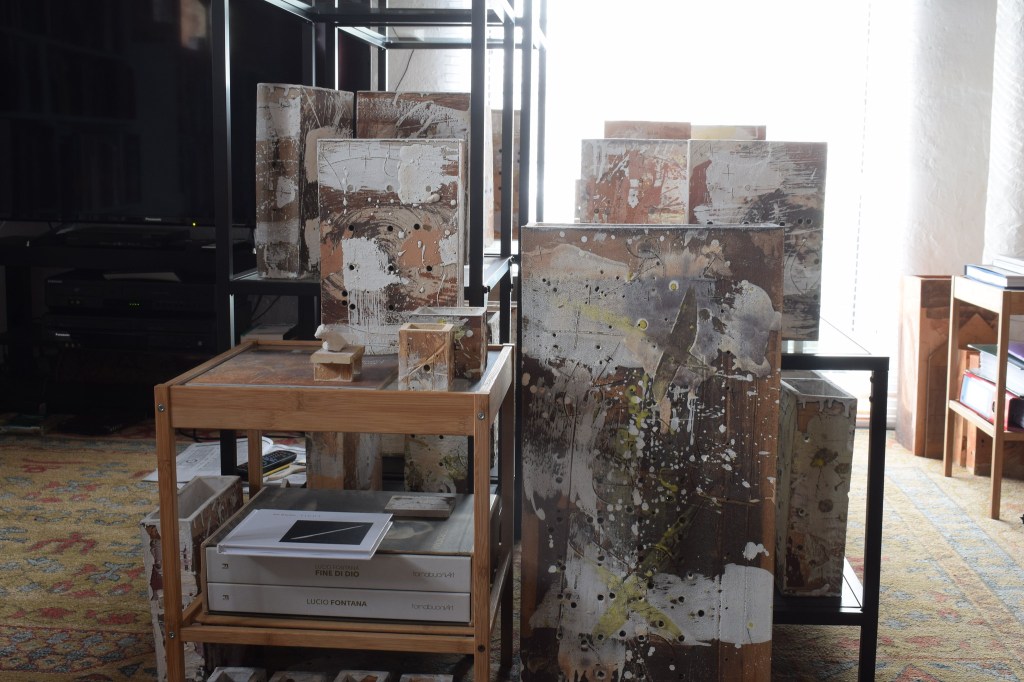
The Ceramic Room with (Fontana, Calvino and Others) into Lightness~Quickness~Exactitude~Visibility~Multiplicity~Consistancy and its Atmospheres
Abstract:
This text revisits an earlier spatial inquiry through the material conditions of clay, ceramic bodies, drawing, reading and making. What began through questions of interiority, architecture, the sensing body and the spaces between things has continued to gather through material encounters, where earlier propositions return differently through clay. The text understands spatial practice as a condition of correspondence: bodies, materials, gestures, memories, spaces and atmospheres entering into relations without a predetermined outcome. Clay becomes a place where these relations can be gathered, altered and partially forgotten. Through drying, firing, layering, scoring, wrapping and perforation, what has been encountered may become forcefelt, transformed and later resurface as another material or spatial condition. The paper develops through five gatherings: Entering the Body Tracing the Encounter Making the Chamber The Hole Surfacing Otherwise These are not stages or conclusions, but little spatial gestures through which an earlier practice can be re-entered. The body becomes permeable; the trace carries an encounter without preserving it; the chamber gathers without completely containing; the hole opens absence towards relation; and surfacing describes the movement through which material encounters find another spatial condition. Alongside these gatherings, Tensions and Correlations : WrappedTensioned and Bandaged Bodies considers the ceramic body through protective refractory layers, scoring, binding and tension. The bandage protects while recording vulnerability; wrapping holds while producing tension; the refractory layer prepares the body to enter fire. Surface becomes not simply a boundary or treatment, but a field across which forces become perceptible. The ceramic body consequently becomes less an autonomous object than a body in correspondence: held, opened, marked, transformed and made permeable to other bodies. What is gathered does not necessarily remain identifiable. A reading may become a gesture, a gesture may enter clay, clay may become ceramic, and ceramic may return as atmosphere. The practice therefore moves not towards resolution but towards further correspondence. The trace looks backwards. The proposition leans forwards. The ceramic occupies the interval between them.
Keywords
Spatial Practice · Gatherings · Material Reciprocity · ForceFeeling · Permeability ·
Interiority · Affect · Correspondence · Ceramic Bodies · Spatial Atmosphere · Thresholds ·
Embodied Practice · Hapticity · Kairos · Productive Unknowing · Material Becoming.
A Hut within Matter(s) of SpaceSurfacing 2026
A HUT WITHIN THE INFLUENCE AND NATURE OF ARCHITECTURE 2015


Leave a Reply