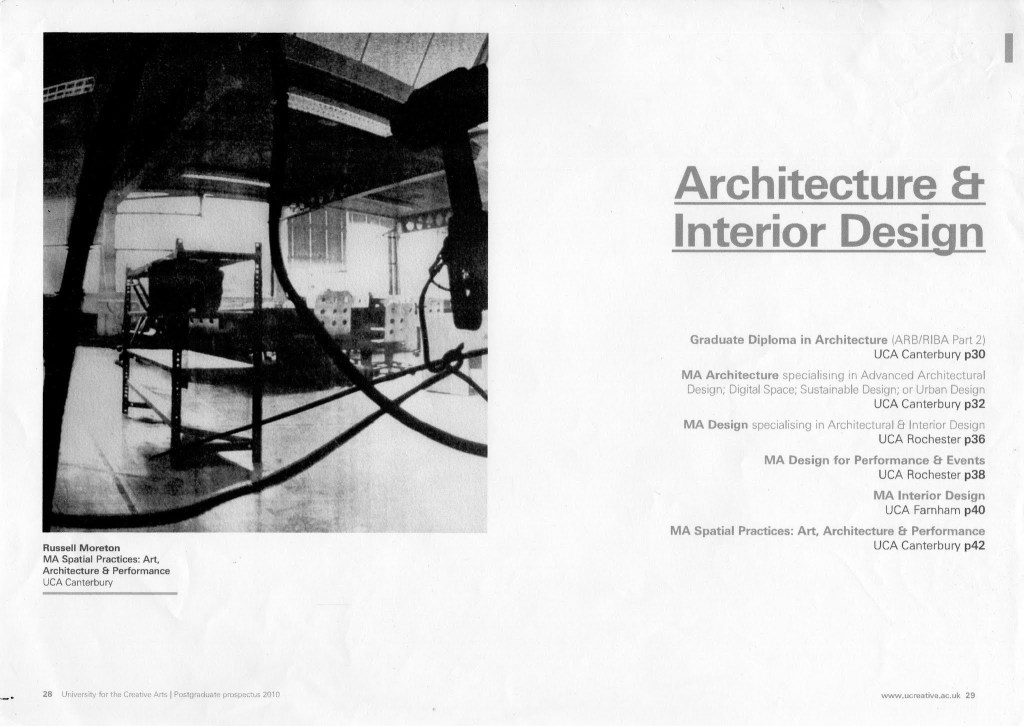
Site ~ Interior ~ Apparatus : Humanities Spatial Relations
This earlier body of work begins from a deceptively simple proposition: space is not simply where something happens. Space participates in what can happen.
The Scriptorium, the Theatre of Research, the reading room, the collage, the ruin and the various apparatuses gathered around them were attempts to make this participation tangible. They were not simply architectural proposals, nor were they illustrations of an already established theory of space. They were provisional situations through which architecture, reading, image, body, memory and material could become uncertainly entangled.
The earlier language of spatial relations can therefore be approached now as an opening rather than a conclusion.
What was being explored was not only the relation between people and buildings, but the possibility that a spatial arrangement might alter the conditions through which a relation becomes perceptible.
The Scriptorium was conceived as an intimate, hut-like interior: a restricted apparatus for reading, contemplation and sensory intensification. The ruined architecture of Waverley Abbey was not treated simply as historical backdrop. Its fragmentary condition, its exposure to the elements and its accumulated traces became part of an inquiry into how place might become an active participant in making. The site was already more than location.
It was a body of relations.
The Theatre of Research extended this proposition differently. Rather than functioning as a library or repository, it was imagined as a working space in which theoretical and practical objects, images, texts and materials could be brought into proximity. Collage became particularly important because its fragments could remain distinct while entering new relations. Images, texts and architectural propositions could occupy the same field without needing to resolve their differences.
This now appears remarkably close to what might be called correspondence without convergence.
The earlier work did not yet use this vocabulary. Nor should it be made to.
What it did was construct situations in which things could interfere with one another.
The fragment could remain a fragment.
The image could remain an image.
The text could remain unresolved.
The ruin could remain ruinous.
The interior could remain provisional.
The apparatus could remain awkward.
And yet something could happen between them.
This is where the question of the heuristic becomes important. You asked whether these miniature architectures might become relational: whether they might be encountered through a hands-on process of finding-out rather than through recognition alone. The question remains remarkably open. russellmoreton.com
It suggests that spatial practice is not primarily the production of an answer.
It is the production of conditions in which another encounter becomes possible.
The earlier interest in voids, cavities and spaces between things can be understood in this way. The void is not simply an absence. It is an interval in which relations can occur. The cavity is not merely an empty interior. It is a condition of potential occupation, sensing, memory and exchange.
This makes the Scriptorium’s interior particularly significant.
It was conceived as a refuge, but not as a sealed refuge. Its sensory intensity depended upon proximity: the occupant, the material, the doorway, the surrounding architecture, the remembered ruin, the act of reading. The interior became meaningful through its relation to what was beyond it.
The interior was already permeable.
The same is true of the Theatre of Research. Its importance was not that it could contain research, but that it could stage relations between different kinds of research — theoretical, practical, visual, architectural, social and material.
Research became spatial when it began to alter the conditions of encounter.
This is perhaps where the older notion of the apparatus begins to move towards the present notion of the chamber.
An apparatus establishes conditions.
A chamber gathers those conditions.
A surface allows something of what has gathered to become perceptible.
The later ceramic body takes up this movement materially, but does not simply repeat it.
The hut becomes chamber.
The chamber becomes body.
The body becomes permeable.
The aperture becomes hole.
The collage becomes gathering.
The palimpsest becomes material memory.
The theatre becomes atmosphere.
The spatial proposition becomes in~play.
What changes is not the existence of the earlier spatial inquiry, but the material body through which it can now be encountered.
Clay enters this genealogy differently from architecture. It resists. It records pressure. It allows correction, interruption, collapse, incision and repetition. It becomes an especially responsive material through which spatial relations can be felt rather than only constructed.
Yet the ceramic should not be understood as the fulfilment of the earlier architectural work.
It is another chamber.
Another threshold.
Another way of asking what happens between things.
This is why the earlier work remains active.
Not because it predicted the ceramic.
Not because the Scriptorium was secretly already a ceramic work.
But because it established a recurring spatial question:
What happens when an arrangement becomes sufficiently open for bodies, materials, images, ideas and places to alter one another?
The question moves from architecture into clay.
It moves from the designed interior towards the material interior.
From spatial apparatus to spatial body.
From representation towards encounter.
From place towards site.
From enclosure towards permeability.
From object towards proposition.
And perhaps this is where the earlier humanities inquiry becomes newly available.
The humanities are not simply a body of texts to be gathered and interpreted. They become another collection of correspondent bodies: philosophy, architecture, literature, image, memory, ruin, material, place and lived experience entering a spatial field.
The work does not need to reconcile them.
It needs to keep them in correspondence.
The old Theatre of Research therefore begins to look less like a proposed institution and more like a proto-spatial apparatus for the practice that is now emerging: a place where different bodies of thought could meet, become troubled, and produce propositions that were not contained in any one of them.
The ceramic chamber continues this operation at another scale.
It gathers without containing.
It opens without becoming transparent.
It withdraws without disappearing.
It surfaces without exhausting what lies within.
Site ~ Interior ~ Apparatus ~ Chamber ~ Surface
The site remains capable of undoing place.
The interior remains capable of undoing enclosure.
The apparatus remains capable of disturbing perception.
The chamber remains capable of gathering.
And the surface remains capable of surfacing otherwise.
Perhaps the spatial practice has always been concerned with this threshold:
not where things are, but what becomes possible between them.
What was once called spatial relations can now be encountered as relations remaining in~play.
The earlier work does not need to be brought forward intact.
It can be re-entered.
And in that re-entry, something from the earlier spatial inquiry becomes available again — not as an origin, but as another body with which the present practice can correspond.
The particularly useful line is the movement already present in the original:
architecture → interior → apparatus → encounter → heuristic inquiry
The present practice extends it:
architecture → interior → apparatus → encounter → heuristic inquiry → body → clay → chamber → ceramic → atmosphere
The later ceramic body re-enters an earlier spatial question.
That is much more consistent with your idea of the archive as anarchive / productive forgetting / resurfacing.
And it means this post can sit in correspondence with the recent Persistent Bodies, Attentiveness / Material Persistence, The Withdrawn Ceramic Body, and the newer Interval~Interiority material without claiming that the 2021 text somehow already knew where the practice was going.
It didn’t know. It left a chamber open.


Leave a comment