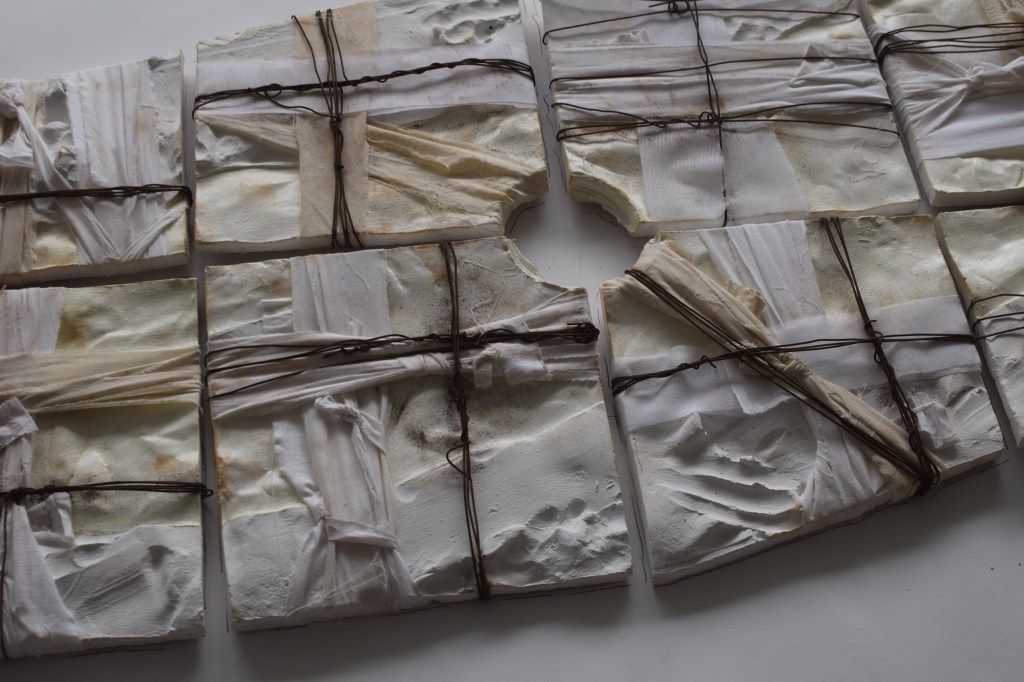
This paper reflects on an emerging spatial practice developed through clay, ceramic bodies, drawing, material encounters and the uncertain conditions of making. Rather than positioning clay within an ecology from the outside, Moreton approaches clay as an ecology through which the maker becomes permeable: entering it sufficiently to be altered by its resistances, forces and relations, while also altering the material field in return. The paper proposes an ecology of asperities: a condition in which minor material disturbances, incisions, traces, tensions, fractures, holes, borings and surfaces-become spatial events through which bodies encounter one another. These gestures are considered not as isolated formal decisions but as affective events within a wider correspondence of material, body, atmosphere, time and space.
Art Theory,
Spatial Practices,
Learning and Teaching,
Curatorial Practice (Art),
Visual Arts,
Ceramics,
Ecology of Asperities
Notes on a Particular Spatial Practice.
Abstract
This paper reflects on an emerging spatial practice developed through clay, ceramic bodies,
drawing, material encounters and the uncertain conditions of making. Rather than positioning clay
within an ecology from the outside, Moreton approaches clay as an ecology through which the
maker becomes permeable: entering it sufficiently to be altered by its resistances, forces and
relations, while also altering the material field in return.
The paper proposes an ecology of asperities: a condition in which minor material disturbances—
incisions, traces, tensions, fractures, holes, borings and surfaces—become spatial events through
which bodies encounter one another. These gestures are considered not as isolated formal decisions
but as affective events within a wider correspondence of material, body, atmosphere, time and
space.
Particular attention is given to the hole as a developing distinction within the practice. In earlier
work, a singular, human-scaled and indexical hole emerged through an encounter with P. D. James’s
The Children of Men, where the fertile centre of the human body was reimagined as absence. The
hole became an excavation within the ceramic body: an absent centre that nevertheless opened a
threshold towards possible futures. In later works, this singular opening becomes smaller, multiplied
and dispersed through the ceramic body. Borings and perforations produce a distributed porosity
through which air, light, atmosphere and other material relations may gather.
The movement from the singular hole to multiple minor openings suggests a shift from absence as
existential condition towards permeability as ecological practice. The minor gesture becomes
cumulative; the threshold becomes a field.
Through this movement, the paper considers making as a tentative form of knowledge: affective,
reflexive and materially situated. Kairos accompanies this unknowingness, describing a moment in
which the maker encounters something not yet fully knowable through the material itself. The paper
proposes that futures may already be present within such relations—not as predetermined outcomes,
but as possibilities gathering through matter.
Rather than claiming a position outside established ecological, ceramic or spatial practices, this
paper offers a particular way of reading with them. It adds to the literature by attending to
permeability, minor material events and affective spatial relations as forms of situated knowledge,
and by proposing the ceramic body not as an autonomous object but as a body capable of becoming
otherwise.
Keywords / Spatial Markers
Spatial Practice; Ecology of Asperities; Clay as Ecology; Ceramic Bodies; The Hole; Threshold;
Porosity; Permeability; Material Reciprocity; Minor Gestures; Affective Spatiality; Interiority;
Correspondence; ForceFeeling; ForceMiddle; Kairos; Productive Forgetting; Atmosphere;
Spatial Reverberation; Becoming; Future Bodies; More-than-Human Relations
Rather than positioning clay within an ecology from the outside, Moreton approaches
clay as an ecology through which the maker becomes permeable.
Russell Moreton’s practice develops through a particular understanding of spatial practice as an
affective and material activity: a way of entering into correspondence with bodies, materials, texts,
spaces and atmospheres without determining in advance what that encounter should produce.
His work moves beyond established distinctions between material and environment, thought and
matter, making and research. This movement is not a rejection of these distinctions so much as a
willingness to loosen them through practice. Moreton’s spatial practice develops in the interval
where categories begin to become less stable: where material becomes atmosphere, where reading
becomes sensation, where an object becomes a body, and where making becomes a way of
encountering what cannot yet be named.
Rather than positioning clay as something to be understood, represented or simply worked upon,
Moreton approaches it as a condition of encounter. Clay becomes an ecology through which the
maker is changed by resistance, pressure, absorption, slippage, time and transformation.
This permeability is central to the practice. To enter sufficiently into an ecology is to risk being
altered by it. The maker gives something to the material, but the material does not simply return it.
It transforms, withdraws, absorbs and resurfaces elsewhere.
Moreton’s practice therefore attends to an ecology of asperities: the uneven surfaces, frictions,
interruptions and resistances through which relations become possible. Friction is not simply an
obstacle to making. It can become a forcefeeling, a slippage between bodies through which
something passes from one condition into another.
A reading may become a gesture.
A gesture may enter clay.
Clay may become ceramic.
Ceramic may become atmosphere.
Another body may encounter it.
The movement is neither linear nor conclusive.
The friction of making therefore has a spatial afterlife. What occurs through pressure, resistance or
interruption within the material may later resurface between bodies as sensation, atmosphere or a
changed relation.
Within this process, clay provides a temporal space for productive forgetting. Encounters gathered
through reading, looking, thinking and making can disappear into material transformation. They do
not need to remain identifiable as knowledge. What returns through ceramic may instead be
sensation, surface, atmosphere, resistance or an altered trace.
Moreton’s ceramic bodies consequently operate less as autonomous objects than as spatial
propositions. Apertures, surfaces, interiors and thresholds form chambers of correspondence: spaces
that hold without completely containing, shelter without closing, and remain hospitable to what is
not yet known.
The practice understands clay as ecology ~ ceramic as atmosphere. The passage between them is
not simply a technical transformation from wet matter to fired object, but a change in the conditions
through which bodies encounter one another. Material friction becomes spatial reverberation.
Matter(s) of Space~Surfacing.
Matter(s) of space~surfacing describes the movement through which material encounters become
spatial intensities. What is gathered through clay does not remain contained within the ceramic
body. It migrates through surface, aperture, interior, shadow, light, proximity and atmosphere,
becoming perceptible in the encounter between bodies.
Surfacing does not mean revealing something hidden beneath a surface. It describes a becoming: an
intensity finding another spatial condition through which it can be sensed.
A pressure may surface as contour.
Resistance as aperture.
Repetition as rhythm.
Absence as interiority.
A remembered gesture as atmosphere.
In this sense, surfacing is not the exposure of a concealed interior, but the movement of matter(s)
into another condition of relation.
Moreton’s spatial practice does not therefore seek simply to represent an ecology or produce
knowledge about one. It seeks to enter ecological relations through making: to gather, become
permeable, be altered, and allow those alterations to surface elsewhere.
The propositions remain tentative. They are not conclusions but chambers through which other
bodies of thought, sensation and experience may pass.
The practice gathers rather than resolves.
It makes chambers rather than containers.
It follows forcefeeling rather than predetermined outcomes.
And it remains open to what might happen between bodies.
Perhaps the ecology is not something the practice enters, but something through which the practice
is continually becoming.
The Hole as a Particular Spatial Distinction.
The hole occupies a particular place within this practice.
It is not simply a formal device, nor does it function consistently as a symbol. Its significance has
developed through making. In an earlier body of work, a singular hole emerged at approximately
human scale, carrying the indexical trace of the body into the ceramic body. Informed in part by P.
D. James’s The Children of Men, the work considered the fertile centre of the body through its
absence: a barrenness that became physically present as an opening.
The hole therefore produced a peculiar spatial condition. It was an absence, but not an empty one. It
excavated the ceramic body while simultaneously creating a threshold through which other bodies,
materials and futures could be imagined. The body had lost its centre, yet the opening gathered
possibility.
The scale of this gesture changes in later work. The singular hole becomes a multitude of smaller
holes, borings and perforations. Their individual significance may appear minor. Yet through
accumulation they alter the condition of the whole ceramic body. What was once a singular aperture
becomes distributed porosity.
The hole becomes less an image of absence and more a capacity for exchange.
Air, light, atmosphere, touch and surrounding matter can pass through the body. The ceramic
surface becomes less a boundary that separates an interior from an exterior and more a threshold
condition between them.
This movement is important to the development of Moreton’s spatial practice. The earlier hole
amplifies the significance of the later minor gestures. It establishes the threshold as a proposition;
subsequent perforations multiply and redistribute it.
The minor is therefore not insignificant. Its force is cumulative.
A small boring can reorganise a body. Several borings can produce an ecology of openings. A field
of openings can transform the relation between interior and exterior without either being entirely
dissolved.
In this sense, the hole becomes a particular spatial distinction: a recurring material event through
which the practice moves from body towards permeability, from absence towards relation, and from
singular gesture towards gathering.
The hole does not necessarily contain a future. Rather, it makes space for futurity to become
perceptible as relation. It is a small spatial event through which something not yet determined can
enter the field.
The hole consequently becomes one of the spatial markers through which Moreton’s practice can be
read retrospectively. What appeared initially as an existential excavation within a human-scaled
ceramic body begins to reverberate through later, smaller acts of boring and perforation. The earlier
gesture is not superseded by the later ones; it remains active within them.
A temporal correspondence begins to emerge.
The hole from the earlier body of work resurfaces as multiple minor openings in later ceramic
bodies. What was once singular becomes distributed. What was once an absent centre becomes a
porous surface. What began as a question of human fertility and existential barrenness becomes a
material question of how bodies might remain open to other bodies.
The hole becomes a threshold through which the practice itself changes scale.
This is where the ecology of asperities becomes tangible. Asperity is not only resistance, roughness
or friction. It can be the small interruption through which a body becomes available to another. The
incision, boring, puncture, aperture or tension marks a place where the apparently autonomous
ceramic body becomes susceptible to relation.
The ecological proposition therefore does not arrive from outside the work. It emerges from the
repeated material consequences of making.
The body opens.
The opening multiplies.
The surface becomes porous.
And through that porosity, other bodies can gather.
The ceramic body does not merely occupy space. It develops organs through which space can be
sensed, gathered and made otherwise.
This proposition carries the section back into the wider argument. The hole is no longer simply an
opening in a ceramic body; it becomes one of the ways the ceramic body acquires a spatial capacity.
The perforation becomes an exploratory and speculative organ through which the work can sense
beyond itself without needing to know in advance what it will encounter.


Leave a comment