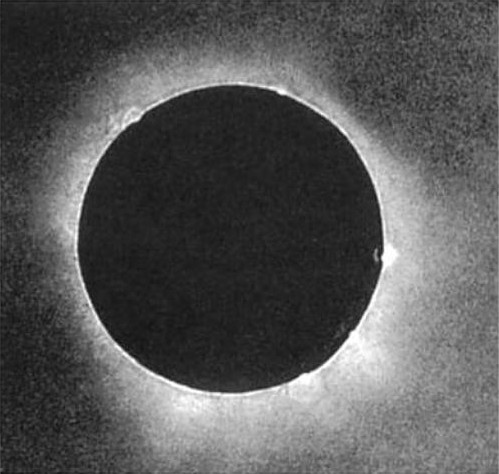
The first daguerreotype of a solar eclipse
The first correctly-exposed photograph of the solar corona was made during the total phase of the solar eclipse of 28 July 1851 at Königsberg (now Kaliningrad) by a local daguerreotypist named Berkowski. Berkowski observed at the Royal Observatory following a proposal by its director A. Busch. A small refracting telescope (D = 6.1 cm, f = 81.2 cm) was attached to the hour drive of the 15.8-cm Fraunhofer heliometer, and a 84-s exposure was taken shortly after the beginning of totality. After the eclipse, Busch (who did not observe the eclipse at Königsberg but at Rixhöft), published some details about the daguerreotype (without mentioning Berkowski’s first name) and ordered a local artist (R. Trossin) to make an enlarged steel engraving from the daguerreotype plate. On the original plate the moon’s diameter is 7.85 mm, and at least 5 prominences are well visible on the limb of the sun. Later Berkowski himself made some daguerreotype reproductions from his original plate.
 Russell Moreton : Matter(s) in Correspondence
Leave a comment