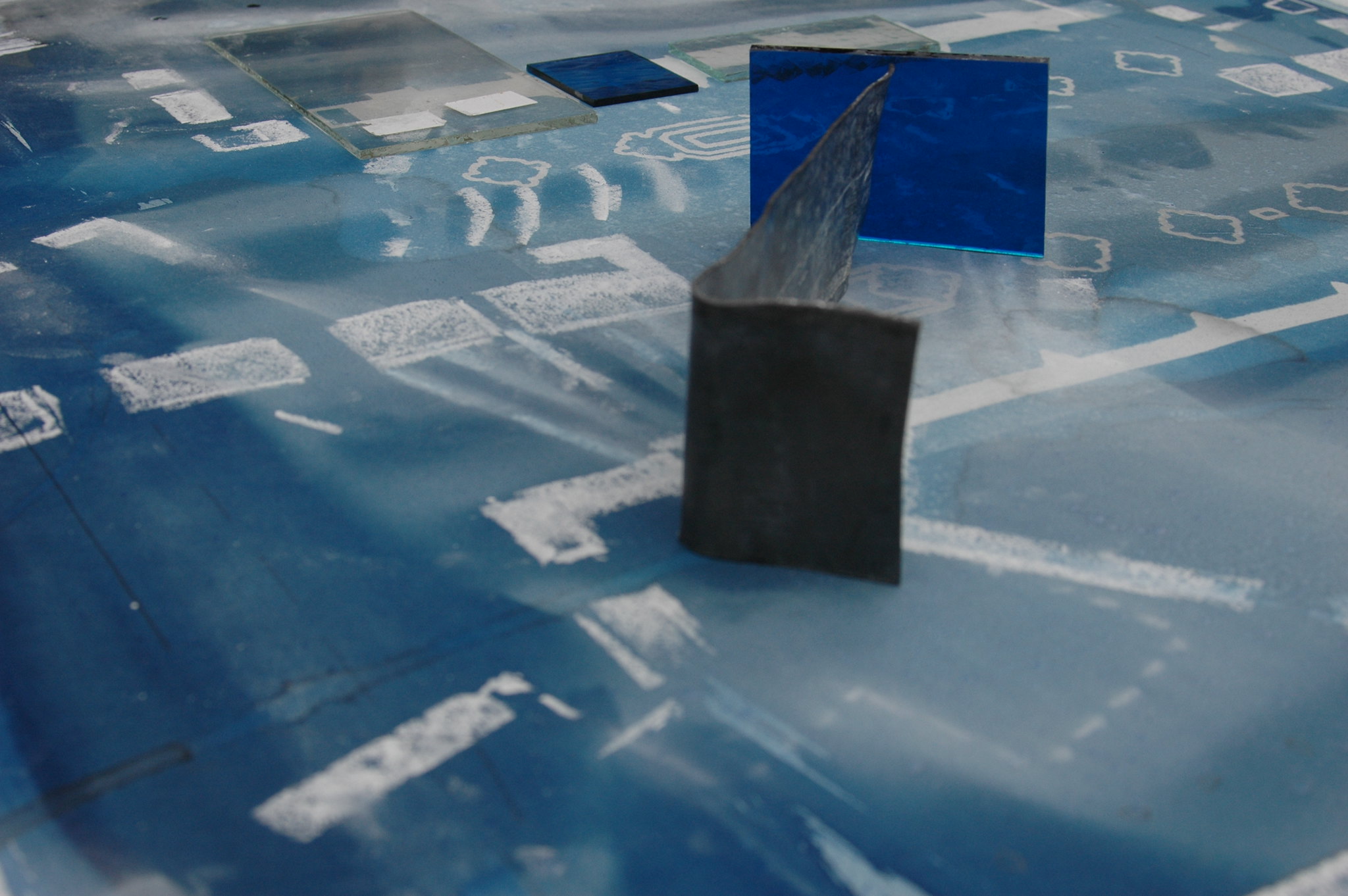
Spatial Practices : Experimental drawing and alternative photography.

  • Molecular Sieve/Performative Apparatuses : CREATING CREATIVE ANTHROPOLOGY INTO TEMPORAL SITES/10 DAYS WINCHESTER

    Winchester – Hyde Abbey Laundry

    The site of approximately 1,500 sq. metres comprises redundant industrial buildings and a yard at the edge of the city centre and close to the Winchester School of Art. The site is considered to be important in townscape terms and being vacant is an underused resource. The Laundry ceased trading in 2007 and has been empty since. It is a short walk from the city centre, near car parks, leisure centre, Winchester School of Art, the Colour Factory artists’ co-operative, but in an otherwise residential neighbourhood. The site consists of a large industrial space with high ceilings, a series of different sized workshops around this main zone, and on its upper floors, office accommodation, staff canteen and a workshop. The private owner and his developer wish to demolish the old buildings and develop the site for housing; however, WCC planning officers wish to see the site or part of the site, retained as offering employment within the city.

    Urban Fallow could encourage the owner to consider live-work units and studios for artists to be constructed on the site and demonstrate that there is demand for this type of activity. The Council’s Estates, Arts Development and Economic Development staff have for some years, been looking for potential sites and business models to establish affordable studios in Winchester. While demand is known, the value of assisting in the establishment of such a scheme is unproven. Urban Fallow has the potential to provide further evidence and advocacy for a permanent studio facility on this site. Winchester City Council would want to work with Winchester School of Art (arts faculty of Southampton University) and the University of Winchester, and the Hampshire Economic Partnership as partners in this scheme.

    The building in its present state, although unsuitable for most purposes, is viewed by creative practitioners from a range of practice, as having great potential as studio space (in great demand in Winchester where suitable premises are hard to find – and afford). In the current market conditions, the site is likely to remain ‘fallow’ for some time to come until these issues are resolved, and the market conditions improve.

    Urban Fallow will bring into sharp focus areas of vacant urban land resulting from the slowdown in construction and the halting of some major redevelopment and housing projects. It is important that these spaces, many of which are significant in both scale and location are not allowed to deteriorate and damage the public perception of a place. The project will reanimate these areas of land by offering them for use by artists, architects, performers and other professionals with an interest in engaging with the public to develop temporary events and interventions. As well as transforming the spaces and reducing urban blight, this project could also have the effect of reinvigorating interest and potential investment in the spaces, encouraging developers and local authorities to look at them again with renewed creativity and optimism.

    Urban Fallow/Solentcentre for architecture and design aims to develop a pragmatic but fluid approach to public access, cultural intervention, use and temporary transformation of urban spaces.

    https://www.flickr.com/photos/russellmoreton/

    CREATING CREATIVE ANTHROPOLOGY INTO TEMPORAL SITES
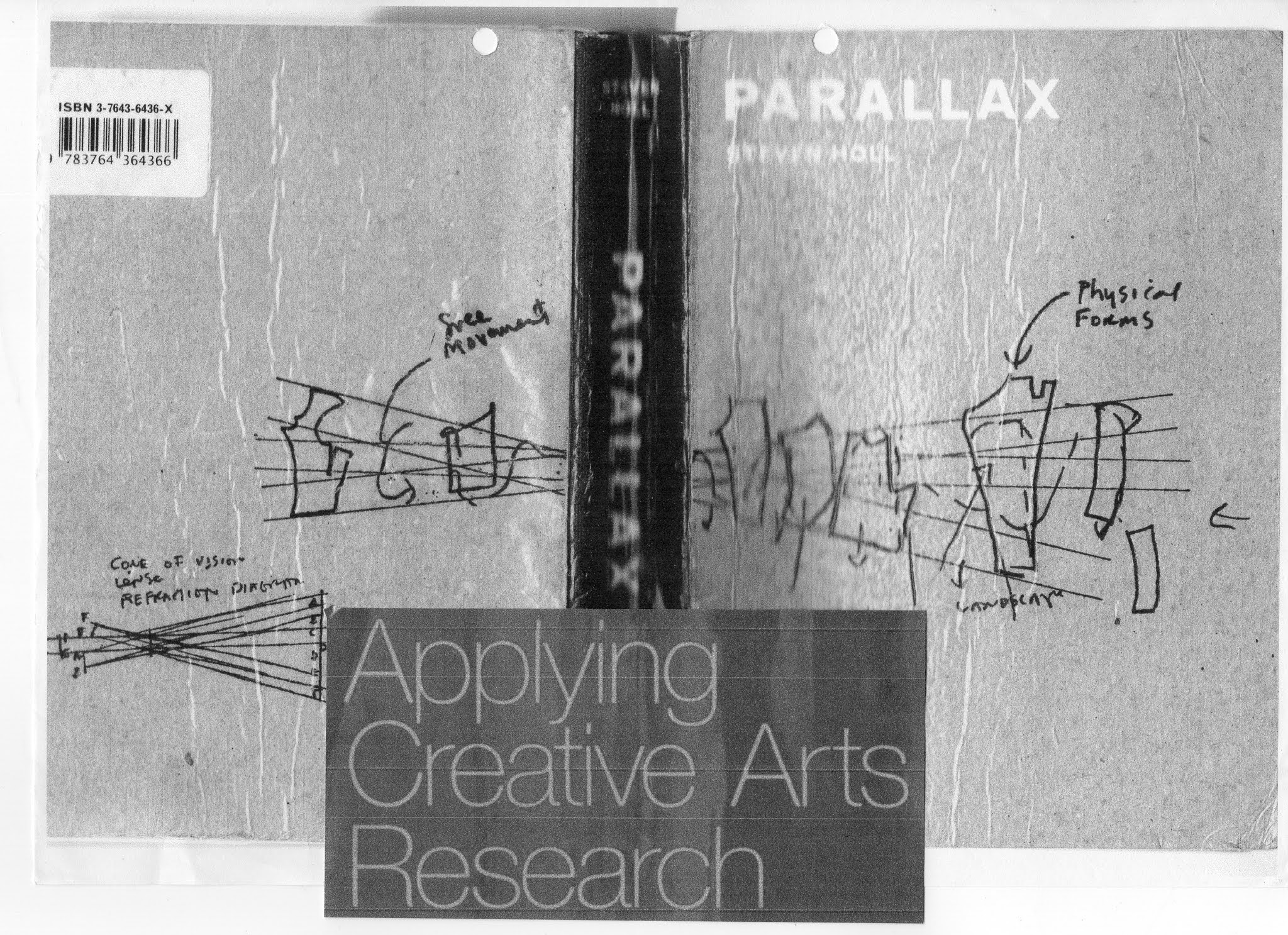
    between the concrete and the spatial

    THE WORKING PRACTICE IS FUNDAMENTALLY SUPPORTED BY ANTHROPOLOGICAL NOTIONS AROUND ISSUES OF SPACES, ORIGINS, SOCIAL RITUALS AND TABOOS
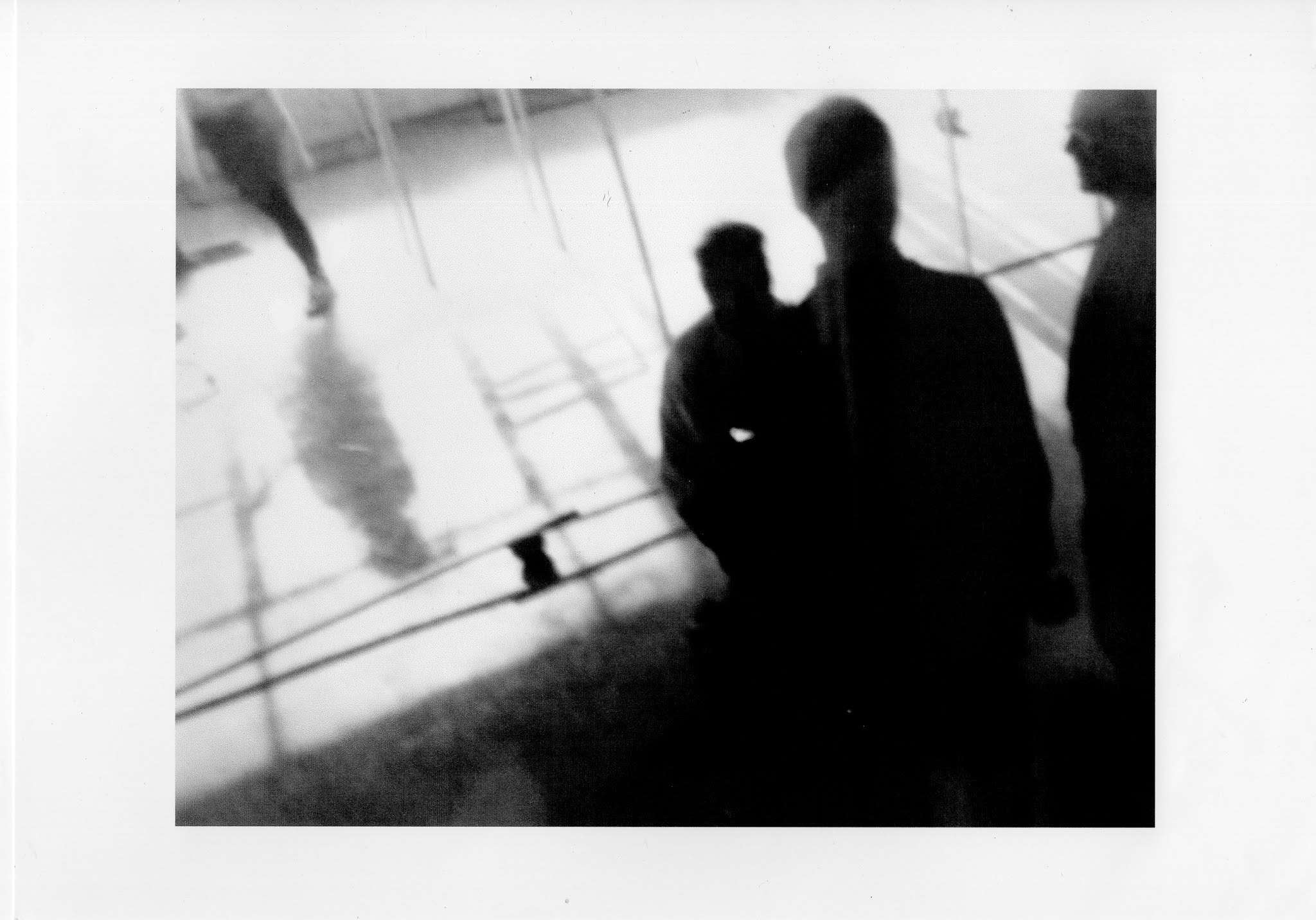
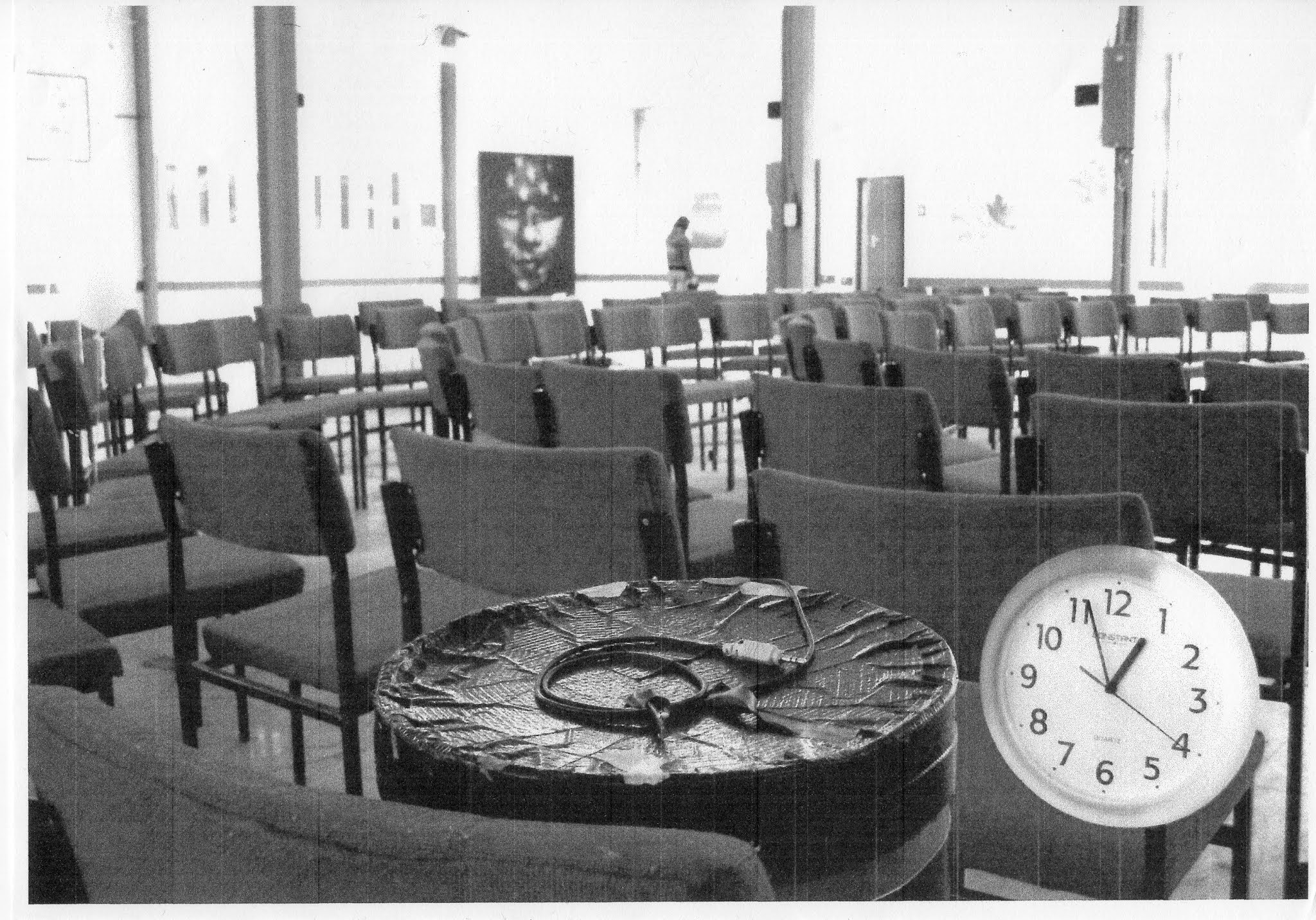
    CAPTURED BY APPARATUSES

    Heuristic Practices : The trace/space of the anthropological
    Utilising processes and strategies and terminologies.

    Demarcation, set the boundaries or limits.

    Acculturate, assimilate to a different culture.

    Ethnology, the study of the characteristics of different peoples and the differences and relationships between them.

    NON- SPACES, Introduction to an anthropology of super modernity. Marc Auge.

    My working practice intuitively reflects and responds to what Marc Auge considers to be the condition of Supermodemity, briefly his defining parameters on the idea of Supermodemity are.

    Overabundance of events.

    Spatial overabundance.

    The individualization of references.

    A SOCIETY IN EXCESS.

    My creative practice attempts to reconstitute spaces from this condition of Supermodemity into temporal sites, places from which to solicit a sense of a mobile anthropology, a dwelling that is both intimate and public and promotes solitudes and subjectivity.

    Marc Auge states the twenty-first century will be anthropological, not because the three figures of excess are just the current form of a perennial raw material which is the very ore of anthropology, but also because in situations of supermodemitiy the components pile up without destroying one another.1

    Contemporary Practitioners like anthropologists will attempt to make sense, they will attempt to resolve, to make or rather remake meaning through the processes of observing the phenomena of acculturation. My practice has now entered into a process that proposes a site for research driven by condition of acculturation. This site of inquiry will attempt to set up an anthropological place of localised relations amidst the condition of Supermodemity.

    This proposed temporal demarcation, a marking out of a territory which will become adaptive, reflexive and spatial. Sets out to engender the inquiry of the ethnologist, to attempt of rather to reflect on how the place is organised. This site marks a private acculturation of material sourced from the world, from a hermetic and esoteric realm of private geographies, now processed and made available, accessible to the social.

    The observer in the role of the ethnologist with others is invited to formulate their own invention of place through their own curiosity of encounter. This demarcation of space into the social, anticipates an intervention which creates a common adventure for a group in movement.

    An interesting comment about gendered space in classical literature examines the relationship between what might theoretically and spatially link the interior with its exterior boundary is to found Mythe et pensee chez les Grecs written by Jean-Pierre Vemant. In this account Vemant describes the spatial and social arrangements of the Hestia/Hermes couple. Marc Auge acknowledges this relation as

    “Hestia symbolizes the circular hearth placed in the centre of the house, the closed space of the group withdrawn into itself (and thus in a sense of its relations with itself);

    while Hermes, god of the threshold and the door, but also of crossroads and town gates, represents movement and relations with others.”2

    Auge makes the critical point that in anthropology studied by both classic literature and history it is identity and relations that form spatial arrangements which are also inscribed in time. It is this time that materially renders the temporal dimension of these spaces and with it our reading of anthropology.

    My earlier usage of long durational photographic devices (large pinhole cameras) was an attempt to realise the identity and relation of a place (its spatial activity and fixity) is totally contingent to its method of register and the particularities of fixed and temporal details. In fact these surfaces rendered from these devices are evidences of historical spaces of hidden social itineraries.

    1  Marc Auge, Non-Places, introduction to an anthropology of super modernity. (London: Verso, 1992) page 41.

    2  Marc Auge, Non-Places, introduction to an anthropology of supermodernity. (London: Verso, 1992) page58.

    Fragment, research/Mechanisms of Seeing/The Architecture of Image

    Architectural Apparatuses of Affect : Daniel Libeskind/Small Voids/Cameras

    light; the darkness is a silent solid, the light etches its surface, it is simultaneously sign and cypher. The light etching itself on the dark surface is akin to a revelation, an epiphany before the building is transformed by its users and movement.

    Daniel Libeskind’s building will, when finished, offer a path for the visitor, the path of history that crosses the void of commemoration. This void is the body of an absence—that of the Berlin Jews who perished in the Holocaust. The void makes us meet this absence, but we meet it by passing through it. When an absence, in the form of a void, meets the surface of daily reality, memory marks that surface. The Holocaust has created such a void, which, in projects such as the Berlin Museum with the Jewish Museum, is brought to the surface and given a place and a house. The void intersects the surface of time and creates a place of passage, of commemoration, of ritual in our daily life. The void is linear sign: lest we forget. But the incisions in the walls of the main exhibition spaces, spaces which house the historical material about the city of Berlin, create voids through which light is let in. These calligraphic empty spaces create a near biblical writing on the wall.

    Cameras consist of small voids, the ‘camera’, a lens and photographic film. They are camerae obscurae  that collect light and allow it to meet the surface of the film. But in fact the light comes from the larger void outside the camera. The moment the light has registered on the light-sensitive surface of the film, memories are constructed. The memory is literally conceived in this meeting and is added to life as an additional layer of being. The process through which void meets surface is therefore also about love—the love of ancestors and relatives, but also of life and its conception.

    Russell Moreton, 10 Days in the Laundry
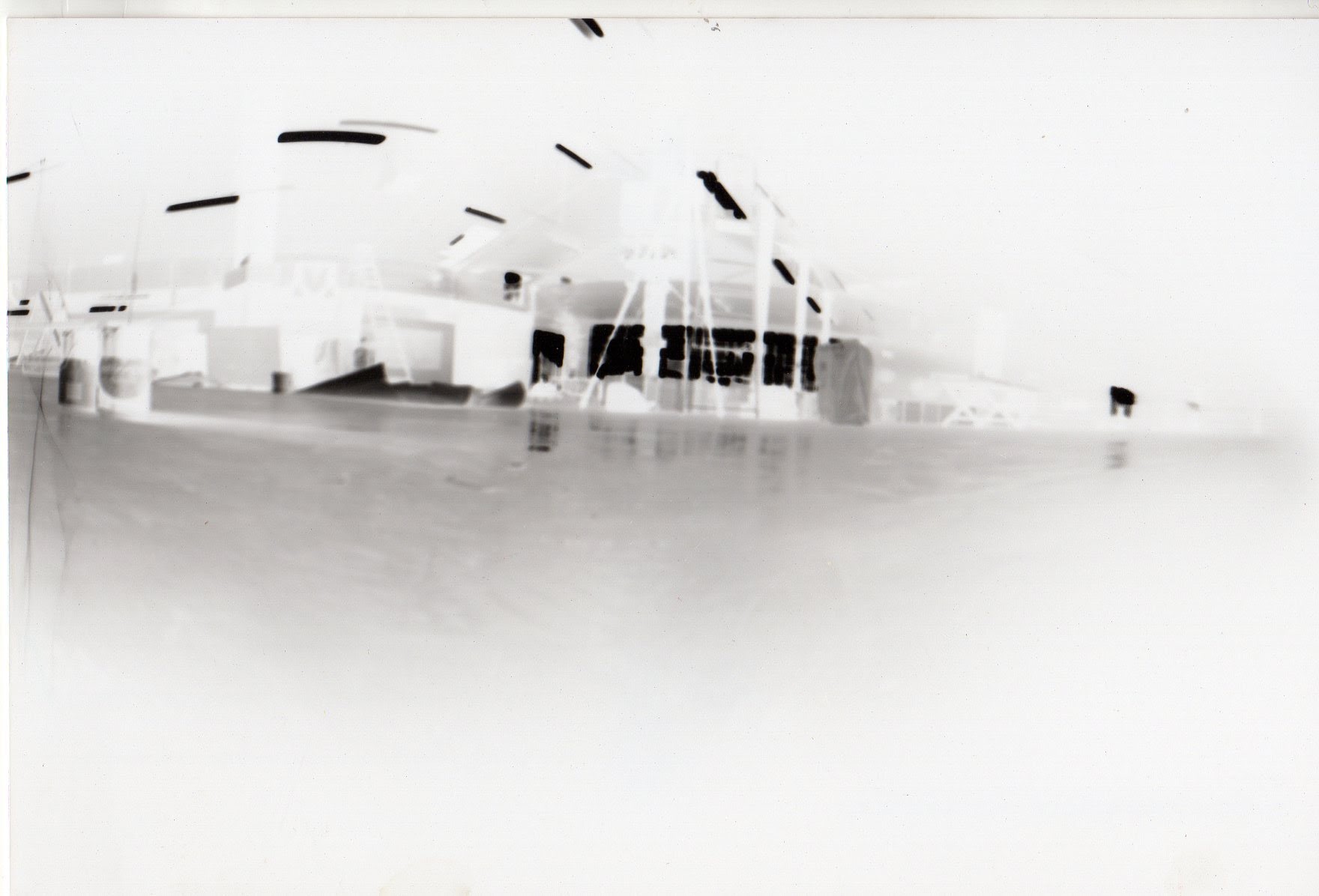
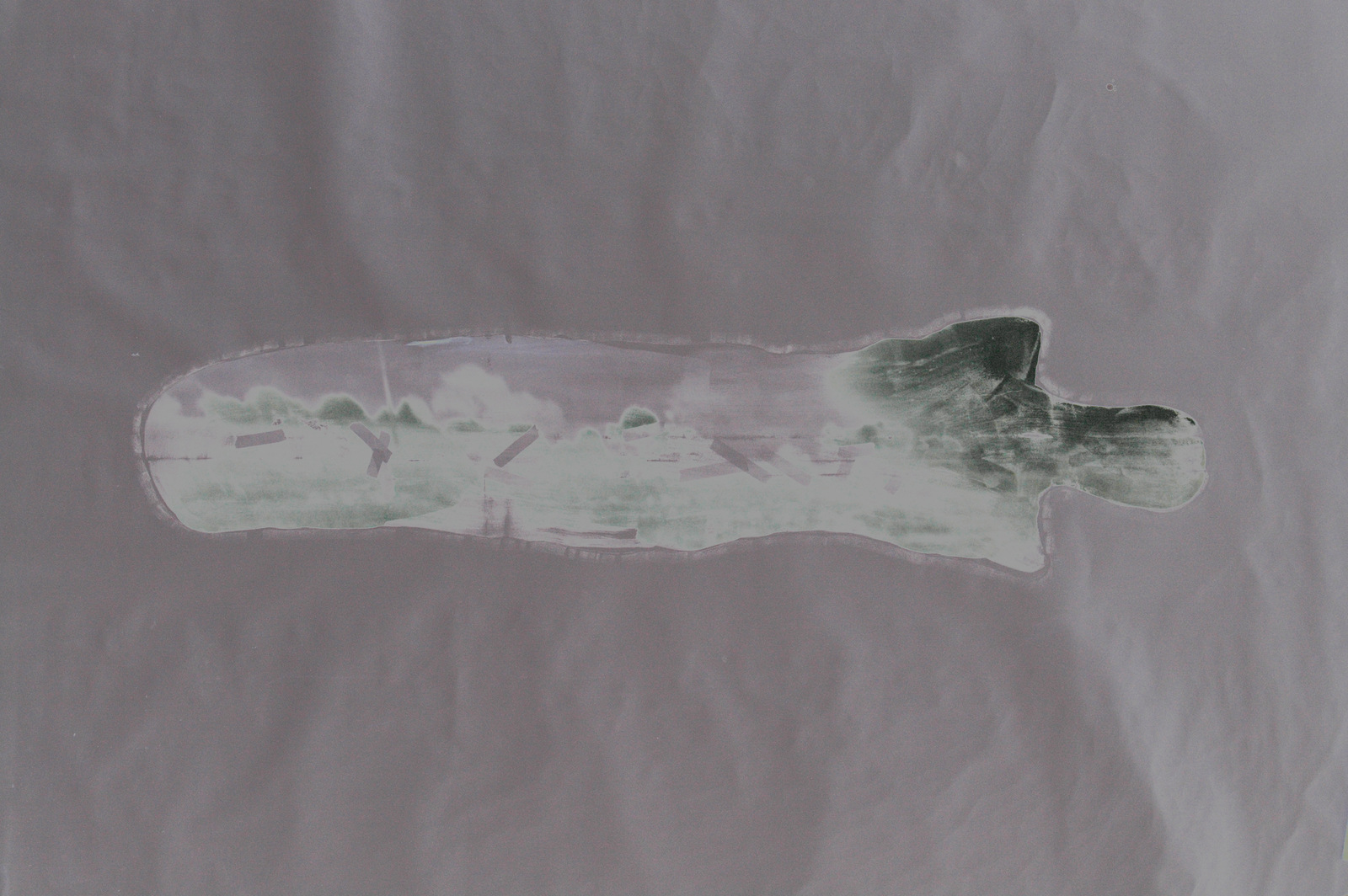
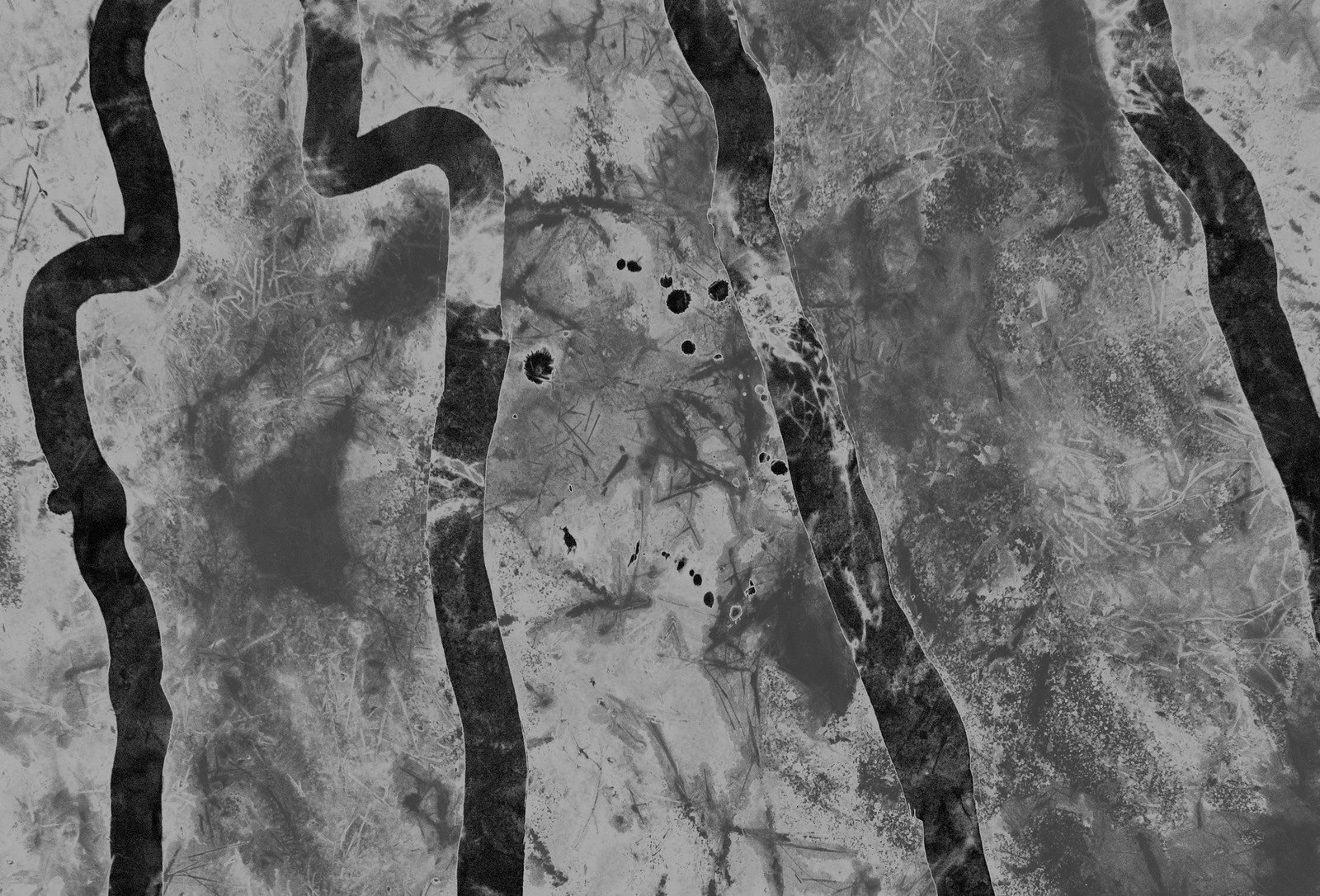
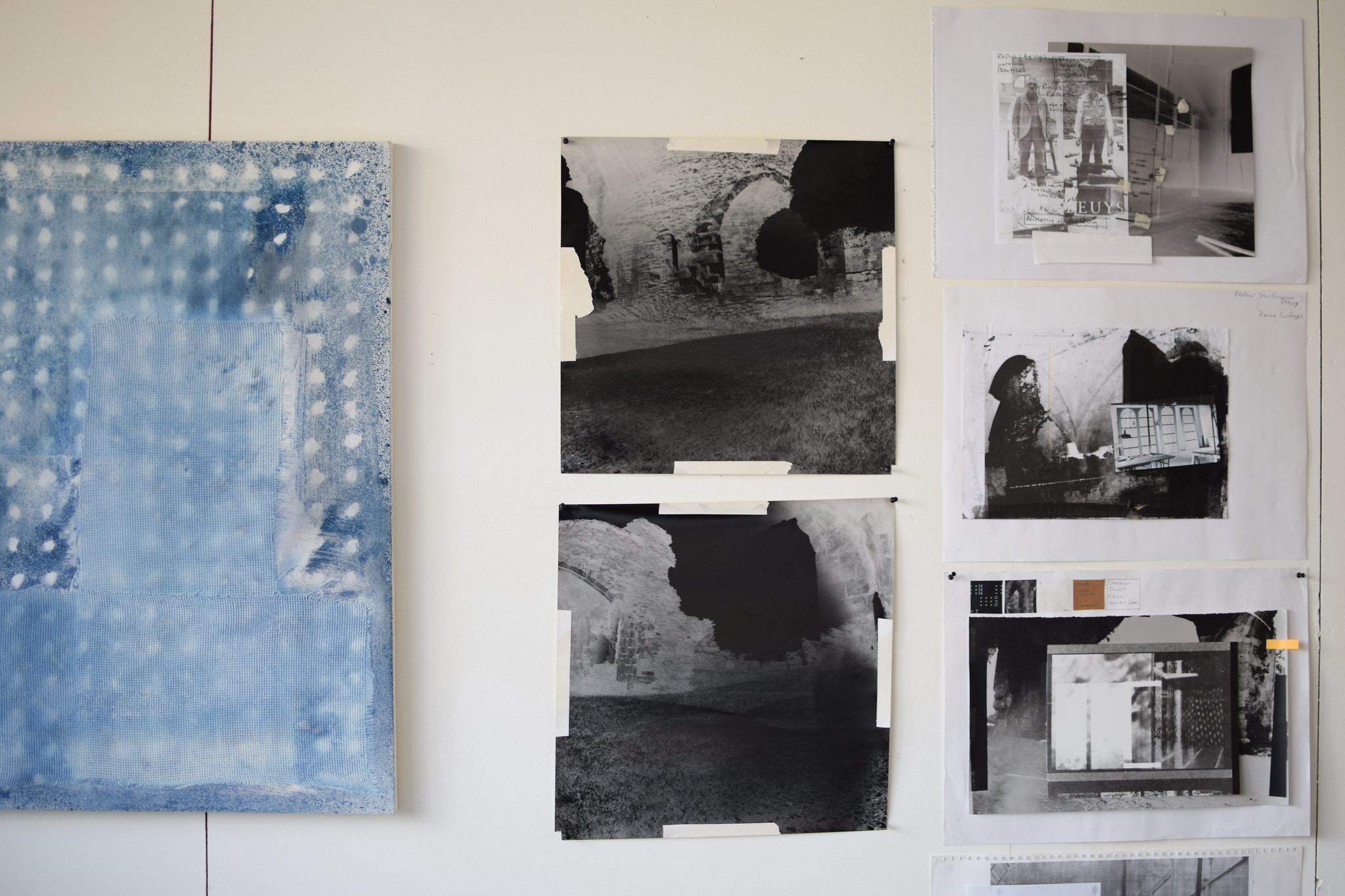
    MOLECULAR SIEVE, is a performative analysis of “this place” utilising the simple properties of the pinhole camera. This appropriated apparatus makes visible the extrusive nature of time as it is deposited on the photographic surface. The extended durations required to register “place” impart a sense of dwelling as recorded by the apparatuses passive gaze. These surfaces record and register a relation constructed by the architecture of the chamber and what is beyond it. Movements when visible appear as simple abbreviated enactments caught like inclusions within this consolidated and timely consolation of place.
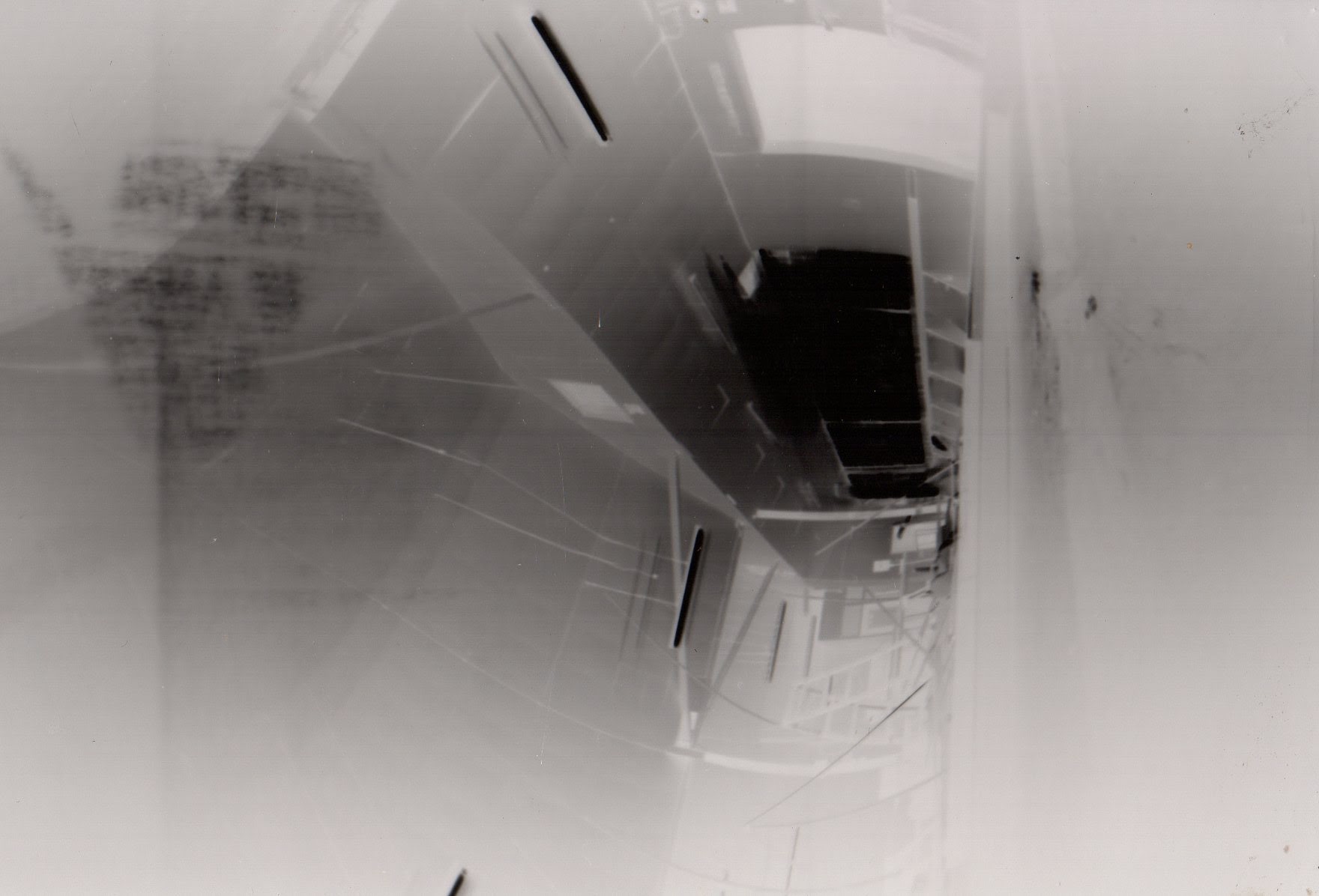


    Time as it accumulates on a photographic surface.

    This performative investigation utilizes a large pinhole chamber which is given mobility via a sack-barrow. This apparatus produces through its very inclusion into spaces a “spatial practitioner” in its own right. My aim is to utilize this device as a means of registering “worksites” both in the duration of the event and in its pre-performative state. The mobility of this research could be used to illustrate a constantly changing set of dynamics throughout the site and its event. The use of perhaps adjacent wall spaces or even a

    “sandwich board” would render a tangible re-presentation of spatial information for the visitor. Darkroom facilities or conversely off-site arrangements would be organised.

    Artist Statement 2009/10 Days

    SITE is anti-place hovering precariously over the abyss of no-place.1

    This “undoing of place” might instigate a threshold and a situation/room from which to reflect upon critical spatial, sociological and psychological conditions and perceptions.

    Practitioner with earlier experience in ceramics and glass, recently completed visual arts course at Winchester, now at Canterbury studying spatial practices. Interested in drawing, photography and interventions that can explore our sense and experience of place. My work seems to harbour a need for a reflective solitude, a sense of dwelling amongst absences. The use of materials from the locality (field chalk) imply a personal geography drawn from the direct relationship to an inherited Earth. There is the suggestion that the absence recorded by the trace is an inclusion, a legacy set into a field of materiality, but it might also suggest a metaphysical field of thought. This act of drawing becomes its own experimental field of exploration, a sort of “in­ between reality”( Merleau-Ponty) an enmeshed experience. Perhaps all that remains is some sense of a material memory encountering the realm of the insubstantial.

    Interested in collaborative projects and ventures that might facilitate issues of “site” as being the very undoing of place. Site for me is part of the rehearsal for the construction of place, site holds relations and intimacies/geographies that will be over-written by methodologies destined to be terminated to create place.

    What is an Apparatus? Giorgio Agamben
    by the term “apparatus” I mean a kind of a forma­tion, so to speak, that at a given historical moment has as its major function the response to an urgency. The appa­ratus therefore has a dominant strategic function.
    I said that the nature of an apparatus is essentially strategic, which means that we are speaking about a certain manipulation of relations of forces, of a rational and concrete intervention in the relations of forces, either so as to develop them in a particular direction, or to block them, to stabilize them, and to utilize them. The apparatus is thus always inscribed into a play of power, but it is also always linked to certain limits of knowledge that arise from it and, to an equal degree, condition it. The apparatus is precisely this: a set of strategies of the relations of forces supporting, and supported by, certain types of knowledge.
    I wish to propose to you nothing less than a gen­ eral and massive partitioning of beings into two large groups or classes: on the one hand, living beings (or substances), and on the other, apparatuses in which living beings are incessantly captured. On one side, then, to return to the terminology of the theologians, lies the ontology of creatures, and on the other side, the oikonomia of apparatuses that seek to govern and guide them toward the good.


    spatial practice, alternative photography, fine art, ceramics,making,Russell Moreton,
    Source: Molecular Sieve/Performative Apparatuses : CREATING CREATIVE ANTHROPOLOGY INTO TEMPORAL SITES/10 DAYS WINCHESTER

  • Melancholy Landscapes : The Plague/Vermilion Sands

    Film Collages, hybrid processes and temporal states
    Liminality : Literature/Philosophy/Visual Art

    Landscapes : entering/intruding/emerging (holga819)
    Existential Gestures : Looking away from the sea
    Ballard : Vermilion Sands  :  Speculative Fields/Spatial Practices

    Albert Camus : The Plague, 1947. (Penguin Fiction)

    The townspeople of Oran are in the grip of a virulent plague.

    Cut off from the rest of the world, living in fear, they each respond in their own way to the grim challenge of the deadly bacillus. Among them is Dr Rieux, a humanitarian and healer, and it is through his eyes that that we witness the devastating course of the epidemic.

    Written in 1947, just after the Nazi occupation of France, Camus’s magnificent novel is also a story of courage and determination against the arbitrariness and seeming absurdity of human existence.

    ‘Camus represents a particularly modern type of temperament, a mystic soul in a Godless universe, thirsty for the absolute, forever rebellious against the essential injustice of the human condition’
    Shusha Guppy, Sunday Times

    https://www.flickr.com/photos/russellmoreton/


    spatial practice, alternative photography, fine art, ceramics,making,Russell Moreton,

    Source: Melancholy Landscapes : The Plague/Vermilion Sands

  • Spatial Representation/Practice : Discursive photography and documentation

    The Poetics of Space : The house, from cellar to garret. The significance of the hut.
    “He will revive the primitivity and the specificity of the fears. In our civilization, which has the same light everywhere, and puts electricity in its cellars, we no longer go to the cellar carrying a candle. But the unconscious cannot be civilized. It takes a candle when it goes to the cellar.”
    Gaston Bachelard.
    “All religions, nearly all philosophies, and even a part of science testify to the unwearying heroic effort of mankind desperately denying its contingency.”
    Jacques Monod,
    The Human/Straw Dogs, John Gray.
    Is there still an aesthetic illusion? And if not, a path to an “aesthetic” illusion, the radical illusion of secret, seduction and magic? Is there still, on the edges of hypervisibility, of virtuality, room for an image?
    — Jean Baudrillard, The Conspiracy of Art, 2005
    Jana Sterbak
    Remote Control 1989
    <a href=”http://art-history.concordia.ca/eea/artists/sterbak.html&#8221; rel=”noreferrer nofollow”>art-history.concordia.ca/eea/artists/sterbak.html</a>
    A heuristic technique (/hjᵿˈrɪstᵻk/; Ancient Greek: εὑρίσκω, “find” or “discover”), often called simply a heuristic, is any approach to problem solving, learning, or discovery that employs a practical method not guaranteed to be optimal or perfect, but sufficient for the immediate goals.
    A Hut of One’s Own, Ann Cline
    Texts, Annotations, Foundations, Pathways, Corridors, Bookmarks, Walking, Thinking, Ramble, Cross Country, Disciplines,

    Sensorium : A Partial Taxonomy, Caroline A. Jones.

    Contemporary artists aim to produce specific relations with the technologies they adopt and adapt;
    This schematic offers a partial taxonomy.
    Caroline A. Jones, Sensorium : Embodied Experience, Technology and Contemporary Art 2006

    Immersive
    the “cave” paradigm, the virtual helmet, the black-box video, the earphone set

    Alienated
    taking technology and “making it strange,” exaggerating attributes to provoke shock, using technologies to switch senses or induce disorientation

    Interrogative
    work that repurposes  or remakes devices to enhance their insidious or wondrous properties; available data translated into sensible systems

    Residual
    work that holds on to an earlier technology, repurposes or even fetishizes an abandoned one

    Resistant
    work that refuses to use marketed technologies for their stated purpose; work that pushes viewers to reject technologies or subvert them

    Adaptive
    work that takes up technologies and extends or applies them for creative purposes, producing new subjects for the technologies in question


    spatial practice, alternative photography, fine art, ceramics,making,Russell Moreton,
    Source: Spatial Representation/Practice : Discursive photography and documentation

  • Seeing Dark Things : Chemical Photography.

     Concept of a ‘Filtow’

    A filtered radiance emanating from a vessel not an object interrupting a beam of light.

    Seeing Dark Things.

    Roy Sorensen.

    The thing contained is not the thing contained.

    The spherical intersection space was also crafted in curved thin wood layers.

    Steven Holl.

    Deep Time.

    The Mutability of Colour Relationships.

    Unleashed Colour World.

    Manifestations of Unhindered Radiance.

    Albers, yellow square.

    Monrian, square of yellow in its field of white.

    For both Mondrian and Winifred Nicholson, colour concentrates light and transforms the world.

    Flowers were sparks of light.

    I used flowers as chalices of light to make my own pictures.

    My Cibachrome darkroom has been as much a domestic space as the Alber’s basement and Winifred Nicholson’s farmhouse kitchen. They are places where ideas about the emotional range of a yellow square can exist as naturally as reflections and shadows cast by the sun and moon.

    In this new colour world of mine, the circle became nature, and the square became thought.


    The circle and square together embody what I think of as human nature.

    Dark Room, Garry Fabian Miller.

    Generating an Aura.

    Fusing and Pulsating Pigment.

    Pinhole Photography

    Photo Tin/Medium.

    Cromer.

    Raveningham.

    Site Cyanotypes/Drawings/Intermediaries

    Spatial Collages Reconfigured


    spatial practice, alternative photography, fine art, ceramics,making,Russell Moreton,

    Source: Seeing Dark Things : Chemical Photography.

  • Confronting The Human Body : A Body Of Relations

     Outpost 270423

    Temporal Demarcations.

    Figural Workshop.

    Confronting The Human Body.

    The Psychology of Nakedness.

    Looking/Showing/The Eye/The Gaze.

    In the scopic field, the gaze is outside; I am looked at, that is to say, I am a  picture.

    The spectacle of the world, in this sense, appears to us as all-seeing, this all-seeing aspect is to be found in the satisfaction of a woman who knows that she is being looked at, on condition that one does not show her that one knows that she knows.

    Jacques Lacan.

    What is a Picture.

    The Split between The Eye and the Gaze.

    A Body of Relations.

    Reconfiguring The Life Class.

    In the article What is a Picture? Jaques Lacan relates the space between the gaze and the eye to the ‘screen’. The ‘screen’ allows the simultaneous perception and projection of the image. In the life class, Lacan’s gaze is significant for the life model and the artist as it formulates the intentions of the psychological engagement and reveals the fundamental pursuit of desire in the methodology of life drawing practice. The subject needs to become an object of its own ‘scopic drives’ and therefore possessed by the perception of others. Lacan’s gaze is somewhat estranged from the body, as it never allows for subjectivity to be fully complete.

    Yuen Fong Ling. 2016

    Palimpsest/Involuntary Surfaces.

    Drawing/Corporeal Intertwinings of body/space.

    Bodyscapes/Movements/Materials.

    Haptic/Visual Abstractions.


    Life Class/Drawing.

    The contested space/subject of the nude as a form of art.

    The Impossible Nude.

    Transfer/Temporal/Media.

    Dyeline Sheet/Rolled Inked Surface.

    Charcoal/Burnt Umber/Pencil

    Shading Colour/Glass Pigments/Fired Glass.


    spatial practice, alternative photography, fine art, ceramics,making,Russell Moreton,

    Source: Confronting The Human Body : A Body Of Relations

  • Diffractive Title/Things : The thing contained is not the thing contained.

     Outpost 240423

    The thing contained is not the thing contained.

    Manifesto for explorations of ‘IN’

    Steven Holl.

    You Are The Weather.

    Roni Horn.

    Rich Lyrical Motifs.

    Brilliant Trees.

    Within each lesson lies the price to learn.

    David Sylvian.

    Alternative Photography/Filtered Radiance

    Documents from research archive

    Seeing Dark Things

    Roy Sorensen. 2008

    Tracing Light : Petworth House, West Sussex 2000

    David Alan Mellor, Garry Fabian Miller.

    Light And The Genius Loci

    For Derrida, the sun not only marks the beginning of metaphoricity but it is also an inescapable reminder of the solar system and oscillations, hidings and occultrations, inherent in ‘a certain history of the relationships; earth/sun inthe system of perception’.

    Mutations Of Light

    Petworth Window, 6 July 1999

    Light’s Windows And Rooms

    Passing towards the Invisible.

    The prospect of some metaphysical realm beyond the blue end of the spectrum and beyond material things illuminated to carnal sight, was a recurrent  theme in William Henry Fox Talbot’s early speculations.

    CATCHING THE LIGHT

    The entangled history of light and mind

    Arthur Zajonc

    BROUGHT TO LIGHT

    PHOTOGRAPHY AND THE INVISIBLE 1840-1900

    Sight Unseen

    Picturing The Universe

    Corey Keller

    Invisible objects, penciled by nature’s own hand.

    In his introduction to the exhibition catalogue Iconoclash: Beyond the Image Wars in Science, Religion, and Art, the historian of science Bruno Latour argues that scientific pictures are powerfully affective because they more than mere images; they are, as he puts it, the ‘world itself’.

    The Social

    Photographic Eye

    Jennifer Tucker

    Nineteenth century science was characterized by both the appeal to visual evidence and the need for confirmation by the testimony of eyewitnesses. The latter explains why scientists pursued public viewings of their photographs by means of illustrated slide lectures, exhibitions, and reproduction in newspapers and magazines.

    An understanding of the social boundaries of nineteenth century science helps make sense of a certain paradox within contemporary attitudes towards photography of the invisible. The ideal of mechanical objectivity in documenting visual knowledge demanded the elimination of the artist-observer and all of the subjectivity implicit in drawing by hand.

    Invisible Worlds

    Visible Media

    Tom Gunning

    William Henry Fox Talbot, Slice of horse chestnut, seen through the solar microscope, 1840, salt print 18.6×22.5 cm.

    Techniques Of The Observer

    On Vision And Modernity In The Nineteenth Century

    Jonathan Crary

    The Camera Obscura and its Subject

    Above all it indicates the appearance of a new model of subjectivity, the hegemony of a new subject-effect. First of all the camera obscura performs an operation of individuation; that is, it necessarily defines an observer as isolated, enclosed, and autonomous within its dark confines. It impels a kind of askesis, or withdrawal from the world, in order to regulate and purify one’s relation to the manifold contents of the now ‘exterior’ world.

    UNDER THE SUN

    By The Light Of The Fertile Observer

    Metaphors of illumination in the photography of Christopher Bucklow, Susan Derges, Garry Fabian Miller, and Adam Fuss.

    An Epiphany Of Light

    David Alan Mellor

    Christopher Bucklow , Guests

    Jeanette Winterson, Gut Symmetries

    Matter is provisional and that includes me. If the physics is correct then we are neither alive or dead as we commonly understand it, but in different states of potentiality.

    Finding enlightenment in the ground beneath one’s feet.

    J. G. Bennett.

    Walking/Thinking with Ideas/Observations.

    Site Drawings and Observational Mappings.

    Cultivation Field.

    Artist’s Development.

    Planting Research

    Vital Nourishment.

    Raveningham Garden Project.

    Circle/Linear Time/Centred on objects.

    Spiral/Deep Time/Awareness between things.

    Architectural Ceramics.

    Inseminations/Sketchbooks

    Working Ideas/Proposals into Matter/Making

    Contents/Description/Instructions/Diagram/Drawing

    Curatorial.

    Spatial Practice.

    Practice/Display/Audience.


    Hungate.

    Julian 600.

    Cell/Seeds/Dispersal/Cloud

    Organism-Person-Environment

    Anglian Potters

    5 Years of membership/exhibition/making.

    Commissioning of 12 cu ft Gas Kiln.

    Kiln Craft Glass Kiln.

    Momentum Wheel, refurbish/rebuild.

    Drawing Confrontations of Flesh and Bone.

    From Models to Drawings.

    Figuring It Out.

    Anatomy/Art/Photography : Living/Deceased/Represented.

    The Body on Display.

    From Naked to Nude.

    The Impossible Nude.

    The Psychology of Nakedness.

    Confronting the human form both practically and theoretically.

    Vital Nourishment.

    Aesthetics in Western Art and Chinese Culture.

    Georg Eisler.

    Francois Jullien.


    spatial practice, alternative photography, fine art, ceramics,making,Russell Moreton,

    Source: Diffractive Title/Things : The thing contained is not the thing contained.

  • Exhibition/Intervention : The Sensitivities of The Physical Self

     Outpost 130423

    The Changing Culture of Display.

    How things work in museums.

    Body/Mind/Movement/Material/Craft

    Dynamics of Display inside The White Cube.

    Liminality of glass display cabinets, spatialities of object narratives, forms and materials.

    Artist as ‘interventionist’ in specific settings, such as collections and places of distinctive architecture.

    The more ‘aesthetic’ the installations, the fewer the objects and the emptier the surrounding walls, the more sacralized the museum space.

    A new generation of complex narratives and juxtapositions in museum displays has evolved as a challenge to the minimal installation.

    Civilizing Rituals.

    Inside Public Art Museums.

    Carol Duncan. 1995.

    The formal qualities of the ‘objects’ and their haptic qualities directly speak to the visitor.

    Julian Stair.

    Giving ‘Pots’ universal aims and characteristics/utilities.

    Ceramics.

    Philip Rawson.

    In this land we placed baptismal fonts

    And an infinite number were baptized

    Americo.

    Patti Smith.

    Refraction phenomena produce a particular magic in architecture that is adjacent to or incorporates water.

    Parallax.

    Steven Holl.

    Site specific artworks/research responding to themes initiated by Water.

    To explore ‘water’ as both a spiritual and corporeal source and vessel for artworks.

    Gathering research and responding to the historical site of St Peter Hungate.

    To further develop exploratory working ideas through site specific research using drawing, cyanotype printing, leaded glass, clay.

    Hungate, Norwich. 2023

    A child ‘concretizes’ its existential space.

    Existence-Space and Architecture.

    Christian Norberg-Schulz.

    Architectural Body.

    Organism/Person/Environment

    Gins and Arakawa.

    ‘Lever’ 1989-92

    Antony Gormley.

    Indios Verdes No 4 1980

    Manuel Neri.

    Figure 2. Upright human body, space and time. Space projected from the body is biased toward the front and right. The future is ahead and ‘up.’ The past is behind and ‘below.’

    These objects are moving through time and space.

    The temporal enactment/kinaesthetic relationship with how things operate/work through the body

    Key Words: Profane, Sacred, Past, Left, Right, Front, Back, Horizon, Future. Upright Human Body, Space, Time,

    Experiential Values.

    Responding to Quietus and the liminality that is created.

    The passage from life to death and the stillness and presence of the objects as generative of a particular kind of haptic and visual experience.

    Making art that is the pivot for human behaviour.

    Pots operate on so many levels.

    When we appreciate/apprehend objects, touch them, hold them in our hand, somehow its a material reinforcement of our physical selves as we negotiate our way through life, both physically and intellectually.

    Pots can become invisible, so familiar that they disappear.

    My interest in pots is in making an art that one engages with, an idea of art operating in a social context, in which the experience of the everyday is important. I have come to realise is that I want to make art that shapes human actions, and is also like an active narrative through the body.

    The Presence of Unglazed Clay.

    Seeing Raw Material.

    Working Vessels.

    Quietus, 12 years in the making.

    A ‘Well Conceived Idea’ an exhibition about pots and death.

    In the mechanics of appreciation there is both the optic and the haptic.

    I wanted to see if I could keep hold of that idea of a single stand-alone object that existed on its own, in its own space, form and surface colour, but on a larger architectural scale. So it was not just about holding a body, but about holding architectural space including outside areas.

    I didn’t even have an idea of what I was going to make. The making process is absolutely central to the evolution of the idea. If you sit down to work, in six months you can be in a totally different place, so that decisions are made in an incremental way.

    Critical thinking/theory is really empowering to me, equipping myself with knowledge has enabled me to chart my way through the present.

    Archaeology of an Exhibition.

    Quietus-Reviewed. 2013

    Julian Stair.


    spatial practice, alternative photography, fine art, ceramics,making,Russell Moreton,

    Source: Exhibition/Intervention : The Sensitivities of The Physical Self

  • The Social : Catching The Light/Architectural Apparatuses/Spatial Methodologies

    It would probably not be wrong to define the ex­treme phase of capitalist development in which we live as a massive accumulation and proliferation of apparatuses.

    To recapitulate, we have then two great classes: liv­ing beings (or substances) and apparatuses. And, be­ tween these two, as a third class, subjects. I call a sub­ject that which results from the relation and, so to speak, from the relentless fight between living beings and apparatuses. Naturally, the substances and the subjects, as in ancient metaphysics, seem to over­ lap, but not completely. In this sense, for example, the same individual, the same substance, can be the place of multiple processes of subjectification.­

    I shall call an apparatus literally anything that has in some way the capacity to capture, orient, determine, intercept, model, control, or secure the gestures, behaviors, opinions, or discourses of liv­ing beings.

    What Is an Apparatus? Giorgio Agamben 2009.

    Alternative Photography : Photography and Architectural Space.

    Photogram, a numinous construction, spaces amongst and within other spaces

    Catching The Light.

    The Entwined History of Light And Mind. Arthur Zajonc

    PROXIMITY OF SPACE

    INTIMACIES IN SOCIAL SPACES

    SCRIPTORIUM

    THREE STAGE METHODOLOGY (Kikutake) Mitsuo Taketani

    KA ‘ESSENCE’

    KATA ‘SUBSTANCE’

    KATACHI ‘PHENOMENON’

    Characteristics of an architect

    CHI ‘BLOOD’

    TACHI ‘TEMPERAMENT’

    KATACHI ‘EMBODIMENT’

    The Phenomenology of Reading. GLAS, Derrida Literature and Language.

    The Stride of The Mind

    Reading Rooms. Figuring Space. Text/Fumiture/Dwelling Reading with Paths

    The Production/use of Space into Places to engender Societies.

    A site specific induced inquiry into dwelling and building through/by way of an attentive awareness (anthropological) to people and place.

    ‘What I am post interested in now is inverting the structure of a culture that is centred around the city.’

    ‘The richness and strength of that (their) culture cannot be understood until one has worked with the people who live their- until one has eaten their food, drunk their sake, talked together with the craftsmen and made things with them.’

    Kengo Kuma, Complete Works, (preface) 2012

    Relativity/Relationality through Walking and Thinking. Subjectivity. Space – Politics – Affect

    Waverley Abbey. Cistercian Monastery

    The peculiarity of the ruin is defined in that it demythologises the impression of seamlessness and linearity. In the ruin, we are at once removed from dichotomised and levelled down space by entering a place at the threshold of experience. At the threshold, we return to the pre- spatial, if primordial, landscape, yet to submit to the suppression of space and site. Instead the place of ruin creates protrusions, which desolates the category of clean space.

    The Aesthetics of Decay, An Uncanny Place. Dylan Trigg

    Immaterial Architecture : The Glass Observatory

    Photograph (132) Cyanotype Alternative Photography

    Documents from research archive

    Tracing Light: Petworth House, West Sussex 2000 David Alan Mellor, Garry Fabian Miller.

    Light And The Genius Loci

    For Derrida, the sun not only marks the beginning of metaphoricity but it is also an inescapable reminder of the solar system and oscillations, hidings and occultrations, inherent in ‘a certain history of the relationships; earth/sun in the system of perception’.

    Mutations Of Light

    Petworth Window, 6 July 1999 Light’s Windows And Rooms

    Passing towards the Invisible.

    The prospect of some metaphysical realm beyond the blue end of the spectrum and beyond material things illuminated to carnal sight, was a recurrent theme in William Henry Fox Talbot’s early speculations.

    CATCHING THE LIGHT

    The entangled history of light and mind Arthur Zajonc

    BROUGHT TO LIGHT

    PHOTOGRAPHY AND THE INVISIBLE 1840-1900 Sight Unseen

    Picturing The Universe Corey Keller

    Invisible objects, penciled by nature’s own hand.

    In his introduction to the exhibition catalogue Iconoclash: Beyond the Image Wars in Science, Religion, and Art, the historian of science Bruno Latour argues that scientific pictures are powerfully affective because they more than mere images; they are, as he puts it, the ‘world itself.

    The Social Photographic Eye Jennifer Tucker

    Nineteenth century science was characterized by both the appeal to visual evidence and the need for confirmation by the testimony of eyewitnesses. The latter explains why scientists pursued public viewings of their photographs by means of illustrated slide lectures, exhibitions, and reproduction in newspapers and magazines.

    An understanding of the social boundaries of nineteenth century science helps make sense of a certain paradox within contemporary attitudes towards photography of the invisible. The ideal of mechanical objectivity in documenting visual knowledge demanded the elimination of the artist-observer and all of the subjectivity implicit in drawing by hand.

    Invisible Worlds Visible Media

    Tom Gunning

    William Henry Fox Talbot, Slice of horse chestnut, seen through the solar microscope, 1840, salt print 18.6×22.5 cm.

    Techniques Of The Observer

    On Vision And Modernity In The Nineteenth Century Jonathan Crary

    The Camera Obscura and its Subject

    Above all it indicates the appearance of a new model of subjectivity, the hegemony of a new subject­ effect. First of all the camera obscura performs an operation of individuation; that is, it necessarily defines an observer as isolated, enclosed, and autonomous within its dark confines. It impels a kind of askesis, or withdrawal from the world, in order to regulate and purify one’s relation to the manifold contents of the now ‘exterior’ world.

    UNDER THE SUN

    By The Light Of The Fertile Observer

    Metaphors of illumination in the photography of Christopher Bucklow, Susan Derges, Garry Fabian Miller, and Adam Fuss.

    An Epiphany Of Light

    David Alan Mellor

    Christopher Bucklow, Guests Jeanette Winterson, Gut Symmetries

    Matter is provisional and that includes me. If the physics is correct then we are neither alive or dead as we commonly understand it, but in different states of potentiality.

    From The Adamantine Land

    Variations on the art of Christopher Bucklow David Alan Mellor

    Etienne-Jules Marey

    A Passion For The Trace Francois Dagognet

    Painting, Photography, Film Laszlo Moholy-Nagy

    A Bauhaus Book

    L. MOHOLY-NAGY:

    DYNAMIC OF THE METROPOLIS SKETCH FOR A FILM

    ALSO TYPOPHOTO OSKAR SCHLEMMER

    MAN

    Interaction of Color Josef Albers

    The Elements of Color Johannes Itten

    Pedagogical Sketchbook Paul Klee

    The New Landscape in art and science Gyorgy Kepes

    The Colour of Time Garry Fabian Miller

    The Majesty of Darkness Adam Nicolson

    The Unmade

    The Pregnant

    The Half Erotically Unmade

    Camera Obscura of Ideology Sarah Kofman

    An optical instrument, which used in drawing, allows one to see at the same time the objects being drawn and the paper.

    I Am Not This Body

    Barbara Ess

    Working Collages

    Ann Wilde, Ulrike Meyer-Stump

    A German Tradition of Photographic Typology

    Collages made from contact prints from Blossfeldt’s negatives, showing the isolation of particular motifs. The working collages were an archive, not for the negatives but for motifs.

    The viewer is less interested in the subjects of the pictures, than in the effect created by the formal system subsuming them.

    His photographic archive of plant forms is not a finished work, but material awaiting processing.


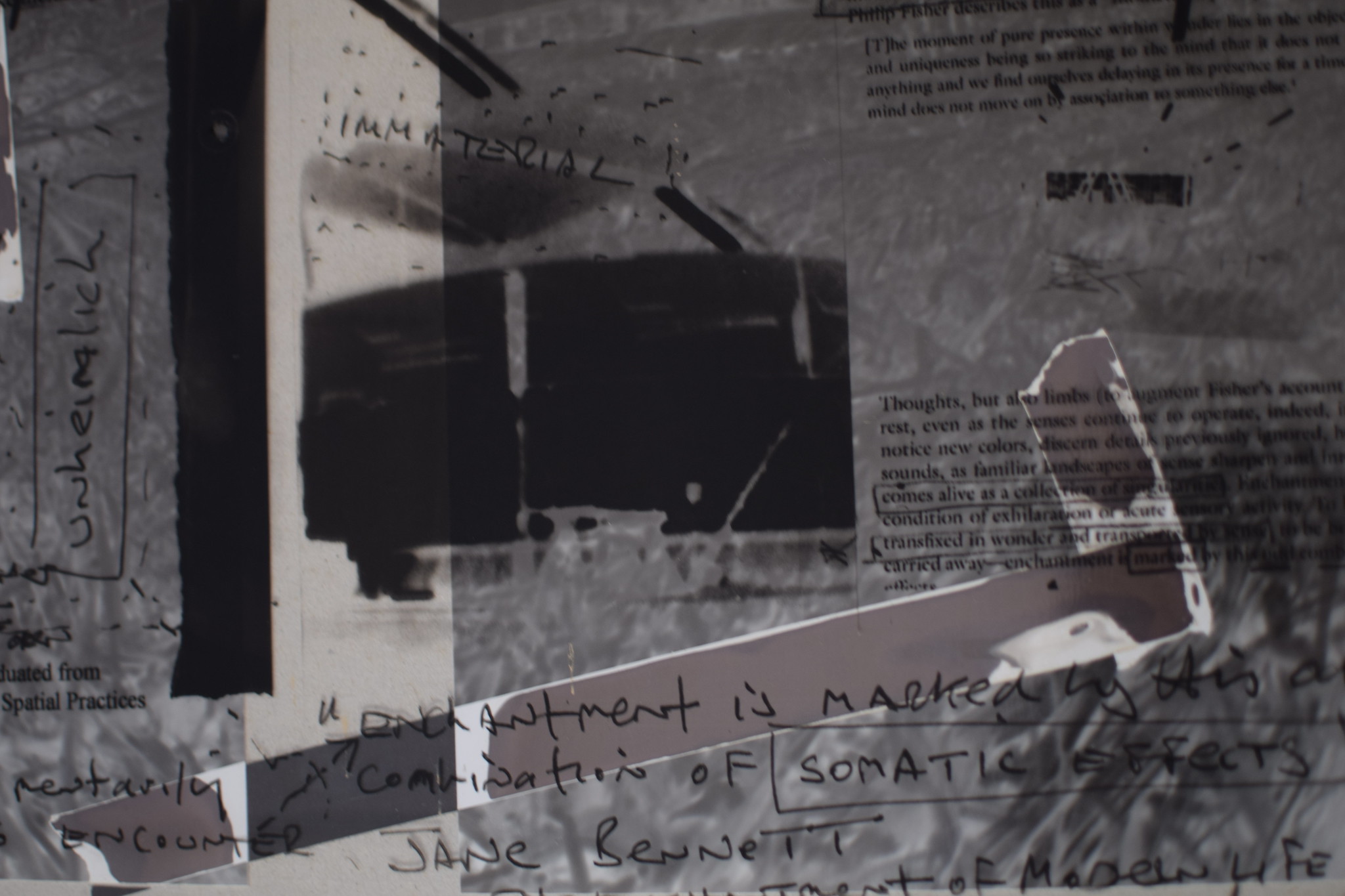
    Enchantments and Crossings : Somatic Effects

    Spatial Methodologies. Worlds and Thresholds.

    The Fanciful and The Scientific.

    The Playful and The Reverent.

    The Material and The Metaphysical.

    Tensions in built spaces.

    Between Evanescence and Substance.

    Between Illusion and Specificity.

    Between Slickness and Tactility.

    Today there is not even a single instant in which the life of individuals is not modeled, contaminated, or controlled by some apparatus, In what way, then, can we confront this situation, what strategy must we follow in our everyday hand-to-hand struggle with ap­paratuses?

    What Is an Apparatus? Giorgio Agamben 2009.

    Making Places where times and tastes, human fabrications and accidents of nature, all collide; in these situations under the shelter of a forming/becoming architecture these ‘spatial texts’ or ‘visual conversations’ of one sort or another are suggested and are manifested and explored through a praxis of inquiry and making.

    Facility and retreat for cross-disciplinary inquiry (Humanities and the Social Sciences).

    Repository and archive of artefacts, texts and objects.

    Exhibition and making spaces, workshops and residential living spaces. Walled garden complex containing a reading pavilion and library.

    Philosophy of Solitude, thresholds/spaces of serenity, a poetics of dwelling.

    Relationships between Art, Photography, Craft and Building. Expanded through Exhibition, Performance, Teaching and Making.

    Realized as a dialogue/delivery (Built Work) into Architectural Terms between Sites of Collection and Sites of Construction.

    Art as Spatial Practice.

    Catalyst Events/Situations to engender the experience of learning.

    West Dean, Singleton. Residential courses in the arts, both the grounds and the house are fully utilised in the social activity of learning.

    Kilquhanity,Scotland. Free School in country setting, used as a site for exploratory fine art practices(converted a pottery into a camera obscura and drew a garden from the movements of the sun across a specific terrain).

    Brockwood Park School, Bramdean. Re-imagining learning, conducted a walk across a landscape with clay, and hidden curriculum in the library with objects and texts centred around philosophy and architecture.

    Space folds : Containing “Spatialities around historicality and sociality”

    Perceptions now gathering at the end of the millennium. Spatiality, Robert T. Tally Jr. 2013

    “All that is solid melts into air”

    Karl Marx, Friedrich Engels,

    (Poetic observation concerning the constant revolutionizing of social conditions)


    spatial practice, alternative photography, fine art, ceramics,making,Russell Moreton,

    Source: The Social : Catching The Light/Architectural Apparatuses/Spatial Methodologies

  • Work : Filtered Light/Colour


    Brian Clarke
    The Art of Light/Paul Greenhalgh, 2018. Sainsbury Centre for Visual Arts
    Properties of Matter and Imagination
    FUSION OF PHYSICAL/METAPHYSICAL
    WORK : An Inquiry with Material Practice
    The poetics of glass as a super-cooled liquid. Molten Fluidity.
    An organic flux frozen for an instant.
    Chaos and order, flow and turbulence, pooling and shifting translucence.
    Chemistry becomes alchemy, the banality of the raw materials – sand, metal and minerals – turn into a magical universe of the imagination. Perhaps this is the key to Brian Clarke’s stained glass; it embodies the fusion of two things that normally don’t mingle; the physical and metaphysical.
    Botanical
    Cosmological
    Biographical
    The screens are an intense site of innovation and artistic consolidation. Some of the screens are principally about the organic flow of forms derived from nature; some of them deal with ideas that push into universal concepts and have a symbolist, otherworldly ambiance; and some yet their driving force incidents, memories and emotions that shaped the artist’s life.
    The Modern World (the artist’s attitudes to)
    Life
    Violence
    Mortality
    Many of the screens are highly specific to an incident or influence, the titles give us a clue to the complex symbology at work and the intertwining of the artist’s personal response with wider perceptions about place.
    Contrapuntal/Counterpoint music introduces multiple melodies that are equally important. Polyphony describes the use of overlapping melodies.
    For Clarke the concept of a screen as a vehicle of artistic expression is not a new concept, rather it clearly resonates back through his life, becoming part of his artistic consciousness virtually from the start of his work in glass.
    Literal and Phenomenal Transparency Layering of Planes/Layering of Spaces
    Rowe and Slutzky 1982
    What exactly is a screen and what does it mean in the context of modernity?
    A screen is simultaneously a physical object and a complex conceptual metaphor.
    We use screens to divide and to mask things off from each other, and as boundaries/barriers to hide behind.
    At the same time, the screen provides ways of looking at things/displaying; we screen films and we screen people.
    We look through them, and they can act as a catalyst that changes our vision of whatever is on the other side.
    In its usage in art, a screen is automatically a series of images – a diptych, triptych or polyptych – a sequence of free standing panels that allows the artist to develop a narrative and aesthetic theme.
    Screens divide up space and make it function differently.
    Alabaster windows before glass, contemporary windows by both Soulages/Sigmar Polke
    Iglesias,
    The Glass House
    The screen as emblematic of modernity.
    Conceptually, the sensibility at work in many early Modem buildings was one of space divided by screen walls and windows. In this sense, the giant windows at either end of Norman Foster’s seminal Sainsbury Centre building for example are light-screens.
    The nature of Brian Clarke’s architectural practice, in which his core practice is painting.
    It is through painting that I understand how to view architecture. It is through painting that I can appreciate the rhythm of the poem.
    It is through painting that I can appreciate and draw pleasure from the structure of a well-composed sentence. And it is through painting that the complexity of music makes itself understood to me. It is through painting, in fact, that I am.
    Brian Clarke, 1989.
    I do not identify mostly with painting, but I identify mostly with all other things because of painting. Brian Clarke, 2018.
    Clarke is gripped by the technology and engineering of how a building is made, but also by the psychological function and its emotional impact, he refers to himself as an architectural artist.
    The medium of glass in its modern form will only be seen when people have been sufficiently exposed to it.
    During the 20th century – the age of specialization – theorists and historians were obsessed with separating out the arts disciplines, positioning them in specific groups or classes, and then subjecting them to philosophical discourse as to why they belonged there.
    In short, the Anglo-Saxon world in particular artificially created the categories of art, design and craft, and then intellectually policed them. Stained glass was inevitably positioned as a craft, with all the confused cultural and economic consequences of this class allocation.
    Clarke with the complexity of his practice and interests has led to embrace the concept of gesamtkunstwerk (total works of art).
    A concept first championed by Richard Wagner, who perceived opera as a means of combining all of the arts, including music, and literature, in order to completely surround the spectator. In the visual arts, it is essentially about generating a complete art environment, in which all elements are orchestrated into an aesthetic whole.
    Charles Rennie Mackintosh, Frank Lloyd Wright, designers of the De Stijl movement.


    spatial practice, alternative photography, fine art, ceramics,making,Russell Moreton,

    Source: Work : Filtered Light/Colour

  • The Creative Act : Energy/Abstractions from a dialectic between the poetic and the systematic.

     Harleston 180423

    Drawings/Concepts/Constructions are forms/movements of thought.

    Being mindful that materials can lead the way.

    Tony Cragg.

    Diffractive Documents

    Matters of Interest/Concern

    Pots are fashioned from clay, but its the hollow that makes the pot work.

    Tao Lao-Tzu

    The Brain Needs Abstractions.

    The World is full of beautiful abstractions.

    Nick Cave.

    The creative act, the opposite of entropy, puts energy back into our world.

    Hungate, Norwich.

    Water/Corporeal/Spiritual.

    Clay/Vessel/Ritual/Body/Spirit.

    Gaston Bachelard, on intimate watery spaces.

    The reverie of light and space of an inspiring room.

    The Conduit of Water.

    Architecture of The Senses.

    The glossy surface of plaster against stone, or the flicker of sunlight on water are all abstract in essence.

    The idea that the mind needs abstraction to throw open the range of its thought capacity is fundamental to art and architecture.

    Killer Road.

    A Tribute to Nico.

    Soundwalk Collective with Jesse and Patti Smith.

    The Wind, Cd1

    P J Harvey.

    I can’t understand why people are frightened on new ideas.

    I’m frightened of the old ones.

    John Cage.

    Splitting.

    Gordon Matta-Clark.

    Site is the un-doing of place.

    Generative and provisional, site-specific investigations for sensing place.

    Clay Drawings/Constructions/Apparatuses.

    Undercroft/Observatory/Library.

    The Garden/Material of Forking Paths.

    Raveningham Sculpture Trail.

    Site Visit 160423

    Sculptural Spacings and Sensual Engagements.

    Showing Points/Lines/Vectors of Change/Movement.

    Dwelling Demarcations/markers of temporality and disappearance.

    A poetics derived/driven from both the systematic and the small wonders of the everyday.

    Circular Breathing/Cyclical Lines.

    The Peripheral Movement/Moment

    The Space/Time between things.

    The Concept of Sculpting Invisible Materials.

    The Array, a phonographic inquiry recording transits of the suns pathways across the sky.

    Wanderings, caught up in the wanderlust of stillness and slowtime.

    Paths of movement, paths of observation, paths of existential abstractions following daylight.

    The artist’s creative act of a self amongst others.

    A sculptural deliberation that engages with the experiences of working a site in the landscape.

    Body/Clay/Movement.

    Breath.

    Bodily Exhumations with Plastic Matter.

    Terracotta, Nature.

    Fontana/Penone.

    Drawing Into The Human Form.

    Its conceptual frameworks, aesthetics and contexts.

    Inclusions/Enclosures/Involuntary Mappings and Erasures.

    Figuring it out, sensuality through making the drawing heard.

    Drawing from a blindness, a memory of seeing.

    Derrida.

    Drawing into the perspectives and  sociological relationships of the Architectural Body, organism/person/environment.

    Gins and Arakawa.

    Explanations/Gestures of Looking and Mark Making.

    Scale/Proximity/Seeing Distance/Situatedness/Environment/Art Work.

    Haptic Seeing/moving over the surface of the sociological subject.

    Frottage, life drawings with involuntary textures and marks derived from their particular locality and working methods, concrete floors, wooden floorboards, graphite sticks, charcoal, pencil and wax crayons.

    The body and its nakedness becomes the instrument of our emotions and our sensuality.

    The Psychology of Nakedness.

    Naked to Nude, Life Drawing in the Twentieth Century.

    Georg Eisler.

    Invites the viewer to meditate on the intimate relationship between the clay vessel and the human body.

    Julian Stair.

    Art, Death and the Afterlife.

    Sainsbury Centre, Mezzanine Gallery. UEA.

    Marking Durations.

    Ground Mappings.

    Solar/Daylight Observed/Shadows Recorded

    Clay/Ceramic Multiples/Terracotta/Glazed/Unglazed.

    The Diagram/The Program/The Inquiry

    A Garden Observatory/Philosophy of Silence/Solitude.

    Upright Human Body.

    Space/Time/Situation/Agency.

    To build, dwell and explore the space of drawing through intuitive and abstract making.

    Like drawings, assemblages drawn and made showing the paths taken.

    Living Architectures/Narratives/Dwelling within the Ruinous.

    Tarkovsky.

    Bachelard.

    Landing Sites/Holding Places.

    Between The Body/Sensing Spaces/Voids.

    Perceptions, body, organism, environment,

    Mezzanines, lofts, basements, balconies, walkways, scaffolds, access platforms.

    Clouds and Clocks.

    The project arises between a dialectic between the poetic and the systematic.

    Between Science and Art.

    Stochastic thinking suggests an interconnected ecosystem of architecture together with all of the arts to achieve new levels of correlation.

    Light Laboratory.

    Camera Obscura/The Pottery Room.

    Free School/Out of The Archive, Kilquhanity.

    I could gather a leaf, place it in the head of the enlarger and allow it to make an image of itself by passing light through it, akin to Fox Talbot’s original pencil of nature experiments. I didn’t use a camera after that. I was free to originate my own visual language. I could walk unhindered, let the light into me, as if my own skin and brain were silvered. I could not create light. I only needed  to expose myself to it, by putting myself in its path.

    For six years this symbiosis between photography and photosynthesis felt like one of the most perfectly resolved working methods imaginable.

    Dark Room.

    Garry Fabian Miller.

    The internal mechanisms with which we see and experience visual and physical phenomena depend on a bottom-up approach. Building up from elements of abstraction, the opposite top-down approach of given figuration stifles necessary imagination.

    Curiosity, imagination and enthusiasm all hold a power in the mind to ignite the creative act.

    The Lake of The Mind.

    Steven Holl.


    spatial practice, alternative photography, fine art, ceramics,making,Russell Moreton,

    Source: The Creative Act : Energy/Abstractions from a dialectic between the poetic and the systematic.