BOUNDARIES AND JUNCTION POINTS
Lefebvre, The Production of Space.
Lefebvre in his chapter on Spatial Architectonics makes reference to the relationships established by boundaries and the relationship between boundaries and named places. These relationships promote significant and specific conditions or features to a space. This in turn results in various kinds of space. Lefebvre states that “every social space, then, once duly demarcated and oriented, implies a superimposition of certain relations upon networks of named places.”1
It is this superimposition of space that can within it demarcate other thresholds of experiences, within an existing demarcated space that interests me.
The act of “blocking in “ the dimensions of another space onto the floor of another create a temporal junction between a host space and a site within this host, a guest. This sets-up the notion of a temporal double occupancy held by the demarcation of a boundary and a site of proposal. This basic and temporal site marking could be said to have affinity towards some sort of anthropological marking, a territory. (Lefebvre defines anthropological marking as being at the stage when demarcation and orientation begin to create place and its social reality in archaic cultures)2. This activity also has associations with nomadic and agricultural-pastoral societies as they use paths and routes as spatio temporal markers or determinants.
Lefebvre acknowledges that geographical space created through the body, through routes which were inscribed by means of simple linear markings. These first markings, paths and tracks drawn into the landscape would become the pores through “which without colliding would produce the establishment of places (localities made special for one reason or another).”3Within my practice drawing is used to form sites which contain visual information, evidence of temporal activities and traces of actual objects. These territories within other territories create fields from with boundaries form material relations, differences. My drawings are inside the temporality of site I have instigated and yet they propose a territory and a surface of light years which could accommodate the temporality of terrestrial space.
Interestingly Lefebvre comments “there is no stage at which ’’man” does not demarcate, beacon or sign his space, leaving traces that are both symbolic and practical.”4
1 Lefebvre, The Production of Space, (London: Blackwell, 1991) page 193.
2 Ibid.,page 192.
3 Ibid.,page 192.
4 Ibid.,page 192.
SENSORY THEATRE
EX MACHINA, Robert Lepage
While Legage continues to pioneer the use of technology, his work is imbued with an intimacy and humanity that few can match. Edinburgh festival 2015
ABBATOIR FERME, Jan Fabre (Troubleyn, Performing Arts)
A SOMATIC ARCHIVE, of subjectivities whose perceptions and environments are going to change forever; like the particularities of the analogue trace in photography that is now becoming a distant experiential condition, an orphan extinct from the subjectivities of its originating culture/organism.
The Waverley Inquiry
A Theoretical and Somantic search amongst Ruins and Archetypes Historical Perspectives
Dwelling/Poetics Heidegger Archetypes/Symbols Jung
Flesh and Stone, Richard Sennett
Flesh and The Logic of Sensation, Deleuze/Bacon Contemporary Spatial Practices
Feminist Geographies The Posthuman
Posthuman thought inscribes the contemporary subject in the conditions of its own historicity.
Posthuman Subjectivity ,Rosi Braidotti LIGHT into SOMANTIC SPACES
Continuum and Chora (light and the shadow of chora)
Life expresses itself in a multiplicity of empirical act: there is nothing to say, but everything to do. Life, simply by being life, expresses itself by actualiizing flows of energies, through codes of vital information across complex somatic, cultural and technologically networked systems. (Braidotti, 2013:190)
De Architectura, Vitruvius
Architecture consists of order, arrangement, proportion or eurythmy, symmetry and decor, and distribution.
Arrangement as an “Idea” refers to the Aristotelian notion of “Image representation” as phaantasia a precondition to drawing, effectively occupying and revealing a space between being and becoming.
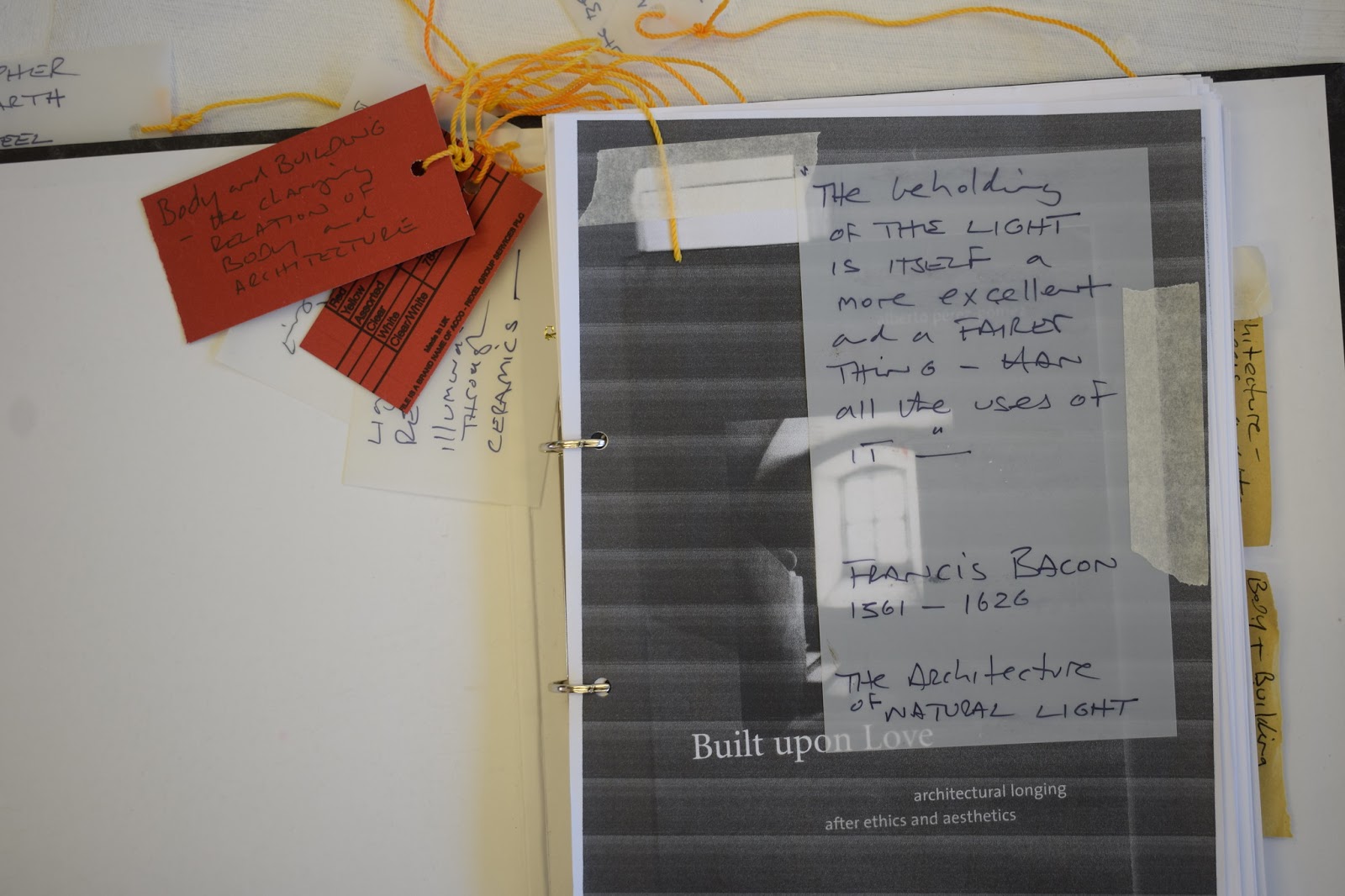
Contents List from a folder in the Theatre of Research Chora Body and Building
Space as Membrane
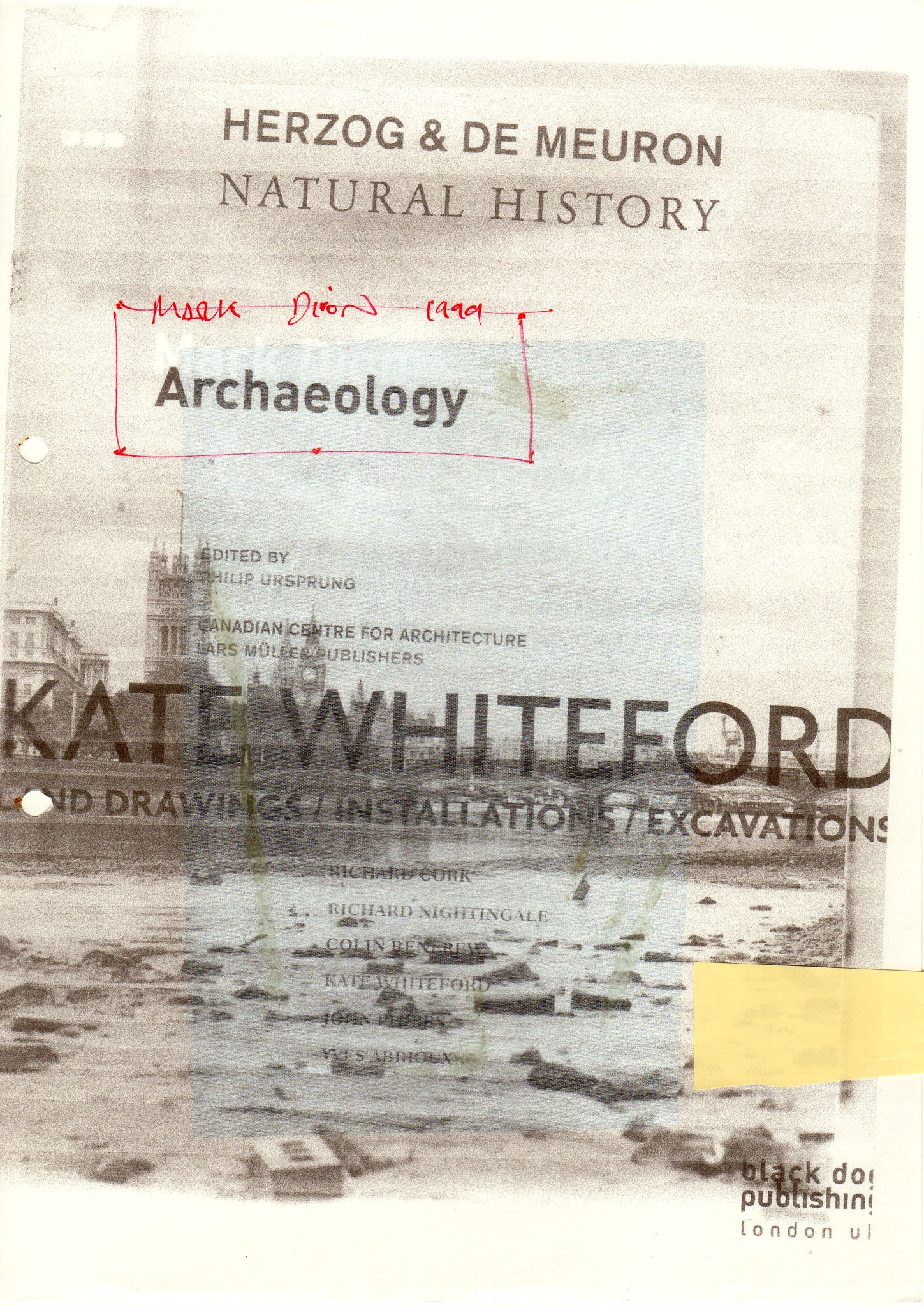
Chora (Exhibition) 1999
Lessons of a dream. Karsten Harries Concrete Blonde: Joanna Merwood
A probe into the negative spaces where mysteries are created. Surrealist Paris : Dagmar Motycka Watson
The non-perspectival space of the lived city Body and Building : George Dodds
Essays on the changing relation of body and architecture. Sphere and Cross : Karsten Harries
Vitruvian refections on the Pantheon Type Body and Building : Marcia f. Feuerstein
Inside the Bauhaus’s Darker Side
Desiring Landscapes/Landscapes of Desire. George Dodds A Tradition of Architectural Figures: Marco Frascari Interwining Metamorphoses : Germano Celant
On the work of Guiseppe Penone Space as a Membrane : Siegried Ebeling
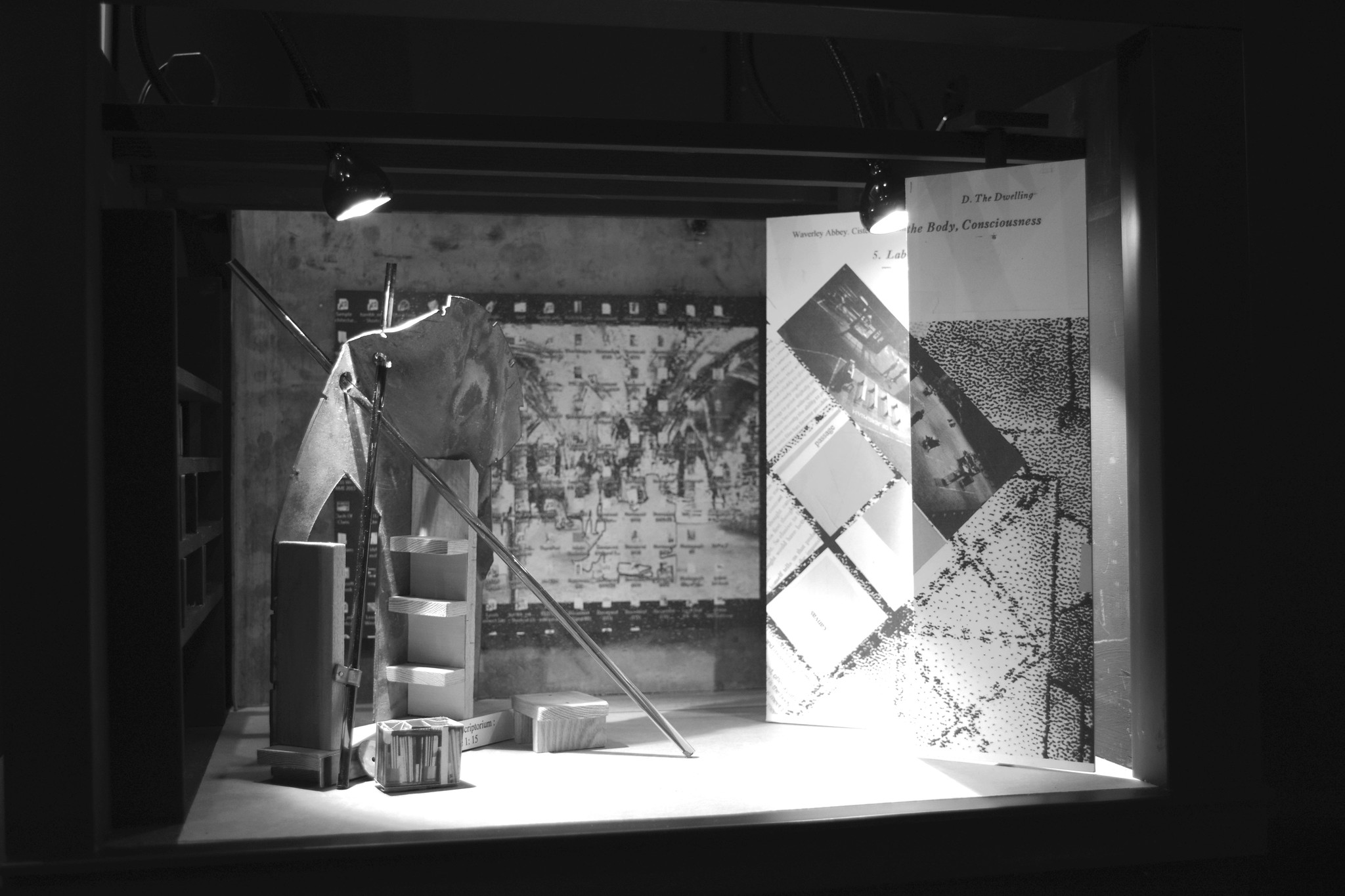
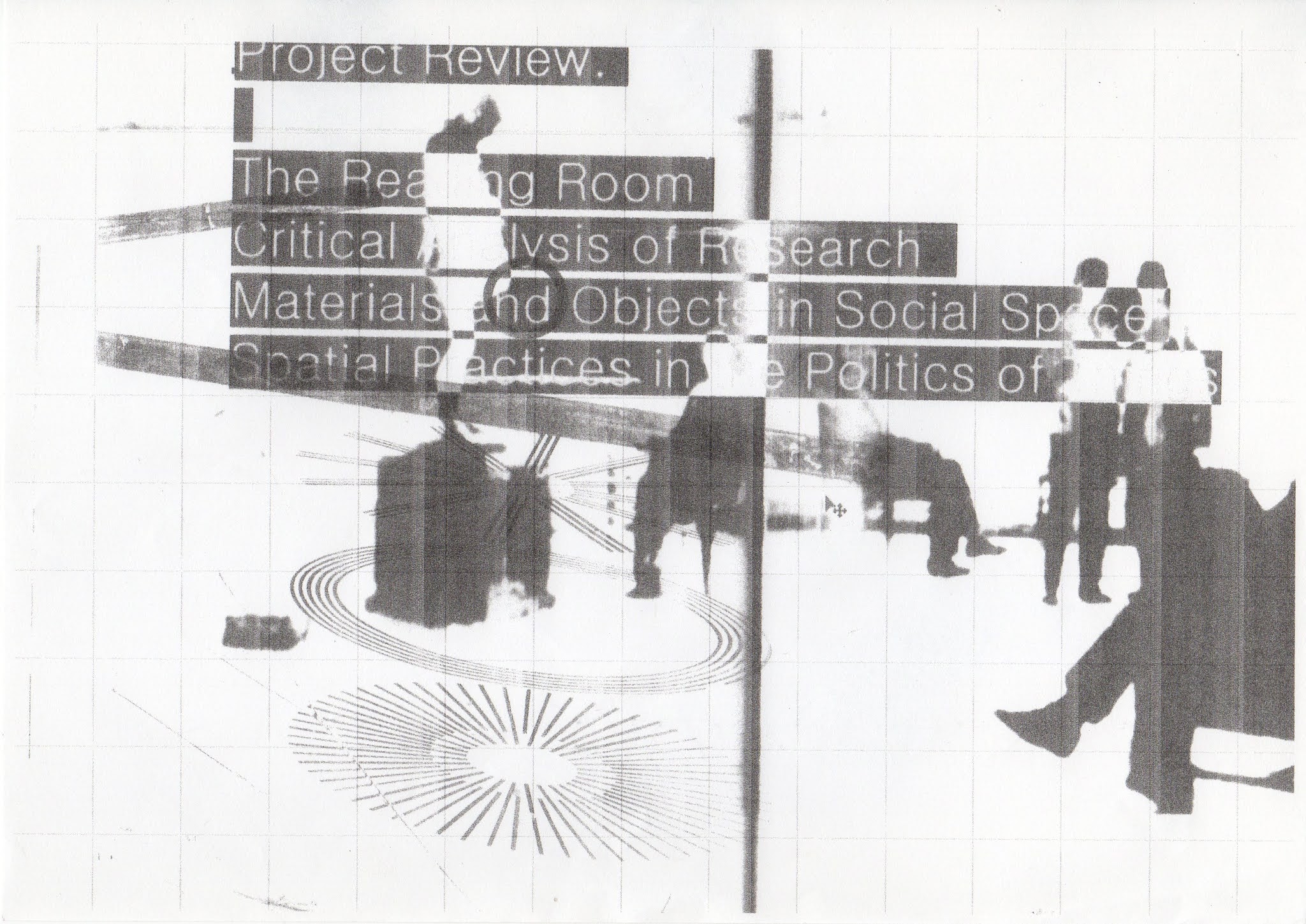
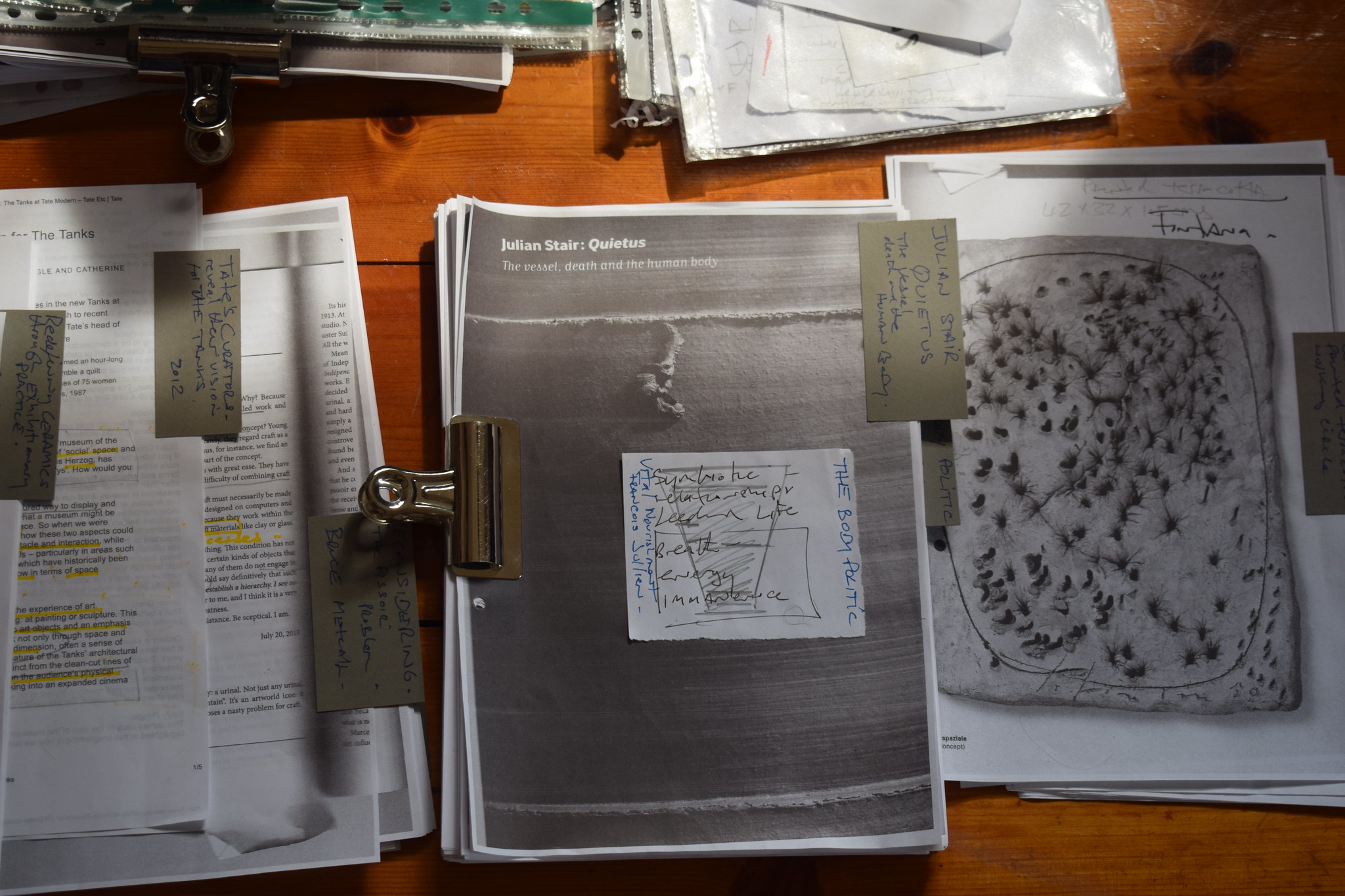
Unlike a Library the Theatre of Research is a working space that creates and crafts both theoretical and practical objects, things and documentation. Its reason for being is to explore the praxis for creative narratives between the Arts and The Humanities. It attempts through performance, fine art and architecture to collage qualitative and diffractive dialogues into new relational discourses, the results of which become exhibited or staged as open workshops engendering praxis, publication and production. In its fledgling state it is seen as being part of a University faculty that has interests in the Arts and The Humanities. The possible linking with other establishments could be investigated. The working space becomes operational as a studio or laboratory that is engaged with full-time research led activities . Separate yet collaborative spaces and activities promote an environment for inquiry and personal development. The Theatre for research becomes a space that allows for the Post Production of ideas into new forms of social interaction. The theoretical merging with the practical into a relational narrative or methodology that enriches the practices of others, forming both new creative environments that can contain innovative ecologies that can question global perspectives.
INDEX OF IMMATERIAL ARCHITECTURES Jonathan Hill 2006
The Psychoanalysis of Fire. Gaston Bachelard 1964 (1938)
AIR
NATURAL FORCES
The Architecture of the Air (blurs the boundaries of architecture and nature) Loose spatial orders suggesting a fluidity of space, matter and use.
The experience of space was not a passive activity, nor was it considered to be pre dominantly retinal. Klein defines his subject matter ‘space’ as sensual, spiritual and an immaterial expanse in which the body is active and immersed; he sought to engage all the senses and to liberate the mind, body and imagination.
Quixotic Gestures that capture the experience and the engagement with natural forces. Klein’s architectural focuses on imprecise boundaries and inconsistent materials in active dialogue with the user.
Space through dialogue/movement defines the user
Most buildings make a clear distinction between the unpredictable natural forces outside and the predictable domestic spaces inside.
The Fireplace is unusual, therefore in that it is a natural force contained within the building.
The fireplace is also paradoxical in that if uncontrolled it threatens destruction of the home.
Evolving Atmospheres, Not Models
Architecture is the affect and its phenomena gained from the experience of the constructed form.
Architecture is a sensorial response to definitions of spatial arrangements. Architectures and their interiors can be infinitely re-imagined through interventions that might not noticeably alter their external appearance.
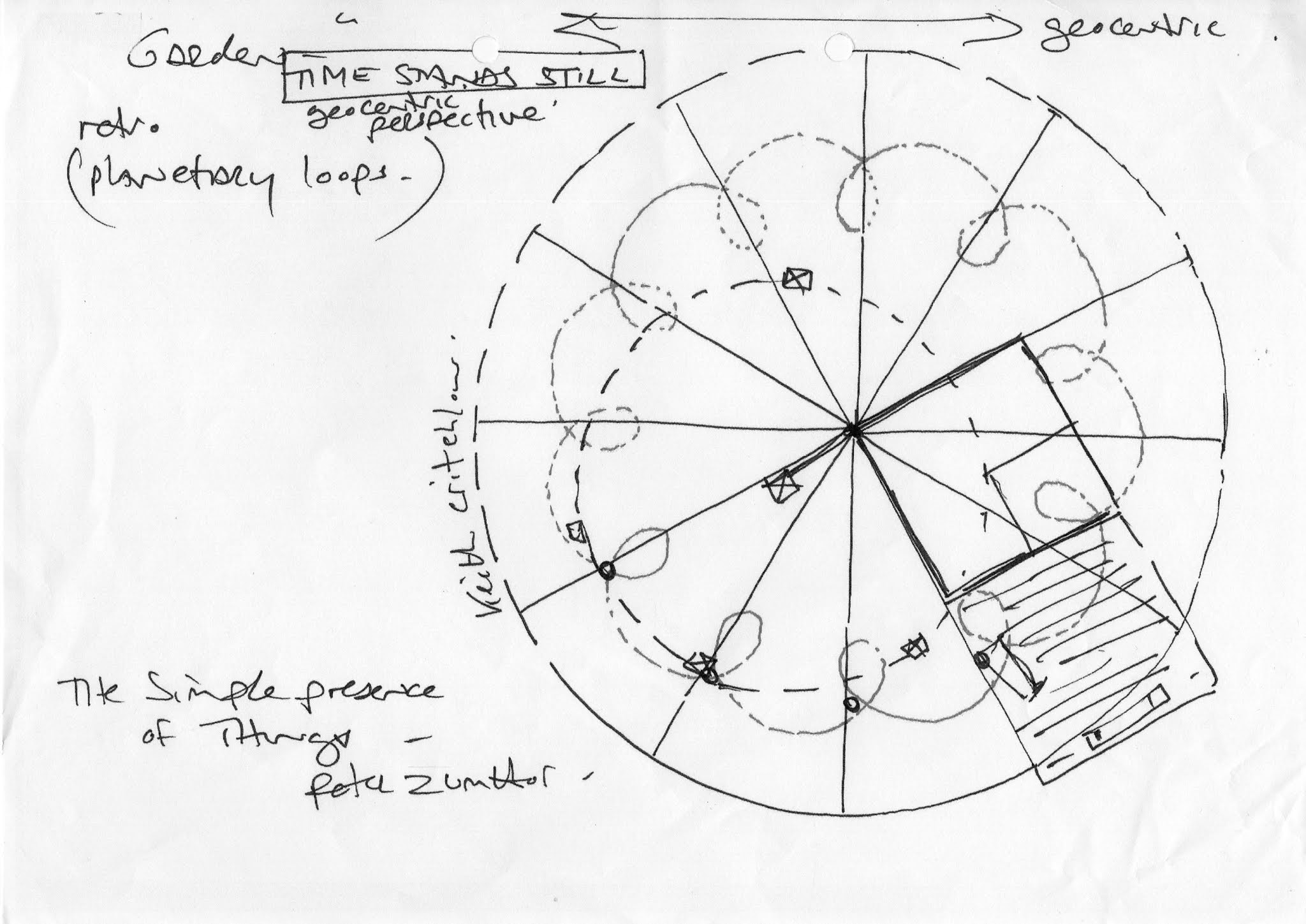
Materials and Place. The Secular Retreat. Zumthor and Heidegger.
Peter Zumthor acknowledges his knowledge and affinity with Heidegger’s writings, see Peter Zumthor, Buildings and Projects 1998,( Sharr,2007:91) In particular his Vais Spa is of particular note for the way in which Zumthor has created ‘evocative sequences of spaces’ within ‘its exquisite construction details’. (Sharr,2009:92)
‘Zumthor mirror’s Heidegger’s celebration of experience and emotion as measuring tools; he also emphasises sensory aspects of architectural experience. He notes that the physicality of materials can involve an individual with the world, evoking experiences and texturing horizons of place through memory.’ (Sharr,2009:92)
The measurement of a house through things that have sensual qualities, creating a memory of place, and its evocative measurement that can be choreographed through selective materials.
‘Flamed and polished stone, chrome, brass, leather and velvet are all deployed with care to enhance the inhabitant’s sense of embodiment when clothed or naked. The touch, smell and perhaps even taste, of these materials were orchestrated obsessively. The theatricality of steaming and bubbling water was enhanced by natural and artificial lighting, with murky darkness composed as intensely as light. Materials were crafted and joined to enhance or suppress their apparent mass. Their sensory potential was relentlessly exploited. With these tactics, Zumthor aimed to celebrate the liturgy of bathing by evoking emotions.’ (Shan,2009:95)
Zumthor comments about his architecture for the Spa at Vais.
‘In the bath there is a bit of a mythological sense of place, there are bits of theatricality, even the mahogany in the changing rooms looks a bit sexy, like on an ocean liner or a little bit like a brothel. They are where you change from your ordinary clothes to go into this other atmosphere. The sensual quality is the most important, of course, that this architecture has these sensual qualities. (Spier,2001:17)
He is trying to configure particular theatrical and phenomenal experiences in architectural form. It is only when the qualities of these prospective places emerge, can Zumthor begin to configure and design the particulars of the buildings construction.
‘The measuring of body and mind, the navigation by intuition and judgement which Heidegger makes sense in sparks of insight, these all become ways for designing, for imagining future places on the basis of remembered feelings. He feels that this process creates the contexts with which people will experience his architecture. (Sharr,2009:95)
The Spa at Vais was conceived to appeal to sensual instincts first, and then open itself up to interpretation and analysis, the spa should be tactile, colourful, even sexy to inhabit. (Sharr,2009:96)
‘Zumthor imagines experiences of the spa to be punctuated by things which evoke memories, which represent associations. He like Heidegger conceives of human endeavour in terms of traditions; Zumthor crafts spatial representations of those traditions by locating things in what he considers to be their proper place in time and history. Heidegger was also anxious to locate his farmhouse dwellers according to rites and routines longer than a life.’ (Sharr,2009:96)
Dwelling and livelihood, rites and routines, are all authenticated and located by design; the simple, sensual, primary and elemental associations that create traditions that both Heidegger and Zumthor can subscribe to. All help to root the spa in an agrarian view of the mountains that is associated with livestock and the necessities of shelter.
Zumthor shares with Heidegger ‘a sympathy for the mystical, claiming mythological qualities for moments in the spa’, and to champion’ the immediate evidence of experience and memory over that of mathematical and statistical data. ’(Sharr,2009:96)
‘ It seems that, for Zumthor, the Vais spa achieves his design intentions by locating rituals of dwelling in place with all the Heideggerian associations of those terms. By choreographing enclosure, mass, light, materials and surfaces, Zumthor sets up conditions from which he can propose a rich layering of place perceptions, by allow people to identify places through their bathing rituals and their associative memories.’ (Sharr,2009:96)
There is perhaps for Zumthor and other Heideggerian architects ‘the suggestion that design involves the choreography of experience’. He advocates a piety of building, of trying to develop a design in a away it wants to be, ‘of configuring physical fabric around real and imagined experiences’.
Heidegger notes of Western societies and their professional architectural regulations do much to ‘obstruct proper relations between building and dwelling by promoting buildings as products or as art objects’. (Sharr,2009:98)
Genius Loci: Towards a Phenomenology of Architecture. Norberg-Schulz. Presents an opportunity for people to achieve an existential foothold in the world. Norberg-Schulz notes that inhabitation as like a layer over the architecture. In effect the architect designs, the contractor builds, and only then do the inhabitants build and dwell.
Zumthor with particular reference to his Vais project likes to perceive his architecture and the things within it as becoming associated with traditions, perhaps these become re-enacted as rich, operative histories made in and for the present.
Steven Holl shares similar working methods with Zumthor, he to is influenced by phenomenology on his thinking. He makes watercolour sketches in perspective, as a means of choreographing experience, painting itself is an intuitive act, which opens up spontaneous and unintended design possibilities.
Drawing processes and mapping that can re-imagine the spatial possibilities of architectural experiences.
The Choreography of Experience. A Manifesto.
Being attentive to atmospheres, moods and sites.
Being concerned with the social and political geometries of human gatherings.
Being participatory to architectural tactics that enable informal gatherings.
Phenomenology and Politics.
Zumthor downplays the activeness of his role in design. The architect is keen to emphasise that he works instinctively with circumstances given to him. He claims a similar modesty in forming a rapport with site and locality. He is able to give the architectural idea a piety to become what it wants to be.
Heidegger’s problematic authenticity claims and the potential consequences of his romantic provincialism became more prominent in architectural debates about the merits of his model of building and dwelling.
Therefore ‘it remains a common assumption among architects that these positions are more or less in opposition. To caricature, phenomenology (at least in its Heideggerian incarnations) champions the value of immediate human experience over scientific, measurement and professional expertise, and tends to mytholize timelessness and situatedness. Critical theory, meanwhile, prioritises the political dimensions implicit or explicit in all human activities, and is opposed to monolithic claims of authenticity. (Sharr,2009:112)
Heidegger’s thinking, including that on architecture, is easily challenged from the perspectives of critical theory. The philosopher perceived the ‘essence’ of building and dwelling in authentic attunement to being, unapologetic about the tendencies of essentialism and authenticity to exclude people. His writings display little fondness for what he saw as the human distraction of politics. (Sharr,2009:112)
Heidegger’s work on architecture and, arguably, the architectural phenomenology which claimed him as a hero, has become a zero-sum game. Whatever it gives, its associations can also take away. Many architects and commentators have turned their backs on Heidegger in consequence although a few, including Zumthor, remain unswayed. (Sharr,2009:113)
Edward Casey, The Fate of Place.
Gaston Bachelard, Poetics of Space.
Maurice Merleau-Ponty, Phenomenology of Perception.














 Russell Moreton : Matter(s) in Correspondence