Spatial Bodies in Architectural and Contemporary Art.
Exploratory Clay/Ceramic Based Inquiry.
The material is just part of the vocabulary of meaning.
Thinking Poetics : Architecture and Ceramics.


Urns : Immersive Cells of Containment~Dissolution.
In And Out Of Material. 2007.
All our senses scan the space in front of us; the future, in both a literal and metaphorical sense, lies before us.
Tony Cragg, 1998.
Cutting Things Up.
Material In Space.
Scale.
Impulses through Drawing.
Working Things.
Generation/Generative/Material.
I think mass and energy need to be generated, any effective change has to be generated. It’s to do with a positive directed initiative to change things.
“Generative” for me, in terms of my work, is the fact that within my own work, within any given period the work generates itself and there is a self-generating characteristic. The work I’m making today is only possible because of the previous work of three or four months ago and that was only possible because of the work of nine or twelve months ago.
Even if it’s not a linear thing, things are generating. There is a sort of self-propagating, self-generative energy that is inherent in the material, I think. And even in the term “generative”, from “genus”, is the idea of making a family group of things, whether making an associative group of things or creating a population, a species of things which “relativise” generation.
Tony Cragg.
The material is just part of the vocabulary of meaning.
Cragg wanted to give the materials ‘more meaning, mythology and poetry. He used the skills available to him at the EKWC residency to create ambiguities and tensions, to suggest past and present, to complicate rather than to describe.
European Ceramic Work Centre, Netherlands. 1990, 1992.
With the return of Cragg to studio based work in the early 1990s, when he was experimenting with clay; ideas around humanness, archaeology, and ritual were being explored within different areas of the fine arts. In addition, studio ceramics were frequently using the vessel as an initiating point to develop new forms and sculptural ideas.
Laibe, with its rich possibilities of interpretation that incorporates the past in the present and the universal aspects of human survival within the ceramic vessel form, lies at the heart of these complex and overlapping areas of practice.
Imogen Racz. 2009.
Reading List from The Ceramics Reader. 2017.
Andrew Livingstone, Kevin Petrie.
Ceramics : Materiality and Metaphor.
Why are Ceramics Important?
The Existential Base, Philip Rawson.
Containers of Life: Pottery and Social Relations, Silvia Forni.
Ceramics and Metaphor.
Analogy and Metaphor in Ceramic Art, Philip Rawson.
Sculptural Vessels, Tony Cragg’s Laibe and the Metaphors of Clay, Imogen Racz.
Ceramics in Contexts.
Historical Precedents.
Studio Ceramics.
Sculptural Ceramics.
Ceramics and Installation.
Theoretical Perspectives.
Conceptual and Post Studio Practice.
Contemporary Clay, Clare Twomey.
Extending Vocabularies: Distorting the Ceramic Familiar
Clay and the Performative ‘Other’, Andrew Livingstone.
Gender, Sexuality and Ceramics.
Identity and Ceramics.
Image.
Figuration and the Body.
Ceramics in Education.
Ceramics, Industry and New Technologies.
Museum, Site and Display.
Re-defining Ceramics through Exhibitionary Practice (1970-2009), Laura Breen.
With Fire.
Richard Hirsch.
A Life Between Chance And Design.
Scott Meyer.
Russell Moreton
clay-based-practices
spatial practice
research creation
ecology of experience
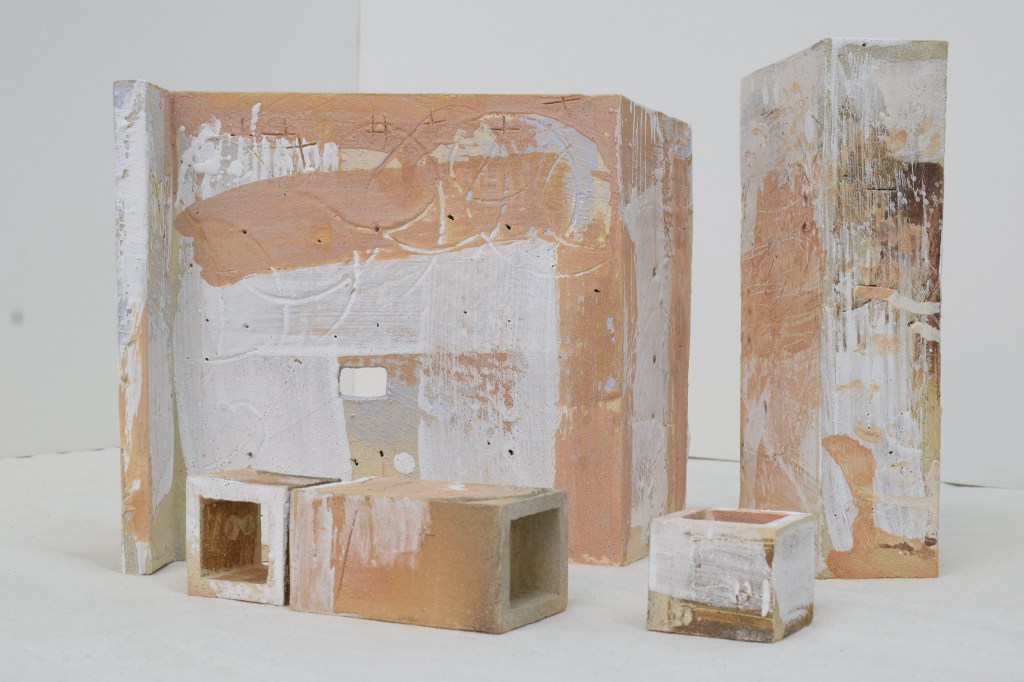
Clay begins to think architecture differently. Enclosure, interior, aperture, surface and volume become less like spatial descriptions and more like sensations within a material body. The architectural begins to move closer to touch: pressure, resistance, piercing, gravity, fire and gesture. Clay~ceramic becomes an atmospheric body, moving between inside and outside, receiving and returning forces. What emerges is not architecture translated into clay, but spatial thinking aroused from the material itself—a correspondence between bodies, spaces and the things that pass between them.


This practice has not developed through a linear progression of ideas, but through a shifting ecology of encounters.
Ceramics, drawing, photography, architecture, interiority, landscape, teaching, spatial research and collaborative making have remained in correspondence across different periods of the work. Some propositions have receded; others have returned years later in altered material conditions. Earlier works continue to participate in the present, not as resolved historical stages but as active traces within an ongoing search.
The practice is therefore situated rather than sequential.
Its formation has taken place through materials, places, bodies, architectures, organisms, images, texts, tools and other people. Each enters differently, producing correspondences that can alter the direction of the work. Knowledge is not simply gathered and applied, but emerges through these encounters.
The studio becomes a site of this activity: a place where research can remain provisional, where material processes can think alongside theoretical propositions, and where visual and spatial material can hold different ontological positions without requiring them to settle into a single explanation.
Clay has become an increasingly important participant in this ecology. Through making, the material receives traces of pressure, resistance, repetition, weathering, drilling and repair. Surfaces become histories of encounters; cavities become interiors produced by action; minor gestures accumulate into larger spatial conditions.
What appears in the present is therefore never entirely new.
It is a surfacing.
Earlier concerns with the body, absence and trace correspond with current questions of perforation, ecological agency and material interiority. Architectural research returns through the vessel and the cavity. Interiority becomes porous. Repetition becomes difference. A minor gesture can move an entire ecology.
I understand this as a spatial practice of learning to make.
The practice remains open to what it has not yet understood. Its research is a gathering of correspondences rather than a search for a final position: a situated ecology in which materials, histories, organisms, spaces, images, texts and gestures can continue to enter, disturb and transform one another.
The work does not simply record where the practice has been.
It creates conditions for where it might go next.
Archival / Anarchival
This is the most immediately current of the three and should sit firmly within Ceramic Bodies.
What makes it interesting in relation to the migration is that the title itself announces the transition we have been uncovering: clay is now doing the architectural thinking.
The important thing is not that clay is being used to make architectural forms. It is that architectural questions—space, enclosure, interiority, aperture, body, threshold—are becoming material questions within clay.
That distinction is crucial.
The earlier spatial posts often constructed situations through architecture, drawing, apparatus, walking and scaffolding. Here, the ceramic body increasingly becomes the site where those relations are felt.
This is exactly where your recent formulation becomes useful:
The spatial language of other bodies and their situatedness is, for me, an arousal from the clay body.
The post can therefore be read as a moment where the spatial practice moves closer to touch. The architectural vocabulary doesn’t disappear; it becomes embodied through clay.
This one should probably become a key connective post in the migration because it sits almost exactly at the point we have been discovering:
spatial practice → spatial bodies → touch → clay body → force~feeling → becoming spaces
And I think this post also gives us an opportunity to change how we understand the whole archive. The older spatial texts aren’t simply research that preceded the ceramics. They are bodies of thinking that have gradually become more tactile.
The new clay work doesn’t abandon that archive. It draws it into the body.
That makes the three-post movement especially nice:
Creative Act
→ energy between poetic and systematic
Raveningham / Wayfaring
→ situated attention through movement and ground
Clay / Thinking Architecture
→ situated attention becomes material, tactile and reciprocal
Or, more simply:
energy → wayfaring → touch
And that feels very close to the direction you have been articulating today: clay~ceramic as an atmospheric body that carries your murmurings while remaining open to the murmurings of other bodies.
 Russell Moreton : Matter(s) in Correspondence
Leave a comment