Visual artist working in the UK.
UCA Farnham, Interior Design MA.
Canterbury School of Architecture, Spatial Practices MA.
University of Southampton, Visual Fine Art BA hons.
Epsom School of Art and Design, Ceramics HSND.
Research as a discursive activity gathering new forms of expression.
Duration, Steven Holl
Time is only understood in relation to a process or a phenomenon.
The duration of human beings alive in one time and place is a relational notion.
The time of one’s being is provisional; it is a circumstance with an adopted aim for the time being.
SPACE-and ARCHITECTURE-exceeds the provisional
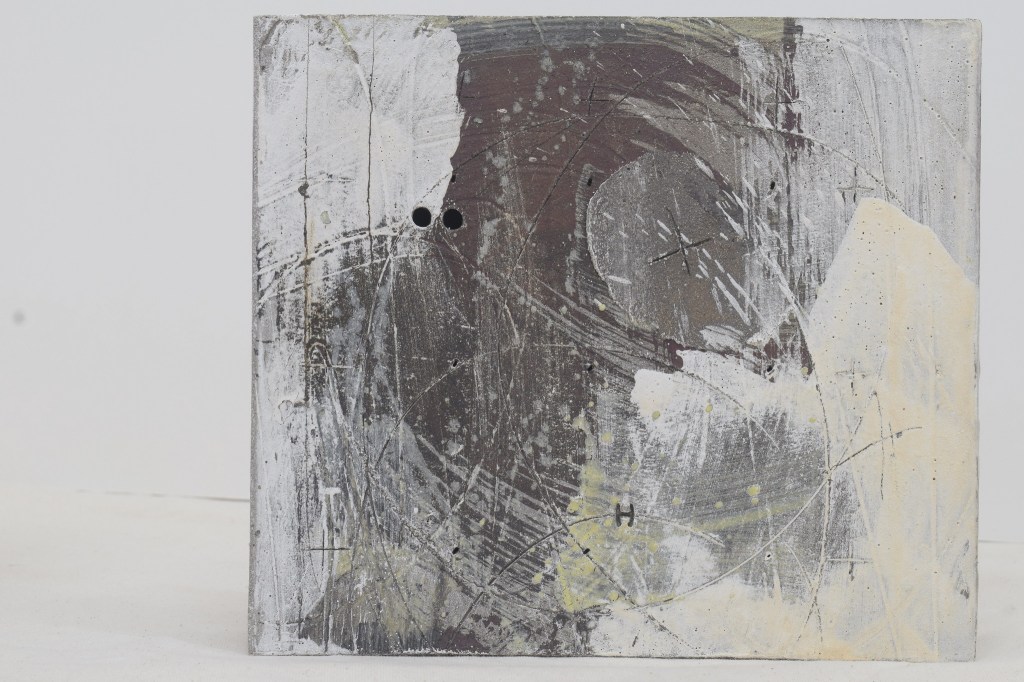
Concrete/Abstract Painting : Areas of Grisaille. Outpost Studios, Norwich.
We are not in the presence of a passively representative image, but a vector of subjectivation.
Guattari, 1995 :25
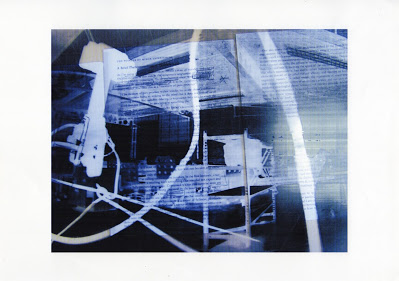
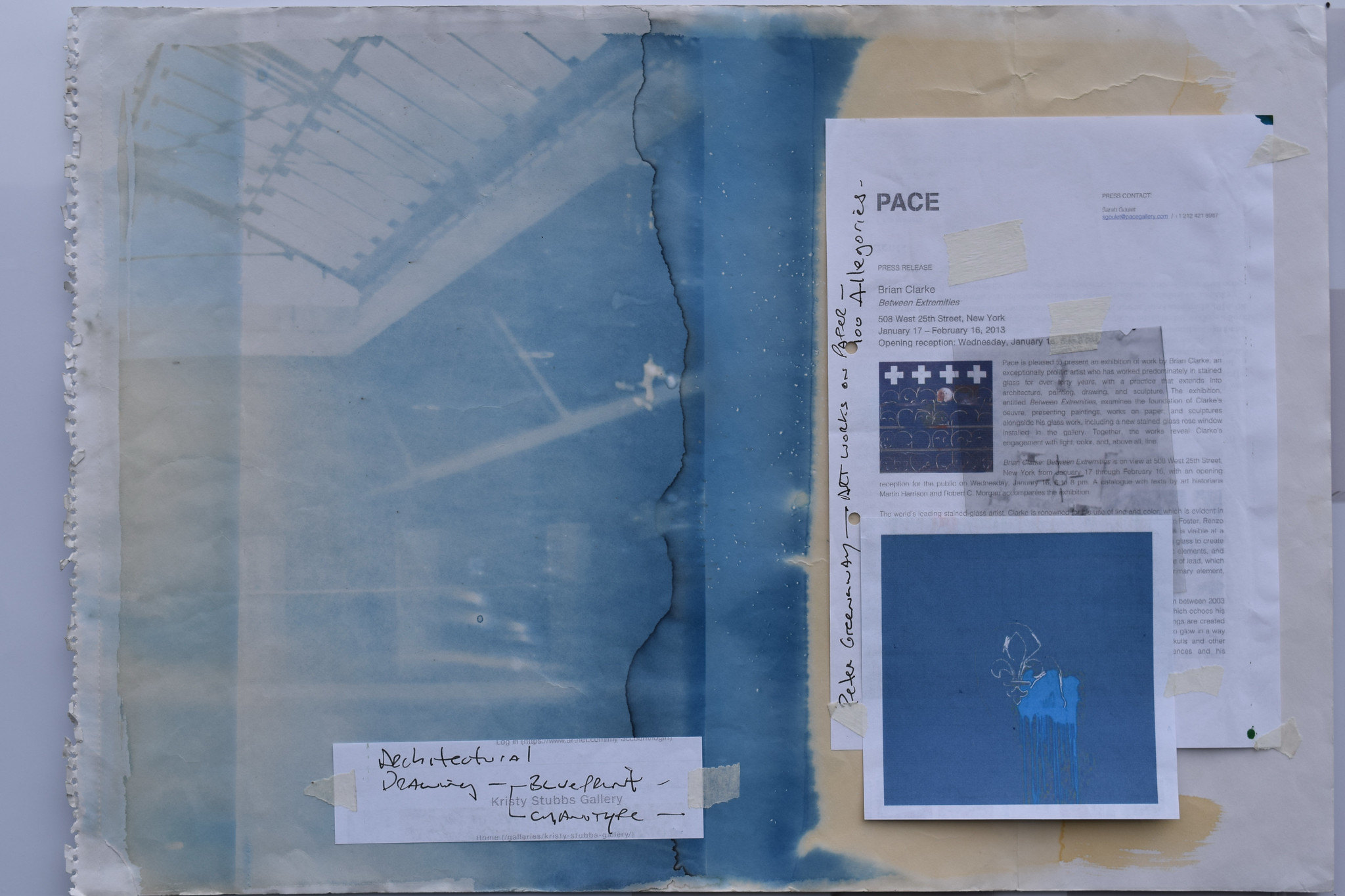
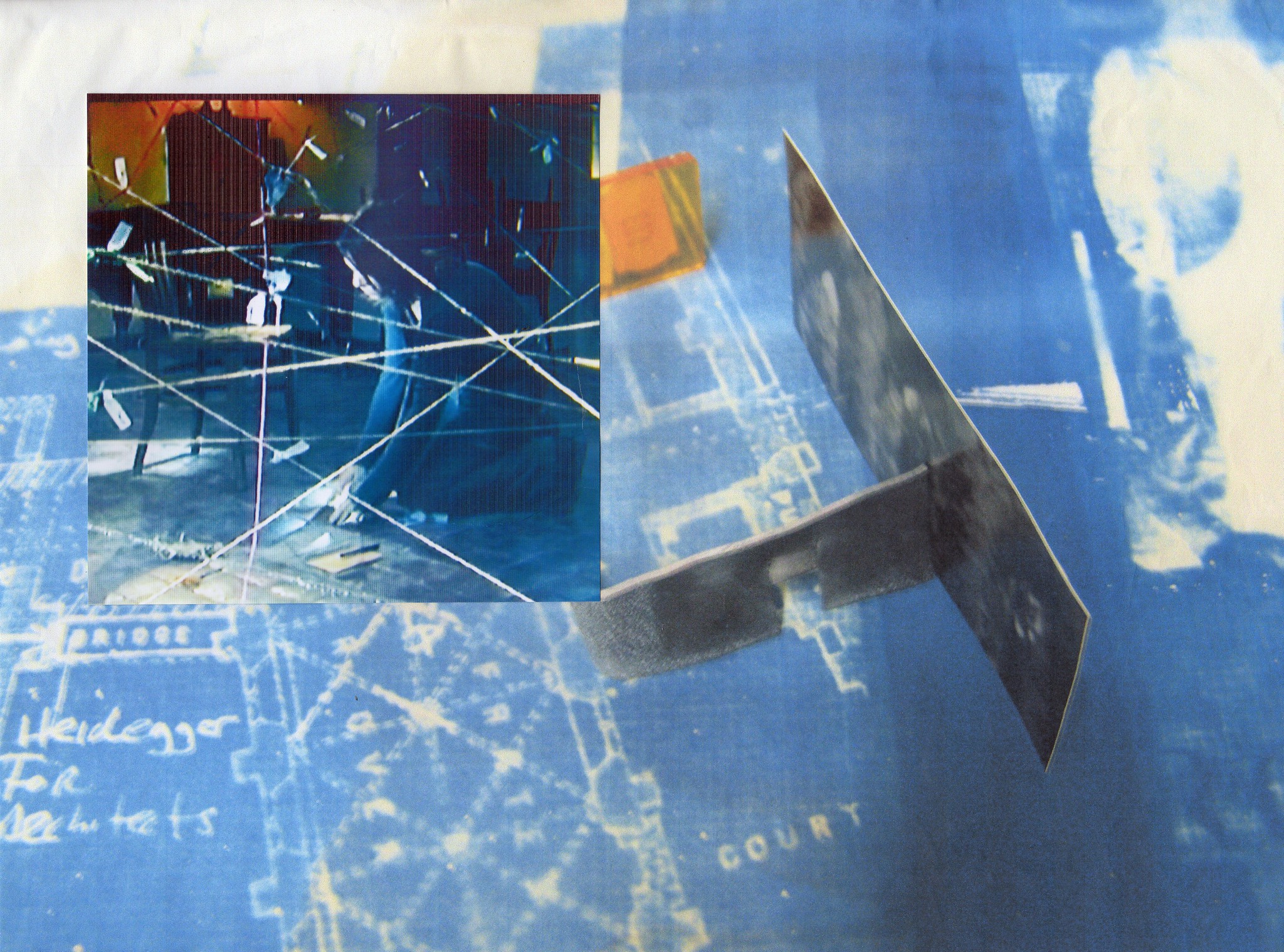
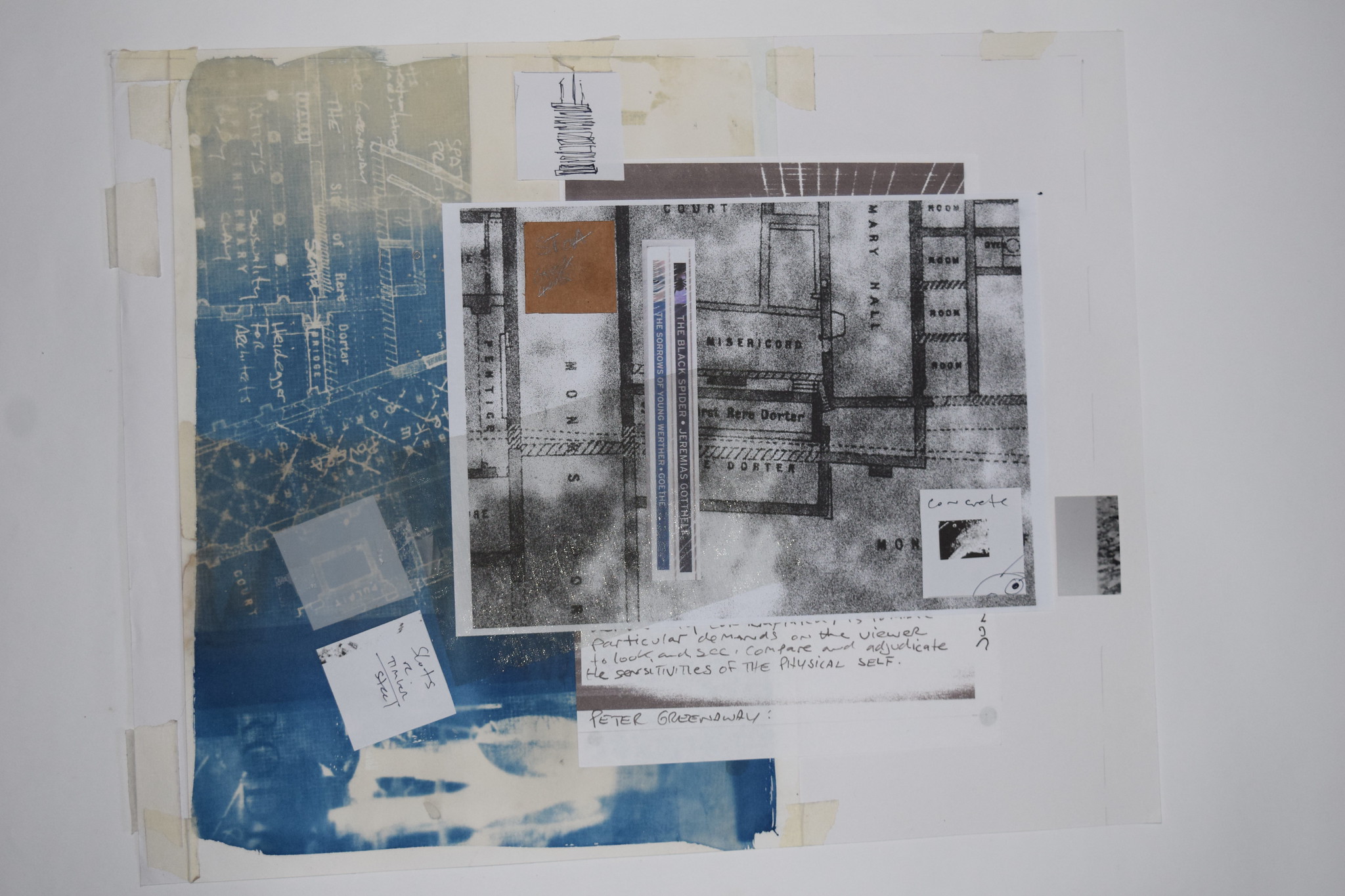
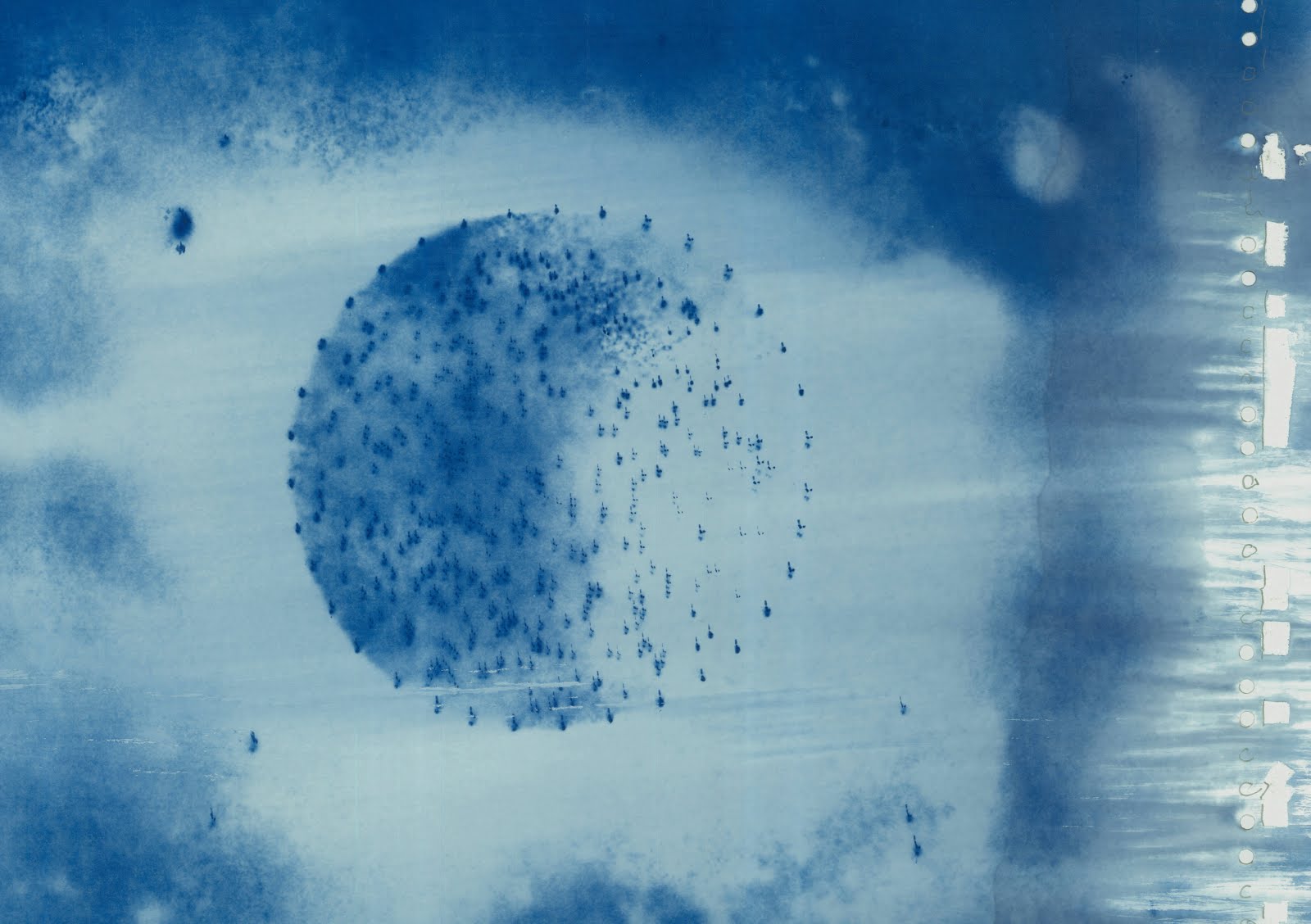
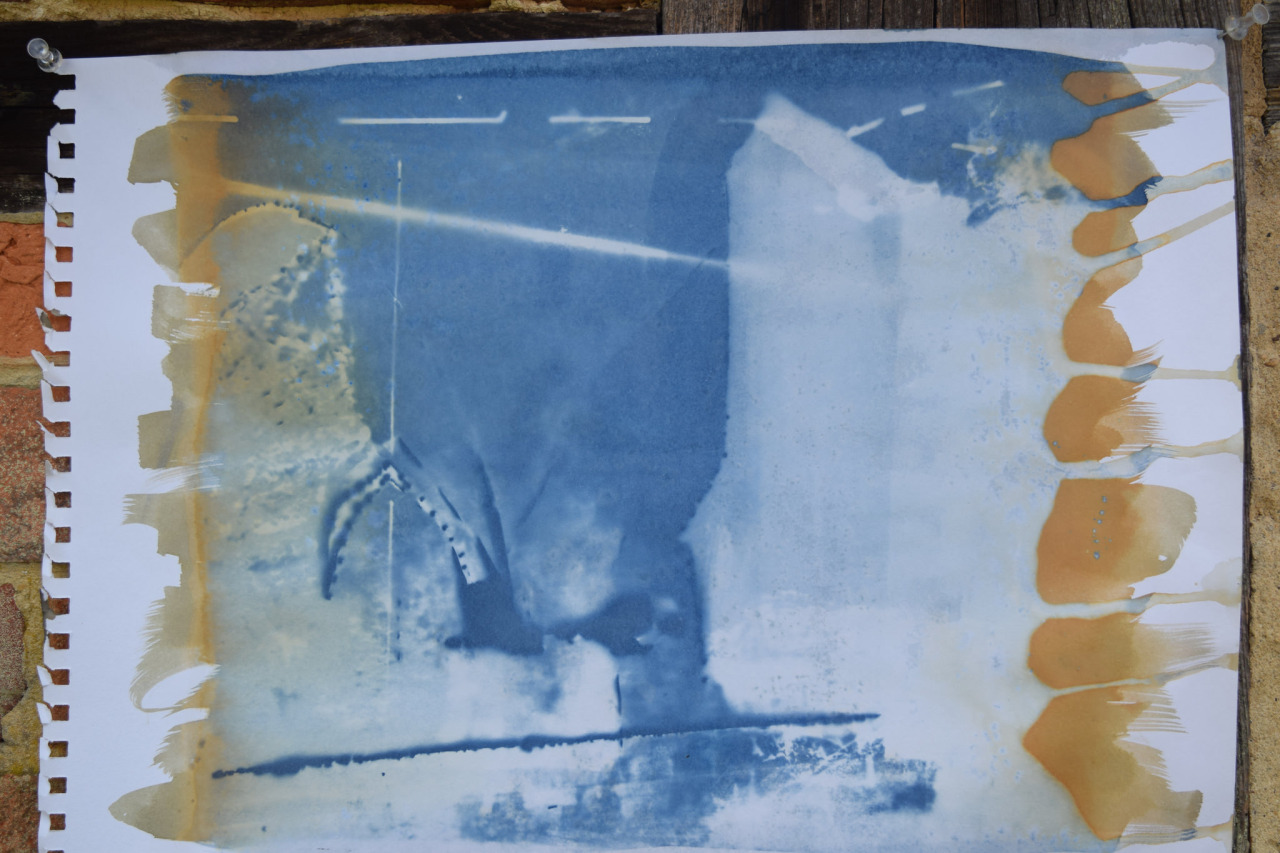
Cyanotype is a photographic printing process that produces a cyan-blue print. Engineers used the process well into the 20th century as a simple and low-cost process to produce copies of drawings, referred to as blueprints. The process uses two chemicals: ammonium iron(III) citrate and potassium ferricyanide.
The English scientist and astronomer Sir John Herschel discovered the procedure in 1842.[1] Though the process was developed by Herschel, he considered it as mainly a means of reproducing notes and diagrams, as in blueprints.[2] It was Anna Atkins who brought this to photography. She created a limited series of cyanotype books that documented ferns and other plant life from her extensive seaweed collection.[3] Atkins placed specimens directly onto coated paper, allowing the action of light to create a silhouette effect. By using this photogram process, Anna Atkins is regarded as the first female photographer.[4]
From Wikipedia, the free encyclopedia
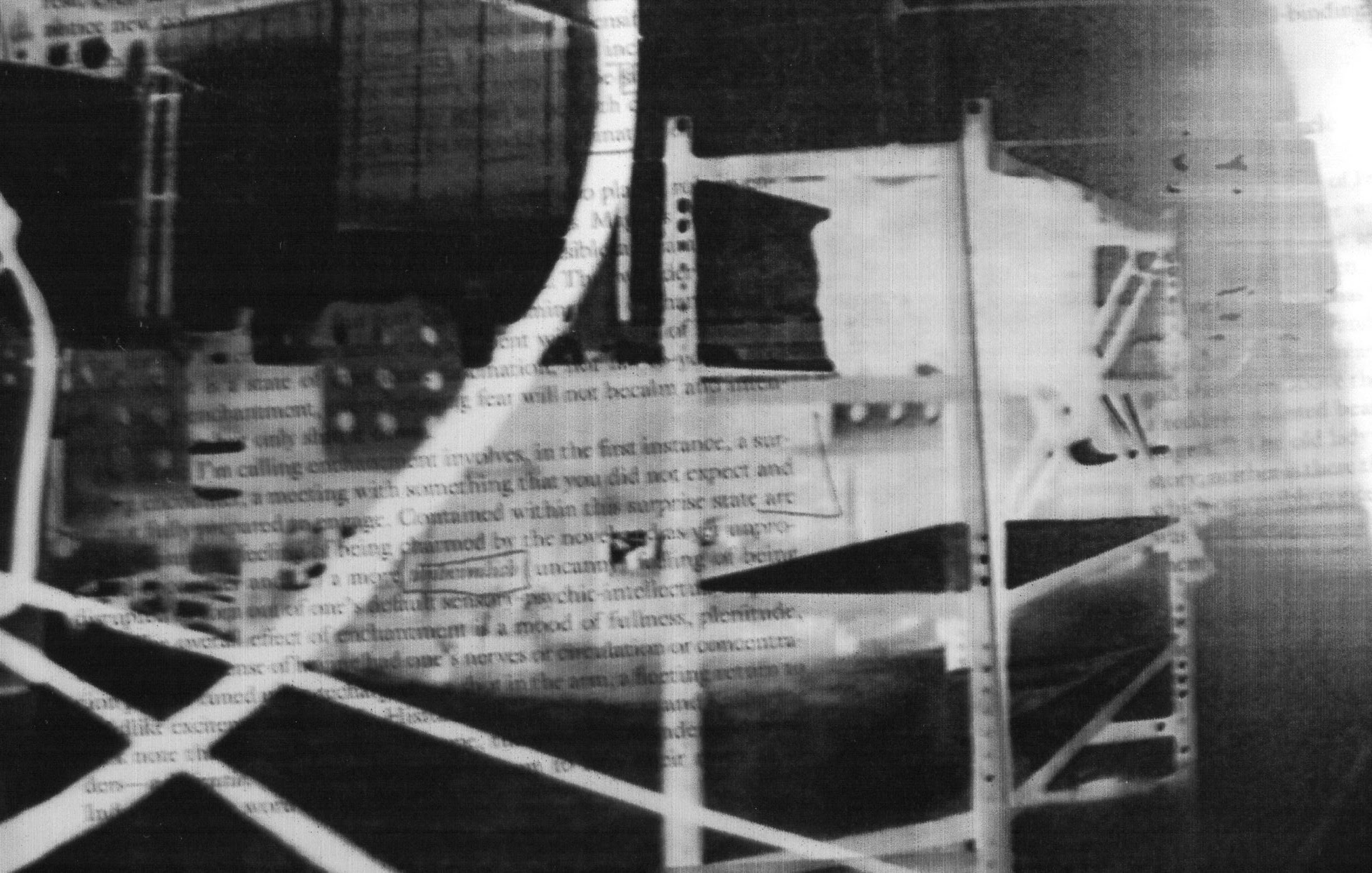
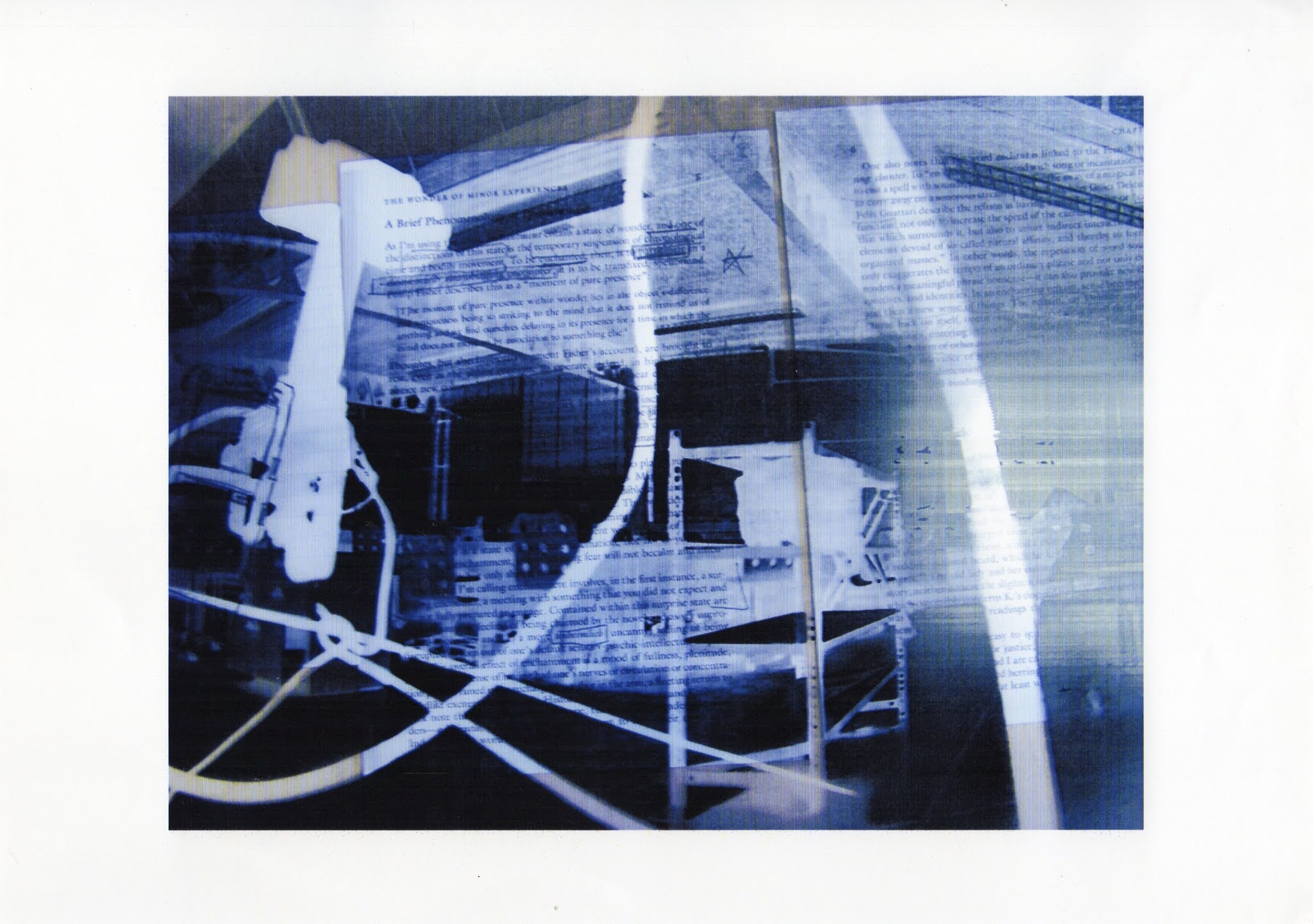
Blue Spaces Of Everyday Enchantments : White Absences #2. Silence/Void : Gap/Reveal
The Enchantment of Modern Life.
Attachments, Crossing and Ethics
The performativity of social representations
When I gather together the animals, arguments, molecules, suggestions, forces, interpretations, sounds, people, and images of this study, one theme emerges. The modern story of disenchantment leaves out important things, and it neglects crucial sources of ethical generosity in doing so. Without modes of enchantment, we might not have the energy and inspiration to enact ecological projects, or to contest ugly and unjust modes of commercialization, or to respond generously to humans and nonhumans that challenge our settled identities. These enchantments are already in and around us.
Jane Bennett
Tracing Light : Petworth House, West Sussex 2000 David Alan Mellor, Garry Fabian Miller.
Light And The Genius Loci For Derrida, the sun not only marks the beginning of metaphoricity but it is also an inescapable reminder of the solar system and oscillations, hidings and occultrations, inherent in ‘a certain history of the relationships; earth/sun in the system of perception’.
Mutations Of Light Petworth Window, 6 July 1999
Light’s Windows And Rooms Passing towards the Invisible. The prospect of some metaphysical realm beyond the blue end of the spectrum and beyond material things illuminated to carnal sight, was a recurrent theme in William Henry Fox Talbot’s early speculations.
BROUGHT TO LIGHT PHOTOGRAPHY AND THE INVISIBLE 1840-1900
Sight Unseen Picturing The Universe Corey Keller Invisible objects, penciled by nature’s own hand. In his introduction to the exhibition catalogue Iconoclash: Beyond the Image Wars in Science, Religion, and Art, the historian of science Bruno Latour argues that scientific pictures are powerfully affective because they more than mere images; they are, as he puts it, the ‘world itself’.
The Social Photographic Eye Jennifer Tucker Nineteenth century science was characterized by both the appeal to visual evidence and the need for confirmation by the testimony of eyewitnesses. The latter explains why scientists pursued public viewings of their photographs by means of illustrated slide lectures, exhibitions, and reproduction in newspapers and magazines. An understanding of the social boundaries of nineteenth century science helps make sense of a certain paradox within contemporary attitudes towards photography of the invisible. The ideal of mechanical objectivity in documenting visual knowledge demanded the elimination of the artist-observer and all of the subjectivity implicit in drawing by hand.
Invisible Worlds Visible Media Tom Gunning William Henry Fox Talbot, Slice of horse chestnut, seen through the solar microscope, 1840, salt print 18.6×22.5 cm.
Techniques Of The Observer On Vision And Modernity In The Nineteenth Century Jonathan Crary
The Camera Obscura and its Subject Above all it indicates the appearance of a new model of subjectivity, the hegemony of a new subject-effect. First of all the camera obscura performs an operation of individuation; that is, it necessarily defines an observer as isolated, enclosed, and autonomous within its dark confines. It impels a kind of askesis, or withdrawal from the world, in order to regulate and purify one’s relation to the manifold contents of the now ‘exterior’ world.
UNDER THE SUN By The Light Of The Fertile Observer
Metaphors of illumination in the photography of Christopher Bucklow, Susan Derges, Garry Fabian Miller, and Adam Fuss.
What we have to remember is that what we observe is not nature itself, but nature exposed to our means of questioning it.
Werner Heisenberg.
Fields of Care.
The metaphor of the container and the contained that has guided Western thought with its vocabulary of inert matter, fragmentation, and frozen and petrified movement has crippled the architectural imagination for over two millennia.
Architecture Is A Verb, Sarah Robinson. 2021
Drawing Projects.
An exploration of the language of drawing.
Mike Maslen, Jack Southern. 2011
The Eye That Feels.
We must learn to think with our feelings and feel with our thoughts.
Towards A Feeling Response.
Human beings are lumps of perceptions in a state of flux, and ‘being’ is a constantly changing state of infinite variety. Drawings are made by human beings and like their makers, they can be complex, somewhat vulnerable, unresolved, and imperfect. Equally, they can be confident, measured, controlled, well understood and decisive.
A drawing is a lexis of marks that represent and describe what our eyes see, and to some extent what our minds/bodies know and feel. It is made by the co-ordination of the eye/brain/hand/medium, and arranged in an organised and cohesive way to form a visual description/illusion. It is a trail of contained energy, incorporating the history of its own making, and recorded through a passage of time. It is an approximate attempt at depicting a perceived truth, and will have been made in either a confident, cautious, well seen, well understood, generalised, decisive, indecisive, ‘right’, or ‘wrong’way.
We live in an age when computer generated reprographic processes provide us with a world of ‘technological perfection’ and ‘high definition’.Three-dimensional imagery offers limited, but enhanced and often ‘super-real’,virtual reality. It is a time in which the large flat TV screen is providing our children with replacement substitutes for what might to a previous generation have been exposed to, and an active involvement with, an experience of rich sensory pre-verbal childhood play. It is more important than ever that, in this world of ‘perfect reproduction’, our children do not literally get ‘out of touch’ with their senses, and that a drawing retains its value as a unique, hand-made object, which contains and expresses qualities that are as individual and special as its creator.
The Body/Corporeality of Drawing.
Seeing/Becoming/Situatedness
The process of making is a magical act, organic and physiological.
The drive to create a cosmos originated in the magic structure of consciousness.
All basic physical and mechanical laws, such as leverage, traction, bearing, adhesion, all constructions such as the labyrinth, the vault, all such technical achievements or discoveries are pre-given to us. Every invention is primarily a rediscovery and an imitative construction of the organic and physiological.
The Ever Present Origin, Jean Gebser. 1984
All arts we must remember, are phases of the social mind. We are in the habit of thinking of them in terms of art products that we forget that the arts themselves are groups of ideas and acquisitions of skill, that exist in the minds, muscles and nerves of living human beings.
Franklin Henry Giddings. 1914
The earliest buildings are grown, they are woven structures. Borne of gathering around a fire and weaving walls.
Understanding Building as Weaving.
Gottfried Semper.
Architecture is a verb outlines an approach that shifts the fundamental premises of architectural design and practice.
It acknowledges the centrality of the human organism as an active participant interdependent in its environment.
It understands human actions in terms of radical embodiment, grounding the range of human activities traditionally attributed to mind and cognition, imagining, thinking, remembering, in the body.
It asks what a building does, that is it extends the performative functional interpretation of design to interrogate how buildings move and in turn move us, and how they shape thought and action.
It is committed to articulating concrete situations by developing a taxonomy of human building interactions.
Sarah Robinson. 2021
Homo Faber.
Architecture shapes ideas, ideas are born through the act of forming.
Thinking and making have traditionally been relegated to two different domains and like architecture and building the former is privileged over the latter.
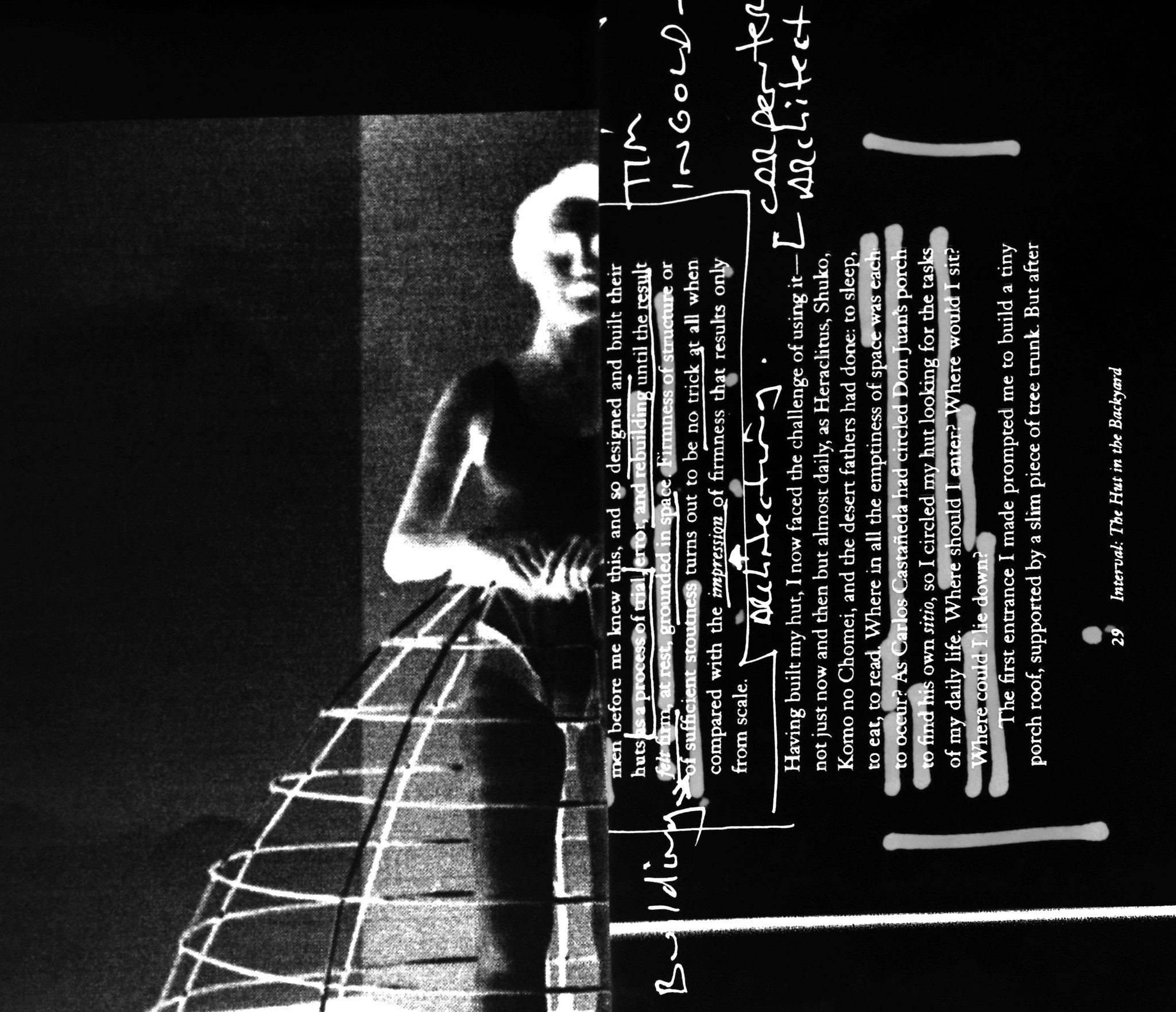
Seldom do we consider the act of making as a method of knowing. For Tim Ingold, both the maker and the theorist are engaged in processes of knowledge, with the important difference that the craftsman thinks through making, while the theorist imposes thought on matter.
The temple at once embodied the interdependent arising of craft and community, and replaced the caves and sacred groves of earlier divine appearances, to become a place apart.
A crafted place where divinity was revealed. The world appeared for the first time through something people made. Through building the temple, cosmos was discovered through making.
The top-down abstract knowing of the theorist verses the bottom-up embodied knowing of the craftsman has come to define our hierarchy on the valuation of knowledge.
The Origins of Architecture in Weaving.
They Wove Their Walls.
Vitruvius.
Tim Ingold comments that just as baskets are woven, so buildings are grown, not built. Their form, and its usefulness emerges from the process of growth rather than from the mandates of a preconceived design on formless raw material.
Materials are not understood in terms of their component parts, but in terms of what they do.
Making is not a matter of imposition, but of intervening in the fields of force and flows of material.
Architecture that forces us to confront our own spatial intelligence by moving us so much that we
recall the eidetic origination of our own mental space. (Schaik,2008:80)
‘The phenomenology of space – the matter of how we experience it.’
Gaston Bachelard, Poetics of Space (space and reverie), The Psychoanalysis of Fire.
Clay Jug
Inside this clay jug there are canyons, and pine mountains, and the maker of canyons and pine mountains. All seven oceans are inside and hundred of millions of stars.
Words, Kabir, Jackie Leven. The mystery of love is greater than the mystery of death
The Architecture of The Ceramic Vessel
The use of the vessel in the investigation of our world.
The exploration through the dichotomy of the analysis between exterior and interior, of one pot to another and from the message they convey.
Atemwende : A breathturn.
Edmund de Waal.
The Great Glass Case of Beautiful Things:
About the Art Of Edmund de Waal
Adam Gopnik. 2013.
The Sensuality of the Clay Body.
‘You have to work quickly and with definition, and your ideas have to come into focus with enormous rapidity.’ Edmund de Waal, on working with the different presence demanded on ones mind and hand whilst throwing with porcelain. The practice of porcelain forced a change in colour and finish in his work. New glazes, shimmering celadon and shiny black, arrived to catch the light and send it back. (Gopnik,2014:9)
The throwing of pots still remains central to his practice. ‘The material goes down, gets wet, is pulled open by the hand, spins- and then produces, as if by magic, the most transcendently human of all made things; volume, inner space, an interior, the carved out air that connects the morning teacup with the domes and spandrels of San Marco. There’s nothing there but clay and air, then there’s defined air. (Gopnik,2014:6)
Edmund de Waal is a maker of objects with imagined histories. (Gopnik,2014:11)
The Library : A Meditation on the Human Condition (Giacometti, artist-philosopher)
Books can step up to us- into us- in many ways.
Voices from Chernobyl by Svetlana Alexievich was for me that rare precipitate force which calls another book into being.
Mario Petrucci, Heavy Water, a poem for Chernobyl.
Hawking understood black holes because he could stare at them. Black holes mean oblivion. Mean death. And Hawking has been staring at death all his adult life. Hawking could see.
Martin Amis, Night Train, 1997.
For Baudrilland the actual photographs are beside the point. It is what precedes them that counts in his eyes- the mental event of taking a picture.
Sylvere Lotringer, The Piracy of Art, 2008.
Inner Worlds : Photographic Visions
Beuys – Klein – Rothko
Transformation and Prophecy
Anne Seymour
The Inner Eye
Art Beyond the Visible
Marina Warner
Thinkers and Vessel Makers.
Ceramic space and life Gordon Baldwin
Objects For A Landscape David Whiting
Vessels-Spaces that cannot be drawn, rather they need to be experienced. Imagining a Vessel in a Rock on a Beach, 2006,(charcoal on paper)
MATERIAL MATTERS ARCHITECTURE
AND MATERIAL PRACTICE Katie Lloyd Thomas
PLENUMS : RETHINKING MATTER. GEOMETRY AND SUBJECTIVITY Peg Rawes
ARCHITECTURE
IN THE AGE OF DIVIDED REPRESENTATION
The Question of Creativity in the Shadow of Production. Dalibor Vesely
The Nature of Communicative Space Creativity in the Shadow of Modem Technology
The Rehabilitation of Fragment
Towards a Poetics of Architecture The Projective Cast
Architecture and its Three Geometries
Robin Evans
Architects do not produce geometry, they consume it
Analysing ARCHITECTURE
Simon Unwin
Geometries of Being Architecture as Making Frames Space and Structure
Poetics as an evolving and discursive system of dialogues that acknowledges environmental changes, of other spatial narratives and histories, and things that are not just about place and space.
‘Speculations about the first shelters, the relationship between our home and the universe, about spaces that we first use as surrogate houses as we form our spatial histories and our mental space. It is about the contemplative effects of the miniature, about the paradoxical way in which the scale of many of our most cherished monuments can switch in our minds from large to minute- the quality of intimate immensity. It is also about propositions around the complex relationships between inside and outside and the surface between, about the phenomenology of roundness’ (Schaik,2008:86-87)
‘We are composed of matter and live in the midst of matter. Our objective should not be to renounce matter, but to search for a form of matter other than objects. What that form is called-Architecture, Gardens, Technology- is not important.’
Kengo Kuma.
On Anti-Object : An extended essay that is not so much history or theory as a volume of self-assessment that gives an opportunity for the author to contextualise his own body of work through considered self-reflection.
‘My purpose in writing this book is to criticise architecture that is self-centred and coercive.’ Kengo Kuma.
‘Like McTiernan or the theorist PaulVirilio, Kuma sees new digital and information technologies as leading us to an aesthetics of disappearance, rather than image or form.(Steele,2008:3)
‘My ultimate aim is to erase architecture’ (Kuma,2008:3)
How then, can architecture be made to disappear?
‘To be precise, an object is a form of material existence distinct from its immediate environment. I do not deny that all buildings, as points of singularity created by humankind in the environment, are to some extent objects. However, buildings that are deliberately made distinct from their environment are very different from those that attempt to mitigate this isolation, and the difference is perceptible to everyone who experiences them.’ (Kuma,2008:Preface)
Ceramics and Architecture.
Exhibition Spaces of the Enlightenment
The Porcelain Rooms
The pot, ancient as it is, is the first instance of pure innerness, of something made from the inside out. Building objects upwards is, in its way, an obvious and brutal thing; it derives from piles, and makes pyramids. Turning objects inward, on the wheel, is a subtler one, and derives from our need to have a place to put things in. (Gopnik,2014:7)
Together these new porcelain vessels collectively produced for De Waal an experience of possessed space.
These collections of vessels in their Modernist vitrines seem to be both an expression of the architecture of a collection and simultaneously an affirmation of an interior space that can hold the singularity of a breath within a small pot.
The ceramic module that he uses, the small pot, is deliberately made as non-functional as possible. (Gopnik,2014:9)
‘Even if we insist on seeing them impersonally, the sheer force of their numbers creates the poetic sense inherent, as Homer knew, in all inventories. They gang up on us.’ (Gopnik,2014:9) These groupings of objects placed together produce their own narratives, their own relations, and lines of inquiry. In so doing their ordering of the space around them brings meaning to those spaces. This is reinforced through the poetry and metaphor of the effect of ceramic vessels on space, as cited by De Waal himself through Wallace Stevens’s “Anecdote of the Jar” 1919.
‘The Jar, the elemental made thing, takes dominion over the unmade world. The air around it suddenly looks “slovenly,” insufficiently jar-like. Made things remake the unmade world. (Gopnik,2014:10)
Gopnik comments that we can’t look at hollow things without sensing their hollowness, as he notes we perceive haptically as aptly as optically. This allows us to read these vessels through both our sense of sight and our sense of space. The result is that we feel these objects; we can sense the heft of them made from their weight, shape and size. We become aware that we can feel objects as much as we can see them.
De Waal’s work brings about a sensuality and an empathy manifested between the strict ordering of his presentation through his vitrines and cabinets and the fragility and grouping of his porcelain vessels. This empathy promotes our interest with the interior parts of his groupings, with the interior emptiness and mystery of things we can only sense. His control and command of the geometric spatial relations found in his installations is juxtaposed by the multitude of diminutive interiors and negative spaces.
The relations of the architectural and those of the vessel are in constant flux, held in some sort of spatial narrative that seems to meditate stillness, like the museum these vessels are protected and intact, yet strangely they are held hostage by their surroundings.
The empathy we feel for their emptiness is perhaps choreographed, staged and ultimately forced, these are not just pots as De Waal admits but pots that have been by design rendered as non-functional as possible although they still bare the marks of his franchising. This neutering of his thrown clay forms into the realm of perhaps a purely sculptural object that is itself now a mere component in his Minimalist cabinets. What remains is a hollowness, but a contrived hollowness that speaks of spaces designed not made; unlike his Signs and Wonders intervention for the V&A, these works feel orphaned and cut adrift by their surroundings.
Does? ‘His art takes a familiar grammer of display and turns it into a poetry of memory. Inside a room, a great case filled with rows of porcelain pots. Along each row, a story. Inside each pot, a breath. (Gopnik,2014:11)
Craft and Art, Skill and Anxiety.
Craft is logic, and art defies it. The defiance is what makes art. The serenity of the artisan lies in her knowledge that it can all be done again. The anxiety of the artist; lies in knowing that if it is done again, she has become an artisan. (Gopnik,2014:7)
DEEP ECOLOGIES OF CONSTRUCTION
Caruso St John : The Phenomenology of Construction
History is the raw material of architecture. Aldo Rossi
The ruined state of the buildings serves to exaggerate the presence of material. The feeling is that of an enormous weight drawn out of the ground into the volume of the valley and held in place by a matrix of structure whose schema is described by the pattern of stone joints.
Adam Caruso, Towards an Ontology of Construction, KnittingWeaving Pressing 2002
The essential change in perspective between Perret and Caruso St John is that of a construction as structure to a construction that is the application of matter. Perret observes the organic dimension of buildings from a distance that makes the structural framework’s overall logic intelligible.
Caruso regards buildings much more closely, at a distance/closeness that enables him to grasp their tactile dimension: he looks at them with his hands. In Fountains Abbey, it is the brickwork joints that are essential; on the rear facade of his Van Nelle factory building, it is the micro-topography of the facade.
Luis Moreno Mansilla remarks that buildings by Sigurd Lewerentz, one of Caruso St John’s main inspirations, can only be seen close up.
For Caruso St John, construction does not refer to a constructional technique, nor to the coherence of its application as a technique, but rather the presence of the built object through the manner in which it is built.
Interestingly Perret’s positivist and absolute approach belongs to a mindset that excludes all form of doubt or ambiguity. To this approach, Caruso St John propose a phenomenological approach in which construction frees itself from pure technological logic to find meaning, both inherent and more relativist, in the field of architecture itself.
INNERNESS/AFFECT : THE CHANGE OF PERSPECTIVES SURFACES, Juxtaposed without articulation.
QUESTIONING STRUCTURAL LOGIC, by playfully obscuring it.
INCREASING THE BUILDINGS PHENOMENOLOGICAL AND PERSPECTIVE COMPLEXITY
CONSTRUCTIVE DIALOGUES/CLADDINGS
Through CRAFT, PROXIMITY, INTIMACY and SITUATION.
The depth of the exposed beams in the exhibition areas is not proportional to their respective spans, but to the overall heights of the rooms in question. Walls with claddings of vertical timber boards alternate with bare concrete walls that seem to have been cast in shuttering identical to the timber cladding. These two surfaces are sometimes juxtaposed, without articulation, and question structural logic by obscuring it, thereby increasing the building’s phenomenological and perspective complexity.
New Art Gallery, Walsall. Caruso St John
The load bearing walls appear to be folded along the complex contours of the non-orthogonal site. At the comers, bricks are cut and bonded together with resin to adapt to the geometry, while maintaining the size of standard bricks. Although they are load bearing, these walls become surfaces that have tactile and phenomenological qualities as well as being constructed surfaces with real architectonic weight.
The Brick House, London, Caruso St John
ATMOSPHERE: CLADDINGS and ARCHITECTONICS.
CLADDINGS and their ability/capacity to create ATMOSPHERES AESTHETICS AND SUBJECTIVITY: KANT to NIETZSCHE ( Andrew Bowie)
Hortus Conclusus
Often translated as meaning “a serious place”. Enclosed all round and open to the sky.
STOA, building and social structure for dialogues
A garden/a mindfulness in an architectural setting.
What happened to the garden that was entrusted to you? Antonio Machado, Jackie Leven.
“Sheltered places of great intimacy where I want to stay for a long time.” (Zumthor 2011: 15)
Every plant name listed here evokes a distinct image; with each of them I associate specific lighting, smalls and sounds, many kinds of rest, and a deep awareness of the earth and its flora.
A garden is the most intimate landscape ensemble I know of. In it we cultivate the plants we need. A garden requires care and protection. And so we encircle it, we defend it and fend for it. We give it shelter. The garden turns into a place.
There is something else that strikes me in this image of a garden fenced off within the larger landscape around it: something small has found sanctuary within something big.(Zumthor 2011: 15)
Illustration of “Orchard”, from Bible of Wenceslaus IV, Vienna, Austrian National Library
Depicts in the manner of an illuminated manuscript, the husbandry and community of the medieval workforce in the secure and sheltered space of a walled garden. This pastoral craft/gathering is evocative of Zumthor’s Hortus Concluses.
Working with ones hands, with the earth in sheltered spaces of a pastoral community. Zumthor underscores this pastoral setting when he places a pavilion at the centre of the garden; he talks of future meeting there, of looking forward “to the natural energy and beauty of the tableau vivant of grasses, flowers and shrubs. I am looking forward to the colours and shapes, the smell of the soil, the movement of the leaves.” (Zumthor 2011: 15)
The Vintner’s Luck , Elizabeth Knox.
Tasting the soil in the wine, the soil and the wine are of the same substance, from the same locality; they are bonded together by the landscape.
In the scopic field, the gaze is outside; I am looked at, that is to say, I am a picture.
The spectacle of the world, in this sense, appears to us as all-seeing, this all-seeing aspect is to be found in the satisfaction of a woman who knows that she is being looked at, on condition that one does not show her that one knows that she knows.
Jacques Lacan.
What is a Picture.
The Split between The Eye and the Gaze.
A Body of Relations.
Reconfiguring The Life Class.
In the article What is a Picture? Jaques Lacan relates the space between the gaze and the eye to the ‘screen’. The ‘screen’ allows the simultaneous perception and projection of the image. In the life class, Lacan’s gaze is significant for the life model and the artist as it formulates the intentions of the psychological engagement and reveals the fundamental pursuit of desire in the methodology of life drawing practice. The subject needs to become an object of its own ‘scopic drives’ and therefore possessed by the perception of others. Lacan’s gaze is somewhat estranged from the body, as it never allows for subjectivity to be fully complete.
Yuen Fong Ling. 2016
Palimpsest/Involuntary Surfaces.
Drawing/Corporeal Intertwinings of body/space.
Bodyscapes/Movements/Materials.
Haptic/Visual Abstractions.
Life Class/Drawing.
The contested space/subject of the nude as a form of art.
The project arises between a dialectic between the poetic and the systematic.
Between Science and Art.
The Embodiment of Minimal Gesture.
Wanderlust, A History of Walking.
Rebecca Solnit. 2002
The Mind at Three Miles an Hour.
Everyday Aesthetics : Ordinary Lives
What shall I do next?
Tim Ingold.
Finding enlightenment in the ground beneath one’s feet.
J. G. Bennett.
Tim Ingold is an anthropologist who has looked at the interface between people and the environment. In The Perception of the Environment, he argues that ecological psychology and the philosophical writings of Heidegger and Merleau-Ponty share the view that the world becomes meaningful through active inhabitation, or ‘dwelling’, rather than cognitive representation.
Curriculum Making : The Enactment of Dwelling in Places.
In a world of materials, nothing is ever finished : ‘everything may be something, but being something is always on the way to becoming something else’
Tim Ingold
Raveningham/Scripted Places
Garden/Ground/Circulation Diagrams.
Doing Slow Philosophy : Materials/Objects/Things/Walking/Listening to the wind
Boundaries/in the making between the personal and the commonly shared.
A space where the individuals mental reality meets cultural narratives.
Few boundaries are impenetrable
They are rather, semi-permeable membranes providing housing while allowing selective commerce
In a world of materials, nothing is ever finished : ‘everything may be something, but being something is always on the way to becoming something else’
Tim Ingold 2011
The Autonomy of The Natural Environment.
Sculpture/Playing with the existence of things.
Field Studies : Pathways around the Sun.
Drawing : Assemblage of Lightness and Weight.
Enmeshed Space : Working Drawing with Handwritten Notes.
Lawn Deliberations/Mappings of Human Agency/Space/Time.
Space projected from the body is biased towards the front and right.
The future is ahead and ‘up.’
The past is behind and ‘below.’
Time as a structure/place to observe things in constant motion/relation.
Ground Pegs/Labels/Text Markings/Archival Information
Points becoming lines, Tim Ingold.
Reading Matter/Rooms.
The Lake of The Mind.
Stochastic Thinking.
Steven Holl.
Raveningham : Site-specific project place
The Garden of Ongoing Differences.
Diffraction/Energy/Analysis/Attunement
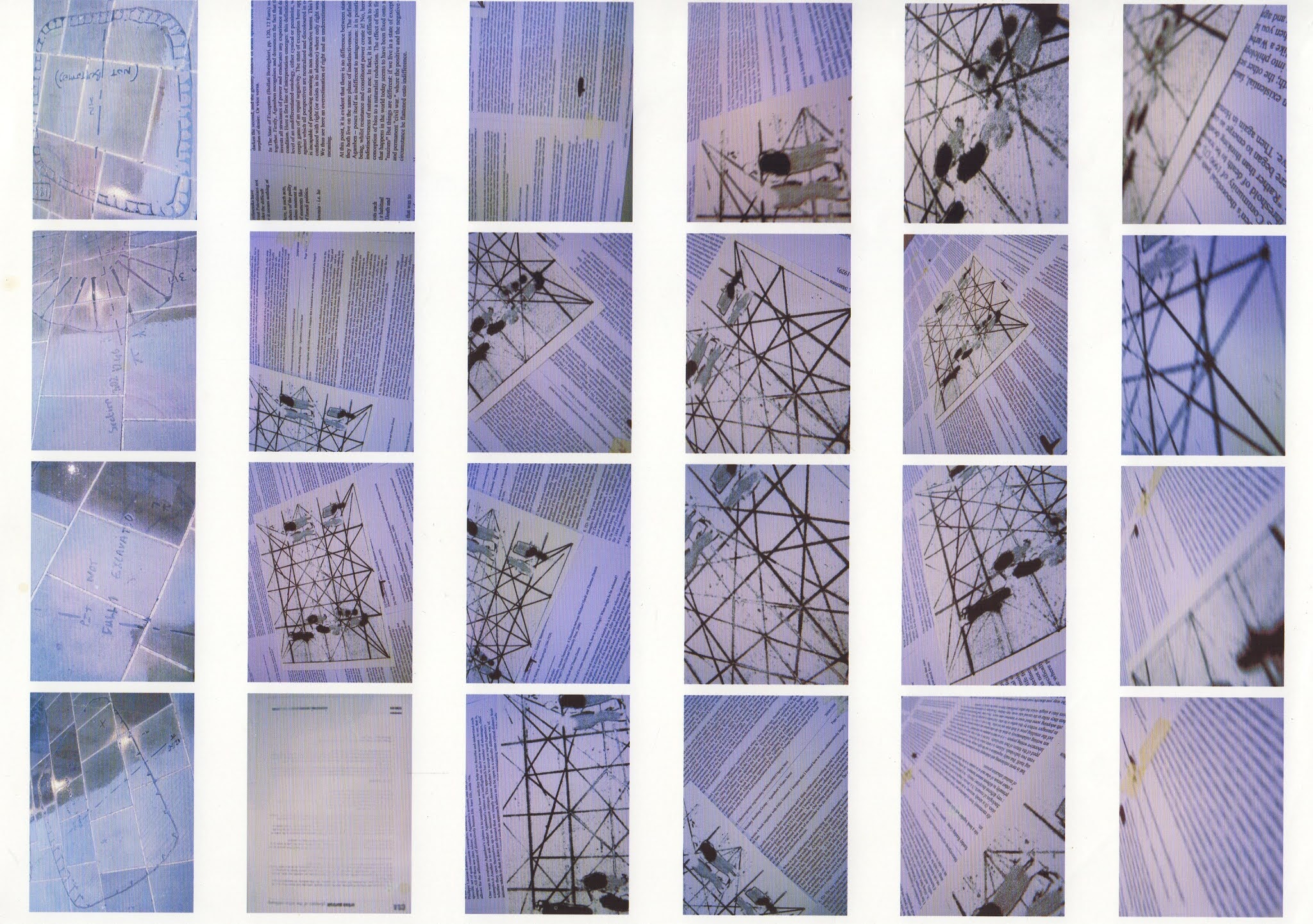
Site Cyanotypes/Drawings/Intermediaries
Spatial Collages Reconfigured
Walking/Thinking with Ideas/Observations.
Site Drawings and Observational Mappings.
Cultivation Field.
The circle and square together embody what I think of as human nature.
Dark Room, Garry Fabian Miller.
If the everyday can be considered an ecology where passions circulate in a perpetual state of intensification and entropic decline, the empirical self (and not just David Hume’s version of it) is essentially in a state of flux. This posits the human as an organism constantly adjusting to its passionate environment, with a self that is constantly appearing and disappearing, crystallising and dissolving.
Ben Highmore
Rich Lyrical Motifs.
Brilliant Trees.
Within each lesson lies the price to learn.
David Sylvian.
Artist’s Development.
Planting Research
Vital Nourishment.
Raveningham Garden Project.
Circle/Linear Time/Centred on objects.
Spiral/Deep Time/Awareness between things.
Architectural Ceramics.
Inseminations/Sketchbooks
Cell/Seeds/Dispersal/Cloud
Organism-Person-Environment
Working Ideas/Proposals into Matter/Making
Contents/Description/Instructions/Diagram/Drawing
Presentation/Ritual/Repetition.
Art is contemplation and must act upon our consciousness.
Objects/Things are part of the artist’s immediate existence.
Contemplative experiences become truly meaningful when they occur in everyday life and when nirvana or the state of superior awareness blurs into samsara or ordered time.
For Tapies, repetition is above all else a perpetual questioning or a perpetual becoming.
A working process that is additive, which incorporates changes and accidents and as such his methods are hardly erasing anything that is already present on the canvas.
A Summer’s Work, Antoni Tapies.
The Garden/Material of/for Forking Paths.
The Diagram/The Program/The Inquiry
Marking Durations.
Ground Mappings.
Solar/Daylight Observed/Shadows Recorded
A Garden Observatory/Philosophy of Silence/Solitude.
Raveningham Sculpture Trail.
Site Visit 160423
Sculptural Spacings and Sensual Engagements.
Showing Points/Lines/Vectors of Change/Movement.
Dwelling Demarcations/markers of temporality and disappearance.
A poetics derived/driven from both the systematic and the small wonders of the everyday.
Circular Breathing/Cyclical Lines.
The Peripheral Movement/Moment
The Space/Time between things.
The Concept of Sculpting Invisible Materials.
The Array, a phonographic inquiry recording transits of the suns pathways across the sky.
Wanderings, caught up in the wanderlust of stillness and slowtime.
Paths of movement, paths of observation, paths of existential abstractions following daylight.
The artist’s creative act of a self amongst others.
A sculptural deliberation that engages with the experiences of working a site in the landscape.
Curatorial.
Spatial Practice.
Practice/Display/Audience.
Of the mason’s who built them, we can say that they both designed as they drew, and drew as they designed. But their designing, like their drawing, was a process of work, not a project of the mind.
Tim Ingold ‘Making’
Camouflage : Neil Leach
Camouflage offers a mechanism of locating the self against the otherwise homogenising placelessness of contemporary existence. It thereby promotes a sense of attachment and connection to place.
Camouflage may therefore provide a sense of belonging in a society where the hegemony of traditional structures of belonging – the family, church and so on – has begun to break down. This aesthetic sense of belonging can be compared to other modes of belonging, such as religious devotion or romantic attachment.
Aesthetic production should maintain the capacity to operate as a mediation between the self and the environment, but only aesthetic production whose design has been carefully controlled can achieve this. The difference between productive and unproductive modes of expression is therefore a question of design. In this respect we can recognise the important social role of design in providing a form of connectivity for ‘cognitively mapping an individual within the environment.
Design becomes a crucial consideration for the effective operation of camouflage.
In highlighting the creative capacity of human beings to adapt to their environment, this book offers a more optimistic account of human existence, which valorizes the present as the site of productive endeavor.
The thing contained is not the thing contained.
Manifesto for explorations of ‘IN’
Steven Holl.
spatial practice, alternative photography, fine art, ceramics,making,Russell Moreton,
Trace drawings on paper with organic and material from the built environment.
Drawing/Making Processes.
Architectural Body : Organism, Person, Environment. Arakawa and Gins.
“[…] the body […] continually transforms itself and is already not, at the moment when I speak of it, what it was a few seconds ago.” (Laplantine, 2015:13)
Laplantine, F. 2015 [2005]. The Life of the Senses: Introduction to a Modal Anthropology. United Kingdom: Bloomsbury Academic.
Through the choreographing of our learning processes we create the conditions for engagement/entanglement and production/transformation, which are all modalities of movement and action. So we see pedagogical, architectural and professional practices as potential practices of transformation and co-learning. Dance – somehow both connected to and different than choreography – brings with it a whole set of values which we consider significant for the architectural pedagogy we enact.
Lepeki lists the ‘constitutive qualities’ of dance as
“ephemerality, corporeality, precariousness, scoring and performativity” (Lepecki 2012:15)
He goes on to say that “[t]hese qualities are responsible for dance’s capacity to harness and activate critical and compositional elements crucial to the fusion of politics and aesthetics …”(Lepecki 2012:16)
His ‘compositional’ and ‘critical’ elements echo the event/discourse relationships within our pedagogy and in our use of choreography as dance/writing. These qualities allude to specific modes of engagement and making, and state particular values. We will use them to underscore our pedagogical modes, and develop them as necessary in a teaching practice which desires students’ engagement, empowerment, and caring.
In that sense, ephemerality can be related to immediacy and an engagement with the here- and-now which cares about effects and duration. Corporeality speaks of a body, but if we ask whose body or what body, then we can expand it to be any-body, in order to speak of matter or, more precisely, of mattering and bodying. Other names for precariousness can be fragility or vulnerability, somehow always already a condition of our impossibly immediate interventions. Scoring, which can be both a ‘writing’ and an unfolding, creates spaces and times and modes for and of improvisation. And performativity always returns us anew to movement, multiplicity, effects and life.
Performative Intraventions and Matters of Care: Choreographing Values
OREN LIEBERMAN
ALBERTO ALTÉS
Abstract
Thinking through choreography as dance/writing – both the doing and the score for that doing, the event and the discourse – we propose to shift the focus of architectural practices and pedagogies from an emphasis in the attainment of competencies and static knowledge, to a privileging of processes and modalities of learning that nurture the values of engagement, empowerment and caring responsibility. Choreography situates our work in the realm of performative action and transformation, and it does so with and through our bodies; also, it helps us frame the power of our intraventions, which aim at transforming the world through immediate, responsible and often fragile acts of engagement with matter, movement and life.
Keywords:
Intravention, matters of care, choreography, architectural pedagogies, modalities of learning.
More on ’intraventions’ can be found in:
Altés, A. and Lieberman, O. 2013. Intravention, Durations, Effects: Notes
of Expansive Sites and Relational Architectures. Baunach: Spurbuch Verlag.
Although the human condition is a crisis condition if ever there was one, few individuals and societies act with the dispatch a state of emergency requires. The fact that the human condition is a crises condition gets routinely covered up, with culture invariably functioning to obscure how dire the condition is and to float it as bearable
If organisms form themselves as persons by uptaking the environment, then they involve not only bodies but domains, spheres of activity and influence
Start by thinking of architecture as a tentative constructing toward a holding in place. Architecture’s holding in place occurs within and as part of a prevailing atmospheric condition that others routinely call biosphere but which we, feeling the need to stress its dynamic nature, have renamed bioscleave
Procedural Architure/Architectural Body
Gins and Arakawa
The role of architecture as a tool for researching the body-environment towards the implementation of these considerations is paramount
The goal of an experimental teaching and learning space based on architectural procedures would be that the process of design and construction would allow students/staff to rethink, re-imagine and enact the curriculum
An Arakawa and Gins Experimental Teaching Space/A Feasibility Study 2013
Jondi Keane
An Architecture of Viability
To help to sustain one throughout life/ to stay tentative
Bioscleave House as an inter-active laboratory of everyday life
Wayfinding (unpacking discourse/meaning) through Landing Sites and Architectural Bodies
What is the metachallenge that bioscleave demands of us? Is it, I propose, wayfinding, a wayfinding defined at many scales from finding one’s way as a person to finding one’s way in a strange physical or social environment
Exploring the Roles of Trajectoriness, Affectivatoriness, and Imaging Along 2013
Reuben M. Baron
Figure/Ground : Double Occupations of Discourses and Events (relationships/co-existances)
So as a diagram (performative agent), the figure/ground does not function to represent even something real. But rather constructs a real that is yet to come (theoretical object/apparatus) as a new type of reality
Situated Field/Constructed Site of People, Institutions, Apparatuses, Events, Discourses
We see intraventions as heuristic devices, as apparatuses that are imbued with a will to transform.
The intravention is not autonomous but contingent and relational and dependent on many other things
The intravention is made as it happens, and it makes us at the same time
Immediate Architectural Interventions, Durations and Effects
Oren Lieberman, Alberto Altes
AEffect initiating Heuristic Life
Procedural architecture, developed in both their written and buillt discourse, providing a process by which to connect theory to practice, disciplinary inquiry to knowledge and art to life
Research should be conducted , not in a library or laboratory but where living happens, enabling the complexity of relationships to be studied within and across the organism-person-environment
Jondi Keane
Carnal Knowledge
Towards a New Materialism through the Arts
Estelle Barrett, Barbara Bolt
To provide observational heuristic devices so that persons may devise transformational and reconfigurative opportunities
Heuristic tools whether built hypothesis or discursive sequences, are of no use if they do not provide a way forward, a way of learning
This house is a tool, a procedural one
A functional tool, whether it be a hammer, a telephone, or a telescope, extends the senses, but a procedural tool examines and reorders the sensorium
Interlude : Cornering a Beginning
An object becomes the threshold for thinking feeling
Relationscapes : Movement, Art, Philosopy
Erin Manning
Born into a new territory, and that territory is myself as organism. There is no place to go but here. Each organism that persons finds the new territory that is itself, and having found it, adjusts it
Ellipsis,(gaps in everyday narratives)
The Construction of Representation of Identity
Using their bodies and immediate surroundings and environment as both subject and context
An Organism-Person-Environment
You cannot see me from where I look at myself
Francesca Woodman
An organism-person-environment has given birth to an organism-person-environment
Bioscleave
Chaos, Territory, Art
Deleuze and the framing of the earth
Elizabeth Grosz
Body, Personal Relations, Spatial Values
Upright Human Body : Space and Time
Yi Fu Tuan
Figuring It Out
The Parallel Visions of Artists and Archaeologists
Colin Renfrew
The act of relating is analysed as a constitutive feature of human agency. Relating is viewed as the continuous work of connecting and disconnecting in a fluctuating network of existential events
Categories and things may make it easier for us to grasp reality but they also hide its underlying complexities