Moreton~~The Reading Body ~ Correspondence Without Convergence
A working paper on reading, spatial practice and the withdrawn interiority of ceramics
Abstract
This working paper considers reading as a spatial practice: an activity through which bodies of thought, material, image and architecture enter correspondence without requiring their differences to be resolved. Drawing upon the thinking of Tim Ingold, Erin Manning and Karen Barad, it explores the reading body as an intercessor, moving between philosophical propositions and the material processes of making. Their ideas are not brought into agreement or applied as explanatory frameworks. Rather, their distinct soundings remain active within a developing spatial practice, sometimes surfacing in the work, sometimes withdrawing into its material and spatial relations.
Through clayceramic, reading becomes implicated in the production of interiority. The ceramic body acquires material persistence, while the propositions passing through its making remain availablewithdrawn for further encounter. The paper proposes correspondence without convergence as a way of understanding how reading, making and spatial body~~ing might continue to inform one another without arriving at a singular conclusion.
Keywords: spatial practice; reading body; correspondence; interiority; clay~ceramic; material thinking; spatial bodying; speculative learning; propositional futurity.
- The Reading Body
What kind of body is reading?
Not simply the body that receives or interprets a text, nor an intellectual position standing outside the material world, but a body already implicated in the relations through which thinking, sensing and making take place. Reading involves a situated encounter between bodies of thought, images, materials, remembered places and emerging propositions. These encounters do not necessarily produce agreement or arrive at a shared understanding. They may disturb, redirect or remain partially withdrawn from one another.
Within Moreton’s spatial practice, reading becomes an activity of correspondence. Texts and ideas are encountered as bodies of inquiry whose propositions remain available to be furthered through material and spatial practice. The reading body moves between these correspondences, allowing their differences to remain active rather than reducing them to a coherent theoretical position.
The reading body is therefore also an intercessor. It inhabits the relations between reading and making, thought and material, architectural proposition and ceramic form. Its activity is neither entirely interpretative nor simply generative. It keeps relations in play, allowing them to surface, recede and return under different conditions.
Reading becomes a way of dwelling within what has not yet been resolved.
- Correspondence Without Convergence
The thinking of Tim Ingold, Erin Manning and Karen Barad offers distinct soundings within this practice. Their work opens different ways of attending to movement, material correspondence, relational emergence and touch. These are not interchangeable positions, nor do they need to be brought into theoretical agreement.
Their value within the practice lies partly in the differences they sustain.
Ingold’s attention to correspondence and material movement offers a way to think beyond the imposition of predetermined form upon passive matter. Manning’s thinking around movement, relation and emergence opens onto the potential of bodies and situations to become otherwise. Barad’s account of material relations and touching unsettles the assumption that bodies and their boundaries are simply given in advance.
These correspondences do not constitute a unified theoretical apparatus. They remain distinct, entering the practice at different moments and with different intensities. A reading may become explicit in a working text, influence a material decision, alter the perception of an architectural situation or remain unrecognisable within the finished ceramic.
The reading body carries these soundings forward without requiring them to retain their original condition. They may be taken up, resisted, displaced or transformed through making.
Correspondence without convergence names this willingness to sustain relations without resolving their differences. It is a reading practice in which ideas are neither preserved intact nor exhausted through their application. They remain available to further encounter.
- The Interval~Interiority of Reading
The interval~interiority between persistence and possibility is itself spatial. It is not an empty distance separating reading from making, but a living condition through which their relations continue to develop.
Interiority here does not designate a sealed inside. It describes a spatial body~~ing through which encounters become gathered, sensed and materially sustained. Reading enters this interiority, but does not simply occupy it. It participates in the changing relations through which an interior becomes perceptible, inhabitable and open to further propositions.
The reading body inhabits an ambiguous position: within the gathering, yet unable to contain it; implicated in the production of meaning, yet unable to determine its eventual direction. It allows propositions to remain present without insisting that they remain visible.
This ambiguity becomes particularly important when reading enters ceramic practice. The relation between a philosophical text and a ceramic form is rarely one of direct translation. The work need not illustrate an idea, and the idea need not explain the work. Instead, their correspondence may persist through less explicit material relations: an aperture, a chamber, a resistance, a hesitation in construction, or an emerging sense of interiority.
What has been encountered through reading may therefore continue within the work without appearing as a recognisable reference. The reading has entered another condition of existence.
- Withdrawn into Ceramics~Still~In~~Play
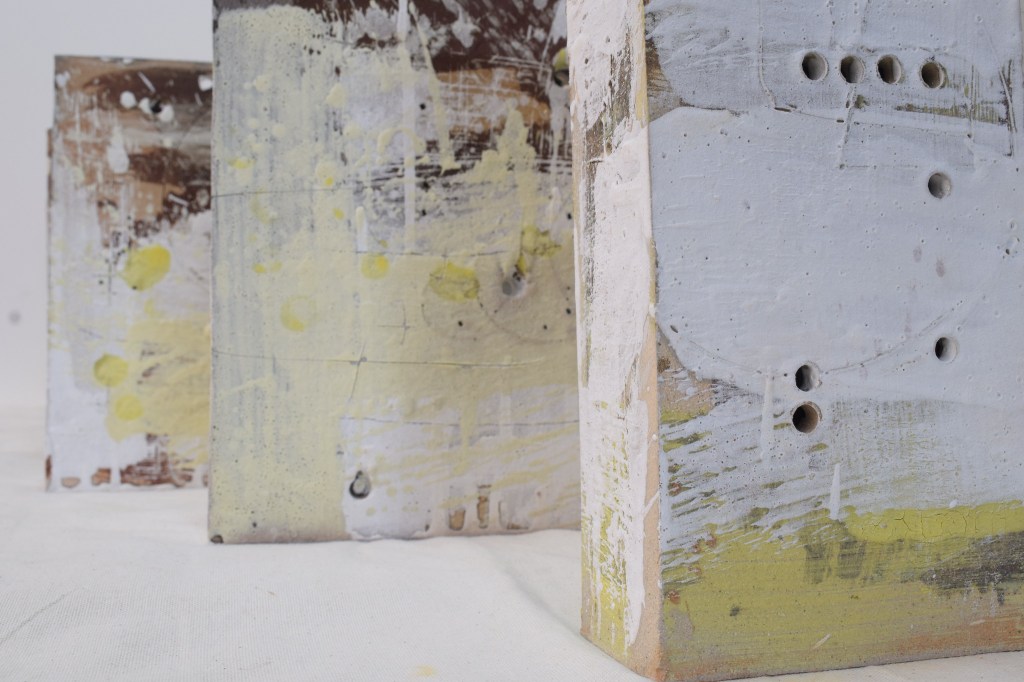
Through clay, relations are registered, negotiated and transformed. Through firing, a provisional field of actions acquires another material condition: the ceramic body becomes materially persistent.
Yet firing does not secure the meaning of what has been made. The ceramic withdraws from the immediate activity of making while continuing to encounter other bodies, architectures, atmospheres and situations. Its surfaces, apertures and chambers make certain relations available, while others remain latent or emerge only through subsequent encounters.
The ceramic body is not the conclusion of the reading practice. Nor is it simply the repository of ideas gathered beforehand. It becomes another site of correspondence, carrying forward relations that may have changed through their passage into material form.
The withdrawal of a proposition is therefore not its disappearance. What has surfaced through reading may recede into the material and spatial conditions of the ceramic, remaining active without needing to declare its presence. A correspondence may become available again through another reading, another work, another spatial situation or another body’s encounter with the ceramic.
The reading body continues to operate across these movements of surfacing and withdrawal. It keeps open the possibility that what has been materially realised may be encountered differently, and that what has withdrawn from immediate attention may yet acquire another expression.
The ceramic becomes materially persistent, while the proposition remains~in~play.
- A Spatial Practice of Continuing Correspondence
Moreton’s reading practice can thus be understood as part of a wider spatial ecology in which reading, making and inhabitation remain entangled. The reading body moves between correspondent bodies, allowing their propositions to enter material and spatial relations without requiring a final synthesis.
The interval~interiority of reading is a space of attentiveness: a situated openness to what passes between bodies, what becomes materially present, and what remains available for futurity. Its propositions may surface through writing or making, withdraw into the ceramic, and return through encounters that cannot be anticipated in advance.
The task is not to preserve every correspondence or to make every influence legible. It is to sustain the conditions through which correspondences can continue to matter.
Reading becomes spatial not simply because it concerns architecture or informs the production of objects, but because it participates in the ongoing body~~ing of relations. It creates passages between thought and material, between what is gathered and what remains outside the gathering, between persistence and possibility.
The reading body does not close the chamber. It keeps its movements inhabitable.
What is gathered is never simply contained. It passes between bodies, where it may surface differently, become otherwise, and continue to reverberate.
Persistent Bodies ~ Correspondence~Kept~in~Play
To sustain the conditions through which correspondences can continue to matter: this is what readingclayand the withdrawn ceramic keepinplay.
These are persistent bodies, though their persistence takes different forms. Reading carries soundings forward, allowing ideas to surface, recede and enter other relations. Clay gathers and transforms these encounters through material resistance, touch, pressure and time. The withdrawn ceramic acquires another material duration, carrying propositions beyond the immediacy of their making.
None simply contains what has passed through it. Each becomes a condition through which correspondence may continue, change direction or become available to bodies not yet encountered. Their persistence is not the preservation of an unchanged content, but the continuing capacity to enter relations.
The reading body intercedes. Clay materialises and transforms. The ceramic persists~~withdrawn, its propositions remaining available without being fully present or resolved.
Readingclayceramic: persistent bodies, keeping correspondenceinplay.
What matters is not simply what these bodies retain, but what their persistence allows to happen next.
Working proposition
Correspondence without convergence is a practice of keeping differences active, allowing the soundings of reading to pass through making and withdraw into materially persistent bodies, where their propositions remain available for further encounter.
The ceramic does not conclude the reading. It gives reading another spatial condition through which to continue.
Reading apparatuse
Persistent Bodies ~ Reading, Clay, Ceramic
Reading does not remain outside making. Its soundings pass between bodies of thought, images, materials and places, sometimes surfacing as propositions, sometimes withdrawing into the material conditions of a work.
The reading body moves between these correspondences without requiring them to converge. Ingold, Manning and Barad remain distinct within this gathering, their differences continuing to resonate through the movements of spatial practice. Clay encounters these soundings otherwise. Through making and firing, propositions acquire another condition of existence: a materially persistent body whose interiority remains open to further encounter.
What persists is not an idea preserved intact, but the possibility of its becoming otherwise.
Reading~clay~ceramic: persistent bodies already enduring their weather~~world, carrying relations forward into situations not yet known.
What is gathered is never simply contained. It passes between bodies, withdraws, and remains~in~play.


Leave a comment