Persistent Bodies ~ Reading, Clay, Ceramic.
Reading does not remain outside making. Its soundings pass between bodies of thought, images, materials and places, sometimes surfacing as propositions, sometimes withdrawing into the material conditions of a work.
The reading body moves between these correspondences without requiring them to converge. Ingold, Manning and Barad remain distinct within this gathering, their differences continuing to resonate through the movements of spatial practice. Clay encounters these soundings otherwise. Through making and firing, propositions acquire another condition of existence: a materially persistent body whose interiority remains open to further encounter.
What persists is not an idea preserved intact, but the possibility of its becoming otherwise.
Reading~clay~ceramic: persistent bodies already enduring their weather~~world, carrying relations forward into situations not yet known.
What is gathered is never simply contained. It passes between bodies, withdraws, and remainsinplay.
The Reading Body ~ Correspondence Without Convergence
The reading practice brings Ingold, Manning and Barad into correspondence, not to reconcile their thinking, but to allow their differences to remain active within the work. Each becomes a distinct sounding within a wider field of inquiry, offering ways of attending to movement, material relations, touch and the emergence of bodies. Their thinking is neither applied to the ceramic nor secured within an explanatory framework. It enters the movements of making, where it may be taken up, resisted, altered or carried elsewhere.
The reading body acts as an intercessor within this gathering. It moves between texts, images, materials and architectural situations, allowing propositions to pass between them without determining their final destination. Sometimes a correspondence surfaces explicitly, finding expression in a written proposition or a material decision. At other times, its sounding withdraws, becoming less immediately recognisable while remaining active within the ceramic’s spatial and material relations.
Reading, in this sense, becomes a practice of ambiguous inhabitation. The reading body dwells within the relations between ideas and things, neither standing outside them as an observer nor dissolving into their differences. It keeps these relations availableinplay, allowing them to acquire other conditions of existence through making.
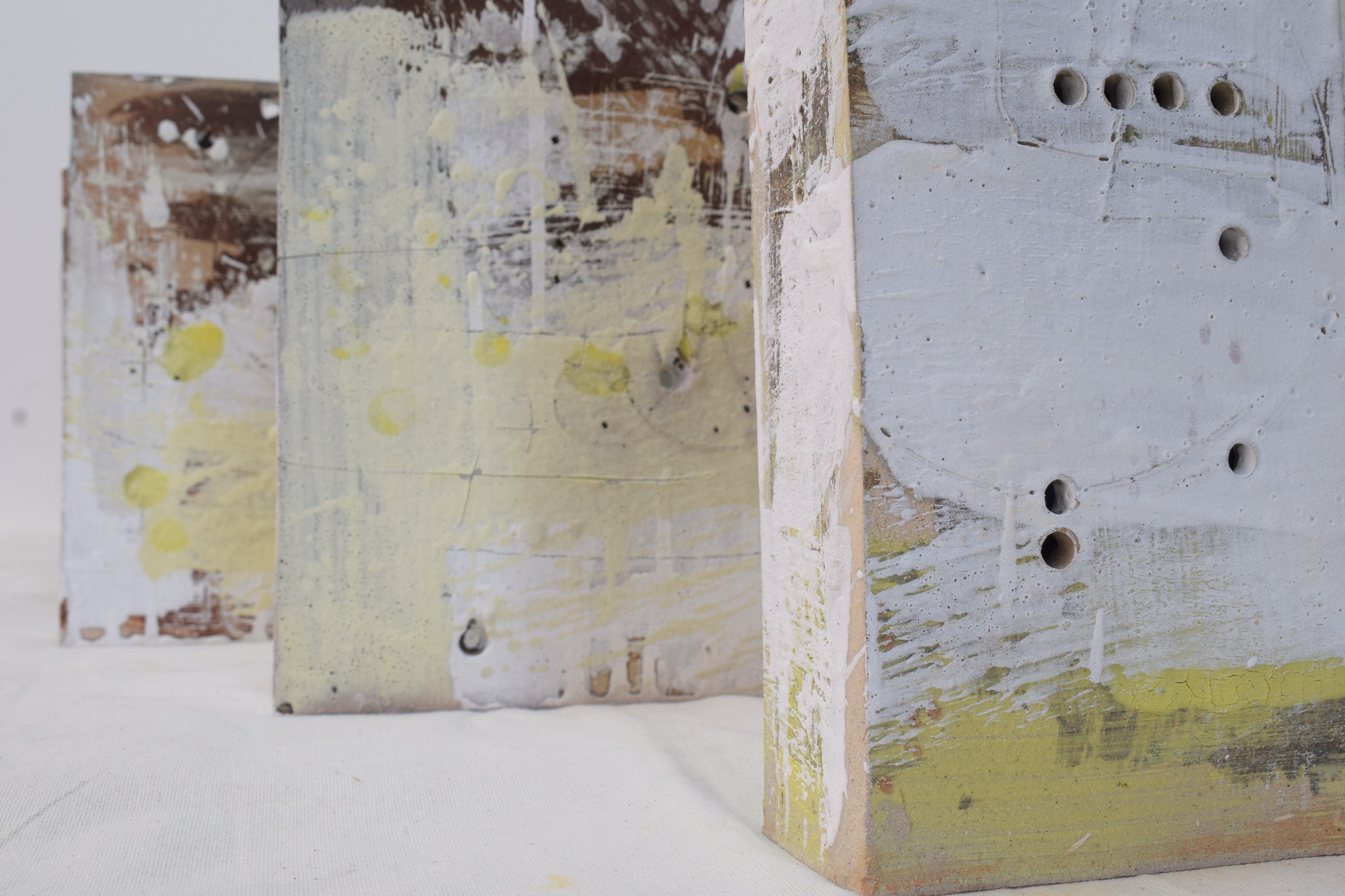
The ceramic body becomes one such condition. What has been encountered through reading may persist there, though not necessarily as a recognisable idea or an identifiable influence. It may surface as an aperture, a chamber, a resistance of material, an uncertain interior or a relation between bodies. The correspondence has changed its condition without exhausting its possibilities.
The reading body carries the soundings forward, allowing them to surface, withdraw and enter other bodies. Its work is not to preserve an idea intact, but to sustain the possibility of its further becoming.
The ceramic becomes materially persistent, while the propositions that have passed through its making remain available~~withdrawn for futurity.
Spatial Practice ~ Wayfaring Inquiry ~ Persistent Bodies
Towards an ecology of spatial correspondence, heuristic encounter and diffractive becoming.
Spatial practice as an ecology of persistent bodies.
Moreton’s spatial practice develops through an ecology of apparatuses and persistent bodies in which making, thinking and spatial experience become mutually implicated. Its formations cannot be adequately understood as a sequence of objects, media or completed projects. Architectural interventions, drawings, photographic surfaces, research collages, situated encounters and withdrawn ceramic bodies establish distinct conditions through which spatial relations become perceptible, materially registered and available for further encounter.
The practice is situated neither exclusively within art nor architecture, but within the relations through which architecting and arting become capable of acting together without being resolved into a single discipline. Its spatiality emerges through the gathering of heterogeneous bodies: materials, images, texts, architectural fragments, places, memories, atmospheres and the bodily movements through which these become consequential. Making is not simply the production of a form within space. It participates in the formation of the relations through which space becomes inhabitable, sensible and available for thought.
This distinction becomes particularly significant when considering the persistence of the work beyond its initial formation. A drawing may register a provisional spatial relation; a photographic surface may retain the effects of light and duration; an architectural intervention may temporarily reorganise an existing interior; a fired ceramic may carry the material consequences of making into encounters not anticipated at the moment of its production. Each body persists differently. Persistence does not mean that the work preserves a stable meaning, but that it sustains a capacity for entering further relations.
The resulting ecology is neither unified nor entirely coherent. Its bodies retain different material histories, temporalities, agencies and capacities. Their correspondence does not depend upon their convergence. Rather, the practice becomes spatial through the continuing negotiation of their differences.
Spatial Practice ~ Wayfaring Inquiry ~ Persistent Bodies therefore names an operative field rather than a disciplinary definition. It proposes that spatial inquiry develops through movement between situated encounters, while the bodies produced or encountered through that movement remain available for further correspondence. The work does not simply represent relations that already exist; it participates in the conditions through which relations become perceptible and capable of changing.
- Wayfaring ~ situated movement through correspondence.
Wayfaring describes the movement of Moreton’s inquiry through places, materials, readings and spatial situations. It provides an orientation towards the world as something encountered through ongoing participation rather than surveyed from a position outside it. The inquiry moves between architectural interiors, archaeological sites, gardens, photographic exposures, research collages and ceramic bodies, following lines of correspondence that become apparent through attention, making and return.
This movement is not adequately described as a linear progression from observation to interpretation and production. The encounter with a place may redirect a reading; a material resistance may unsettle an established proposition; a photographic trace may bring an earlier spatial situation into renewed relation with the present. Wayfaring is consequently less a route towards a predetermined destination than an attentiveness to the possibilities that emerge along the way.
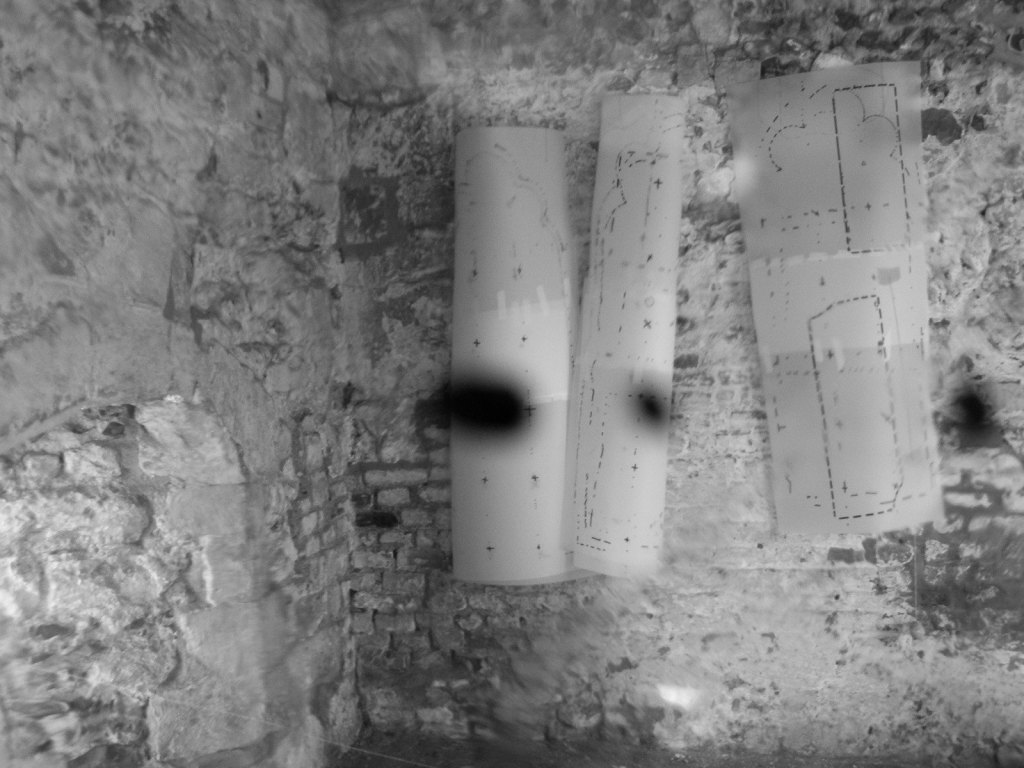
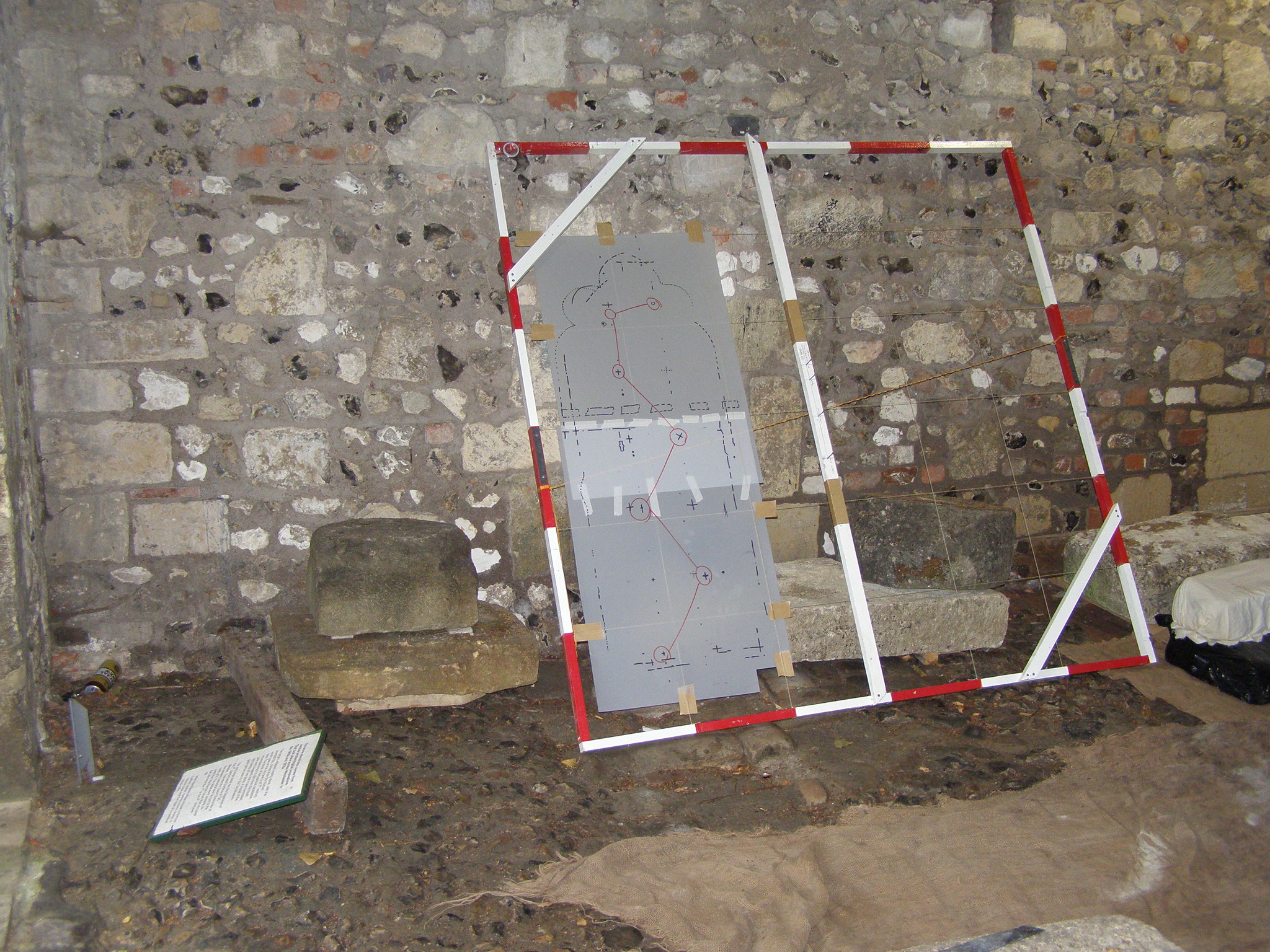
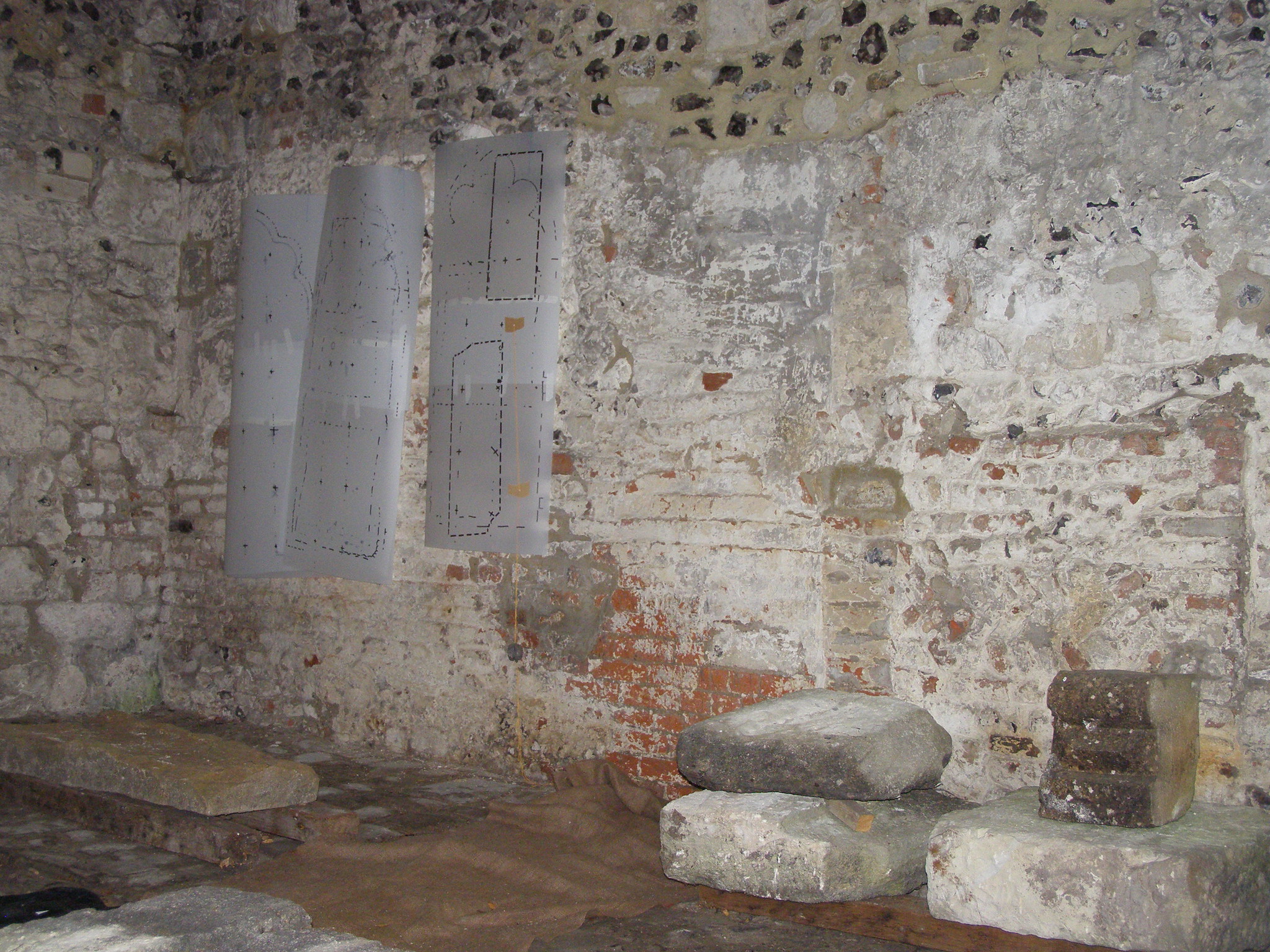
The Winchester works offer an early instance of this situated movement. In Leylines: Localities and Drawings and Beams and Netting: Negotiations in the Chamber, locality, architectural structure, drawing and provisional intervention become involved in the formation of spatial propositions. The chamber is not simply an existing enclosure into which a work is introduced. Its apertures, supports and architectural conditions participate in how the work becomes spatially organised and encountered.
In later photographic works, the movement extends into the temporal relations of sunlight, exposure and indexical registration. The photographic surface becomes a body through which an encounter with the weather-world persists beyond the duration of exposure. In the ceramic practice, wayfaring acquires another material condition: the encounter with clay proceeds through touch, resistance, drying, alteration and firing, while the resulting ceramic body carries these relations into a different temporal and spatial situation.
These practices do not form a hierarchy of increasingly sophisticated spatial operations. They offer distinct ways of travelling through the relations between bodies, materials and environments. Their differences remain productive because each makes available something that the others cannot simply reproduce.
Wayfaring thus establishes the movement of inquiry without fixing its trajectory. It allows Moreton’s practice to remain situated while opening it to relations beyond any single place, material or disciplinary vocabulary.
Russell Moreton is a visual fine artist whose practice explores making as a relational and speculative encounter between bodies, materials, space and thought. Working across ceramics, drawing, photography, collage and spatial practice, he is interested in the imprint not simply as the mark of an artist upon material, but as the trace of an encounter between body, material, force, resistance, movement and time.
His site-based practice develops through heuristic inquiry and wayfaring attentiveness, exploring how craft, theory, art and architecture might enter into correspondence. Through speculative making spaces, spatial assemblages and material experiments, he develops creative propositions for knowledge production in which different bodies and disciplines can remain in dialogue without needing to converge.
Moreton’s practice is increasingly concerned with spatial bodies, interiority, atmosphere and the timbre of relational encounters: how materials, places, architectures, images and bodies might enter into accord and wayfare together.


Leave a Reply