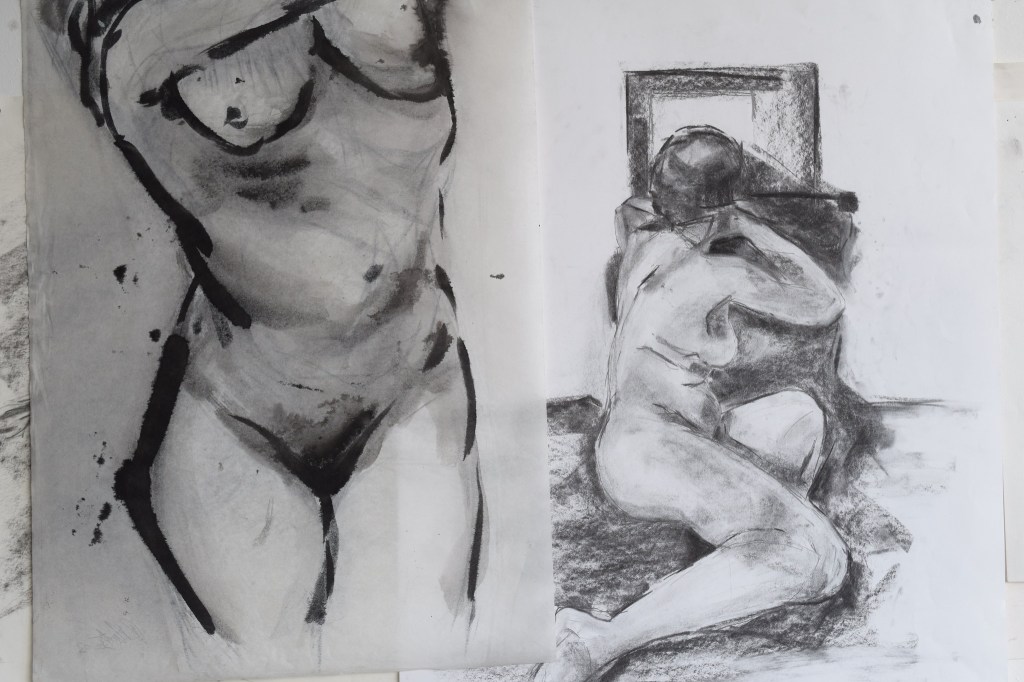
Confronting The Human Body : A Body Of Relations
From the human body as subject towards the body as relation.
This post can now be re-entered through the emerging vocabulary of body~body, surface, trace, touch and correspondence. Its concern with the instability of the life-class encounter provides an early genealogy for the current understanding of the ceramic body as a body among other bodies.
The body is not encountered here as a fixed figure but as a field of relations. Looking, drawing, surface and movement begin to unsettle the separation between the body that is seen and the body that sees. The life drawing becomes a threshold where eye, hand, paper, space and flesh enter an uncertain correspondence. What appears as an image begins to carry the pressure of another body. The trace is therefore not simply a record of looking, but the residue of an encounter.
Yes — I think blood~bodies opens something much more visceral than the more familiar language of “embodiment.”
It shifts the life drawing from drawing the human body toward drawing as a correspondence between bodies. Blood is especially interesting because it is both intensely bodily and relational: it circulates, carries, connects, nourishes, marks, stains. It is inside the body, but also gives the body its colour, temperature, vitality and vulnerability. It makes the body feel less like a figure and more like a living material condition.
And that could be very productive alongside clay.
Lifedrawingbodies
The double tilde is doing something useful here. It prevents life drawing from settling into a conventional art-historical category. It becomes:
life ~~ drawing ~~ bodies
Drawing is the middle condition through which bodies correspond.
Perhaps the emerging vocabulary is something like:
bloodbodiessurface
skin
touchtraceclay
flesh
pressuremarkbody
body
insideoutsidemaking
drawing
lifematterceramic
body
Then the drawing isn’t primarily representational. It becomes a visceral registration of correspondence.
I think this also gives you a stronger route into In~~Touching. The body isn’t simply one of the subjects that your spatial practice happens to investigate. Rather, the body becomes a sensate threshold through which other bodies are encountered.
The life drawing could therefore be understood as an early form of the same proposition you are now finding in clay:
A body is never only itself.
The drawn body carries the pressure of the hand, the movement of the eye, the duration of looking, the resistance of the paper, the remembered body of the model. Blood~bodies then becomes almost a material metaphor for this correspondence: something moving between bodies, while remaining materially of the body.
And this could become quite a powerful passage in the larger text:
Lifedrawingbodies
The body is encountered not as an image but as a living correspondence. Blood~bodies: interior becoming surface, circulation becoming sensation, flesh becoming trace. Drawing enters this movement. The line does not simply describe the body; it registers an encounter between bodies.
The body of the model, the body of the drawer, the body of the drawing, the body of the paper begin to occupy the same uncertain territory. Looking becomes touching. Touch becomes pressure. Pressure becomes trace.
Here, drawing becomes visceral.
Not because it represents flesh, but because it begins to participate in the material relations of being a body.
That last distinction feels particularly important for your practice:
not representing the visceral, but becoming visceral through correspondence.
And suddenly the older life-drawing work doesn’t sit outside the ceramic practice as a previous chapter. It becomes one of the active bodies that has entered the ceramic body.
The drawing body touches the clay body.
The clay body returns that touch differently.
bloodbodies → drawingbodies → clay~bodies → ceramic bodies
That feels like a genuine genealogy of In~~Touching, rather than simply another thematic cluster.
Outpost 270423
Temporal Demarcations.
Figural Workshop.
Confronting The Human Body.
.jpg)


The Psychology of Nakedness.
Looking/Showing/The Eye/The Gaze.
In the scopic field, the gaze is outside; I am looked at, that is to say, I am a picture.
The spectacle of the world, in this sense, appears to us as all-seeing, this all-seeing aspect is to be found in the satisfaction of a woman who knows that she is being looked at, on condition that one does not show her that one knows that she knows.
Jacques Lacan.
What is a Picture.
The Split between The Eye and the Gaze.
A Body of Relations.
Reconfiguring The Life Class.
In the article What is a Picture? Jaques Lacan relates the space between the gaze and the eye to the ‘screen’. The ‘screen’ allows the simultaneous perception and projection of the image. In the life class, Lacan’s gaze is significant for the life model and the artist as it formulates the intentions of the psychological engagement and reveals the fundamental pursuit of desire in the methodology of life drawing practice. The subject needs to become an object of its own ‘scopic drives’ and therefore possessed by the perception of others. Lacan’s gaze is somewhat estranged from the body, as it never allows for subjectivity to be fully complete.
Yuen Fong Ling. 2016
Palimpsest/Involuntary Surfaces.
Drawing/Corporeal Intertwinings of body/space.
Bodyscapes/Movements/Materials.
Haptic/Visual Abstractions.
Life Class/Drawing.
The contested space/subject of the nude as a form of art.
The Impossible Nude.
Transfer/Temporal/Media.
Dyeline Sheet/Rolled Inked Surface.
Charcoal/Burnt Umber/Pencil
Shading Colour/Glass Pigments/Fired Glass.
spatial practice, alternative photography, fine art, ceramics,making,Russell Moreton,
Source: Confronting The Human Body : A Body Of Relations
Archival / Anarchival
Archival — with strong anarchival potential.
This is an important archive post because it contains a very explicit early investigation into the life class, the gaze, the body as an unstable subject, and the relationship between drawing, space and corporeal experience. The post moves from Lacan’s eye/gaze distinction towards “A Body of Relations,” “Reconfiguring The Life Class,” “Palimpsest/Involuntary Surfaces” and “Drawing/Corporeal Intertwinings of body/space.”
Migration entry
From the human body as subject towards the body as relation.
This post can now be re-entered through the emerging vocabulary of body~body, surface, trace, touch and correspondence. Its concern with the instability of the life-class encounter provides an early genealogy for the current understanding of the ceramic body as a body among other bodies.
Anarchival note
The Lacanian gaze does not need to be retained as the dominant theoretical framework. What becomes newly available is the movement from looking at the body towards being caught within relations between bodies.
The “screen” becomes interesting as a threshold rather than simply a psychoanalytic device. The life drawing becomes a site where model, artist, eye, surface, mark and space enter correspondence.
This is one of the clearest precursors to the later proposition:
The ceramic body is a body of other bodies.
BODY → LOOKING → DRAWING → SURFACE → ENCHANTMENT
or, in the vocabulary that is now emerging:
body → sensation → trace → surface → correspondence → other bodies
And there is a particularly strong migration through them:
Confronting the Human Body
→ the body becomes relational
A Sensation of Looking
→ looking becomes sensation
Drawing the Body / Luminescence
→ the body becomes spatial/atmospheric
Drawing Surfaces / Situated Knowledges
→ surface becomes a site of encounter
Enchantment / Sites of Sensual Engagement
→ the encounter opens into a world of other bodies
That makes In~~Touching feel less like a newly invented concept and more like something that has been slowly surfacing through the archive.
And I think that is exactly the kind of migration we want: not retrospective correction, but latent correspondence becoming perceptible.
There is also a very beautiful route now emerging between this cluster and the ceramic work:
body → flesh → surface → touch → trace → clay → firing → ceramic body → atmosphere
That is probably where we should return later when we work with your fleshbloodbody of others through sensate materials. I would leave that proposition open for now rather than prematurely resolve it. The archive has given us enough material to know that something is there.


Leave a Reply