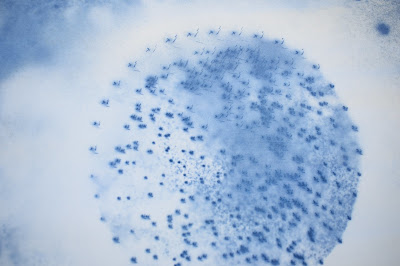
The Trace and its Connector/Ceramics, drawing and walking/wayfaring with things.
Outpost 040523


Making Visible.
Walking The Drawing.
The co-existence of overlaying fragments of construction, by selective excavation and creative demolition.
Castelvecchio an attitude to history. Carlo Scarpa.
There is no stage at which humankind does not demarcate, beacon or sign their space, leaving traces that are both symbolic and practical.
The Production of Space.
Lefebrve.
Kairos : The movement and its moment
Being Alive.
Up, Across and Along.
The trace and the connector.
Tim Ingold.
Jannis Kounellis.
Lefebvre acknowledges that geographical space created through the body, through routes which were inscribed by means of simple linear markings. These first markings, paths and tracks drawn into the landscape would become the pores through which without colliding would produce the establishment of places and localities made special for one reason or another.
Hand Built, Slab Ceramics.
Oxide washes, incised lines and piercings undertaken to the raw clay forms.
Architectural Facades/Camera Obscura.
Darkroom’s Erasure.
One day , we will understand that darkrooms were one of the last pools of darkness, where a pure form of thought was made visible. In the darkness at its heart, photography enabled us to see ourselves and the world more clearly, it was a place of truth and visions.
Dark Room, Garry Fabian Miller.
“The Pot, ancient as it is, is the first instance of pure innerness, of something made from the inside out.”
Adam Gopnik 2014
Richard Batterham
In 1981 he provided a rare statement: “The main work is not to make pots, but to allow them to come, to allow them to grow, to allow them to be alive, and to communicate warmth and life in that uncannily direct and undemanding way that true and naked work can, vulnerable as it is. To make this possible, I feel that it is necessary to use our skills and materials with humility and respect. This requires a certain quietness of living.”
A Vessel Defines Emptiness As Presence : Craft, Studio Practice /Theory and Analysis on Hans Coper, Edmund De Waal, Martin Heidegger
STUDIO PRACTICE, THEORY AND ANALYSIS.
MA SCHOOL OF CRAFTS AND DESIGN.
Working Notes : Brockwood Granary 2014
Theory and Analysis Documents, UCA Farnham
“A predynastic Egyptian pot, roughly egg-shaped, the size of my hand : made thousands of years ago it has survived in more than one sense. A humble, passive, somewhat absurd object, yet potent, mysterious, sensuous. It conveys no comment, no self-expression, but seems to contain and reflect its maker and the human world it inhabits, to contribute its minute quantum of energy.”
Hans Coper, 1969
Jean Vacher acknowledges Hans Coper’s links with Modernism and that his pots possess an “innerness” that might be profoundly biographical in nature stemming from “the profound displacements that occurred to him and his family as a result of the upheavals in Europe.” (Personal e-mail correspondence CSC 28 March 2014)
Re-entering / 2026 — The trace is no longer only something left behind. Through the aperture it becomes a connector: a small material event through which space, light, body and interior begin to correspond.
Or perhaps the even tighter version:
The trace became a hole. The hole became a passage.
I really like that as an anarchival intervention because it doesn’t explain the old post. It opens it.
spatial practice, alternative photography, fine art, ceramics,making,Russell Moreton,
Source: The Trace and its Connector/Ceramics, drawing and walking/wayfaring with things.
Archival / Anarchival note
Archival:
This is a particularly important bridge post and I think the category should now definitely be Spatial Practice, rather than Ceramic Bodies.
The post brings together an unusually broad constellation: Wallace Stevens’ Anecdote of the Jar, Carlo Scarpa, Lefebvre’s production of space, Ingold’s trace and connector, walking and wayfaring, hand-built slab ceramics, incised lines and piercings, architectural facades, camera obscura, the darkroom, and the vessel as innerness.
What makes it significant is that ceramics isn’t isolated as a medium. It is already operating within a spatial ecology of drawing, walking, construction, excavation, photography and architecture.
The existing WordPress archive has it sitting simultaneously in several old categories — architecture, art, building, construction, cyanotype, diagram, drawing, mapping, photography, site specific, spatial practices, traces and Uncategorized.
That makes it almost a perfect example of why the new taxonomy is useful.
One principal category: Spatial Practice.
The other identities become tags.
Anarchival
This feels like one of the key posts in the whole migration because it contains so many of the later relations in embryonic form.
The title asks about the connection between ceramics and space, but the deeper question seems to be:
How does a trace become spatial?
The post moves through:
walking → drawing → trace → connector → place → architecture → ceramic → aperture → interior
That is remarkably close to the trajectory we have subsequently been describing through the ceramic body.
The idea of the connector is particularly interesting now. Ingold’s trace isn’t simply a mark left behind; it is a line generated through movement and relation. Your later holes, incisions and apertures can be understood similarly—not simply as marks on ceramic, but as material events that connect bodies, interiors, light and atmosphere.
And then the camera obscura becomes important. The aperture is simultaneously:
a hole,
a threshold,
a connector,
a means of seeing,
a producer of interiority.
That gives us a very strong correspondence with your current thinking about the hole as an interior produced by action.
I would mark this as a high-priority archival post. It is one of the places where your current spatial practice can be seen already beginning to form—not as a theory imposed upon ceramics, but through the actual convergence of walking, drawing, architecture, photography, vessel, trace and material making.


Leave a Reply