• Diffractive Surfaces : Imaginative Cartographies

    Speculative Fields/Spatial Practices

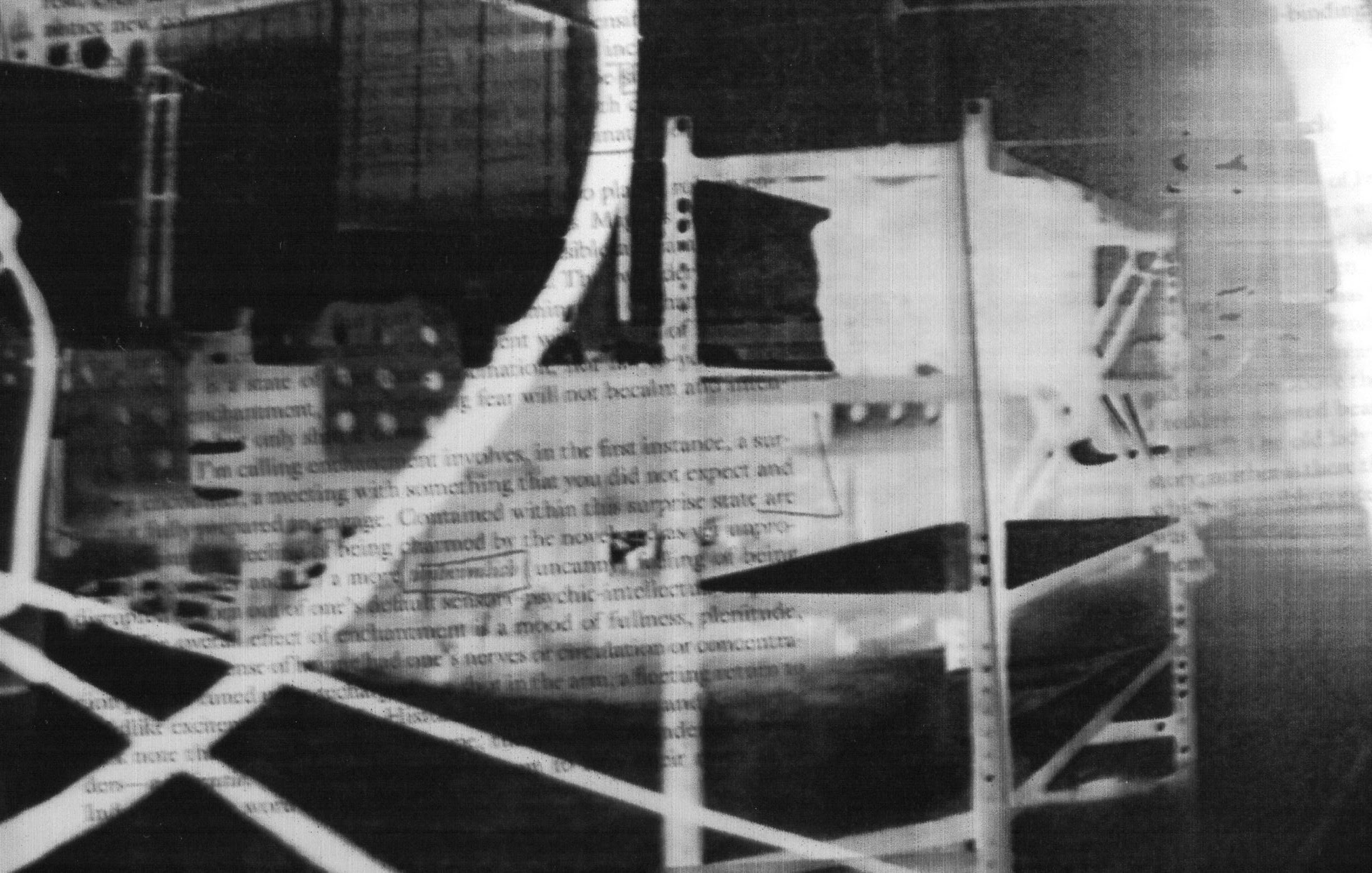
    Discursive Reading (against linearity)/New Modalities of Inquiry

    New Generative Boundaries/Situatedness

    Wayfinding and Heuristic/Everyday Practices

    Reading is also thinking through the body

    Viscous Porosity/Flesh of the world

    Enfleshed Materialism/Membranes that affect interactions

    Words Become Material

    Troubleyn Laboratorium/Jan Fabre

    In this moment the words become a performative agent writing and acting on the body

    Installing ourselves in the event, that emerges in our reading

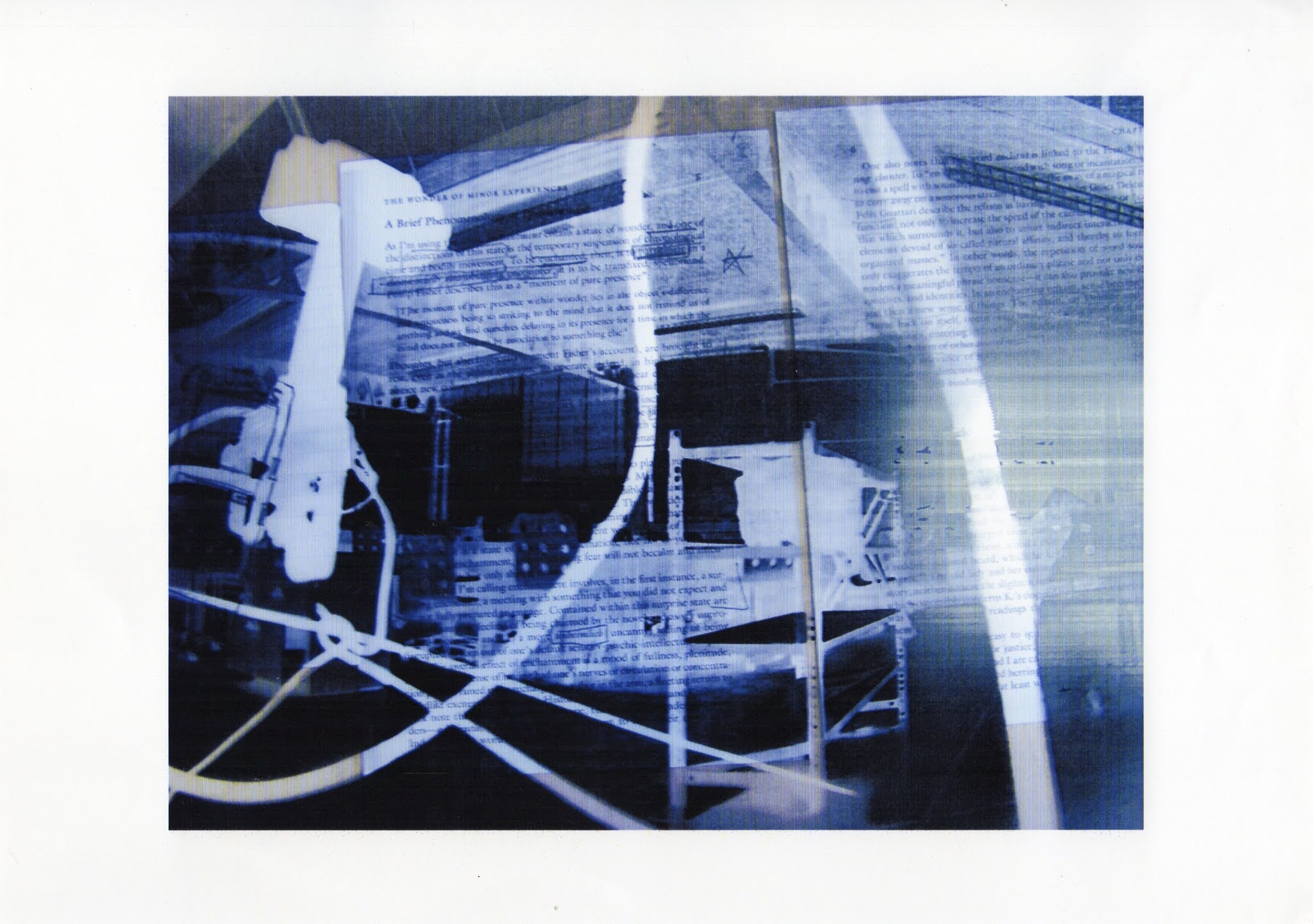
    Reading diffractively means that we try to fold these texts into one anther in a move that flattens out our relationship to the material. In so doing we install ourselves into its/our becoming

    Thinking with Theory in Qualitative Research/Barad Thinking with intra-action

    Alecia Y. Jackson, Lisa A. Mazzei

    Paintings/Art Works are boundary making apparatusses

    The Diffractive Apparatus/Analysis of Intra-ventions/actively/entanglements

    Phenomena and Thresholds from which to create new analytical questions/forms

    An entangled state of agencies, that which exceed the traditional notion of how we conceive of agency, subjectivity, and the individual.

    Agency is an enactment, not something that someone has. Such entanglements require an analysis that enables us to theorize the social and the natural together.

    Barad

    Diffraction

    Two major authors write about the metaphor of diffraction, Karen Barad and Donna Haraway.
    They explain how diffraction is a method for reading and writing based upon the physical phenomena. Diffraction is a way of coping with epistemological problems of representation (invisible knowledge maker as a false sense of objectivity, self-vision of reflexivity as totalizing and undermining knowledge claims).

    To paraphrase Haraway, from “Modest_Witness@Second_Millenium.FemaleMan_Meets_OncoMouse” diffraction is an attempt to make differences while recording interactions, interference, and reinforcement. It does not have an origin and has a heterogeneous history. In addition, the practice of diffractive reading and writing never sediments the relationship between signifier and signified. Van der Tuin explains, “Diffraction is meant to disrupt linear and fixed causalities, and to work toward ‘‘more promising interference patterns’’ (26). She also explains that this can be practiced by reading texts through one another, and rewriting.This disrupts the temporality of a piece of writing, transverses boundaries such as discipline, and can change meanings in different contexts opening up meaning.

    https://newmaterialistscartographies.wikispaces.com/Diffraction

    Is there still an aesthetic illusion? And if not, a path to an “aesthetic” illusion, the radical illusion of secret, seduction and magic? Is there still, on the edges of hypervisibility, of virtuality, room for an image?
    — Jean Baudrillard, The Conspiracy of Art, 2005

    Jana Sterbak
    Remote Control 1989

    A heuristic technique (/hjᵿˈrɪstᵻk/; Ancient Greek: εὑρίσκω, “find” or “discover”), often called simply a heuristic, is any approach to problem solving, learning, or discovery that employs a practical method not guaranteed to be optimal or perfect, but sufficient for the immediate goals.

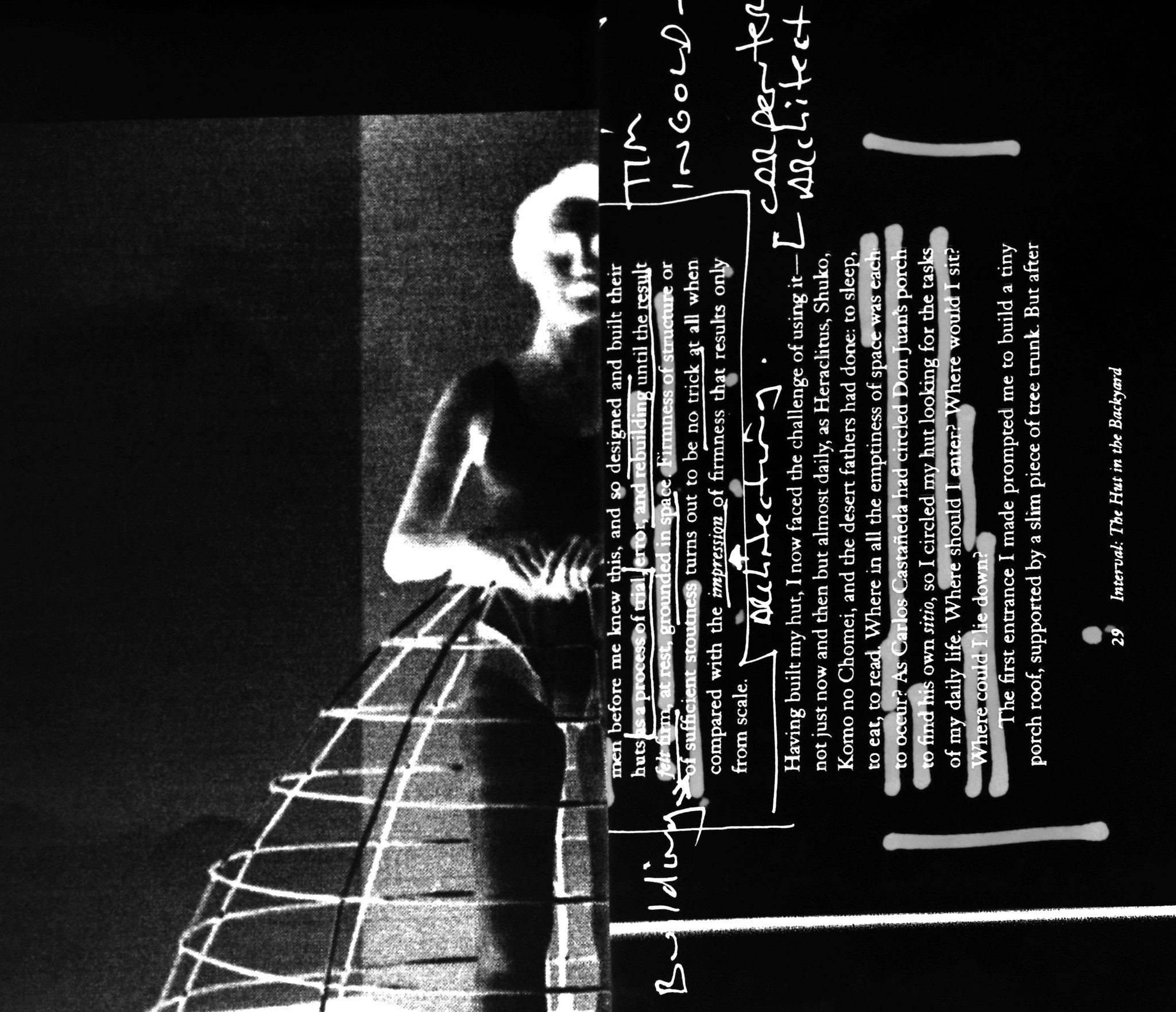
    A Hut of One’s Own, Ann Cline

    Texts,Annotations, Foundations, Pathways, Corridors, Bookmarks, Walking, Thinking, Ramble, Cross Country, Disciplines,


    Speculative Fields/Spatial Practices Discursive Reading (against linearity)/New Modalities of Inquiry New Generative Boundaries/Situatednes…

    Source: Diffractive Surfaces : Imaginative Cartographies

  • Kengo Kuma, anti object, hut, poetics of shelter in the immediate environment

    Thinkers and Vessel Makers.
    Weaving the body into architecture
    Kengo Kuma
    Poetics as an evolving and discursive system of dialogues that acknowledges environmental changes, of other spatial narratives and histories, and things that are not just about place and space.
    ‘The phenomenology of space – the matter of how we experience it.’
    Gaston Bachelard, Poetics of Space (space and reverie), The Psychoanalysis of Fire.

    ‘Architecture that forces us to confront our own spatial intelligence by moving us so much that we recall the eidetic origination of our own mental space.’ (Schaik,2008:80)
    ‘Speculations about the first shelters, the relationship between our home and the universe, about spaces that we first use as surrogate houses as we form our spatial histories and our mental space. It is about the contemplative effects of the miniature, about the paradoxical way in which the scale of many of our most cherished monuments can switch in our minds from large to minute- the quality of intimate immensity. It is also about propositions around the complex relationships between inside and outside and the surface between, about the phenomenology of roundness’ (Schaik,2008:86-87)
    ‘We are composed of matter and live in the midst of matter. Our objective should not be to renounce matter, but to search for a form of matter other than objects. What that form is called-Architecture, Gardens, Technology- is not important.’
    Kengo Kuma.
    On Anti-Object : An extended essay that is not so much history or theory as a volume of self-assessment that gives an opportunity for the author to contextualise his own body of work through considered self-reflection.
    ‘A monument is a form that preserves time through the compression of space, a form in which visual perception is the parameter. A monument is a compression of time and space’ (Kuma,2008:92) Anti Object.
    ‘My purpose in writing this book is to criticise architecture that is self-centred and coercive.’ Kengo Kuma.
    ‘Like McTiernan or the theorist Paul Virilio, Kuma sees new digital and information technologies as leading us to an aesthetics of disappearance, rather than image or form.(Steele,2008:3)
    ‘My ultimate aim is to erase architecture’(Kuma,2008:3)
    How then, can architecture be made to disappear?
    ‘To be precise, an object is a form of material existence distinct from its immediate environment. I do not deny that all buildings, as points of singularity created by humankind in the environment, are to some extent objects. However, buildings that are deliberately made distinct from their environment are very different from those that attempt to mitigate this isolation, and the difference is perceptible to everyone who experiences them.’ (Kuma,2008:Preface)

    Art and The Humanities in reference to Waverley Abbey
    Contemporary Art Practices, Installations and Interiors

    This research and its design proposal are centred on the arts and the humanities and their ongoing function in our contemporary society. The emphasis of this inquiry is located by the spatial practices of architecture, fine art and performance. My project is a field event and symposium that would be able to host intellectual dialogues, lectures (TED) workshops, performative events and exhibitions. I am particularly interested the relational production of social spaces and the aesthetics of builtspaces, both historical and ephemeral. The proposed use of Waverley Abbey near Farnham as a possible site and retreat for this venture is valid as it links a possible interdisciplinary territory of anthropology, archaeology, art and architecture. Tim Ingold (Making) Colin Renfrew (Figuring it Out) and others have for many years been researching and mapping this new spatiality.
    What remains of Waverley Abbey and its sense of place are critical to the holistic and contemporary underpinning of this experiential event. Founded in 1128 it was the first Cistercian Abbey to be built in England. It is recorded that Cistercian life was initially based on manual labour and self-sufficiency, this was further supplemented by other activities like agriculture and brewing that enabled the abbey to support itself. Later over the centuries education and academia began to dominate the concerns of the abbey. The abbey was suppressed with its dissolution in 1536, although records show its activities were already at this time substantially diminished. The ruins and their site then enter into the imaginary realm through classic literature in the novel Waverley by Scott. Further on a pictorial reference from an engraving shows the ruins now incorporated as a fashionable landscape feature within the newly built Waverley Abbey House.
    On a contemporary note Waverley Abbey has featured in a number of films ranging in genres from period costume dramas through to fantasy, together with post apocalyptic visions of dystopia. A recent film shoot required the construction of a sixty-foot tower made from internal scaffolding with a skin that recreated the adjacent ruinous fabric of this historic site.
    Encountering the site is currently only manageable by foot; this short walk in the surrounding landscape sets up the sense of place and prepares our own subjectivities to its reception. It is in this expectation, this thinking in the landscape that the pastoral and educational aspects of the site become apparent. Currently access is only available through one directed pathway; a multiplicity of other access points and even other structures (bridges, earthworks and thickets) could begin to open up the spatial palimpsest already located at Waverley. What remains of the architectural fabric with its diminished interiors still grants a hospitality and refuge for both the body and the imagination. This activity opens up the experiential space of encountering ourselves through the enjoyment/entanglements of layered social space.
    Waverley Abbey is a public monument in the custodian care of English Heritage. It can only be accessed by walking about a quarter of a mile from the limited parking spaces.


    Thinkers and Vessel Makers. Weaving the body into architecture Kengo Kuma Poetics as an evolving and discursive system of dialogues t…

    Source: Kengo Kuma, anti object, hut, poetics of shelter in the immediate environment

  • Photographic Ruins/Mixtures and Dissolutions : Sontag, Tarkovsky, Barthes.

     Ruins are buildings which have lost their function and have turned into instruments for measuring time.

    ROLAND BARTHES MYTHICAL SPEECH, LANGUAGE-OBJECT:

    PLINY THE ELDER: NATURAL HISTORY, translation H. Rackham 1952. BOOK 35

    Origins of Painting (XXXV, 5).

    The question as to the origin of the art of painting is uncertain and it does not belong to the plan of this work. The Egyptians declare that it was invented among themselves six thousand years ago before it passed over into Greece—which is clearly an idle assertion. As to the Greeks, some of them say it was discovered at Sicyon, others in Corinth, but all agree that it began with tracing an outline round a man s shadow and consequently that pictures were originally done in this way, but the second stage when a more elaborate method had been invented was done in a single colour and called monochrome, a method still in use at the present day.

    Plastic art. Early stages. Butades and others. (XXXV, 43).

    Enough and more has now been said about painting. It may be suitable to append to these remarks something about the plastic art. It was through the service of that same earth that modelling portraits from clay was first invented by Butades, a potter of Sicyon, at Corinth. He did this owing to his daughter, who was in love with a young man; and she, when he was going abroad, drew in outline on the wall the shadow of his face thrown by a lamp. Her father pressed clay on this and made a relief, which he hardened by exposure to fire with the rest of his pottery; and it is said that this likeness was preserved in the Shrine of the Nymphs until the destruction of Corinth by Mummius.

    Roland Barthes states in his text titled Myth Today in Mythologies that “myth is a system of communication that is a message.” And that it “allows one to perceive that myth cannot possibly be an object, a concept, or an idea.1” Put simply it is as Barthes confirms” a mode of signification, a form.” The interesting thing about myths is the fact that this “mode of signification” is then assigned to a form. It is onto this form that further conditions are then placed and the form then becomes loaded with historical values, and conditions of use that will reintroduce it back into society.

    Barthes acknowledges that “mythology can only have a historical foundation, for myth is a type of speech chosen by history: it cannot possibly evolve from the “nature” of things.2” Myths therefore have particular qualities as Barthes assigns them as being created from a “semiological chain which existed before it.” Their historical situation is such that it forms their first contextual space which is simultaneously placed in the present. This creates a sense of a portal or window into a mythological space of reflection, whilst at the same time acknowledging our immediate surroundings. The myth appears like a projection from these historical origins and has the ability to illuminating itself and the moment into a contemporary mythical experience. Barthes illustrates the myths ability to attach itself to any material that can arbitrarily become endowed with significance by stating.

    It can consist of modes of writing or of representations; not only written Or representations; not only written discourse, but also photography, Cinema, reporting, sport, shows, publicity, all these can serve as a support To mythical speech. Myth can be defined neither by its object nor by its Material.3

    Barthes denotes myths as having three components, the signifier, the signified, and the sign. Myth having been created by used materials has “a second-order semiological system.” Barthes clarifies this by stating” that which is a sign (namely the associative total of a concept and an image) in the first system (signifier and signified becomes sign) becomes a mere signifier in the second.4” The raw materials that make up mythical speech, its very language, rituals and objects are all “reduced to a pure signifying function as soon as they are caught by myth.5” The myths ability is that it is able to project language as an language-object that can be reconstituted by our contemporary sensibilities into mythical language .

    Barthes again notes that the important issue here is that myth wants to see these “raw materials” only as “a sum of signs, a global sign, and the final term of a first semiological chain. “ Barthes further states that it is this “final term” that will become the “first term of a greater system.” Myth is stationed in a historical situation yet their reappropriated content is able to be projected into the anthropological situation that surrounds us. Barthes recognizes that “myth shifts the formal system of the first significations sideways.” It is this almost lateral shift that gives myths their complexities within what appear to be concise simplifications. They appear to be able to just inhabit the very surface of things, creating associations that can arise almost indiscriminately.

    Barthes states that myths are derived from a speech chosen by history. Mythical speech appears both like a notification and like a statement of fact. Barthes quotes “Mythical speech is made of a material which has already been worked on so as to make it suitable for communication: it is because all the materials of myth presuppose a signifying consciousness, which one can reason about them while discounting their substance.6”

    Myth has something of an imperative message woven around its character which can exist in any space or time; it also has an inherent contingency that allows its message expediency. This notion that myths exist on a material that presupposes a signifying consciousness gives them their complexities when we re-examine the material which the myth adheres to.

    Barthes philosophical perceptions surrounding myths could seem to have an affinity with the notion of the photographic negative. Both share a sense of a historical situation, onto which other signs of signification can be placed on their representation. They both have the ability of projection or rather the ability to be used to project language-object narratives. All of which makes them synonymous with bringing the past into the present. Myths and negatives seem to surround their reinterpretation with a feeling that they are auguries brought from another time to confirm or question values. Strangely the projected values of the negative have something of a mythical resonance, the evidence however of the negatives materiality a known origin casts exactitude of death. Myths don’t have and don’t require this witnessing origin. The notion of a photographic projection that marks a material surface in the situation of an installation is perhaps as far as photography can aspire to the sense of myth.

    Barthes in Camera Lucida comments on what he terms “flat death” whilst contemplating pictures of his mother shortly after her death.

    The horror is this: nothing to say about the death of one whom I love Most, nothing to say about her photograph, which I contemplate with out ever being able to get to the heart of it, to transform it. The only “thought” I can have is that at the end of this first death, my own death is inscribed; between the two, nothing more than waiting; I have no other resource than this irony, to speak of the “nothing to say.7”

    Barthes comment on his inability to transform the exactitude of his mother’s image with its sense of “an asymbolic death” perhaps illustrates the differences between the mythic language and photography? Does the exactitude in the representation of the photographic image petrify and simultaneously create an imperious sign of a future death? The mythical sense of some semblance left in some old photographs seems to be in fact, that some mythical language has not been totally terminated by the exactitude and witness of the photographic process. Myths on the other hand as noted by Italo Calvino in Six Memos for the New Millennium, possess “concise exactitudes of details yet creative reception in their telling.” This “creative reception in their telling” is what sets them far apart from the petrifying gaze of photography, they are in fact more gesture and act, and myths are re-drawn as living experiences. This further quote by Calvino sums up the magical quality inherent in mythological language.

    I know that any interpretation impoverishes the myth and suffocates it. With Myths one should not be in a hurry. It is better to let them settle into the memory, to stop and dwell on every detail, to reflect on the without losing Touch with their language of images. The lesson we learn from a myth lies in the literal narrative, not in what we add to it from the outside.8

    1  .Roland Barthes, Myth Today, A Roland Barthes Reader (Reading: Vintage, 1993), page 93.

    2  .Ibid., page 94.

    3  .Ibid., page 94.

    4  .Ibid., page 99.

    5  .Ibid., page 99.

    6  .Ibid., page 95.

    7  .Roland Barthes, Camera Lucida (Reading: Vintage, 2000), page 93.

    8  .Italo Calvino, Six Memos for the Next Millennium (London: Jonathan Cape, 1992), page 4.

    Moreton, Russell. The Daughter of Butades. Winchester School of Art 2008

    Susan Sontag, on photography

    Photographs are, of course, artefacts. But their appeal is that they also seem, in a world littered with photographic relics, to have the status of found objects, unpremeditated slices of the world. Thus, they trade simultaneously on the prestige of art and the magic of the real. There are clouds of fantasy and pellets of information.

    Susan Sontag examines photography’s relationship to art via conscience and knowledge. Her analysis done before the advent of digital photography embraces the notion of the negative, the witnessing document. The picture may be distorted but there is always a presumption that something exists or did exist.

    Her probing phenomenology into photographic practice and the way it influences our perceptions are based on monochromatic film images. She reads the photographic image as an image taken from reality, but recognizes the attitude and sensibilities of the photographer, in the portrayal of that reality. She recognizes the camera’s ability to democratize all experiences, by translating them into images. She recognizes that photographers are haunted by tacit imperatives of both taste and conscience. They produce undiscriminating, promiscuous and self-effacing interpretations of the world.

    Sontag recognizes the aggression of the photographers capture, and its ability to subvert by freezing time segments and replaying them dislocated from their original experience. Sontag also notes that taking photographs has setup a chronic voyeuristic relationship to the world, which levels the meanings of all events through the camera.

    Photographs can also refuse experience simply by the limited nature of looking for the photogenic image. The camera has become a compelling interface between ourselves and what we encounter.

    To take a picture is to have an interest in things as they are in the status quo remaining unchanged. It is to be in complicity with what makes a subject interesting.

    The camera records subjects considered disreputable, taboo and marginal. Sontag notes Times relentless passage and photographs as a pause of evidence, Together with the camera’s ability to turn people into objects that can be symbolically possessed.

    She recognizes the inherent pathos in .objects being photographed, and the compulsion to take photographs. Sontag realizes the photographic recycling of reality, acceptable as a daily activity in our consumer society.

    Photographs do not explain themselves, they just acknowledge.

    A photographic contemplation dislocated from its original moment of reality, and as such allows thought not tied by cause and effect of that moment.

    Tarkovsky, Sculpting in time/The architecture of the image

    The architecture of image explores both architecture and cinema through the notion of existential. Cinema projects experientially images true to life, whereas architecture attempts to frame both human existence and the human condition as it inhabits space. The poetics of image Andrei Tarkovsky illustrates this director’s ability to use architectural settings to evoke and maintain a specific mental state in the viewer. They illustrate the poetic potential of space and light. Tarkovsky is able through images of space matter light and time to evoke the experience of being reflected by the metaphysical nature of the poetic situation. Tarkovsky emphasizes the importance of the singularity of experience, because of this perhaps his images resist interpretation, a sort of poetic riddle to distance them from any conventional reading, yet maintain their sense of flight. His images derive from a sense of a poetic logic/filmic phenomenology interwoven into a situation out of equilibrium.

    He creates a constellation of associations and possible meanings and utilizes space for emotional impact. There is a sense of imprinting, acknowledging the unseen space, he achieves this by giving the viewer a sense of spatial awareness of the situation not of visual realization, and he creates a mental sensation of the environment.

    Tarkovsky uses to four pre Socratic elements, fire , air, water and earth, together with their various mixtures and dissolutions, smoke, rust, clay, mud, slime and dust. He also records time by its action on things its erosion, and its scars. Tarkovsky affirms ruins are buildings which have lost their function and have turned into instruments for measuring time.

    Ruins have a special hold on our emotions because they challenge us to imagine their forgotten faith


    Ruins are buildings which have lost their function and have turned into instruments for measuring time.  ROLAND BARTHES MYTHICAL SPEECH, LA…

    Source: Photographic Ruins/Mixtures and Dissolutions : Sontag, Tarkovsky, Barthes.

  • Speculative Indexes of Agency : Template and Form/Enchantments and Insights between materials


    THE BODY AS A TERRITORY IN RAW CLAY

    Developing Formative Histories/Indexical and Involuntary Markings

    Observational essay/account whilst work is resident in the Yard,

    Pastoral Space: Material, Inquiry and Craft

    Temporality. The state of existing within or having some relationship with time. A clay form with its pre-performative drawing used as a template.

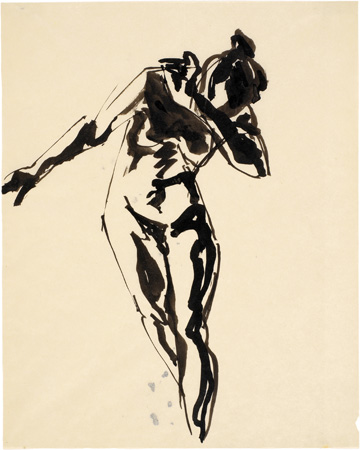
    These distinctively different yet closely related works are arranged with the clay piece on its custom made trolley with its calico material that acts as a sheet on which the clay work rests. The drawing is placed behind it fastened to a wall with the drawings bottom edge just making contact with the floor adjacent to the castors that grant the clays supportive trolley mobility. The clay work has a direct relation to this adjacent drawing, the drawing is revealing the traced female that is just discernable on the surface of the clay. On closer inspection of the drawing it is just possible to see a rubbing taken from the periphery of the clay form. Both the paper and the clay seem to be in some reflective mode of mutual intimacy, marks transferred between one another during the manufacture of both are subtly replicated on the form of one and the surface of another. The pierced clay slab (vessel) is the first visible casualty of the entropic process of shrinkage. A significant crack separates the clay vessel into two separate but unique entities that share the same defect as if they were still whole. This division through the continent of the body has been subtly marked by the raised furrow of silica deposited when the clay bodies were in closer proximity. The calico has also rendered a new visual territory around the entire periphery of the form, created by the deposited silica sand and the resultant shrinkage that is taking place. There is the sense of this form moving in two dimensions, creating an extended footprint of previously covered territory whilst continuing to shrink bodily within the details and markings on its surface. This phenomena seems to give the piece a strange complexity of both temporality and a duration on which that temporality is directly charted, the calico is instrumental in registering this perception. The agencies of both the silica sand and the calico sheet between them regulate and guide our understanding of the observation of the clays infinitesimal shrinkage. The compression of the clays structure due to its shrinkage increases its density and visually alters the arrangement of the piercing that are mapped over its surface, the concise circles and holes cut through the clay have now blended into the overall tension imparted by shrinkage, there is a sense that precision of the marks, their machined appearance which contrasted to the locality to the clay around them has been lost, reclaimed by the inner natural torsions taking control of the piece as a whole. The clays surface with its sandy granular deposits whose particle size has become visually larger at the expense of its hosts shrinkage now auger for a territory, a land mass devoid of water, the sense of this territory becoming anhydrous, giving rise to thoughts of thirst and fragility, even the once precise holes give the impression of barren watering places isolated within a landscape in a state of drought. The once visible markings are now obscured by the action of the shrinking territory and its granular coating as it now gains in its ability to obscure features. The traced and drawn female form is still harboured somewhere under this obscuring sand. Yet she now resides as a brittle uncompromising inscription of her former self, the plasticity that once gave her a sensuality into the yielding and pliable surface has succumbed to the unstoppable internal shrinkage of the clay particles starved of moisture. The clay is acknowledging the atmosphere of its given surroundings, our environment.

    The Draught, J G Ballard

    The Woman in the Dunes, Kobo Abe

    The Disposition of the Body, Peter Greenaway (The Draughtsman’s Contract)

    The clay suffers, dehydrates as its moisture is absorbed by the surrounding atmosphere, giving up its plasticity and its almost inhuman sensuality and tactility. Presented amongst us, it is rendered into a state of its own homogeneity Conversely the working drawing which has evolved from being a simple template to aid the registration of celestial information within the territory of the body. Has itself become involved in its own creation as an art object. On completing its initial purpose, the task of transferring details onto the surface of the embryonic clay form. It has now become embroiled and entangled as it were with the creative issues of the clay form; “they” have become members of the same intuitions the same creative flux, sisters. The drawn “sister” contains the origin of their shared inscription, the originating female trace. The gesture and act still remains, visible only by physical impression of transference; which is left proud, raised and projecting passed the original flatness of the paper. These material read together render insights into superimposed temporalities shared by the art object, they question and reveal the reverse side of origins, of the work or its working drawing, they all underline the complexities and multiplicities of contemporary art practice.

    The Drawing strangely or ironically displays values in a state of stasis, now lost with its sister. The cyanotype “sea” with its fluidity bleeding into the porosity of the news print. The “ streams” of residues washed from other areas are now deposited into the interior space where they have collected finally to evaporate leaving their watery remains. Only the clarity of the “permanent” marker pen remains untouched by any entropic activity. Objectively the drawing materials has slowed down to the point when one might grant it a measure of completeness. Its particular temporalities now exist within the interactions it can manifest from others, other things, other situations that are drawn into its proximity, its particular field of intuitive reverberations, its unique dwelling place.

    The clay form seems to have gathered up its history of temporal acts that culminate in its present form. This presented object, with temporalities marked on site has become a vehicle, a vessel for its own entropic voyage, another temporality that itself adds a spatial dimension. This object for me appears to be totally contingent yet relational to aspects of space and time, it exists uniquely “once” in the present, presence it creates with its observer. The result of this contingent object is that “we through it” are constantly travelling away from its point of origin, we as a result feel the passage of the entropic value of time through the human condition. Whereas the drawing does refer to a now and a past, an elsewhere ,it seems locked between these two comprehensions.

    The clay form has clearly an entropic element which seems to give rise to phenomenologically driven inquiry which in turn helps to creates our sense of a spatiality. Uniquely formed between observation and our own movement, we are in effect made to sense that the object heralds our own becoming.

    Material Agency : Carl Knappett, Lambros Malafouris

    Visualising Environmental Agency

    “Agents are defined as persons or things, which have the ability and intention to “cause” something “in the vicinity” or “in the mileau” to happen ( Art and Agency, Alfred Gell 1998)”

    “These latter artefacts are described with the term “index”, to remove the appellation “art” and to imply that they are indexes of agency.”

    Some Stimulating Solutions, Andrew Cochrane.

    Drawing intervention and speculative sculptural environment.

    Speculative Learning Environment : Russell Moreton.

    Re- Imagining Education, Brockwood Park School.

    Teacher Education Manual

    Insight-Bohm-Krishnamurti. 1979

    David Bohm, Are we saying that insight is an energy which illuminates the activity of the brain, and that in this illumination the brain itself begins to act differently?

    Krishnamurti, You are quite right. That’s all-that is what takes place. That is -this flash has altered completely the pattern which the material process has set.

    a thousand plateaus

    Deleuze, Guattari

    Assemblage

    Becoming

    Body Without Organs

    Nomad

    Rhizome

    Smooth Space

    State

    War Machine

    The book, as described above, is a jumbling together of discrete parts or pieces that is capable of producing any number effects, rather than a tightly organized and coherent whole producing one dominant reading.

    The beauty of the assemblage is that, since it lacks organization, it can draw into its body any number of disparate elements. The book itself can be an assemblage, but its status as an assemblage does not prevent it from containing assemblages within itself or entering into new assemblages with readers, libraries, bonfires, bookstores, etc.


    THE BODY AS A TERRITORY IN RAW CLAY Developing Formative Histories/Indexical and Involuntary Markings  Observational essay/account whilst …

    Source: Speculative Indexes of Agency : Template and Form/Enchantments and Insights between materials

  • Hiding Making Showing Creation : The Studio from Turner to Tacita Dean 2013, Academia post

     Making : Tim Ingold

    The Materials Of Life

    Re-Shaping Learning


    You read the paper FROM IMAGE TO INTERACTION: MEANING AND AGENCY IN THE ARTS. A related paper is available on Academia.

    Rachel Esner, Sandra Kisters, Ann-Sophie Lehmann (eds), Hiding Making, Showing Creation. The Studio from Turner to Tacita Dean, Amsterdam: AUP 2013
    Paper Thumbnail
    Author Photo Ann-Sophie Lehmann
    2013
    View PDF ▸ Download PDF ⬇
    Your recent reading history:


    Making : Tim Ingold The Materials Of Life Re-Shaping Learning You read the paper  FROM IMAGE TO INTERACTION: MEANING AND AGENCY IN THE ARTS…

    Source: Hiding Making Showing Creation : The Studio from Turner to Tacita Dean 2013, Academia post

  • Working Notes : Edmund de Waal : How the history of pottery and the philosophy of pottery has informed contemporary practice

    Working Notes: Edmund de Waal.

    Independent research for Studio Practice Theory and Analysis

    Why does Edmund de Waal make architectural interventions through the arrangement of porcelain pots?

    To what extent, if any is this Ceramist interested in the ability of the single pot to engender meaning?

    How is the “innerness” of pots that he talks about so eloquently actually manifested in his architecturally staged installations and exhibitions?

    Signs and Wonders: Edmund de Waal and the V&A Ceramic Galleries 2009.

    During his career Edmund de Waal has moved from that of being a domestic potter to that of an installation artist.

    His large scale installations show large groups of ceramic vessels, these are often in historic architectural settings. He is both an artist and an historian of ceramics. His installation Signs and Wonders contains up to 425 pieces of wheel thrown porcelain. This site specific installation is located at the heart of the galleries. The installation will be visible to viewers as they look upwards into the space of the monumental central dome.

    Central to Edmund de Waal’s practice is the concern to offer a ‘dialogue about the use, preciousness, survival, preservation and display of ceramics.’ (Graves,2009:8)

    He has further explored the use of installations and vitrines in the pursuit of framing and underpinning these intellectual concerns. The use of purpose made structures, shelves and boxes adds the aesthetics of a tightly control clean minimalist style of presentation to his assembled collection of pots.

    Interpretation and display are now central to these ‘grouped works’ that have become presented as ‘cargoes of pots’ that now seem at home in the collecting environment of the museum.

    ‘The way in which the pots are displayed has become an integral part of the work. And increasingly there is a sense that it is about putting on a show, albeit one that might be for a private audience.’ (Graves,2009:8)

    De Waal working with specific settings has produced installations that by their very impermanence offer ‘new and unexpected dialogues’ through interventions that are ‘framing pots within architectural features or the intimate spaces of furniture.’ (Graves,2009:10)

    ‘By altering the character of a known space, by intruding on areas within it that might not usually be associated with the display of art, the viewer’s awareness of both the changes and the space are heightened.’ (Graves,2009:10)

    This methodology of display ultimately disappears as if it were never actually present, leaving the underlying fabric of the interior space as it were untouched, the impermanence of the work now resides only in its memory.

    What remains of these sensing spaces (interiors) through spectacle, event and place? Proposal for the ceramics department at the Victoria and Albert Museum.

    Site specific work in the new contemporary ceramics gallery that responded to the architecture of the space, and that could remain in place for years. An installation or feature that could remain in place and yet allow the gallery to function as a location for frequently changing displays and exhibitions.

    De Waal’s response is Signs and Wonders ‘a lacquer red metal channel tracking the circumference of the dome and housing more than 400 of his pots; is an act both of daring and of breathtaking elegance and simplicity, a magisterial achievement on a scale surpassing anything he has previously undertaken.’ (Graves,2009:10)

    Signs and Wonders is in reality a major contemporary architectural adaptation into the very fabric of the historical building. Its very reality creates a physical link between the past and the present, and it represents a long term commitment that began with the redevelopment of the ceramic galleries into the new Contemporary Ceramics Gallery.

    Edmund de Waal’s Signs and Wonders is an iconic statement of intent for the Contemporary Ceramics Gallery, it underpins a new platform for the expanding territory of creative practice in ceramics. Signs and Wonders actively seeks to simulate new ways of seeing ceramics.

    Architectural feature that comprises of some 425 thrown pots made of porcelain by Edmund de Waal and installed under the oculus of the great dome situated directly above the main entrance hall.

    Edmund de Waal reflects on the vitrines that used to be found in the old ceramic galleries (room 137) at the Victoria and Albert Museum in the 1970s.

    ‘Most of the vitrines were firmly policed into taxonomies of kiln or modeller or religion, less ’pseudo-scientific’ than a slightly desperate attempt to control the vastness of the collection. Some of the vitrines had the work of a single potter. All the pots by Hans Coper used to be in one mahogany case, huge early textured vessels shadowing the fine later Cycladic forms. They barely fitted.’(De Waal,2009:16)

    De Waal’s memories of the old galleries in the 1970s was that they were an attempt to compare pots from different galleries, of the strangeness of seeing through one great case into another; the tops of a row of bottles cresting a line of dishes and the layering of one series of forms or colours onto another. And of course the fact that there were very few people.

    Signs and Wonders; Edmund de Waal.

    ‘I have made an installation of pots for Galleryl41. There are 425 vessels made out of porcelain and they are placed on a red metal shelf that floats high up in the dome. You can just see it from the entrance hall through the square aperture in the coffered ceiling if you stand in one of the mosaic circles on the floor. It is called Signs and Wonders.’

    I want to make this installation part of the fabric of the V&A. (De Waal,2009:20)

    ‘It began with the combination of a gesture of a pen and the plans to this austere bit of Edwardian architecture.’ (De Waal,2009:22)

    The porcelain vessels are on a red shelf, the colour of lacquer.

    The integrity of the shelf is upheld by being made from a proper material so as to form an accord with the historical architecture.

    De Waal has experimented with placing porcelain on steel shelves and by having pots placed within lead lined boxes. He is aware of how these materials can form provocative combinations from their inherent densities.

    The controlling presence of the vitrine is an intervention itself of its own display, (decommissioned mahogany vitrines from the V&A, illustrate the phenomenal weight of these enclosures)

    De Waal’s porcelain vessels (shape shifters) are in effect objects from memory brought into a shifting nature of influences from the Chinese porcelains, the 1800 Century European porcelains and the collections of the Modem era from Vienna, Bauhaus and the Constructivists.

    ‘This is not a simple linear relationship, but part of a flow around into Modernism and back again. It is a perpetual rediscovery.’ (De Waal,2009:26)

    On Pots Behind Glass:

    On the memory of objects, the afterimage, its distillation, and the blindness of looking away that gives it its form. What is left to be adapted or to be pared down through volume and angle into these new reflective forms?

    Derrida on drawing from ‘blindness’ The shadows of the stacked pots.

    ‘I wanted to work with objects that have been part of my life for 30 years, and to make sense of my memories of how pots lived in the galleries.’ (De Waal,2009:26)

    ‘Other sections, one run of bottles that are in different celadons for instance, are a memory of vessels from disparate parts of the ceramics collections brought into a taxonomic focus. This is the use of memory and the after-image as the intense holding of a form on the retina.’ (De Waal,2009:26)

    In Heidegger’s work ‘not least in his use of etymologies, his writings are imbued with a sense of historicity; a sense of the passage of time, of destiny, and of the past as a reservoir of thinking available to contemporary life.’ (Sharr,2009:99)

    The Architecture of Place :

    Architects that were sensitive to site, dwelling, inhabitation and place. Form Making as a Response to Site and Inhabitation.

    In The Ethical Function of Architecture 1997, Karsten Harries seeks to reclaim a sense of meaning in architecture that he feels has been lost to a scientific rationality. He sees ornament as being able to convey meaning by linking and reflecting stories and in so doing it gives us an appreciation of nature. This type of ornament has a poetic function in that it helps to locate people with their place and community.

    Dalidor Vesely believes that architecture can manifest the attitudes of its builders, and that this can describe through the very fabric of the building the very thinking of the society that implemented its construction.

    Vesely ‘explored what he considered to be the tensions between instrumental and communicative, or technological and creative, roles of architecture. He argued that these roles have become divided; a split which is recorded in the respective roles of architects and engineers. Vesely traces the historical origin of this division to that of mediaeval optics and the development of perspective; to the first attempts to privilege a scientific description of light over immediate experiences of the qualities of vision. This division is a crisis of representation, that that is displacing meaning in architecture from human experience to the visual qualities of surface and appearance.’ (Sharr,2009:103)

    For Vesely, creativity remains the antidote to technology.

    Zumthor shares with Heidegger in that he believes in architecture’s potential to evoke associations and invite meaning.

    Regionalism, a critical dialogue with the site, a rapport between place and building as if it had always been there.

    ‘Stone and water are more than materials or phenomena for Zumthor; they’re also intellectual notions, traditions of thought with a long history.’ (Sharr,2009:104)

    Critical Regionalism, see Kenneth Frampton, ‘Zumthor aligns himself with Frampton when he writes about a critical dialogue between his designs and their sites, unafraid to claim meaning from locality.’ (Sharr,2009:105)

    Choreographing Experience.

    Zumthor ‘I need time to create an atmosphere, I have to be careful about things otherwise I won’t have this atmosphere and the whole objective of my work somehow would be gone. That’s the way I work.’(Spier,2001:19)

    ‘Much of the installation uses memory in a different way to produce the blurred after­ image.’ (De Waal,2009:28)

    De Waal cites the photographer Hiroshi Sugimoto as being a revelatory influence on this notion of memory and the blurred after-image. In particular the series

    ‘Architecture’ which features blurred photographs of Modernist architecture. These images seemed to have the ability to take ‘you back to a particular moment standing in front of a particular building. It was that they seemed to be simultaneously images of a memory of place.’

    Sugimoto ‘Architecture’ The German Pavilion from Barcelona, Mies van der Rohe. ‘A graduated run of whites into greys is a memory, for me, of the archive photographs of Bauhaus ceramics with their regimented attempt at teaching pottery by breaking forms down to component parts.’

    (De Waal,2009:30)

    Hans Coper builds up spatial interiors in his pots by using component parts thrown on the wheel.

    The pot can be seen as a cultural trace that can bring a sense of immediacy from across the centuries.

    ‘The special historical value of pottery is due to its stillness underground. Almost uniquely, it does not corrode or disintegrate when exposed to earth and water, and so it forms the most important part of the physical record of the past. Like an invisible architecture, inverted and buried out of sight, they are our most reliable evidence of human endeavour.’ (Adamson,2009:36)

    The Architecture of Natural Light, Henry Plummer 2009

    Procession, the choreography of light for the moving eye.

    Iconic works of space in motion: The Perceptual Flow.

    ‘Related concepts relevant to architecture are found in the films of Andrei Tarkovsky, for whom cinematic flow is a living rather than linear experience, achieved when film is stretched and lengthened by human memory and by images that evoke something significant beyond what we see before us, allowing time to flow out of the edges of a frame. ’(Tarkovsky, 1986:117)

    Mies van der Rohe’s Barcelona Pavilion. Peter Zumthor’s Therme Vais.

    Donald Judd’s Untitled 1980.

    Jean Nouvel’s Culture and Congress Centre 1999.

    ‘More important still to de Waal’s project is the way that Judd’s stacks use interval. These cantilevered boxes are literally, one thing after another; but they do not touch. Rather the positive steel and plastic elements are separated by negative spaces that are their exact equal in volume. The works operate according to a binary, on/off logic, suggesting temporal as well as spatial extension.’(Adamson,2009:40) see also

    Michael Fried, Art and Objecthood: Essays and Reviews: Chicago, 1967/1998.

    Fried recognizes the durational aspect or dimension of minimalist sculpture, but condemned it for its “quasi-theatrical presence” that by occupying the time of the viewer this sculpture became mundane and everyday rather than transcendent.

    Stacking is a way for de Waal to engage with the history of sculpture. It can be thought of as a compositional tool that suggests the storeroom, the kiln or a way of just putting pots together. Stacking produces a visual syntax through ‘exploring the formal and implicitly psychological relationships that pots can have with one another. ’(Adamson,2009:38)

    Simultaneous Temporal Structures: Windows or Objects in Sequence.

    ‘Pictures in motion have long been exploited by Parisian architect Jean Nouvel, who describes his buildings as “scenographic” with routes composed along a series of camera angles and apertures.’ (Plummer,2009:56)

    ‘Another technique Tarkovsky employs to loosen time from any rigid progression is the directorial power to endow not only the entire film, but also its segments and even separate frames, with simultaneous temporal structures that are not unlike William’s “ice in March” or Viola’s “parallel times”.’ (Plummer,2009:56)

    Steven Holl ‘movements are threaded rather than linear, pulled vaguely along by what Holl calls sequences of shifting and overlapping perspectives. Beckoning light draws the visitor onward step by step, and image by image, through a fragmentary rather than comprehensive narrative. (Plummer,2009:56)

    Gianni Vattimo, Italian Philosopher.

    The End of Modernity: Nihilism and Hermeneutics in Postmodern Culture. 1991.

    Weak Ontology/Fragile Thought.

    A latent learning under the safe light of the darkroom. The red pages of the signs and wonders catalogue links a narrative with spatial object of his installation by its colour, but it might also reflect the inner space of the photographic darkroom.

    ‘Light neither centres nor aligns space, as in the past, but appears in the periphery as a vague and marginal background event.’(Vattimo, 1991:85)

    ‘Filled with intricate constellations’: (Adamson,2009:34) Looking/seen from the oculus of the dome.

    ‘De Waal has placed his pots in circulation, but not in the sense that they can be held and passed around. They are even, to some degree withheld.’ (Adamson,2009:34)

    “When they are so high up they become blurred”

    Rather than the object stranded on the plinth attempting to flag you down, if you place it elsewhere there is a feeling of possibility and latent discovery, similar to the feeling that you get if you are lucky enough to see the stores of the museum.

    (De Waal,2009:30)

    In between spaces/stores and other latent spaces, re Mike Nelson, photographic darkroom between rooms. London 2007.

    Wallace Stevens, Anecdote of the Jar. (1919) Heidegger, The Jug, “gathering vessel”

    “What is de Waal charting in these looping circles within circles?”

    De Waal acknowledges the influence of Wallace Steven’s poem “Anecdote of the Jar”. Glenn Adamson remarks how the special qualities of the round perhaps thrown pot is itself both an object, brought into the being by the world and encircled by it. (Adamson,2009:34)

    In so “being” the vessel brings its own order, a subjectivity that acts and takes dominion everywhere. This communion (spatial relation) between the vessel and its environment is further echoed in the lines of the poem “the wilderness rose up to it, and sprawled around, no longer wild”(Stevens, Anecdote of the Jar. (1919)

    Signs and Wonders is about seeing pots from a distance, De Waal is seeking to reflect the sentiments found in Wallace Stevens poem that makes the pot itself appear as a still centre from which we can step back from and observe as it/we gather our surroundings. This work is not about tactility, immediacy or possession, perhaps De Waal has succeeded in producing a collection that is also ‘a talisman of subjectivity’ of one man’s personal vision of ceramics.

    ‘When potters throw a certain curve in a vessel wall, they are in affect in dialogue with every kindred pot that they have seen or held. Like an archaeologist’s excavated sherd, the experiential dimension of making can act as a bridge across temporal distances.’ (Adamson,2009:44)

    Temporal Zones/Re-Imagined Social Landscapes: Archaeology/Making : Pot Shard/Pottery.

    See Tim Ingold the four A’s, Anthropology/Archaeology/Art and Architecture.

    Working Notes : 26 February 2014

    Theory and Analysis/Tutorial with Simon Olding CSC.

    COMPONENTS :

    Essay 2000-3000 words and a research journal that informs the essay/texts. Interested in using this research to inform my “Object Analysis” and its exploratory  essay.

    The Object:

    Ceramic Vessel made by Hans Coper.

    A Level Ceramics at Farnham Sixth Form College. Workshop experience locally at the Hop Kiln Pottery, Farnham and at Grayshott Pottery.

    HND in Ceramics, Epsom School of Art and Design.

    Self employed and freelance as a ceramist until 1992.

    Currently working with clay in a contemporary practice that includes Architecture, Fine Art and Performance.

    Research Questions.

    What “anthropological traces” remain within the vessel of the “Pot”

    What is its Symbol-Function-History.

    How much of the artist’s social biography is caught up in its making.

    Does the object in question underscore a deeper humanity/ a visionary present. How does the craft of making affect the perceptions of our surroundings.

    The worn vessel/telluric values and the sensuality of humans.

    Making: The Contemporary Craft Praxis. Research Texts.

    Making, Tim Ingold.

    The Perception of The Environment (Essays in Livelihood, Dwelling and Skill) Tim Ingold.

    Heideggar for Architects, Adam Sharr. A Potters Book, Bernard Leach,

    Hans Coper, Tony Birks/Contemporary Potters/Ceramic Review. The Psychoanalysis of Fire, Gaston Bachelard.

    Rethinking Materiality, Colin Renfrew. (At The Potters Wheel)

    How Things Shape The Mind/A Theory of Material Engagement, Colin Renfrew.


    Working Notes: Edmund de Waal.  Independent research for Studio Practice Theory and Analysis  Why does Edmund de Waal make architectural int…

    Source: Working Notes : Edmund de Waal : How the history of pottery and the philosophy of pottery has informed contemporary practice

  • Working with/into experiential perspectives : CHOREUTICS : Principles of Dynamic Space and Movement

    The Curse of the Contemporary

    Living in Spatial Times
    Instantaneity/depthlessness
    Doreen Massey, for space

    Making sites that matter : choreographing situated knowing in architectural analysis and design.
    Oren Lieberman
    Organism, Person, Environment :  Architectural Body
    Madeline Gins and Arakawa
    Space for Peace, Winchester
    Situated Knowledges : Donna Haraway
    chaos, territory, art
    Deleuze and the framing of the earth
    Elizabeth Grosz
    The Illuminated Cathedral

    RELATIONSCAPES
    Movement, Art, Philosophy
    Erin Manning

    Prelude : What moves as a body returns as a movement of thought

    Something in the world forces us to think. This something is not an object of recognition, but a fundamental encounter.
    Gilles Deleuze, Difference and Repetition

    Deeper Darkness, Photographic Memory/Process, Metonymy, Negative,
    Analogue, Negated Nocturne. Walking, Others, Presence, Becoming,

    Temporal Perspectives

    Working Notes/Spaces

    Space and Place
    The Perspective of Experience
    Yi-Fu Tuan

    Experiential Perspective
    Space, Place, and the Child
    Body, Personal Relations, and Spatial Values
    Spaciousness and Crowding
    Spatial Ability, Knowledge, and Place
    Architectural Space and Awareness
    Time in Experiential Space
    Intimate Experiences of Place
    Attachment to Homeland
    Visibility : the Creation of Place
    Time and Place

    for
    space
    Doreen Massey

    A Relational Politics of The Spatial
    Making and Contesting time-spaces

    Contemporary artists aim to produce specific relations with the technologies they adopt and adapt;
    This schematic offers a partial taxonomy.
    Caroline A. Jones, Sensorium : Embodied Experience, Technology and Contemporary Art 2006

    Immersive
    the “cave” paradigm, the virtual helmet, the black-box video, the earphone set

    Alienated
    taking technology and “making it strange,” exaggerating attributes to provoke shock, using technologies to switch senses or induce disorientation

    Interrogative
    work that repurposes  or remakes devices to enhance their insidious or wondrous properties; available data translated into sensible systems

    Residual
    work that holds on to an earlier technology, repurposes or even fetishizes an abandoned one

    Resistant
    work that refuses to use marketed technologies for their stated purpose; work that pushes viewers to reject technologies or subvert them

    Adaptive
    work that takes up technologies and extends or applies them for creative purposes, producing new subjects for the technologies in question

    Transactive Memory
    Systems Virtual Teams
    The Body
    Minds and Metaphors
    Laban-CHOREUTICS

    The Mind In The Cave
    David Lewis-Williams

    The Matter of The World
    Minds and metaphors
    Cathedrals of Intelligence
    The ‘Looking mind’

    Information Processing and Performance in Traditional and Virtual Teams
    The Role of Transactive Memory
    Terri Griffith, Margaret A. Neale

    Acquisition/Sharing of Implicit and Explicit Information

    Organisations increasingly rely on teams to do much of the work traditionally accomplished by individuals.
    Successful groups are those who are able to create synergies in the form of information aggregation and innovation that is beyond the ability of any single member.

    Nascent Knowledge
    Information Diversity
    Task Conflict

    The knowledge and perspectives of group members from the same social networks may be more redundant than diversified. However a total diversity among work group members is not desirable; some ‘redundancy’ (agreement in perspective) among group members is necessary to ensure enough common ground to facilitate successful group interaction.

    Transactive Memory : Knowing and Accessing What We Know

    For teams to have synergy they must be able to access their information, it is important to know who does what.
    Wegner 1987; 1995)

    RELATIONAL DEVELOPMENT
    TIME
    Synchronous/ Asynchronous
    COMMUNICATION

    Transactive Memory : A Contemporary Analysis of the Group Mind
    Daniel M. Wegner

    The study of transactive memory is concerned with the prediction of group (and individual) behaviour through an understanding of the manner in which groups process and structure information.

    Individual Memory
    Information is entered into memory at the encoding  stage, it resides in memory during a storage stage, and is bought back during the retrieval stage.

    Organisation : differentiated/ integrated
    Label
    Location

    THE LABAN SOURCEBOOK
    Dick McCaw

    Rudolf Laban (1879-1958) was a pioneer in dance and movement, who found a extraordinary range of application for his ideas; from industry to drama, education to therapy. Laban believed that you can understand about human beings by observing how they move, and devised two complimentary methods of notating the shape and quality of movements.

    Diagram : Three Planes of Movement from Choreography
    Inner and Outer Tension : Inner and Outer Form

    CHOREUTICS : Principles of Dynamic Space and Movement

    Choreutics presents the grammar and syntax of spatial form in movement and the nature of movement’s harmonic content.

    Effort
    Exertion of Power, Physical or/and Mental

    Force
    Space
    Time
    Flight

    Indulging/Contending

    SPACE Flexible/Direct
    WEIGHT Light/Strong
    TIME Sustained/Quick
    FLOW Free/Bound

    Shadow Moves
    An acute observer of Shadow Movement of a person in different situations and at different times will show the consistency of that individual’s basic attitude and personality.

    Effort and Recovery

    Movement Psychology
    Thinking
    Intuiting
    Sensing
    Feeling

    AN
    ANTHROPOLOGY
    OF
    LANDSCAPE
    Christoper Tilley, Kate Cameron-Daum

    Materiality
    From our perspective in this book representations of landscape, textual or pictorial, are of secondary significance and we should treat them as such; they are selective and partial, and often highly ideological, ways of seeing and knowing.
    It forms a material medium in which we dwell and move and think.
    Redirecting the study of landscape from representation to the materially grounded messiness of everyday life and the minutiae of material practices that constitute it.
    Landscapes are contested, untidy and messy, tensioned, always in the making. Our landscapes of modernity are frequently on the move and peopled by diasporas and migrants of identity, people making homes in new places.

    Field Observations
    Spatial relations within the landscape are complex.
    The manner in which persons and their bodies cannot be understood apart from the landscapes of which they are a part, reciprocally involved in forms of movement, action, awareness and social memory.
    Embodied Identities
    Art in and from the landscape
    Fragile Environments : Nature and Culture

    On Ways of Walking and Making Art
    A personal reflection
    M Collier
    Making art is a practical application of phenomenology
    Engaging  with an embodied experience of space and depth (what Merleau-Ponty called the ‘flesh of the world’).

    WATERLOG
    Journeys Around An Exhibition
    Landscape and Memory

    AFTER SEBALD
    Essays and Illuminations
    Edited by Jon Cook

    The Forum, Norwich : Research Outposts
    Alternative Photography


    The Curse of the Contemporary Living in Spatial Times Instantaneity/depthlessness Doreen Massey, for space Making sites that matter : choreo…

    Source: Working with/into experiential perspectives : CHOREUTICS : Principles of Dynamic Space and Movement

  • Vessels of Retreat/Dark Pots : The Body and its Entanglements with Things/St Ninian’s Cave, Scotland.

    Vessels of Retreat : Dark Pots around the Innerness of Ceramics

    Curriculum making as the enactment of dwelling in places

    Thrown ceramic vessels fired on the remote beach at St Ninian’s Cave, Scotland.


    These vessels were originally thrown on a momentum wheel situated in the small niche like space of a scriptorium. The interiority of the bowls seek to reflect the quietness and openness of a ‘retreat’ through material and the muted light of its surroundings. A post firing process was employed of removing the bowls and their still molten interior into a chamber excavated on the beach to become reduced by local organic material and to cool. Once cooled the bowls were washed in the Irish Sea to reveal their glazed interiors for the first time.

    Heidegger’s topology, Being Place, World.

    Jeff Malpas on the concept of place and how it relates to core philosophical issues found in Heidegger’s engagement with place, his philosophical starting point: of finding ourselves already ’’there” situated in the world, in “place.”

    Clarifying the relation between space and place which contains inherent difficulties in as much as they are necessarily connected (inasmuch as place carries a spatial element within it even while space is also a certain abstraction from out of place), but there has been a pervasive tendency for place to be understood in terms of purely spatial. Jeff Malpas

    SPACE= ROOM TO MOVE

    or as a verb To Make EMPTY, EVACUATE, EMPTY OUT. The Production of Space/Human Agency/Place

    PLACE=VTLLAGE, TOWN, or OTHER SETTLED LOCALITY.

    PLACE=HOME

    PLACE=A VERY SPECIFIC FORM OF BOUNDEDNESS/GATHERING As a gathering of elements that are themselves mutually defined only through the way in which they are gathered together within the place they also constitute.

    DESIGN=TO PUT IN PLACE

    Place referred to merely in the sense of position or location – usually the location or position of some already identified and determined entity.

    Slippages, Anomalies and liminal spaces. Our relationships with space and place.

    THE MEMORY OF PLACE

    A PHENOMENOLOGY OF THE UNCANNY

    Dylan Trigg’s The Memory of Place charts the memorial landscape into the body and its experience of the world. Trigg analyses monuments in the representation of public memory, “transitional” concepts such as airports and highway rest stops; and the “ruins” of both memory and place in sites such as Auschwitz. The Memory of Place argues that the eerie disquiet of the uncanny is at the core of the remembering body, and thus of ourselves.

    STOA, a complex topology.

    The Stoics took their name from the place where they met. In the stoa they talked as they walked along the long shaded alcoves. The stoa offered shelter from the sun and rain without becoming an enclosed room. It was an in-between and transitional space, neither outside nor inside. Conversations could commence through casual interruptions in a site of gossip, rumour and information.

    We imagine the stoa as a spatial metaphor for the emergence of critical consciousness within the transnational public sphere. It is a space for criticality without the formal requirement of political deliberation and for sociality without the duty of domestication.

    The stoa is the pivot point at which private and public spheres interact and from which the cosmopolitan sense of being and belonging from the vantage point of the stoa, then the telematic linking of two screens in the public squares of Australia and Korea can be viewed in a new light.

    The linking of these screens creates a new transnational public space, a space for the creation of a new discourse on the topology of the cosmopolitan imagination in contemporary art practice.

    Thinking the place of art within this context is more than jumping from either the local to the global, the private/oikos to the public/bouletrion, or even the singular to the universal. It is more like the liminal zone of the stoa.

    Public Screens and Participatory Public Space Nikos Papastergiadis, Scott McQuire

    Flesh and Stone,

    The Body and the City in Western Civilization. Richard Sennett.1994

    Basically a long shed, the stoa contained both cold and hot, sheltered and exposed dimensions; the back side of the shoa was walled in, the front side consisted of of a colonnade which gave access onto the open space of the agora. Though free-standing the stoas were not conceived as independent structures, but rather as edging for the open space of the agora.

    Sennett: Flesh and Stone, page 50. Bringing Things to Life

    Creative Entanglements in a World of Materials Tim Ingold

    EWO= The Environment Without Objects

    THINKING AT WAVERLEY, as a site of multiplicity and memory. Walking is Thinking, Richard Long

    Heidegger-To participate with the thing in its thinging

    Our most fundamental architectural experiences, as Juhani Pallasmaa explains, are verbal rather than nominal in form. They consist not of encounters with objects – the facade, door-frame, window and fireplace – but of acts of approaching and entering, looking in or out, and soaking up the warmth of the hearth (Pallasmaa 1996: 45).

    As inhabitants, we experience the house not so much as an object but as a thing. (Ingold 2008: 8)

    Curriculum making as the enactment of dwelling in places

    Ceramic Gate/Waverley Stoa : Objects in a landscape/studio space of Gordon Baldwin

    One Place After Another: Notes on Site Specificity, Miwon Kwon. 1997

    The Reading Room (a library of subjective taxonomies on the alchemy of building)

    The Listening Room (a soundscape interior in time with its environment)

    The Sheltering Corridor (a modernist Stoa as a place for encounters/dialogues)

    The Pot Room (a installation of thrown objects creating the interior partitions)

    The Empty Studio (a adaptation of architecture through the ritual of creativity)

    Kengo Kuma, Anti-Object, mindfully and experientially explores voids, vernacular materials and agency of spaces.

    Utsu means nothing or emptiness, the void.

    Wa means the border between nothing and something.

    I want to make what we don’t see, and that means I must make what we see. My work is a container for what we don’t see.

    Taizo Kuroda, Potter.

    Natural Connections, Exhibition Proposal.

    Humanities about the processes and experiences that map the evolving human condition.

    Humanities and the Arts.

    The Body and its Entanglements with Things.

    The Ceramic House,

    A space of life.

    Exhibition

    Architecture of the ceramic vessel

    Ideologies of Innerness

    The Archive

    Flesh can house no memory of bone; only bone speaks memory of flesh. Voids, spaces between the bones, residues of the flesh

    Flesh and Stone, Richard Sennett

    Understanding the beliefs and practices that enable Relational Egalitarianism

    Kuper, Tim Ingold

    Exhibitions, Pavilions, Huts and Observatories.

    The Parallel of Life and Art, Alison and Peter Smithson The Physical Self, Peter Greenaway

    Thames Dig, Mark Dion

    The Barcelona Pavilion, Mies de Rohm

    The Solar Pavilion, Alison and Peter Smithson

    Field Photography: Light on Natural Phenomena and Site.

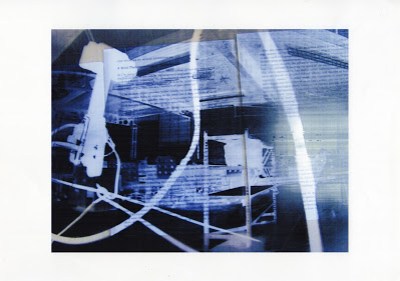
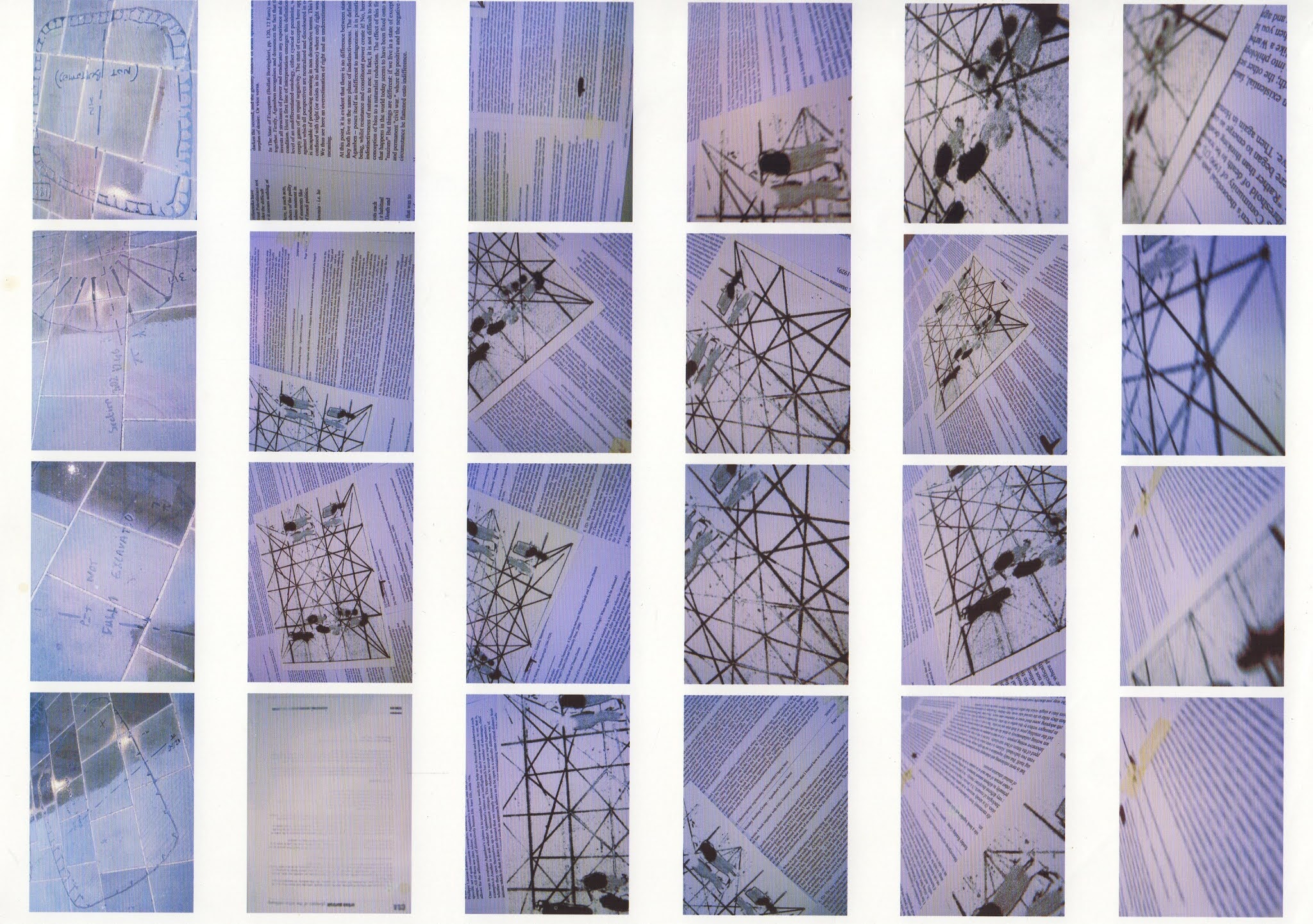
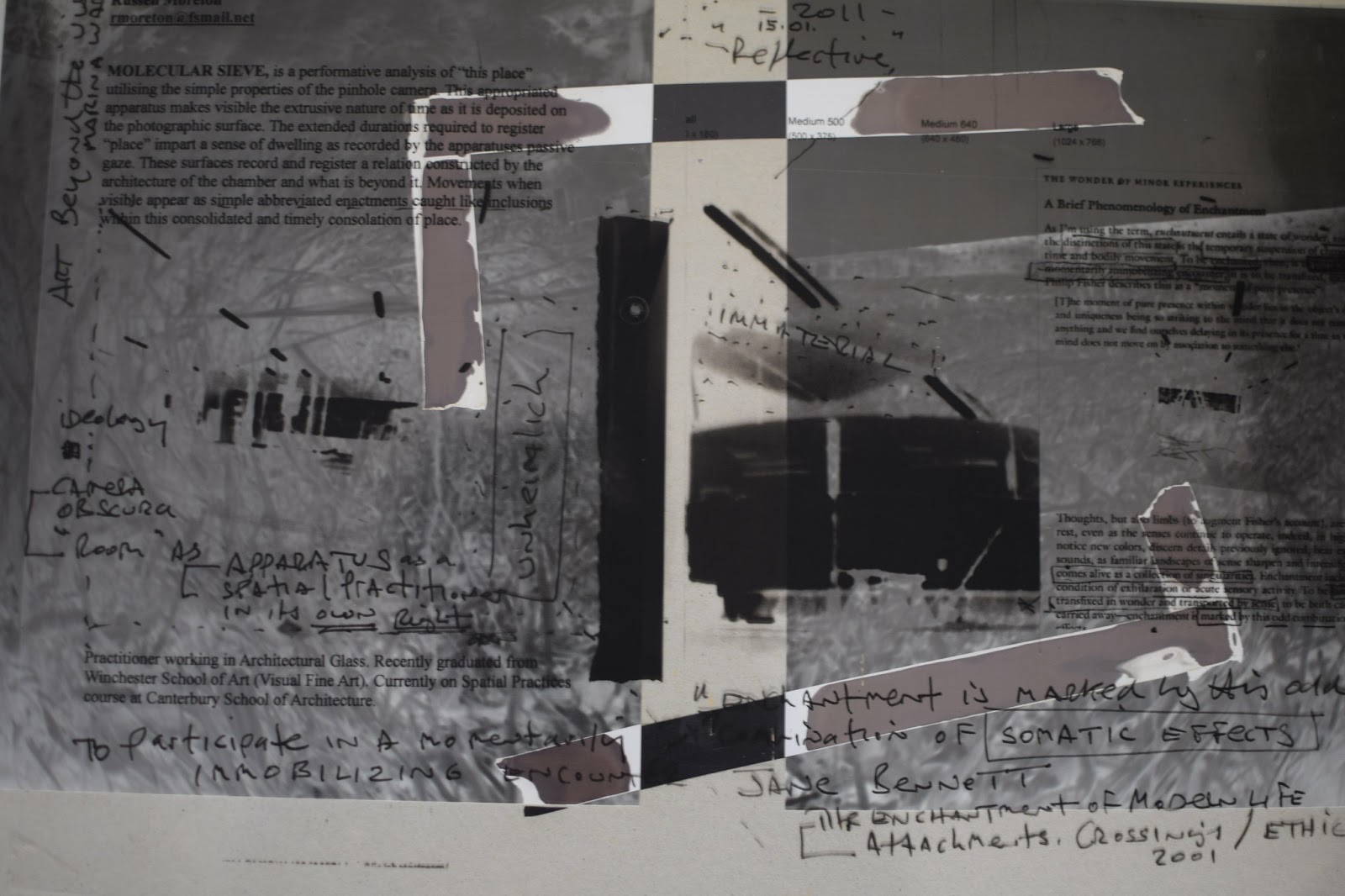
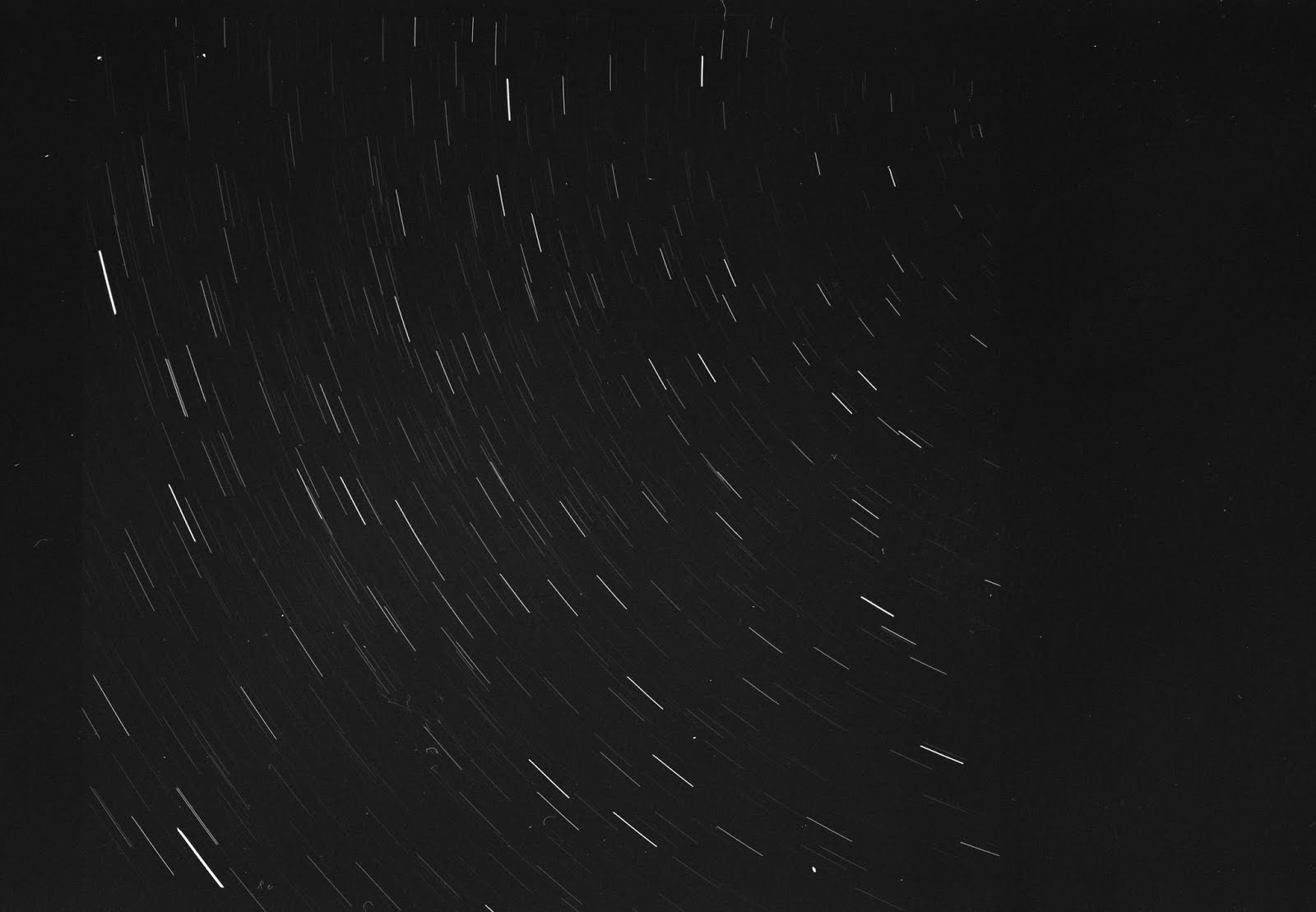
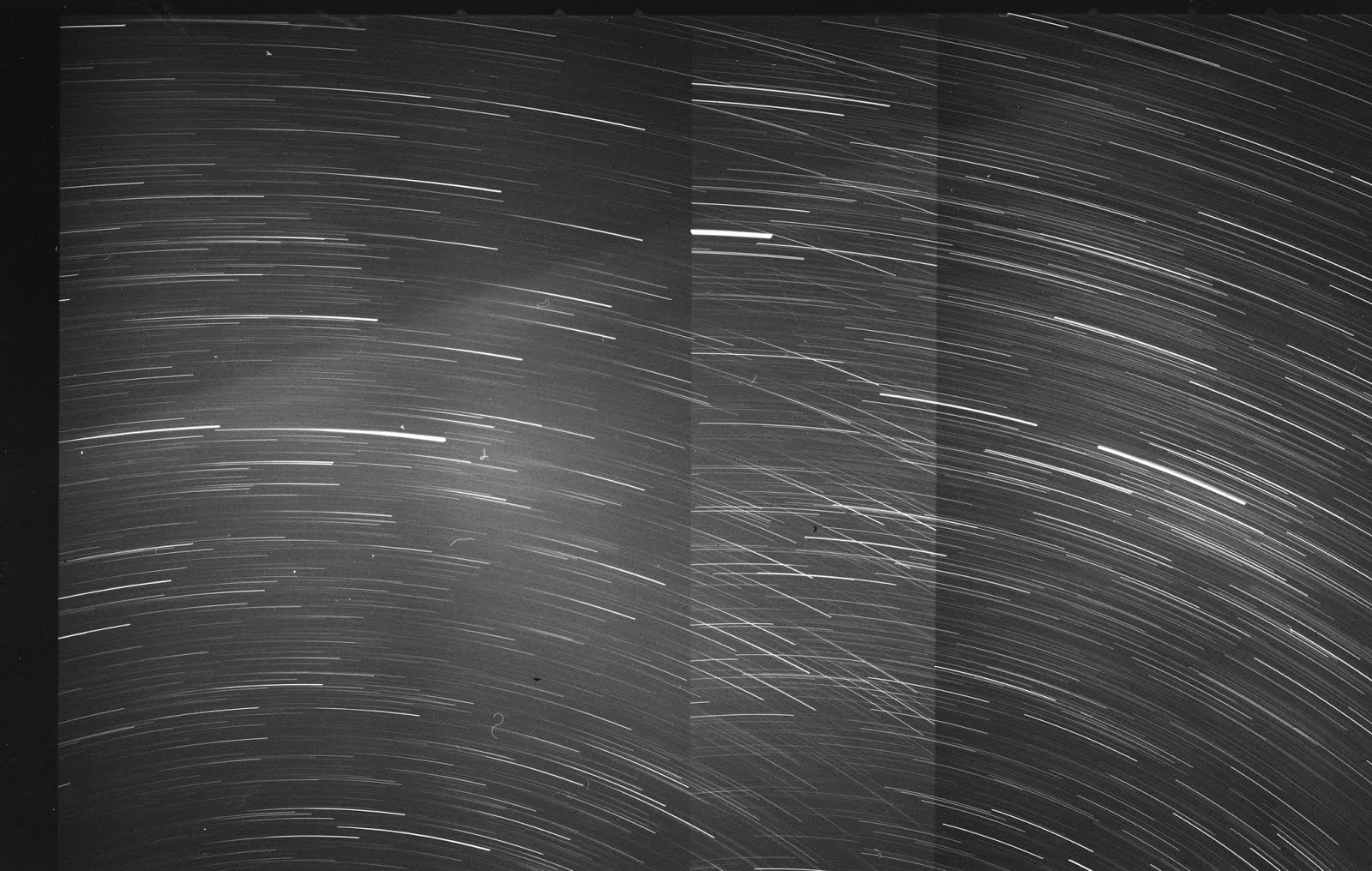
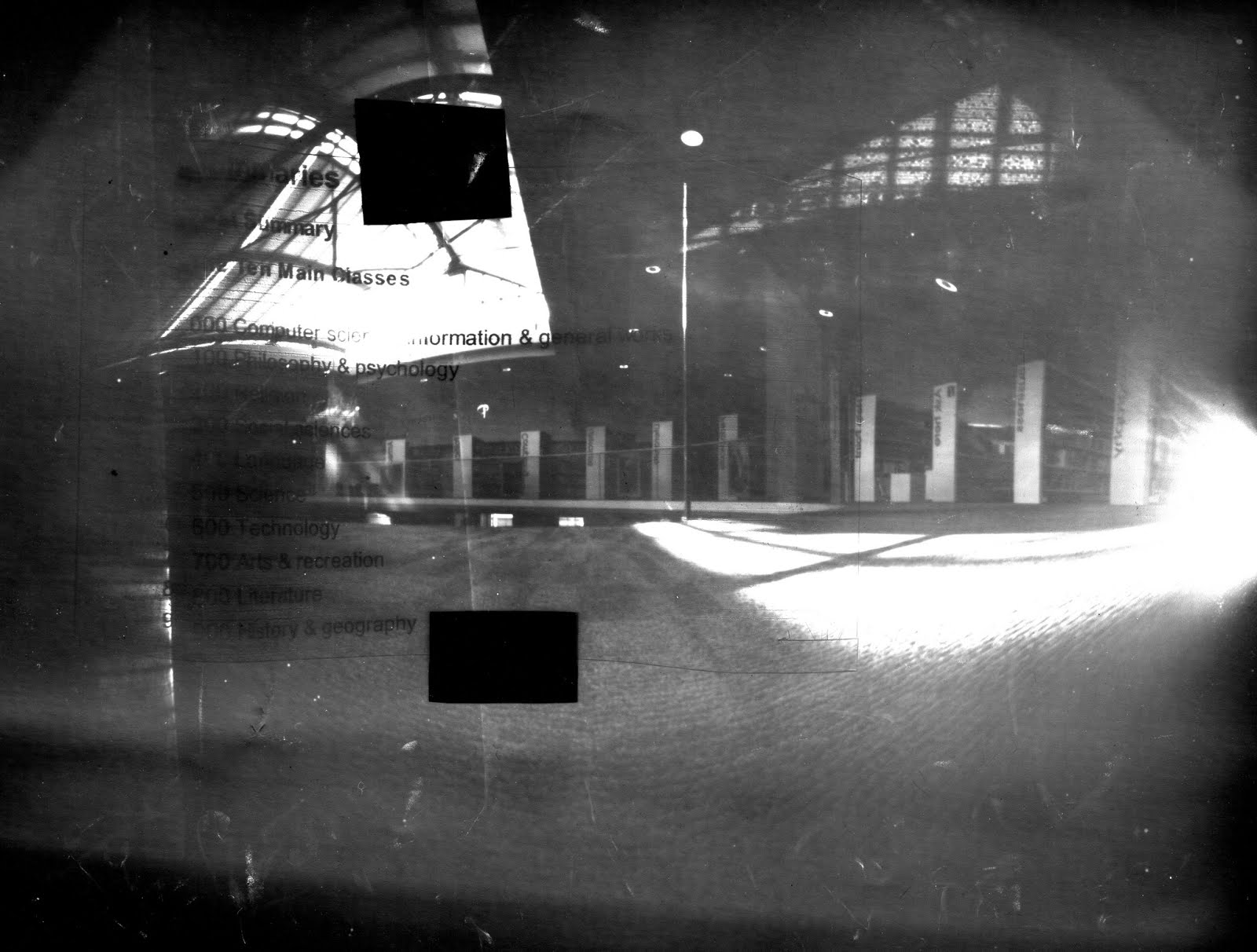
    Pinhole photography and photograms on light sensitive paper with annotations from both research material and working practices. Visual material and artefacts acquired from archaeological sites whilst participating in recording the archaeological process at St Mary Magdalene Leper Hospital, Mom Hill, Winchester. The work explores subjectivities in the recording of natural phenomena, the spirit of place and its scientific inquiry and production of fabricated forms in the realm of a contemporary art context.


    Vessels of Retreat : Dark Pots around the Innerness of Ceramics  Curriculum making as the enactment of dwelling in places Thrown ceramic ves…

    Source: Vessels of Retreat/Dark Pots : The Body and its Entanglements with Things/St Ninian’s Cave, Scotland.

  • Spatial Agents/Local Materials : Kilquhanity Free School/The Yard and Link Gallery, Winchester.

    Camera Obscura : Kilquhanity 2011

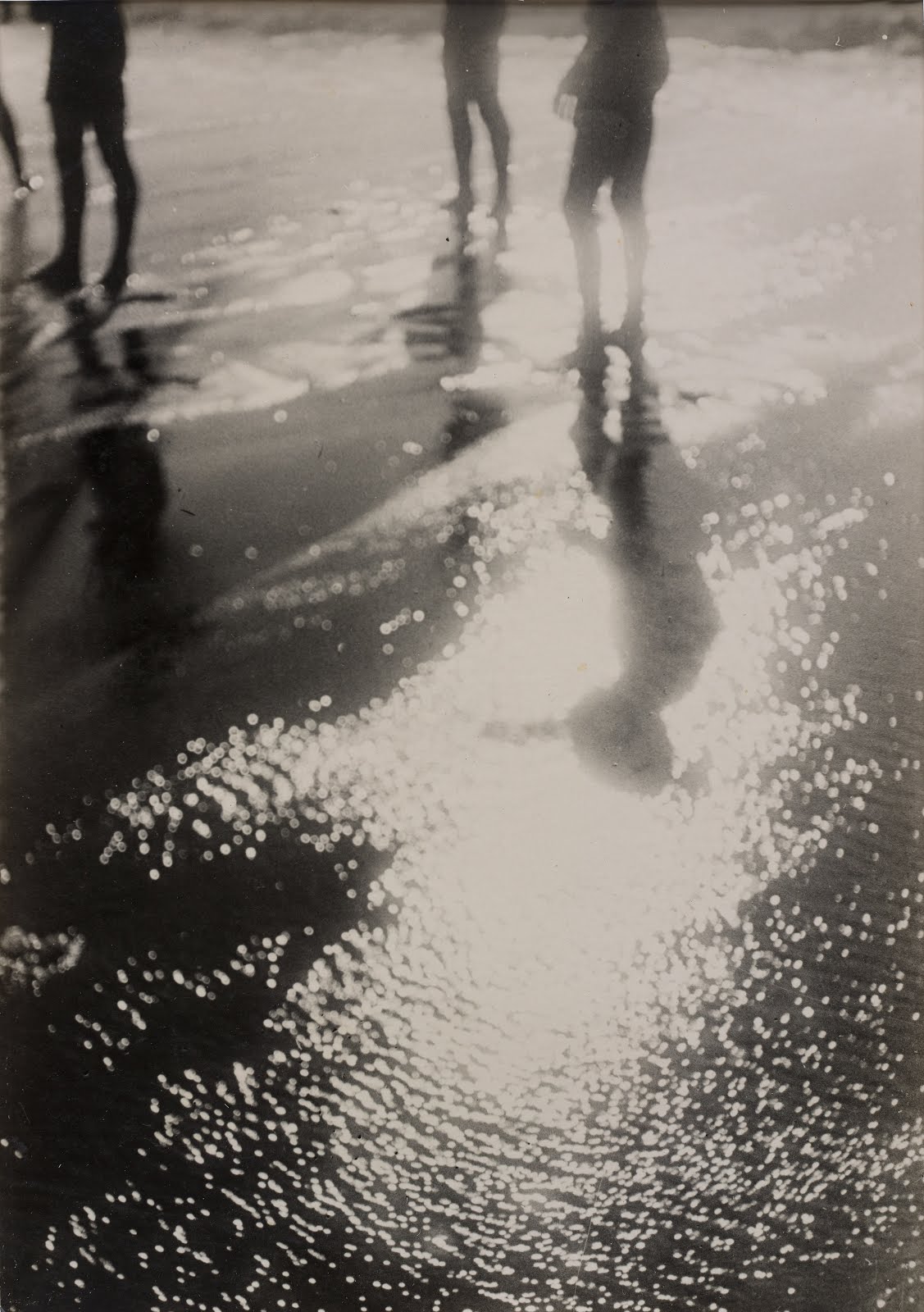
    Dark Session’s : Shadowy speculations in the pottery. Kilquhanity 2011

    Silver gelatin prints from a “room obscura” set up at Kilquhanity, Scotland 2011 as part of “Back to Free school, Drawing out the Archive.”

    Thoughts relating to Spatial Practice as a site of operation in which to locate my practice. Use of spatial correspondences (place, identity gesture and resonances) as a means of mapping the diversity of human presence and passage into architectural space.

    Possibilities of using methodologies and aptitudes gained from visual fine art and experience with glass and ceramics as architectural interfaces to instigate situations and promote a sense of an interactive spatiality through the role of the viewer becoming an active interlocutor into the dynamics of the site.

    Artist Statement, re Galloway/Kilquhanity excursion Easter 2010.

    My work utilises simple scientific phenomena and by appropriated registering apparatuses ( chambers to act to become placed in relations to place, this placement is in effect an act of intervention and place becomes site, a proposal is delivered through this action. This proposal is in the form of a relational device/threshold that attempts to fold into the place, a site of creative intervention around a paradoxical inquiry, into objectivity and abstractions, between embodied knowledge’s and findings. These
    “working Sites” attempt to engage the interlocutor on their own theoretical and subjective relations and to reveal and form their own singularities from the experience of becoming placed. This immersion into the objective, the philosophical, and the poetic, could be seen as trying to create a “metaphor around dwelling/becoming.” A subjectivity enlightened by theorising around issues of the production of space and the notion that time is both a structure and an event. The interlocutor (the
    view/relation of others present) becomes brought into “place” becoming as it were a ’’guest” of place through this placing inquiry, place can become ones own familiarity of space.
    The Yard Studios, Winchester.
    Multi-disciplinary practice, drawing on a long association with Art, Craft and the Building/Construction industry. Working mainly on drawing/mapping with local materials ( Arte Provera), alternative photographic processes and architectural interventions/installations that explore our sense and experience of place. Interested in the intimacy and mobility of “Artists” books and journals as a device to accompany the experience of place. My work commands and demands a need for a reflective solitude, a sense of dwelling amongst absences, that have themselves been transposed into another physicality. Interested in using drawing and materiality as a site of exchanges, traces formed into inclusions within its own experimental field of experience. The practice is continually informed by contemporary practitioners such as Roni Horn, Melanie Counsell, Christopher Bucklow. My work sets out to contains its own sense of a consolidation of time through ephemeral processes and reflection. The use of elemental mobile photographic devices is being investigated as a means of “registering” durations of human occupation continually superimposed amongst the agencies of “Place” and “Time”. The use of the human body as a trace allows my drawings a direct spatial encounter of absence. This method of working directly with the body is a direct result of earlier sculptural works in concrete and clay.
    Artists Information & Material For
    Interfaith-Group-Show: STRONG VOICES part of Hyde 900/2010
    Co-organised & curated by Stephen Cooper & Arielle Klobusiczky
    Russell Moreton
    Process  &  Materiality:  mirror  arcane  symbols  ranging  from  science  – humanity spiritual -pagan mythology & Christianity
    Symbol & Vision: 3 Layers containing a portable space of vision/ thought
    Binding Factor : Layers & Locality (Non places)
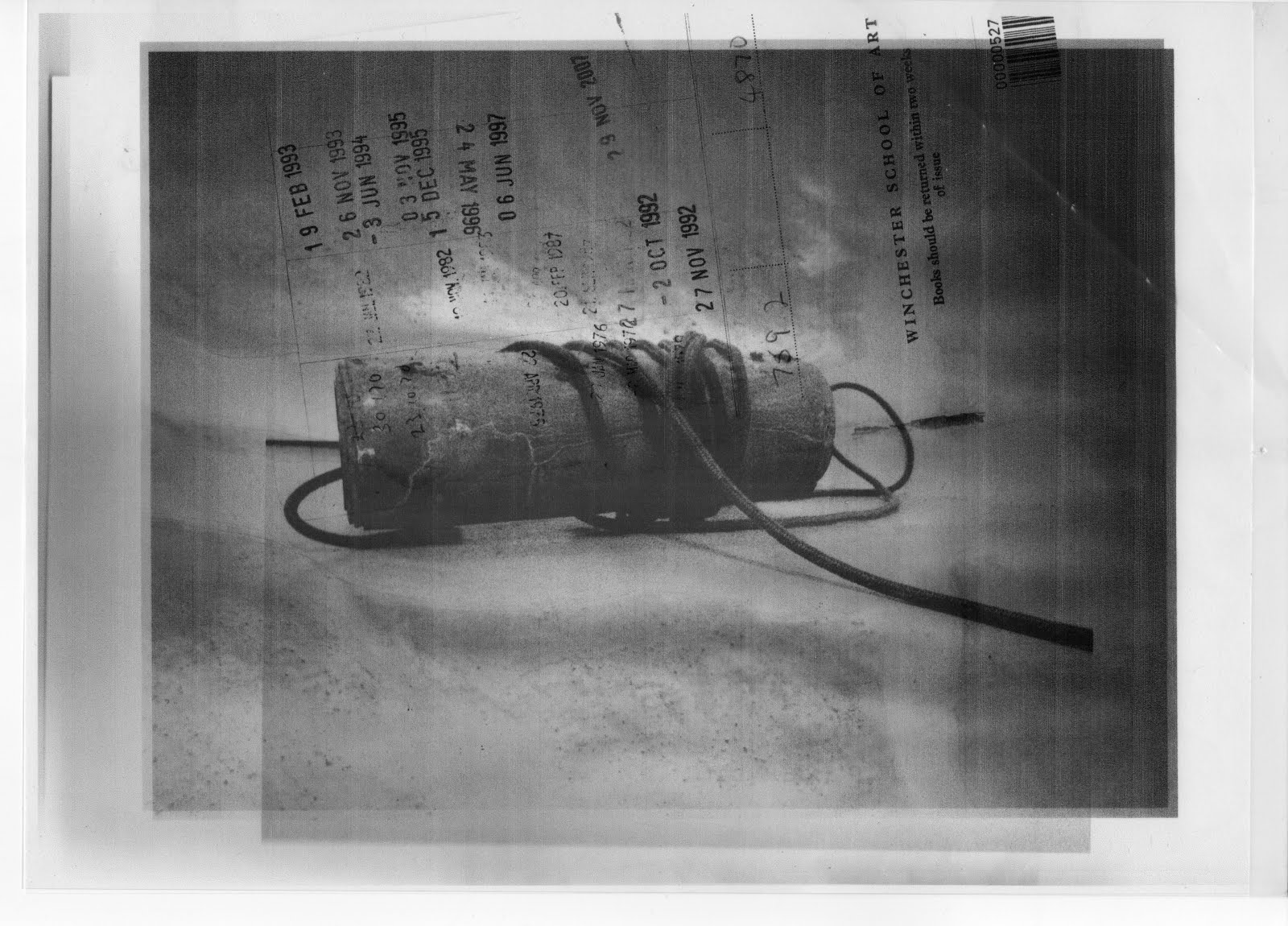
    Layer I
    Lyrical  intervention  with/&/or  of  Space  particular  Non  spaces
    Tracing activity contain in suspended materiality placed in space
    Layer II Consolidation of Time
    Capturing  notion  of  time  bound  process,  performance  and  procedure
    Documentation of resulting absence from ephemeral activity
    Layer  III
    Surface & Traces
    Sense  of  Equilibrium  between  matter  and  process  material  &  activity  paused
    Haptic Tactile resonance
    Locality
    Site Specific
    response to space, architecture and surroundings including work
    of others issues of frontality versus experiencing 3d work over come by designing samples/glimpses of concepts II!
    Material & Process: all include water/moisture/ and light
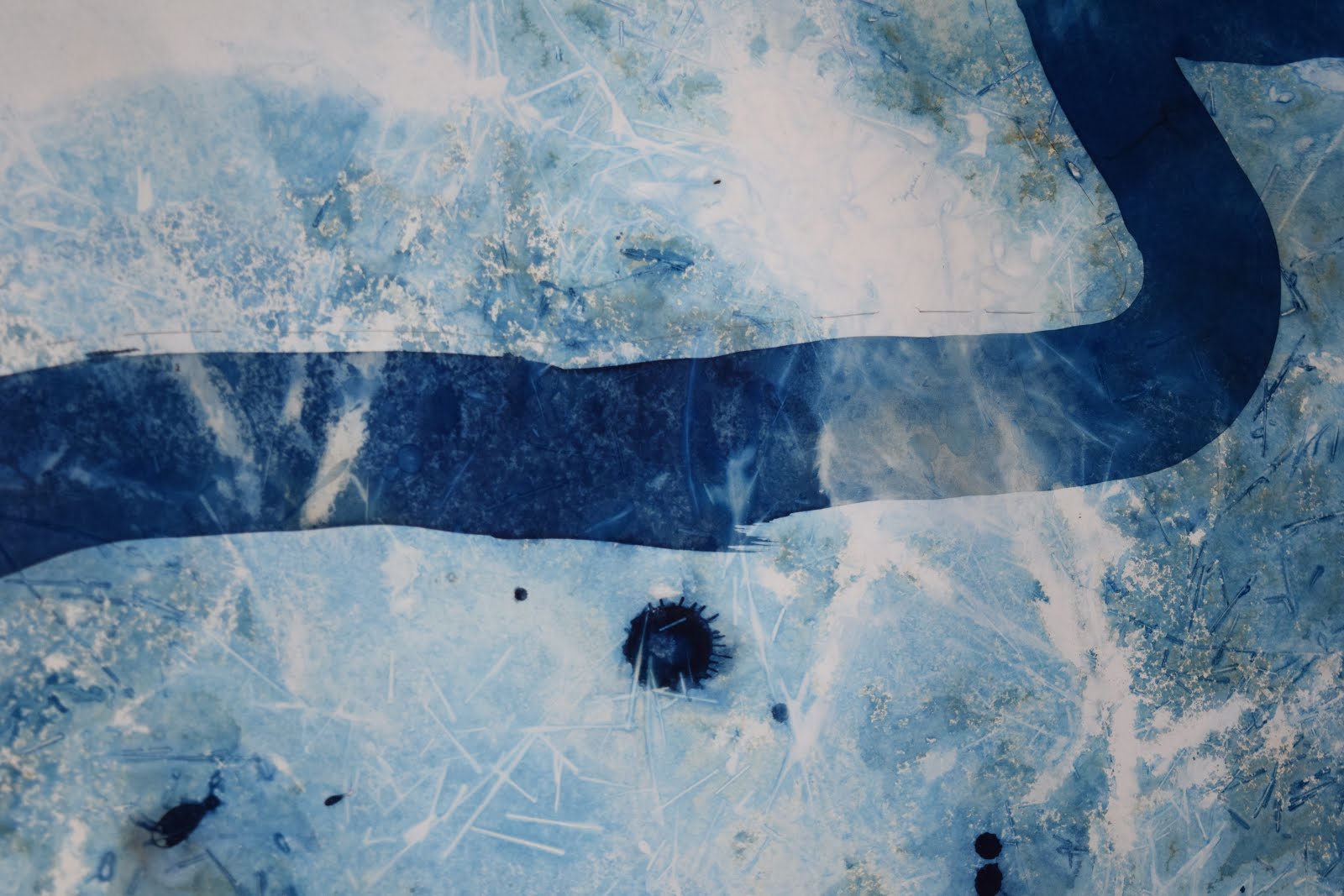
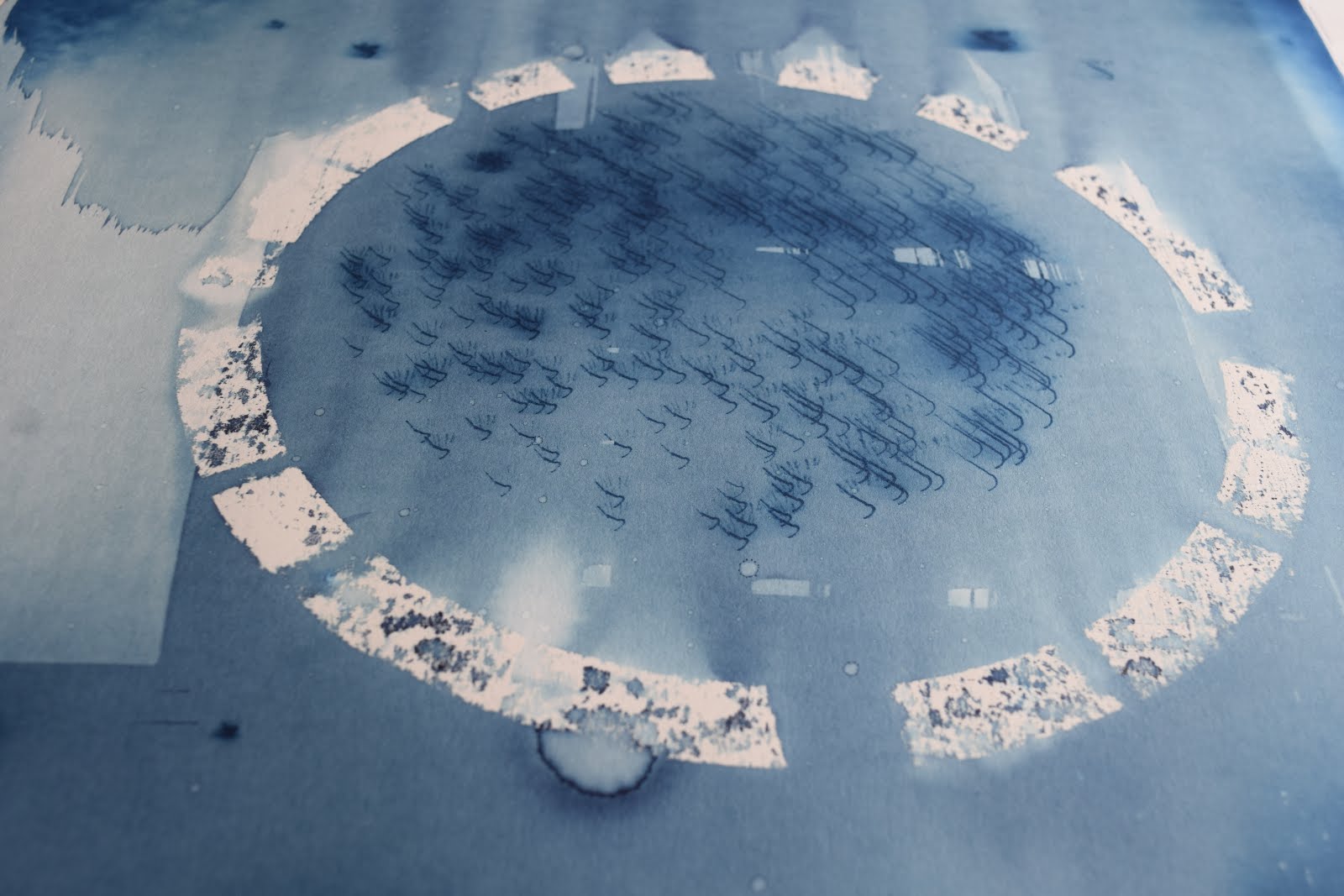
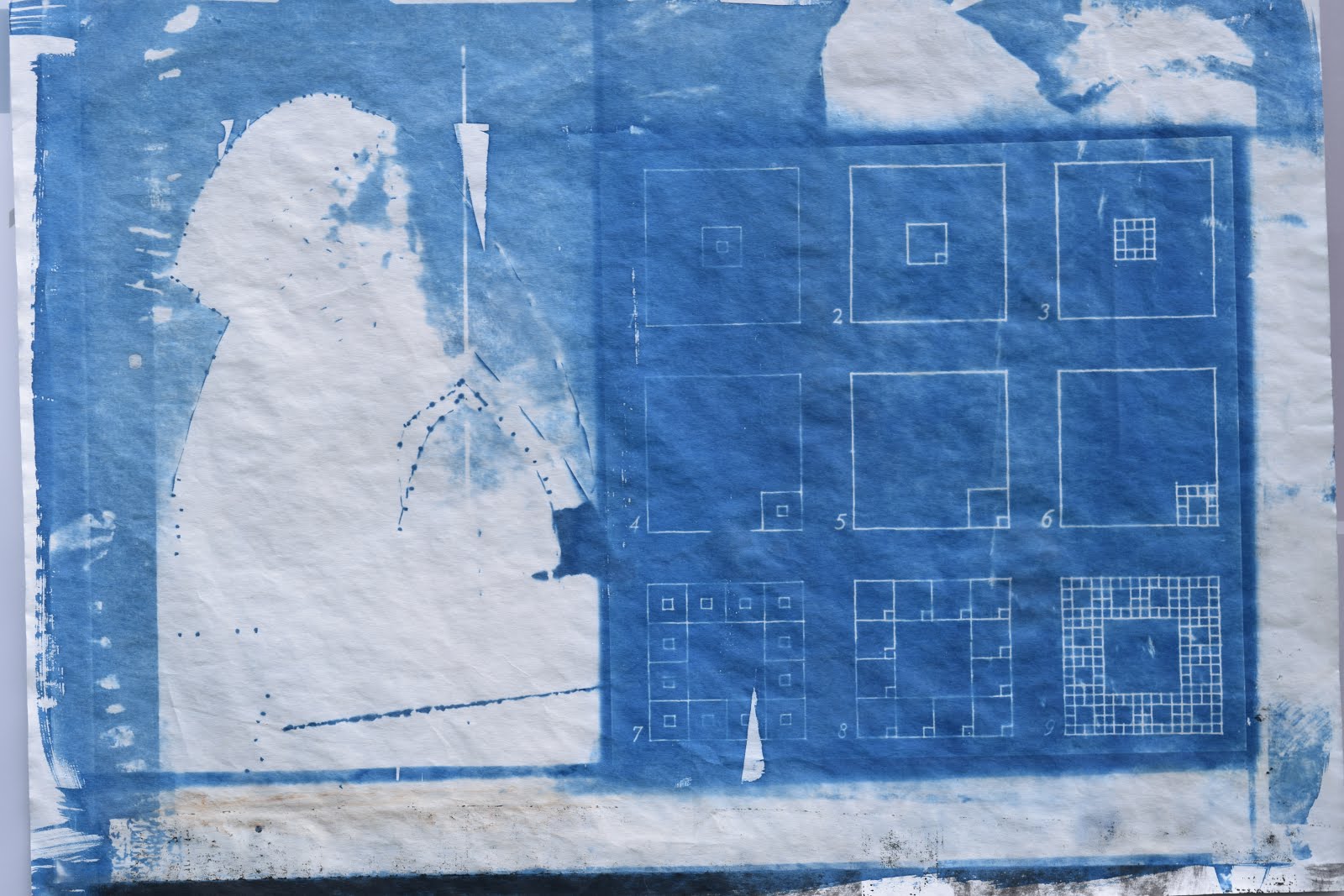
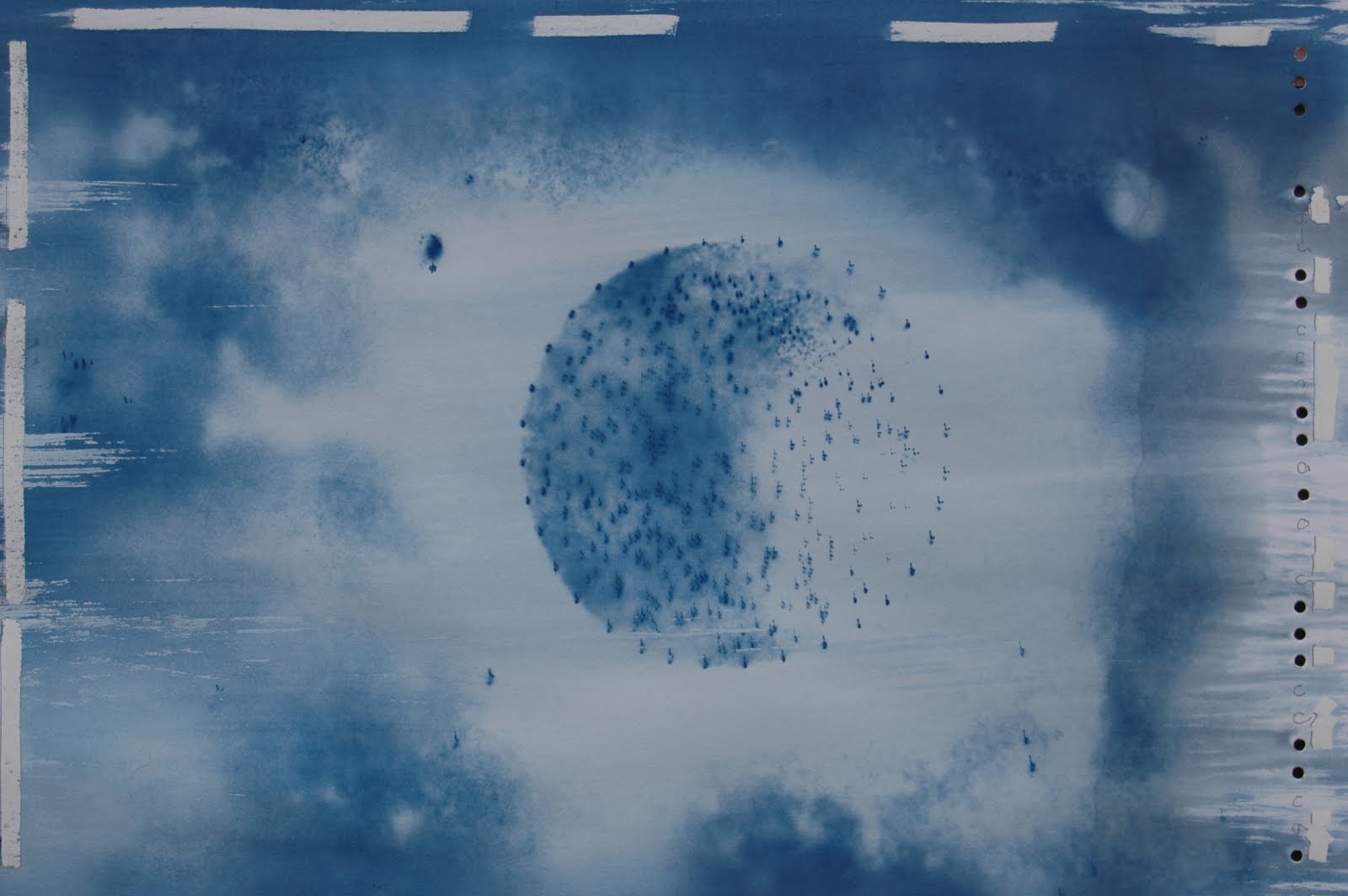
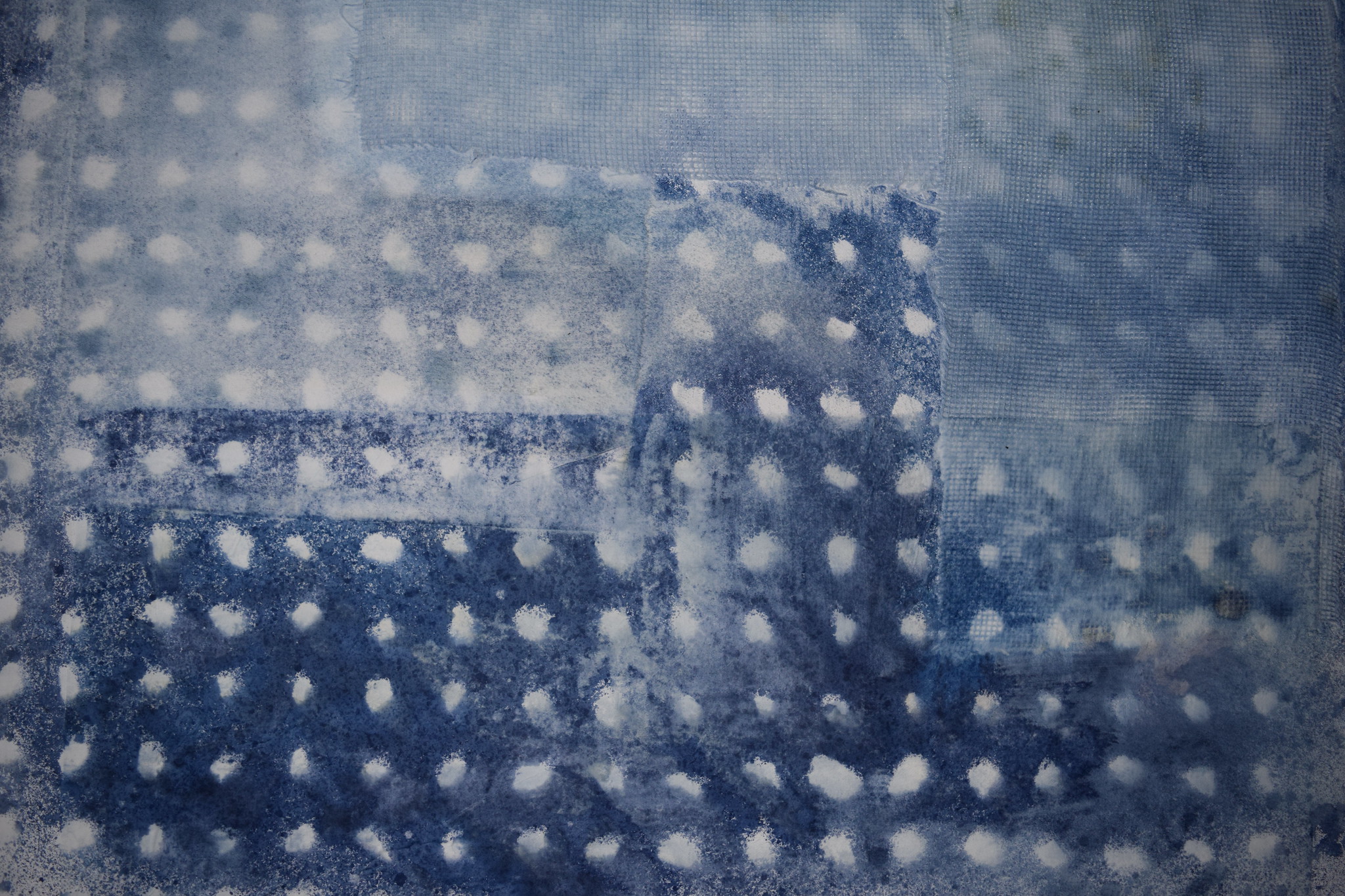
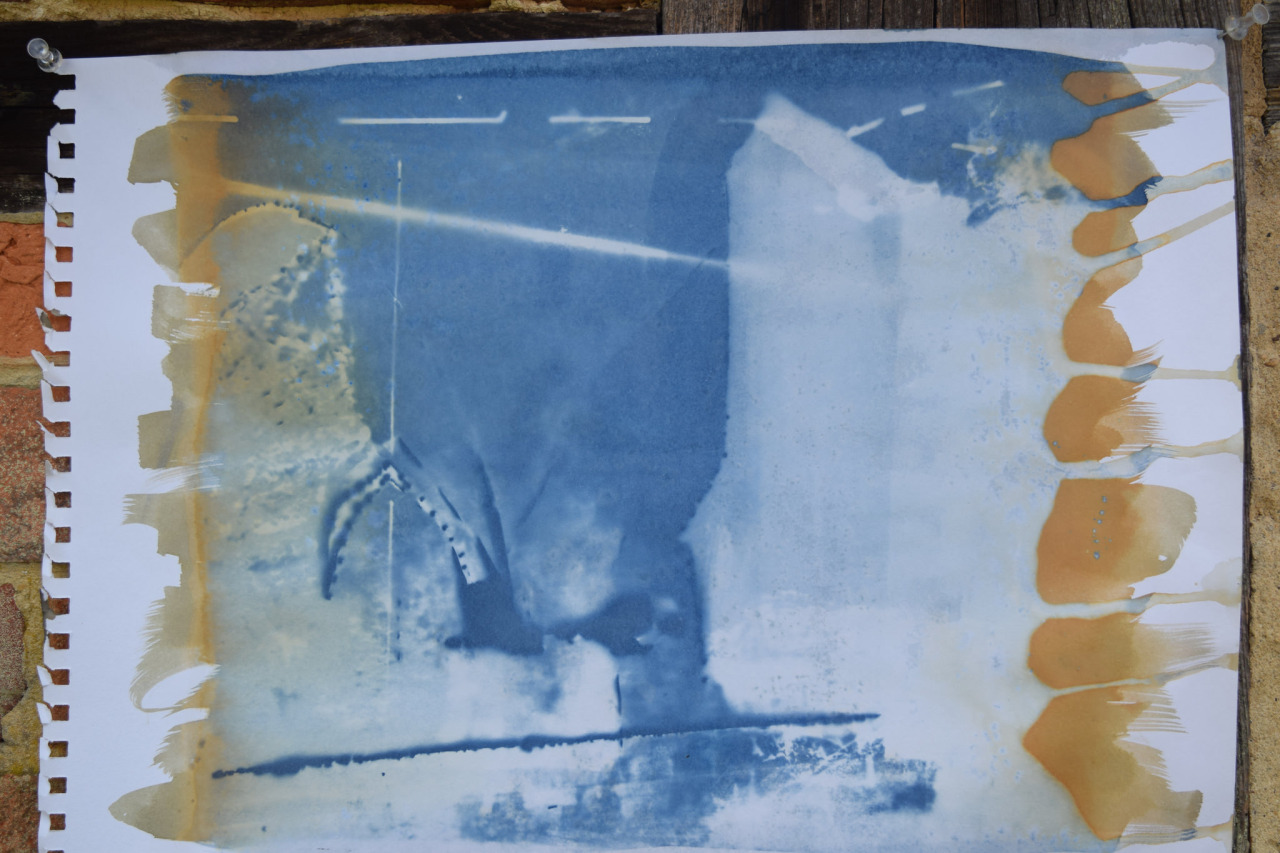
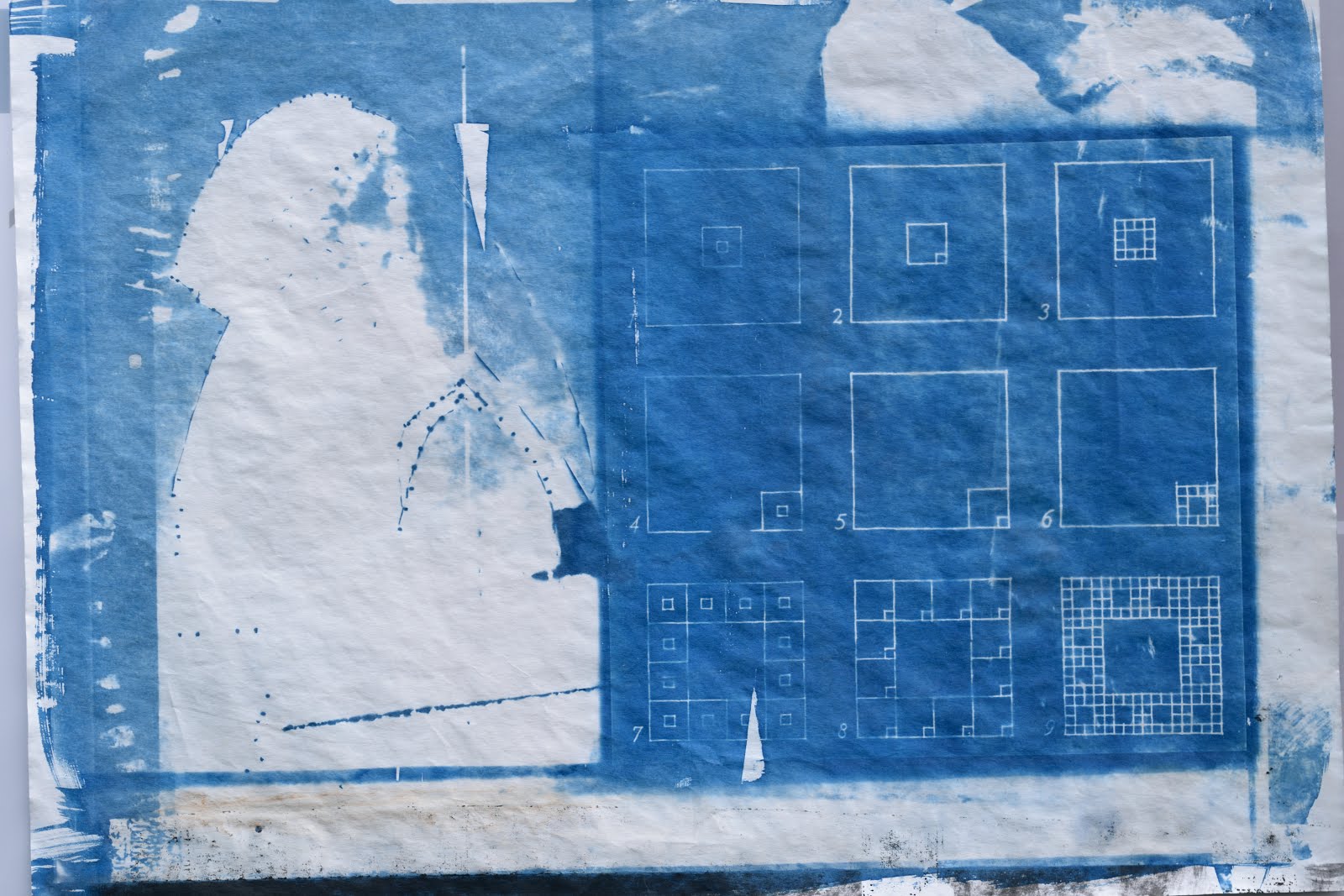
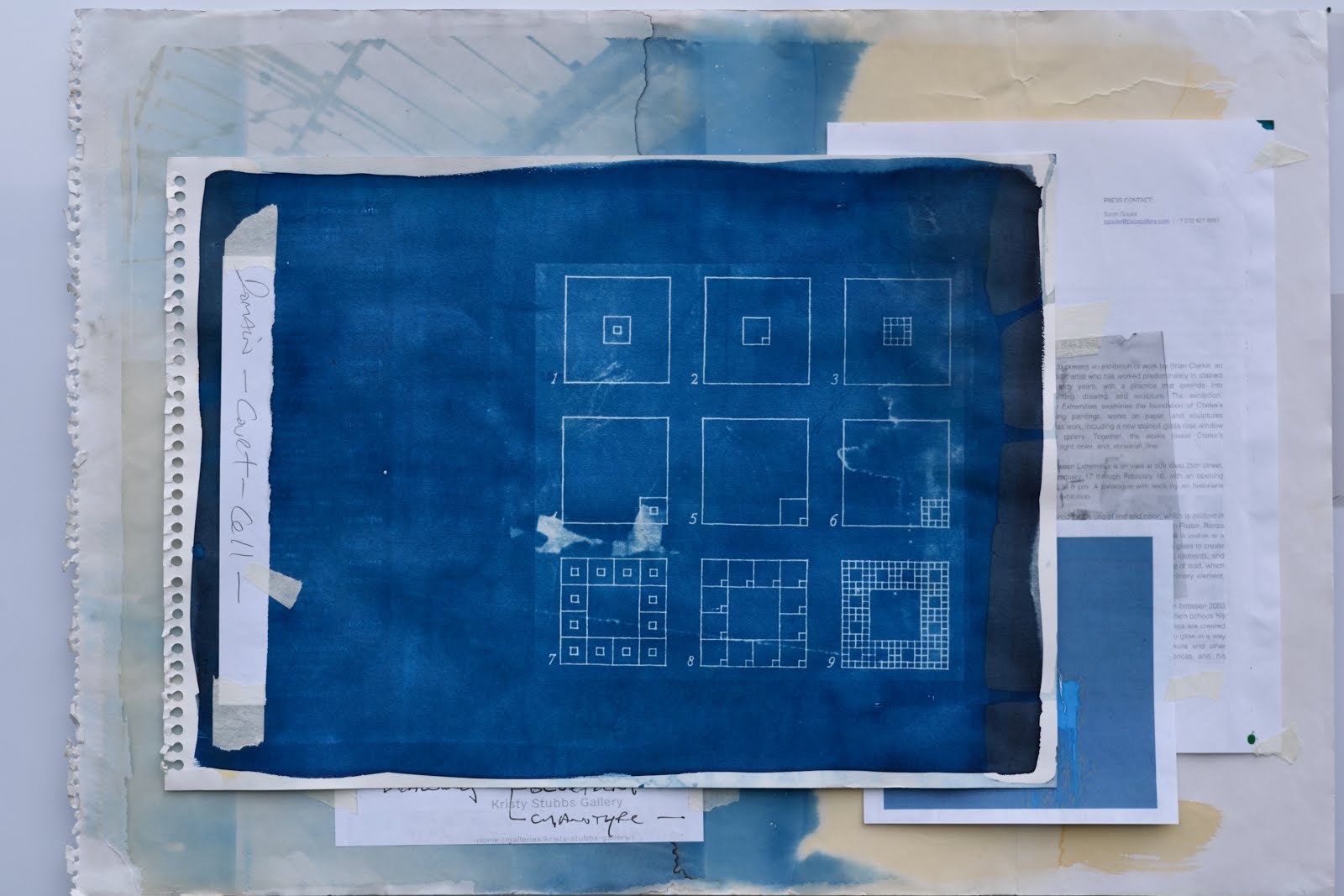
    Blue, Cyanotype ( Blue Print)
    Off White, China Clay & /or Chalk
    Negative Image, Pin Hole Camera
    Orange/Brown, Rust
    INTERFAITH GROUP SHOW AT THE LINK GALLERY 2010
    Artist Statement
    Spatial Practitioner using a multi-disciplinary art practice to explore relations in Architecture, Fine Art and Performance. Interested in the production of spaces that are relational and collaborative to both the practitioner and the visitor/interlocutor. My work utilizes simple indexical strategies to engender interest and perhaps a con spiritual enchantment for the everyday. These resultant correspondences “trace strategies” are open, active and present in-situ; they become “placed geographies around human relations.” Previous workings have used the agencies of natural light in both photographic apparatuses and projection through transparency and clay both as a material from which to retain impressions of mobility through its material memory and its analogy to the “Promethean myth” and its use of clay to fashion mortal man. This particular event invokes for me the notion of a shared humanity, a mutuality that could be understood as reflexive through simple material relations and collaborative gestures. Art space can promote these working intimations that are in the realms of beliefs.
    Working Notes for Proposal
    Notion of a shared hospitality/threshold that excepts diversities through a simple gesture. Explorative/relational surface or device to register and contextualize spatial relations produced by the participation of this event and its reception.
    Artist Statement, re proposal for “Strong Voices”.
    It is my intension to utilise the ambiguous and strangely intimate nature of a continuous line around a human being to act as a site for the viewer to inhabit an engagement with the work. I am interested in utilizing the “open space” the territory within the traced outline as a sort of vessel for the temporary thoughts and reflections of others. This space hopes to set up a condition, a place that allows a dispassionate observer or thinker time to find and form their own thoughts. The use of material residues left from enactments seems to concur a metaphysical presence to that of the inner trace. The use of simple materiality (clay, chalk, rust) invokes a notion of a shared simple relation, to the human form; these sensibilities are reflected in artists like Giuseppe Penone and other Arte Povera artists. The use of light sensitive materials, liquid light and cyanotype brings the representation of worlds into proximity of a human absence. Photographic processes also bring with them a surface of compressed and superimposed time, an event through which time has left behind, like the trace we are left thinking and reflecting a loss that creates equilibrium in the present. To add a presence of temporality and nowness, water vapour has been sprayed onto the chalk creating moisture a breath around absences.
    The Link Gallery , Winchester. Strong Voices, part of Hyde 900
    Untitled 2010
    Wax, field chalk and pencil on paper 230×150 cm
    This work utilises the ambiguous and strangely intimate nature of a continuous line performed around a human being to act as a site for the viewer to inhabit an engagement within the work. I am interested in the performativity of this “open space” the territory within the staged trace, creates an outline as a sort of absent vessel for the temporary thoughts and reflections of others. This space hopes to set up a residency, a place that allows a dispassionate observer or thinker time to find and form their own thoughts.
    Wax, Field Chalk and Pencil on Paper, focuses our attention on the vulnerability and finitude of the human condition through a representation of its absence given only in the traces of past gestures. Inviting meditation, the simplicity of the materials and their use, directly evokes an emotional register and aesthetic sensibility tied to the human form. In the open space performed by a continuous line, the work seeks to offer us a temporary haven for reflection, a quiet space of respite, shielded from the incessant press of events.
    What is the aspect of Faith/Belief in this work?
    Personal Statement.
    The work allows for me a space for reflection, however awkward its present location engenders. This drawing its manufacture and its materiality for me speak of the intimate space of a domicile, a domesticity and a sense of a proximity to material and geographical relations. For me there exists within its presence a space to ponder issues, some relevant to ones own intimate beliefs and observations. The poetics engendered by the materiality seek a sense of encounter harboured by territory of a human gesture. This encountered materiality is explicitly subtle, yet it is for me raw, open, unclothed and perpetually awkward. For me the confrontation of this awkwardness reveals the trace as being both vital and mortal. It is into this state of the vital and mortal I can begin to harbour my sensitivities and those of others.


    Camera Obscura : Kilquhanity 2011 Dark Session’s : Shadowy speculations in the pottery. Kilquhanity 2011 Silver gelatin prints from a ‘room …

    Source: Spatial Agents/Local Materials : Kilquhanity Free School/The Yard and Link Gallery, Winchester.

  • Drawing, a place of exchange : Social Mappings : Traces and Indexical Wanderings, containing the anticipation of loss

     ART AS A CUSTODIAN WITHIN ARCHITECTURAL SPACE.

    INTERLOCUTOR between ART and ARCHITECTURE

    AS AN “OBSERVER” AS IN CONSTRUCTIVIST THEORY

    The evidence of this correspondence is fabricated in the situation and its attendant traces and material residues, the “indexical” knowledge and its familiarity are encountered in this fabrication of the observer, as “being of human sensibilities”.

    Phenomenological traces begin this process of observational identity as a condition of being human, we see as we know ourselves to be seen, we comprehend ourselves in the knowledge and existence of others.

    The anticipation of an appointment, situation grants a sense of autonomy in as much as the potential of expectation is still fluid, unfixed in the location of others.

    Espace-Milieu : Painting as Environment

    Aerial

    Social Mappings : Winchester Cathedral

    Space for Peace 2011

    Drawings more than ever have become the site of investigations and correspondences in the search of an authenticity, fidelity and truth; they indorse the activity. comment and energy of the artist.

    The trace seems to emit a contaminating sense of communication based around proximities and their anarchical sensibilities, it attempts to develop a language brought from a contaminating communication in as much as it is not based on a subject as such, rather the trace of an occurrence now dislocated by that very action.

    Cyanotype as a method of passing a “blueprint” a proposal to others, a working set of ideas for the transposition into a reality framed by a situation of realisation and construction.

    Cyanotypes originally concerned with the production of things, not images rather working documents of both evidence and possibilities.

    In the role of transposing scientific observations into the practical application of the everyday.

    The theatre of experimentation, scripted between a proposal and its practical application in and amongst the spatial relations it is presented with.

    The blueprint is presented as something proposed against an already present arbitrary and temporal reality.

    Contemporary’ drawings are all about “thinking” to paraphrase Joseph Beuys. They are an intimate language, in fact the first visual language visible to both the artist and to others. Drawing is the beginning of the synthesis of internal thoughts being tentatively externalized in the search of a form they can inhabit. Drawing uniquely brings together a complexity of gesture attitude sensation and creative invention simultaneously into the light of the moment. Drawing could even be said to present a possibility as a fact, praesentia the fact in the light of its time. These values conspire to engender a presence, a semblance of some physicality that the artist is trying to form, a form that may be forever absent the drawing acting as a gesture of remembrance, or as an emergence, a premonition of an evolution of a per formative response to situation.
    Drawing has always been a verb, and in the contemporarily of art it is the activity or performance that is of interest, a being in the intension of drawing. This sense of performance and the spatiality of both space and time have given rise to the notion of mapping with its direct correlation to the body. Drawing attempts to map the relationship of the body as a locus in its surroundings. We are now much more interested in the situation and immediate proximities that the artists body and its gestures being traced in spacetime. Drawings map dynamics and velocities, they interact with the fluidity of liquids and contingency. Materials are also bought into the arena, to act as indexical witnesses, to record and echo the gesture and act of drawing. The artist Monika Weiss writes with regard to drawing in her own practice, “Weiss makes marks, videos and objects, but she does not pour, drip or fling, she inhabits, smudges and draws. This is a distinctly female approach. Drawings more than ever have become the site of investigations and correspondences in the search of an authenticity, fidelity and truth; they indorse the activity. comment and energy of the artist.

    Drawings by sculptors that place the relationship of the line derived from the body.- on the same field as material/media residues. These configurations give rise to conceptual associations and meanings. This contemporary ’approach is in evidence in  a  number of artists work where the per formative aspects of drawing are the key issue. To put it simply there is a growing awareness of the gesture of drawing as the work, and not just simply the representational merit of recognition that has previous acquainted skill and draughtsmanship. I am talking about the authentic gesture of inscription, the combination of both the trait and trace that the trait has circumscribed. This almost primal visual rendering from a sensation of blindness.

    Life “drawing” trace on paper with water and field chalk.

    Work submitted to Interfaith Group Show at the Link Gallery, Winchester 2010.

    “This particular event invokes for me the notion of simple material relations and collaborative gestures that underpin human agency. Art space/practice can promote these working intimations that enter into  the realm of beliefs.”

    Artist’s Statement (archive)  07.12.2009.

    The human trace, a continuous line traced around the presence of a living body. Within its boundaries their emanates, a curious absent presence with its uncanny silence. These attributes give the trace its force of absence its haunting manifestation on the present. The human trace surrounded by indexical residues echoes an act of archiving within the materiality of the world. The work embodies both action and trace, it contains a drawing as a trace of an activity and beneath this its conceptual language with its associations to the proximity of the viewer. The performative ritual that the trace has undergone is now a meditation, a site of lament this confirmed signification endorses the fact of the performance having passed leaving a sense of the moment that is still resonating yet irretrievable. A moment suffused by the proximity of residues. The trace is not only an activity but it is simultaneously a phenomenological proposition .The physicality of the artists movement articulate an echo, a reverberation within the vacant zone of the absent body. This reverberation induces a compression of time and space between trace as act and trace as loss. This site of slippage is held by indexical residues that indorse its authenticity via its intimate proximities drawn on its surface. The relationship between an activity and its trace promotes a trajectory with a velocity that articulates and implicates the past in present. The very nature of the relationship between action and trace allows the past to manifest itself through traces which both act as records of the past, but also suggest future actions. The radical nature of the human trace amongst indexical residues conspire to create not only a comment of the time, but questions what other residues may the human trace be conceptually associated with in the future.

    The notion of trace brings with it a sense of the traces embodiment in the particularities of a given time and place. This empowering which gathers into latency is marked by the traces occurrence its event of becoming. In the story of the maid of Corinth in which she seeks to trace the shadow of her lover, the trace literally underlines and implicates her proximity to her lover. The trace catches and snares them both in witnessing praesentia of candle light. They are forever bonded conceptually by this simple action; the fact of this action is brought into the eternal light of day. The almost mythic quality of the story its concise exactitudes that can be deduced from its very lightness evokes much said by Italo Calvino in his book “Six Memos for the Next Millennium” when he elaborates in the chapter centred around the values, qualities, or peculiarities of literature. The notion of lightness of fleetingness and a temporality of presence adheres to the veiy periphery of the trace as it viewed disconnected and dislodged from the encounter of its origin. The love of daughter is transcribed by the inscription around her lovers head into a conceptual truth enclosing a poetic proximity. This poetic notion of a semblance of a human body traced by the action of another’s activity is used by Tony Harrison in his short film Hiroshima.

    The ritualistic repetition of this motif throughout the film adds to the sense of pathos that like the trace it emanates from seems to conjure up a Promeneathen Tragedy, reinstalled daily as if it can continually exist before history can grasp it. That the human trace replicates through our proximities to loss, a colossal conceptual depth of presence that reverberates in the mind, a sublime lightness of terror. For the daughter the trace is something more than mere representation it colludes in its very action to form a relationship with the moment that contains her fidelity to the performance of what will eventually site her loss. The trace has the ability to encapsulate and contextualize these actions and their possible propositions. The trace remains framed by indexical signs that emit residues from the activity of the drawing .Is the trace really just an action of drawing, a marked presence with that presence confirmed by the inscription of the moving point following a shadow. In the instant of its activity and in intimate proximity to its phenomenological origin ,the trace because as yet there is no absence, only a proposition of absence, cannot exist as such. The trace awaits in a state of expected latency, almost pregnant with loss. The marking and its referent hold the trace moribund inoperative, language seems to wait on events. The slippage that occurs will be in the instant of recognition when the physical separation of the lovers body is removed from the situation and leaving with him the gesture of the drawing, their collective mark as a perfomative entity without substance, yet still withheld within residues contained in the emergence of the trace. The trace may well be the conceptualization of a mark, its ability to give via proximities a deeper significance and connectivity, a site that conceptually has a latent quality that disrupts superficial perceptions. Something within the human trace radically assaults the primacy of language; it attempts to arrest the connectivity of the existing historical system, as if the trace is always in advance of existing language, or rather it proposes changes.

    I propose to utilize the story of Plinys shadow to illustrate and elaborate the particularities of the human trace in its situation , activity ,action and proposition .I further wish to investigate the inherent intimacy of the human trace its sensuality brought by the sensibilities of proximity which become gathered and tethered by the trace of another. The story is about the maid of Corinth, this extract comes courtesy of Michael Newman, contained in his essay “The Marks, Traces, and Gestures of Drawing” this essay is included in Tate Moderns publication “The Stage of Drawing.”

    “…all agree that it began with tracing an outline round a mans shadow..”

    It was through the service of that same earth that modelling portraits from clay was first invented by Butades, a potter of Sicyon, at Corinth He did this owing to his daughter, who was in love with a young man; And she, when he was going abroad, drew in outline on the wall the Shadow of his face, thrown by a lamp .Her father pressed clay on this And made a relief, which he hardened by exposure to fire with the rest Of his pottery; and it is said that this likeness was preserved in the Shrine Of the Nymphs until the destruction of Corinth by Mummius.

    The trace by the maid of Corinth, that of tracing her lovers shadow on a wall is essential a love story, it possesses a human quality that is felt by a feeling of a shared proximity. Emmanuel Levinas describes proximity as a communication of an anarchic sensibility that occurs before the subject can gather itself into a position in relation this otherness which cannot be assembled in a representational present. He comments further that rather than being apprehended by the subject, proximity is a signifying of an expositional, there is that is alien to but suspended in presence. The human trace has the ability to solicit this notion of proximity, signaling a sensibility which is different than that which occurs in experience and knowledge. The trace seems to emit a contaminating sense of communication based around proximities and their anarchical sensibilities, it attempts to develop a language brought from a contaminating communication in as much as it is not based on a subject as such, rather the trace of an occurrence now dislocated by that very action.

    The human trace with its inherent sense of presence seems strangely unmarked except in the fact that it acts as a kind of residue of the indexical memory of its absent host. This unmarked quality allows proximity to dislodge ,knowledge and experience and induce a sense of the uncanny ,a familiarity without fore knowledge or experience. There is imprinted by the action of circumscribing an outline destined to become a trace an intimate betrayal, a boundary marked, a territory claimed whilst in a state of passitivity. The daughter due to the sensibility of her proximity to her lover may be to close to objectify this betrayal of intimacies. The fathers work which will hide all trace of authentic sensuality of the act, and render a mere likeness a representation culled from an action whose very performance was an expression containing the anticipation of loss, an anticipation now made permanent.

    The trace through its indexical sign and its conceptual space latently awaiting a return of the sensuality of the act, like ”the Sirens with their elusive and forbidden form of the alluring voice. They are nothing but song.” Maurice Blanchot, Eurydice and the sirens. and Indexical  The human trace of another intimately marked in the proximity of a shared intimacy, now vacant, void by withdrawal, only the visible intimacy of a residue remains into which to harbour our sensibilities.

    “They are nothing but song, no presence shimmers in their immortal words, they are pure appeal, an invitation to pause, a seduction.”


    ART AS A CUSTODIAN WITHIN ARCHITECTURAL SPACE. INTERLOCUTOR between ART and ARCHITECTURE AS AN “OBSERVER” AS IN CONSTRUCTIVIST THEORY The e…

    Source: Drawing, a place of exchange : Social Mappings : Traces and Indexical Wanderings, containing the anticipation of loss