• Working Spaces/Six Memos : Sites of Inquiry and Dialogue/Investigative Thinking/Post Studio

    Every action happens in its own right and every action is an analogy of something else.

    What I do need be no more than what appears at the moment of the happening.

    Peter Brook, The Open Stage.

    BOUNDARIES AND JUNCTION POINTS ARE IN THE NATURE OF THINGS POINTS OF FRICTION.

    Lefebvre, The Production of Space.

    MAKING : Essentializing of site and community through artistic presentation and production.

    ITALO CALVINO

    SIX MEMOS FOR THE NEXT MILLENNIUM

    LIGHTNESS

    QUICKNESS

    EXACTITUDE

    VISIBILITY

    MULTIPLICITY

    CONSISTENCY not written at the time of the authors death.

    SETTING UP THE IMMEDIATE THEATRE

    MA Spatial Practices, Canterbury.

    Project analysis and comment from Prof. Oren Lieberman, Dr Terry Perk, Dr Judith Rugg.

    The desire to register working spaces is an interesting, and I believe fruitful, direction in the work. It is important that through this registration, you allow and encourage a theory to evolve. ‘Register’ is a useful term in that it accommodates both the index (through the notion of recording information) as well as the performative registering of, say, an opinion. As the pinhole apparatus registers ‘public’ spaces as well, it would be worthwhile assigning them the value of ‘work’ spaces also.

    Also: you should understand the apparatus as a significant performative, spatial practitioner in its own right, and be careful about focussing only on the very engaging images produced by it.

    Developing an engaging thesis exploring various forms and frameworks for thinking about thematics of photography and architecture in relation to space and its potential meanings and productions.

    Using both practical workshops and theoretical enquiry to explore the differing values for both reading or engaging with the poetics of spatial formation in an ‘post’ sense of the studio.

    The work explores the concept of the open text in various ways and traces a development of the research from various approaches. This is a useful document of investigative thinking around ways of working for the project.

    There are some methodological approaches proposed here through a range of contestatory areas – in particular, the nature of the document and the text as spatial tools or ways of thinking about the interfaces between them.

    Some fascinating areas of insight and propositions on the nature of space – especially concepts of latency, peripheral space and methods of interaction/intervention. How could this area be explored in conceptual and crucial terms for the development of the project? – Behind your fluid approach, there is a sense of the need of the relational.

    The bibliography could be further developed in terms of defining its taxonomies and the rationale or relationships between them and with the proposal.

    Marc Auge, Non-Places, introduction to an anthropology of super modernity (London: Verso, 1992).

    Gaston Bachelard, The Psychoanalysis of Fire (Boston :Beacon Press, 1964).

    John Berger, Berger on Drawing ( Aghabullogue: Occasional Press, 2005).

    Peter Brook, The Open Stage (London: 1968).

    Giuliana Bruno, Public Intimacy, Architecture and the Visual Arts (Massachusetts: MIT Press, 2007).

    Italo Calvino, Six Memos for the Next Millennium (London: Jonathan Cape, 1992).

    Martin Clark, The Dark Monarch, Magic and Modernity in British Art (London: Tate St Ives,2009).

    Mary Douglas, Purity and Danger (London: Routledge, 1994).

    John Houston, The Abstract Vessel, Ceramics in Studio (London: Bellow Publishing, 1991).

    Lefebvre, The Production of Space (London: Blackwell, 1991).

    James Lovelock, The Vanishing Face of Gaia, A Final Warning (London: Penguin books,2009).

    James Salter, A Sport and a Pastime (San Francisco: North Point Press, 1967).

    Richard Serra, The Matter of Time (Bilbao: Steidl Publishers,2005).

    Rose Temkin, Thinking is Form: The Drawings of Joseph Beuys (London: Thames and Hudson, 1993).

    Tracey Warr, The Artists Body ( London: Phaidon Press,2000).

    Christopher Wilmarth, Drawings into Sculpture (New York: Fogg Art Museum,2003).

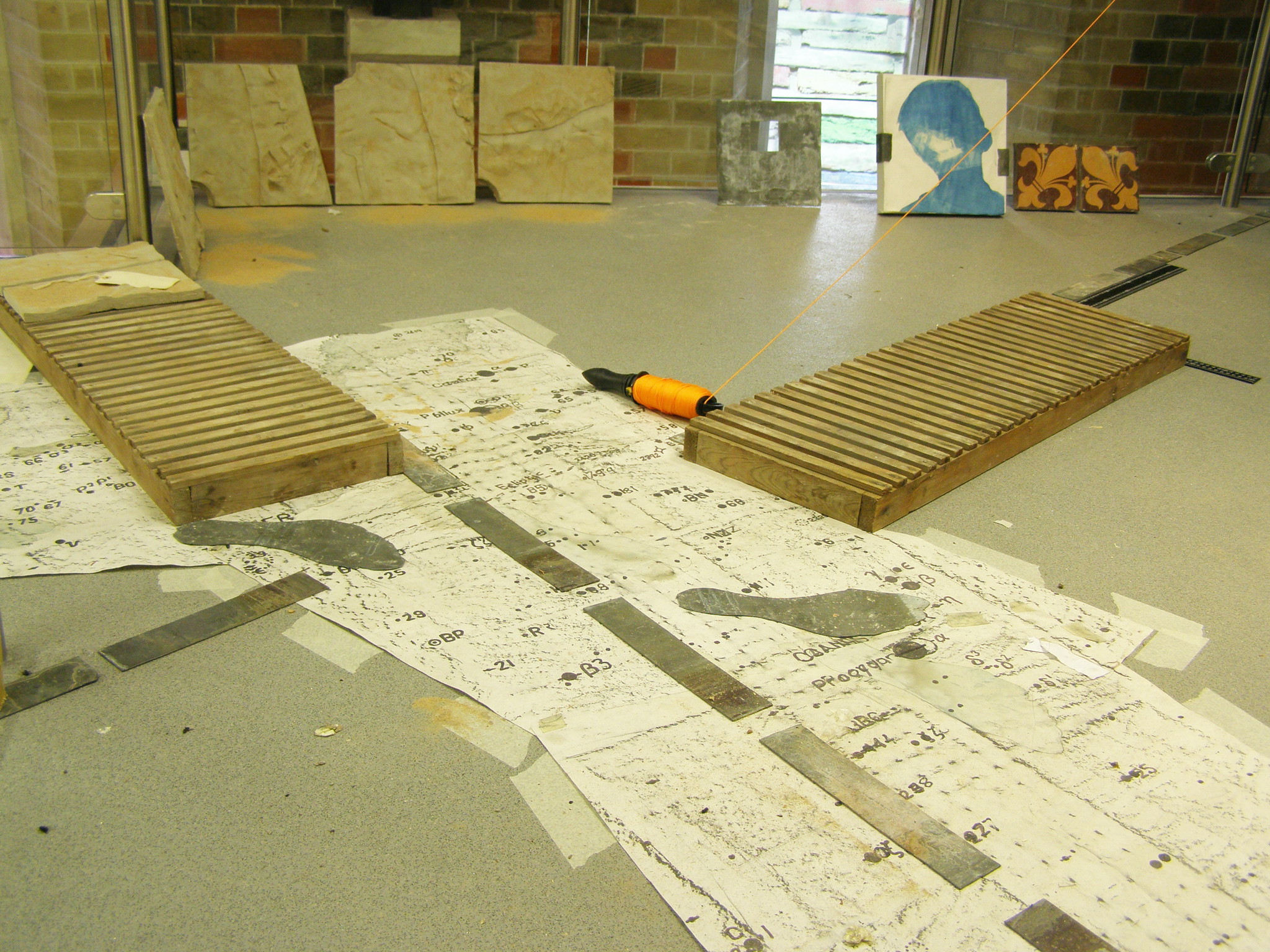
    I propose to register a site by its boundary. This new space will attempt to represent the internal dimensions of the artist’s current working studio space and be given a similar terrestrial orientation. Into the interior of this marked space objects from the working studio are to be reinstalled. This intervention attempts to create a spatial temporality into which a contemporary art practice will act as a context. The intervention sets out to display the complexities of the contemporary practitioner, the research material and works completed and those that are to instigated as a direct adaptation/response to the situation and site at hand. The temporal nature of this staged work reflects issues of mobility needed by the professional practitioner to be able to set up working sites and the ability to transpose them into other hosting environments, other challenging opportunities.

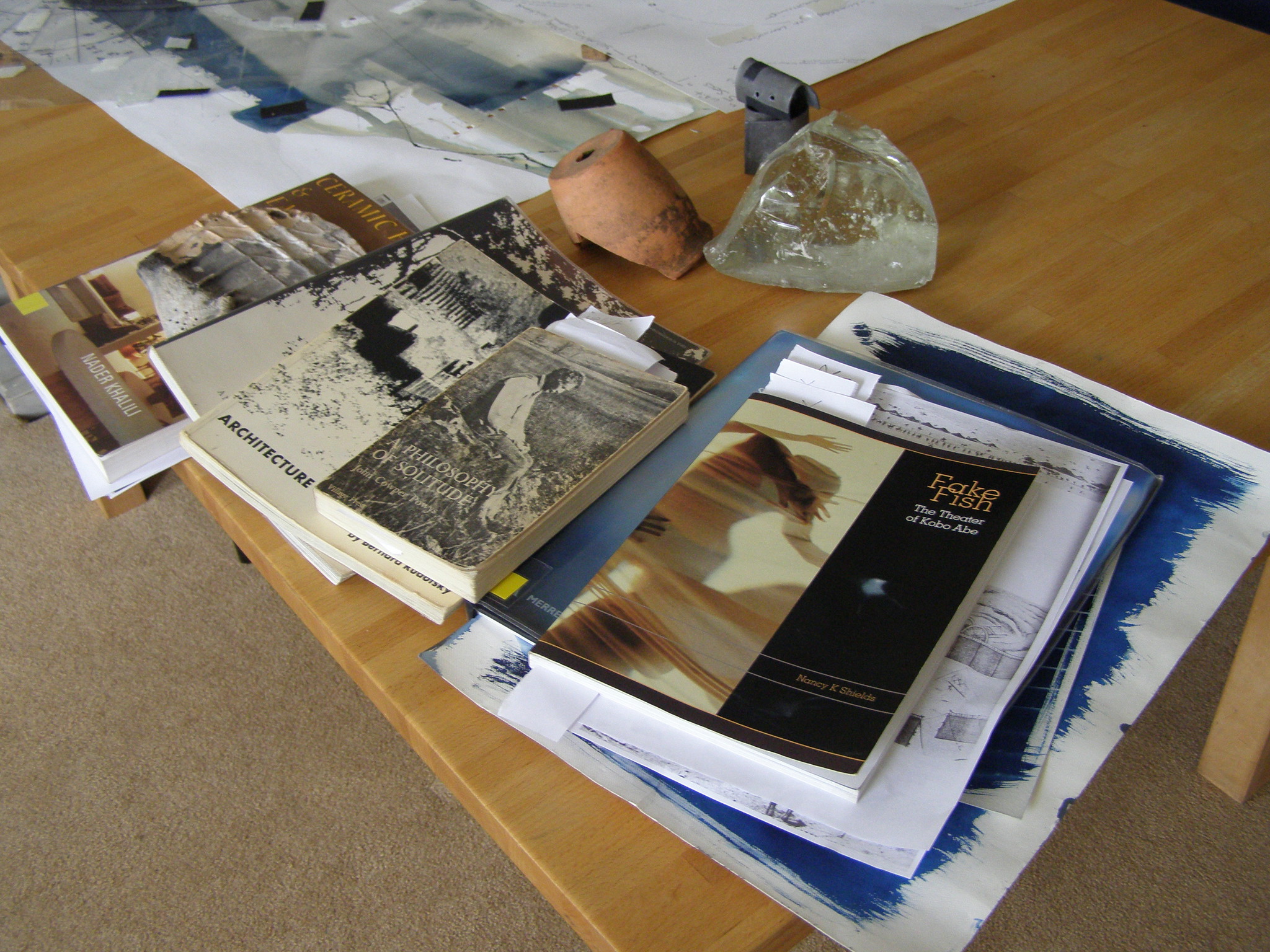
    BIBLIOGRAPHY OF DISPLAYED/BOOK MARKED MATERIAL.

    Edward Casey, The Fate of Place (Berkeley: University of California Press, 1998)

    Giving a face to place in the present,

    By way of the body.

    Yve Lomax, Sounding The Event (London: I. B. Tauris, 2006)

    An impossible refrain,

    Fortuity,

    Giuliana Bruno, Public Intimacy, Architecture and the Visual Arts (London: MIT Press, 2007)

    Modernist Ruins Filmic Archaeologies,

    DRAWING SPACES.

    This activity of marking out an elsewhere (the studio space) and presenting it here and now is a fundamental quality of drawing. The act of drawing is in itself a private act undertaken primarily for the artists benefit. The finalisation of the research project revolves around issues of public intimacy with art objects whilst being in public spaces. This investigation into public intimacy and the reception of contemporary art practice as an open site; complete with works completed but not yet “framed” for any given spatial or social context attempts to stage this reality. Together with supplementary material present including in some cases work in progress, this might allow the temporal space frame of an absent space the ability to create a privileged and therefore valued experience of art objects within and amongst the intimacy of their conception.

    Letting the practice stage its own intimate theatre might engender more collaborate speculation and interdisciplinary workings. “Spatial Practices” envisaged practitioners from Architecture, Fine Art and Performance driven disciplines, my own research at Canterbury has attempted to orchestrate a spatio-temporal theatre of reception for this purpose.

    The Architecture of Science in Art: An Anatomy Lesson,

    The room as the real protagonist of the film.

    Bridget Elliott, Peter Greenaway, Architecture and Allegory (London: Academy Editions, 1997)

    On Common Ground,

    Allegory as Architecture.

    (Un)Natural Histories Collecting Cultures, Crossing Limits.

    Ian Buchanan, Deleuze and Space (Edinburgh: Edinburgh University Press, 2005)

    The Nomadic Subject in Smooth Space,

    Territories and the Refrain,

    The nomadic subject open to unconventional spatial orientations can make new connections in keeping with the movements of life as it unfolds.

    Irit Rogoff, Terra Infirma, geography’s visual culture (London: Routledge, 2000)

    Vicente Todoli, Time Zones, Recent Film and Video (London: Tate Publishing, 2005)

    The Where of Now,

    Bernard Poerksen, The Certainty of Uncertainty, Dialogues introducing Constructivism (Exeter: Imprint Academic, 2004)

    Gerhard Richter, Zufall, The Cologne Cathedral Window (Koln: Walther Konig, 2007)

    Glen Onwin, As Above So Below (Halifax: HMST, 1991) Caroline Christov, Arte Povera (London: Phaidon, 1999)

    Guy Brett, Force Fields, phrases of the kinetic (London: Hayward Gallery, 2000)

    The Laboratory : Spatial Practices,

    Canterbury School of Architecture. 2009

    Post studio practice/social processuality

    Superimposition of studio space into the main foyer of a university. The disclosure of creative practices, spatial relations entangled by the private and the public.

    Lefebvre in his chapter on Spatial Architectonics makes reference to the relationships established by boundaries and the relationship between boundaries and named places. These relationships promote significant and specific conditions or features to a space. This in turn results in various kinds of space. Lefebvre states that “every social space, then, once duly demarcated and oriented, implies a superimposition of certain relations upon networks of named places.”1

    It is this superimposition of space that can within it demarcate other thresholds of experiences, within an existing demarcated space that interests me.

    The act of “blocking in “ the dimensions of another space onto the floor of another create a temporal junction between a host space and a site within this host, a guest. This sets-up the notion of a temporal double occupancy held by the demarcation of a boundary and a site of proposal. This basic and temporal site marking could be said to have affinity towards some sort of anthropological marking, a territory. (Lefebvre defines anthropological marking as being at the stage when demarcation and orientation begin to create place and its social reality in archaic cultures)2. This activity also has associations with nomadic and agricultural-pastoral societies as they use paths and routes as spatio­ temporal markers or determinants.

    Lefebvre acknowledges that geographical space created through the body, through routes which were inscribed by means of simple linear markings. These first markings, paths and tracks drawn into the landscape would become the pores through “which without colliding would produce the establishment of places (localities made special for one reason or another).”3Within my practice drawing is used to form sites which contain visual information, evidence of temporal activities and traces of actual objects. These territories within other territories create fields from with boundaries form material relations, differences. My drawings are inside the temporality of site I have instigated and yet they propose a territory and a surface of light years which could accommodate the temporality of terrestrial space.

    Interestingly Lefebvre comments “there is no stage at which ’’man” does not demarcate, beacon or sign his space, leaving traces that are both symbolic and practical.”4

    1 Lefebvre. The Production of Space, (London: Blackwell, 1991) pagel93.

    2 Ibid..page 192

    3 Ibid., page 192.

    4 Ibid.,page 192

    UCA CANTERBURY 2010.Brief outline of final realisation.

    I propose to physically register a site by creating its boundary, by way of applying 50mm self adhesive tape to the main reception area at UCA Canterbury. This new space will attempt to represent the internal dimensions of the artist’s current working studio space (5.0xl2.0metres) and as such it be given a similar terrestrial orientation. If it is necessary (through issues of setting up and health safety) a contingency plan would be to crop the footprint of the space by the use of a broken detail line where required. Into the interior of this marked space objects from the working studio are to be reinstalled and where possible to match existing placements, these initial positions will be documented to allow the registration of changes to be recognised. It is envisaged that these first points of departure may well migrate as the site becomes populated by activity and the spatial dynamics of the hosting space. This intervention (the superimposed space onto and within the existing) attempts to create a spatial temporality into which a contemporary art practice will act as a context for an investigatory and performative setting in public space of a creative private practice. The intervention sets out to display the complexities of the contemporary practitioner, the research material and works completed and those that are to instigated as a direct adaptation/response to the situation and site at hand. The temporal nature of this staged work reflects issues of mobility needed by the professional practitioner to be able to set up working sites and the ability to transpose them into other hosting environments, other challenging opportunities.


    Every action happens in its own right and every action is an analogy of something else.  What I do need be no more than what appears at the …

    Source: Working Spaces/Six Memos : Sites of Inquiry and Dialogue/Investigative Thinking/Post Studio

  • Temporal Perspectives/Relationscapes : Urban Space and Place/Transactive Memory/Outpost Studio Norwich

    Movement : Art : Philosophy : all a movement of thought that moves a body. Erin Manning

    The Studio is no longer a retreat but it now integrates. It is all exterior.

    Ways of Curating, Hans Ulrich Obrist. 2014

    Temporal Perspectives : Urban Space and Place

    Space and Place

    The Perspective of Experience

    Yi-Fu Tuan

    Experiential Perspective

    Space, Place, and the Child

    Body, Personal Relations, and Spatial Values

    Spaciousness and Crowding

    Spatial Ability, Knowledge, and Place

    Architectural Space and Awareness

    Time in Experiential Space

    Intimate Experiences of Place

    Attachment to Homeland

    Visibility : the Creation of Place

    Time and Place

    for

    space

    Doreen Massey

    Living in Spatial Times

    Instantaneity/depthlessness

    A Relational Politics of The Spatial

    Making and Contesting time-spaces

    The Forum, Norwich : Research Outpost #2

    RELATIONSCAPES

    Movement, Art, Philosophy

    Erin Manning

    Prelude : What moves as a body returns as a movement of thought

    Something in the world forces us to think. This something is not an object of recognition, but a fundamental encounter.

    Gilles Deleuze, Difference and Repetition

    AN

    ANTHROPOLOGY

    OF

    LANDSCAPE

    Christoper Tilley, Kate Cameron-Daum

    Materiality

    From our perspective in this book representations of landscape, textual or pictorial, are of secondary significance and we should treat them as such; they are selective and partial, and often highly ideological, ways of seeing and knowing.

    It forms a material medium in which we dwell and move and think.

    Redirecting the study of landscape from representation to the materially grounded messiness of everyday life and the minutiae of material practices that constitute it.

    Landscapes are contested, untidy and messy, tensioned, always in the making. Our landscapes of modernity are frequently on the move and peopled by diasporas and migrants of identity, people making homes in new places.

    Field Observations

    Spatial relations within the landscape are complex.

    The manner in which persons and their bodies cannot be understood apart from the landscapes of which they are a part, reciprocally involved in forms of movement, action, awareness and social memory.

    Embodied Identities

    Art in and from the landscape

    Fragile Environments : Nature and Culture

    On Ways of Walking and Making Art

    A personal reflection

    M Collier

    Making art is a practical application of phenomenology

    Engaging  with an embodied experience of space and depth (what Merleau-Ponty called the ‘flesh of the world’).

    WATERLOG

    Journeys Around An Exhibition

    Landscape and Memory

    AFTER SEBALD

    Essays and Illuminations

    Edited by Jon Cook

    Transactive Memory

    Systems Virtual Teams

    The Body

    Minds and Metaphors

    Laban-CHOREUTICS


    The Mind In The Cave

    David Lewis-Williams


    The Matter of The World

    Minds and metaphors

    Cathedrals of Intelligence

    The ‘Looking mind’


    Information Processing and Performance in Traditional and Virtual Teams

    The Role of Transactive Memory

    Terri Griffith, Margaret A. Neale


    Acquisition/Sharing of Implicit and Explicit Information


    Organisations increasingly rely on teams to do much of the work traditionally accomplished by individuals.

    Successful groups are those who are able to create synergies in the form of information aggregation and innovation that is beyond the ability of any single member.


    Nascent Knowledge

    Information Diversity

    Task Conflict


    The knowledge and perspectives of group members from the same social networks may be more redundant than diversified. However a total diversity among work group members is not desirable; some ‘redundancy’ (agreement in perspective) among group members is necessary to ensure enough common ground to facilitate successful group interaction.


    Transactive Memory : Knowing and Accessing What We Know


    For teams to have synergy they must be able to access their information, it is important to know who does what.

    Wegner 1987; 1995)


    RELATIONAL DEVELOPMENT

    TIME

    Synchronous/ Asynchronous

    COMMUNICATION


    Transactive Memory : A Contemporary Analysis of the Group Mind

    Daniel M. Wegner


    The study of transactive memory is concerned with the prediction of group (and individual) behaviour through an understanding of the manner in which groups process and structure information.


    Individual Memory

    Information is entered into memory at the encoding stage, it resides in memory during a storage stage, and is bought back during the retrieval stage.


    Organisation : differentiated/ integrated

    Label

    Location


    THE LABAN SOURCEBOOK

    Dick McCaw


    Rudolf Laban (1879-1958) was a pioneer in dance and movement, who found a extraordinary range of application for his ideas; from industry to drama, education to therapy. Laban believed that you can understand about human beings by observing how they move, and devised two complimentary methods of notating the shape and quality of movements.


    Diagram : Three Planes of Movement from Choreography

    Inner and Outer Tension : Inner and Outer Form


    CHOREUTICS : Principles of Dynamic Space and Movement


    Choreutics presents the grammar and syntax of spatial form in movement and the nature of movement’s harmonic content.


    Effort

    Exertion of Power, Physical or/and Mental


    Force

    Space

    Time

    Flight


    Indulging/Contending

    SPACE Flexible/Direct

    WEIGHT Light/Strong

    TIME Sustained/Quick

    FLOW Free/Bound


    Shadow Moves

    An acute observer of Shadow Movement of a person in different situations and at different times will show the consistency of that individual’s basic attitude and personality.


    Effort and Recovery

    Movement Psychology

    Thinking

    Intuiting

    Sensing

    Feeling

    POST STUDIO

    Daniel Buren

    Rem Koolhaas

    The development of subjectivity as spatiality hinges on architectural construction and is written in the very articulation of architectural discourse.


    Atlas of Emotion : Journeys in Art, Architecture, and Film. Giuliani Bruno

    The Mobile Home

    A space is something that has been made room for … A boundary is not that at which something stops, but as the Greeks recognized, the boundary is that which something begins its presencing. That is why the concept is that of horizons, that is, the horizon, the boundary. Space is in essence that which room has been made, that which let into its bounds. That for which room is made is … joined, that is, gathered, by virtue of a location, that is by such a thing as a bridge.

    Martin Heidegger. ‘Building Dwelling Thinking’

    House (Gendered House) is actually, both a private museum and a public library. It is a laboratory built on the threshold of diverse and interpretive and creative perimeters, binding architecture to the cinematic/everyday drama of statis and movement in the sensing of space.


    The Voyage of Modernity, Guiliani Bruno.

    Artist Statement re application for Outpost residency at Gildengate House, Norwich.

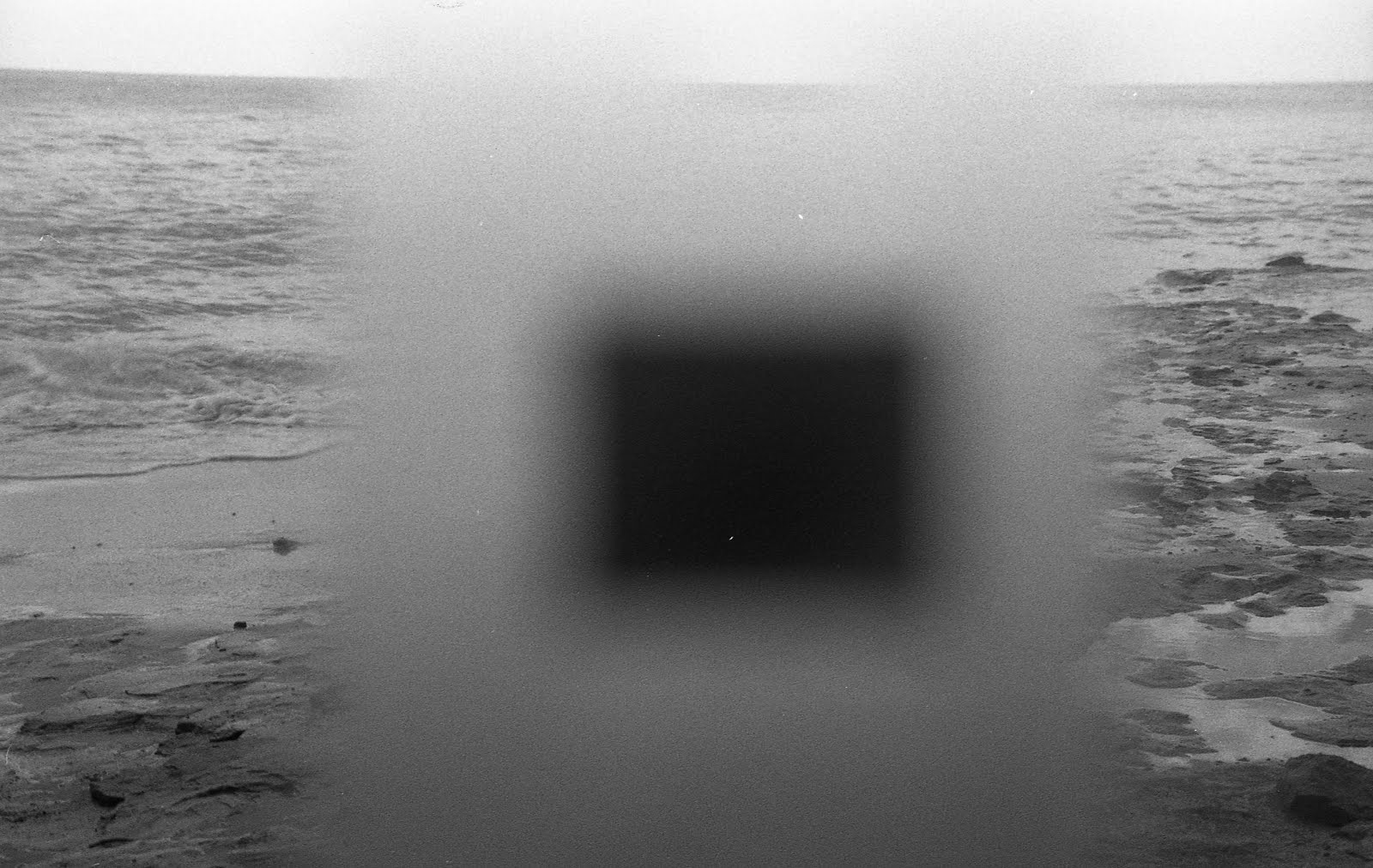
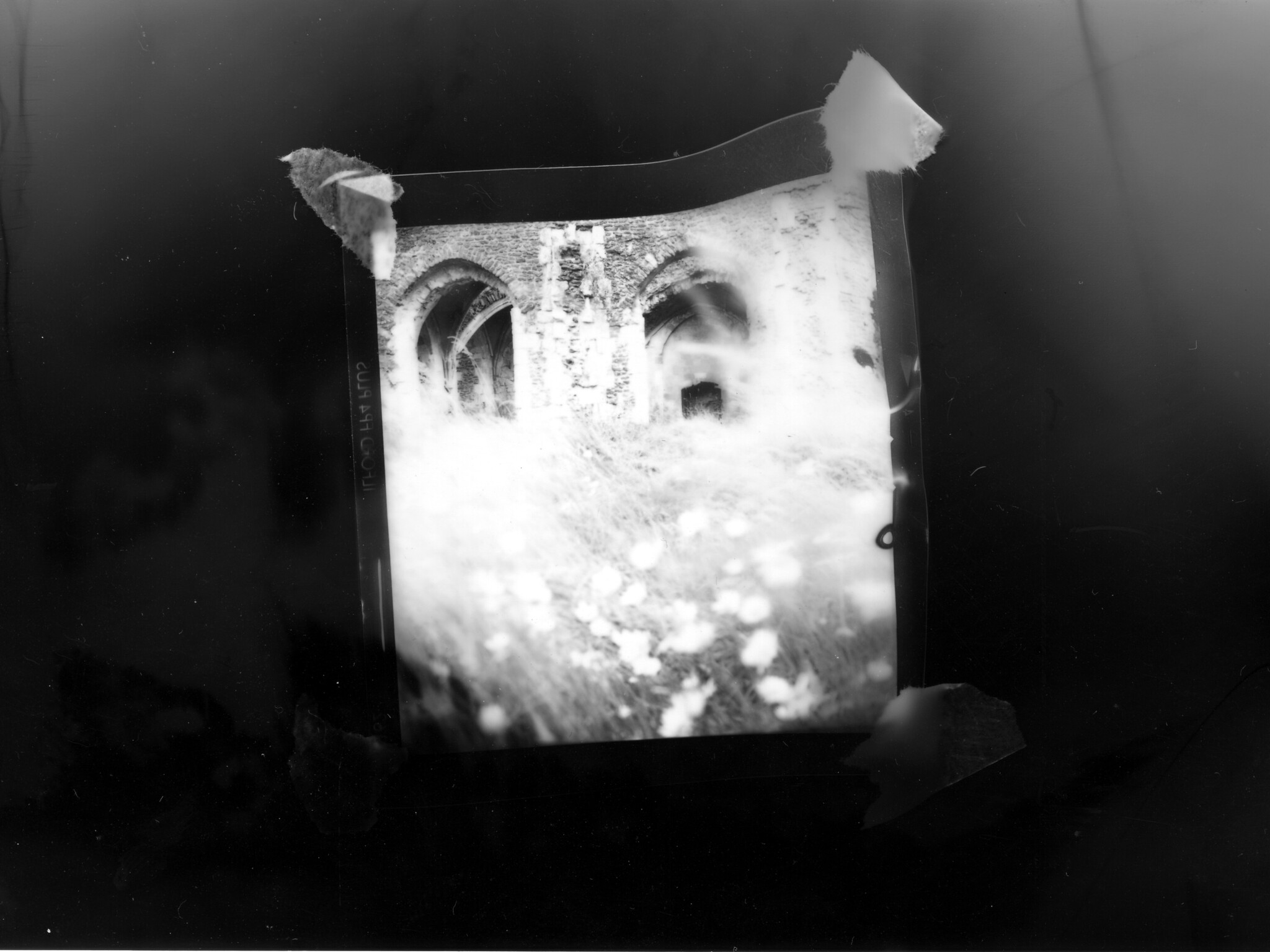
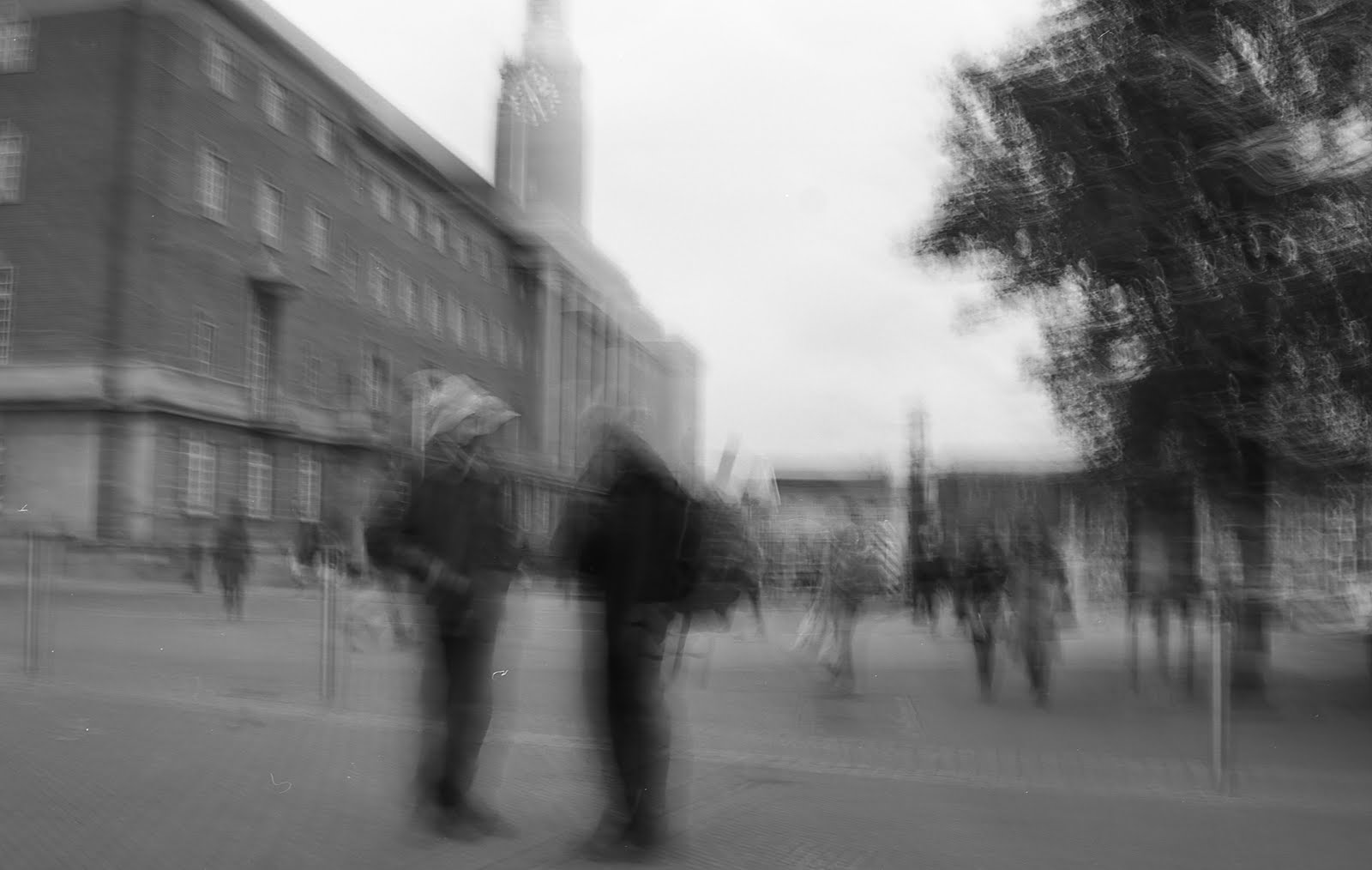
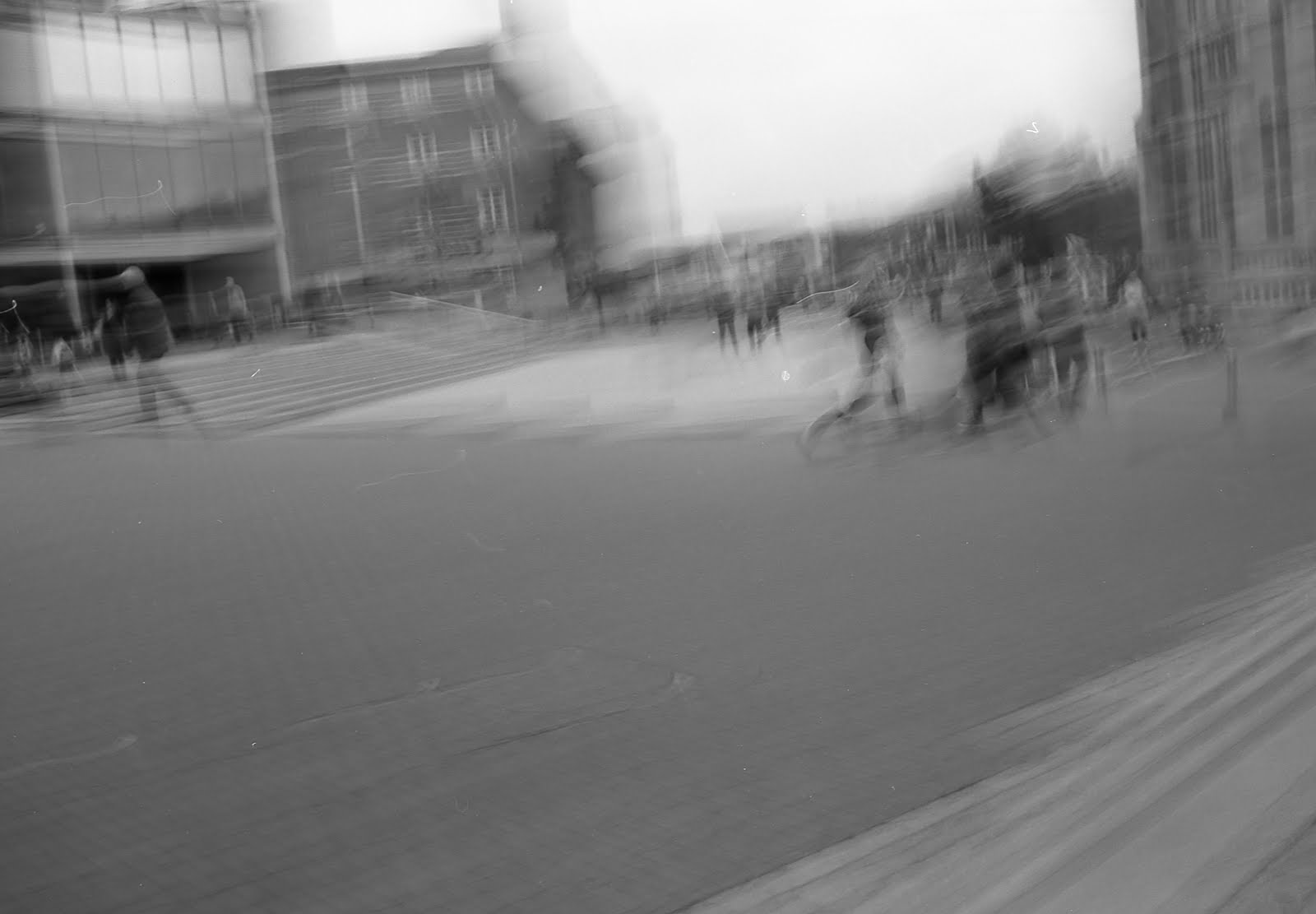
    Using simple apparatuses (pinhole cameras) and the urban environment my practice gathers up time based evidence of everyday activities and render them into a surface of seamless abstractions. These surfaces prompt me to inquire into particularities of place, its after-image and our

    subjectivity/objectivity of the photographic document that is itself permanently extracted from the flow of contexts.

    I am interested in bringing these speculative findings/sequences into the interior space and time/situation of an exhibition.

    The photographic surface has a pathology of looking built into its aesthetic, it takes the urban fabric of human circulation and the built environment and articulates a poetic of isolated complexities. I am interested in finding these spaces and presenting them for further analysis.

    Selected Images : Pinhole Photography with texts, Winchester Library, Millennium Bridge, London.


    Statement of Objectives

    Set-up working environment, darkroom, space for large oil drum camera, drawing space and studio for the interaction of other creative/interested practitioners within the Gildengate House/Complex.

    Mapping of possible ‘sites’ within easy reach of the studio, walking the city with the camera to gather both qualitative and quantitative material, building possible narratives and points of departure for further inquiry.

    The apparatus of the camera and its functionary act as spatial protagonists creating a psycho- geographical rendering of found and experienced places, this material is returned to the studio to be drawn from and collaged into documents of working ideas.

    A dossier of activities and their observations as wall drawings or book works, will begin to form the documentation of the inquiry and suggest possible innovative methods of presentation for exhibition.

    Possible Artist’s Intentions for the Conclusion of the Residency


    I am keen to display the working environment of my practice, its processes and the visualization of my findings, this could be achieved as a working photographic installation, I am reminded of Mike Nelson’s installation at the Frieze Art Fair 2006. Other thoughts around dioramas and projections that evoke the feeling of between spaces of the everyday. I feel confident that the residency itself will craft its own innovative response to the agency and inquiry of my activities with others.

    Art Based Exhibitions/Working Projects/Collaborative Events/Workshops


    Anthropological Entanglements : Strange Tools/An Anthropology of Landscape

    Conversations, Collages/Walks and Creative Consciousness. 2018

    An exploratory approach into the archives of Waveney and Blyth Arts.

    Setting up an inquiry that can become an opportunity for exploration, investigation and exhibition, as well as a place for mutual exchange and support.

    Norfolk & Norwich Open Studios. 2018

    Visual fine artist working with experimental photography, collage and interior design.

    Interior Design MA Degree Show, Farnham UCA. 2015

    Presentation of “The Scriptorium” as a speculative learning environment, realized through collage, model making and digital technologies.

    The Art Barn, Brockwood Park School. 2015

    Design and exhibition of A level student’s work, art books, textiles, drawings and paintings.

    Yard and Meter, 10 days Creative Collisions. 2013

    Collaborative exchange between visual art and poetry. Cyanotype images used as a projection and inspiration for live poetry event and publication.

    Angelus Gallery, Winchester College, Winchester. 2013

    Setting up of a exhibition, artist’s talk and workshop. Works displayed, large drawings, collage, artists journals and research material.

    This exhibition attempted to create dialogues between Fine Art, Studio Practice and Interior Design.

    Negative Capability, The Link Gallery, The Hyde Artist’s Group. 2012

    Art and Archaeological study from the site of the Leper Hospital, Morn Hill, Winchester.

    Exhibition of large cyanotypes/anthropological forms and drawing frames with alternative photographic processes.

    Back To Free School : Drawing out The Archive. Kilquhanity, Scotland. 2011

    Speculative practiced based symposium, converted Pottery into a Camera Obscura, drawings and presentation of land art, pathways from sunrise to sunset.

    10 Days in The City, Winchester. The Theatre Royal Winchester. 2011

    Dressing Room Installation, Darkroom and Studio Space.

    Teaching Academy/Re-Imagining Learning, Brockwood Park School. 2011

    Performed  alternative  learning  environments,  hidden  curriculum/architecture  without  architects  in  the library, walking/making/thinking in the landscape with clay.

    Strong Voices/Interfaith part of Hyde 900. The Link Gallery, University of Winchester. 2010

    The Human Body, absences/presences. traces left through drawing and field chalk on paper.


    10 Days at The Laundry, Winchester. Urban Fallow Project/Thinking Sociologically. 2009

    Large communal arts project organized by The Yard Artists and Winchester School of Art.

    Developed a roving pinhole camera from a oil drum which was used as an apparatus and spatial practice from which to engage with other practitioners and members of the public.

    Wolvesey Castle,Winchester, Live theatre, music and arts installations. 2007 Installation in the foundations and medieval drainage channels of the ruins.

    Childhood “armada” oversized paper boats in restricted area, only accessed via raised viewing platform.

    Hampshire Open Studios, Bramdean. 2006

    Drawings, artist’s books, photography and sculpture all housed in a temporary art space appropriated from a greenhouse (white washed interior throughout with limited access to 2-3 viewers at a time).

    Drawing Spaces : Picturing Knowledge (an interactive artwork) 2006 Hartley Library. University of Southampton.

    Hampshire Open Studios, Bramdean. 2006

    Drawings, artist’s books, photography and sculpture all housed in a temporary art space appropriated from a greenhouse (white washed interior throughout with limited access to 2-3 viewers at a time).

    Artist Statement 2018

    Curatorial Architectures/Assemblages

    Spatial Practice could be a program and a site for a critical approach to social engagement and interdisciplinary collaboration.

    Praxis could be the energy produced between combining research and creative embodiment as speculative strategies/assemblages.

    The Reading Room

    Materials and Objects in Social Space

    Spatial Practices in The Politics of Things


    ‘Ordinary things contain the deepest mysteries’

    Russell Moreton has developed a practice that continues to explore and build interests between the post studio operations of the contemporary artist and the new curatorial assemblages of the 21st Century. He is actively constructing research material that becomes transactive through interventions and installations that are in affect blurring art and the everyday rituals of creative enterprise. Through processes of almost anthropological mappings he attempts to create innovative and immersive exhibition formats that seek to engage a discursive audience.

    Museum Director, Curator, Collector. Artist, None of that means anything anymore.

    J. Rhoades. 1998


    The Studio is no longer a retreat but it now integrates. It is all exterior.

    Ways of Curating, Hans Ulrich Obrist. 2014

    Outpost Studio Application

    Visual artist working with, drawing, alternative photographic processes and installation.

    My contemporary practice utilises and explores the notion of creative working and learning spaces, I am interested in the ability that contemporary arts practitioners develop and craft a praxis between the practical aspects of their practice and its theoretical underpinnings/findinqs. I find these interior spaces and their unique subiectivities/ecologies to be the real value of contemporary arts production. My work seeks to explore and present these findings through, installations, workshops, drawings and photographic presentations.

    I am currently developing ideas around immersive studio spaces/obiects/events that can act as catalysts/containers for my speculative researches into Gaston Bachelard’s, Intuition of the Instant.

    My reading of the text has opened up for me possibilities and thresholds that could be developed through installation, and spatial practices.

    I am interested in using the studio space as both a speculative site that supports my practical experimentation and for theoretical research questions and contexts that may be further developed. The central urban location reflects my previous studio space in Winchester which allowed interactions through the fabric of the city and the social networks of institutions.

    Selected Workshops and Short Courses

    Lost Wax and Kiln Fired Glass : Liquid Glass Centre, Trowbridge 2006.

    Pinhole Photography with Stuart Quinnell : Bradford on Avon 2005.

    Drawing Course with Michael Grimshaw : Winchester School of Art 2004-2005

    Mono Printing and Life Drawing : West Dean College 2002.

    Life Sculpture with Les Johnson ; The Vine Centre Basingstoke 2001-2003

    Life Drawing : Adult Education Weeke Centre Winchester 1993-2003

    Photography Liquid Light with Yoko Matse : West Dean College 1998.

    Picture Framing, Box Mounting and Art Conservation, West Dean College 1995.

    Master Class in Glass Painting with Paul Quail: West Dean College 1987.

    Russell Moreton a visual artist who uses simple gestures of drawn human traces gathered and presented amongst natural materials. Materials and processes are employed to further underpin our sense of place and time. The choice of materials gathered together implies a personal geography, with both an emotional and aesthetic sense of locality and place.

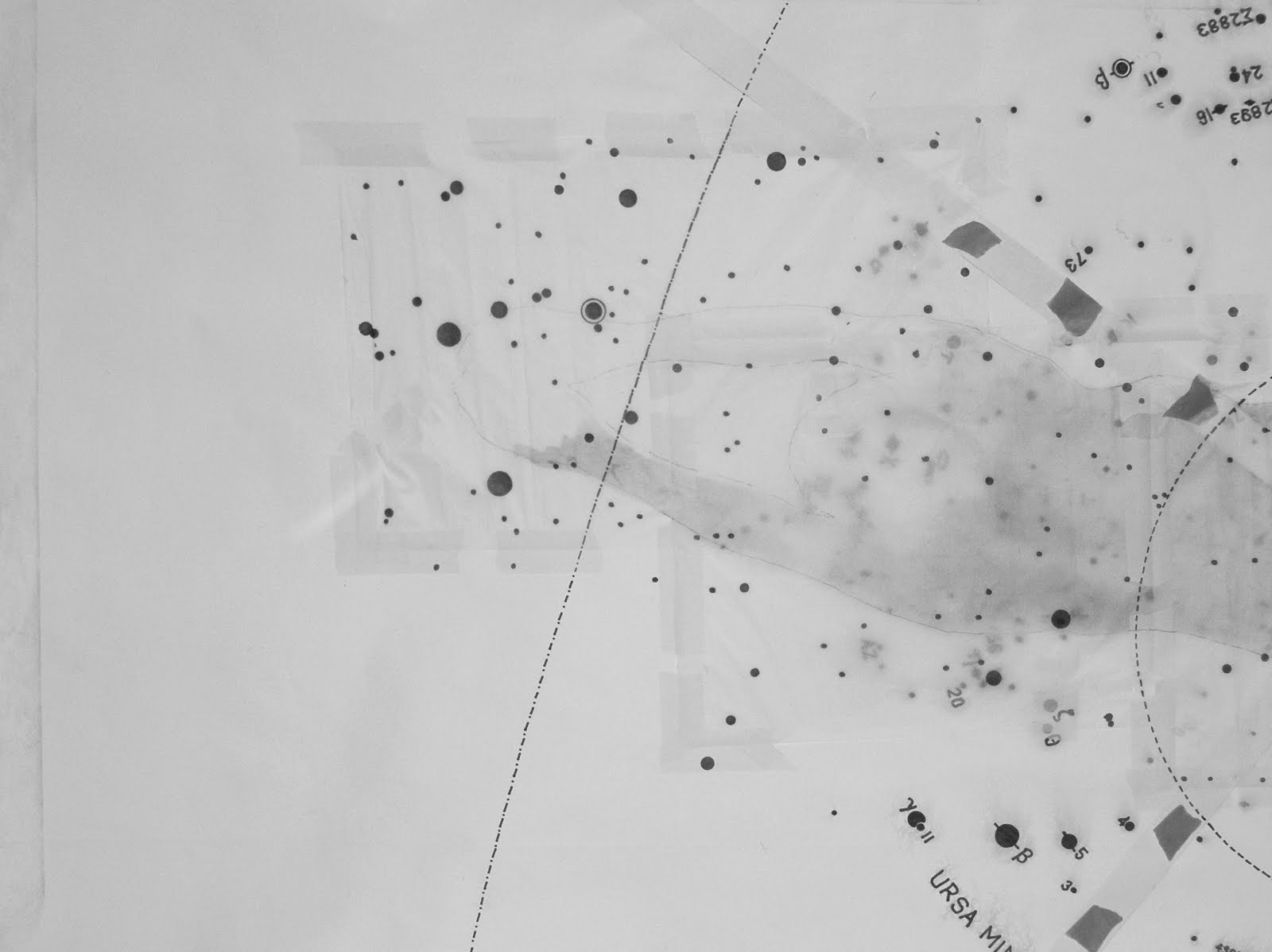
    Currently using trace outlines from the human body, together with cyanotype liquid as a process for registering natural plant forms and other involuntary/found objects. Drawings are further annotated with astronomical charting and research notes from the practice. Previous experience in ceramics, glass and the construction industry is promoting my work into the realm of architectural space.


    Movement : Art : Philosophy : all a movement of thought that moves a body. Erin Manning The Studio is no longer a retreat but it now integra…

    Source: Temporal Perspectives/Relationscapes : Urban Space and Place/Transactive Memory/Outpost Studio Norwich

  • Space Folds/Melts : All that is solid melts into air : Metaphors of Memory : We exist constantly reciprocating between perceptions and relations


    All that is solid melts into air

    Armature :  Memory/Personal Biographies

    The Everyday complexity of things

    Saturnian Form : Lead and Library Dates

    Spatiality : Space over Time

    Space folds : Containing “Spatialities around historicality and sociality”

    All that is solid melts into air

    Karl Marx, Friedrich Engels,

    (Poetic observation concerning the constant revolutionizing of social conditions)

    Perceptions now gathering at the end of the millennium. Spatiality, Robert T. Tally Jr. 2013

    Douwe Draaisma, Metaphors of Memory (Cambridge: Cambridge University Press, 2000).

    “What metaphor, of all those that have been discussed, best describes the memory of psychology itself’

    The author Draaisma Douwe poses this question at the end of an extensive study on the nature of what might be used to give form to ideas about metaphors of memory. The use in my practice of traces, inscriptions, photographic surfaces and materials used as indexical and material memories, call me to give some sense of critical analysis to the issue of metaphor and how it might be “formed” and “utilized” in the situation of work.

    The attraction of metaphors is that they bridge or “hold court” within the visual and the textual, in the physical as perhaps a object association to a situation, and in the sensibility of the poetic.

    Their inherent ability to be an intermediary between a number of things , gives them a lightness, a brevity and a concise comment on a situation, they auger well as a “what remains” of an experience.

    An intriguing quality of metaphors is that they are a union/relation of oppositional associations, which are realized as “go-betweens” active presentations of a specific relation or thought “placed” by the association of concrete and abstract

    relations/relativities. They function by their ability to reference their “betweeness” as held open by their associative registers.” There is a reference to a set of concrete relations in one situation, in order to facilitate the recognition of an analogues set of relations in another situation.”1 Metaphors are structured and formulated around abstract relations around a concrete factualness of image associations.

    G. F. Beck notes that “the metaphor is an intermediary between the agencies of the sensory and the perceptual and those of the verbal and the semantic thought; it belongs neither completely to one nor the other it mediates between analogous and semantic forms of thought

    In a metaphor two constituents work to create its meaning, its place of register, the topic term and the vehicle term. This topic and vehicle terminology is used by Martin and Harre’ when they write “ that the topic term and the vehicle term are each the centre of a semantic field and that the interaction between these two fields enables us to produce and understand new insights.”2 This research has been further investigated and subsequently the terms structured and functional have now been applied to inform the existing relations of topic and vehicle.

    These further defining terms have arisen through metaphors becoming ideally suited to “explaining and teaching theories due to their combination of image and language, and of the graphic and the abstract.”3

    This ability of “metaphor” could be directed at making it site-specific to a particular set of relations, an informative teaching device, that might engender interest through its perspectival analysis.

    The metaphor is in effect a vehicle of projection in as much as it can project associations of one term over that of another , granting an intermediary state given by a superimposed form over its forming relations. This transparency and its associate projection creates new forms of thought. This value/trait has been intimated by research based around “ interaction theory” presented by contemporary theorists Martin and Harre’ although the fundamental theory had already been presented by I. A. Richards in 1936. Richards stated “when we use metaphor we have two thoughts active together and supported by a single word, or phrase, whose meaning is a resultant of their interaction.”4

    The “essence” of metaphor is that it has the ability ( or rather one appropriates this ability) to use something with a “concrete” image in which to form relations and new forms abstracted from this originating situation. This trait creates and is resolved by a “response”, giving comment and a registering of relations. The response of metaphor to a situation could be used to underline a psychological feeling or comment about place.

    Another interesting feature regarding metaphor is that metaphors can display a subjectivity, they can be said to become subject to “wear and tear.”

    Like all human creations metaphors are subject to wear and tear and the process of interaction between the two domains which is set in motion by a metaphor may become fainter and finally disappear.5

    This interaction between “domains” that can slide and eventually fail, and in so doing become obscured , announces the arrival of the phenomenon of the “dead metaphor.” The realisation of the “dead metaphor” is that of a metaphor gradually becoming a literal expression. The metaphor and its prose becomes as it were ossified out of usage, out of the living present. On the subject of dead metaphors Draaisma remarks “ that they have lost their graphic vitality as description of human actions.” Interestingly metaphors have already as it were “been done to death” through literal representation by conceptual artists. My interest is to appropriate their ability to encapsulate differences into a relation that mediates those differences, to aid a sort of summing-up that is “placed between” and is strangely pervasive and fluid , being just held between relations that could suddenly slide or shift. Giving and creating a metaphorical attitude to accompany the experience of place.

    1  G. F. Beck, The Metaphor as a mediator between Semantic and Analogic modes of thought. ( Current Anthropology 19 1978)

    2  J. Martin and R. Harre’, Metaphor in Science in Metaphor, Problems and Perspectives. ( Sussex 1982)

    3  Douwe Draaisma, Metaphors of Memory, (Cambridge: Cambridge University Press, 2000) page 15.

    4  1. A. Richards, The Philosophy of Rhetoric. ( Oxford. OUP, 1936) page 93.

    5  Douwe Draaisma, Metaphors of Memory, (Cambridge: Cambridge University Press, 2000) page 13.

    MA Project Development, Reflective Journal: Notes/Analysis/Comment drawn from previous journal entries.
    29 November 2009
    Photography a process/operating system that holds “Loss” to Dwell in its Detail. Place and its Ruin.
    Representation.
    The Photograph proposes a “site of Loss” within the continuum of place.
    Re-Visit Methodologies and Project Proposal, what might be still relevant and valid, what has occurred to shift the field of perspectives. What has had a limiting effect on the practice in respect to the projects original sphere of operations. Was the project ever thought of in the terms of being “representational” of the practice or was it a device to engage and formulate spatial practices. Recent personal research and events with other proposals for 2010 firmly speculate the need to greatly enlarge the structure of the practice so as to house its diversities, the project is now seen as merely a trace of my activities but it must in some way be representational in its formulation to the practice.
    This bringing together of the various fine-art and visual-art processes present in my practice can only be accomplished through a multi-disciplinary curatorial based spatial relation for the encounter of others. By the nature of a proposal “ a working site” could be seen as an intervention into place from which material sensibilities from fine art practices are interwoven in a situation and experience of spatial relations. Into this field of material and spatial relations a performative element of the practitioner being present and theorising/working could help to create a praxis of informative encounters, which might directly and immediately be implemented into the situation of site. With all this activity and its resultant research derived from site this dialogue , a methodology of sublimation could be engaged that could render down the experience. Maybe in the form of a token of participation, a site driven metaphor, an image that re-constituents the experience and findings of the situation .Added to this gesture it might be possible to engender some sense of hospitality, a feeling that the “visitor” has become an active “interlocutor” for themselves and others, and finally that they have become placed as it were, a “guest” hosted by their own singularities.
    Working in and with Theoretical Methodologies in The Visual Arts
    Gathering Exploratory Notations : Performative/Speculative Spatial Inquiry
    Time as a Structure,
    I
    M                                          a tool acts as a intervention, a memory into material
    E
    A                                           an apparatus can register directional occurrences into visual information to      form from their abstraction, their objectivity, new sensibilities within our subjectivity.
        Rose Graphs (directional analysis of occurrences) used to plot the occurrences and frequencies of           childhood cancers in and around power stations.
    S
    A  Working Sites as spaces of experiencing practical intimacies written into the poetic.
    N
         forming relations by registering phenomena’s that collide with the everyday
    E
         time has a duality, a fluidity, a, between, and, the rehearsal has ended, and with it the misreading or        chance is rendered corrected.
    V
    E  memory as scared time (Chris Marker) or Memory as the intersection of event and its structure, its        dimension of spatial possibilities.
        Information, a superimposed system of transparent relations. Actor-networks,
        Thinking Sociologically.
    N
        Time as an event
    Fire-Space, “objects maintain “their” condition”. Law.
    Praesentia-the Phenomena of something presented in the light of its time.
    Diagrammatic re-enactments drawn as reflections/introspections of a situation.
    A Cosmology of sensibilities illustrated and staged through a predilection for materials and processes, a sort of material allotropy centred around theoretical and physical phenomena.
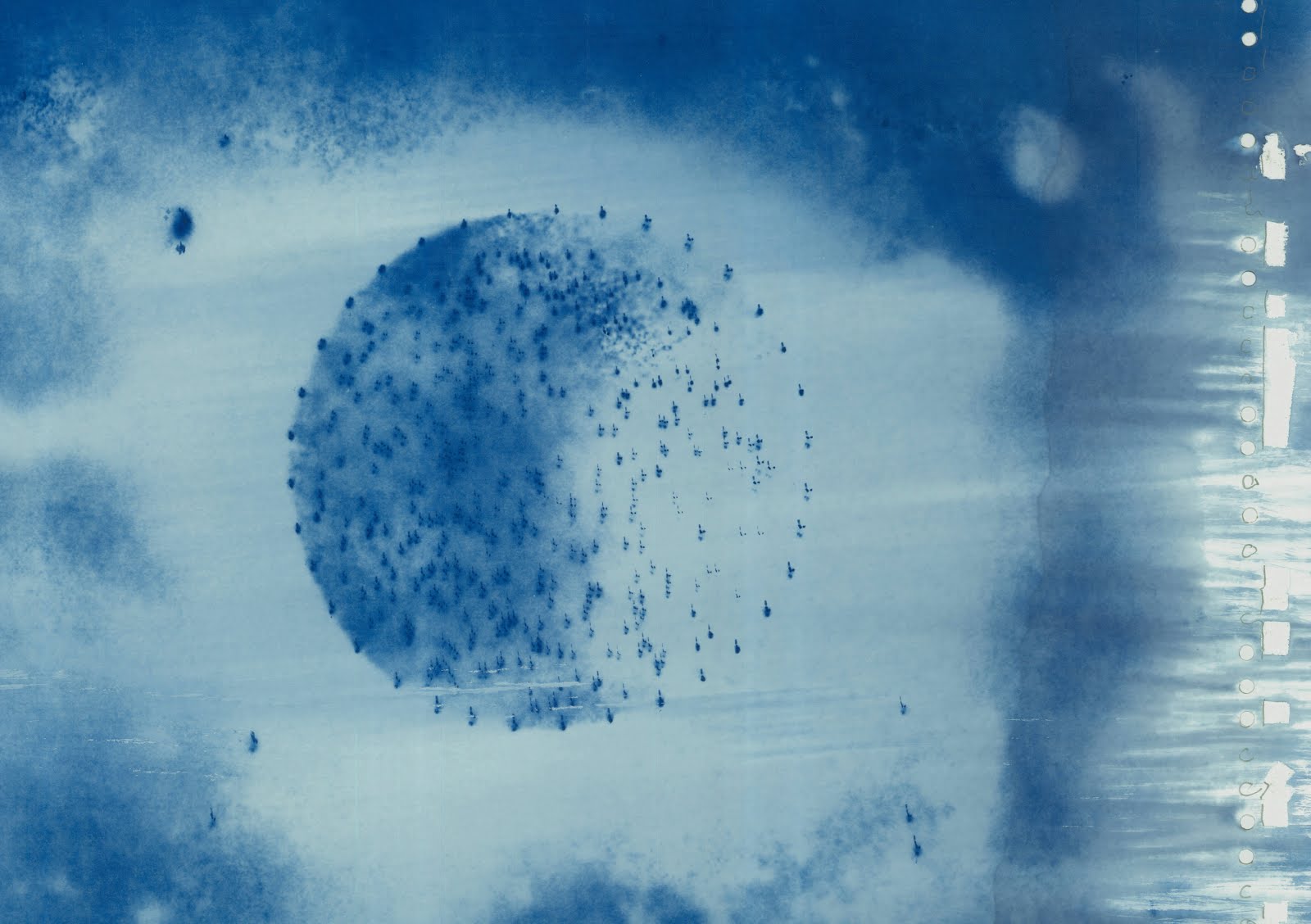
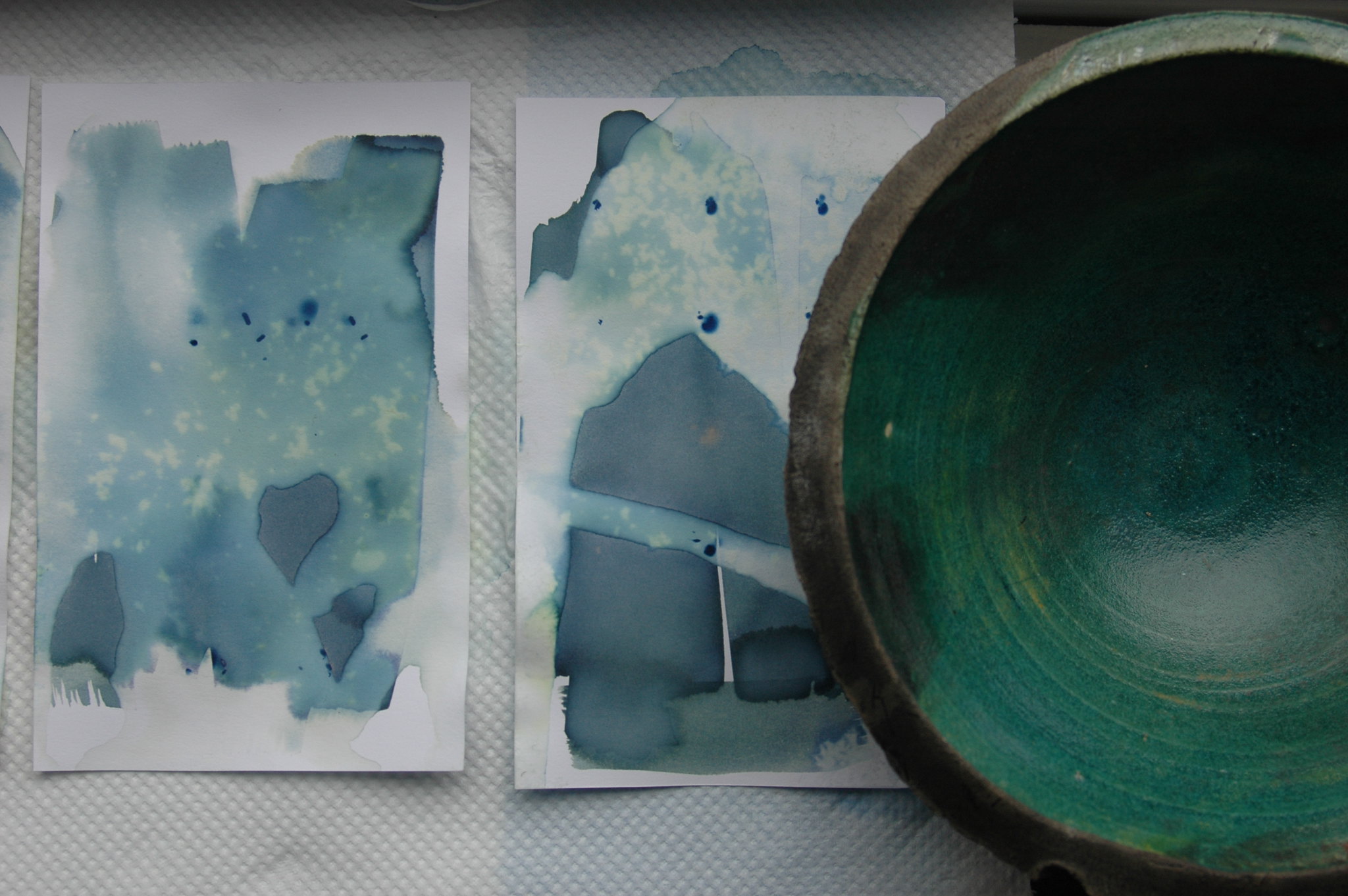
    Cyanotypes, a photographic process that uses a transparency to render a permanent opposite when exposed to sun-light and fixed by washing in water.
    Self reflectivity, the ability to cope (gain wisdom) from a new set of co-ordinates and possibilities.
    We exist constantly reciprocating between perceptions and relations.
    Field notebooks/journals allow and support poetic observation amidst theoretical and practical workings out.
    Stillness and an open stage conceived by a lyrical exactitude between trace and material.
    A place between words and worlds.
    Intimacy of the practical written up into the poetic
    The writers ability “Milton” to hold a number of themes fluid at the same time.


    All that is solid melts into air Armature :  Memory/Personal Biographies  The Everyday complexity of things Saturnian Form : Lead and Libr…

    Source: Space Folds/Melts : All that is solid melts into air : Metaphors of Memory : We exist constantly reciprocating between perceptions and relations

  • Tentative Building/Building The Drawing : Speculative Architecture, landing sites of surface, image and texts.

     Building The Drawing

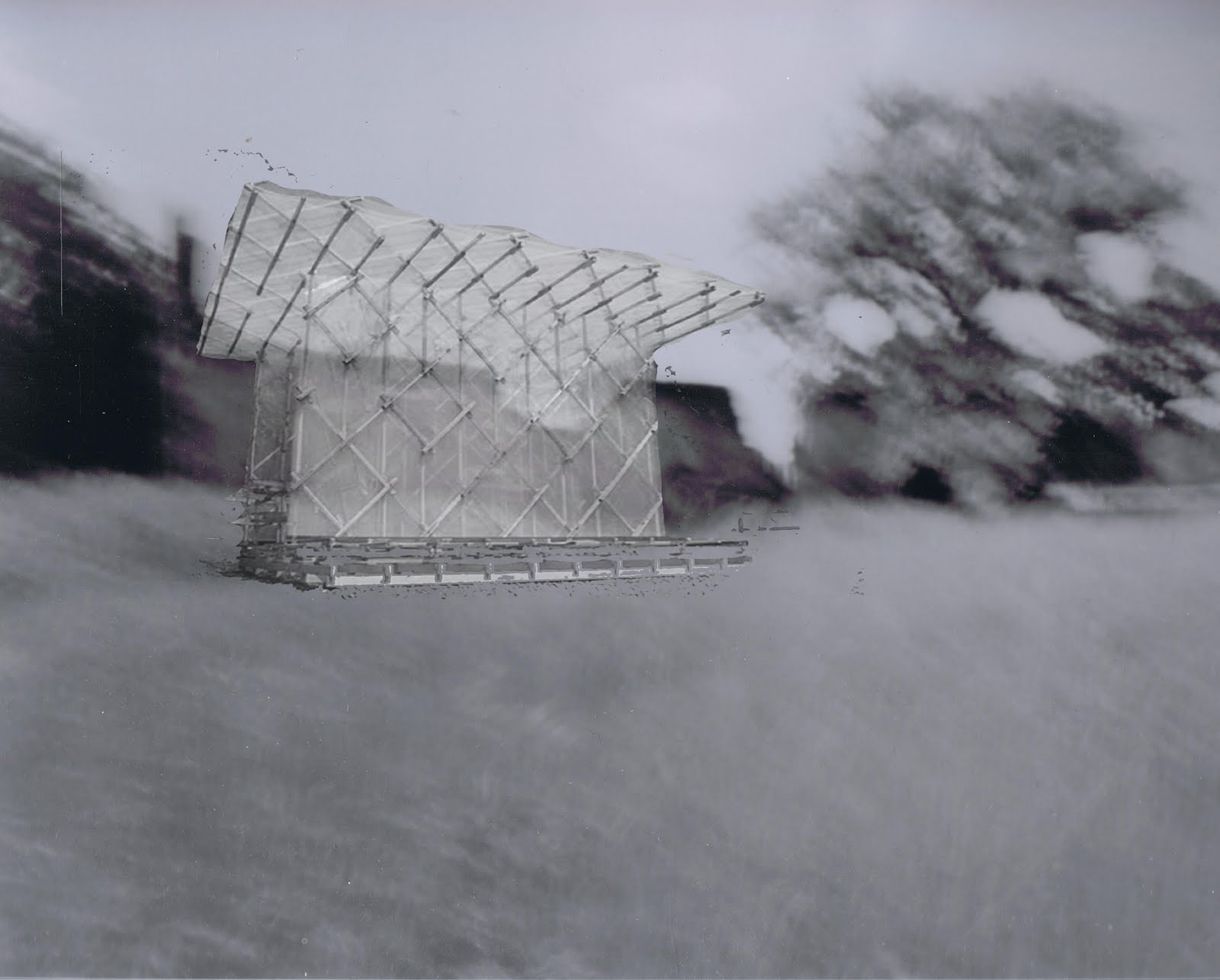
    The drawing as analogue allows more subtle relations, of technique, material and process, to develop between drawing and building.
    Immaterial Architecture
    The Illegal Architect
    Jonathan Hill
    Oak Tree
    Oil
    Paper
    Plaster
    Rust
    Sgratfito
    Silence
    Sound
    Steel
    Television
    Weather
    The arrival of Beuys in a world that was gradually falling asleep amidst minimalism generated a kind of confusion that was truly excellent for opening up the mind. Comfort vanished, driven away by subversive complexity.
    TRANSPARENCY : LITERAL AND PHENOMENAL
    Colin Rowe, Robert Slutzky
    Interactions of the Abstract Body
    Josiah McElheny
    A heuristic technique (/hjᵿˈrɪstᵻk/; Ancient Greek: εὑρίσκω, “find” or “discover”), often called simply a heuristic, is any approach to problem solving, learning, or discovery that employs a practical method not guaranteed to be optimal or perfect, but sufficient for the immediate goals.
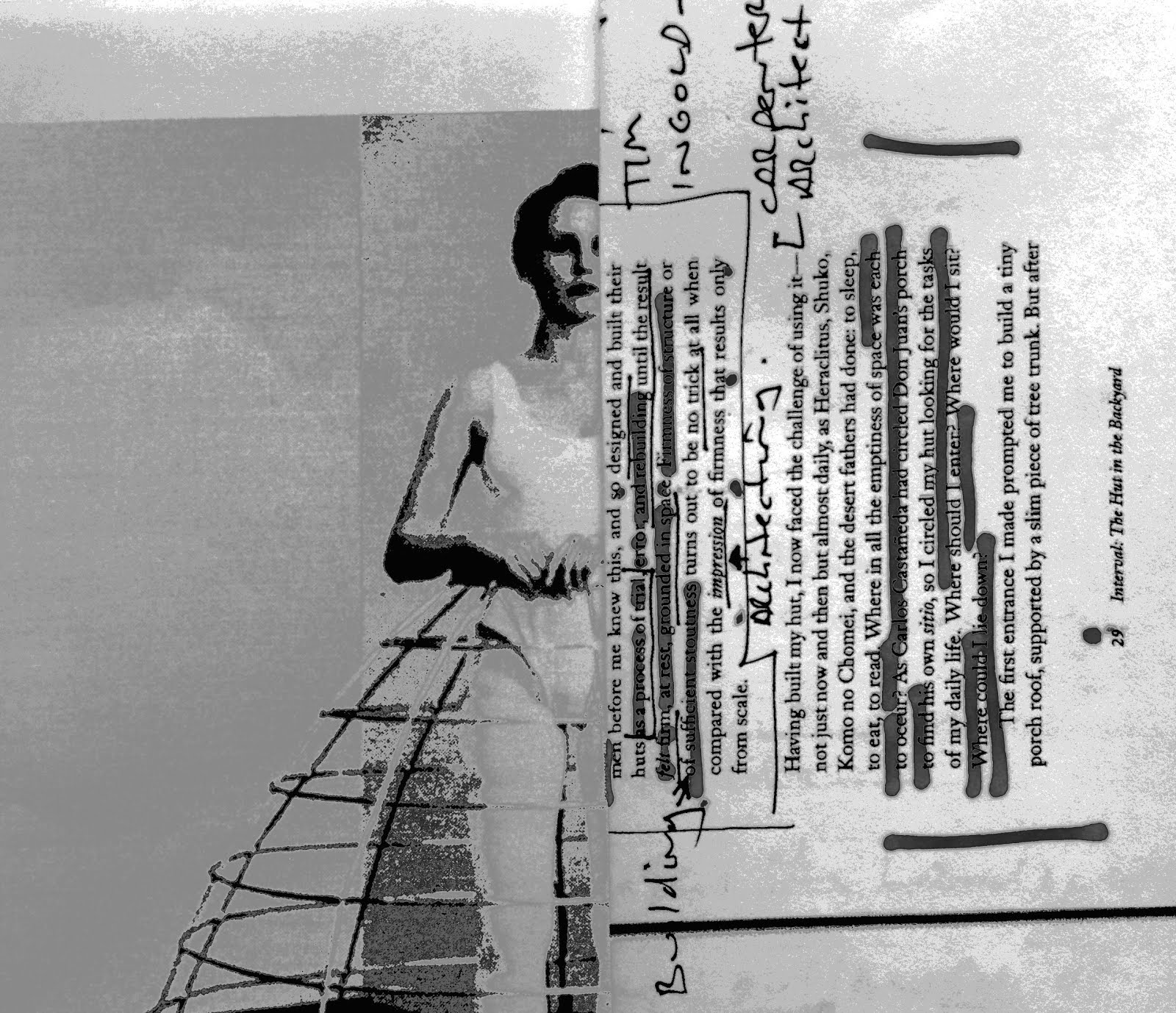
    A Hut of One’s Own, Ann Cline
    Texts, Annotations, Foundations, Pathways, Corridors, Bookmarks, Walking, Thinking, Ramble, Cross Country, Disciplines,
    Analogies in and of sensate materials
    Drawing Surface
    Table Fabric
    Colour Palette
    Timbre in Objects
    Assembled Spatial Volumes/Assemblage
    Photographic Collage (mise en scene/abyme)
    Making Discursive : Art Practice/Praxis
    Outpost Studio, performative drawing, photographic collages, gallery bench (movable)
    Drawing for charting table 1.5m x2.2m
    Human trace, rust/wax on paper
    Material Thoughts
    Marks and Residues
    Process and Reading
    Matter and Desire : An Erotic Ecology. Andreas Weber.
    Walking and Mapping : Artists as Cartographers. Karen O’Rouke.
    Art as Contemplative Practice : Expressive Pathways to the Self. Michael A. Franklin.
    Object Lesson
    Interactive Abstract  Body (Square)
    The Spatial Body (After Fontana)
    Tracing Eisenman
    Stan Allen
    Indexical Characters
    FABRIC=MASS+ FORM
    Alan Chandler
    The interest in fabric formwork is in its deployment in a building process, which is faster than conventional formwork. Fabric formwork is inherently more sustainable due to the minimising of both concrete and shuttering, and more radically, allows the constructor to intervene in the process of casting even as the cast is taking place.
    ReThinking Matereriality
    The engagement of mind with the material world
    Elizabeth DeMarrais, Chris Gosden, Colin Renfrew
    The Affordances of Things
    Towards a  Theory of Material Engagement
    Aesthetics, Intelligence and Emotions
    Relationality of Mind and Matter
    Material Agency
    Towards a Non-Anthropocentric Approach
    Carl Knappett, Lambros Malafouris
    At The Potter’s Wheel : An Argument for Material Agency
    We should replace our view of cognition as residing inside the potter’s head, with that of cognition enacted at the potter’s wheel.
    The Neglected Networks of Material Agency : Artefacts, Pictures and Texts.
    Material Agency as Cognitive Scaffolding
    The Cognitive Life of Things
    Material Engagement and the Extended Mind
    Lambros Malafouris, Colin Renfrew
    Minds, Things and Materiality
    Michael Wheeler
    Communities of Things and Objects : A Spatial Perspective
    Carl Knappett
    Imagining the Cognitive Life of Things
    Edwin Hutchins
    Things and Their Embodied Environments
    Architectures for Perception
    Structuring Perception through Material Artifacts
    Charles Goodwin
    Ceramic Pavilion/Fired Earth Architecture
    People make space, and space contains people
    MATERIAL MATTERS
    ARCHITECTURE AND MATERIAL PRACTICE
    Katie Lloyd Thomas
    PLENUMS : RETHINKING MATTER, GEOMETRY AND SUBJECTIVITY
    Peg Rawes
    ARCHITECTURE
    IN THE AGE  OF DIVIDED REPRESENTATION
    The Question of Creativity in the Shadow of Production
    Dalibor Vesely
    The Nature of Communicative Space
    Creativity in the Shadow of Modern Technology
    The Rehabilitation of Fragment
    Towards a Poetics of Architecture
    The Projective Cast
    Architecture and its Three Geometries
    Robin Evans
    Architects do not produce geometry, they consume it
    Analysing ARCHITECTURE
    Simon Unwin
    Geometries of Being
    Architecture as Making Frames
    Space and Structure
    Atelier/Glass Studio with Scriptorium

    They will be schools no longer, they will be popular academies, in which neither pupils nor masters will be known, where the people will come freely to get, if they need it, free instruction, and in which, rich in their own experience, they will teach in turn many things to the professors who shall bring them knowledge which they lack.

    This then will be a mutual instruction, an act of intellectual fraternity.


    Michael Bakunin, 1870.


    Freedom in Education/Anarchism, Colin Ward 2004.

    Procedural Architecture

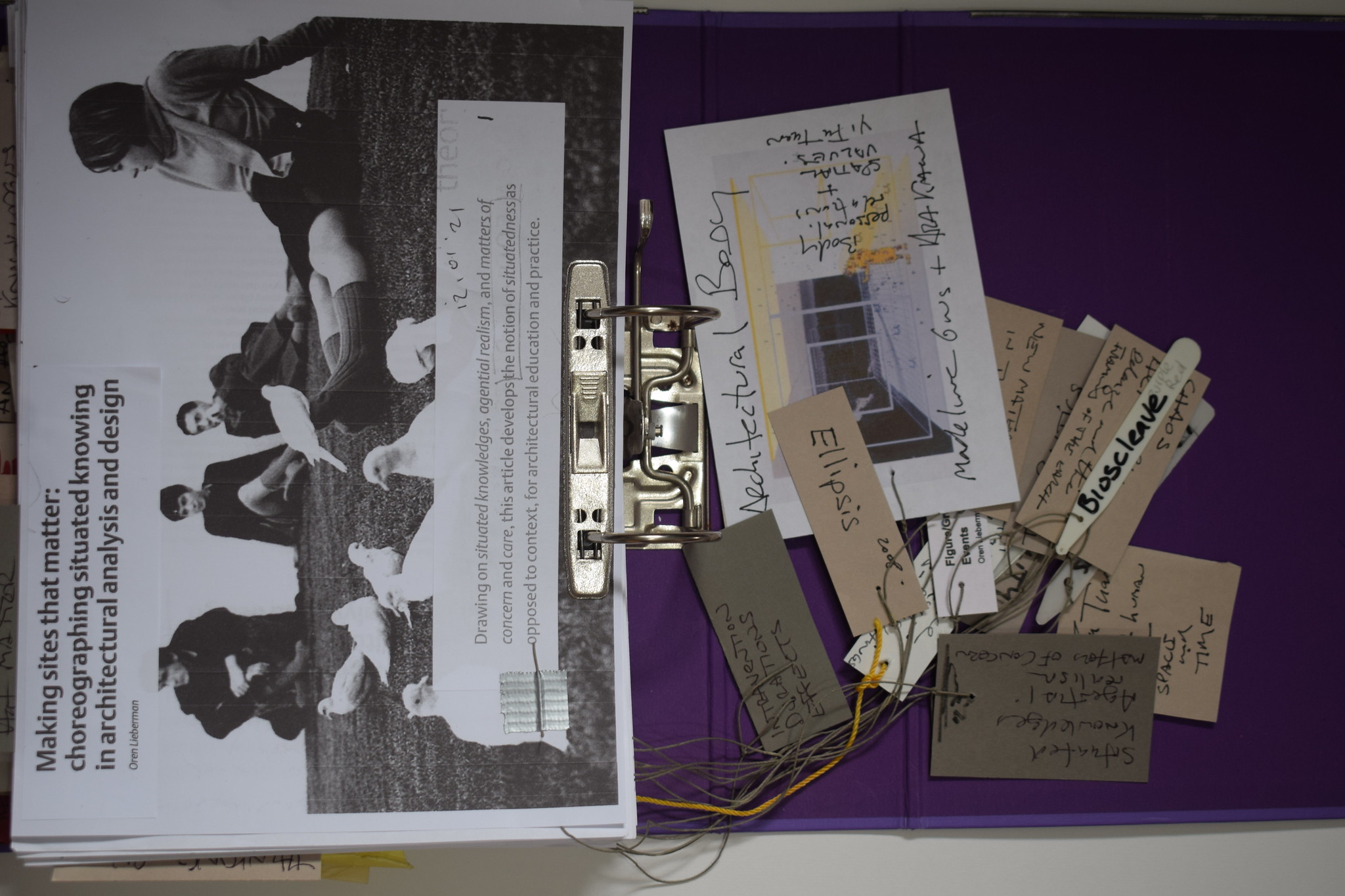
    Start by thinking of architecture as a tentative constructing toward a holding in place. Architecture’s holding in place occurs within and as part of a prevailing atmospheric condition that others routinely call biosphere but which we, feeling the need to stress its dynamic nature, have renamed bioscleave.

    Architectural Body

    Madeline Gins and Arakawa

    Working Notes/Holding in Place

    Interior design presented as an interactive and immersive spatial inquiry

    My research and its design proposal are centred on the arts and the humanities and their ongoing function in our contemporary society. The emphasis of this inquiry is located by the spatial practices of architecture, fine art and performance. My project is a field event and symposium that would be able to host intellectual dialogues, lectures (TED) workshops, performative events and exhibitions.

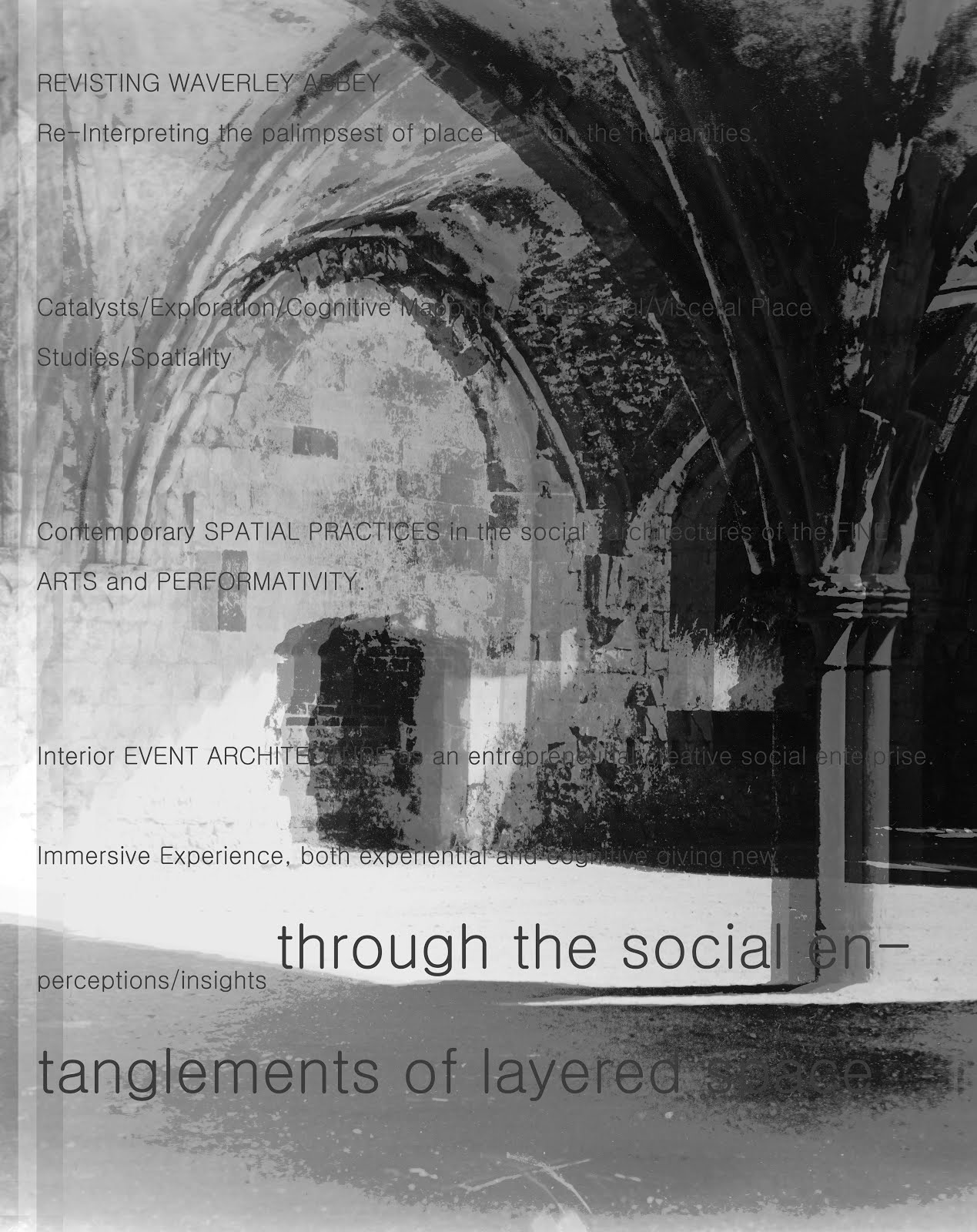
    I am particularly interested in the relational production of social spaces and the aesthetics of built spaces, both historical and ephemeral. The proposed use of Waverley Abbey near Farnham as a possible site and retreat for this venture is valid as it links a possible interdisciplinary territory of anthropology, archaeology, art and architecture.

    The ruined site of the abbey at Waverley, near Farnham has been appropriated as a site and as a place within which to position and develop my practice. The Abbey, its buildings, and its grounds have provided a valuable source of the material evidence for thinking about hapticity and time in a pastoral setting.

    The Scriptorium presents the “performativity of research” through specifically designed apparatuses and partitions. These designed components, made objects, together with annotated texts and drawings conspire to create a complex interior design, a “Place Study” staged in a niche-like space. This interior presents itself as both distinct and relational to the other projects in the MA Interiors Show. The interior presents the many manifestations of creative research that have been developed through engaging with the site.

    Wayfinding/Movements through accumulated research

    Running scripts, enactments, instances, involvements

    Collaborative texts, complexity, emergent, discursive

    From The Bookcase to The Field Table : Landing Sites of Inquiry

    A Philosophy of Emptiness

    Gay Watson

    Artistic Emptiness

    Everything flows, nothing remains.

    Heraclitus

    Rethinking Architecture

    Neil Leach

    Figure 1, Sketch by Jacques Derrida for Choral Work project. 343

    Foucault, Figure 2 Bentham’s Panopticon (1791). 360

    Page laid in, The Atrocity Exhibition by J. G. Ballard, new revised edition, annotations, commentary, illustrations and photos.

    Tracing Eisaenman

    Plenum, juxtaposed to form/haptic values/body absences

    Robert Mangold

    Between moments of ‘meaning’ lie spaces or blanks of immediate experience. Such blanks are actuality. Usually the blank, the actuality, goes unnoticed because it works so efficiently to differentiate one meaningful event from another. Kubler discussed this in The Shape of Time.

    Interactions of the Abstract Body

    Josiah McElheny

    Object Lesson/Heuristic Device

    The term ‘heuristic’ is understood here to denote a method of addressing and solving problems that draws not on logic but on experience, learning and testing. In this regard stories and fictional narratives can be heuristic devices in acting as ideal models that are not to be emulated but which help to situate characters, actions and objects.

    Space Between People

    Degrees of virtualization

    Mario Gerosa

    Adaptive Architectural Design

    Device-Apparatus

    Place

    Function

    Adaptation

    The second phase of project activity acknowledges that the proposal involves two sites; the landscape of settlement and the artifice of the factory. The design is intended to be a reflection of the conditions of each, so there was a need to work directly with the manufacturing process, at full scale, as early as possible. This would provide an immediate counterpoint to the earlier representations and a necessary part of exploring the manufacturing medium in the context of architectural design. 69

    Immaterial Architectures

    Mark Cousins suggests that the discipline of architecture is weak because it involves not just objects but relations between subjects and objects. And if the discipline of architecture is weak, then so, too, is the practice of architects. Architecture must be immaterial and spatially porous, as well as solid and stable where necessary, and so should be the practice of architects.

    Herzog and De Meuron

    Natural History

    Exhibiting Herzog and De Meuron

    We are not out to fill the exhibition space in the usual manner and to adorn it with records of our architectonic work. Exhibitions of that kind just bore us, since their didactic value would be conveying false information regarding our architecture. People imagine that they can follow the process, from the sketch to the final, photographed work, but in reality nothing has really been understood, all that has happened is that records of an architectural reality have been added together.

    My studio is a piece of architecture that is silent. The things of which it is made say all and at the same time nothing. Its strength lies in its demanding silence. A stern silence in order to permit works to occur. I imagine that a painting by Newman could be hung there.

    The arrival of Beuys in a world that was gradually falling asleep amidst minimalism generated a kind of confusion that was truly excellent for opening up the mind. Comfort vanished, driven away by subversive complexity.

    Speculative architecture

    On the aesthetics of Herzog and De Meuron

    My photographs are part of my way of thinking about and imagining spaces and light, of pondering and approaching an idea. In this case, the photographs generate a way of looking at a structure that exists only in order to provoke a sensorial and intellectual experience.

    Cristina Iglesias : METONYMY 2013

    Working Collages

    Karl Blossfeldt


    Building The Drawing The drawing as analogue allows more subtle relations, of technique, material and process, to develop between drawing a…

    Source: Tentative Building/Building The Drawing : Speculative Architecture, landing sites of surface, image and texts.

  • Architectural Light : Drawing into the photographic process

    When you make photograms, without the use of a camera, you can indeed call that abstract photography, as the lens and the corresponding registration medium are lacking. No longer do you have pictures of reality or objects; you only have their shadows. It is a bit like Plato’s cave, where one could only imagine reality; the objects themselves were not visible.

    Thomas Ruff

    Found Objects : Archaeological Photogram

    Drawings : Speculative Constructions in Photography

    Deleuze claimed that he did not write “about” art, literature, or cinema, but, rather, undertook philosophical “encounters” that led him to new concepts.  As a constructivist, he was adamant that philosophers are creators, and that each reading of philosophy, or each philosophical encounter, ought to inspire new concepts. Additionally, according to Deleuze and his concepts of difference, there is no identity, and in repetition, nothing is ever the same.  Rather, there is only difference: copies are something new, everything is constantly changing, and reality is a becoming, not a being.

    Cell

    Court

    Domain

    Drawing into the photographic process

    Poche/Niche : The shaped presence between two surfaces/volumes

    Reading Rooms : Waverley Project


    When you make photograms, without the use of a camera, you can indeed call that abstract photography, as the lens and the corresponding regi…

    Source: Architectural Light : Drawing into the photographic process

  • LIVING Intensity : FRONTIERS OF ARCHITECTURE, Kirosan Observatory/Anti-Object/Anthropology/Art

    Anti Object

    We are composed of matter and live in the midst of matter. Our objective should not be to renounce matter, but to search for a form of matter other than objects. What that form is called architecture, gardens, technology is not important.

    Kengo Kuma

    Procedural Architecture

    Start by thinking of architecture as a tentative constructing toward a holding in place. Architecture’s holding in place occurs within and as part of a prevailing atmospheric condition that others routinely call biosphere but which we, feeling the need to stress its dynamic nature, have renamed bioscleave.

    Architectural Body

    Madeline Gins and Arakawa


    LIVING : FRONTIERS OF ARCHITECTURE

    Louisiana Museum of Modern Art.

    Wang Qingsong : Dormitory, China, 2005

    Key Words : Observatory, Camera Obscura, Living, Seeing, Intensity

    BEHAVIOROLOGY ( the study of the combination of natural dispositions, social environment and personal experience)

    Deals with the special atmosphere and character of the suburb. In film, literature and art the suburb often has an undertone of something mysterious, eerie, of events that are kept hidden.

    The dual desire to see and to be seen leads to instability. An object may be made transparent, but it remains an object. And transparent, it is more thoroughly under observation and more thoroughly dominated. Conditions in the suburbs are in a sense even more wretched than those in the panopticon.

    Kengo Kuma/Observatory/Anti-Object

    Uchronia, Burning Man Festival, Nevada. 2006

    Rouen Concert Hall and Exhibition Complex

    Architectural Envelope/Heterogeneous Composite

    Movement Vectors/Layers : Interior Concrete Skin/Visible Arches of the Steel Skeleton

    Painting Space : Yellow ochre on white gesso over kraft paper

    An Anthropology of Landscape

    Christopher Tilley

    Kate Cameron-Daum

    Spirituality in Contemporary Art

    The Idea Of The Numinous

    Jingu Yoon

    New Global Ecologies

    Baratunde Thurston

    INTENSITY : Portable Architecture as Parable. Mark Prizeman

    The act of moving through mobile societies makes this transient architecture understandable.

    A nomad uses what is to hand and able to be replaced or adapted.

    The success of a tent depends on the exploration of an idea in the workshop by wandering through the dream and not being restricted by the finite parameters of a drawn representation of the future object.

    Like explorers planning to venture into the unknown, an ability to imagine the consequences of what one takes and what one leaves behind is imperative.

    ERASING :

    Kirosan Observatory, Kengo Kuma

    Observatories demonstrate the self-centred nature of human perception. They are generally objects, that is the core of the problem. I wondered if this observatory could be made transparent, that is, effectively erased, so minimising the damage to the environment.

    In terms of erasing an object, the settin is more important than the choice of material. In this case, the setting was a summit that had already been levelled and turned into a perfect pedestal. Anything that is set on a pedestal becomes an object, regardless of what it is made of or how discreetly it is placed.

    Most works of contemporary art are tiresome because they rely on this particular property of the pedestal.

    Observatory/Artists Outdoor Studio with astronomical ‘Hortus Conclusus’ /pavilion/segment built from the walled garden.

    IMMATERIAL :

    Layer upon layer of reality and image, the material and the immaterial, were thus overlapped.

    The Camera Obscura and Telescope, Dumfries. 1836

    It is not quite clear what the real astronomical purpose of camera obscurae was, not only the Royal Observatory at Edinburgh but also the Royal Observatory at Greenwich still posses theirs, though dismantled and stored in cupboards for a century or more.

    Paramatta Observatory, New South Wales, 1822

    Sepia stained cyanotypes of architectural building plans

    Plaster tabletop viewing screen, concave, chalk/matt surface

    Lead weights on natural ropes used to control the apparatus

    What I am most interested in now is inverting the structure of a culture that is centred around the city. The twentieth century was an age of industry, and an age in which everything from material goods, information and culture flowed from the cities to local towns and villages. Following the same vector, architecture, too, flowed out from the centre to the periphery.

    Kengo Kuma

    APPARATUS :

    The Observatory is a facility for stealing looks at visitors

    Electronic technology is used in these devices to expose the imperfection of vision and reverse its privileged status. Under ordinary circumstances, the seeing object is under the illusion that he/she dominates what they see. However, seeing also opens up the possibility of being seen. Anyone who dominates another through vision is always vulnerable to a brutal reversal.

    High and Low, 1963. Akira Kurosawa

    I therefore tried designing a transparent object. My real aim was not to create an object, but to choreograph a sequence of movements by the subject, that is, to create a device controlling his/her vision. Anti-Object, Kengo Kuma.

    Your Chance Encounter, 2010. Olafur Eliasson

    Messr Barr and Stroud, Optical Engineers, Glasgow, used to produce obscuras for industry, they were much cheaper to purchase and maintain in a large industrial establishment than closed-circuit television.


    Anti Object We are composed of matter and live in the midst of matter. Our objective should not be to renounce matter, but to search for a f…

    Source: LIVING Intensity : FRONTIERS OF ARCHITECTURE, Kirosan Observatory/Anti-Object/Anthropology/Art

  • Palimpsest/Architectural Models/Formworks : Installation/Ceramic Forms/Sketchbooks


    Painting Canvas/Formwork 3mx3m : Shelter/Sensing Place/Painting in the Landscape
    FABRIC DEVELOPMENTS = MASS + FORM
    Collected Notes : Raveningham Sculpture Trail 2020
    Studio Blackboard
    ODYSSEY  Aesthetic Intervals/Timbre/Traces
    Raveningham Architectural Canvas/Form
    Framed-Un-Framed Construction Sensing/Site  2020
    Aesthetics between objects
    Fragments from note books
    Art Works, a constellation of coincidences/intuitions resting the not being made
    Re-animating context
    Aesthetic perception, how aesthetics are represented in a object by philosophers and scientists
    Espace-Milieu : Painting as environment entanglements
    Painting in a landscape situation.
    Canvas as spatial phenomena, reading both sides.
    Asymmetries between a particular past and a general future
    The passing of the present through the pure past
    Difference and Repetition : Production/Synthesis of Temporality
    Art Practice/Gathered from Everyday Life : Micropolitics of slowness and repetition.
    The Living Present, constructed from habits, anticipations and recurrences
    Chaos, territory, art
    Deleuze and the framing of the earth
    Elizabeth Grosz
    Immateriality/Temporal/Transitions material and movement/Human agency
    A Species of Spaces
    Construction/Making/Collage
    Forming, slowness and repetition, elements of painting
    Assemblage, sensation, surface, objects and spaces between them gathered/thresholds
    Sheltering/Weathered/ Exploring a fragility of a painting in the landscape
    Robert Mangold, Paintings and Architectural Forms
    Fragments from sketchbooks
    Ephemeral Architecture
    Canvas as spatial verb
    Yellow Ochre, Molochite, Gesso, Canvas, Paper, Textiles, Wood, Lead, Nails
    Canvas as folded construction/shelter/place
    Operative Design, A Catalogue of Spatial Verbs
    Georg Simmel, text Frames, Handles, Landscapes and the aesthetic ecology of things


    Painting Canvas/Formwork 3mx3m : Shelter/Sensing Place/Painting in the Landscape FABRIC DEVELOPMENTS = MASS + FORM Collected Notes : Rav…

    Source: Palimpsest/Architectural Models/Formworks : Installation/Ceramic Forms/Sketchbooks

  • CARETAKING/INTERSPACES The Weird And The Eerie/fluctuating networks of existential events : Photographic pathologies of alterity

    RESEARCH METHODOLOGIES CRITICAL THEORY

    SPATIAL PRACTICES : CANTERBURY 2009

    PERIPHERAL VISION : RELATIONALITY, ROBERT COOPER.

    I have quoted the entirety of this abstract, as its concise and articulate statement needs to be preserved as a fragment capable of reconstituting interest for others and, by keeping its first reading authentically present, it is presented “live” and synchronic with its other enactments.

    “The act of relating is analysed as a constitutive feature of human agency .Relating is viewed as the continuous work of connecting and disconnecting in a fluctuating network of existential events. Relating re-lates the human world as a restless scene of flowing parts in which whole, self contained objects take second place to the continuous transmission of movement. The relating of the world of moving parts is illustrated through the examples of modem methods of mass production and the transmission of information which both produce a “weakening of reality.”

    Keywords: human agency, information transmission, the latent, part-whole relationship, production-prediction

    Robert Cooper’s observation that relating is a continuous connecting and disconnecting, probes the possibilities of spatial encounters that can be grafted onto and within our readings of place. The notion of the temporal and the contingent, are never far away in this “fluctuating network of existential events.”

    Cooper makes an informative comment on modem methods of mass production and communication, “categories and things may make it easier for us to grasp reality but they also hide its underlying complexities.”1

    This sense of partial visibility, made and controlled by things, intrigues me as does the parts on the periphery of perception which remains with the potential to become relational. My work seems to be seeking out and mediating the interspace between the individual and their environment. For me this interspace becomes the space of unfolding implications, whose dynamics, or resonances, are achieved through connections that imply disconnections.

    The photographic evidence utilized in my practice, the way emergent findings are presented and then over written, suggests that this idea of inter space, is totally contingent. This gives a sense of an archaeology of perceptive meanings, which are manifested as visual consolations. These held in an ever emergent state of contingences interests me. The space and time of relativity and relationship, Cooper notes is a place where “nothing can be itself and everything is suspended in an unfinished betweenness that seems to refuse simple location and identity.”2

    Betweenness/walking into a latent field of relationality?

    “Relationality re-lates latency. It re-lates in the double sense of connecting terms and thus creating coherent structures of relations out of gaps and intervals of disconnection, as well as narrating and making explicit the dormant and implicit nature of latency.”3

    1 Robert Cooper, Peripheral Vision: Relationality (London: Sage Publishing, 2005), page 1689.

    2  .Ibid., page 1692.

    3  .Ibid., page 1693.

    PORTRAITS, STILL VIDEO PORTRAITS AND THE ACCOUNT OF THE SOUL, JOANNA LOWRY.

    This text taken from Stillness and Time: Photography and the Moving Image is of interest, as it analylises the properties of the compression of time into a single image and our reading of such material. It is this central issue of time, or rather that photography can intercept it, that interests me through the use of simple light gathering devices. Joanna Lowry remarks on the ability of photography to disrupt “ our common-sense understanding of the relationship between past and present, stopping the flow of time and holding it in an uncanny stillness for years on end, revealing to us a present without a future.”1

    Photography seems to be more about what remains after time is interrupted; it reveals “a fissure in the field of the visible.”2 This fissure could be said to be a frame of a detachment of time, a hermetically sealed dimension, preserving its own unique value of dwelling and promoting a sense of temporality of human subjects, surrounded by an exactitude of place.

    One of the interesting properties of these “time based stills” is that they give a visual site for the triangular relationship between subject, spectator and time. The time element is duration, so therefore these images are filmic semblances, witnessing their subjects, or as Benjamin termed them as “growing into the picture”. The spectator of these encounters (framed by time) becomes aware of a photographic duration. This duration is constantly emerging and it is also constantly forming “sedimentary remains”. Perhaps as Lowry comments “they offer us a new enchantment with the provisionally and fragility of the pose.”3

    This new enchantment, or the site of its alternation, is created by a photographic absorption of a human performance. This phenomenon, of an absorbed and distracted subject as Benjamin has noted, belongs to the earliest forms of photography. What is also relevant here, is the observation made by Mark Godfrey “new technologies produce new forms of subjectivity.”4 Photography produces and procures a difference and a distance. It is a “differentiated space of the visible.”5

    1 .Joanna Lowry, Portraits, Still Video Portraits and the Account of the Soul (Brighton: Photoforum, 2006), page 65.

    2  .Ibid.,

    3  .Ibid., page 78.

    4  .Mark Godfrey, Fiona Tann : Countenance (Oxford: Modem Art Oxford,2005), page76.

    5 Joanna Lowry, Portraits, Still Video Portraits and the Account of the Soul (Brighton: Photoforum, 2006), page 77.

    Artist Statement/Analysis  re Spatial Practices/Methodologies

    My previous experiences have been drawn from a physical relationship to “site” and the possibilities that might be embedded to be encountered for others. It is in the spatiality of Drawing from which I am attempting to create a form, that allows the multiplicity of material associations and yet has a sort of transparency and physicality, that allows specific readings to be experienced through this membrane. Spatial practices offers up a frame of references and cross multidisplinary approaches that are already offering possible solutions.

    My initial use of surfaces Ceramics and Glass, in architectural surroundings, is being redrawn into relationally with the notion of an interlocutor being an active participant and for those others whose proximities and contingences they might create.
    Analysis of my assemblages, which are housed in book form, reveal a spatial overwriting of both written annotations and diagrammatical routing of specific elements. All of this occurs, or is illuminated adjacent too and between, photographic evidence of place.
    This evidence of place is itself a surface of compressed time, inscribed during that time by light. Light therefore suggests itself as the ultimate vehicle of transparency, of both being able to illuminate information and also being able to stream and superimpose seamlessly contingent knowledge’s as they appear.
    The intertextuality of Language, as something that might be configured as an inclusion into physical place is a possibility. My work seems to require this transparency on one hand and yet recent reviews of my drawings, reveal a dynamic engendered from precisely drawn articulations, to a nebulous semblance on the same surface. In effect my interests are on the transition points, thresholds even, of the periphery of perceptions being retained, whilst other things become open and emergent.

    This dynamic across a spatial volume activates the possibilities of seeing things becoming interwoven with creative potentials.
    Other observations, brought from the presentation of working practice, have been the issue of intensive notations, almost as if the photographic surfaces, themselves vestiges of solitudes were being re-enacted by a choreographic sense of re-encountering place. The embedded durations, overwritten by light within the photographic surface, give a semblance of the notion of inter- textuality, or rather its creative possibilities; in fact they are ensnared continuances.
    J G Ballard refers in his writing that it is being envisaged in the visionary present. The extended durations of “the present” captured on a photographic surface could be said to be a concretization of the present by the past.
    These extended durations of always “becoming present” have something about an intervisionary trait, held captive within them. A further visual distortion, achieved by the use of a chamber as the receptacle to mediate the relations between the light outside with the light that penetrates, produces a kind of visual psychosis, a distorted sense of being captive which seems to accompany the image.


    RESEARCH METHODOLOGIES CRITICAL THEORY SPATIAL PRACTICES : CANTERBURY 2009 PERIPHERAL VISION : RELATIONALITY, ROBERT COOPER. I have quoted t…
    Source: CARETAKING/INTERSPACES The Weird And The Eerie/fluctuating networks of existential events : Photographic pathologies of alterity