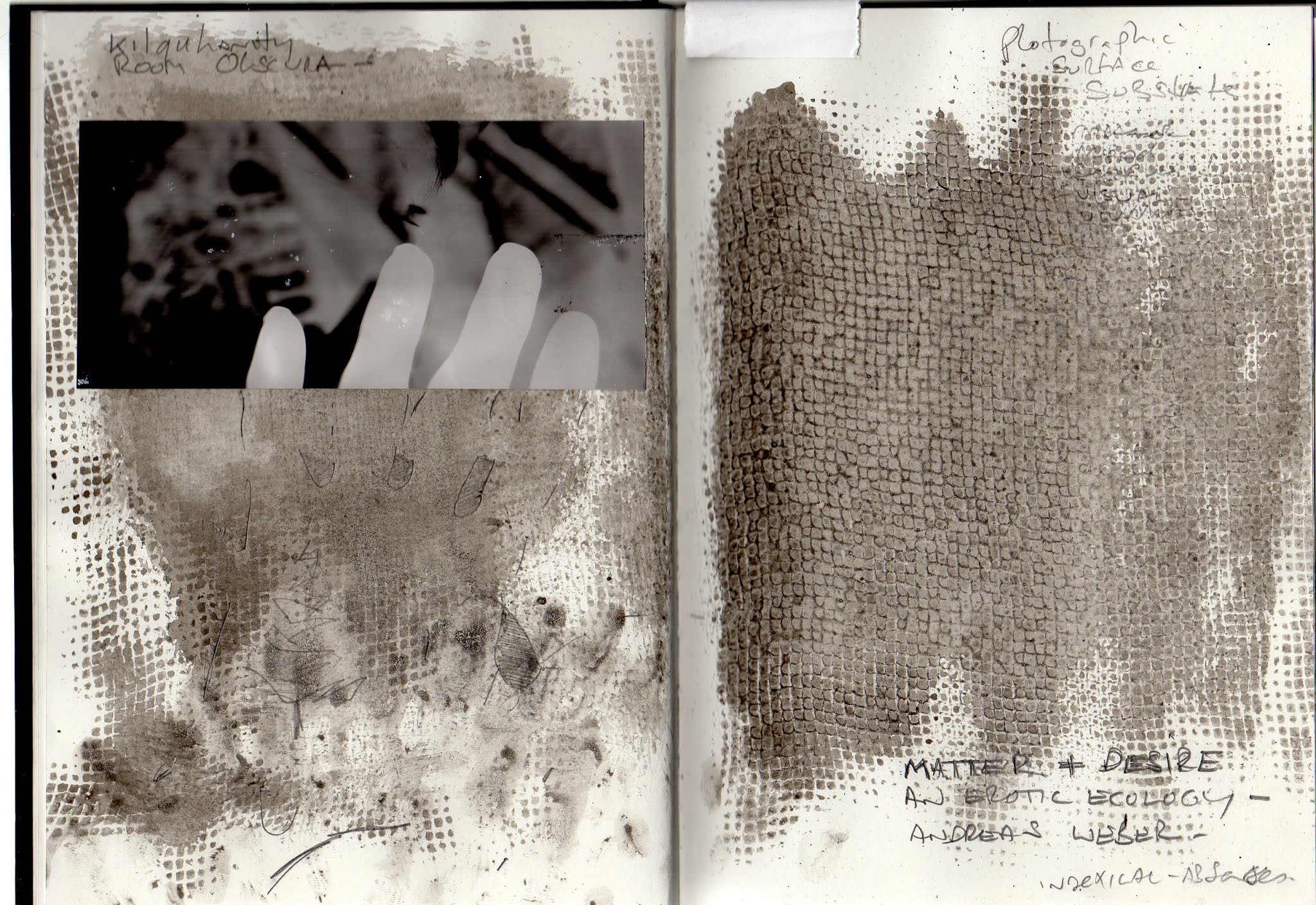
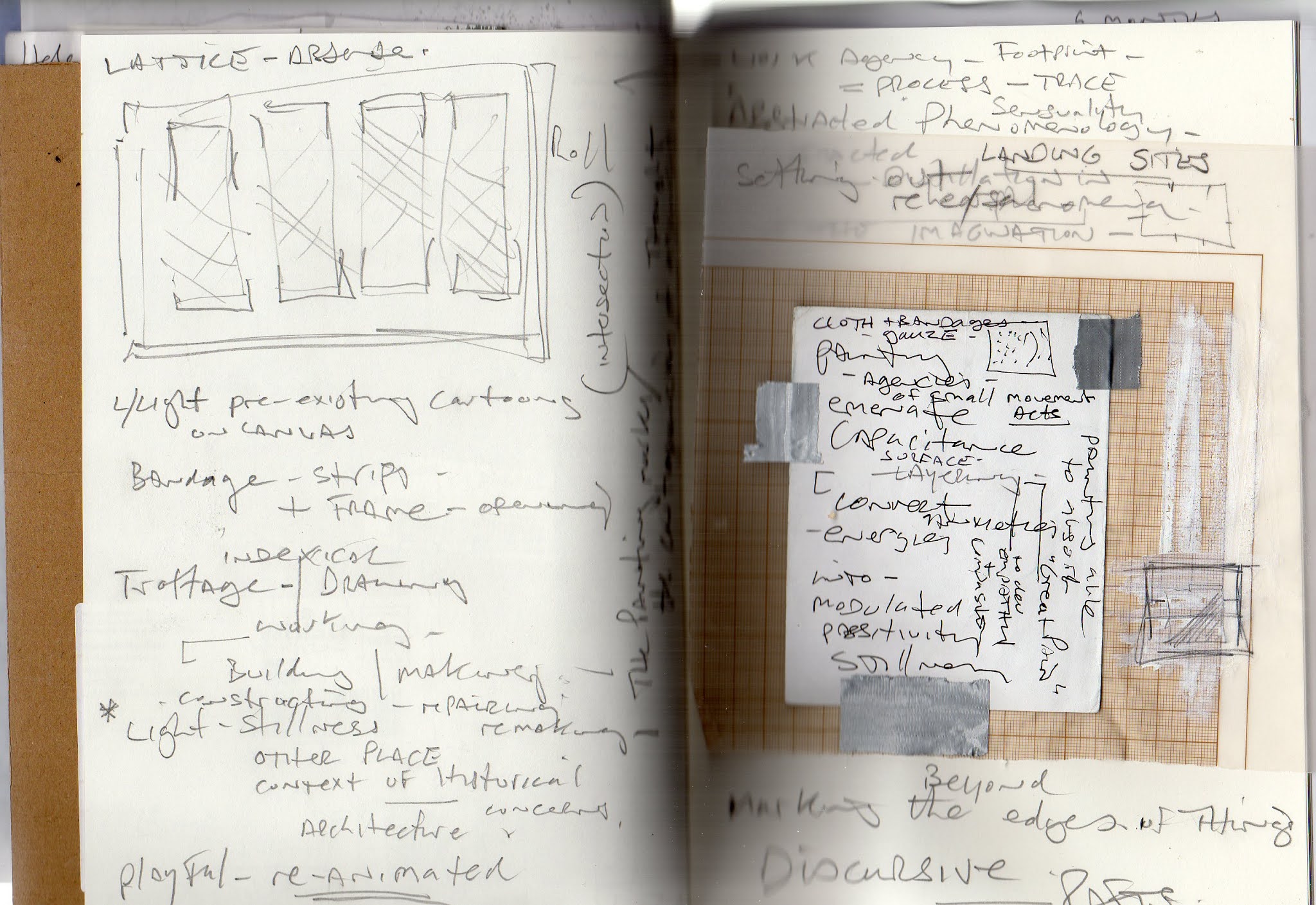
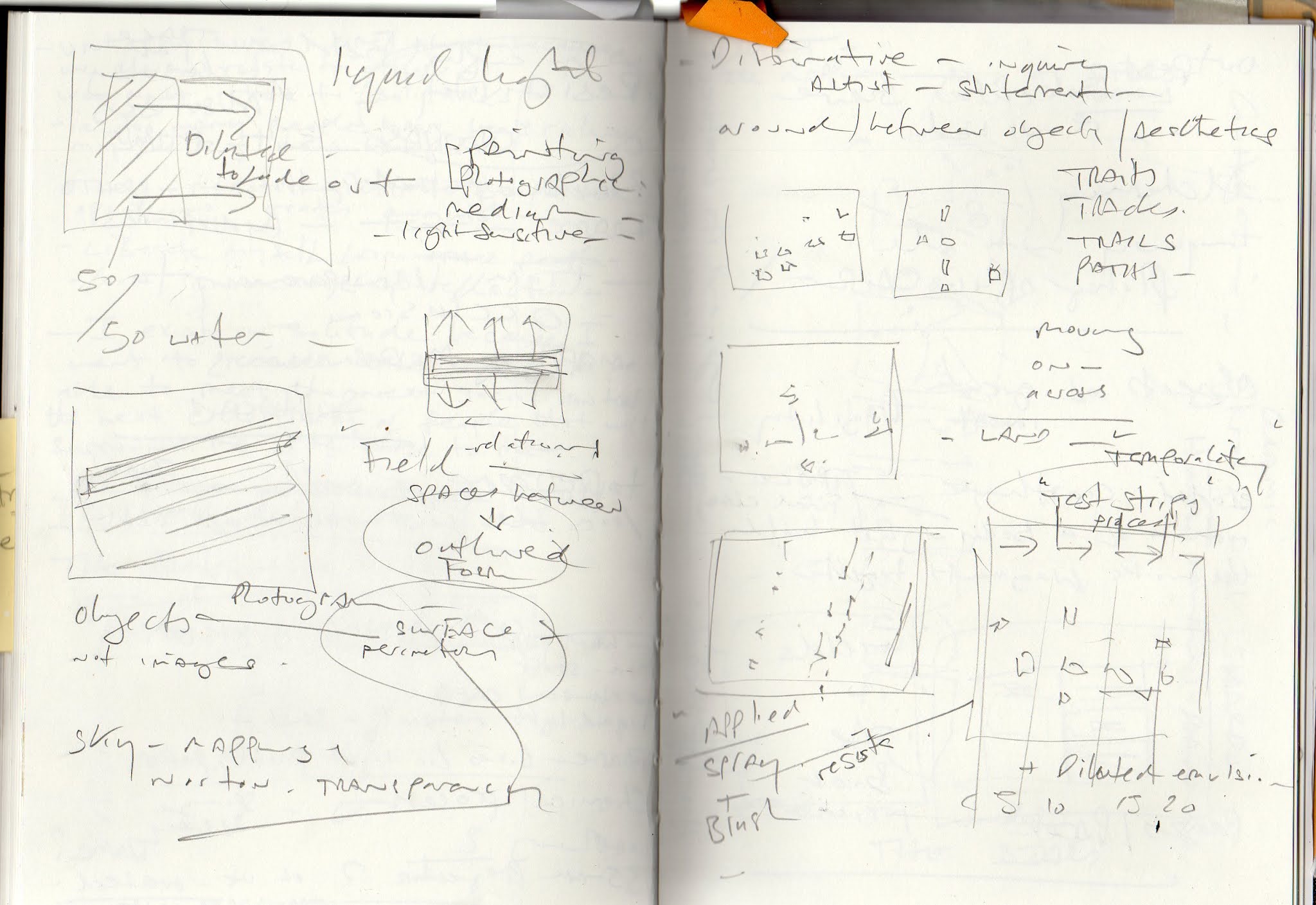
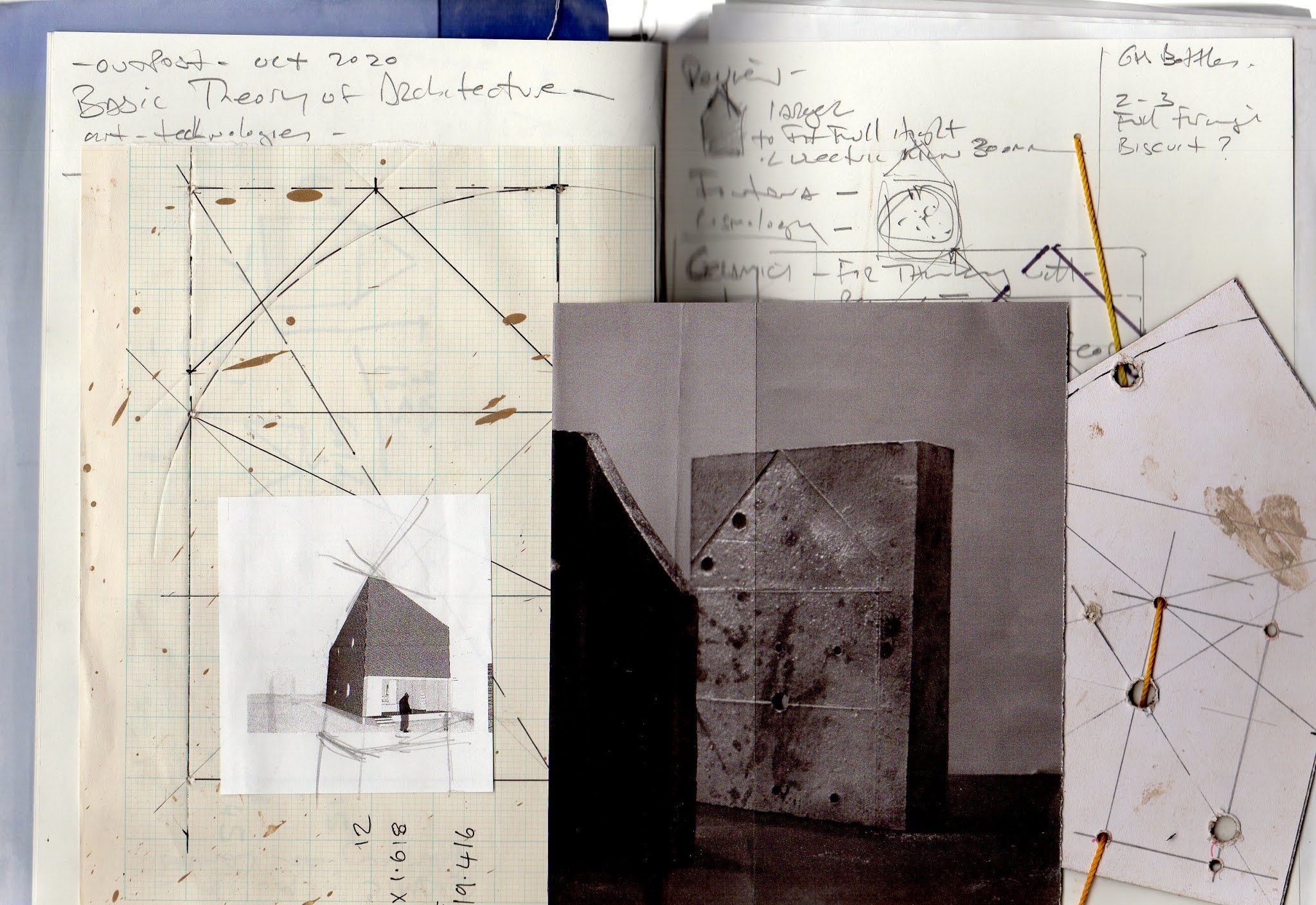
Spatial Practices : Experimental drawing and alternative photography.

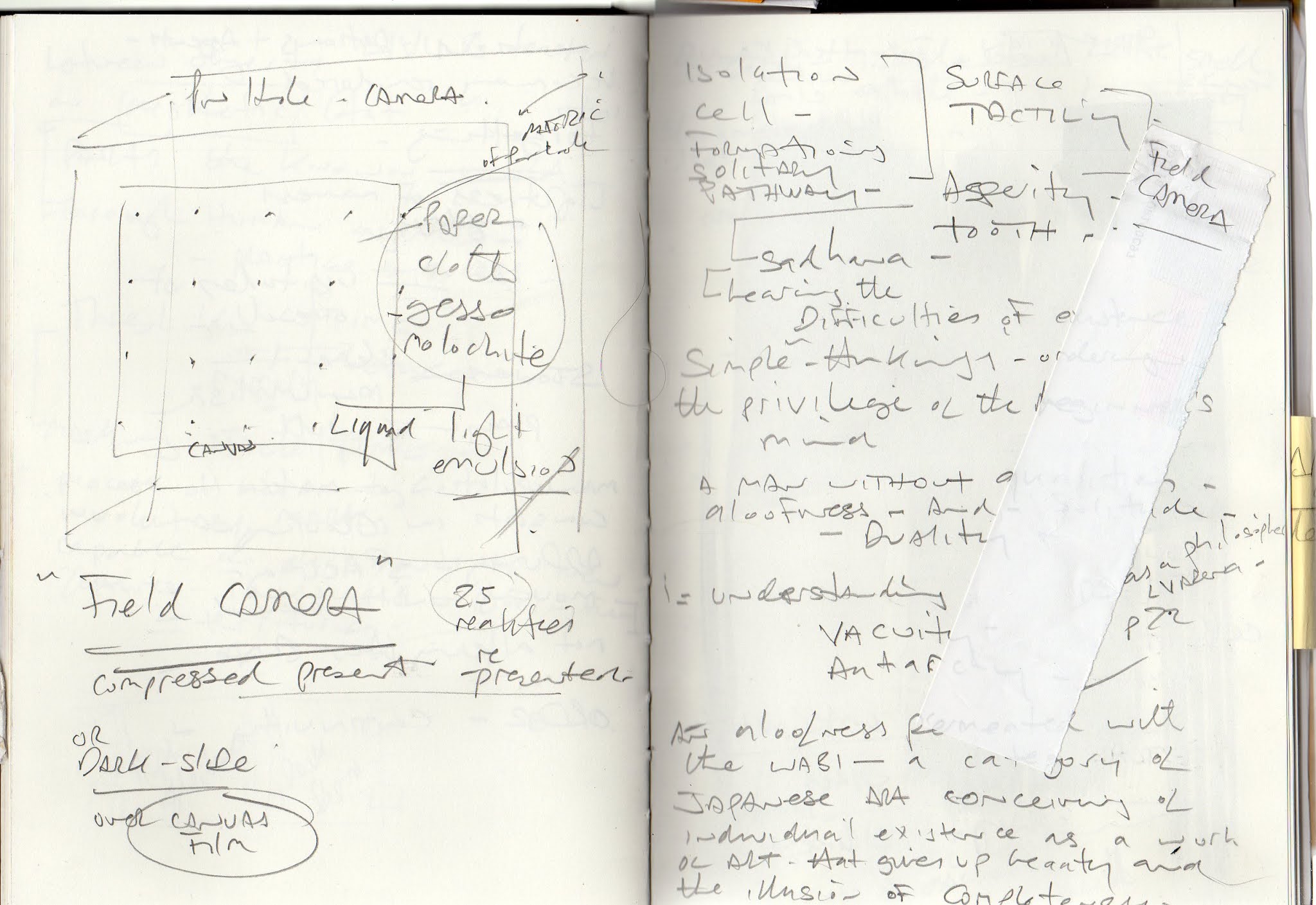
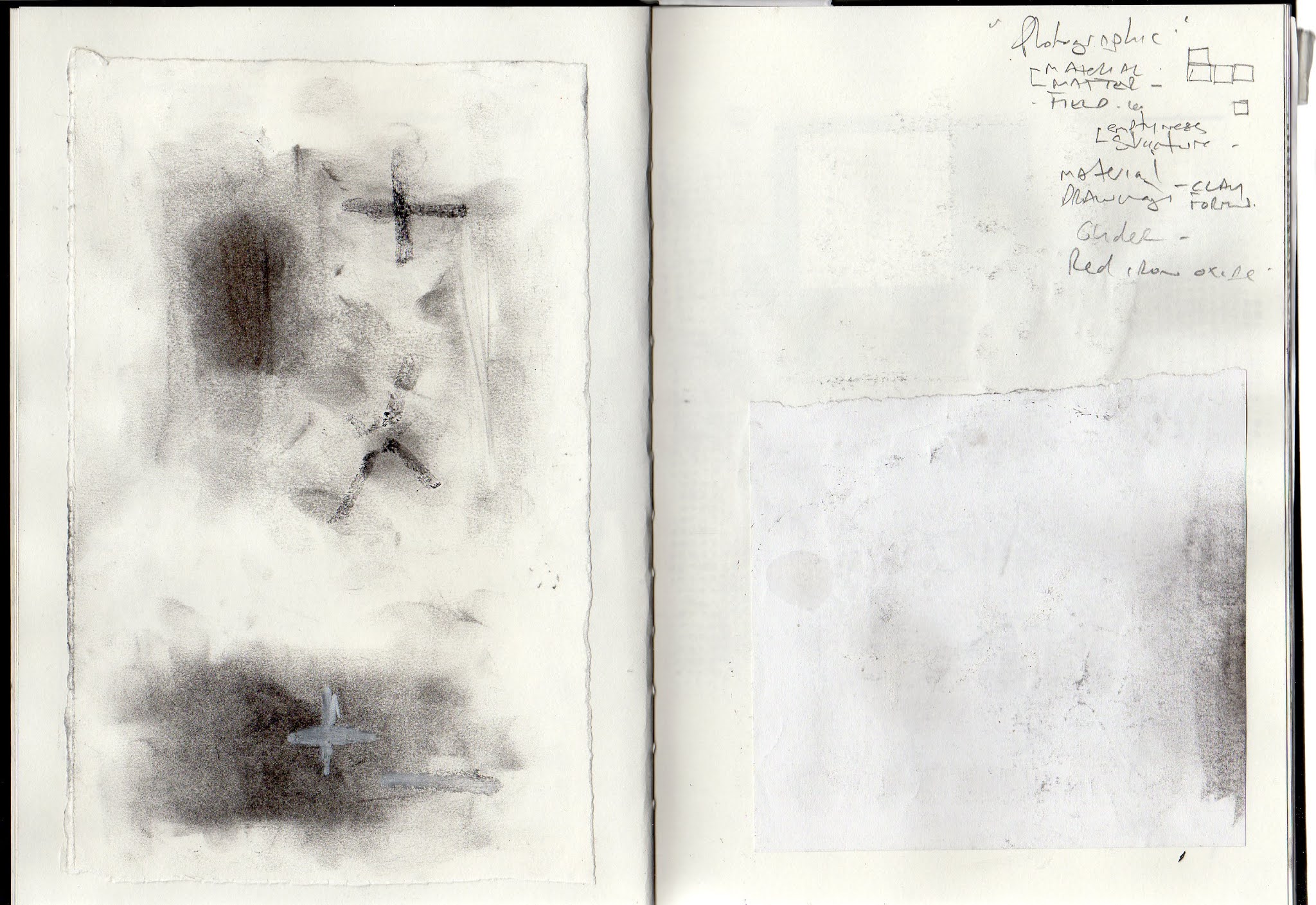
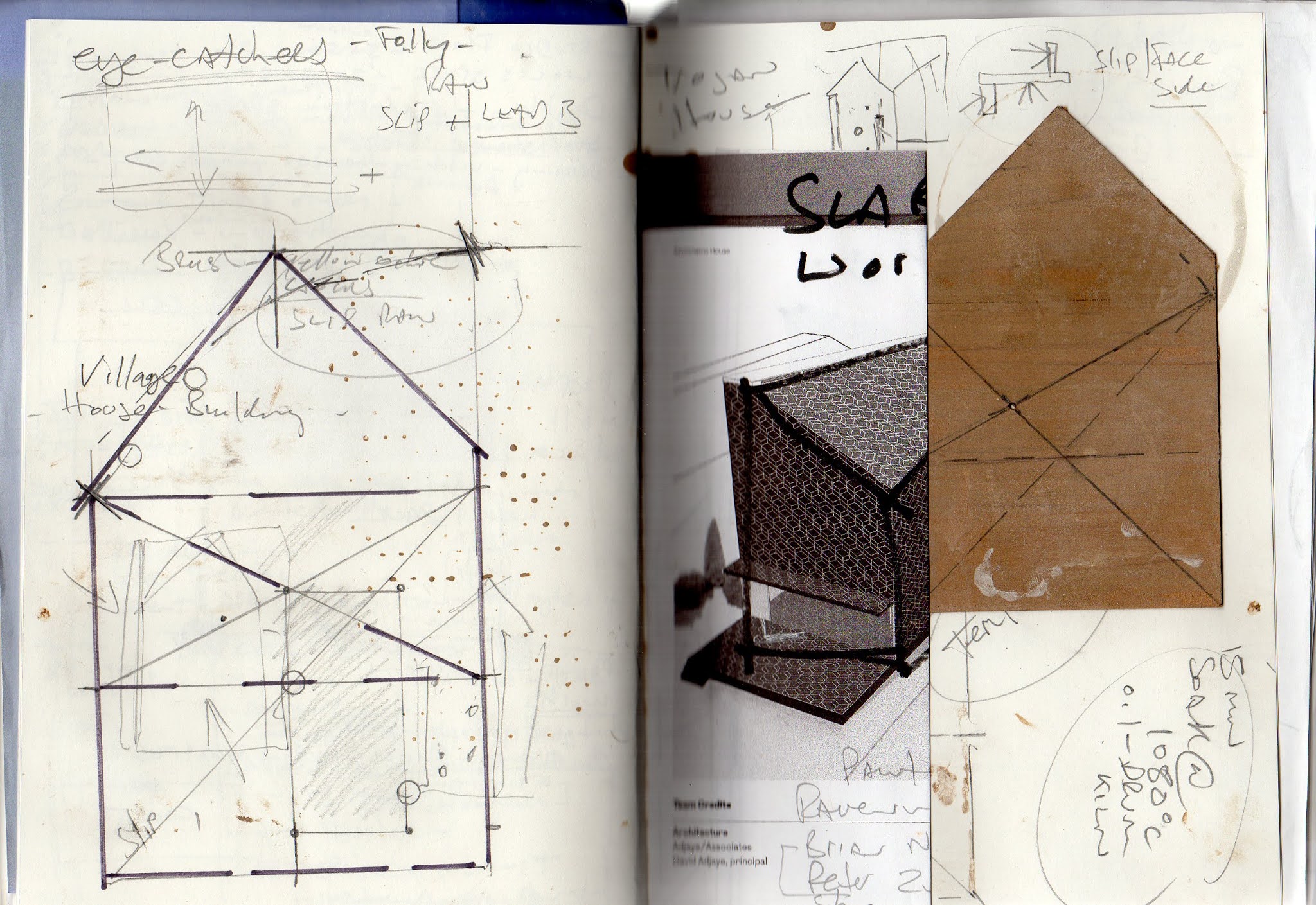
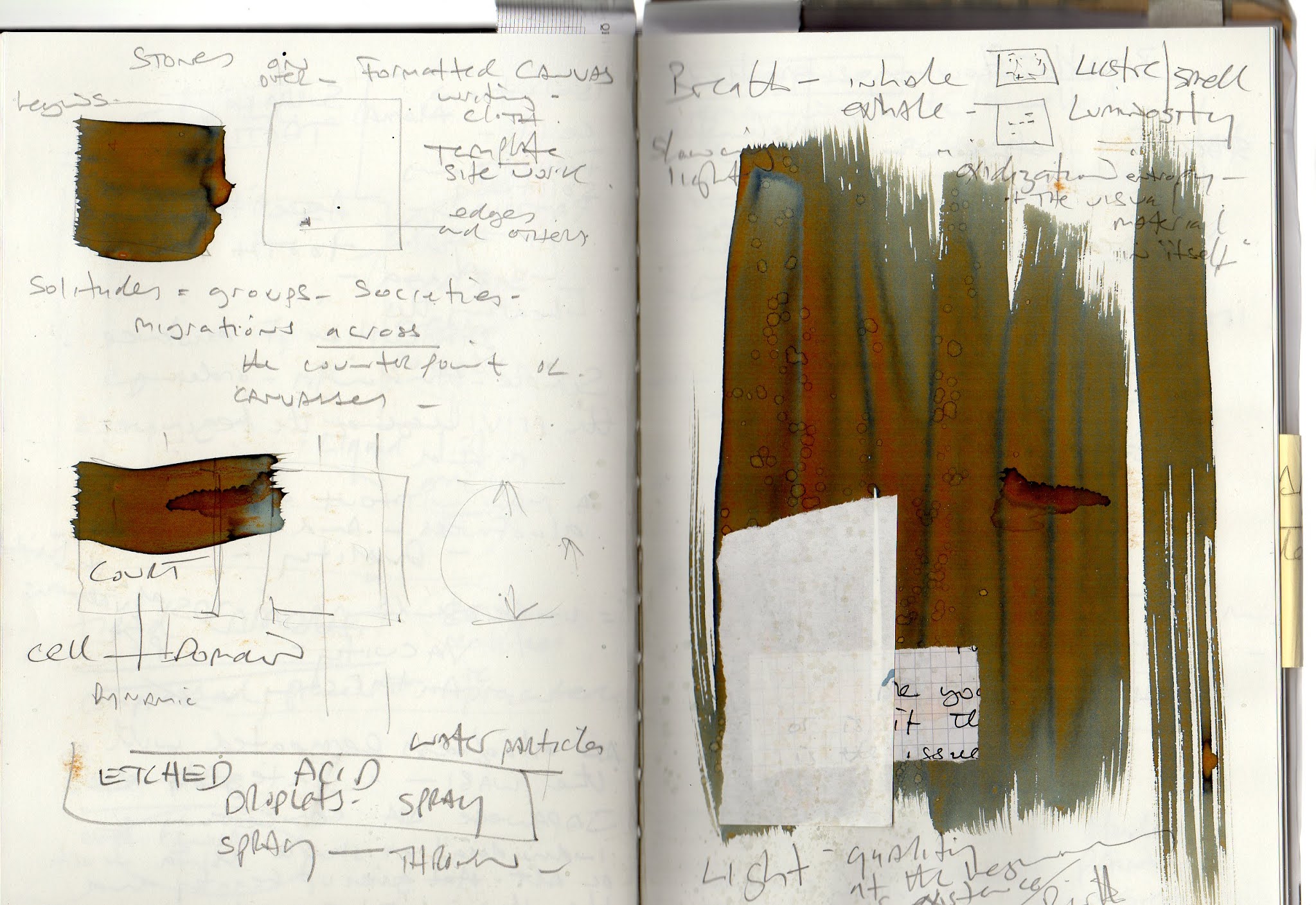
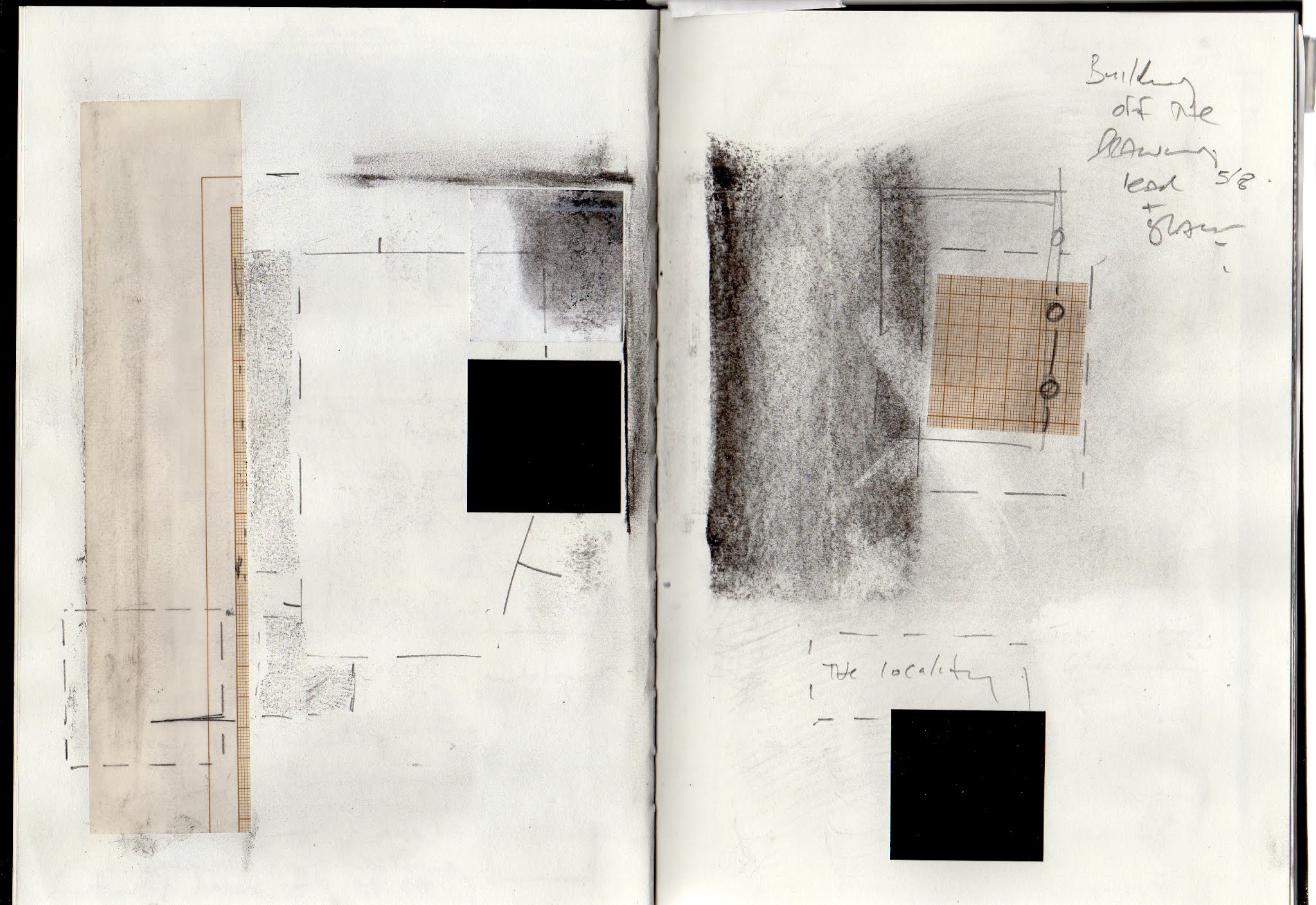
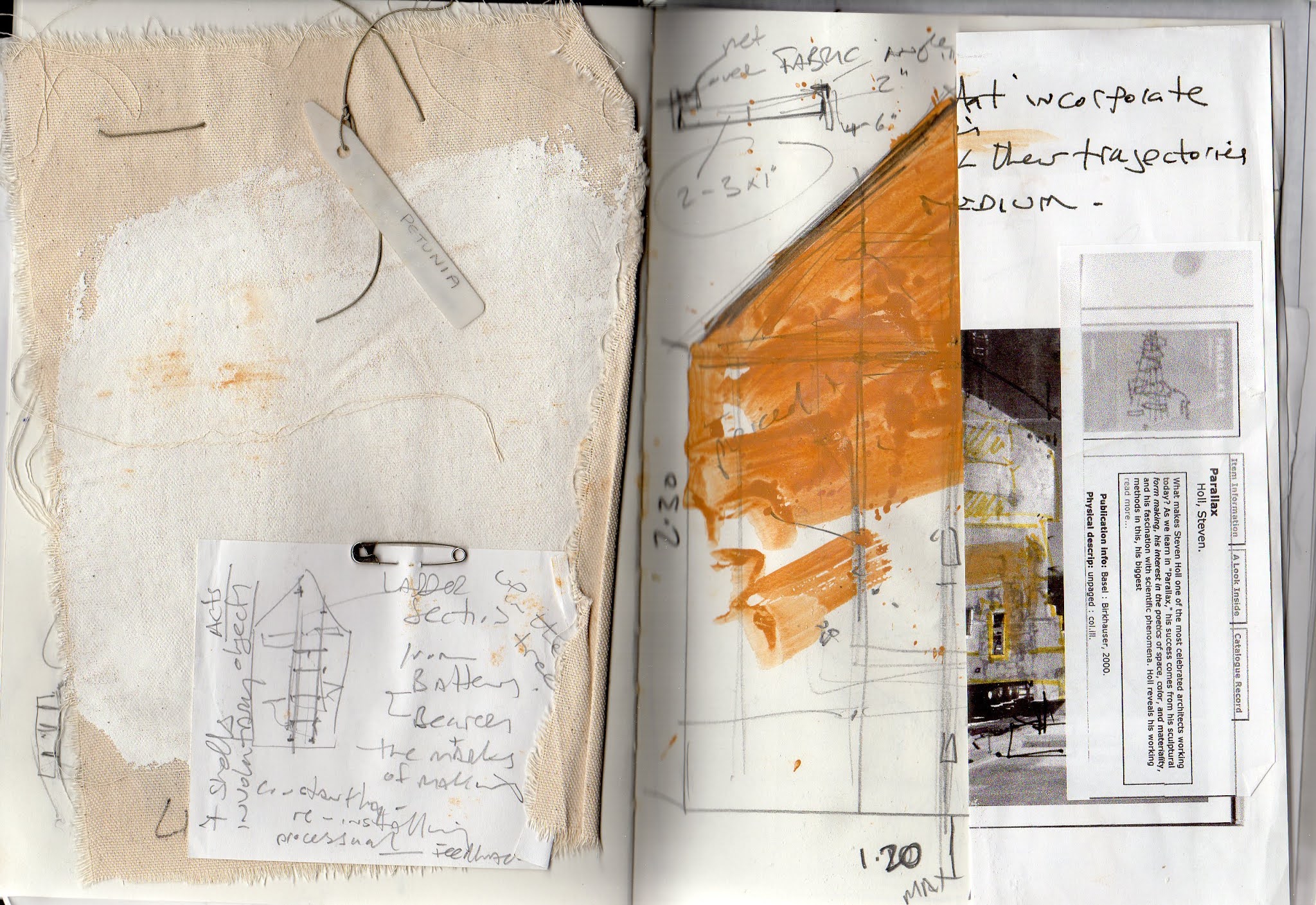
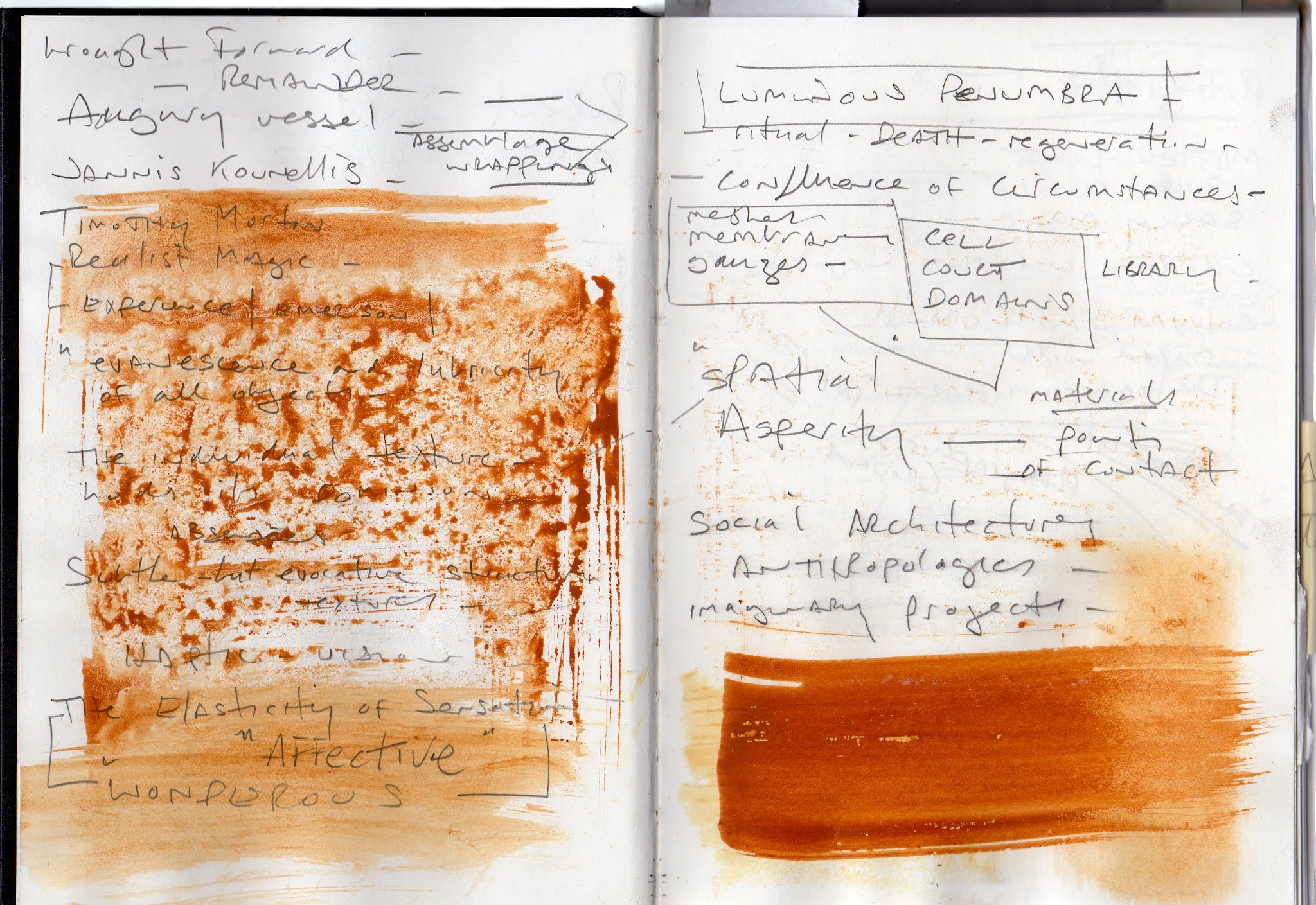
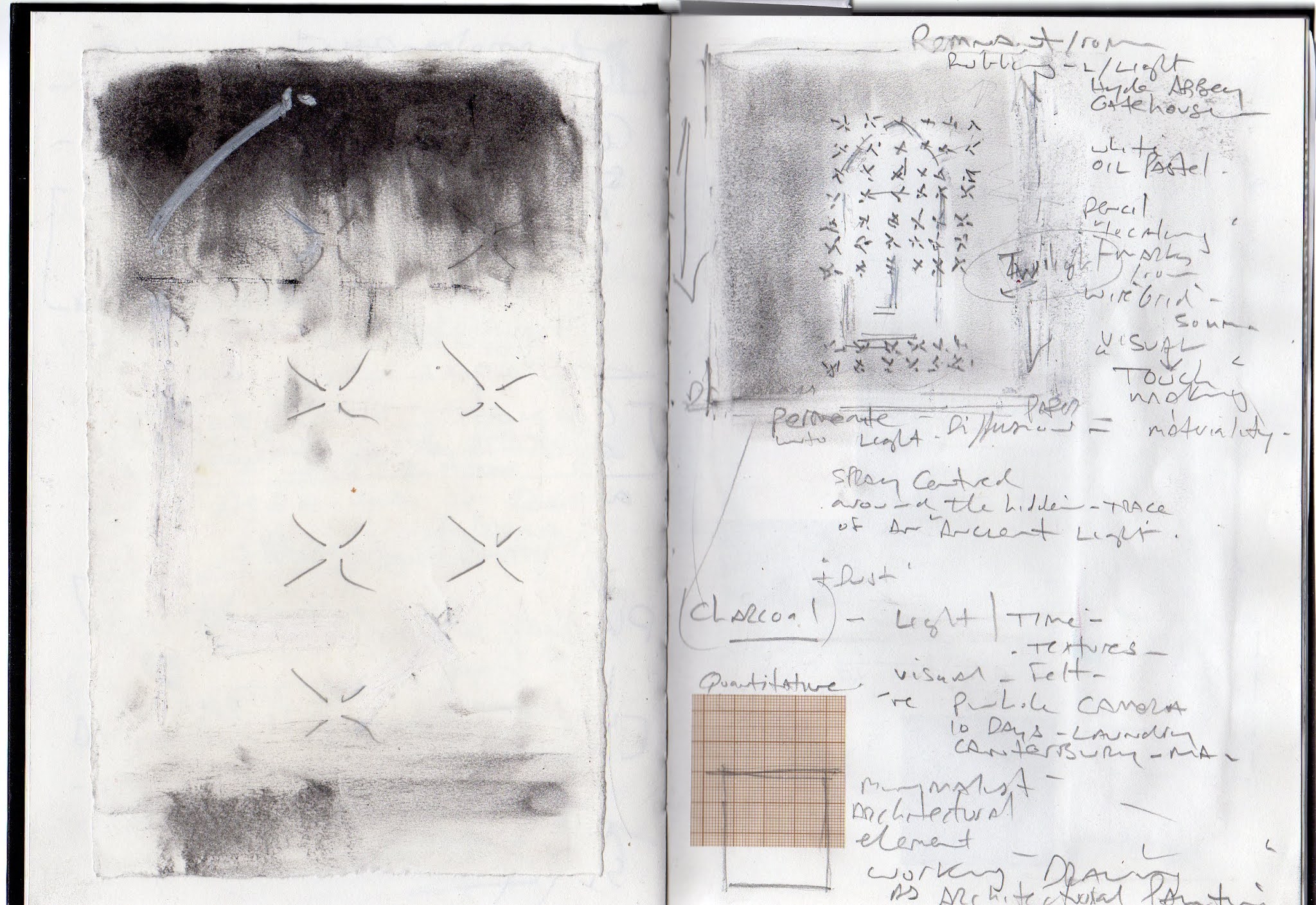
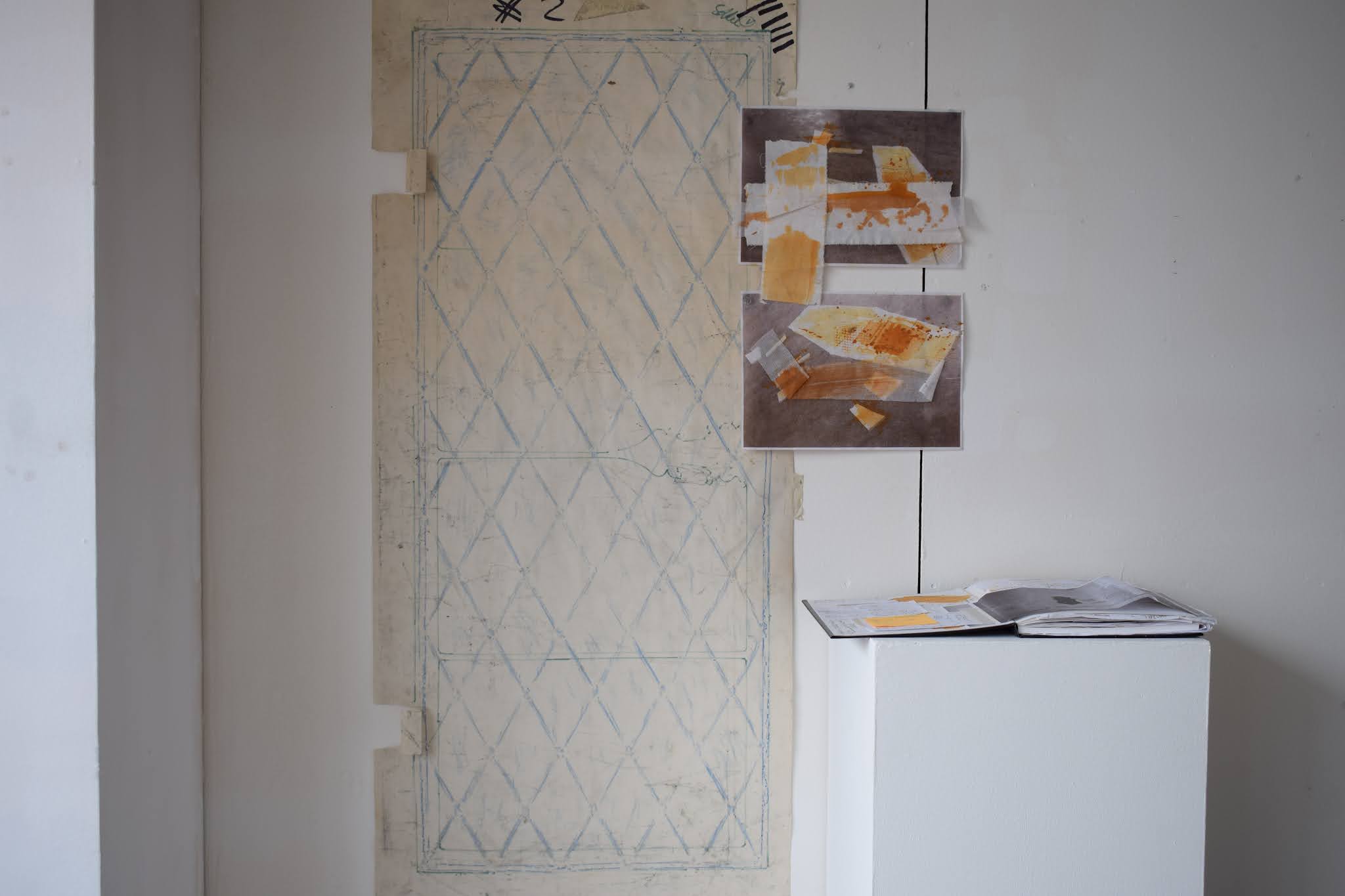
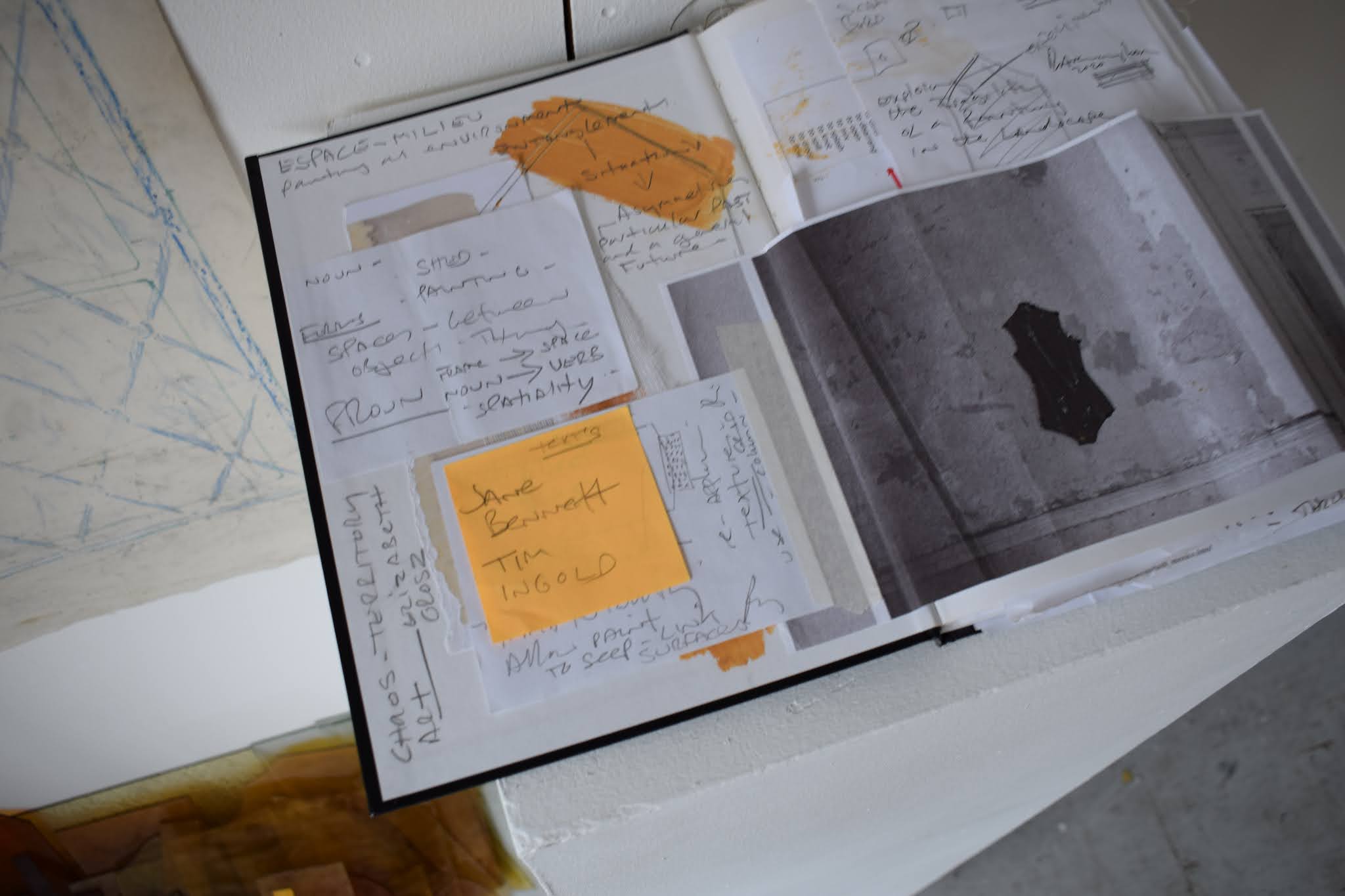
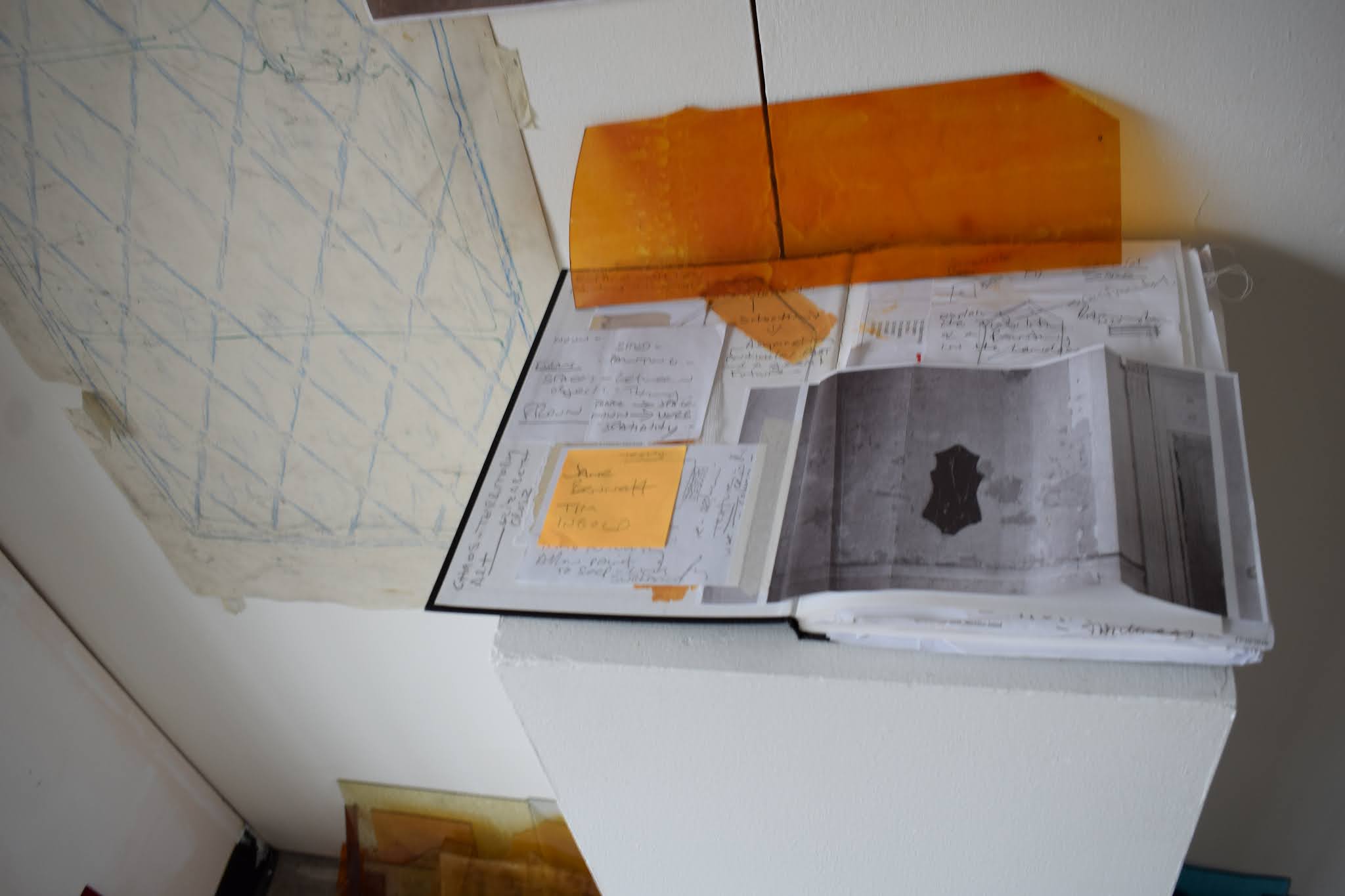
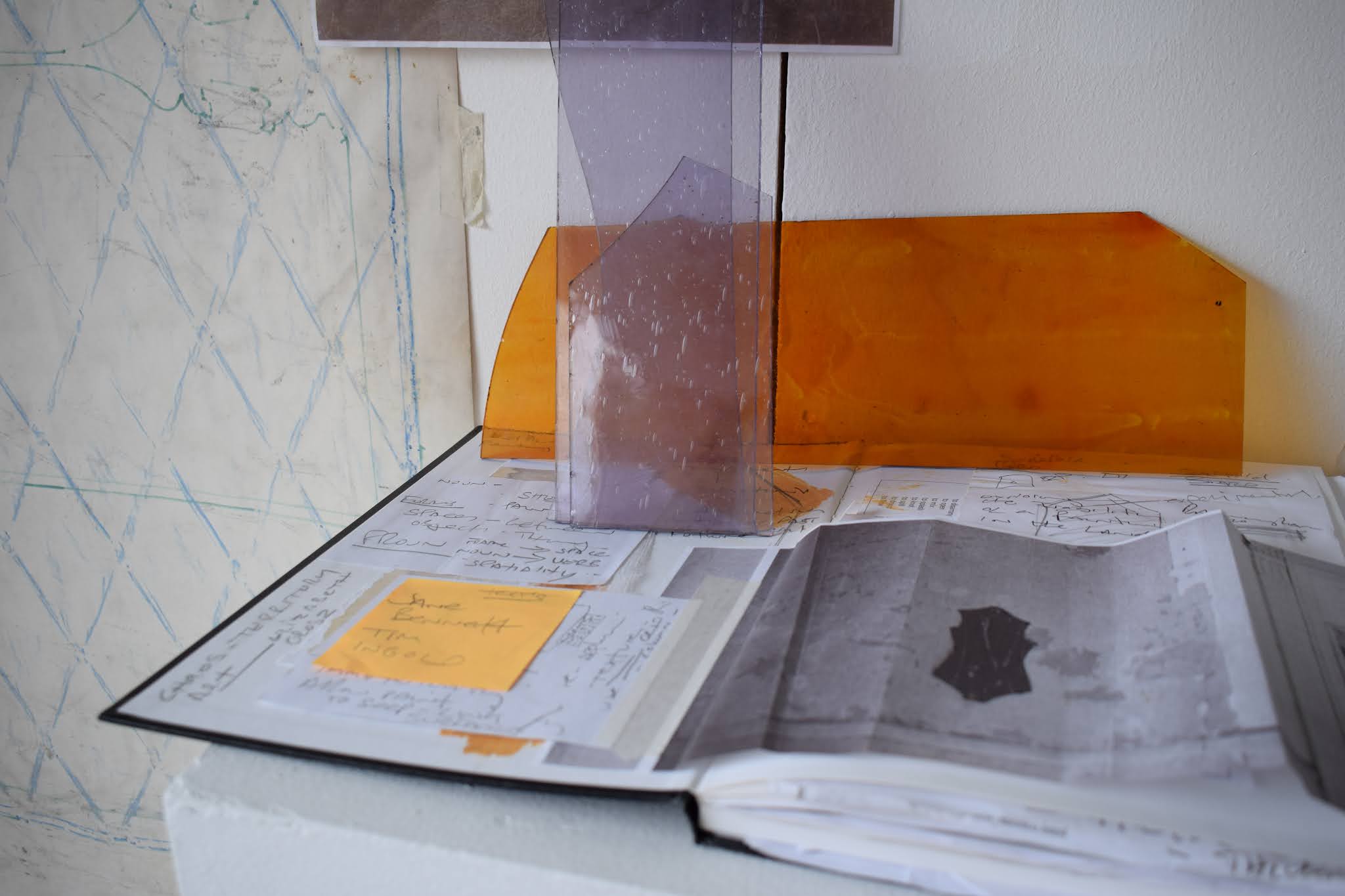
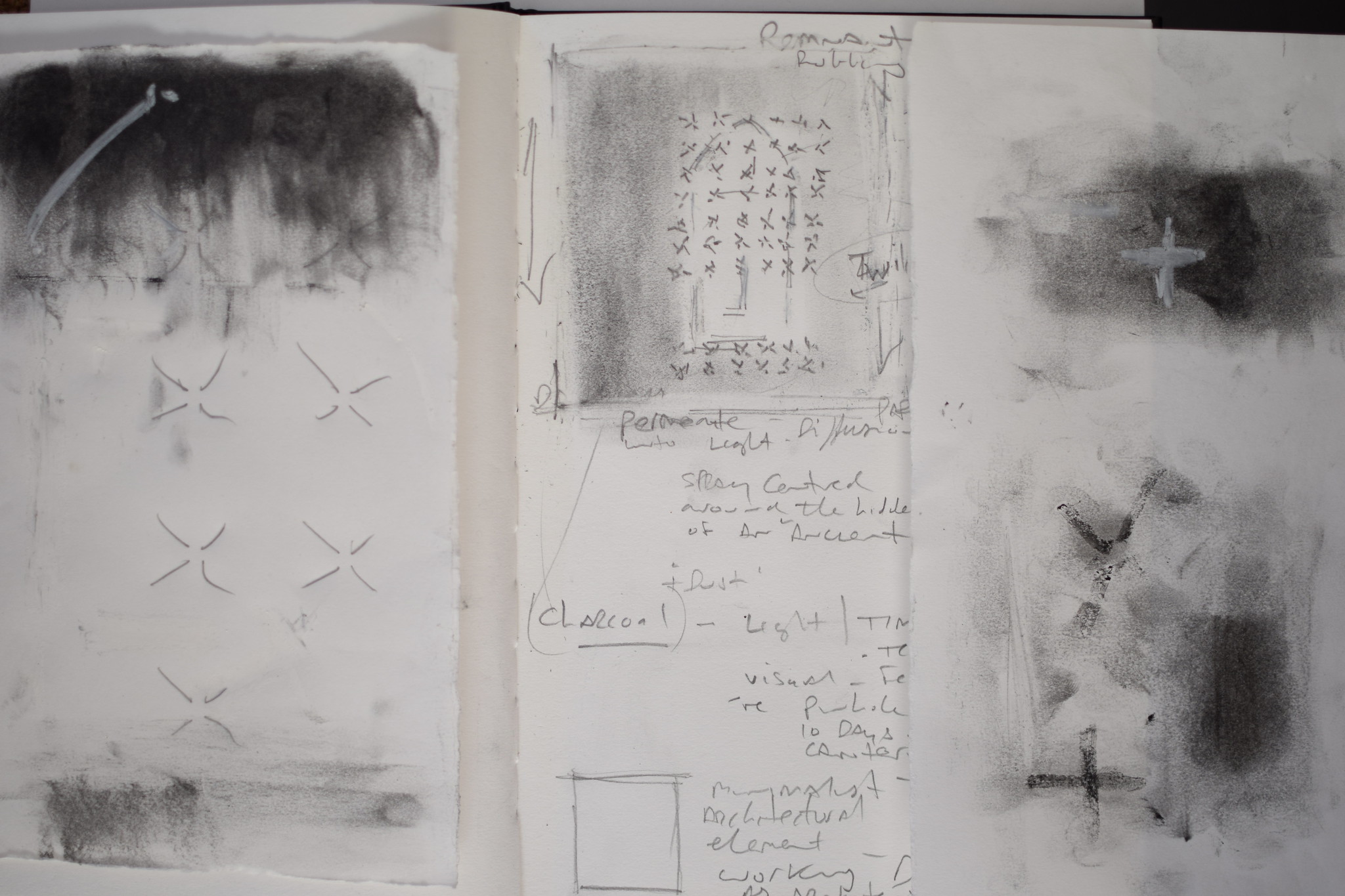
  • Sketch Books/Strange Loops : Drawings, Materials, Annotations, Collages and Constructions 2018-20

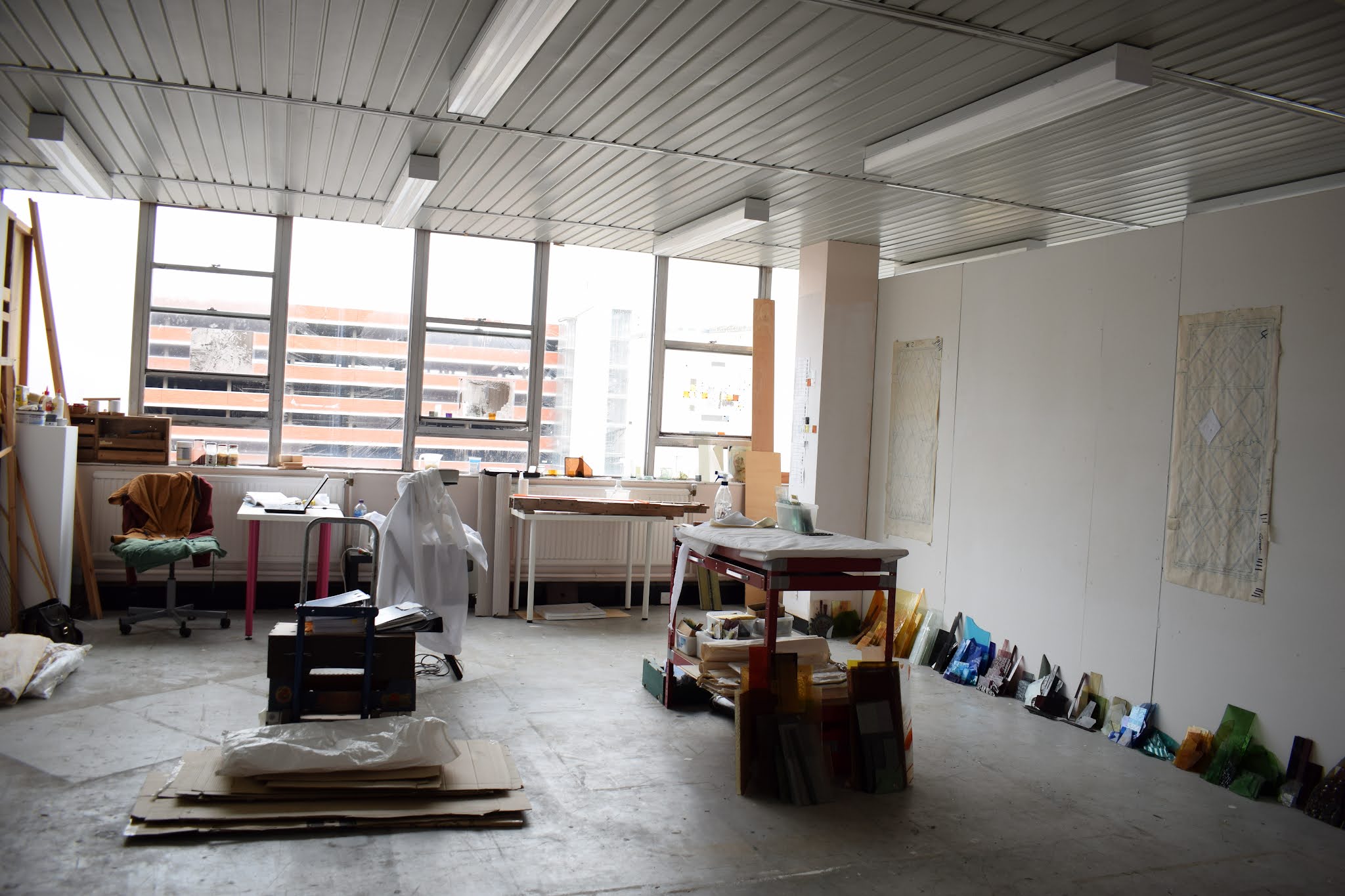
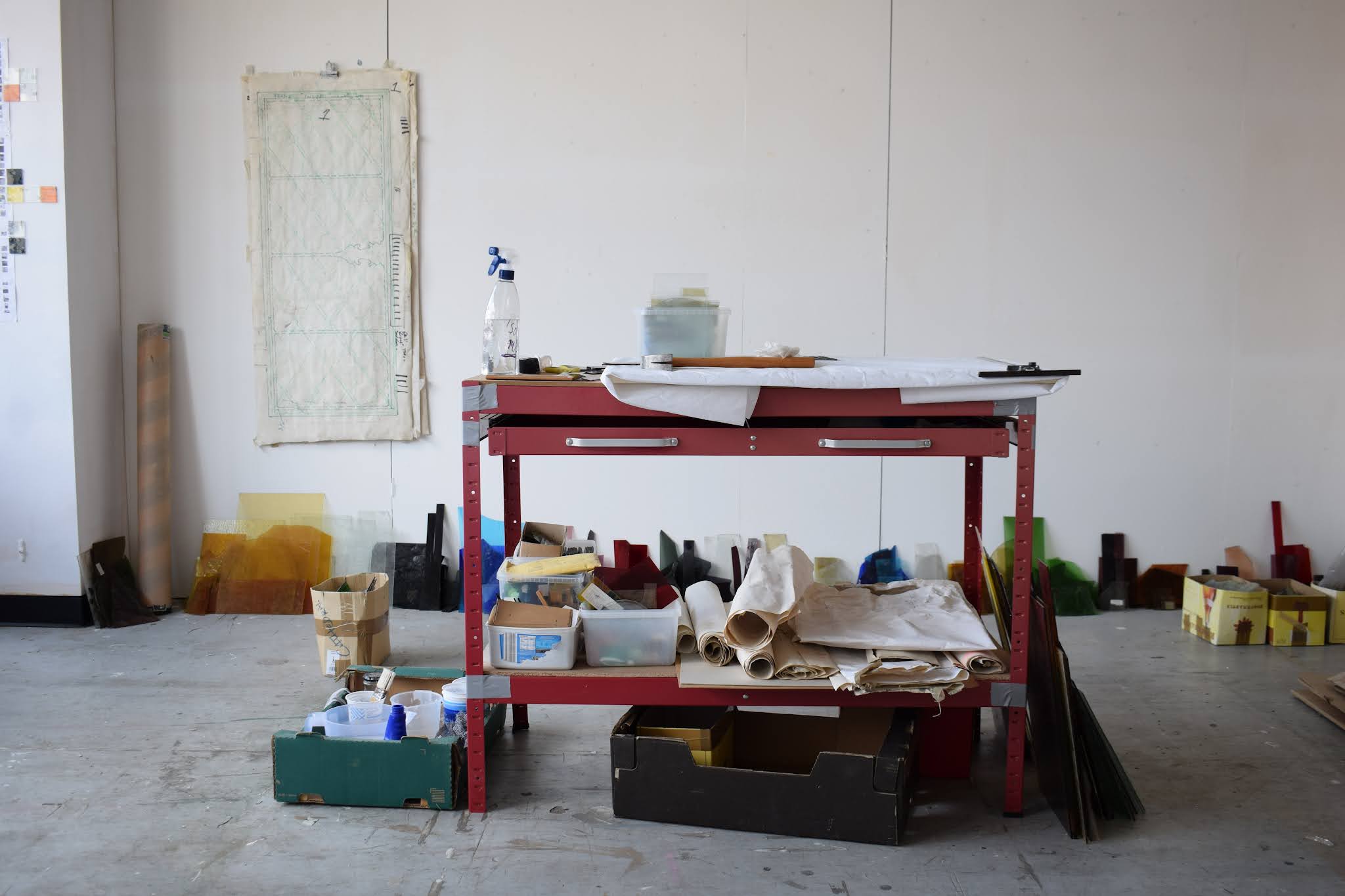
     OUTPOST STUDIO 3.16

    Agency through sketchbooks

    Apokatastasis : Jim Jarmusch, Jozef Van Wissem

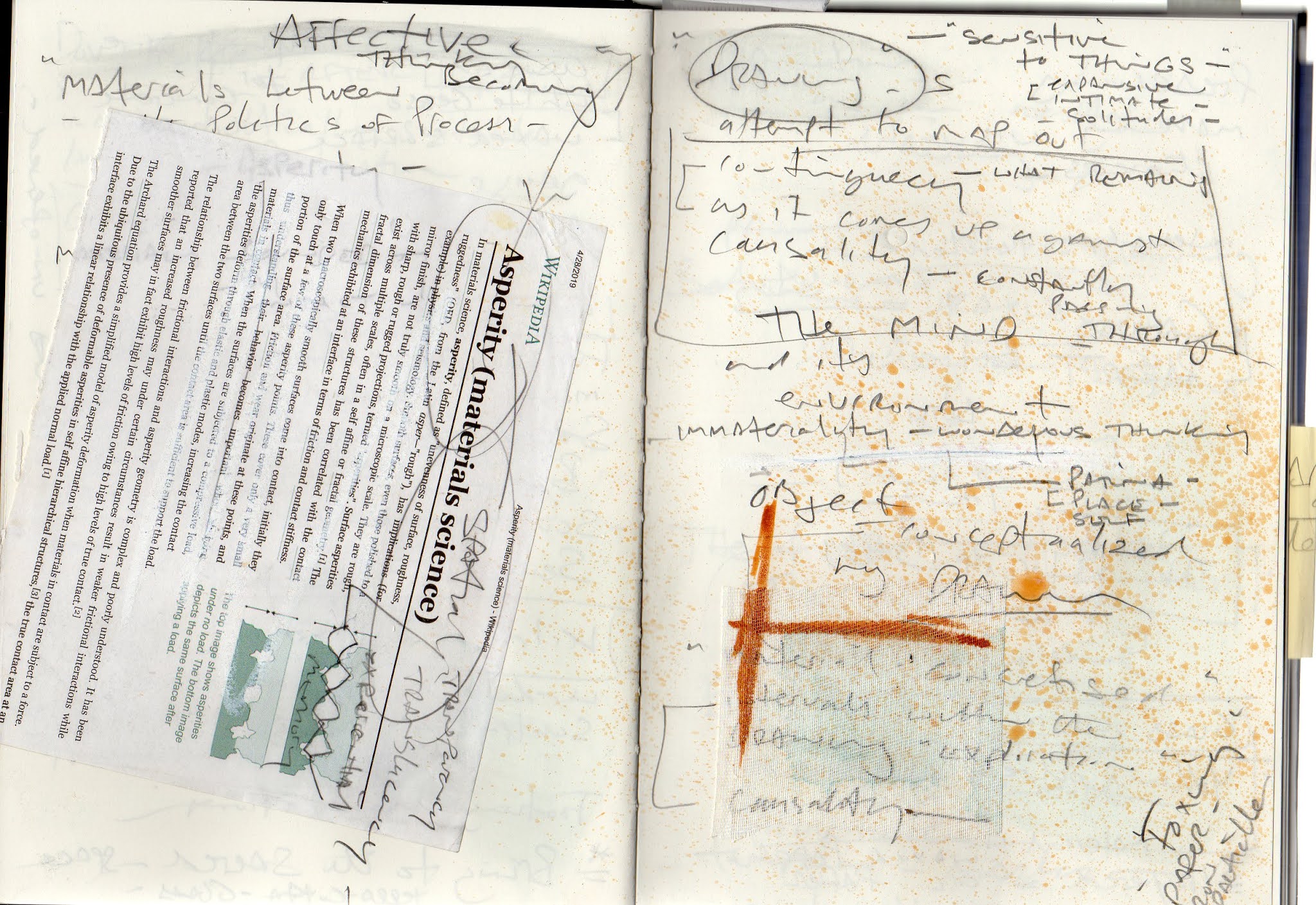
    Spatial Asperity/Mesh, Membrane and Gauze

    Drawing and its attempts to map out/make visible contingent things

    Contingency, is what remains, as it comes up against causality/constantly passing through

    Objects/Things conceptualized by the exploration of drawing (intervals of blindness)

    Linking Surface to the Aesthetic Experience of Space.

    Experiences incorporating interests with environmental textures into Art.

    Points of Contact/Confluence of Circumstances

    Materials bound by contact/canvas

    Patina, absences, gesso, textile wrappings, field chalk, exhumed oyster shells, yellow ochre,

    A philosophy of Reading

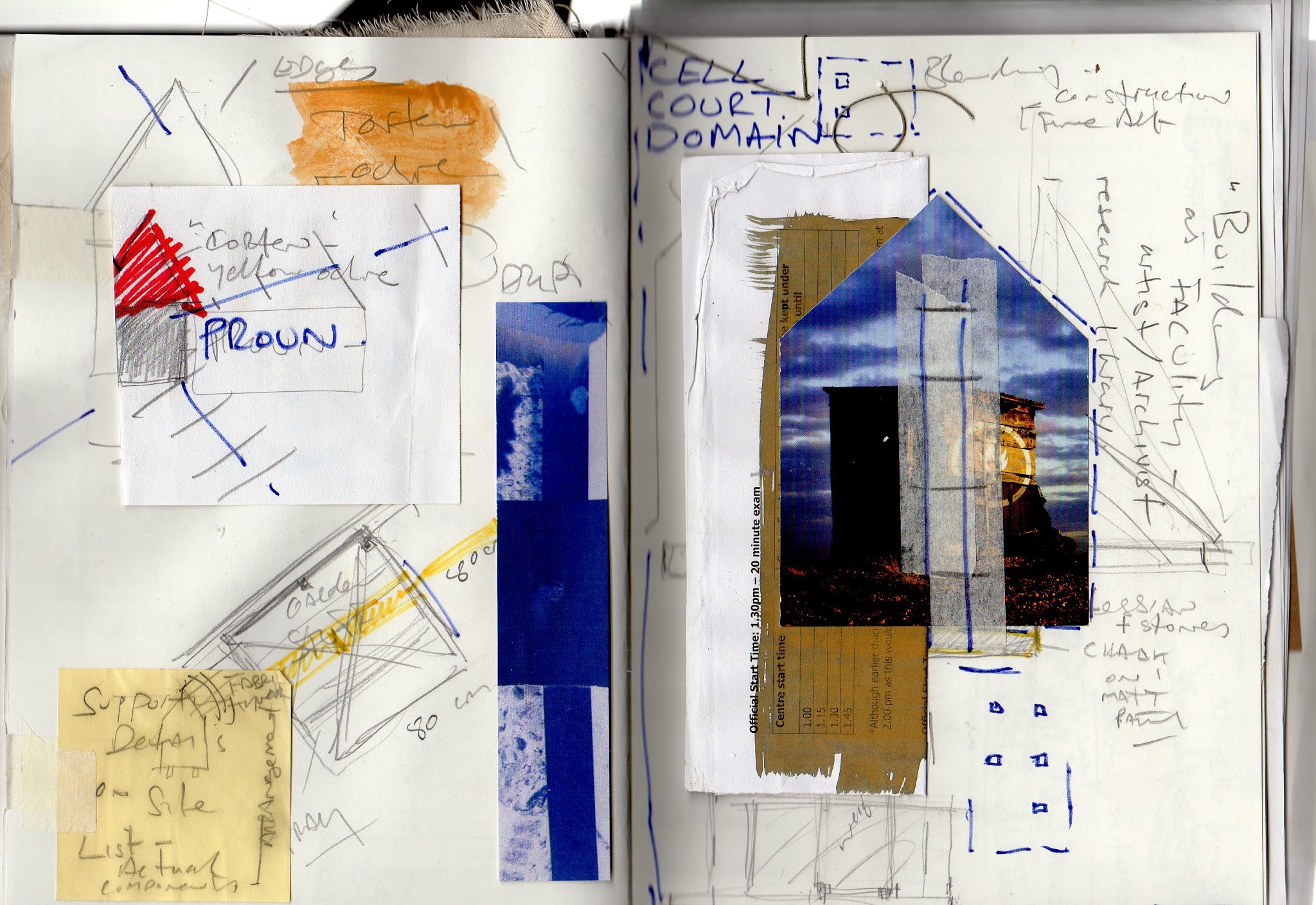
    Solitude/Libraries : Cell/Court/Domain

    Clay, Waxed Surface, Liquid Rust, Calico,

    Sensate Bandages/Windings/Armatures : Corporeal Landscapes/Assemblages/Things

    Social Architectures/Anthropologies/Imaginary Projects

    Timothy Morton : Realist Magic

    The elasticity of sensation, affective and wonderous

    Sally Mann : Matter Lent/Collodion wetplate negatives

    Corpus, liquid light, flesh, spirit, trace, outline, human body, performative,


    Bookmark and Share


    Social apparatuses and agents that explore the possibilities of space. Other Worlds : Insistent moments of mark making/subjectivity.
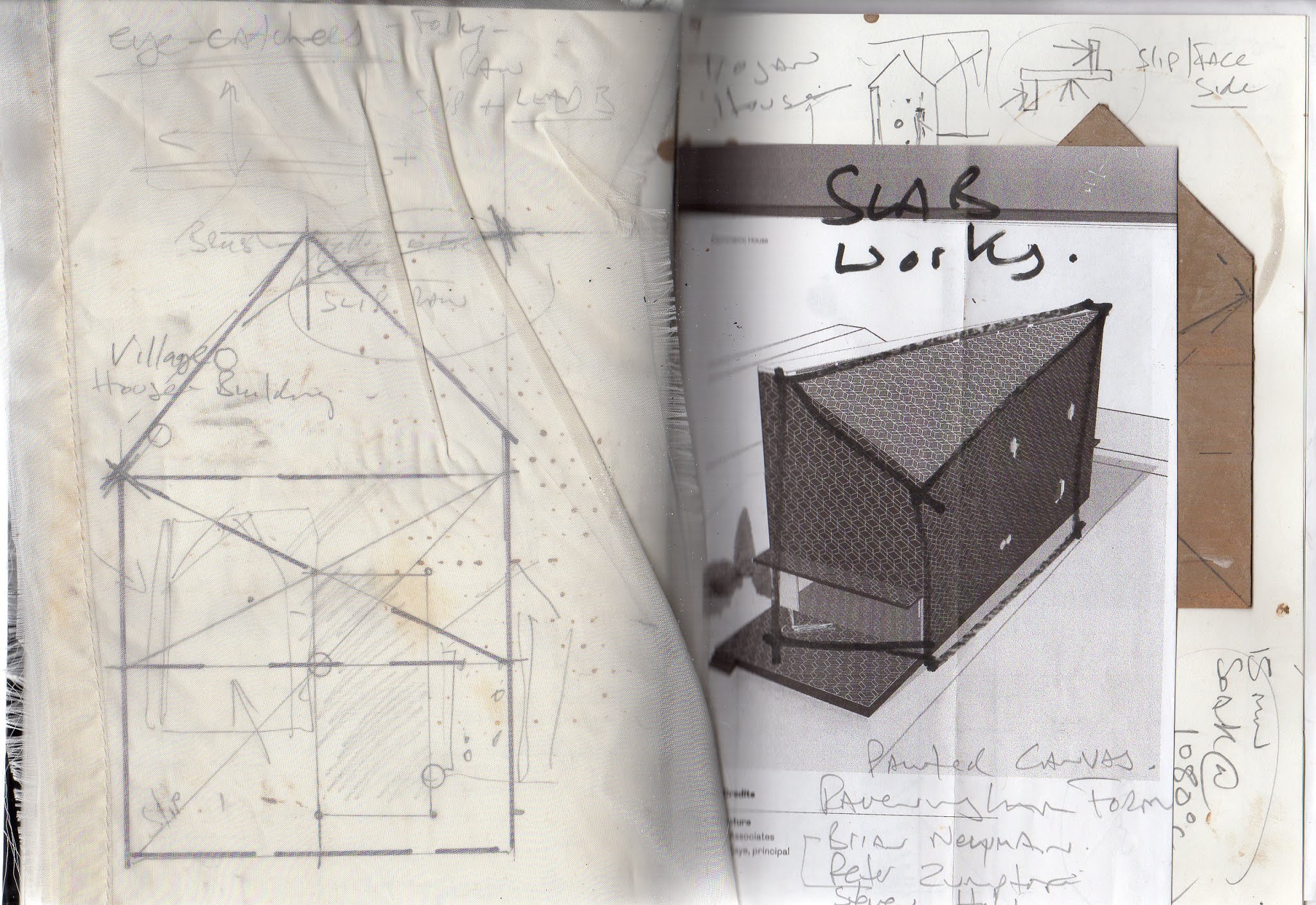
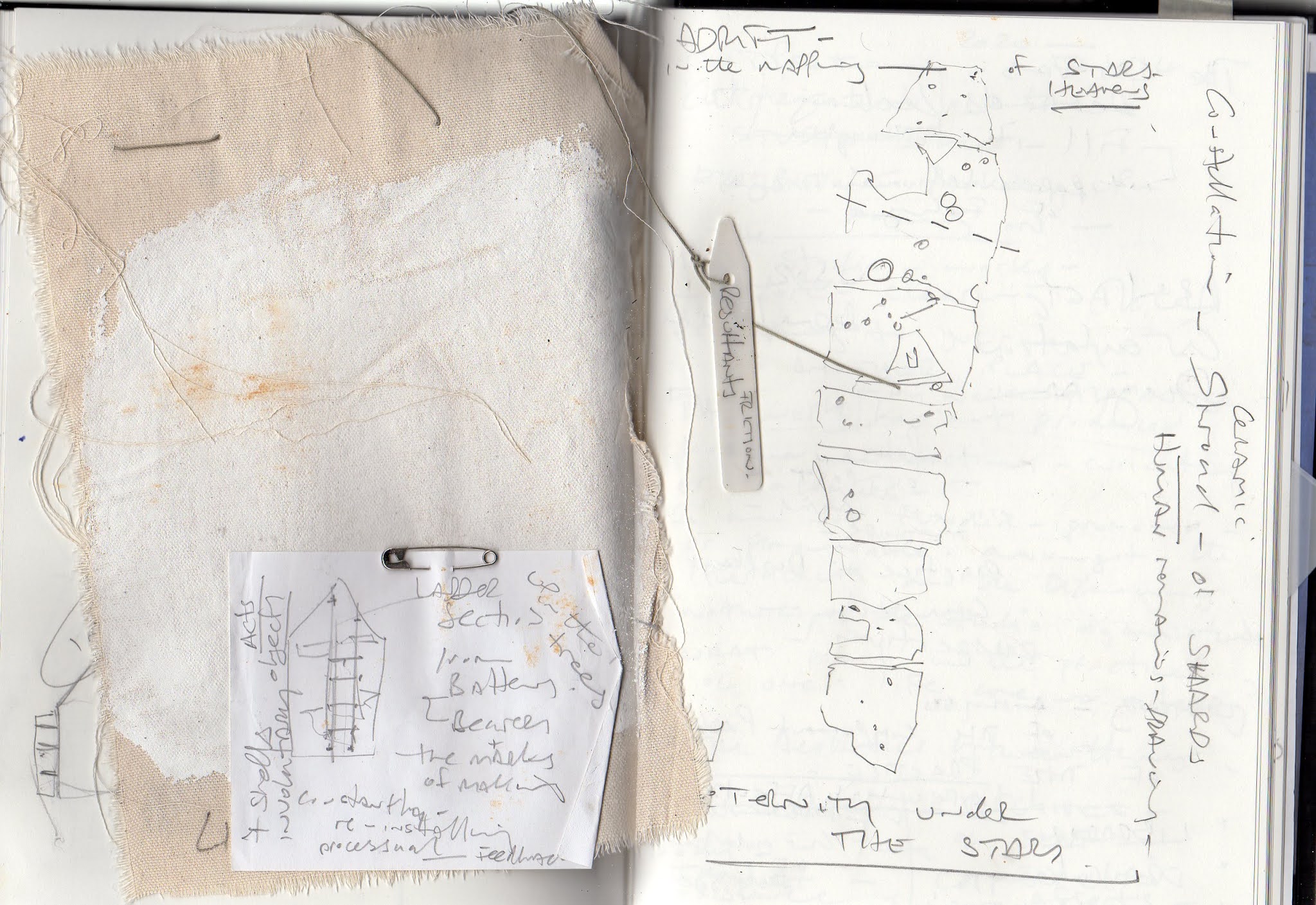
    Source: Sketch Books/Strange Loops : Drawings, Materials, Annotations, Collages and Constructions 2018-20

  • Atmosphere and Surrounding Objects : Loose Assemblages/Living Emotions/Theoretical Gaze

    Paintings being living emotions. Mark Rothko

    The atmosphere of a work of art, what surrounds it, that ‘place’ in which it exists – all this is thought of as a lesser thing, charming but not essential. Professionals insist on essentials … not understanding that everything we use to make art is precisely what kills it. This is what every painter I know understands. And this is what almost no composer I know understands.

    The Music of Morton Feldman, reprinted from his essay  “The anxiety in art”

    OUTPOST STUDIO  July 2021

    Loose Assemblages : The Movement of Ideas and Feelings

    Touch and materials as a normative support/exploration for the theoretical gaze

    Bento’s Sketchbook : John Berger

    Existence appertains to the nature of substance.

    A substance cannot be produced from anything else: it will therefore be its own cause, that is its essence necessarily involves existence, or, existence appertains to its nature.

    Ethics, Part 1, Proposition VII, Proof

    Conscious minds arise from establishing a relationship between organism and an object-to-be-known. Damasio

    Architectural Body

    Organism-Person-Environment

    Drawing is a  form of probing. And the first generic impulse to draw derives from the human need to search, to plot points, to place things and to place oneself.

    The Human Body through drawing and philosophy

    Berger/Spinoza 141

    Matters of a discursive consciousness are explicit and explainable, and the line between discursive and practical consciousness is fluctuating and permeable, both drawing on the other in the act of agency/making social.

    The defining point of agency is namely its potential to transform the given.

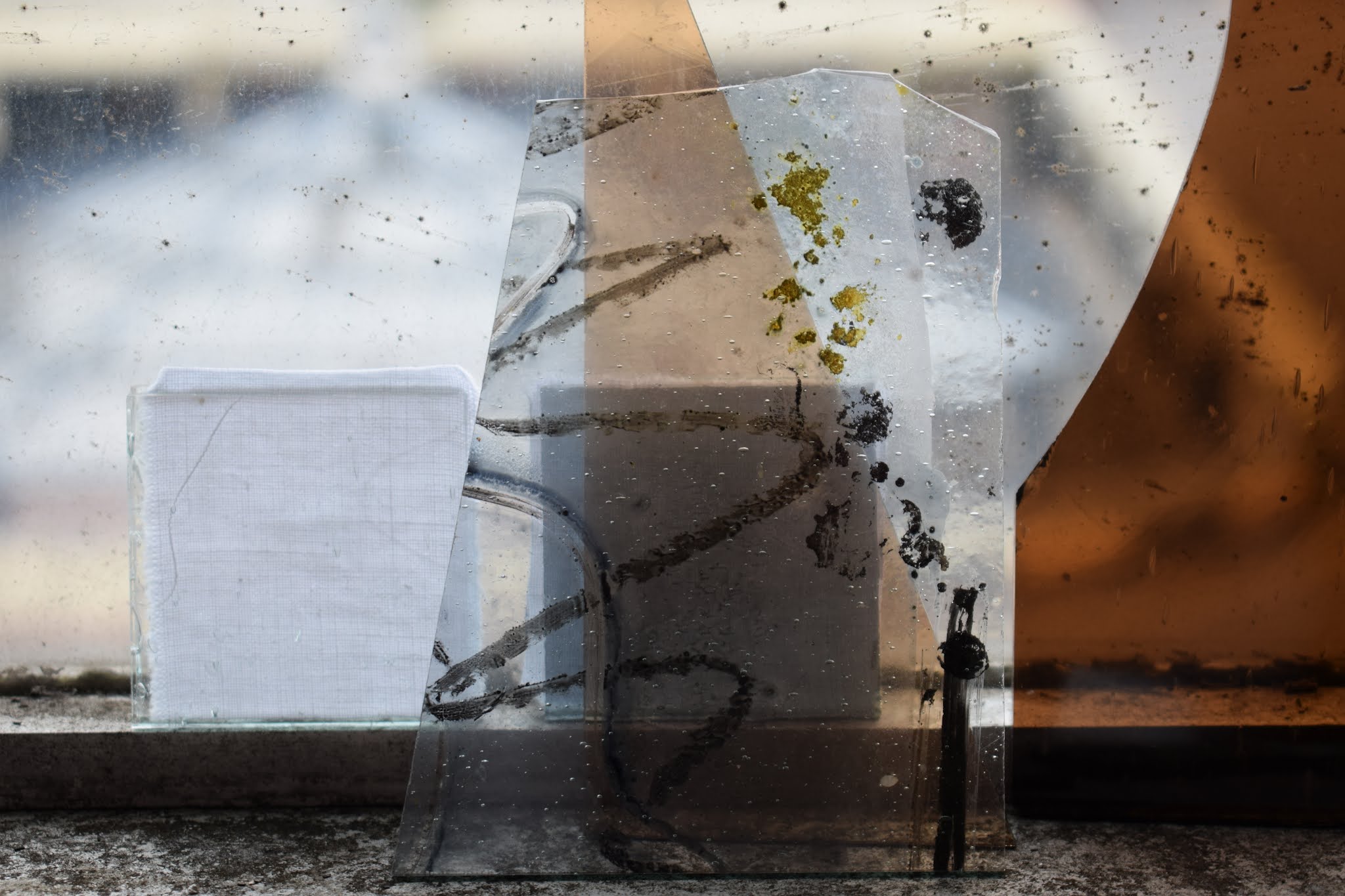
    Generative energies, entanglements, sensorial diversions from an open studio window overlooking Anglia Square

    Improvisations/choreographed with the music/ambient noise are exploratory encounters  between flesh and sound

    A hut of ones own (within and bounded by others), crafted and organized around simple processes and interactions within a fallow site given over to creative ecology of energies and enterprise

    Vibrant yet curiously passive form of  urbanism

    Affectivity as a mimesis of lively transfers between things, humans and non-humans

    Human subjectivity : Mimetic Encounters/Explorations

    Art works by gathering up forms and materials for affective experimentations in subjectivity

    Corporeal unconscious animated by sensitivities/sympathies, a putative affinity (haptic) between certain things including bodies and organs which makes them liable not only to be similarly affected by the same influence, but more especially to affect or influence one another.

    Intentionality/Sympathy/Sentiment/Difference

    Inducing a particular set of ethical/political/social responses in actor/social audience

    Mimesis : Paradox or Encounter. Jane Bennett

    Calling a sympathy/subjectivity between coloured cloth/wallpaper/display cabinet and human flesh

    Francesca Woodman

    Mimesis and suggestion in the social,enacted through layers of mediation surrounding humans, objects and non-humans.

    Camouflage. Neil Leach

    Mimesis

    Sensuous Correspondence

    Sympathetic Magic

    Mimicry

    Becoming

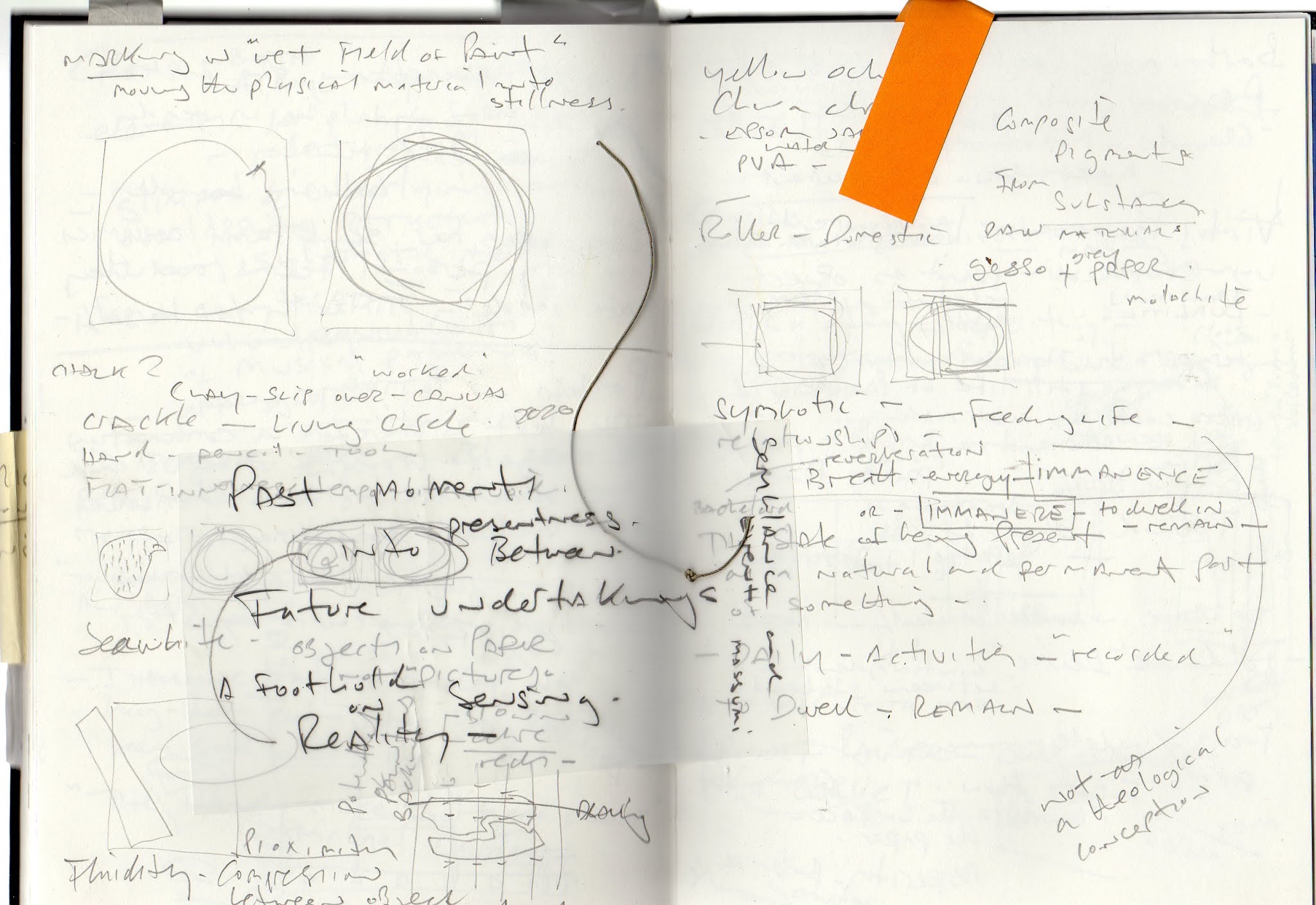
    Sensations in Space and Time (the experience/entanglement of phenomena and idea)
    Agency/Foraging/Making/Gathering
    Subjectivity is relational (always in process)
    A Species of Making Spaces
    Tentativeness, attentive to situatedness
    A diffractive methodology enables a critical rethinking of science and the social in their relationality, moving beyond separate entities, separate sets of concern.
    Karen Barad
    Organism
    Person
    Environment
    Arakawa and Madeline Gins
    For Merleau-Ponty, Experience can only be understood between the mind and the body or across them in their lived conjunction.
    The mind is always embodied, always based on corporeal and sensory relations.
    Elizabeth Grosz.
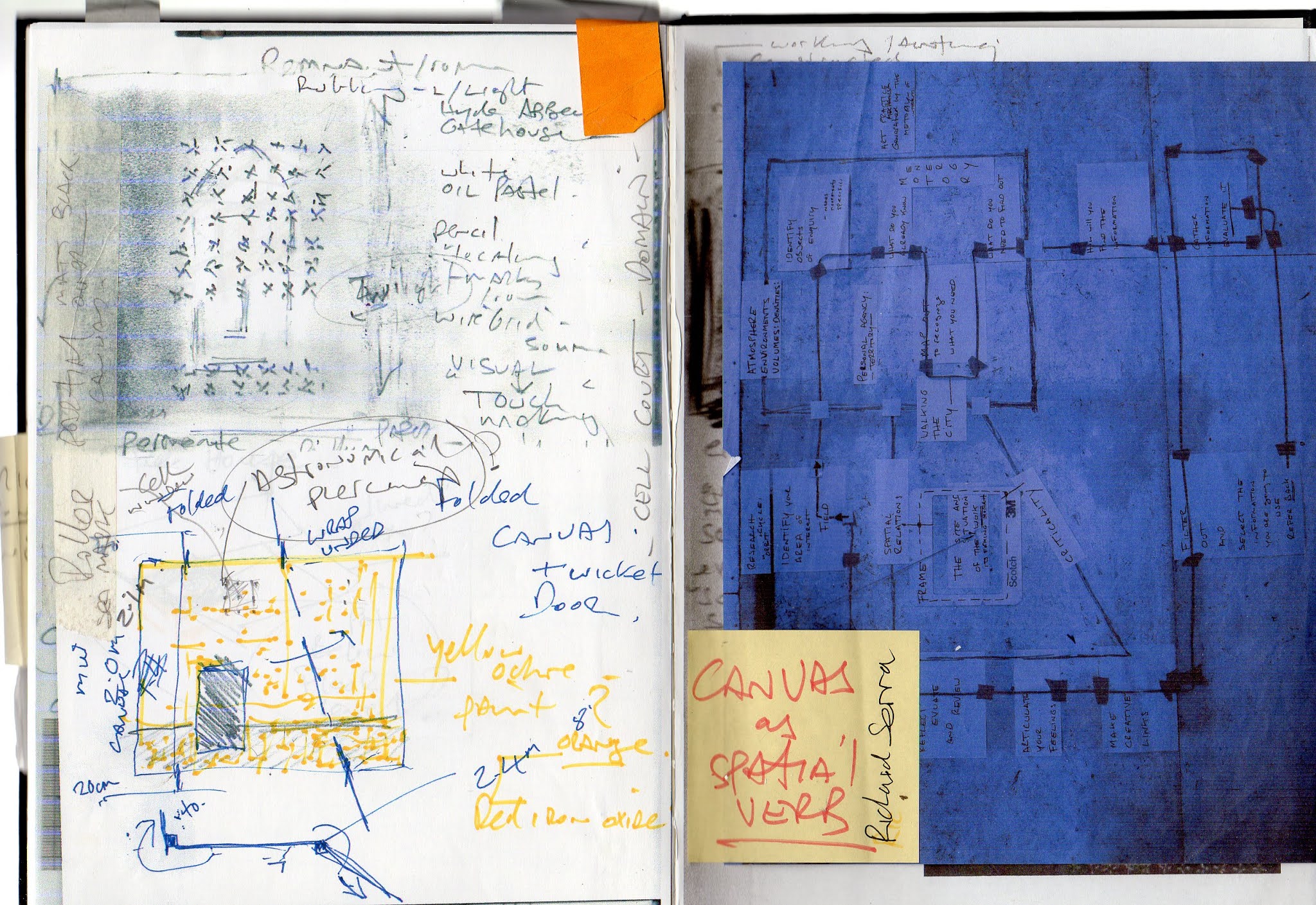
    Richard Serra : Verb List Compilation
    Actions to Relate to Oneself, 1967-1967
    Drawing in its frameworks and dimensions/presence and absence/its here and elsewhere
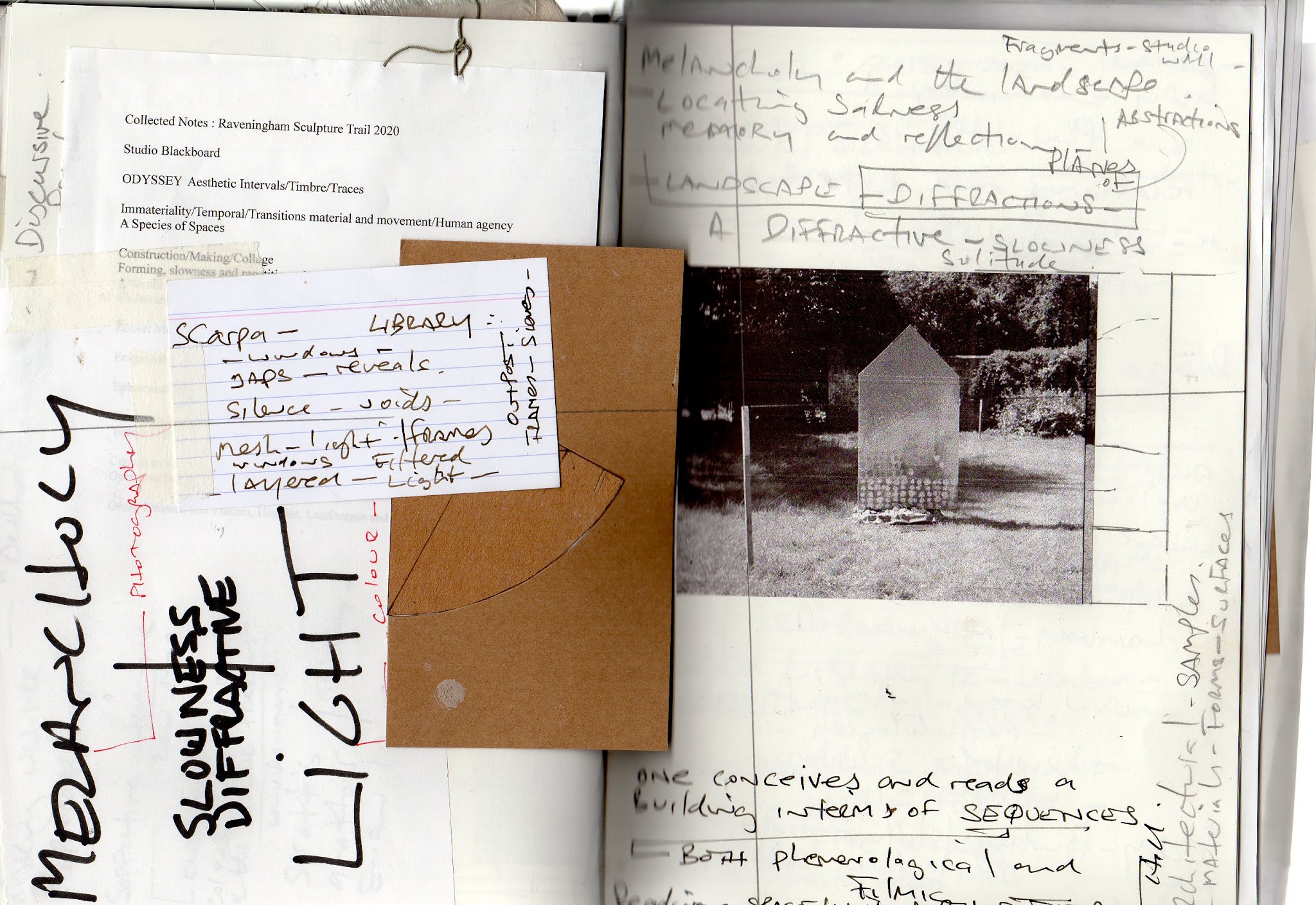
    Exploring the fragility of a painting in the landscape
    Canvas as sheltering construction, Raveningham Sculpture Trail
    Diagram-Map-Chart, is a symbolic depiction emphasizing (mapping) relationships
    Diagrams For The Imagination : Arakawa
    Apokatastasis : Jim Jarmusch, Jozef Van Wissem
    Litany Of Echoes : James Blackshaw
    New Music, for old instruments : Paul Metzger, Jozef Van Wissem
    Brilliant Trees : David Sylvian
    Body As Cultural Product
    Both psychic and social dimensions must find their place in reconceptualizing the body, not in opposition to each other, but as necessarily interactive.
    Volatile Bodies/Chaos-Territory-Art : Elizabeth Grosz
    Spatial Asperity/Mesh, Membrane and Gauze, Möbius Strip, Pattening,
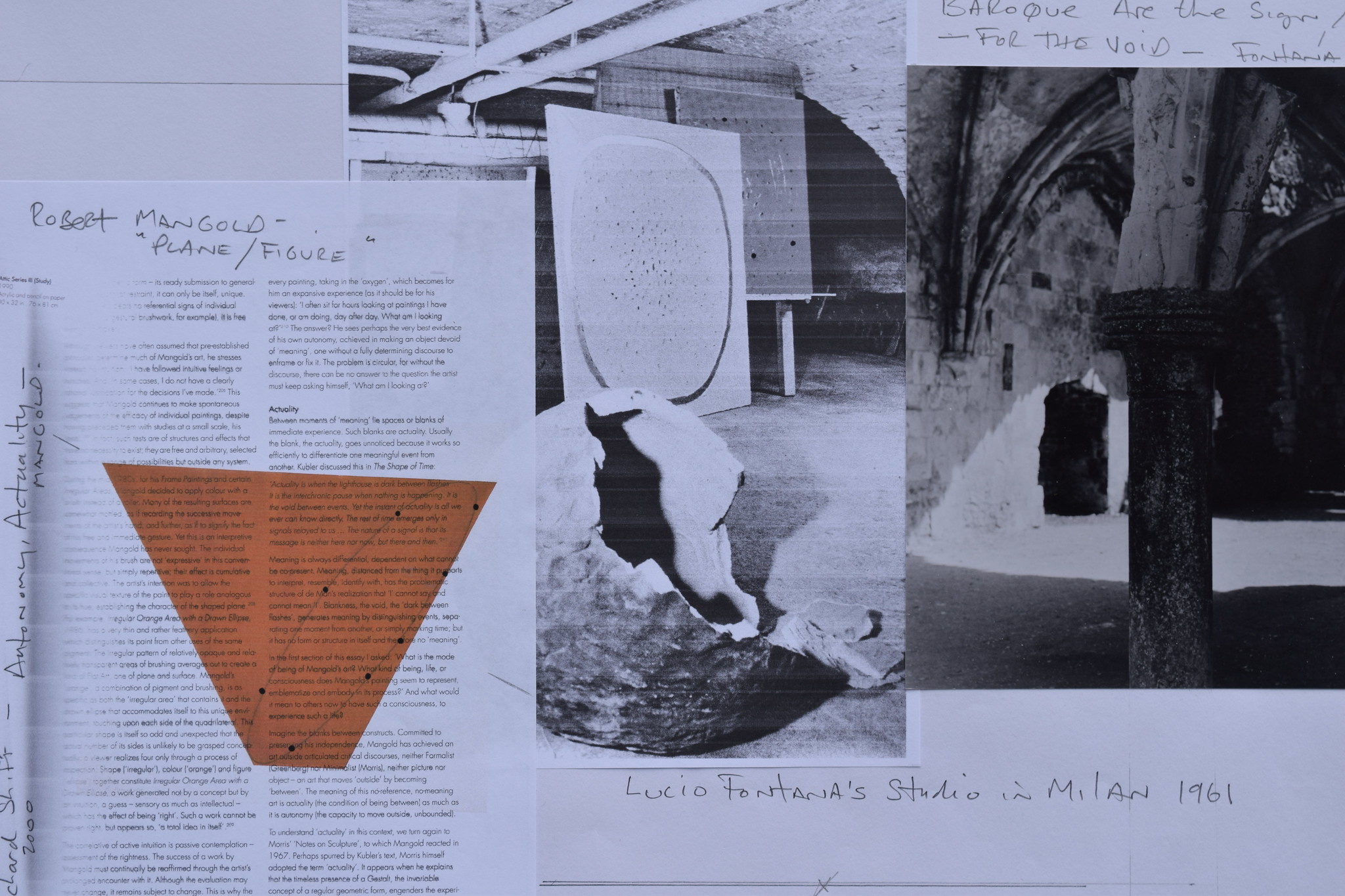
    Actuality : Robert Mangold
    Paintings around the particles/flows of things/boundaries/intervals of presence and absence
    Induction/Capacitance/Encapsulated Layers
    Drawing and its attempts to map out/make visible contingent things
    Contingency, is what remains, as it comes up against causality/constantly passing through
    Objects/Things conceptualized by the exploration of drawing (intervals of blindness)
    Linking Surface to the Aesthetic Experience of Space.
    Experiences incorporating interests with environmental textures into Art.
    Points of Contact/Confluence of Circumstances
    Materials bound by contact/canvas
    Patina, absences, gesso, textile wrappings, field chalk, exhumed oyster shells, yellow ochre,
    A philosophy of Reading/Matter/Rooms,
    The Lake of The Mind
    Stochastic Thinking, Steven Holl
    Solitude/Libraries : Cell/Court/Domain
    Capacitance, relationships between intensities and movements
    Clay, Waxed Surface, Liquid Rust, Calico,
    Sensate Bandages/Windings/Armatures : Corporeal Landscapes/Assemblages/Things
    Flesh, elementary pre-communicative, subject and object develop.
    Making as Growth : Tim Ingold
    Social Architectures/Anthropologies/Imaginary Projects/Interfaces/Screens
    Timothy Morton : Realist Magic
    The elasticity of sensation, affective and wonderous
    Sally Mann : Matter Lent/Collodion wetplate negatives
    Corpus, liquid light, flesh, spirit, trace, outline, human body, performative,
    Paintings/Enactments : Canvas as a spatial verb
    Espace-Milieu, painting as environment/entanglements and situations
    Ceramic/Process and its theoretical objects
    As a series of practices, making reality by bringing things together or separating them into their singularities, or making machines/desiring machines
    Desire can be seen as an Actualization
    Gathering Notations : Bernard Tuchumi
    Both presence and absence are coupled in this framework
    Deleuze/Guattari
    Glass/GLAS : Resistivity/Inclusions, A Field in England.
    Translucent aesthetics, beyond the opacities of the sensible the rational.
    An image that adequately expresses both the efficacy and the temporariness of the phenomena ( joining a diffused/invisible flow of energy, a breadth that wends its way ceaselessly through the world). Animating it as it goes.
    Vital Nourishment, Departing from happiness, Francois Jullian.
    What is a body capable of –
    Spinoza
    Building/Making, into the theoretical performative object (that does theory)
    Albers/Clarke : Interactions, Counterpoints, Intervals between colour/forms,
    Membrane, Discursive, Diffractive, Sensory, Layered and Filtered Light,
    Body, Movement, Mind, Assemblages, Exploratory, Speculative, Choreographic,
    Deleuze/Guattari, understand the body more in terms of what AFFECTS it is capable of, instead of the consequences of having a body.
    Peter Zumthor : Thermal Baths
    Human Agency/Temporal transitions between matter and movement.
    Immaterial/Concrete/Water : Bodies in contact/the corporeal social human body
    Manifolds/Theory of Temporality/3 Synthesis of Time
    Memory     Past Preserved                    Condition
    Present       Habit Instants                     Agent
    New           Future, actual/virtual          Creation of The New
    Multiplicity, purality of contemplating souls.
    Asymmetries between particular past and general future.
    Temporality involves multiple interacting processes.
    Architecture becomes Spatial Agency
    We all make space : Jeremy Till
    Paintings, space, volume, surface, passages, actualizations, claddings/camouflage
    One conceives and reads a building in terms of sequences, both phenomenological and filmic, reading a space by its depth of field, its thickness.
    Turbulence House, New Mexico, Steven Holl.
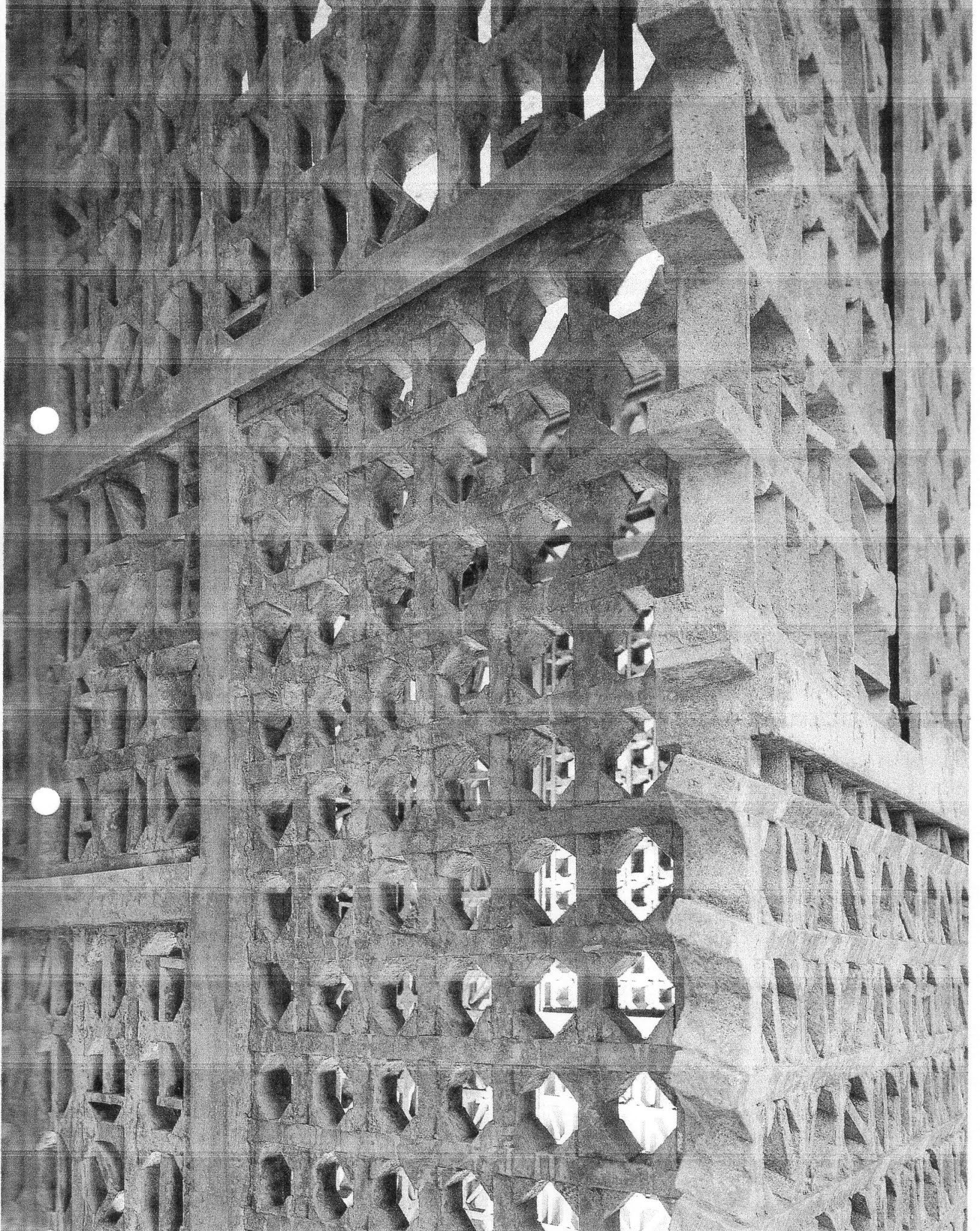
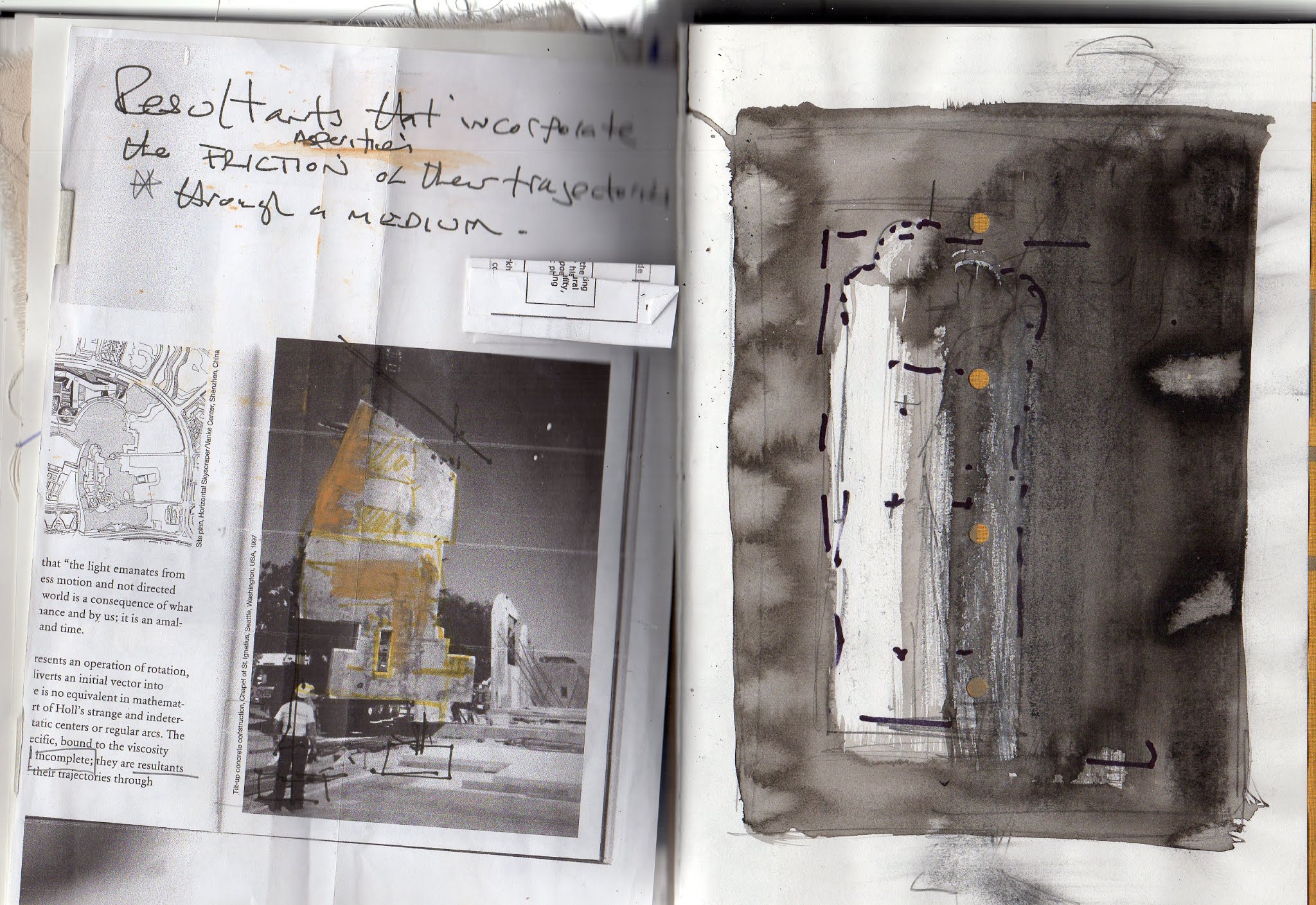
    Aesthetics/Asperities : Resultants that incorporate the friction (asperity) of their trajectories through a medium. Tilt-up concrete construction, Chapel of St, Ignatius, Seattle. Steven Holl.
    Navigations and Vectors/conduits/intervals and traces between discursive practices.
    Wrapped Silences : Assembled Sectional Elements/Thresholds
    Surfaces on Mourning/Samsara, a beauty fed on emptiness
    Bookmark and Share


    Social apparatuses and agents that explore the possibilities of space. Other Worlds : Insistent moments of mark making/subjectivity.
    Source: Atmosphere and Surrounding Objects : Loose Assemblages/Living Emotions/Theoretical Gaze

  • Inquiry is essentially the way of learning : Fragile Architectures of Hapticity and Time

    In an era in which architecture is once more learning its potential as a form of inquiry, rather than as a service — as a producer of knowledge, and not merely of ‘projects’.

    Brett Steele, Atlas-Tectonics in Barkow Leibininger, Bricoleur Bricolage. AA 2013

    Inquiry is essentially the way of learning.

    On Learning ‘The Cultivation of a Good Mind’ J. Krishnamurti, Brockwood 1963

    THE WAVERLEY INQUIRY

    ROOMS AS EXPERIENTIAL OUTPOSTS

    Translations from Drawing to Building.

    Robin Evans.

    Interiors crafted as a palimpsest of augmented realities.

    Robin Evans, Figures, Doors and Passages.

    The architect is Not a Carpenter:

    On Design and Building, a talk by Tim Ingold Fieldwork on Foot: Perceiving, Routing, Socializing

    Jo Lee, Tim Ingold.

    The Perception of the Environment,

    Essays on Livelihood, dwelling and Skill, Tim Ingold.

    The Aesthetics of Decay

    Nothingness, Nostalgia, and the absence of Reason, Dylan Trigg. The Projection Room (the darkened room, camera obscura)

    Ruin In Architecture and Cinema, Kiefer, Pallasmaa

    Sculpting in Time, Tarkovsky

    The Artist/’Monk, Andrei Rublev (Tarkovsky 1966)

    Six Memos for the New Millennium, Italo Calvino Architecture as a stage for the effects of an immersive cinema. Palimpsest

    Edward De Waal, Antony Gormley, Studio Spaces designed by Architects. Tony Fretton on Retreats, Creative Centres and Exhibition Spaces. Herzog and De Meuron, Working Models, Surfaces, Images and Materials.

    Subversive Libraries, researching between the walls of culture and politics.

    A HUT WITHIN THE INFLUENCE AND NATURE OF ARCHITECTURE

    The tendency of technological culture to standardize environmental condition

    and make the environment entirely predictable is causing a serious sensory impoverishment. Our buildings have lost their opacity and depth, sensory invitation and discovery, mystery and shadow.

    Juhani Pallasmaa. Hapticity and Time. Notes on Fragile Architecture. 2000

    The Scriptorium Description of Work

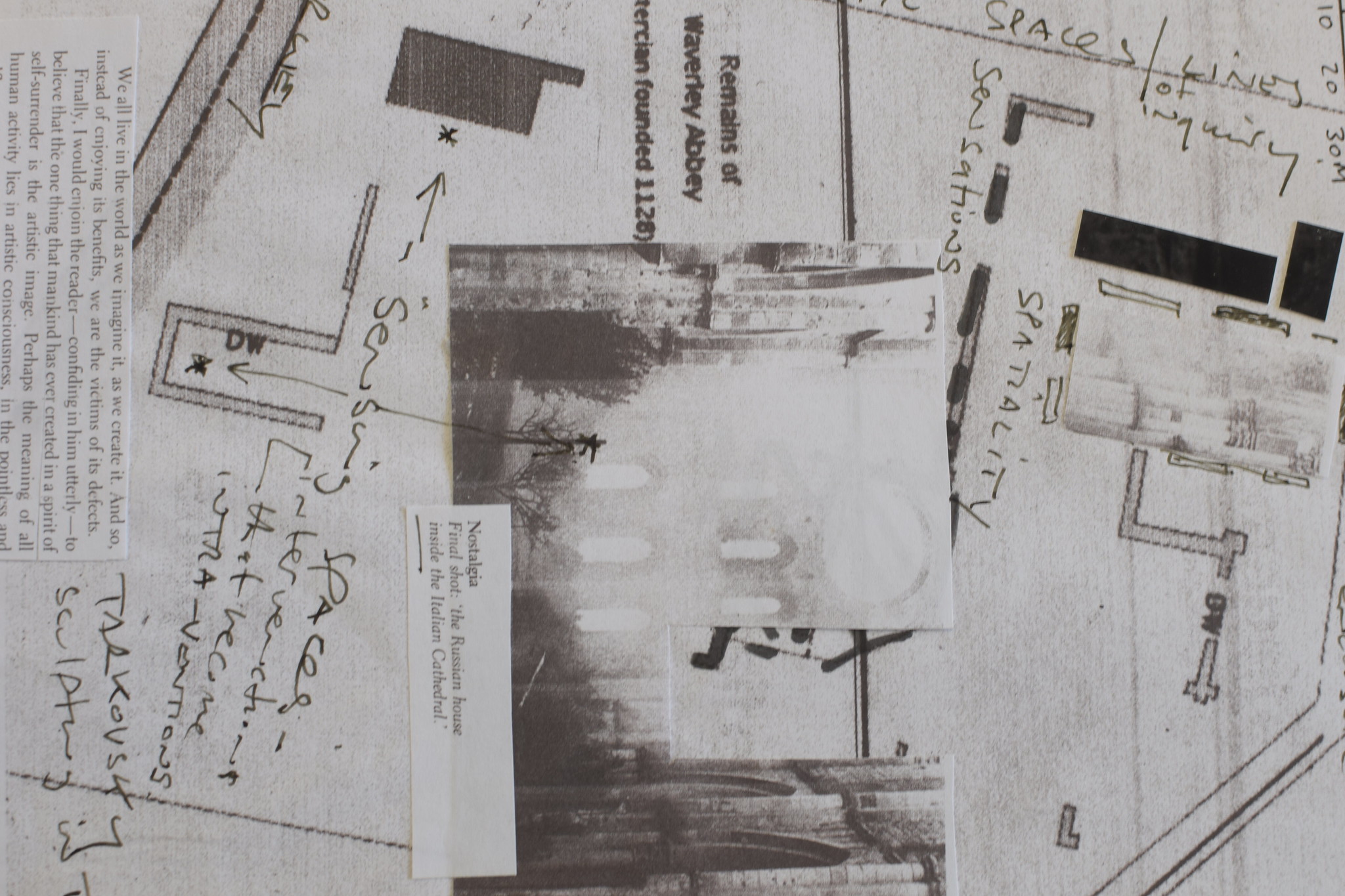
    The ruined site of the abbey at Waverley, near Farnham has been appropriated as a site and as a place within which to position and develop architectural and sociological inquires. The design processes of interiors have been employed as a tool to both critique and to create how we might further develop the contents of architecture. This Spatiality and its diffractions of differences and similarities, narratives and subjective experiences are what my interior spaces attempt to initiate.

    Design as a interactive structure, an interlocutory interior in the making of space and spatial relations.

    Interior design presented as an interactive and immersive spatial inquiry

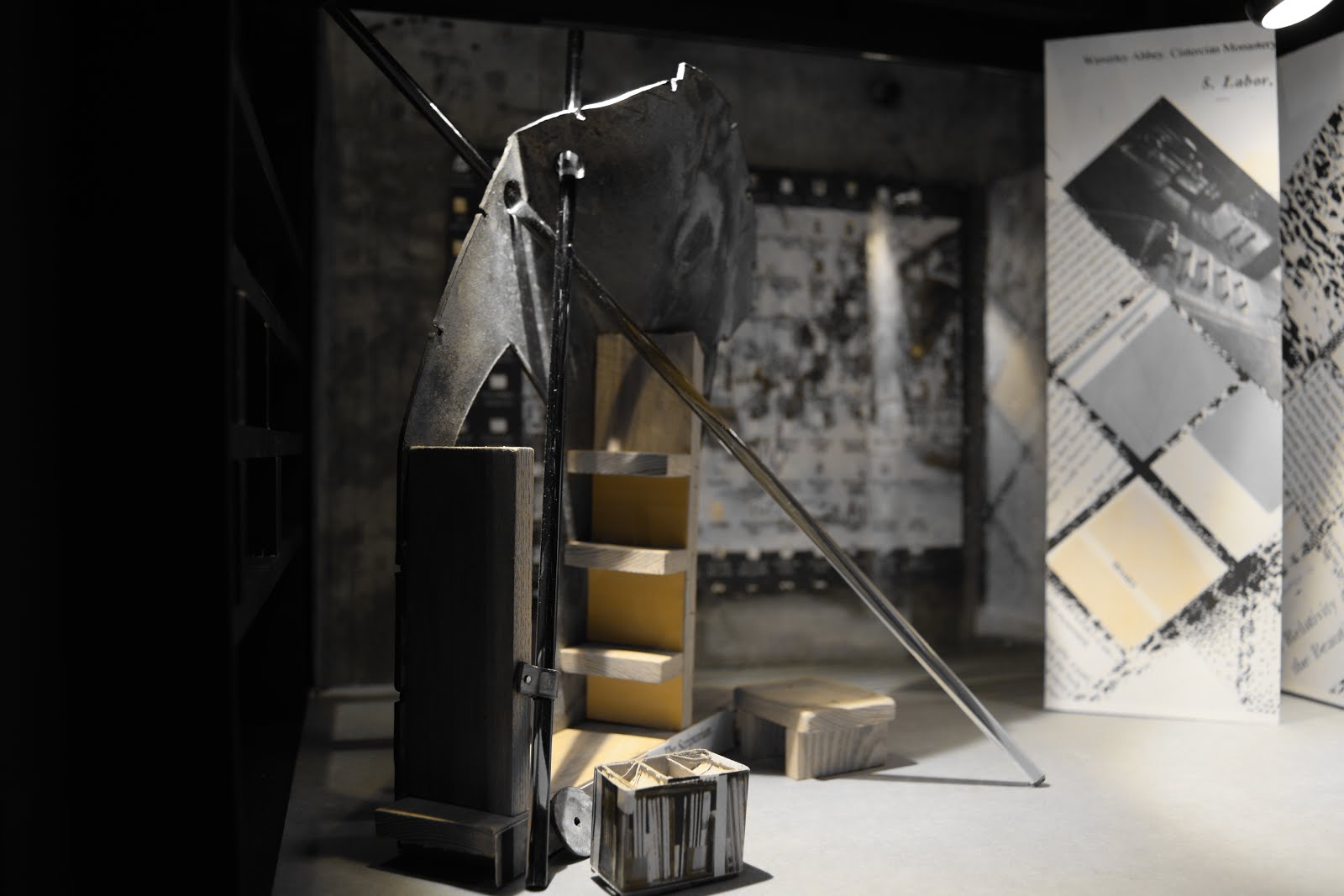
    The Scriptorium brings together a varied and discursive set of objects, texts and i interior architectures. This work seeks to understand how the virtual changes physical architecture and how this affects the space between people and buildings. The “performativity of research” is presented through specifically designed apparatuses and partitions. These designed components, made objects together with annotated texts and drawings conspire to create a complex design led inquiry a “Place Study” staged in a niche-like space. This interior presents itself as both distinct and relational to the other projects in the MA Interiors Show. The interior presents the many manifestations of creative research, structures and even symposia that have been developed through engaging with the site. The visualization of the research and the relational architectures rendered through montage and collage explores digital and analogue technologies. This hybridisation and the use of pinhole photography and film footage further explore interests in the field of performance as an immaterial architecture drawn in the presence of place.

    The realisation of my interiors project consists of two separate but relational elements that are presented into a built environment. The small ‘Scriptorium’ conceived as a space as a refuge, an intimate minimal construction that features a doorway and an interior that contains a place for objects, perhaps books, as well as a small sitting area. This construction, an open cell perhaps is evocative to a state of contemplation between the fabric of the everyday. The rather hybrid design appropriates a merging of minimalism, modernism and the plastic architecture of a ruined Cistercian Abbey. The construction comes into close contact with its occupant, it is a restricted spatial apparatus that attempts to promote through its awkwardness distinctive experiences. In particular the apparatus of the Scriptorium and its materiality is attempting to promote a sensory intensification that is further underpinned by the cognitive processes of reading and perhaps other social dialogues. The sensory intensification of a hut like space promotes a haptic sensibility, allowing the nearness and intimacies of both the built space and the imaginative, virtual realm to become entangled. Ultimately the Scriptorium is trying to build on unique human subjectivities that are manifested through a kinaesthetic repertoire or script that helps to enact further spatial experiences. It might be useful to think of this constructed space as itself still under construction, a site that acts as its own vessel within the multiplicities of human perception itself. The influence of the Cistercian Order, the site of Waverly Abbey and its pastoral landscape, have all contributed to a sense of the design process, The Scriptorium like the ruins themselves is open to the elements. Waverley Abbey remains as a sensory site between the remains of architecture and its society and the effects of our own global culture in the information age.

    In troubled times they all sought to experience life away from social definitions of success or failure. From there, these primitive huts marked personal, original inquires into the ever-mysterious nature of human existence.

    Anne Cline. A Hut of One’s Own

    Life Outside The Circle Of Architecture.

    The Scriptorium began through a research of both architectural themed texts and documentation of the site, and creative practice involving photography (digital, analogue and film) art practices of collage and drawing. The many visits promoted my own subjectivities to the site and these were also frequently subjected to change by the intervention of others in unexpected ways, these social intrusions by other revealed the very boundaries that the historic site engenders, some playful other malicious. These extremities within the social order of the visitors became problematic in designing for the site itself. An earlier proposal to host a Symposium centred on the Arts and The Humanities, that would use the Abbey and its surrounding ground appeared to be a project of vast diversities and logistics better suited to a cultural project through arts management and funding. As the project developed certain creative methodologies around particularities of the site itself began to appear, the notion of palimpsest being one of them. This promoted the idea of a reading room, as an ephemeral interior space that gathers up the experiential values of ‘ruins’ and re-enacts them as a site to explore the architectures of images. It became apparent that ‘palimpsest’ could be both a visual surface of erasures, earlier markings partially over written by newer ones ‘annotations’ and it could be a scaffold of developing ideas clearly visible merging as adaptations into the very usage of the site.

    These re-imaginations through the notion of palimpsest seemed filmic and as such they would able to display a vast amount of diversities and subject matter, a library of recourses that would require users or an audience or both. The referencing of the reading room to the library, and the symposium to the cinema or theatre allowed me to realise that I was dealing with a number of spatial arrangements that needed to develop together, but which could be employed separately. The theatre of research became the vehicle in which to see if this collaboration might be possible.

    The use of the image and text in my architectural collages allowed me to visualize associations, to create the possibilities of interior spaces that might be manifested into the built environment. The use of the collage in Architecture is widely acknowledged, architects from the likes of Mies van der Rohe, Daniel Libeskind and Rem Koolhaas. The ability of the collage process to juxtaposition fragments, images and texts from irreconcilable origins into an experience, that is visual, tactile and time-based makes it an interesting tool into the realms of architectural design. Collage begins to visualise not only the structure of spaces but also there content and circulation. The theatre of research is interested in how to promote collage and its use as a cognitive and perceptive tool in architecture.

    Collage and montage are quintessentially techniques in modern and contemporary art and filmmaking. Collage combines pictorial motifs and fragments from disconnected origins into a new synthetic entity, which casts new roles and meanings to the parts. It suggests new narratives, dialogues, juxtapositions and temporal durations. Its elements lead double-lives; the collaged ingredients are suspended between their originary essences and the new roles assigned to them by the poetic ensemble.

    Juhani Pallasmaa. The World is a Collage

    Jennifer A. H. Shields. Collage and Architecture

    Both the Scriptorium and The Theatre Of Research exist only in the form of the exhibition presentation. What they singularly of together propose can only be imagined through their manifested form as static objects placed within a built structure that loosely references architectural concerns and materials. They appear diminished and assigned to the voyeuristic gaze of the visitor that is equally curios and dismissive. These objects and the interior spaces they promoted seem stilled and stalled, as much they appear beyond reach as if the authenticity of their materials and construction have some how been subsumed by their stature and scale. The issues and qualities of which they are attempting to speak of seem reduced by the hegemony of vision, there is little hapicity and time to encounter, only it seems by investing narratives can we begin to re-enact the spatial encounter.

    How might the performativity of research be staged, and into what contexts might it be appropriated?

    As Hans Ulrich Gumbrecht notes, we live in a culture of meaning, not in a culture of presence. We constantly produce effects of meaning and multiply them with mass media. This applies not only to the humanities but also to a large degree to our wholly normal everyday lives. And in this respect, our experience of presence is getting drastically lost.

    Art works may never completely be explained by theory or meaning. The sensual, material makeup of the work in its presence is not the cinders, slag, and ashes, the undigested remains of theory, but remains of an intensified moment

    Peter Lodermeyer.Time, Symposium Amsterdam 2007.

    Personal Structures, Time, Space, Existence.

    The question I ask is do these objects and their interior spaces cause me to think beyond mere representation and recognition, or rather do they create enough of an encounter to force me to engage with them, even if I or the viewer are un-certain as to their meaning or possible outcome. Deleuze comments that something forces us to think. This something is not an object of recognition, but a fundamental encounter. Something that challenges us. Have these miniature architectures of objects become relational, do we start to use them in perhaps a heuristic manner, a hands-on approach to learning or inquiring, something that we can discover for ourselves. This heuristic finding-out could be made informative through collective collaborations and exhibition through the theatre of research. Is design stripping us of our qualitative spaces as the digital tooling removes the makers trace.

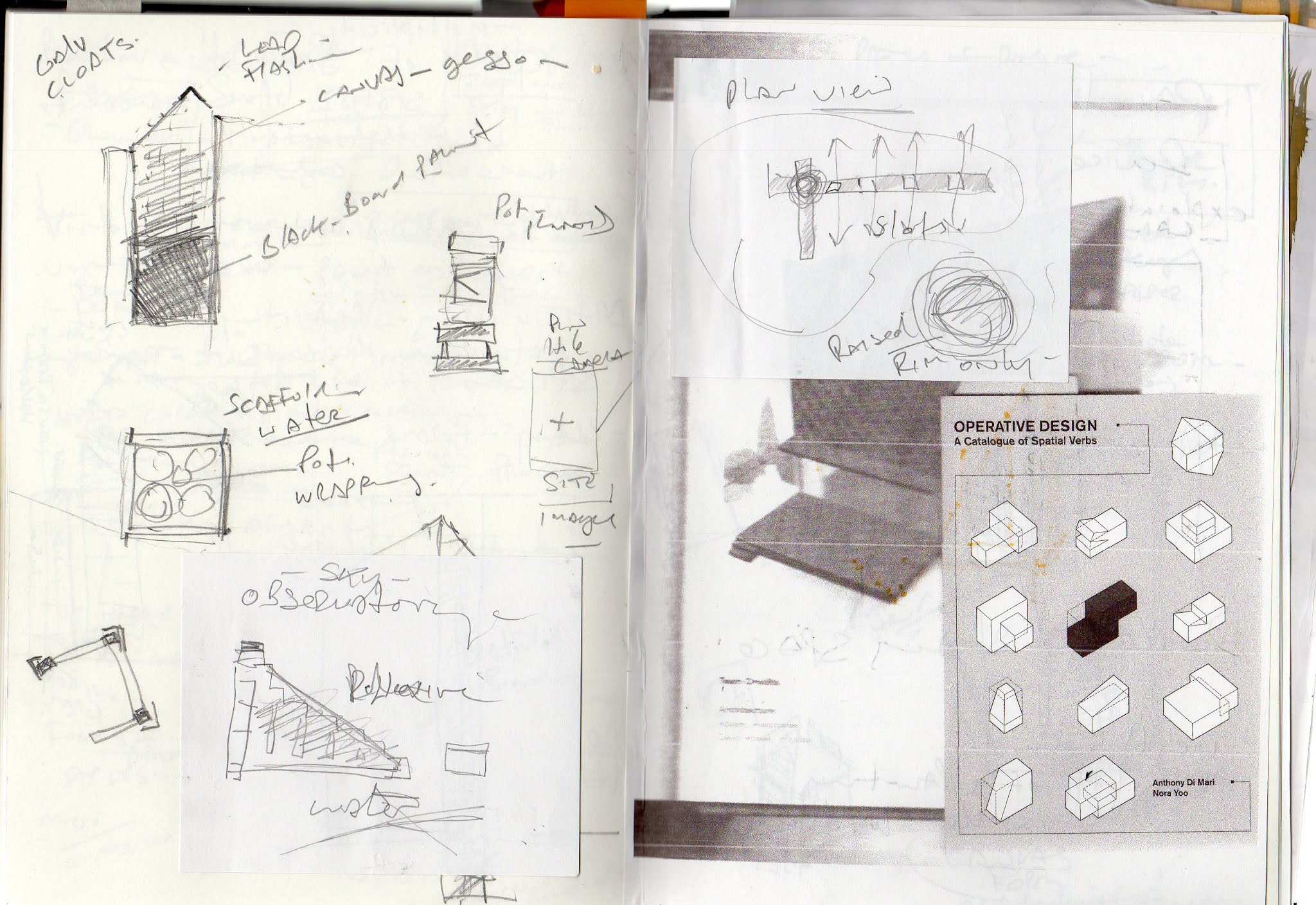
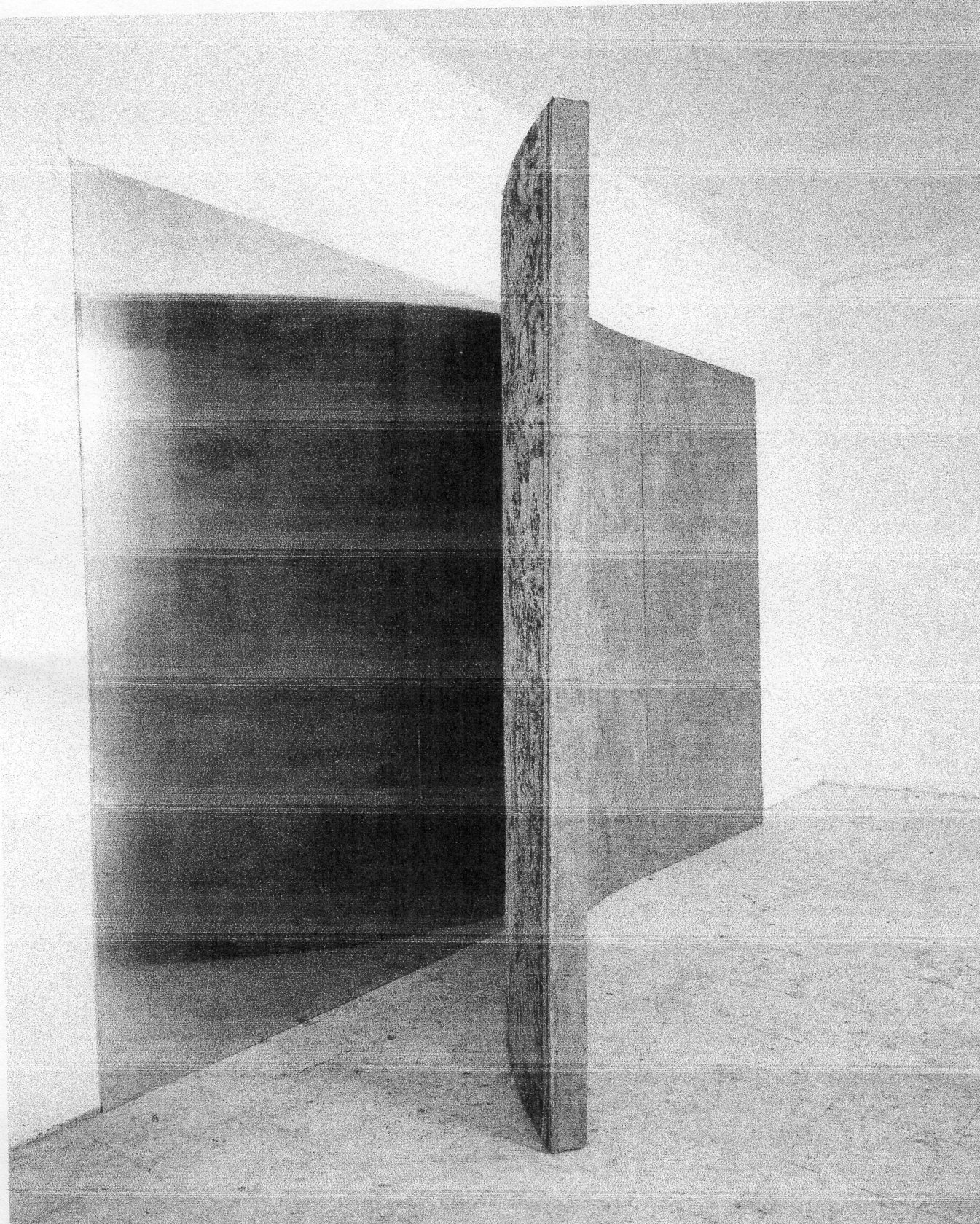
    The model object has served as a thinking place in the development of the idea of the Scriptorium. The materials used and their proportions echo interests in Minimalist Sculpture, the intervals between things in the work of Donald Judd and the architectural languages of memory and tectonics of the craftsman turned architect Peter Zumthor. This open sided hut seems cut away almost anatomical as if we were looking into the internal workings of an environment and resident. The structure would have to be made relational to its surroundings if it were to be placed in the landscape. Adaptations to weather the structure, to make it serviceable for use. The Scriptorium has analogues to the notion of a fire-place and its chimney stack. It is a the heart of a building the place of warmth, of dialogues and under the influence through fire of the imagination. The incompleteness that surrounds the scriptorium creatively asks for further design proposals that are even more site specific. The Solar Pavilion built by the Smithsons utilised the old fire place and chimney from the demolished cottage. Around this central element they developed the beginnings of their Modernist (Brutalism) pavilion, an architecture clad with glass, wood and zinc and contained by a walled garden and situated in the pastoral landscape of Wiltshire. Furthering the themes of being in the landscape the Scriptorium could become an observatory, as place from both to look out from and also to look in. The mobility or need to be re-assembled from site to site could promote innovative design solutions as well as interesting detailing or use of materials and surfaces that would facilitate interactions between visitors.

    The notion of the Scriptorium becoming clad by an exterior skin, an ephemeral membrane which would then render the differences between the interior and the exterior into the realms of an almost immaterial architectural experience; in as much as the usual distinction between the unpredictable forces of nature outside and the predictable domestic spaces inside. This prompt further investigation into an  architecture that blurs the boundaries of both architecture and nature, this could be further explored through the notion of quixotic gestures, art and performance that can capture the experience and the experiential engagement with the natural elements. The Scriptorium becomes the centred structure of remnant that is surrounded by an architecture that can create imprecise boundaries through inconsistent materials. This spatial arrangement will create its own qualitative responses, dialogues and subsequent movements. Architecture in this context becomes purely a sensorial response.

    The body as the vector for active mediation with the world of the spirit. The body is the instrument of a qualitative evaluation, the measure of intensity, which alone is capable of giving space extension and modifying it Space is no objective parameter; it must be ‘excavated’ related to the mobile living parametrics of the body.

    Frederic Migayrou. Architectures of the Intensive Body. Yves Klein. Guggenheim. 2005

    Mark Prizeman. Intensity. Ephemeral, Portable Architecture.

    Time, space and existence are amongst the greatest of themes-so great that we could never be so presumptuous to think we could do them justice, and too close that we could ever escape them, whether with our thoughts or actions, in life or in art.

    Peter Lodermeyer. Personal Structures Time. Space. Existence. 2009

    My design project has attempted to produce spaces and their interiors together with the apparatus of the Scriptorium that qualitatively seek to inquiry into the world we inhabit. The Theatre of Research attempts to establish some sense of a community that can do field work that invigorates the perception of the environment. My own interests are centred through experientially and mindfully exploring voids, cavities, and spaces between things, together with use of clay, glass and other vernacular materials. As an interior designer/artist I have become experiential to the agency of spaces. The theatre of research becomes a meeting place for furthering my programme initially proposed as a symposium at Waverley Abbey.

    Through experiencing familiar images, smells, sounds, and textures, but also through making certain familiar movements and gestures, we achieve a certain symbolic stability. Disrupt that familiar world, and our psychic equilibrium is disturbed. From this we can surmise that home, and the operations performed at home, are linked intimately with human identity. Architecture, it would seem, plays a vital role in the forging of personal identities.

    Neil Leach. Camouflage

    Analysing the desire to blend-in with our surroundings

    Beyond the limits of academic levels of discourse and learning

    Building/Working with Theoretical Objects in Architecture

    The Scriptorium would need to collect up and question considerable more qualitative data. Some sort of portable shelter, lightweight and offering some protection from the elements; would have allowed longer periods of stay and the possibility of experiencing different times of day. The activity of walking to the site, of having to incorporate it into a journey would help to create a stronger sense of place and routine. I am interested in the ‘thingness’ of this place, its influence and how its influence might be transposed into a methodology of reading, theorising and making. I am reminded of the Peter Brook who deliberately demolished his avant-garde theatre building Bouffes du Nord in Paris so as he could create a more emotionally responsive space for theatre. It is this under the influence of the Abbey, which I wish to explore as a creative catalyst, a tool that picks up on its differences as qualitative readings. The ruin by its very nature has re-defined its own architecture from one of form into that of experience, this sense of liminality or immateriality that constitutes itself as the architectural experience.

    A good space cannot be neutral, for an impersonal sterility gives no food to the imagination. The Bouffes has the magic and poetry of a ruin, and anyone who allowed themselves to be invaded by the atmosphere of a ruin knows strongly how the imagination is let loose.

    Peter Brook. The Open Circle

    Andrew Todd. Peter Brook’s Theatre Environments. 2003

    Bookmark and Share


    Social apparatuses and agents that explore the possibilities of space. Other Worlds : Insistent moments of mark making/subjectivity.
    Source: Inquiry is essentially the way of learning : Fragile Architectures of Hapticity and Time

  • Drawing Rooms : Cyanotypes/Collages/Photography

    Slow Philosophy. 2017
    Reading against the institution
    Michelle Boulous Walker

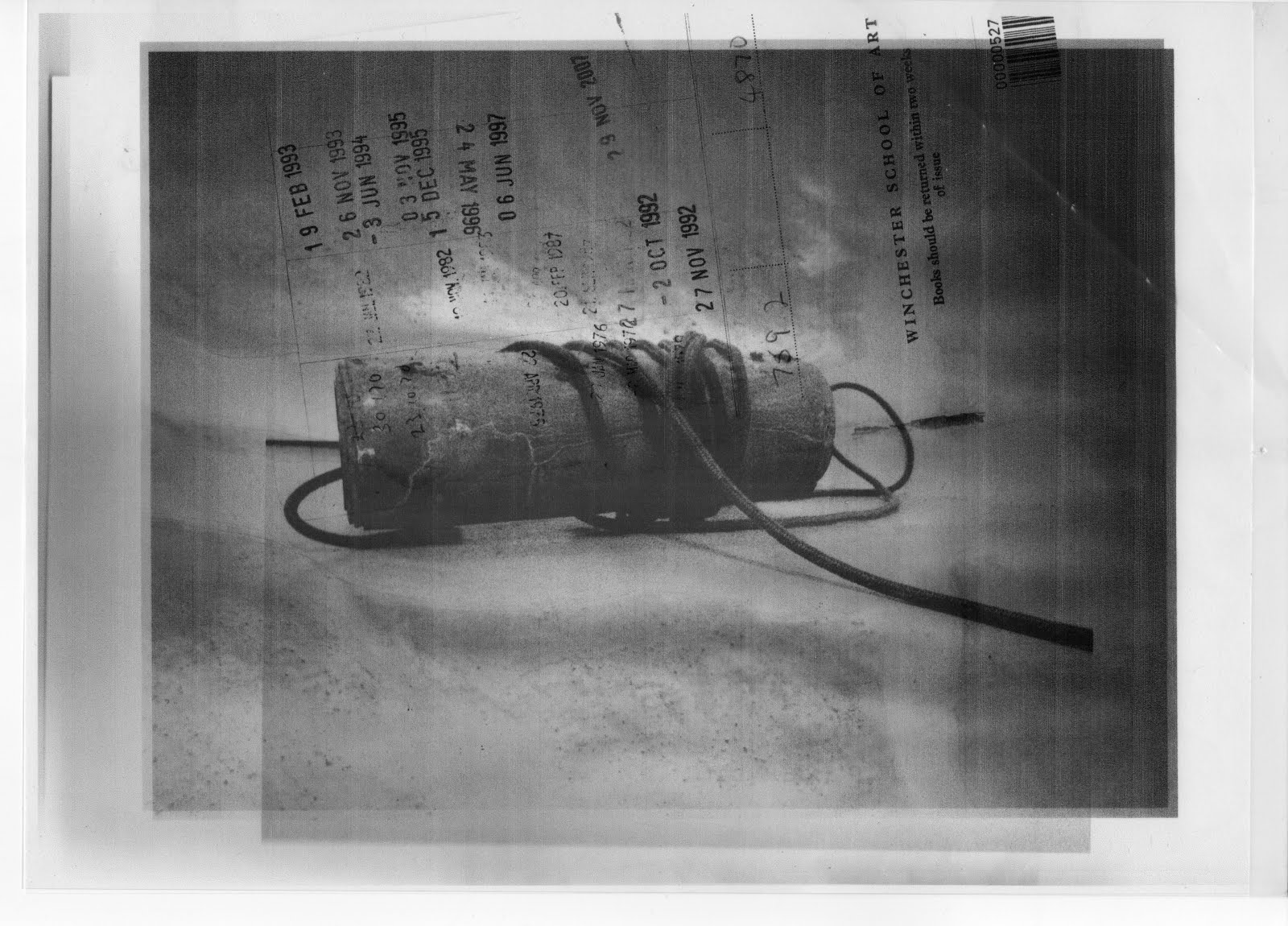
    Saturnian Form : Lead and Library Dates
    Russell Moreton

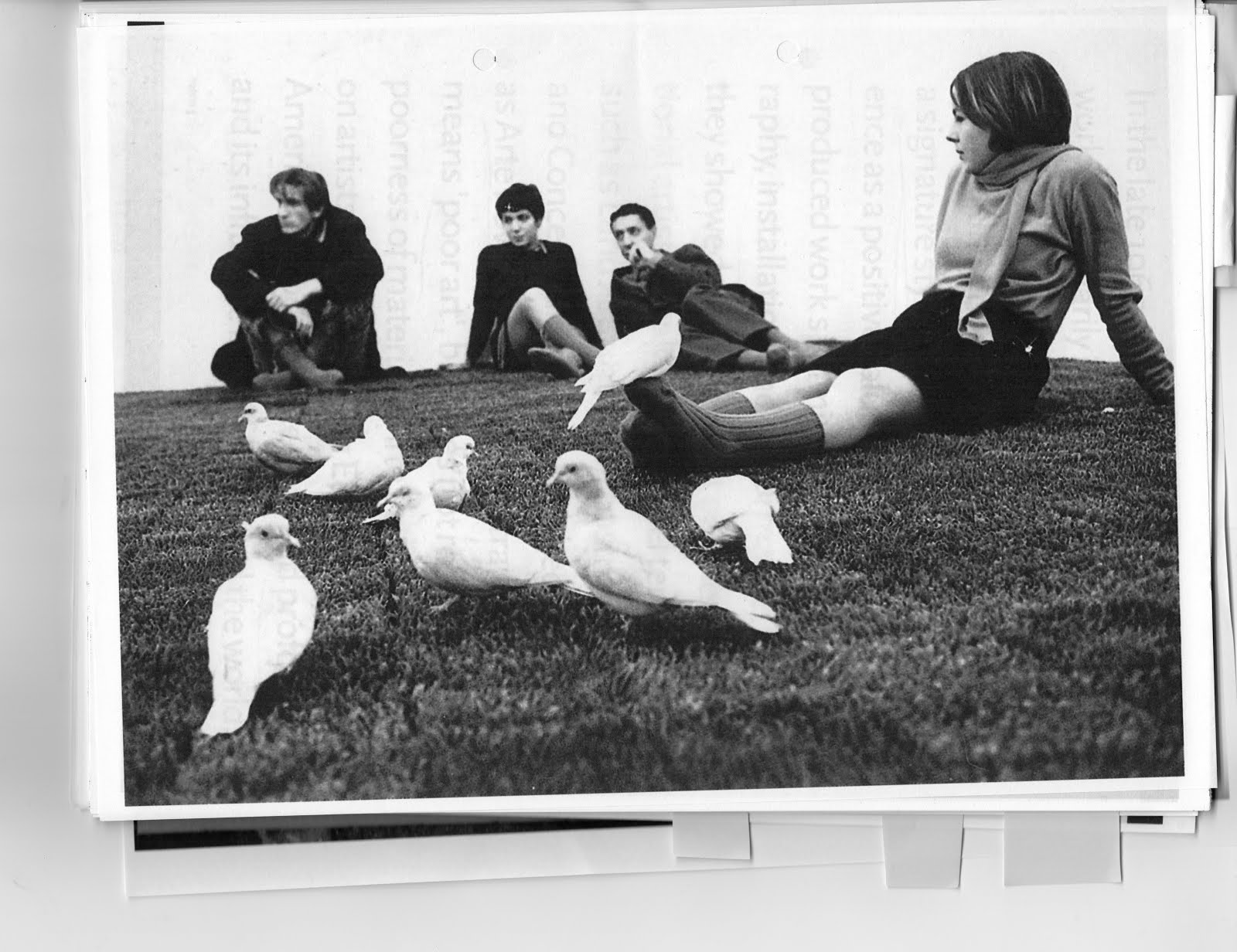
    Emilio Prini
    The filter and welcome to the angel, 1967
    Environment with participants, doves, artificial green grass, socks, ultra-violet light.
    Dimensions variable,
    Installation, Studio Bentivoglio, Bologna.

    Artist-run exhibition space

    Emilio Prini well illustrates the spirit of Arte Povera: the artist is not the creator of artefacts, nor even of a documented ‘happening’. In the transferral of energy and subjectivity into matter or an event, the work exists in the instant it comes into being and is simultaneously received.

    To document his work in photographs and present these as a record of it contradicts the very basis of Prini’s art.
    Arte Povera, Themes and Movements
    Carolyn Christov-Bakargiev

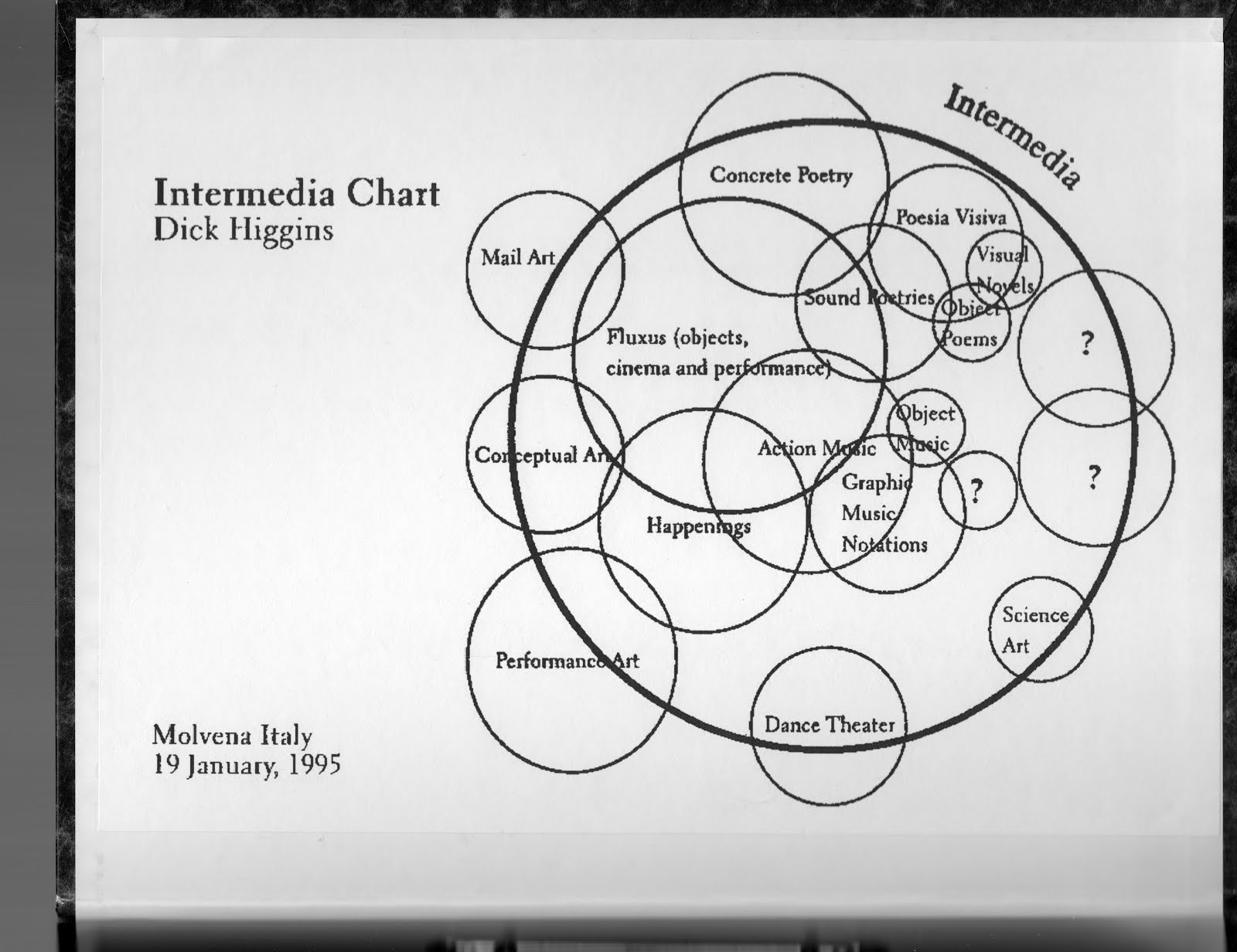
    Intermedia Chart
    Dick Higgins
    Molvena, Italy. 1993

    Bookmark and Share


    Social apparatuses and agents that explore the possibilities of space. Other Worlds : Insistent moments of mark making/subjectivity.
    Source: Drawing Rooms : Cyanotypes/Collages/Photography

  • Inside Phenomena : Innerness and Interior : Surface Pleasures

    Theory and Analysis.

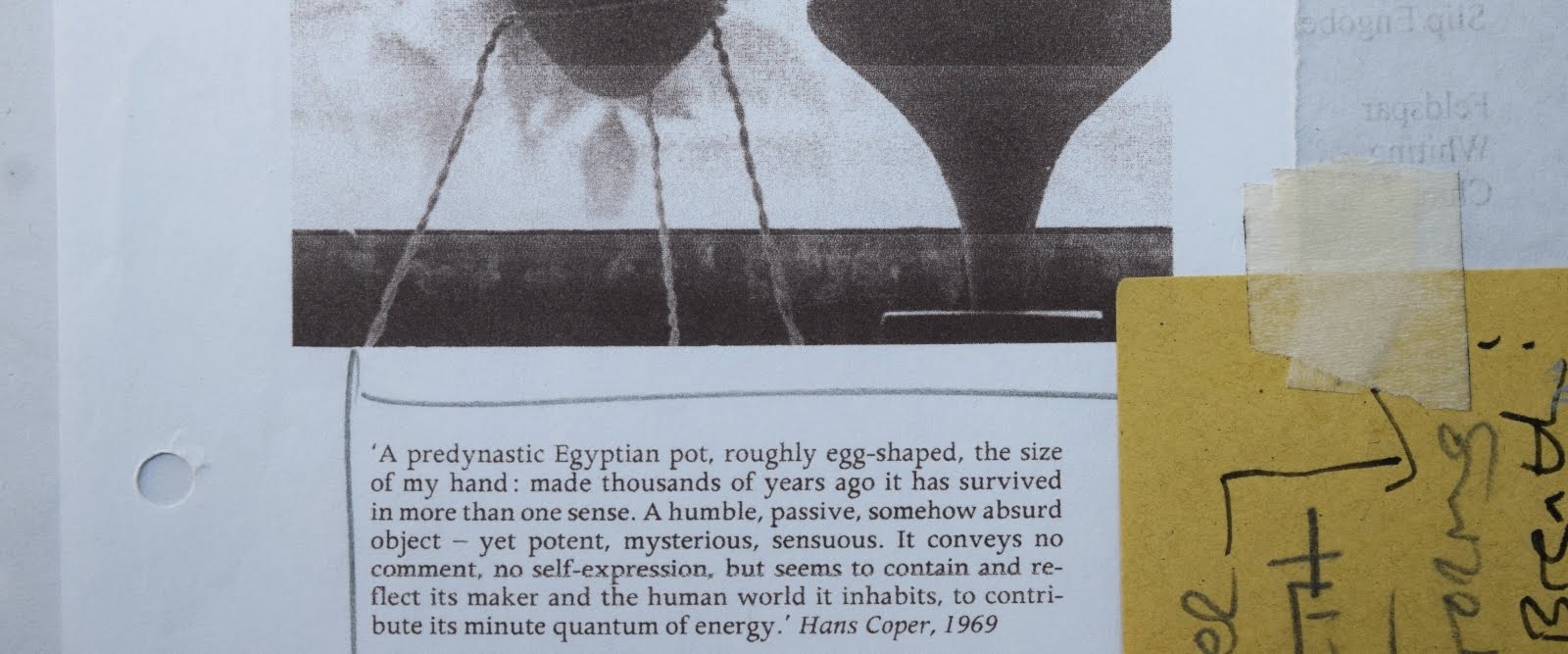
    In the future will we be able to extract the Platonic values that Hans Coper writes about with regard to the Egyptian vessel?
    This essay is an attempt to get to understand my current concerns centred around the interior spaces of things and places. This sense of the interior is itself held in place by the notion of some kind of vessel or material whether it is a pot or an architectural structure. It is this vessel and its materiality together with its form and its formlessness that I want to explore more closely.
    In architecture an interior can become a ‘sensing space’ with its own particular characteristics it becomes a host space, an extension of our own existential space; it can promote memories, sensations and can act as a reflective refuge from our post modern lives. Do these vessels and spaces re-enact the particulars of traditions and livelihoods, of other lives; are they in fact built expressions on the basic needs of a civilisation whether they be pots or architecture?
    Do we in some way attempt to reconcile and balance opposites, the outside with the inside; and as a result the practicality of a space depends on a larger degree to issues regarding its actual emptiness? I am interested in both the interior of a vessel, and the interior sensations of being in a space. The Poetics of Space by Gaston Bachelard is also interested in this dialectic between ‘inside’ and ‘outside’.
    In her essay The Essential Vessel, Natasha Daintry (Daintry, 2007:9) cites The Tao Te Ching ‘we turn clay to make a vessel, but it is on the space where there is nothing that the usefulness of the vessel depends.’ It follows then that this might be where the vessel starts to embody ‘something and nothing and becomes an effortless three dimensional manifestation of both form and formlessness.’ (Daintry,2007, :8) It is interesting to note that the potter is dealing simultaneously with both form and its attendant space as he hollows out the clay to create what might be termed an ‘essay to abstraction, a clothing of emptiness.’(Daintry,2007:8) This defined air is the ‘most transcendently human of all made things; volume, inner space, an interior, the carved out air that connects the morning teacup with the domes and spandrels of San Maco. There’s nothing there but clay and air, then there’s defined air.’(Gopnik, 2014:6) Adam Gopnik essay on the pots of Edmund de Waal speaks of an ‘innerness’ and De Waal speaks of ‘a breath held inward’. My own experience of De Waals work in the Architects House at Roche Court, Salisbury, is that of a multitude of similar porcelain pots that were all uniquely able to hold just a single thought or a memory. The installed pots and their simple wooden support became a permeable wall for remembered silences.
    This sentiment and its sensitivity to describing visible aspects of the world that are conjoining the concrete with emptiness becomes a poetic on the permeability of spaces and their vessels. The philosopher, Lucretius who was interested in infinitesimal entities comments in his poetic work ‘On the Nature of Things’ records how ‘knowledge of the world tends to dissolve the solidity of the world.’(Daintry, 2007:8) This lightness and its associative attendances can be found in ‘Hans Coper’s only extant piece of writing.’(DeWaal, 2004:34)
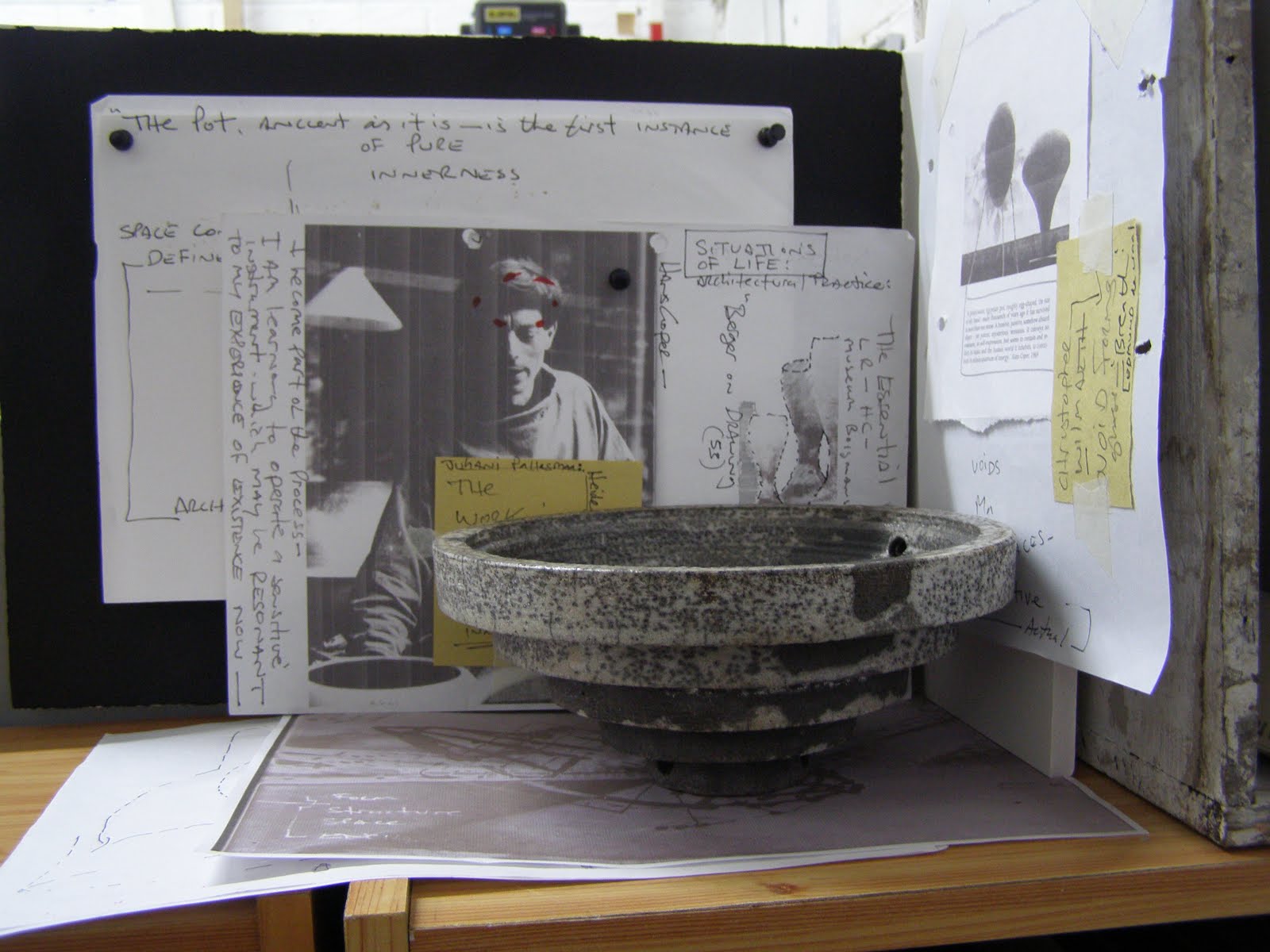
    A pre-dynastic Egyptian pot, roughly egg-shaped, the size of my hand made thousands of years ago, possibly by a slave, it has survived in more than one sense. A humble, passive, somehow absurd object – yet potent, mysterious, sensuous. It conveys no comment, no self expression, but it seems to contain and reflect its maker and the human world it inhabits, to contribute its minute quantum of energy – and homage. Hans Coper, 1969.
    Does Hans Coper’s text reflect through this archaic pot the human sense of innerness that this vessel still dwells with? ‘Theories of relativity and uncertainty have shown that all matter, even the airy oxygenated void inside a vessel is energy, and that it is composed of the same building blocks generated from exploded stars.’ (Daintry, 2007:8) Hans Coper’s Egyptian pot certainly as he observes, is still contributing its minute quantum of energy from thousands of years ago; an innerness put into being by the human hand. The sensing, doing and being that is caught, even marooned in this vessel talks of existential states, rituals, of things that shift and move as you inhabit the interlockingness of skin, volume and displacement.
    There is a material memory at work here, an artefact from another epoch, another mindset, but our corporality and the physical traces left in the clay concur its humanity. Pottery is given a priority in its ability to reveal cultures of the past.
    ‘The special historical value of pottery is due to its stillness underground. Almost uniquely, it does not corrode or disintegrate when exposed to earth and water, and so it forms the most important part of the physical record of the past. Like an invisible architecture, inverted and buried out of sight, they are our most reliable evidence of human endeavour.’ (Adamson, 2009:36)
    Gaston Bachelard writes in his Poetics of Space that ‘We absorb a mixture of being and nothingness.’ He is interested in the dialectic of ‘outside’ and ‘inside’. He asks is outside vast and fluid and inside concrete and small? He surmises that perhaps there is some membrane or intermediate surface that could separate the two states or rather a duality of ‘outside’ and ‘inside’. But these are concepts and abstractions, ‘the real experience is more kinetic, more fluid and interchangeable.’ (Daintry,2007:11) Can it be that as Bachelard argues that the mind and its imagination actually blurs the duality of inside and outside. He comments ’everything, even size, is a human value, even the miniature can accumulate size.’ In this way he explains further ‘being does not see itself, it does not stand out, it is not bordered by nothingness: one is never sure of finding it, or of finding a solid when one approaches a centre of being. We absorb a mixture of being and nothingness.’(Bachelard,1994:53)
    Bachelard seems to be in accord with the poetics of Lucretius as described by Italo Calvino in his Six Memos for the Next Millennium as ‘the poet of physical concreteness, viewed in its permanent and immutable substance, but the first thing he tells us is that emptiness is just as concrete as solid bodies.’(Calvino,1996: 61) There is a lightness and an exactitude in this ‘interior space’ that exists between its states of form and its formlessness. The vessel seems to have the ability to inhabit, mediate and transpose spaces between the ‘rich liminal territory of uncertainty and abstraction.’ (Daintry,2007:12)
    The transformative power of the vessel on changing spaces and our perceptions through its existential condition is illustrated in the poem “Anecdote of the Jar by Wallace Stevens” cited by Edmund De Waal. The jar or rather its vessel qualities becomes a spatial metaphor as it ‘practices’ the landscape around it by taking dominion as it were over the unmade. Perhaps Wallace Stevens’s ‘Jar’ promotes an architecture for the soul, an intimate yet social interior illuminated through the imagination?
    Natasha Daintry asks are we now using objects to lead us back to ourselves, objects that before were used as a way of feeling our way into the world? (Daintry,2007:13) She remarks on the strong resonance that clay in particular has to human civilisation and as a material that can socially inform us.
    I am interested in exploring further these notions of material and spaces, of form and formlessness through the social contexts and professional practices of Hans Coper and Edmund de Waal. I am particularly interested in the making process ‘throwing’ as it promotes the situation of attending to the physicality of things which has the effect of locating you in the world and connecting you to your own physicality. Daintry comments ‘it represents a way of existence of felt experience, of being known, and knowing the world through the corporeal.’ (Daintry,2007:13)
    Pottery Making, Inner Spaces, Installation Art and the Post modern.
    ‘When potters throw a certain curve in a vessel wall, they are in affect in dialogue with every kindred pot that they have seen or held. Like an archaeologist’s excavated shard, the experiential dimension of making can act as a bridge across temporal distances.’ (Adamson, 2009:44) The pot can be seen as a cultural trace that can bring a sense of immediacy from across the centuries.
    Hans Coper’s assembled ceramics are constructed from a number of thrown components, throwing a process that he remarks on by saying ‘I become part of the process, I am learning to operate a sensitive instrument, which may be resonant to my experience of existence now.’(Birks,1983:63) Tony Birks comments that all his works were containers and that they were all thrown and that some of their energy is the direct response of being solely conceived on the wheel. This ceramic practice of throwing gave him his sense of livelihood, dwelling and skill.
    Coper’s pots celebrate the studio potters pioneering spirit of innovation and discovery through the daily practice and discipline of a craft. He produced composite forms of his own invention that underpinned his modernist aesthetic. His ceramics have evolved through a series of archetypes, families and groupings, from which he could propose subtle amendments and adaptations.
    Hans Coper’s pots are objects that seem to spatialize their surroundings with their complex inner spaces. They seem to set up in their interiors, narratives and intimacies that radiate outwards to the surface of the vessel and then beyond into the scale of the world.
    The Pots themselves have an almost mechanical surface treatment. This is caused by abrading the glazed engobe layer. This seems to give their interior space a reverence for the handmade and sensibilities of the once plastic clay.
    Hans Coper’s candlesticks made for Coventry Cathedral could be seen as epochal points of reflection and reconciliation with humanity.
    His pots take up dominion as thinking, sensorial vessels, artefacts that enter into our existential social realm.
    Hans Coper was part of an ethical avant-garde. He produced modernist artefacts that sat on his studio shelves; his pots had no need of biography, plinth or cabinet. They exist solely through the agency and inquiry of their makers’ situation; they reference the modernist traits of their time, yet they are touched by an archaic timelessness, an entropy that they and we can never escape. These pots now question the new social consciousness that has itself left art in the world of the Post modern, which is itself addictive, conditioned and fetishized. Hans Coper’s pots remain humble in their humility despite market forces; but can they really gives us some sense of ‘a vision that affords perspective on our existence and the hidden aspirations of man?’ (Kuspit,1994:5)
    Suzi Gablik in The Re-enchantment of Art confirms that our way of thinking about art (has become conditioned) to the point where we have become incredibly addicted to certain kinds of experience at the expense of others, such as community, or ritual. Not only does the particular way of life for which we have been programmed lack any cosmic, or transpersonal dimension, but its underlying principles (have become) manic production and consumption, maximum energy flow, mind-less waste and greed. (Gablik, 1991:2)
    In sharp contrast to the abraded and textured reworkings found on Hans Coper’s pots, Edmund de Waal’s contemporary installations furnished with his own hand thrown porcelain pots; shimmer and shine with a suffused surface of reflections producing a delicate aesthetic that promotes his ‘dialogue about the use, preciousness, survival, presentation and display of ceramics.’(Graves, 2008:8)
    His large scale installations show large groups of ceramic vessels, these are often in historic architectural settings. He is both an artist and an historian of ceramics. His installation Signs and Wonders contains up to 425 pieces of wheel thrown porcelain. Through working with specific settings De Waal has produced installations that by their very impermanence offer ‘new and unexpected dialogues’ through staged interventions that are ‘framing pots within architectural features or the intimate spaces of furniture.’ (Graves, 2009:10) This site specific installation is located high up in and under the main oculus window at the Victoria and Albert museum in London. The installation will be visible to viewers as they look upwards into the space of the monumental central dome.
    Signs and Wonders could be about seeing and sensing pots from a distance, De Waal is seeking to reflect the sentiments found in Wallace Stevens poem that makes the pot itself appear as a still centre from which we can step back from and observe as it helps us to gather in our surroundings.
    ‘De Waal has placed his pots in circulation, but not in the sense that they can be held and passed around. They are even, to some degree withheld.’ (Adamson, 2009:34) De Waal’s porcelain vessels (shape shifters) are in effect objects from memory brought into a shifting nature of influences from the Chinese porcelains, the 1800 Century European porcelains and the collections of the Modern era from Vienna, Bauhaus and the Constructivists. ‘The way in which the pots are displayed has become an integral part of the work. And increasingly there is a sense that it is about putting on a show, albeit one that might be for a private audience.’ (Graves, 2009:8)
    This work is not about tactility, immediacy or possession, perhaps De Waal has succeeded in producing a collection that is also ‘a talisman of subjectivity’ of one man’s personal vision of ceramics.
    His work and the interior spaces associated with it are in some way becoming endemic of his and our post modern world. Is there some sense that De Waal’s throwing, his vessel making has itself just become a function, an endless repetition. Is there a fear that the presentation and the framing of De Waal’s vessels actually ends up with him filling in the spaces he has strived to construct?
    Although the body has been existential throughout the throwing process and is clearly represented in Edmund de Waals work. It might now appear that these new thrown pots destined for another staged presentation, are being crafted with this aim in mind.
    Rebecca Solnit explores Susan Bordo’s claim that ‘if the body is a metaphor for our locatedness in space and time and thus for the finitude of human perception and knowledge, then the post modern body is no body at all.’ Solnit comments on this post modern body that it is more of a passive object, appearing most often laid out upon an examining table or in bed. ‘A medical and sexual phenomenon, it is site of sensations, processes, and desires rather than a source of action and production, this body has nothing left but the erotic as a residue of what it means to be embodied. Which is not to disparage sex and the erotic as fascinating and profound, only to propose that they are so emphasised because other aspects of being embodied have atrophied for many people.’(Solnit, 2002)
    We return back to the urgent need to make and experience things that in someway that lead us back to ourselves. The creative architectural work of Peter Zumthor is something that I am engaging with. He has developed architectural design practices that consider each project in terms of a comprehensive and encompassing sensory experience. He looks beyond the mere physical form and its fabric. He attempts to address issues of the body and how it may interact within a built environment. The use of memory as a spatial narrative to accompany the atmosphere of his spaces is realised through evocative material surfaces and densities. I feel that there is a synergy here between the opening up of the interior of a pot and the opening up of a space to dwell in.
    In sensing a pots interior from its surface, we are as it were in some intimate tacit correspondence with its spatial sensing centre. We become known to it through its maker’s creative gesture of innerness. This anthropological inner space linking us to the potter is both sensual and distant; its vacancy allows us dwell in the maker’s absence. We become part of the vessel, we enter its philosophy of solitude.
    Bookmark and Share


    Social apparatuses and agents that explore the possibilities of space. Other Worlds : Insistent moments of mark making/subjectivity.
    Source: Inside Phenomena : Innerness and Interior : Surface Pleasures

  • A humble, passive, somewhat absurd object, yet potent, mysterious, sensuous : Hans Coper

    Hans Coper, Theory and Object Analysis, Crafts Study Centre, Farnham.

    MA Interior Design

    A vessel (as membrane/threshold that can hold social rituals/traditions and memories) seems to occupy space but simultaneously be occupied by space.

    Theories of relativity and uncertainty have shown that all matter, even the airy oxygenated void inside a vessel is energy, and that it is composed of the same building blocks generated from exploded stars. (Daintry2007:10)

    Water, although fluid it is supremely germinative and represents the condition of all potentials.(Eliade Mircea l983)

    Permeable in flux, water and water’s symbolism became the pagan’s way of intuitively knowing the world. Matter was plastic, fluid and changeable. The body was plastic with parameters defined not only by individual consciousness, but also in relation to other realms of the physical world.

    The pagan participated in a vast mythology where his identity changed according to narrative fantasies that combined and recombined human and animal activity endlessly, weaving together memory, reason and sensation. In this permeable world there is no sharp division between things or between life and death. It is a world of energetic flow where bodies can indifferently become attached or unattached from myriad objects and forms. (Daintry2007:9)

    Flexible Ways of Seeing/Re-Making the World.

    “A large part of the reason for making is to see things that I have never seen before, to build something which I cannot fully understand or explain.”

    Artist Statement, Ken Eastman.

    Drawings in the form of tracings were gathered from the flat planes of the display cabinet; these were further superimposed in an attempt to map the surface and forms of the Hans Coper pots and to explore their volumes and interior spaces. These new sight lines subjectively link surface details with profiles into the possibility of new spatial forms. These plans and mappings became the starting point for a series of slab and thrown assemblages. Thrown and slab worked clay forms in T Material, preliminary drawings done in-situ some with annotations. (Russell Moreton. 2014)

    Rotterdam Exhibition with Lucie Rie. 1967 Hans Coper.

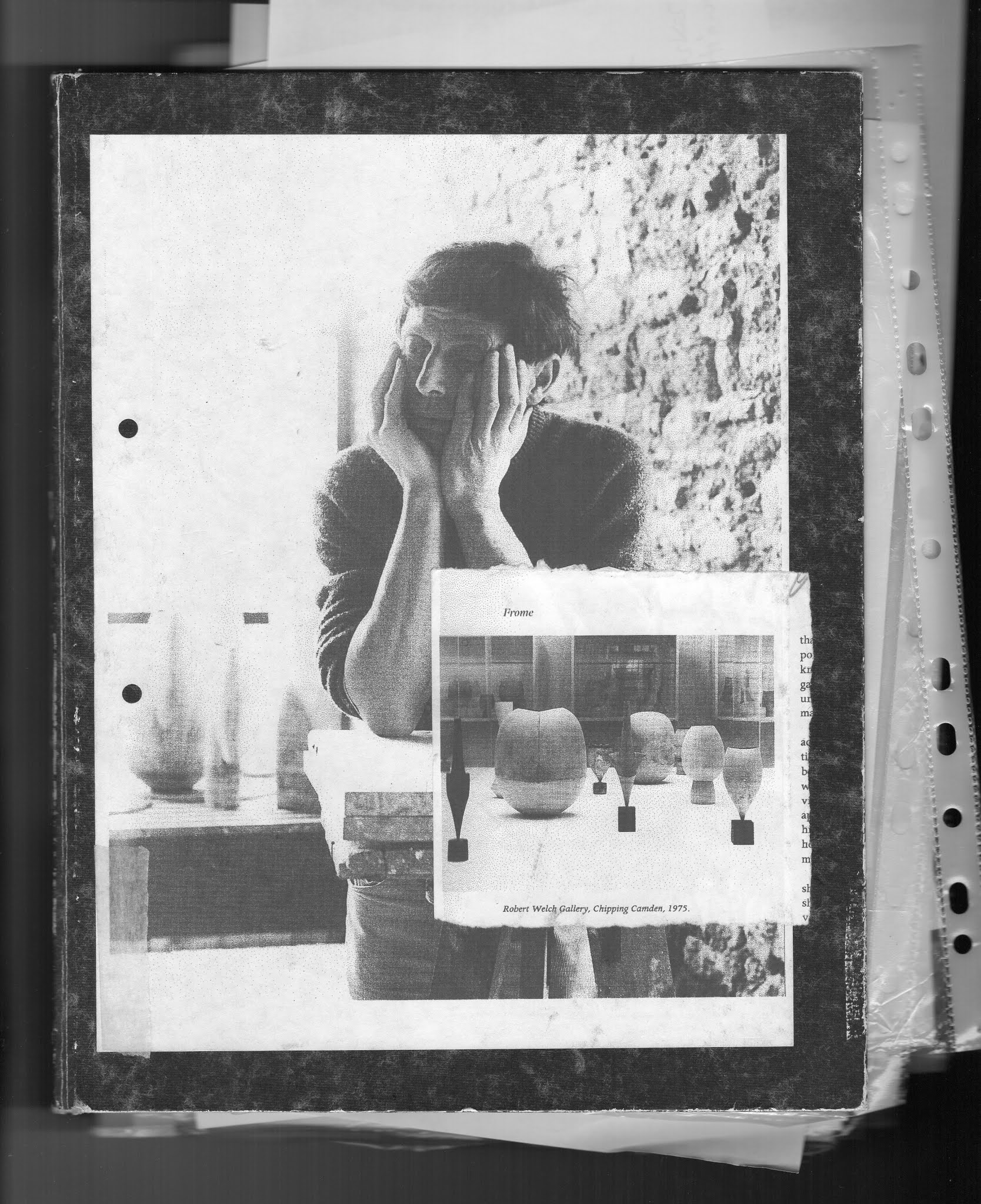
    His arrangement was highly original and innovative, he showed his families of vases in groups, emphasising their subtle differences in form and surface treatment. The space between the pieces was just as important as the objects themselves. The architectonic character of Coper’s pots become visible through their dry, stone like skin and the sophisticated way in which Jane Gate photographs the work.

    “Potters of reconciliation, they sought a marriage of function and beauty.” Douglas Hill SF author/intro to exhibition.

    Craft Study Centre Publication 2014

    Object Analysis

    Name of object:   Vase, flattened oval form on a cylindrical stem, pinkish cream to grey glaze over                                       manganese on exterior, manganese over interior and recessed foot. It is decorated                                    with incised lines on back and around the stem with concentric rings incised on the                                   foot

    Accession number:                P.74.28

    Maker:                                   Hans Coper

    Construction techniques:

    Materials:                               stoneware

    Dimensions:                           22.2 x 18.8 centimetres

    Date made:                             1960s

    Provenance:                           Made in Hammersmith, London. UK

    Given to Muriel Rose by Hans Coper in 1966

    This thistle-shaped vase is constructed from five individually thrown pieces. The joints making up the pot have been selectively accentuated with the residues of the manganese engobe. Incised geometric marks remain from the initial turning process of the component parts, prior to the construction of the pot. (Russell Moreton. 2014)

    Name of object:     Vase, unglazed rim. manganese interior, decorated with vertical scoring on the                                         exterior

    Accession number:                   P.74.103

    Maker:                                       Hans Coper

    Materials:                                  stoneware

    Dimensions:                              12.7 centimetres

    Date made:                                1950s

    Provenance:                               London. UK

    Single thrown form with the remains of the sgraffito technique after the ceramic has been heavily abraded after firing. The vertical lines of the sgraffito technique and the form itself are similar to Lucie Rie’s flower vases, see Lucie Rie by Tony Berks page 112.

    This single thrown form perhaps best illustrates the creative union of both Coper’s and Rie’s practices, the form almost a kind of beaker might itself been inspired by the “dark pots” Lucie Rie found whilst visiting Avebury Museum. (Russell Moreton. 2014)

    Name of object:     Squeezed ovoid-shape vase with flower holder inside, manganese interior

    Accession number:                    P.74.30

    Maker:                                   Hans Coper

    Materials:                              stoneware

    Dimensions:                          22 x 22 centimetres

    Date made:                            1970s

    Provenance:                          London. UK

    Wheel thrown forms, comprising of bowl, open cylinder and an interior ring acting as a flower holder. The bowl form has been turned before being jointed with the upper section. The piece was then indented at four points to form an ovoid form. Pronounced incised horizontal marks remain from the joining, which has been further transposed by the action of becoming ovoid. Very subtle and restrained use of the manganese engobe followed by Coper’s characteristic post firing technique of abrading the surface of the ceramic. (Russell Moreton. 2014)

    Hans Coper : Working Notes CSC/10 March 2014.

    Notes re/statements

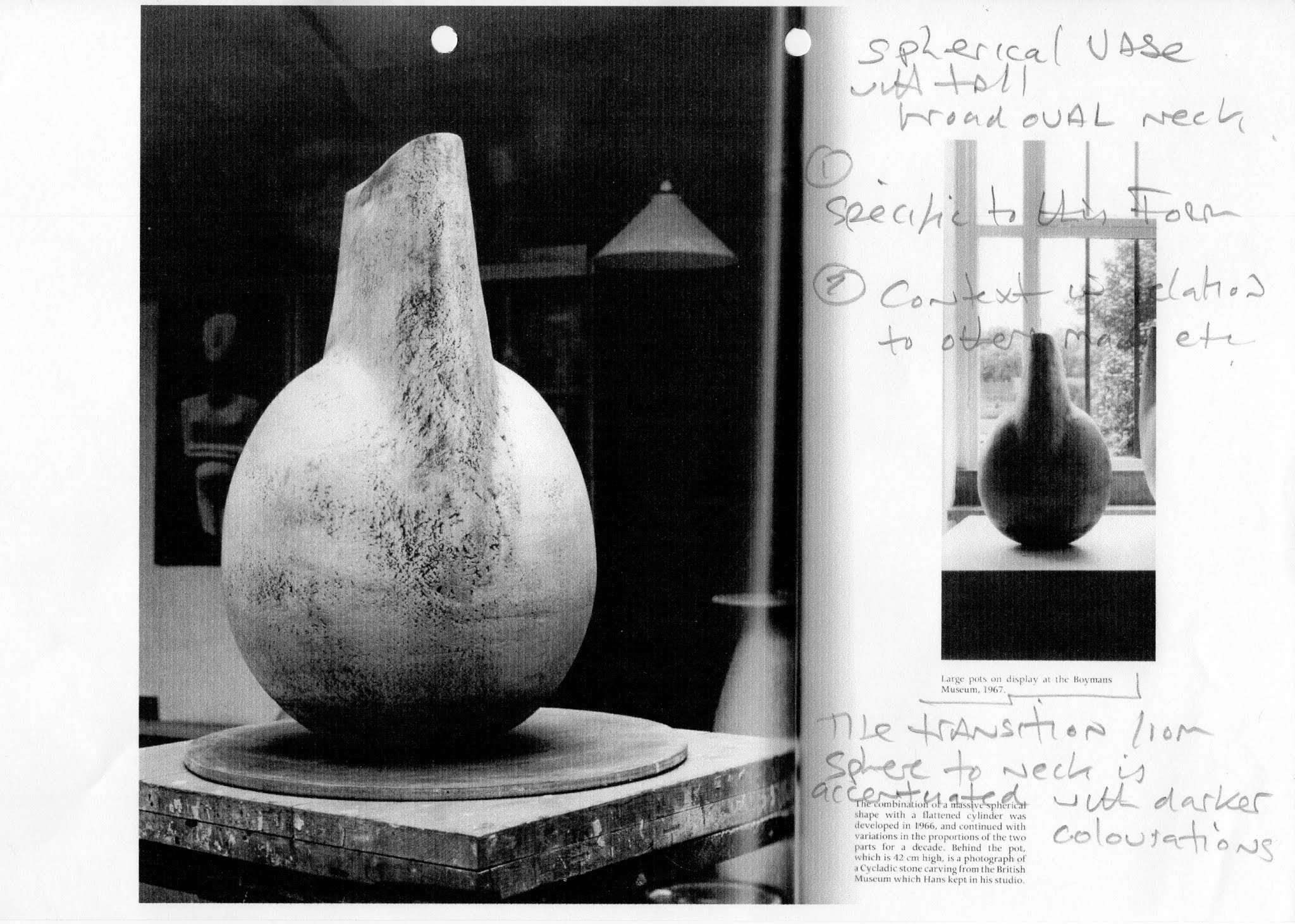
    1.   Specific to the form in question.

    2.   Context in relation other similar forms.

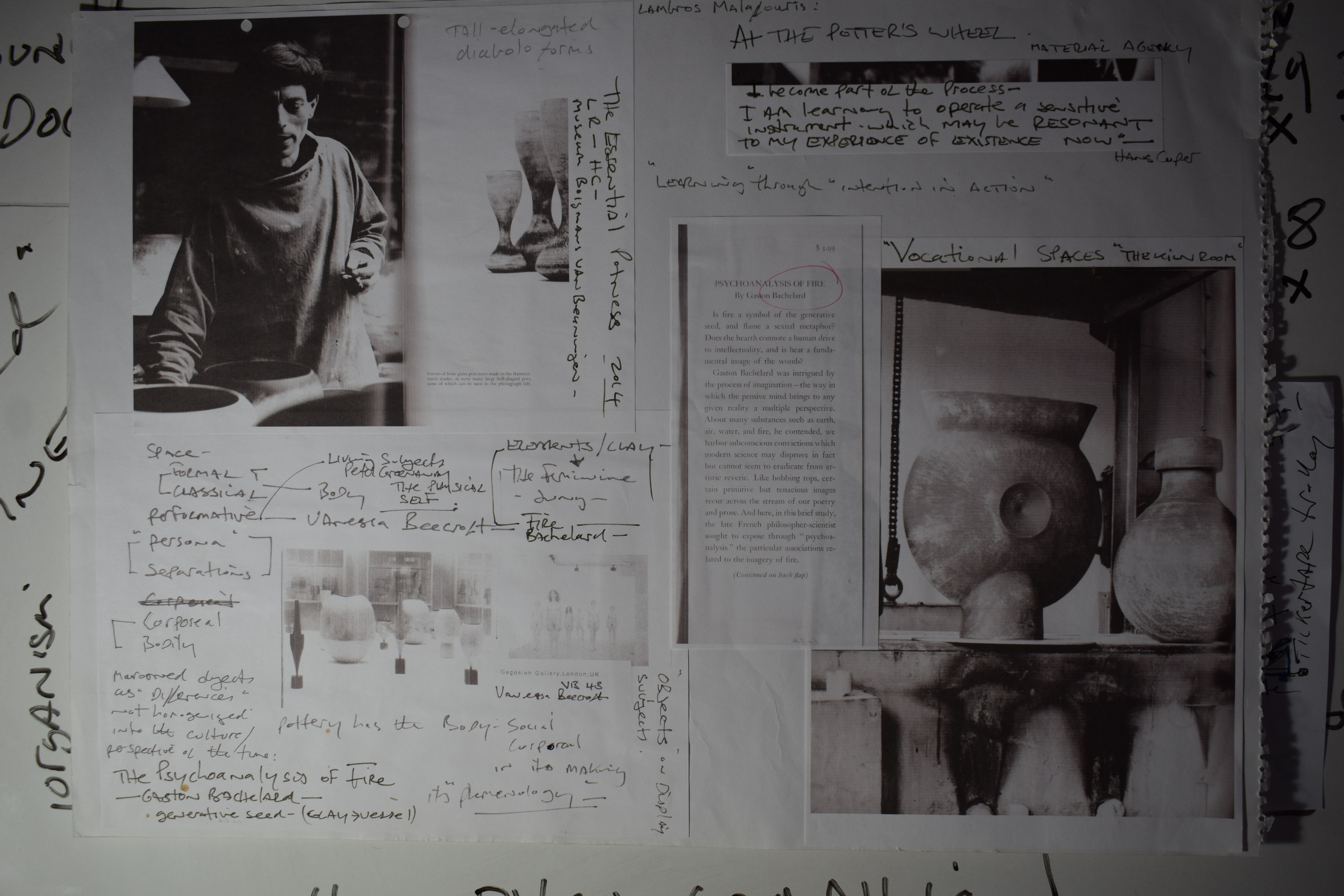
    3.   Key Words: Impregnated, Incised, Eroded, Reduction, Surface, Soil, Abraded Surfaces, Machining, Grinding, Assemblage, Components, Parts, Groups, “Aryballos,Spade, Thistle, Diabolo, Cycladic, Spherical,” Sculptural, Pottery, Architectonic, Space between Forms, Spatial, Sensuality, Form and Fold, Bodily Spaces, Light and Dark, Clay, Water, Fire, Agency, Difference,

    Extracts from catalogue “The Essential Potness, Hans Coper and Lucie Rie 2014”

    “I become part of the process, I am learning to operate a sensitive instrument which

    may be resonant to my experience of existence now.”

    “My concern is with extracting essence rather than with the experiment and exploration. The wheel imposes its economy, dictates limits, and provides momentum and continuity. Concentrating on continuous variations of simple themes I become part of the process.”

    Artist Statement, Victoria and Albert Museum/Collingwood, Coper Exhibition 1969. Small Beige Spade 1966.

    The body comprises a thrown circular form, from which the bottom has been flattened into an oval and the lower section has been pressed together.

    Throwing rings are visible on the inside.

    Areas of the white engobe have loosened from the underlying layer during firing and formed blisters.

    Cycladic Vase 1973.

    Blisters in the slip have been sanded down to reveal a rust coloured underlying layer. Medium Sized Spade 1973.

    There is a clear delineation between the light upper section and the rougher and darker lower section.

    Small Thistle Shaped Vase 1973.

    There is a large incised circle on one side of the disc and a smaller circle on the other. Hans Coper’s characteristic use of light engobe and dark manganese oxide has produced a hazy texture.

    Black Aryballos 1966.

    This ceramic form has its origins with the Oil Flask used by athletes in Greece and Asia Minor.

    Tall elongated diabolo forms.

    After being thrown the cup has been formed into an oval and then indented at four points.

    Text Fragments. Momentum Wheel.

    It is difficult to determine in which order the parts were assembled.

    The underlying surface is showing through the grooves that are linking the body and the base.

    The manganese engobe is demarcating dark and light zones through an undulating incised line.

    “Rings” caused by the placement of a prop in the kiln. Brown-Beige Colorations.

    Sensations caught within the form.

    Soil like deposits/remains.

    Reductions of the fired surface.

    Abraded Surfaces

    Incised Line.

    Droplet.

    Blisters, pricked open and sanded after firing. This process has produced an irregular, patch surface.

    Parallel lines have been incised with a pointed object on the exterior of the base. Thistle Shaped Vase 1966.

    The dark brown patches (around the jointing of the pot) and flecks appear randomly distributed but have been purposefully placed to accentuate the structure of the vase. This flat vase with the contour of a stylised thistle flower is made up of five individually thrown pieces. The tall cylindrical foot supports a vertical disc, comprising of two individually thrown flat plates. It is as though the disc has sunk approximately ten centimeters into the foot.

    Spherical Vase with Tall Broad Oval Neck 1966.

    The transition from sphere to neck is accentuated with darker colourations.

    Hans Coper

    Hans Coper’s iconic assembled ceramics frame the later part of the twentieth century with an ambivalence of both alienation and reconciliation. His pots reveal differences that have resisted the homogenizing effects of the culture of the time. They embody and are a physical testament to what the potter himself has reflected on his life, “endure your own destiny”1 2 within the space and time of the human condition.

    Bom in 1920 into a prosperous middle dass background, his childhood years were spent in the small town of Reichenbach in Germany. In 1935 his father Julius, is singled out like many other Jewish businessmen for harassment and ridicule

    under National Socialist Party. This would result in the Coper family moving frequently to escape the attention of the Nazis. Tragically in 1936 Julius takes his own life in an attempt to safeguard the future of his family. The remaining family. Erna Coper and her two sons return to Dresden. In 1939 Hans at the age of 18 leaves Germany for England, the following year he is arrested in London and interned as an enemy alien. He spends the next three years first in Canada then returns to England by volunteering to enroll in the Pioneer Corps. In 1946 a meeting with William Ohly who ran an art gallery near to Berkeley Square, brought about an opportunity for a job in a small workshop run by Lucie Rie, a refugee potter from Vienna. Hans Coper now began earnestly through his engagement with ceramics to reveal a continental modernity “whose work seemed uncomfortably abrasive to the traditionalists.”*

    Hans Coper and Lucie Rie worked together at Albion Mews for 13 years forming a friendship and a working relationship that was mutually reciprocated through practical concerns, innovation and experimentation. There is a creative synergy in place through their mutual sharing of process and experimentation within the practicalities of the studio space. A documented instance of this reciprocal inventiveness is in the appropriation of the technique of “Sgraffito” which Lucie Rie employs after being inspired by some Bronze Age pottery at Avebury Museum bearing incised patterns, which are displayed with some bird bones, which may have been used as tools to incise the pottery. These “dark bowls of Avebury”3  are transposed through the use of manganese engobe and a steel needle into Lucie Rie’s ceramics, Hans Coper although not present appropriates the bird bone for the engineered steel of a pointed needle file and uses the action of an abrasive hand tool to remove layers of the manganese engobe. In this way Coper is enacting onto the surfaces of his ceramics, the very agencies that Modernism was acting out in the realms of architectural space and surface treatment of materials. In 1959 a move to Digwell Arts Trust would bring to a close his working relationship with Lucie Rie. Coper now became involved with a number of architecturally based projects through the Digswell Group of architects and building professionals. Coper’s engagement with the Digwell Group was not without problems and creative frustrations, but seen in retrospect it became an experimental period where Coper was strengthening his ability to bring his pottery into a spatial communion with the modernist architectural sensibilities of the time. However it was a wartime friend Howard Mason who introduced Coper’s work to Basil Spence, from this introduction Hans Coper was commissioned to design the candlesticks for the new modernist cathedral at Coventry. The Six Coventry Candlesticks completed in 1962 explicitly reveal a sensitive and progressive spatial awareness to the architectonics of built spaces. The candlesticks delicately tapered and waisted are made in sections and assembled on site onto rods set into the architectural interior. These assembled thrown and fired towering forms seem to be more about a presence than their actual physicality. They appear to paradoxically transcend the monumentality of their setting through their very immateriality, their slight of form being perfectly balanced to accommodate a single candle and its temporal flame.

    As a maker of pots he was in constant touch with his working process, an analogue process, a creative membrane that surrounded the agency of making and thinking. He was able to pursue his vocation “My concern is with extracting essence rather than with the experiment and exploration”4 His resultant works reflect what might be termed a “machining in” of a creative durability that is both ancient and modern that contains both tensions and fragility, and that above all seems to exist in a state of timelessness.

    His assembled “pots” are constructed from thrown components, “throwing” as o process that he remarks on “I become part of the process. I am learning to operate a sensitive instrument, which may be resonant to my experience of existence now”. It is through the wheel, the body and the interplay between clay and air that the inner space that defines the form is created. Adam Gopnik writing about the art of Edmund de Waal describes what I might be termed a spatial sensibility “the pot-ancient as it is. is the first instance of pure innerness, of something made from the inside out.”5 Hans Coper further adds sensuality to this “innerness” when he encloses it in a skin that appears archaic through a deeply physical surface treatment of engobes, incised grooves and scratching of the raw pot; then when finally once fired the dry vitreous surface is further machined and abraded to give a graphite-like sheen.

    Hans Coper’s pots speak in silence of this interior “architectonic” space that is itself reverberated through an almost archaic modernity. He seems to be able to tune the interior, to load its mass, its void.

    There is a strong sense of the vessel, the concrete with the emptiness, even an analogy to corporality set in motion by his treatment of the surface and interiors of his pots. The pots themselves belong to ever extended families, to new familiarities created by the subtle interlays between the negative spaces created through the spatial awareness that has been crafted into their very making. The pots through proximity with each other are in a spatial communion, they act to define particular spaces by defining boundaries and creating thresholds between exterior surfaces and space. These pots are themselves are ‘encounters’ they ask us to be attentive to the responsive sensory inner space set up in residence by the permeable world of the ceramic vessel.

    1 Birks. Tony. 1983. Hons Coper. London. William Collins Publishers. p75.

    2 Birks, Tony. 1983. Hans Coper. London. William Collins Publishers p22.

    3 Birks. Tony. 2009. Lucie Rie. Catrine. Stenlake Publishing ltd: p44.

    4 The Essential Potness. Hans Coper and Lucie Rie 2014. Collingwood and Coper Exhibition 1969. Victoria and Albert Museum.

    5 Gopnic.Adam 2013. The Great Glass Case of Beautiful Things : About the Art of Edmund de Waal. New York; Gagosian Gallery: p6-7

    Bookmark and Share


    Social apparatuses and agents that explore the possibilities of space. Other Worlds : Insistent moments of mark making/subjectivity.
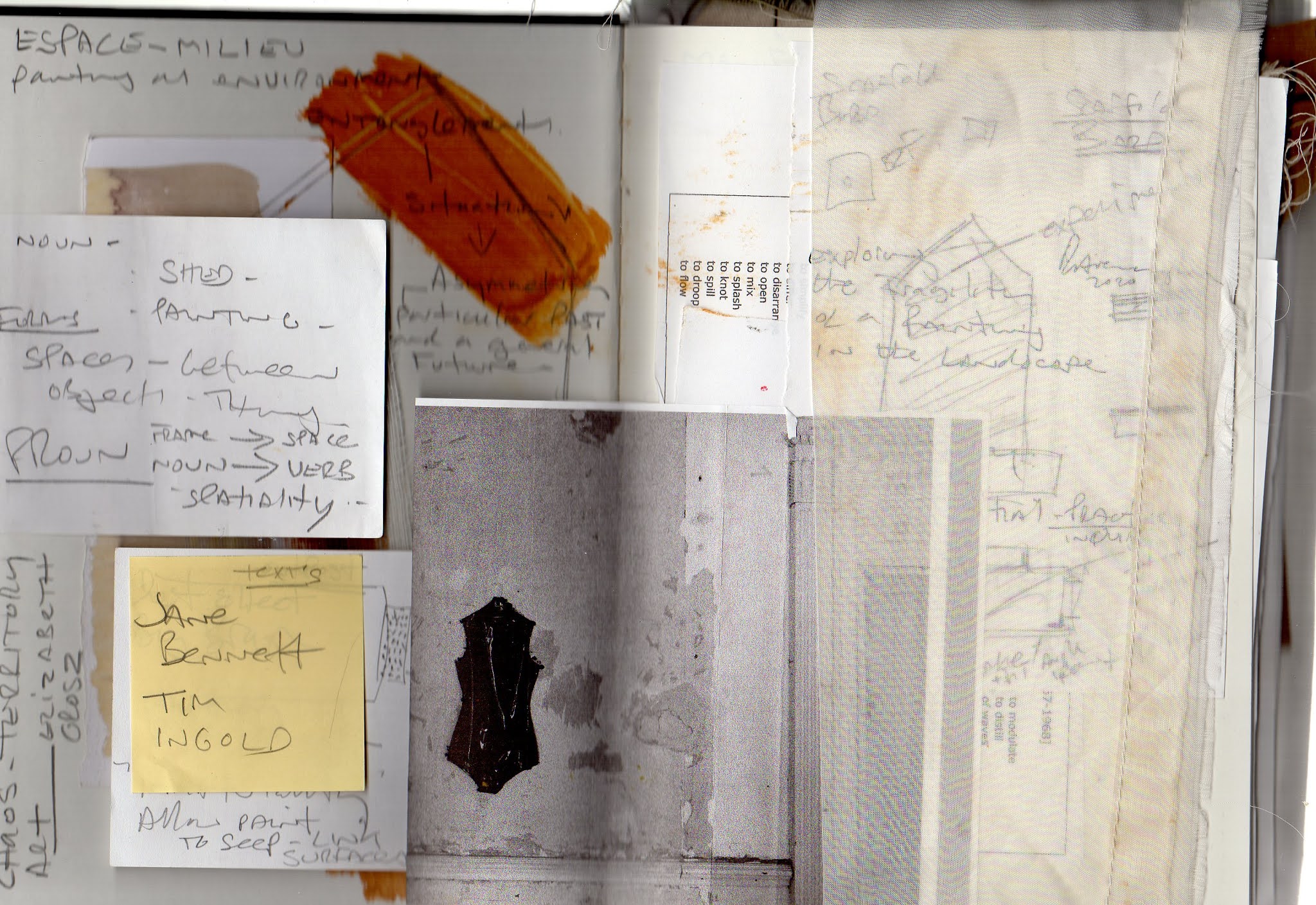
    Source: A humble, passive, somewhat absurd object, yet potent, mysterious, sensuous : Hans Coper

  • Thinking Things : The Archi-Textual Surface.


    Rebecca Solnit explores Susan Bordo’s claim that ‘if the body is a metaphor for our locatedness in space and time and thus for the finitude of human perception and knowledge, then the post modern body is no body at all.’ Solnit comments on this post modern body that it is more of a passive object, appearing most often laid out upon an examining table or in bed. ‘A medical and sexual phenomenon, it is site of sensations, processes, and desires rather than a source of action and production, this body has nothing left but the erotic as a residue of what it means to be embodied. Which is not to disparage sex and the erotic as fascinating and profound, only to propose that they are so emphasised because other aspects of being embodied have atrophied for many people.’(Solnit, 2002)

    We return back to the urgent need to make and experience things that in someway that lead us back to ourselves. The creative architectural work of Peter Zumthor is something that I am engaging with. He has developed architectural design practices that consider each project in terms of a comprehensive and encompassing sensory experience. He looks beyond the mere physical form and its fabric. He attempts to address issues of the body and how it may interact within a built environment. The use of memory as a spatial narrative to accompany the atmosphere of his spaces is realised through evocative material surfaces and densities. I feel that there is a synergy here between the opening up of the interior of a pot and the opening up of a space to dwell in.

    In sensing a pots interior from its surface, we are as it were in some intimate tacit correspondence with its spatial sensing centre. We become known to it through its maker’s creative gesture of innerness. This anthropological inner space linking us to the potter is both sensual and distant; its vacancy allows us dwell in the maker’s absence. We become part of the vessel, we enter its philosophy of solitude.

    Bookmark and Share


    Social apparatuses and agents that explore the possibilities of space. Other Worlds : Insistent moments of mark making/subjectivity.
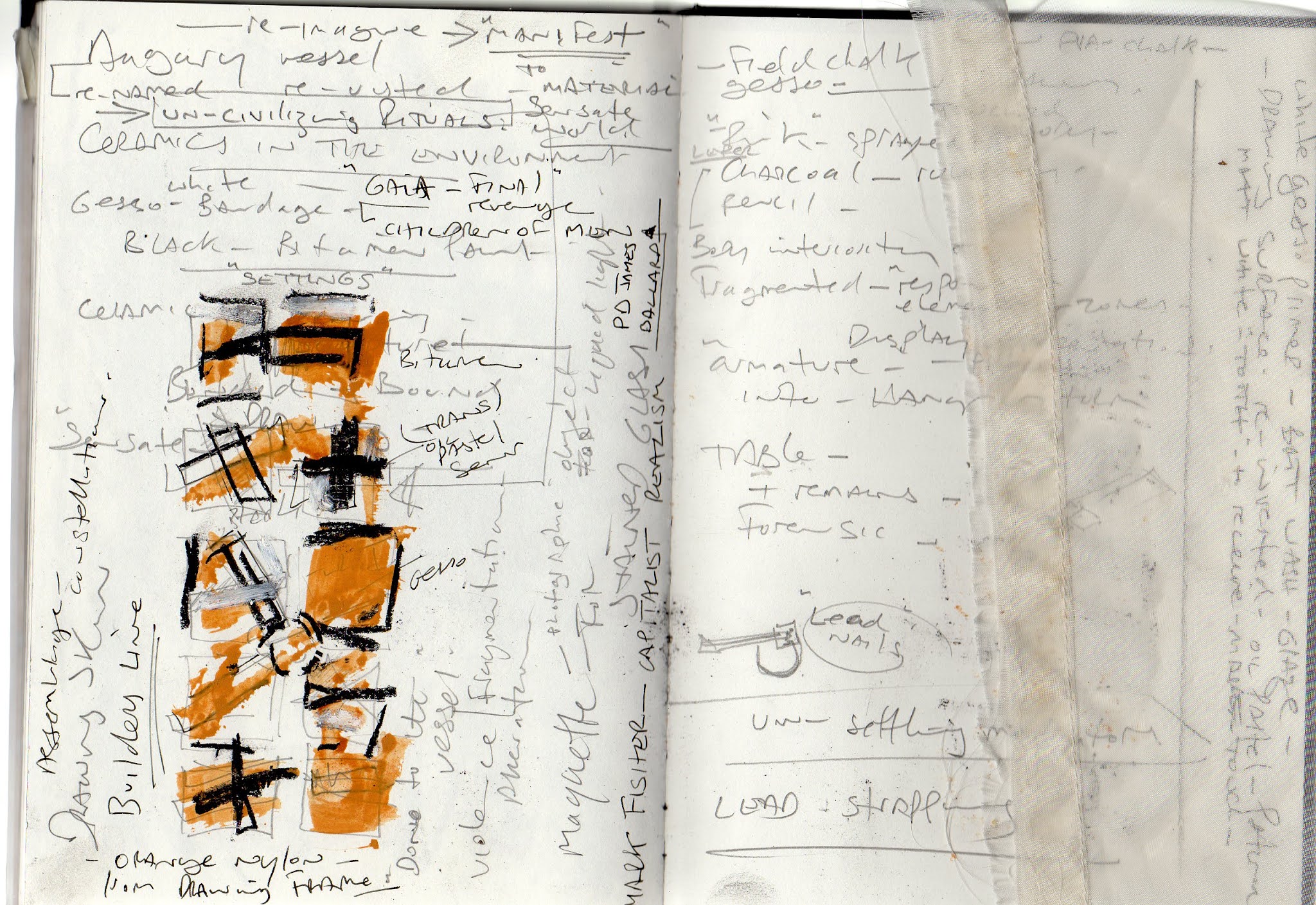
    Source: Thinking Things : The Archi-Textual Surface.

  • Drawing Surfaces : Situated Knowledges

     Outpost 120123

    Red Is Not A Colour

    Architectural Concepts

    Bernard Tschumi

    What role does the audience play in the definition of a provocative project?

    What are the ways in which I want to construct my world?

    The in-between chapters that reveal his underlying beliefs and influences. From movies to built spaces or from art pieces to historical events, a melting pot of his imagination. This is where we understand what Tschumi means by his endless questioning  of the world and what the architect’s contribution could be.

    Antoine Vaxelaire, AA 5th Year. 2013.

    Marking The Line

    Ceramics and Architecture.

    Christie Brown, Carina Ciscato, Nicolas Rena and Clare Twomey in response to Sir John Sloane.

    Cathected

    Aesthetic Phenomenon

    Aesthetic Causality

    Sensual Object

    Allure

    Graham Harman reminds us that moments of allure, the fusion of always accessible sensual qualities onto a reified sensual object, are ontologically special experiences, but they are very common in human life.

    Architecture articulates our experiences of being-in-the world.

    The very essence of the lived experience is moulded by hapticity and peripheral unfocused vision.

    Pallasmaa. 2005

    The simple complexity of the sensibility found in textures and the drama of shadows.

    Developing natural aptitudes through the sense of touch.

    The senses considered as perceptual systems are defined as a haptic system in which the sensibility of the individual to the world adjacent to their body and by use of their body.

    J Gibson. 1966

    In some cultures, the senses of smell, touch and taste have collective importance for memories, behaviour and communication.

    Indigenous clay and mud constructions, with their plastic properties, seem to be generated more from the haptic senses than the eye.

    Hapticity and Alvar Aalto’s Architecture.

    Sam Barnham.

    David Abram, The Spell of the Sensuous. 1996

    Juhani Pallasmaa, The Eyes of the Skin. 2005

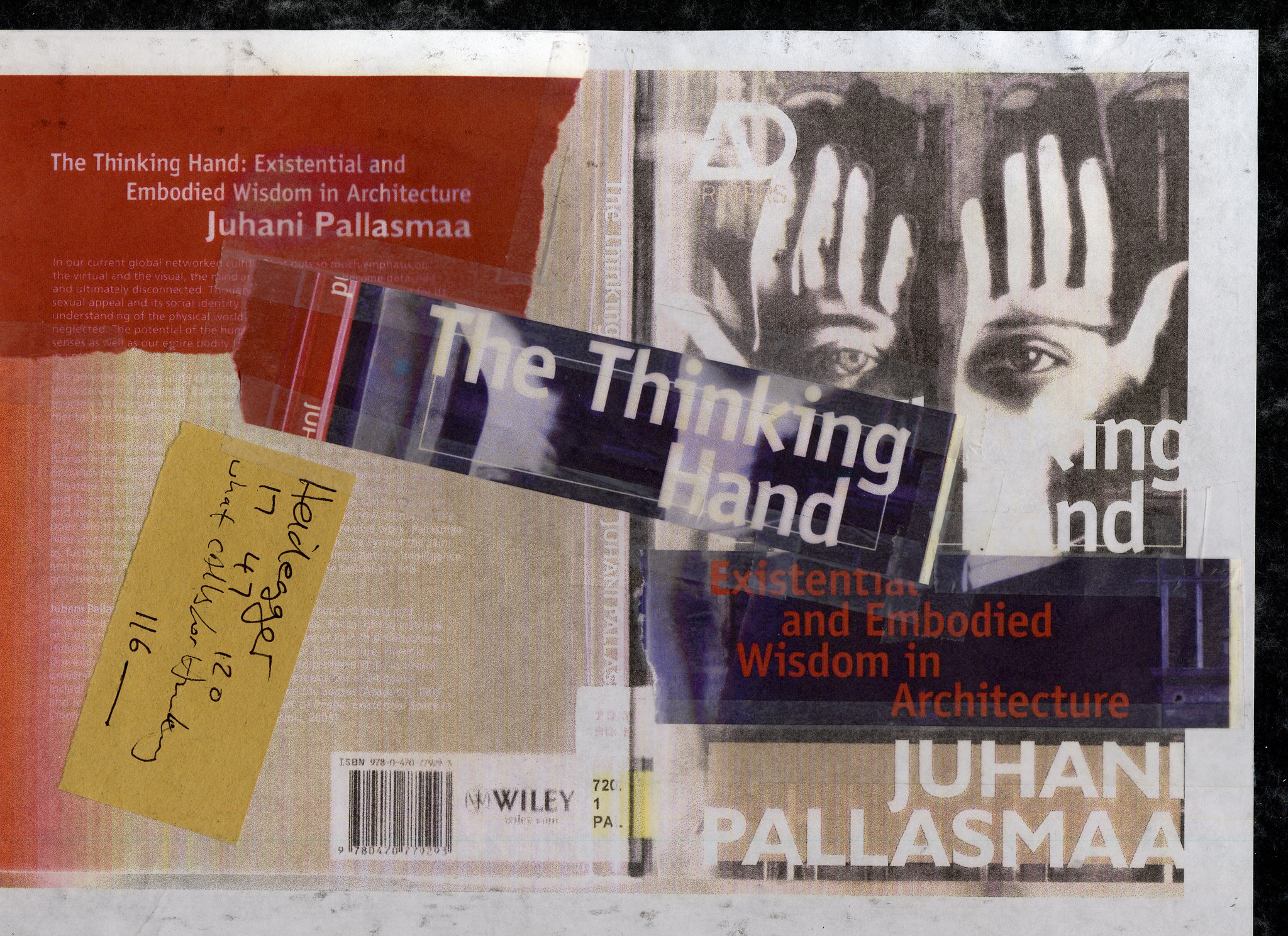
    Juhani Pallasmaa, The Thinking Hand. 2009

    Gaston Bachelard, The Poetics of Space. 1969

    Bookmark and Share


    Social apparatuses and agents that explore the possibilities of space. Other Worlds : Insistent moments of mark making/subjectivity.
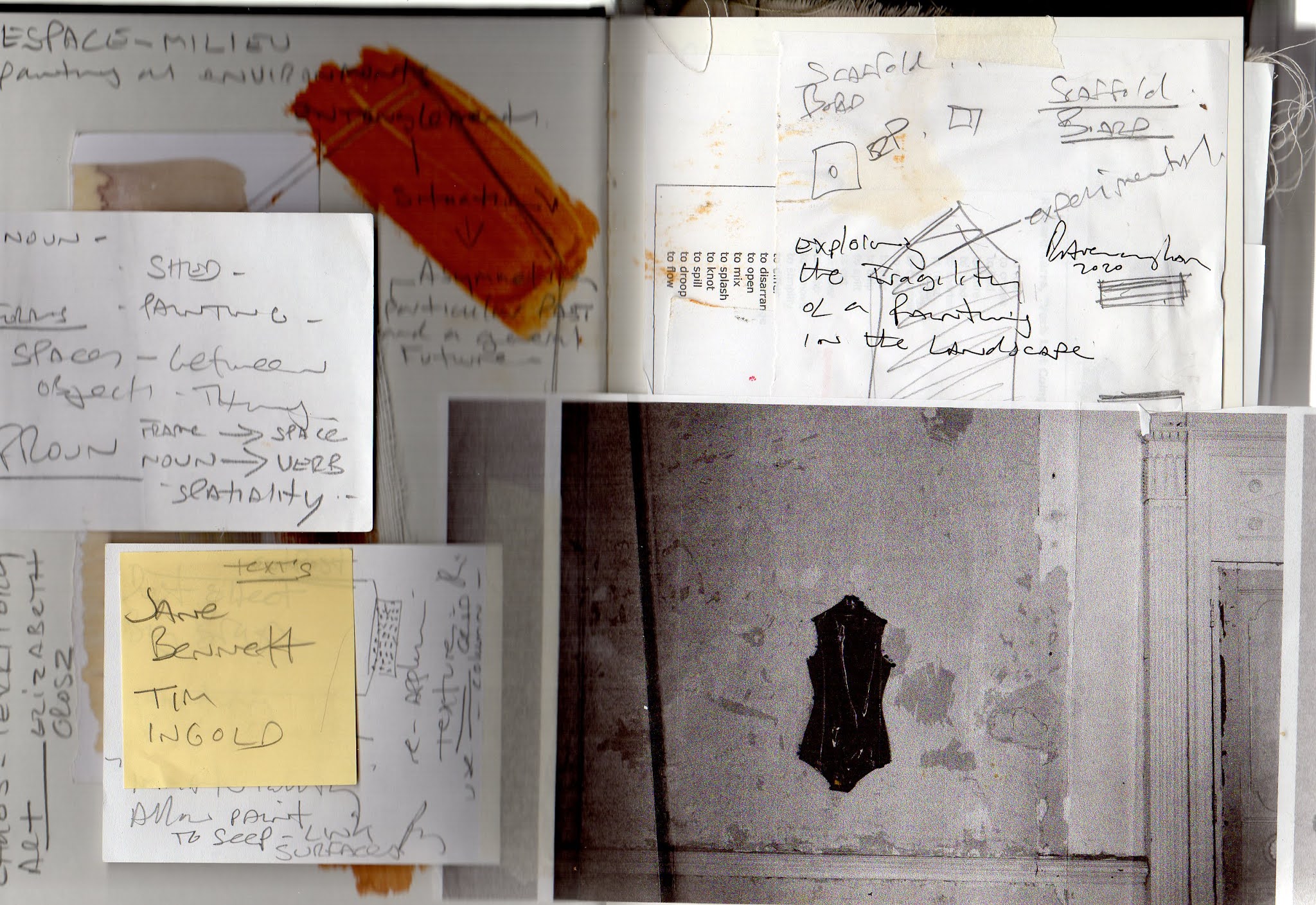
    Source: Drawing Surfaces : Situated Knowledges

  • Corpus/Borderlands : A Society in Excess, Marc Auge.

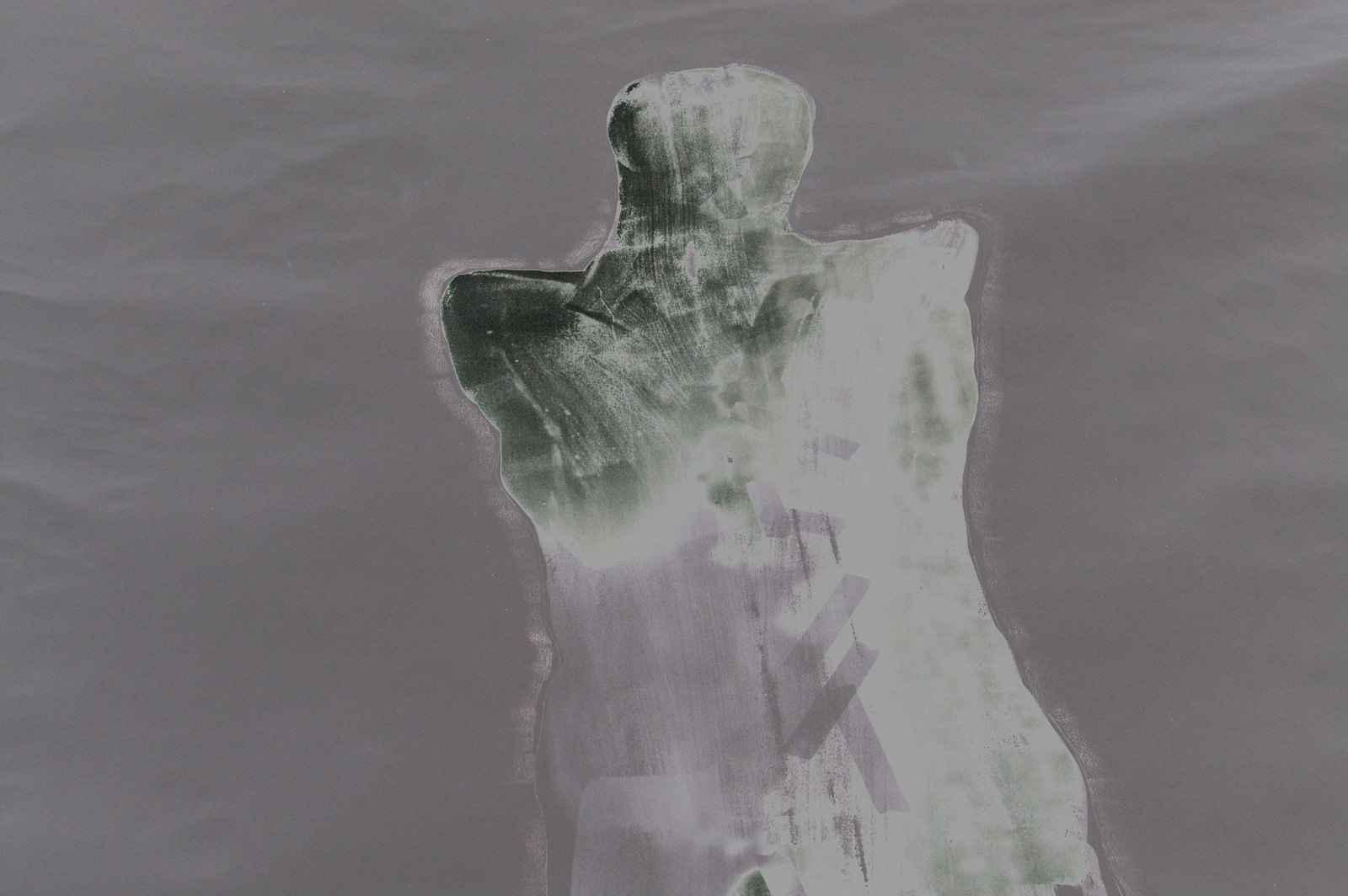
    Corpus : Photographic drawings from human outlines

    Borderlines : Cley 19, speculative submission for exhibition

    ANTHROPOLOGICAL NOTIONS AROUND ISSUES OF SPACES, ORIGINS, SOCIAL RITUALS AND TABOOS.


    CREATING CREATIVE ANTHROPOLOGY INTO TEMPORAL SITES, between the concrete and the spatial.

    Utilising processes and strategies and terminologies.

    Demarcation, set the boundaries or limits.

    Acculturate, assimilate to a different culture.

    Ethnology, the study of the characteristics of different peoples and the differences and relationships between them.

    NON- SPACES, Introduction to an anthropology of super modernity. Marc Auge. My working practice intuitively reflects and responds to what Marc Auge considers to be the condition of Supermodemity, briefly his defining parameters on the idea of Supermodemity are.

    Overabundance of events.

    Spatial overabundance.

    The individualization of references. A SOCIETY IN EXCESS.

    My creative practice attempts to reconstitute spaces from this condition of Supermodemity into temporal sites, places from which to solicit a sense of a mobile anthropology, a dwelling that is both intimate and public and promotes solitudes and subjectivity.

    Marc Auge states the twenty-first century will be anthropological, not because the three figures of excess are just the current form of a perennial raw material which is the very ore of anthropology, but also because in situations of supermodemitiy the components pile up without destroying one another.1

    Contemporary Practitioners like anthropologists will attempt to make sense, they will attempt to resolve, to make or rather remake meaning through the processes of observing the phenomena of acculturation.

    1  Marc Auge, Non-Places, introduction to an anthropology of super modernity. (London: Verso, 1992) page 41.

    Submission Guidelines

    All proposals must be for new work that addresses the brief, artists are encouraged to experiment, be playful and push the boundaries of their practice.

    BORDERLINES

    Artists translate cultural moments and offer responses to their environment, whether geographical, political or spiritual. Inviting artist’s to respond to the theme Borderlines as it requires an inquisitive approach to the site that surrounds them and to the climate in which we live.

    Geographical Environmental Landscape

    Terrain

    Migration (Wildlife/Humans) Transmigration

    Socio Political Departure

    Borderlands

    Borderlines

    Borders

    Lines

    Spiritual Embodied Walking

    Wandering

    Wanderlust

    Movement

    Borderlines, simultaneously both boundary and threshold.

    Visible, Existential, Imaginative, Porous, Contingent, Reflexive, Nowness, Un-Knowing, Awkwardness, Liminality, Territory, Subjectivity,

    Concrete Collage : Raku fragment, clay form/photograph, drawing, handwriting and painted surfaces.

    Ancient Lights : Abstract Painting and Constructional Drawing for Architectural Glass.

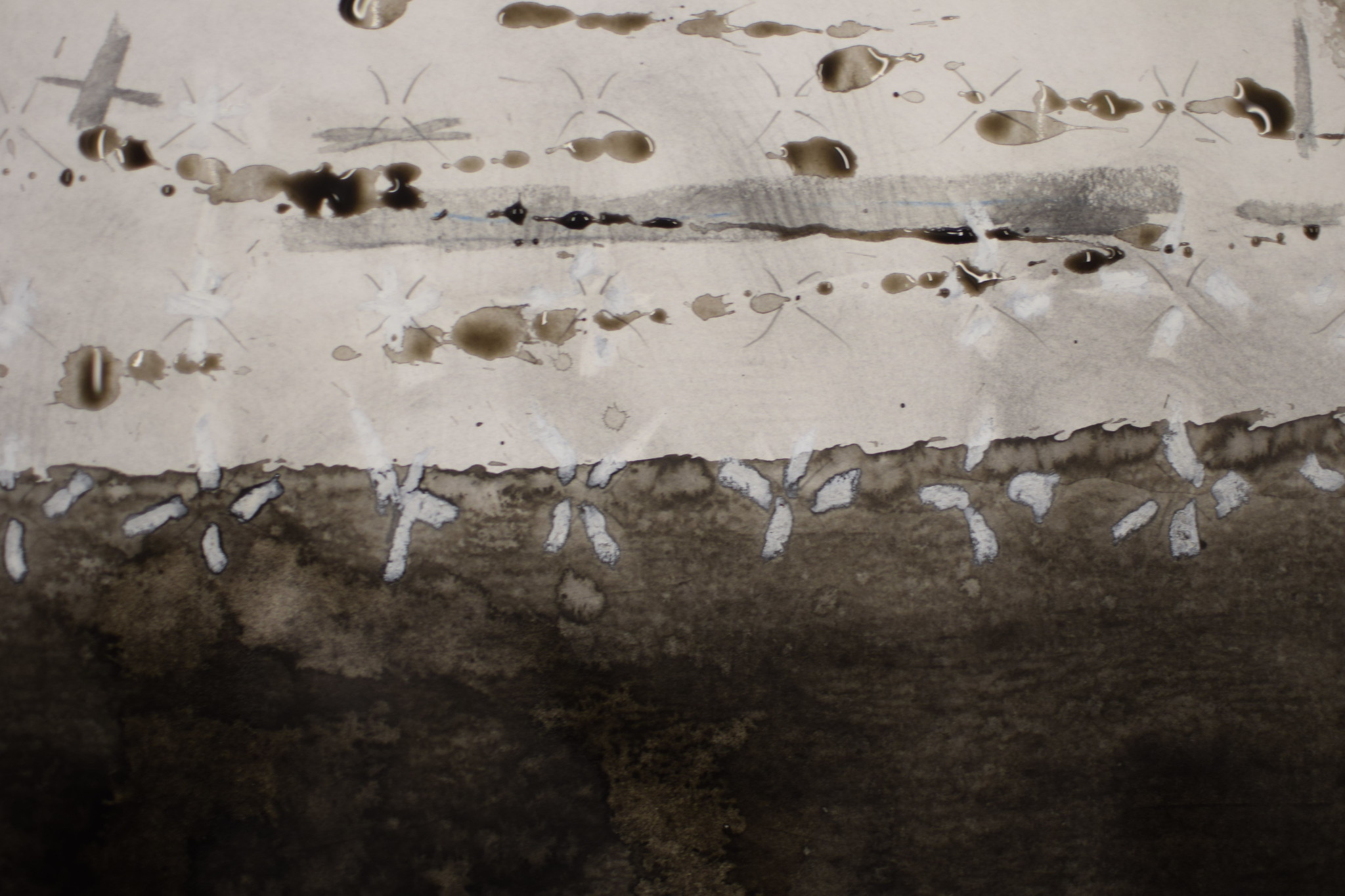
    Anthropological Landscape : Drawing from archaeological dig, liquid light, field chalk, charcoal.

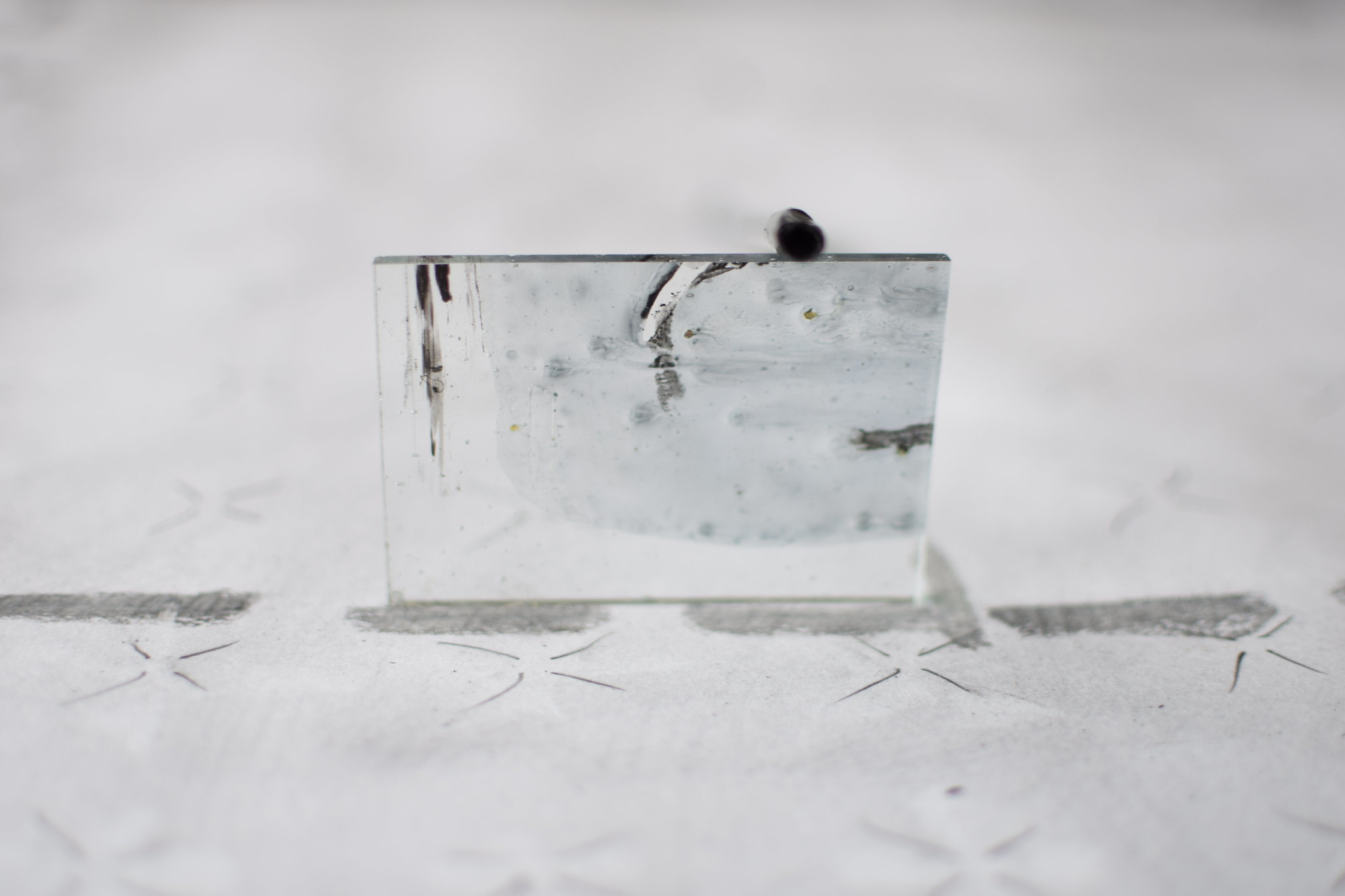
    Cley, St Margaret’s South Entrance : Collage, Sketchbook, working ideas for small glass panels.

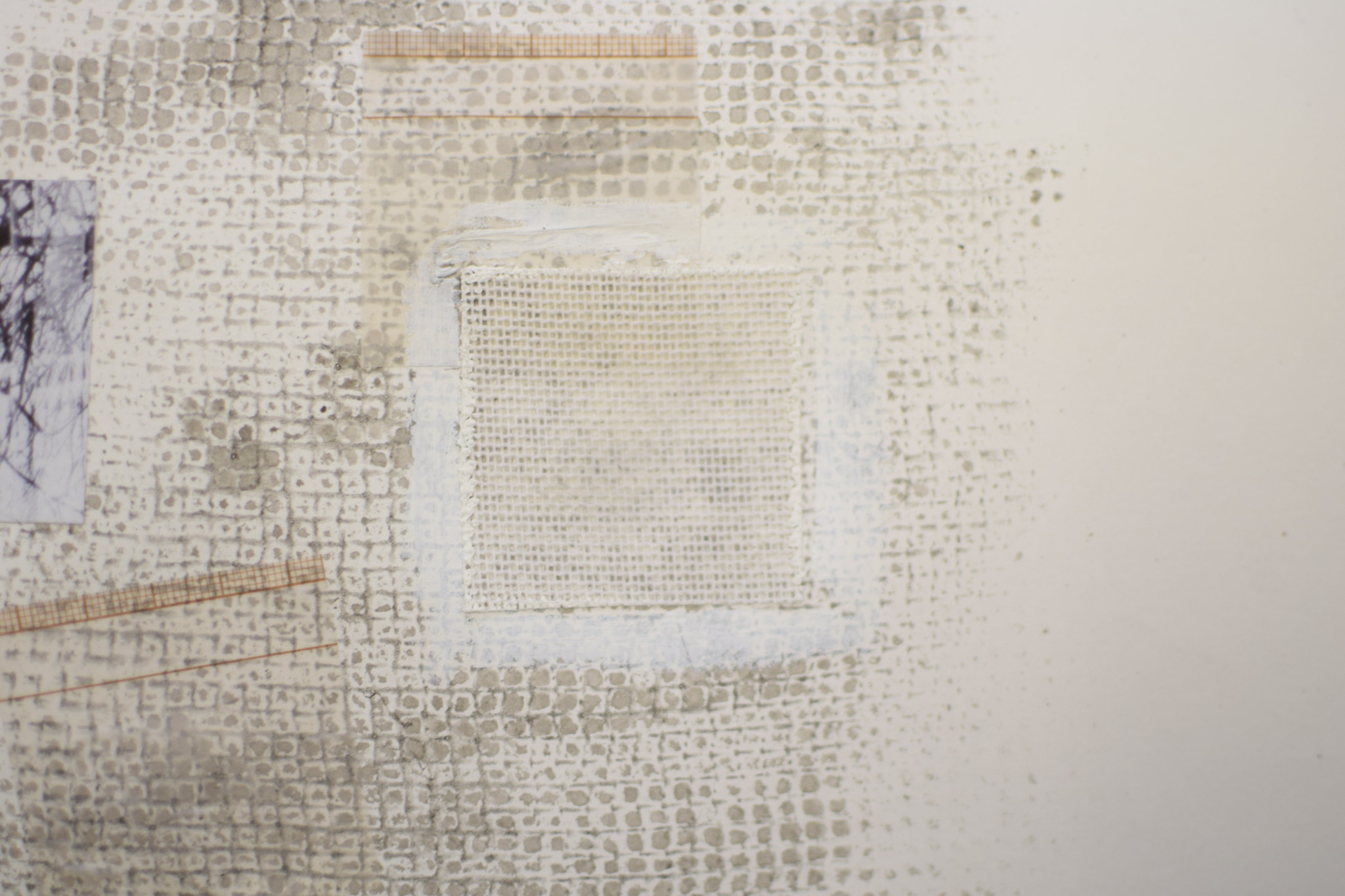
    Cell, Court, Domain, Field : Layered paper, paint, and absent objects.

    Architectural Concerns : Collage ,drawing, installation, blue prints, historical building plans. Scriptorium : Architectural model for a reading space within a pastoral landscape or community.

    Working Notes/Extracts and Fragments from site visit. St Margaret’s Church

    Silence and stillness, social/historical shelter from/within the landscape

    A place acting through our sensate/spiritual world, a space crafted by the specificity of its making/usage.

    An interior sensing space of a protected and defended/fortified silence, affirming beliefs and community.

    Subtle and muted, stillness, embodiment from the patina of use. Bleached woodwork, lightness, dryness and the humidity of absences.

    Empty and eroded stone mullion windows/ancient lights, architecture framing its un-making worn, broken and repaired flooring surfaces, ceramic and stone.

    What does Borderlines mean to you? Boundary and Threshold

    Visible, existential, imaginative, porous, contingent, reflexive, nowness, un-knowing, awkwardness, liminal, territory,

    Material Process/Inquiry, Praxis, Content, Context

    Form, Existential Qualities/Values AGENCY

    Mindfullness of the brief to discover things through the inquiry and engagement with the site.

    Develop Inquiry

    Documentation, Artist Book, and other media mixed media painting

    Small series of glass panels ceramic tiles/facades

    Photographic material/photograms, drawings/hangings on Chinese paper

    Melancholy Landscapes : The Plague/Vermilion Sands

    Film Collages, hybrid processes and temporal states Liminality: Literature/Philosophy/Visual Art

    Landscapes : entering/intruding/emerging (holga819) Existential Gestures : Looking away from the sea

    Ballard : Vermilion Sands : Speculative Fields/Spatial Practices Albert Camus : The Plague, 1947. (Penguin Fiction)

    The townspeople of Oran are in the grip of a virulent plague.

    Cut off from the rest of the world, living in fear, they each respond in their own way to the grim challenge of the deadly bacillus. Among them is Dr Rieux, a humanitarian and healer, and it is through his eyes that that we witness the devastating course of the epidemic.

    Written in 1947, just after the Nazi occupation of France, Camus’s magnificent novel is also a story of courage and determination against the arbitrariness and seeming absurdity of human existence.

    ‘Camus represents a particularly modem type of temperament, a mystic soul in a Godless universe, thirsty for the absolute, forever rebellious against the essential injustice of the human condition’

    Shusha Guppy, Sunday Times

    Walking into Emergent Landscapes

    Walking/Thinking/Physical Entanglements in the Landscape
    Deeper Darkness, Photographic Memory/Process, Metonymy, Negative,

    Analogue, Negated Nocturne. Walking, Others, Presence, Becoming,

    Walking into Emergent Landscapes : Covehithe Beach

    The OLD WAYS, a JOURNEY ON FOOT, Robert Macfarlane

    “ Walking was a means of personal myth-making, but it also shaped his everyday longings:

    Edward Thomas not only thought on paths and of them, but also with them.”

    “To Thomas, paths connected real places but they also led out-wards to metaphysics, backwards to history and inward to the self. These traverses- between the conceptual, the spectral and the personal-occur often without signage in his writing, and are among its most characteristic events. He imagined himself in topographical terms.”

    Bookmark and Share


    Social apparatuses and agents that explore the possibilities of space. Other Worlds : Insistent moments of mark making/subjectivity.
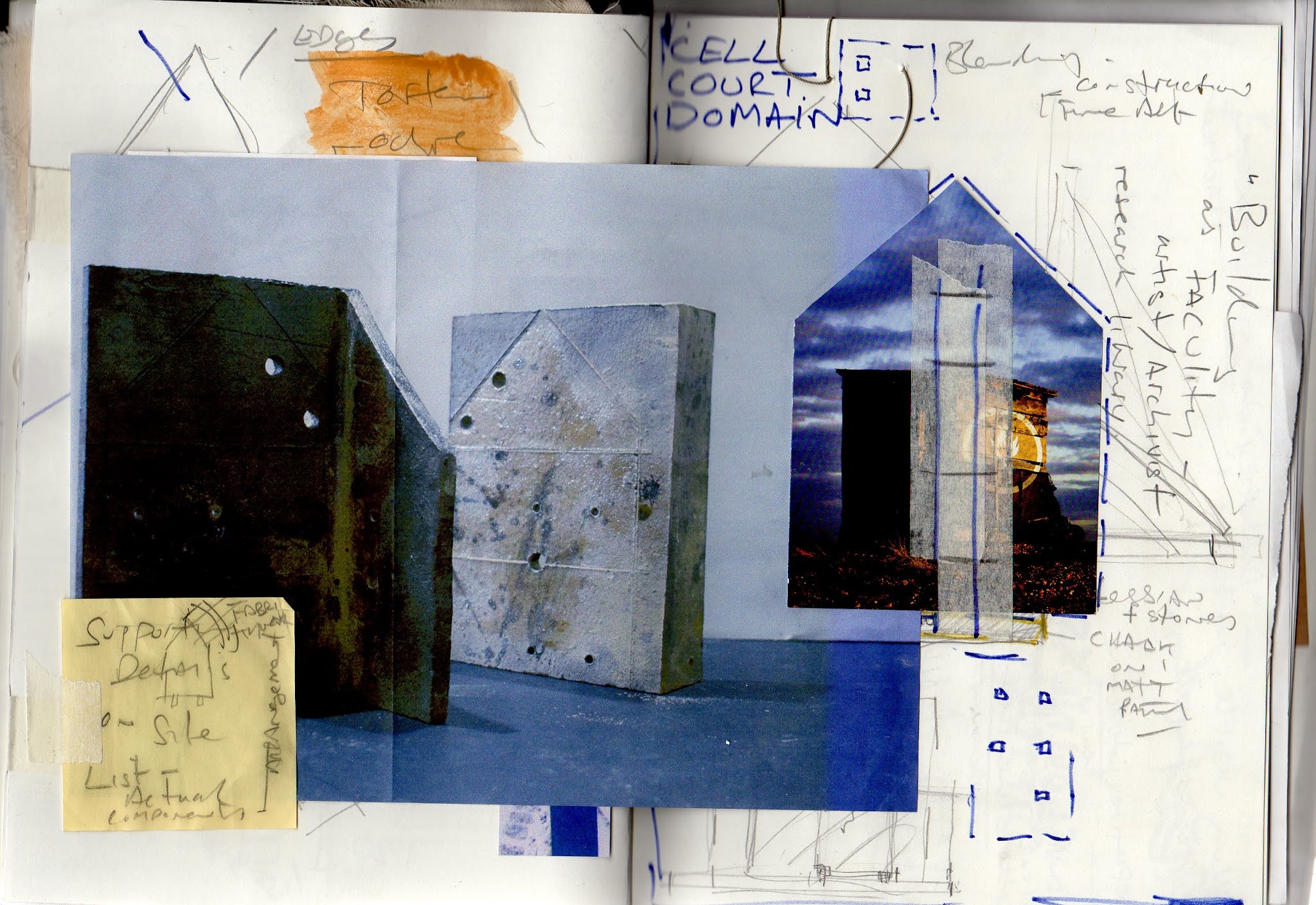
    Source: Corpus/Borderlands : A Society in Excess, Marc Auge.

  • Spatial/Diffractive Bodies Situated in Place : Matters of Fidelity and Precariousness.


    Bringing Things To Life.

    Creative entanglements in a world of materials.

    The Environment Without Objects.

    Tim Ingold. 2008

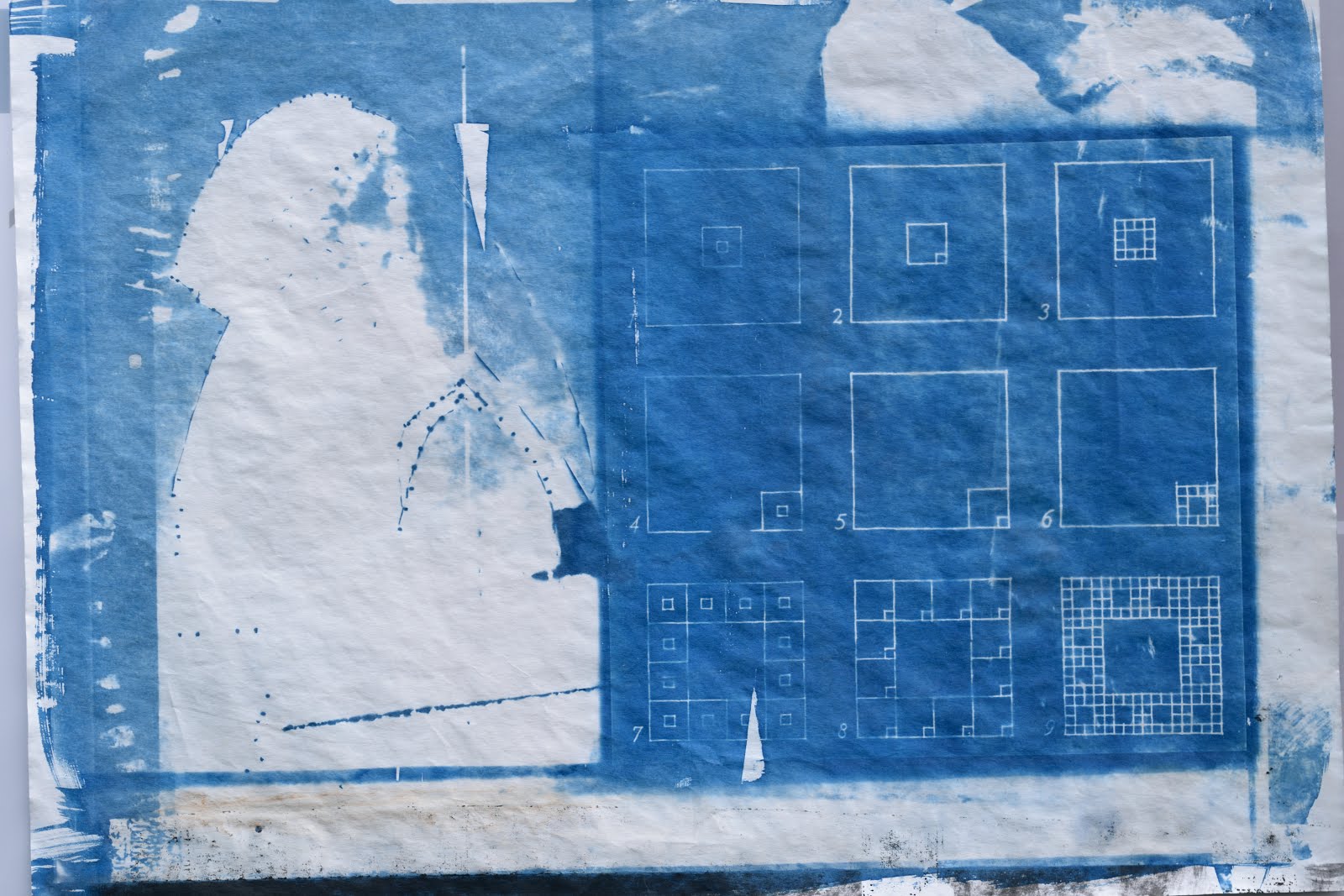
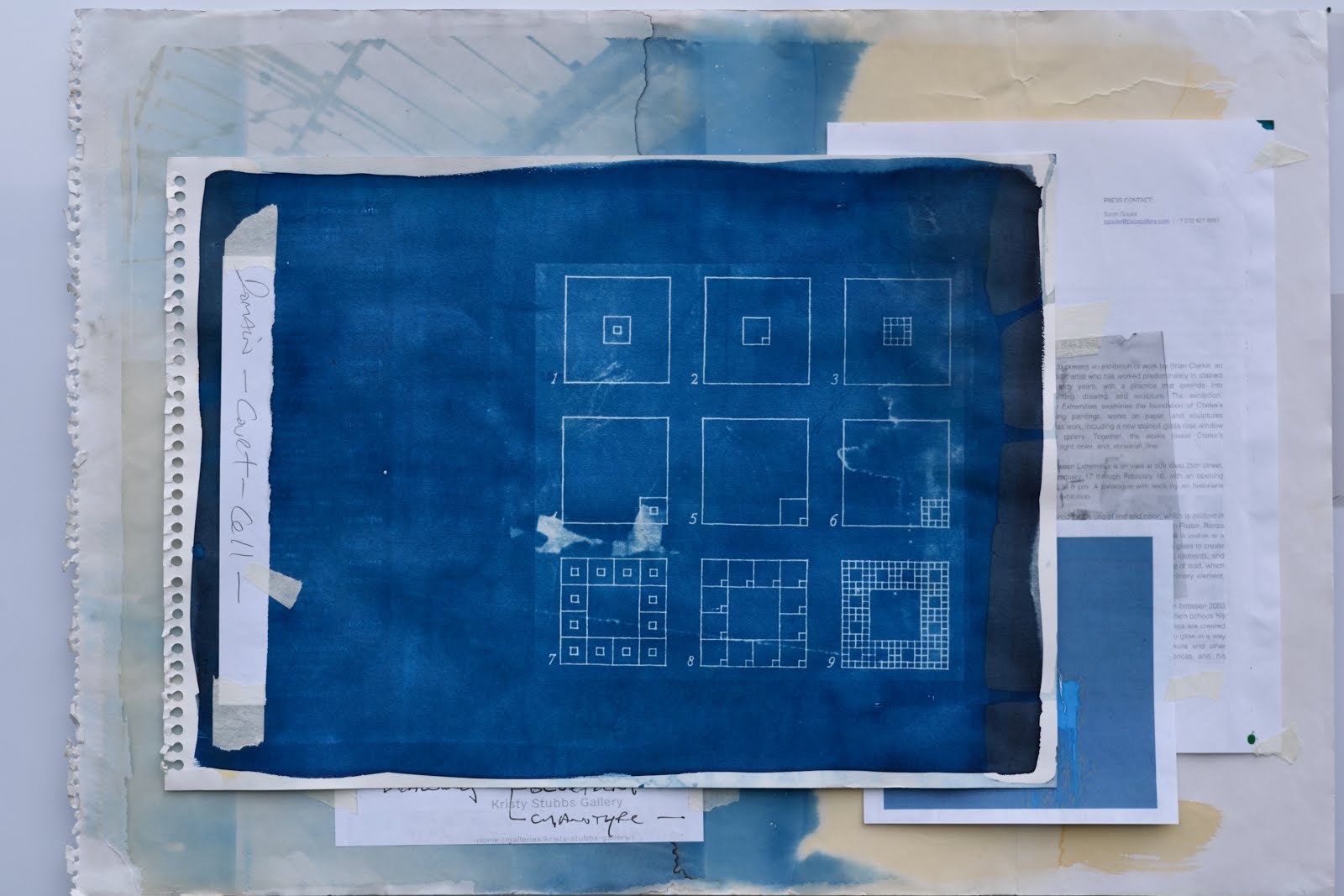
    Intermediaries within the cyanotype process.

    Trace drawings on paper with organic and material from the built environment.

    Drawing/Making Processes.

    Architectural Body : Organism, Person, Environment. Arakawa and Gins.

     “[…] the body […] continually transforms itself and is already not, at the moment when I speak of it, what it was a few seconds ago.” (Laplantine, 2015:13)
    Laplantine, F. 2015 [2005]. The Life of the Senses: Introduction to a Modal Anthropology. United Kingdom: Bloomsbury Academic.
    Through the choreographing of our learning processes we create the conditions for engagement/entanglement and production/transformation, which are all modalities of movement and action. So we see pedagogical, architectural and professional practices as potential practices of transformation and co-learning. Dance – somehow both connected to and different than choreography – brings with it a whole set of values which we consider significant for the architectural pedagogy we enact.
    Lepeki lists the ‘constitutive qualities’ of dance as
    “ephemerality, corporeality, precariousness, scoring and performativity” (Lepecki 2012:15)
    He goes on to say that “[t]hese qualities are responsible for dance’s capacity to harness and activate critical and compositional elements crucial to the fusion of politics and aesthetics …”(Lepecki 2012:16)
    His ‘compositional’ and ‘critical’ elements echo the event/discourse relationships within our pedagogy and in our use of choreography as dance/writing. These qualities allude to specific modes of engagement and making, and state particular values. We will use them to underscore our pedagogical modes, and develop them as necessary in a teaching practice which desires students’ engagement, empowerment, and caring.
    In that sense, ephemerality can be related to immediacy and an engagement with the here- and-now which cares about effects and duration. Corporeality speaks of a body, but if we ask whose body or what body, then we can expand it to be any-body, in order to speak of matter or, more precisely, of mattering and bodying. Other names for precariousness can be fragility or vulnerability, somehow always already a condition of our impossibly immediate interventions. Scoring, which can be both a ‘writing’ and an unfolding, creates spaces and times and modes for and of improvisation. And performativity always returns us anew to movement, multiplicity, effects and life.


    Performative Intraventions and Matters of Care: Choreographing Values
    OREN LIEBERMAN
    ALBERTO ALTÉS
    Abstract
    Thinking through choreography as dance/writing – both the doing and the score for that doing, the event and the discourse – we propose to shift the focus of architectural practices and pedagogies from an emphasis in the attainment of competencies and  static  knowledge,  to  a  privileging  of  processes  and modalities of learning that nurture the values of engagement, empowerment and  caring  responsibility.  Choreography  situates  our  work  in  the  realm  of performative action and transformation, and it does so with and through our bodies; also, it helps us frame the power of our intraventions, which aim at transforming the world through immediate, responsible and often fragile acts of engagement with matter, movement and life.
    Keywords:
    Intravention, matters of care, choreography, architectural pedagogies, modalities of learning.
    Bookmark and Share


    Social apparatuses and agents that explore the possibilities of space. Other Worlds : Insistent moments of mark making/subjectivity.
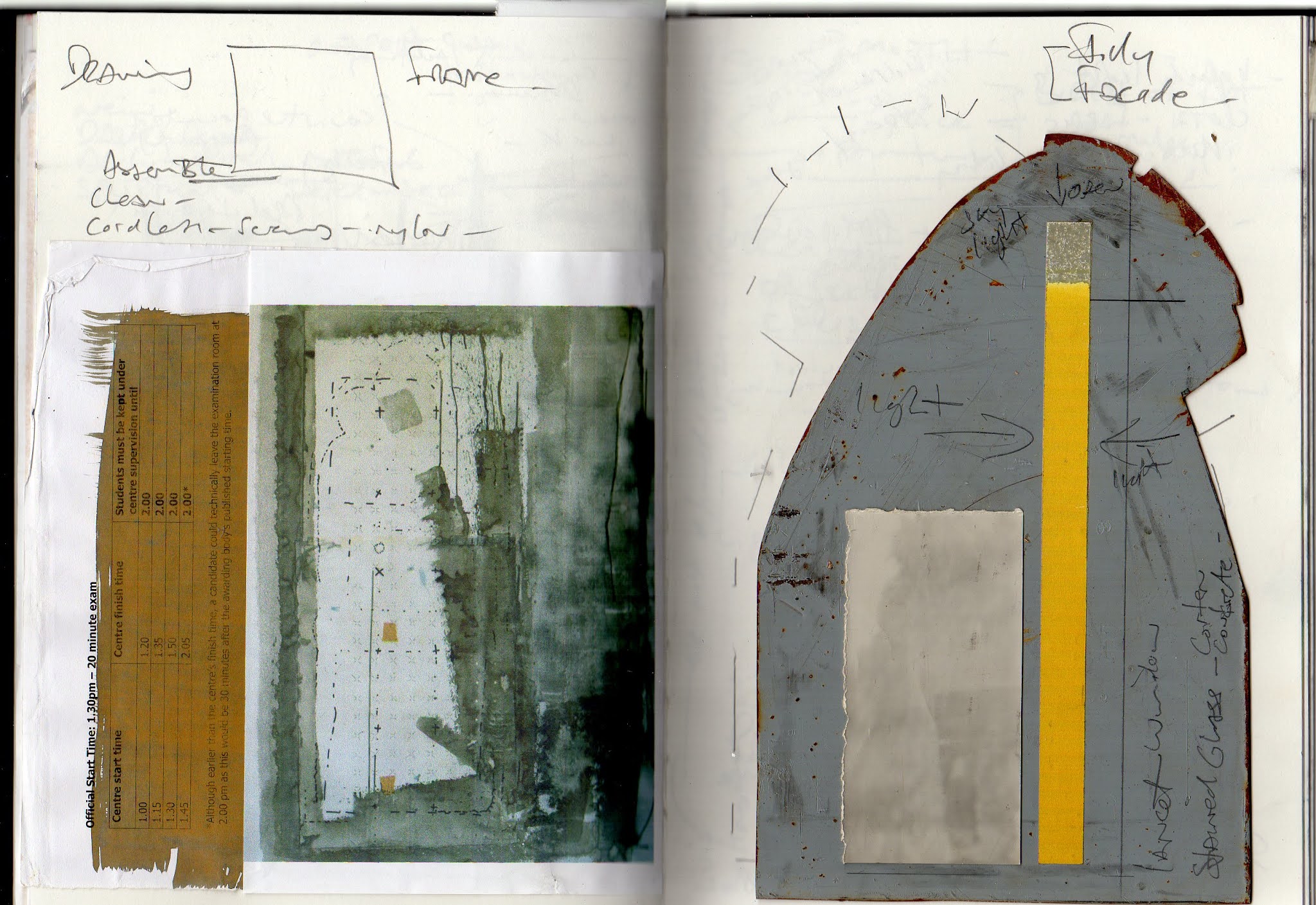
    Source: Spatial/Diffractive Bodies Situated in Place : Matters of Fidelity and Precariousness.