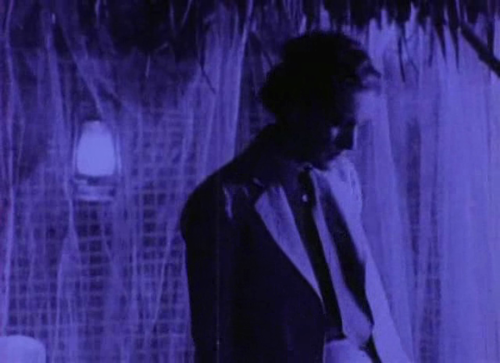
In 1936, the artist and romantic urban scavenger Joseph Cornell discovered a warehouse in New Jersey that was selling off old film reels as scrap. Most buyers presumably intended to melt them down to recover the silver nitrate, but Cornell instead recovered and recycled the images. For a pittance he bought a complete print of a 1931 B movie called East of Borneo, starring Rose Hobart, cut it up and reassembled it as what may be the first collage film, Rose Hobart (1936).
In this modest, 19-minute experiment Cornell managed to say more than any number of critics and theorists about the essence of the cinematic experience; about how even bad actors can transfix, and why even tired, shoddy Hollywood programmers contain flickering spells of cinematic power. With a pair of scissors he neatly filleted the movie of its plot, leaving only a hallucinatory sequence of fragments. Rose Hobart sleeps, she wakes, she parts curtains, she enters rooms. Mostly, she gazes off screen—at what, we never know. In a dramatic film, her unchanging, hypnotized expression would surely result in a boring, unconvincing performance. But here, stripped of context, she is enigmatic and mesmerizing. She keeps appearing in different costumes, a masculine tailored safari suit one moment, the next a flimsy white evening gown through which you can see her ribs. Her thin frame, bony face and cropped hair give her an androgynous look; in the blurred and battered print, her luminosity bleeds into the air around her. She is isolated, constantly framed at the center of the screen, like a pinned moth with its translucent wings spread open. She seems to withhold some unknowable secret. Thus, a forgotten actress of mediocre looks and talents becomes a celluloid goddess, embodying that hieratic power of the gazed-upon and gazing woman over the camera and the audience.
Cornell interspersed the close-ups of Hobart with jungle scenes from East of Borneo and also unrelated footage of a solar eclipse. The astronomical event, with its visual echo of a camera lens opening and closing—a slow-motion enactment of the process that creates the illusion of moving pictures—becomes the mysterious heart of the movie, the subject of Hobart’s reveries and silent conversations.
When Cornell screened Rose Hobart at the Museum of Modern Art, projecting the film at a slow speed through a piece of blue glass and accompanying it with repetitive, rhythmic Brazilian music, it was chiefly met with perplexity. One audience member had a violent reaction, however—Salvador Dali erupted in jealous fury, knocking over the projector and hurling insults at Cornell. He announced despairingly that he had dreamed of making just such a film, and though he had never spoken of it, he felt as though Cornell had stolen his idea.
The shy and reserved Cornell was mortified by the incident, and avoided publicly screening his films again, though he put together private soirees for his friends, at which he showed favorite movies and his own experiments. He made other collage films, though none with the sophistication and coherence of Rose Hobart, crudely splicing together old footage of vaudeville performers, children’s parties, ethnographic and travel movies, science films. In his iconic boxes, Cornell assembled astronomical drawings, engravings of ballerinas, scraps of French books, Dutch clay pipes, marbles, painted wooden birds. But here the pieces follow one another in time, rather than forming a single image perceived at once. The sequences are connected in the mind, not in the eye. Time passes and the abraded images slip away, not preserved in the bright eternity of the shadowbox.
A man grips a chair in his teeth, with a girl sitting in it, and climbs a flight of stairs. A seal balances a ball on its nose while perched on a rolling barrel. The ghosts of tightrope dancers, trapeze artists and knife throwers perform their feats. Children waltz in party dresses, clown and bob for apples. Dutch women in clogs hang laundry on lines; young men in felt hats browse the bookstalls along the Seine. Amoebas ooze through the dark, glistening like galaxies; a caterpillar chews through a leaf. These images salvaged from the junk-heap, murky and silent, randomly strung together, whisper of penny arcades and nickelodeons, peepshows and lectures in dingy classrooms. These are the attics of cinema, the bargain basements, and Cornell the committed surrealist revealed rather than disguised the oddness and illegibility of lost and found images.
He kept the same dedication to chance and spontaneity in his original films, collaborations with cameramen (Rudy Burckhardt, Stan Brakhage) who did the actual shooting. Filmed in the streets and parks of New York, the films often follow solitary women as they wander through urban spaces, watching pigeons, studying the stone carvings on fountains, moving through the crowds in a melancholy, enchanted reverie. The women (Cornell cast young actresses and dancers of his acquaintance) are both stand-ins for the artist as urban observer, and embodiments of the kind of unattainable feminine beauty and grace that inspired so much of his art. The films are sentimental about stone angels and autumn leaves, but they also take in city life—shuffling bums, the neon sign of a Horn and Hardart automat, a male dwarf in an overcoat crossing Union Square, a cigarette between his fingers. The camera follows pigeons in their swooping flight, a scrum of little boys roughhousing, dead leaves scudding in circles on the pavement.
Cornell wanted the films to just happen—he disapproved when Rudy Burckhardt edited footage they had shot into a finished film, What Mozart Saw on Mulberry Street, because he thought Burckhardt had made it too tidy, polished and controlled. The Mulberry Street footage, which uses as a touchstone a bust of Mozart in a shop window, is beguiling in any form: a symphony of rain, umbrellas, black and white cats, dark-haired girls chewing gum and holding hands, little boys in plaid coats and caps with earflaps shooting at storefronts with bows and arrows, dolls and mannequins in shop windows, graffiti on scuffed grimy walls. “The city is a vast image machine,” Charles Simic wrote in his book about Cornell, “a slot machine for the solitaries.” Pictures spin and freeze, and the prizes come unexpectedly in silver floods.
by Imogen Smith
 russellmoreton.com
Leave a comment