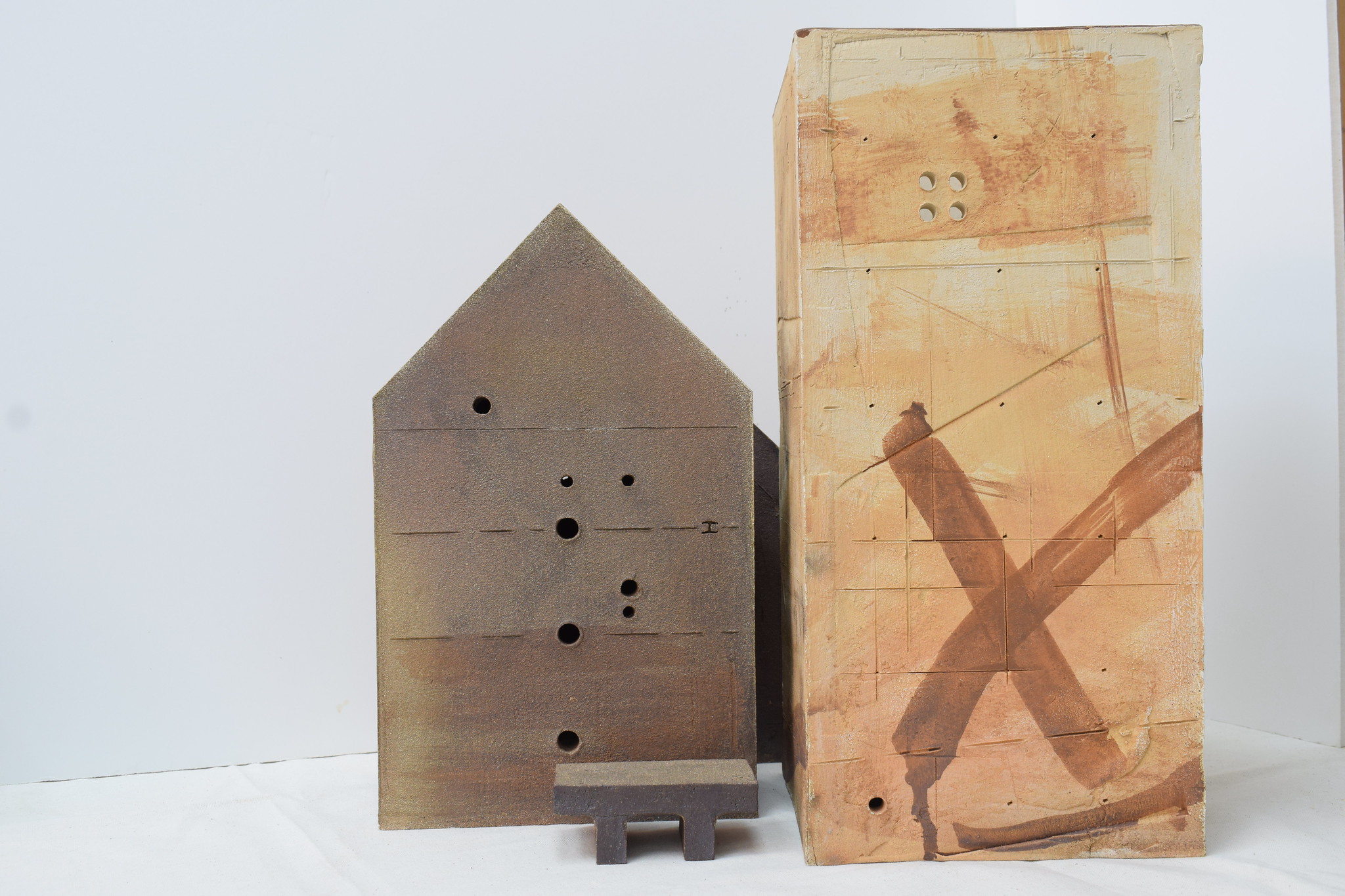
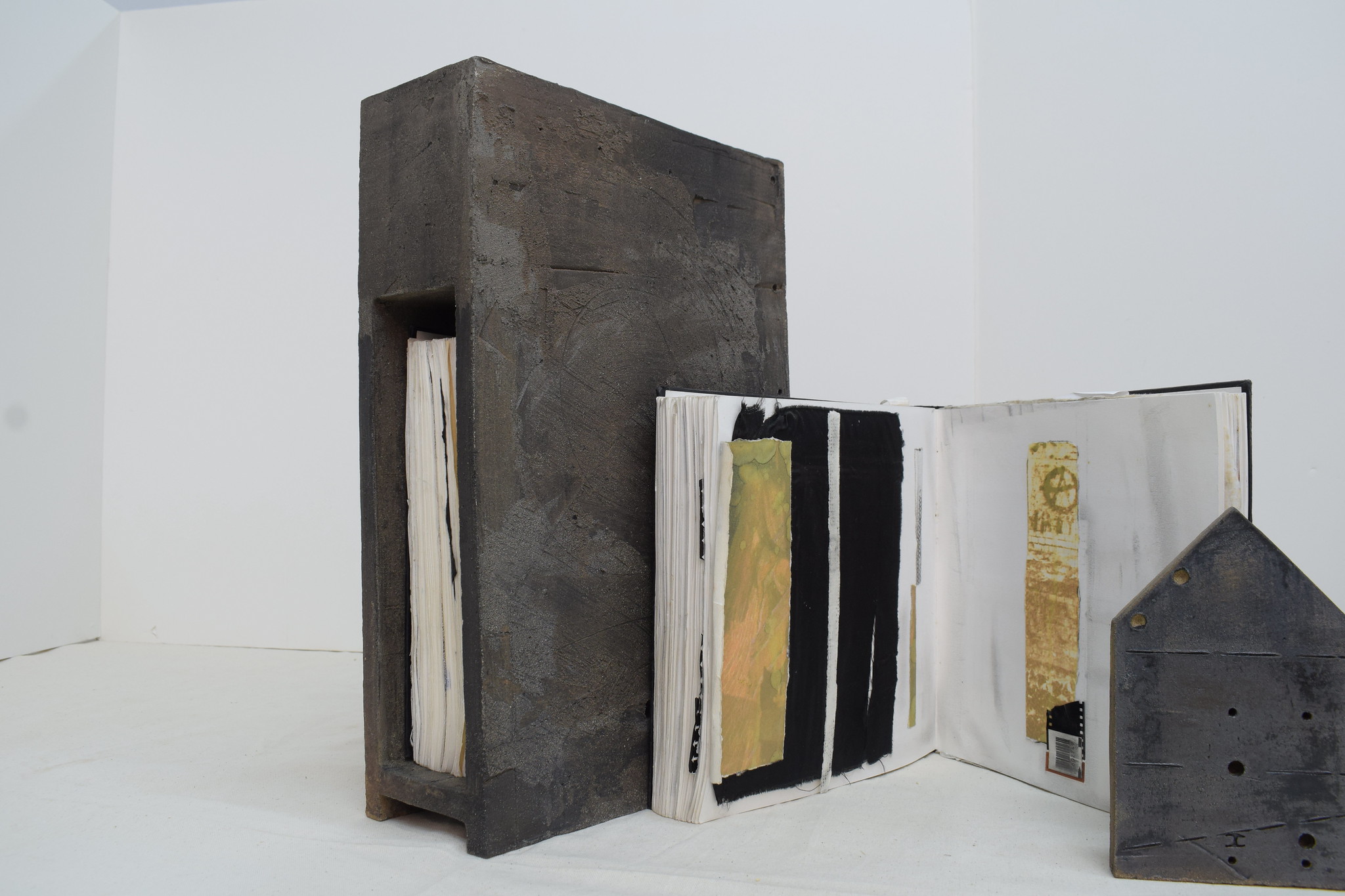
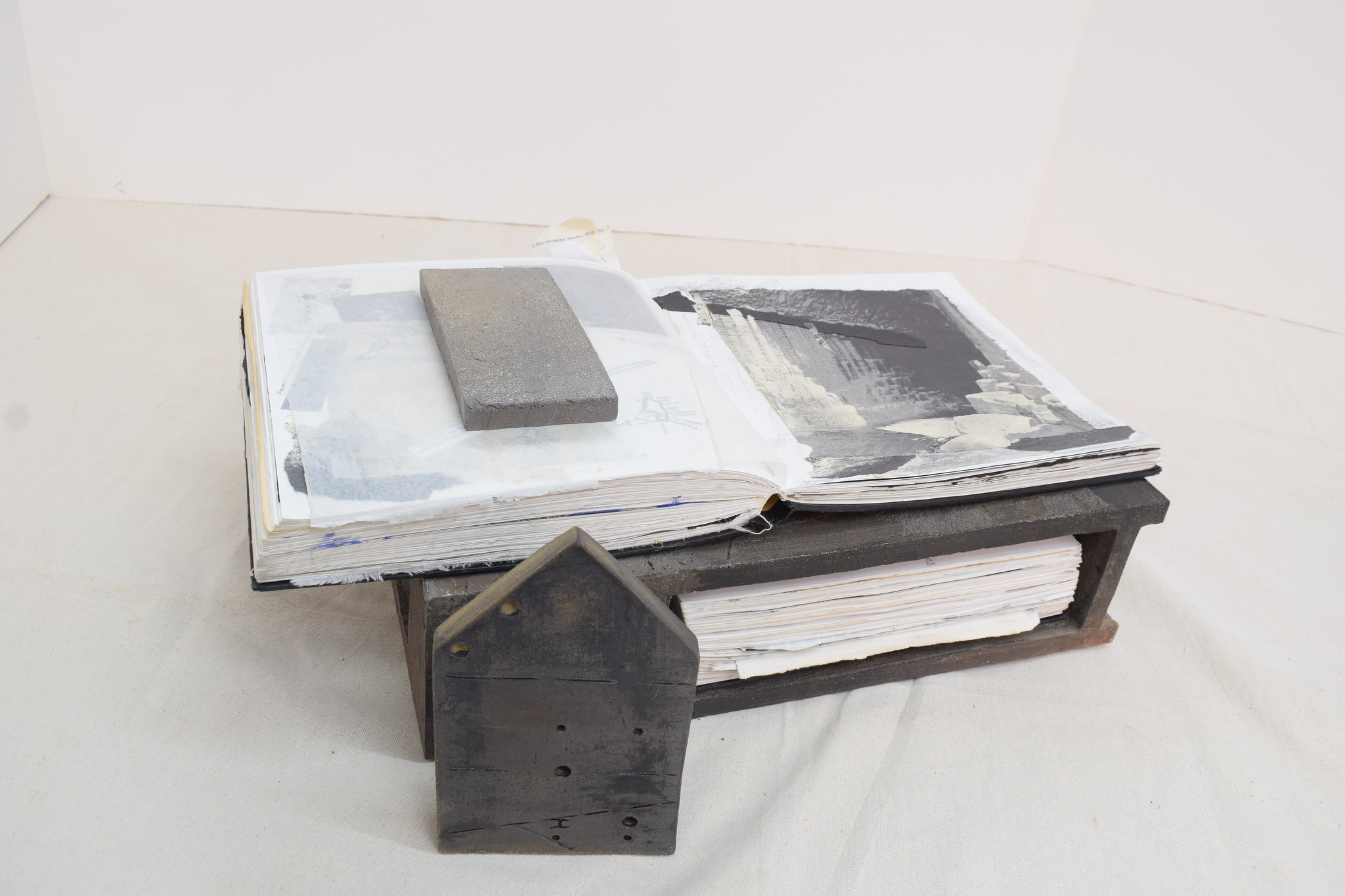
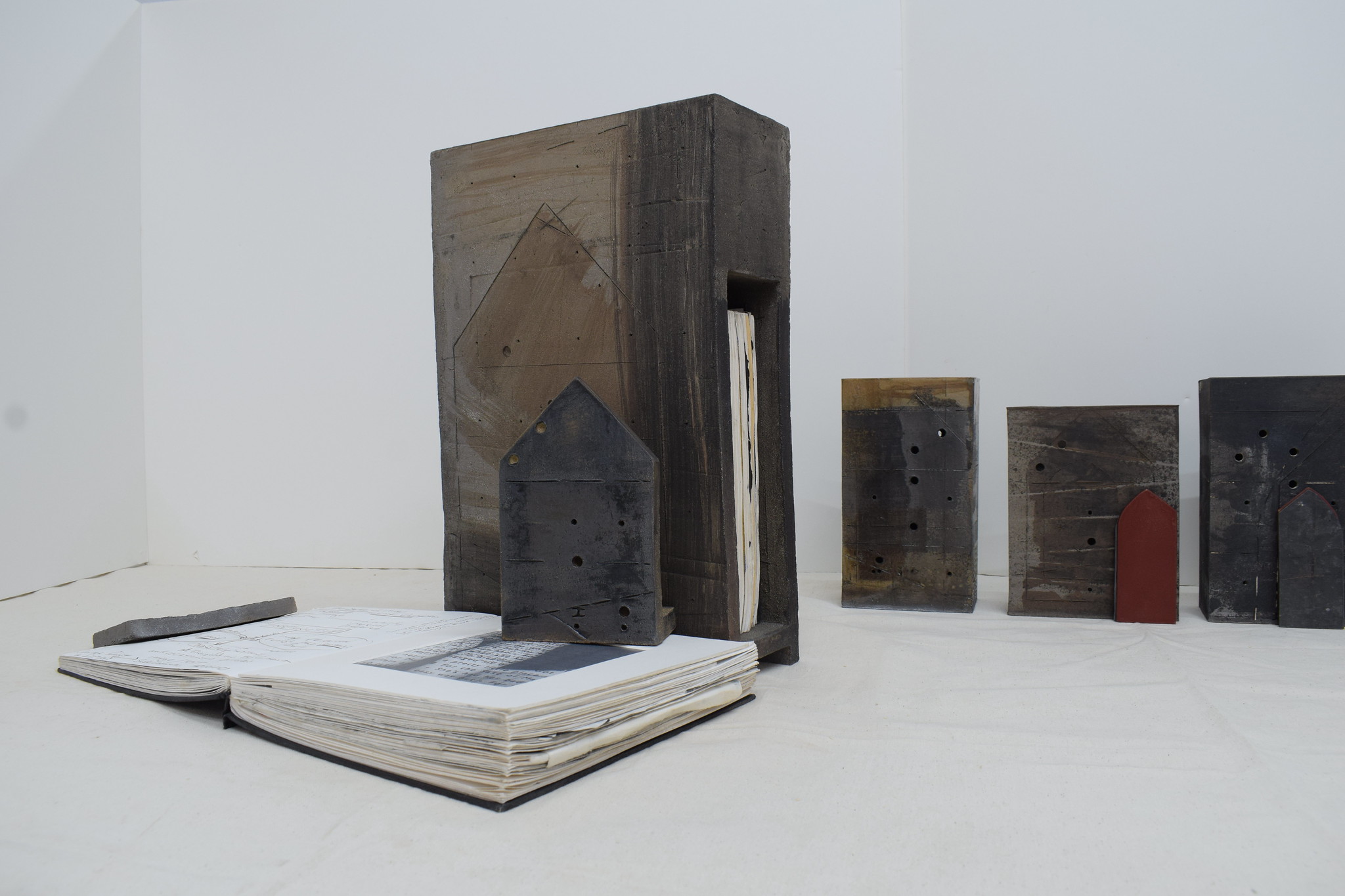
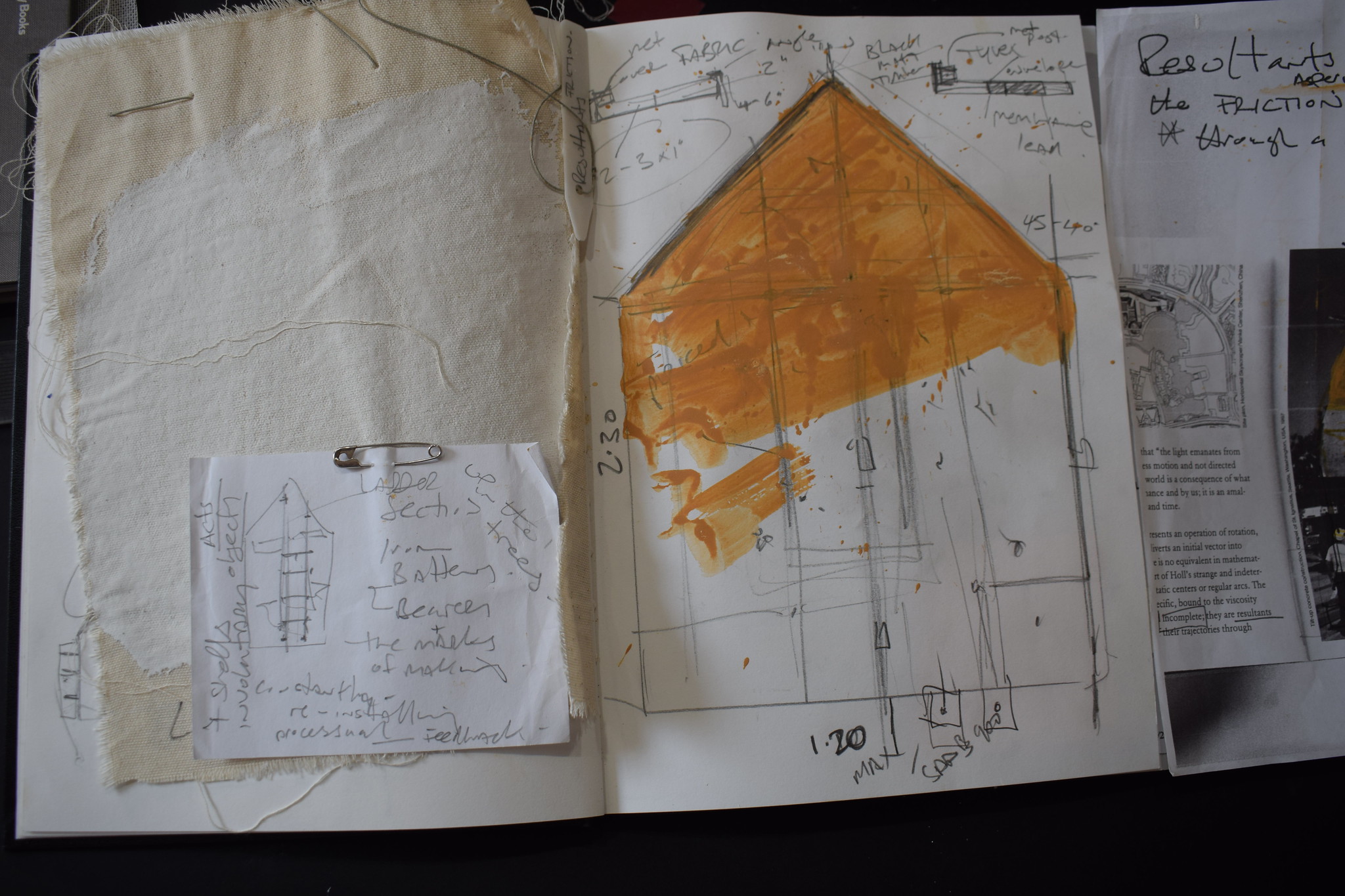
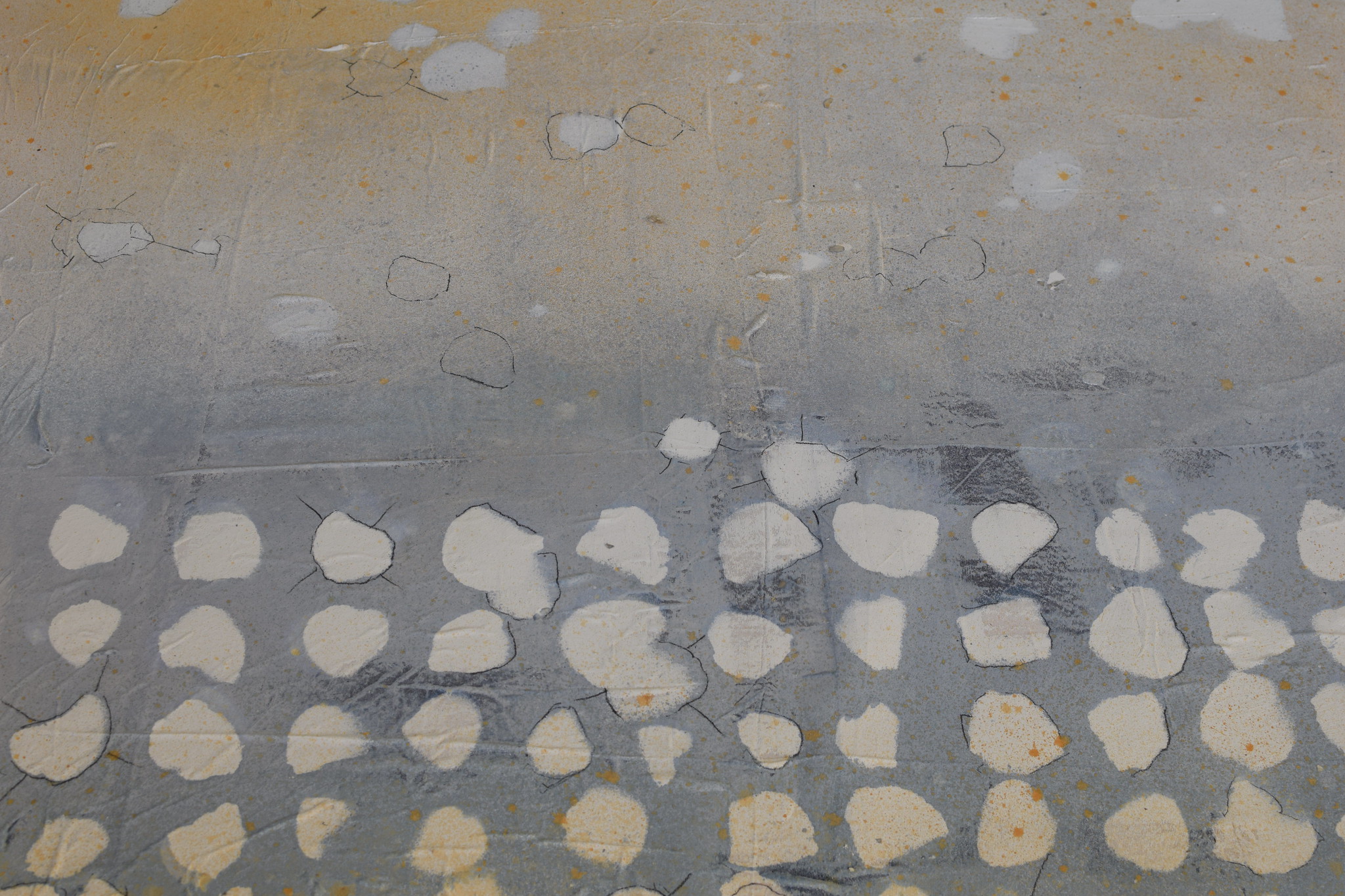
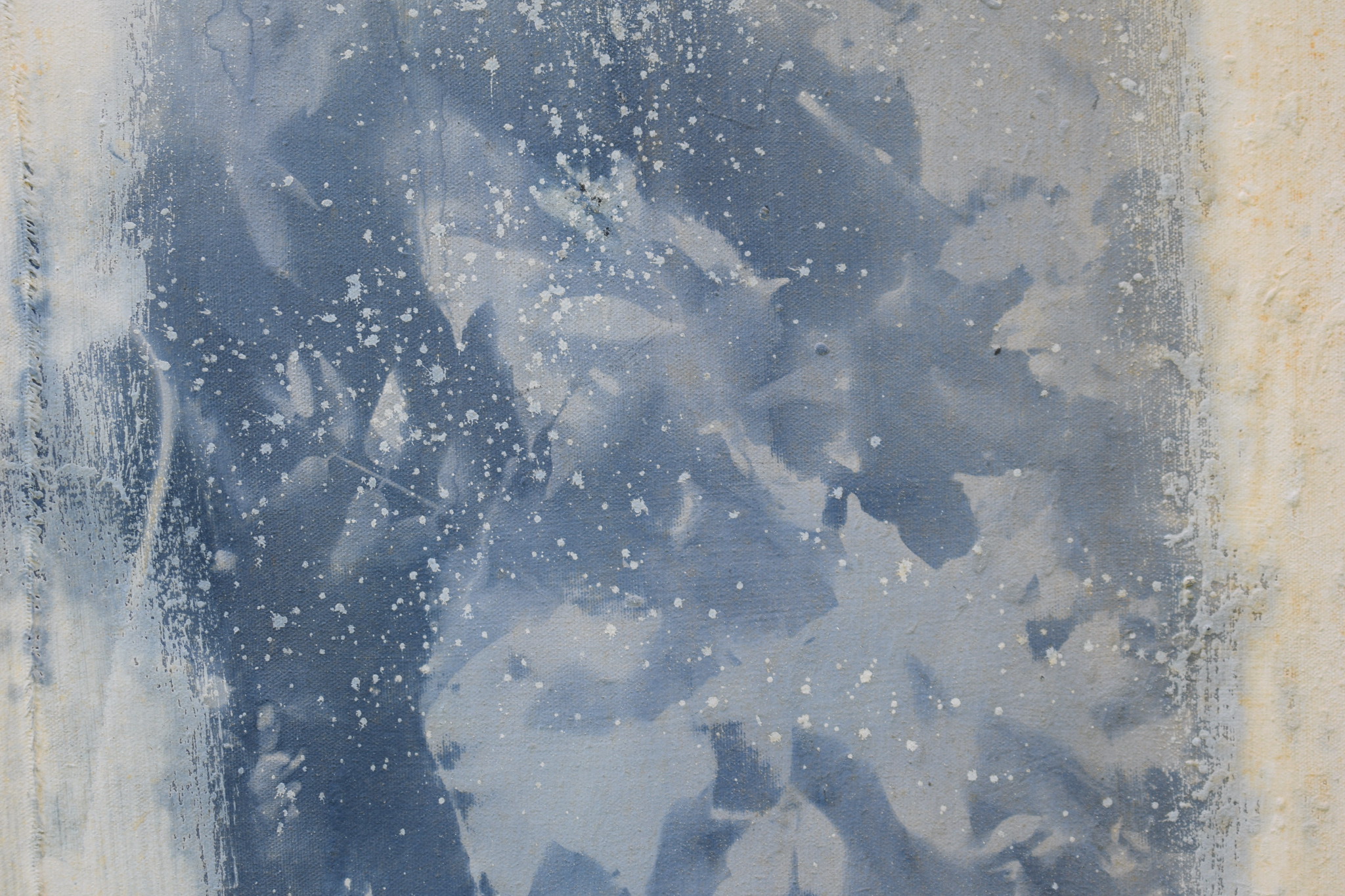
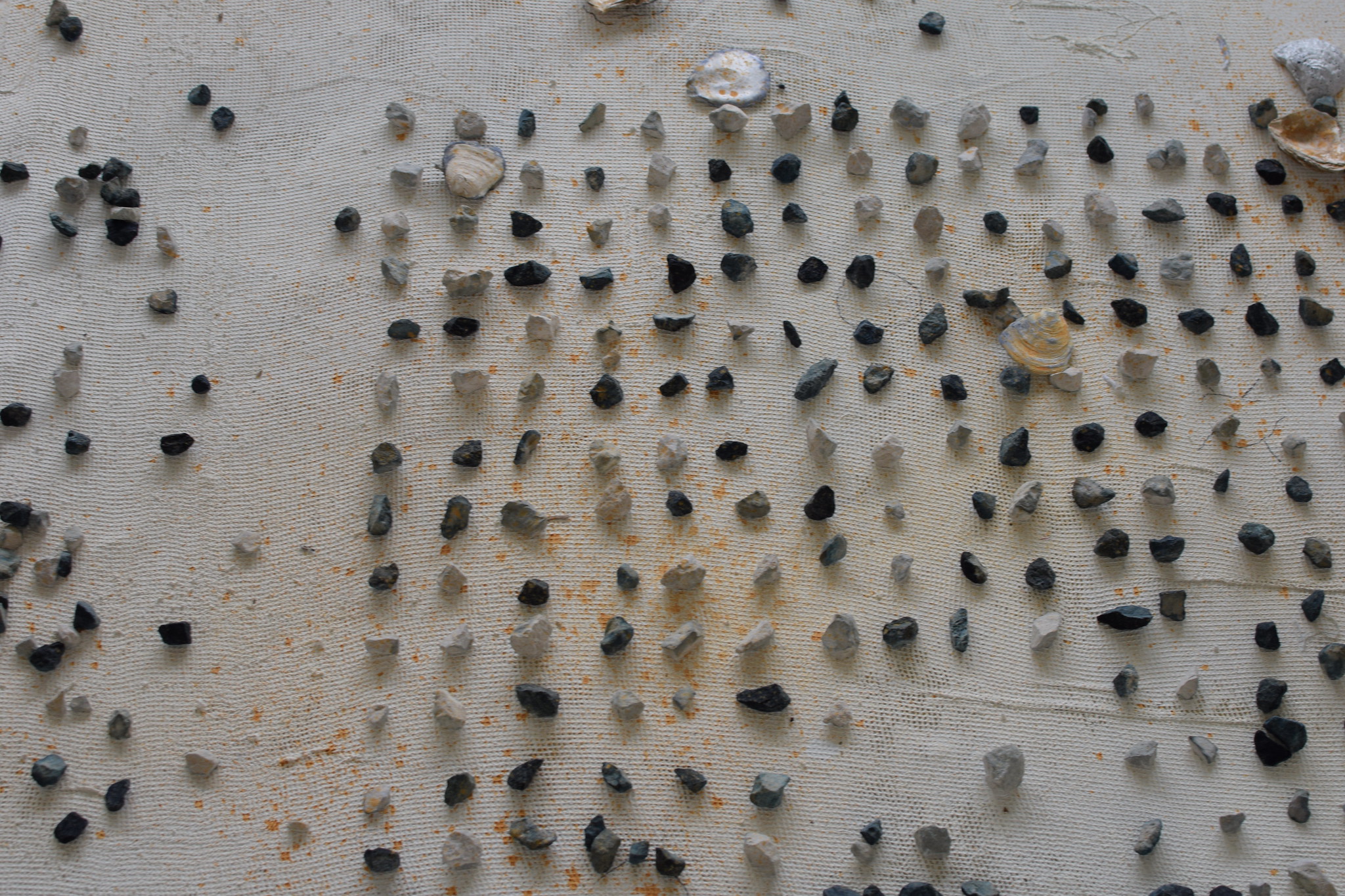
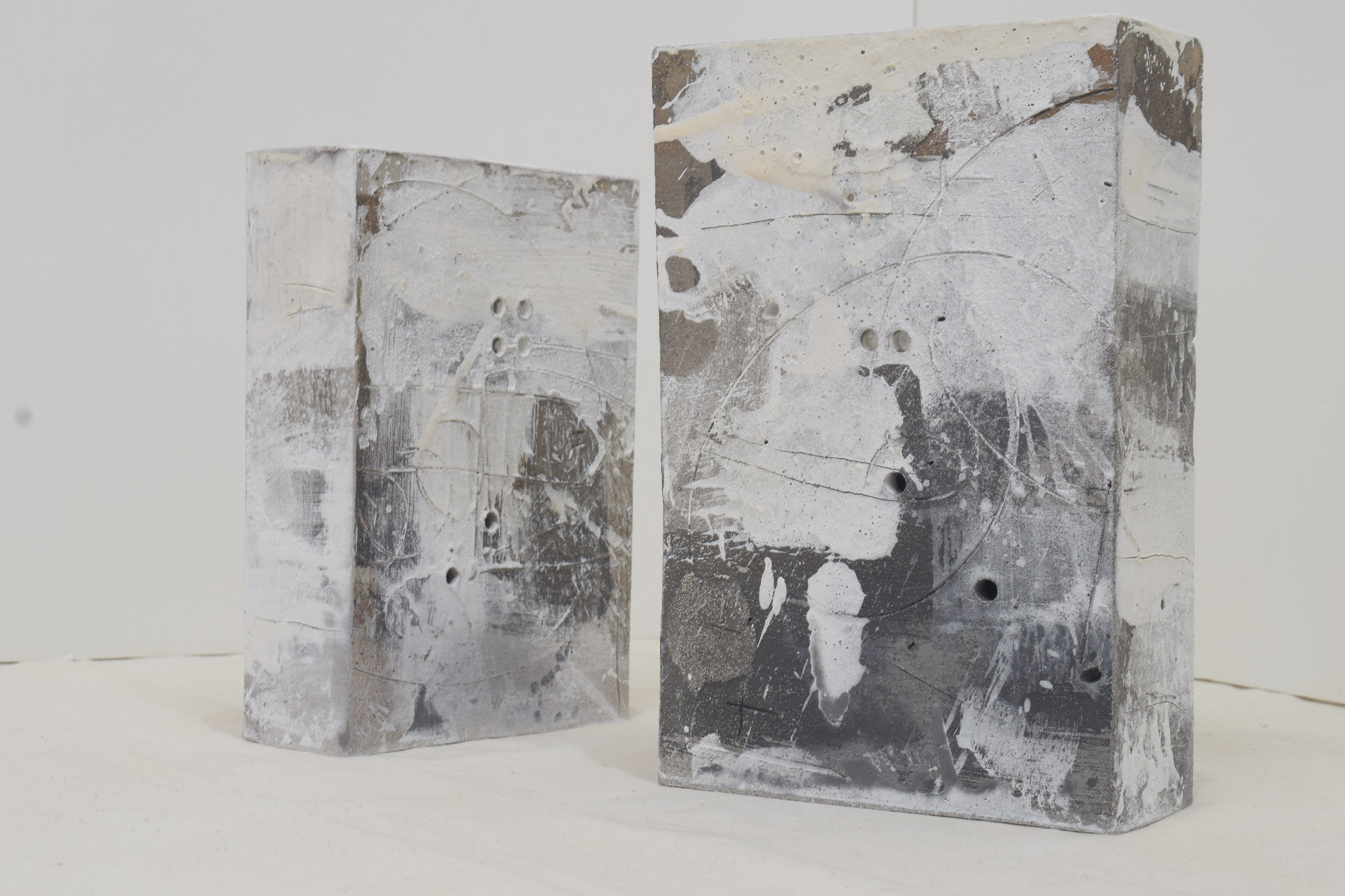
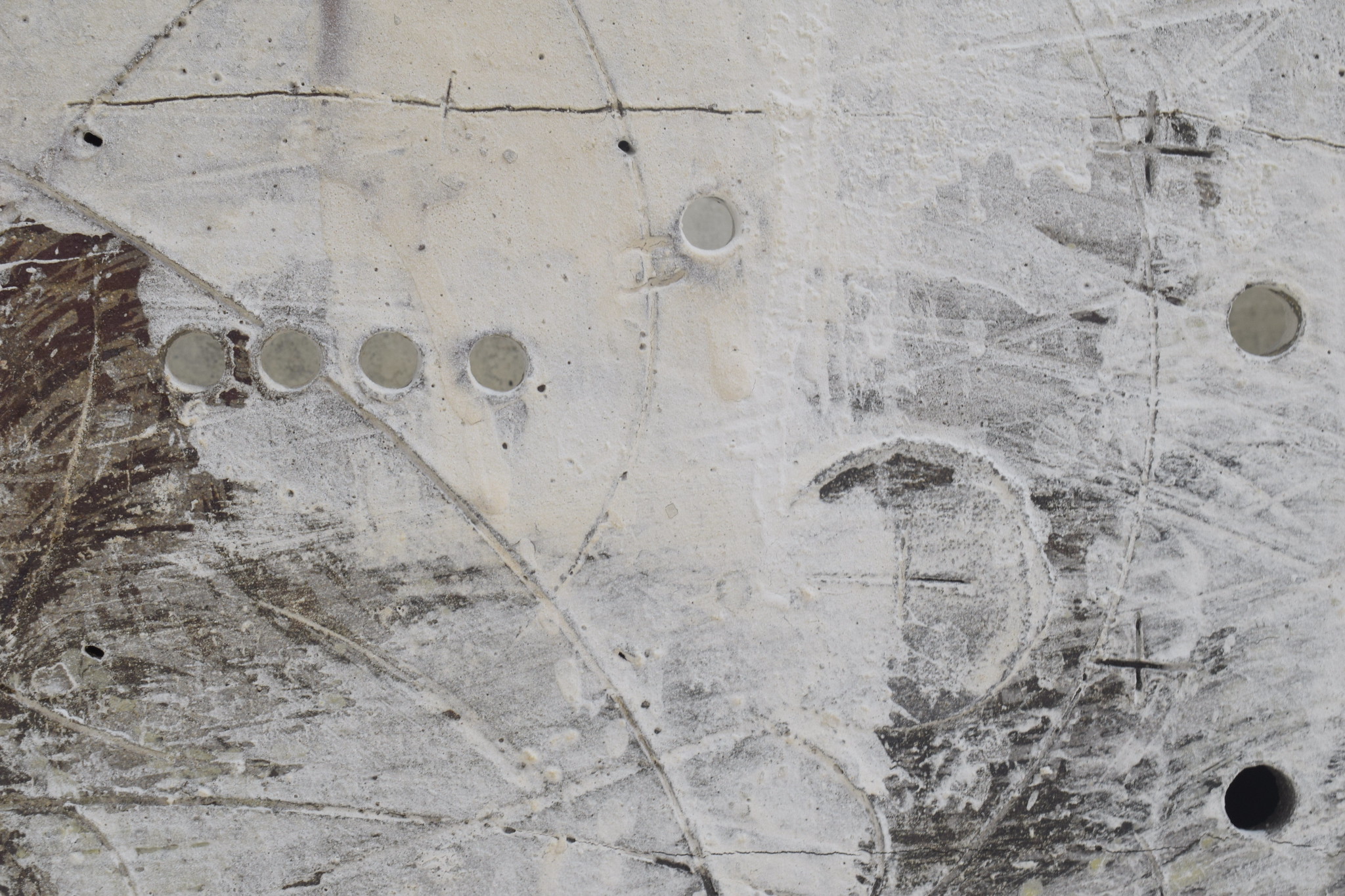
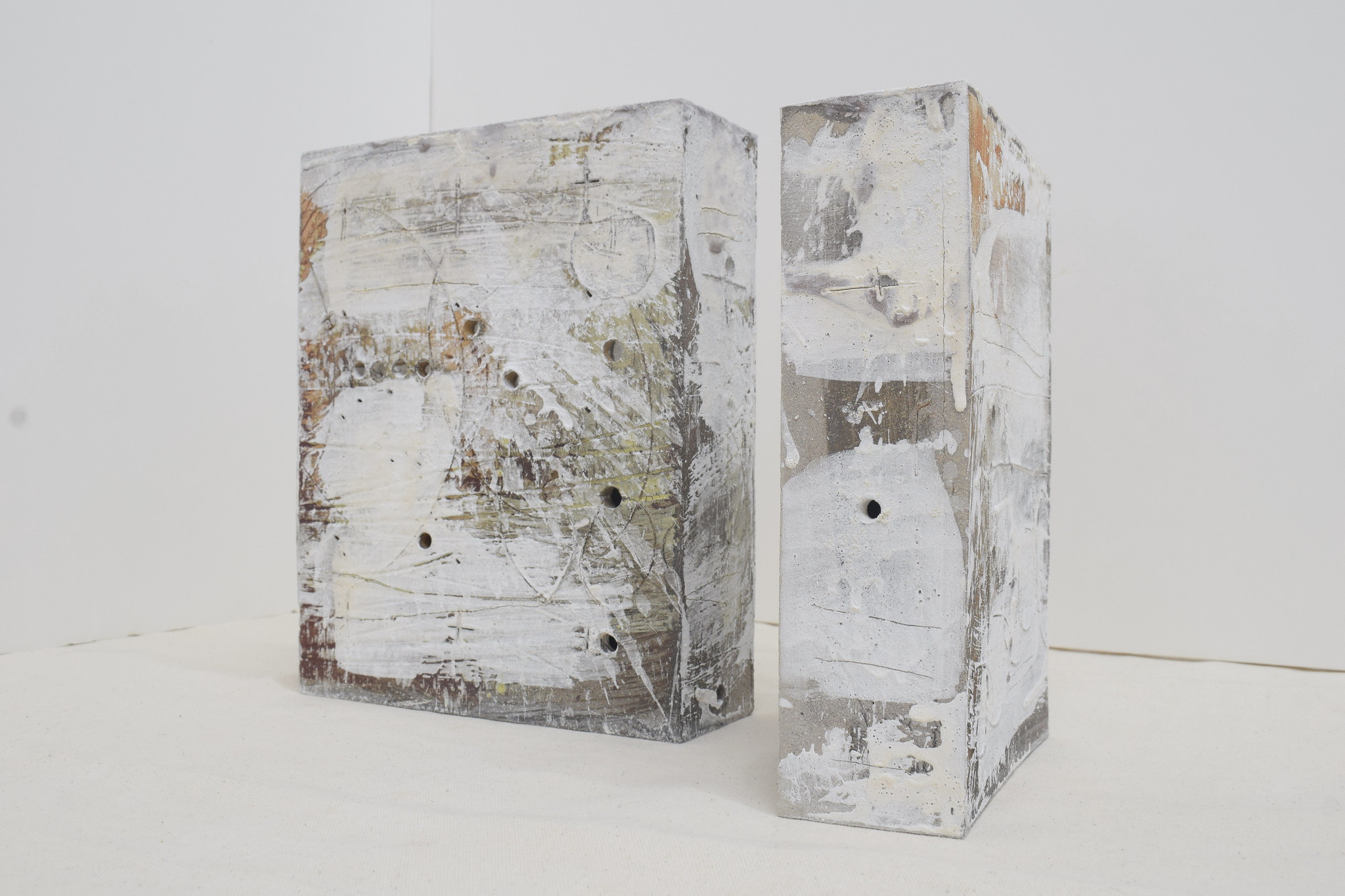
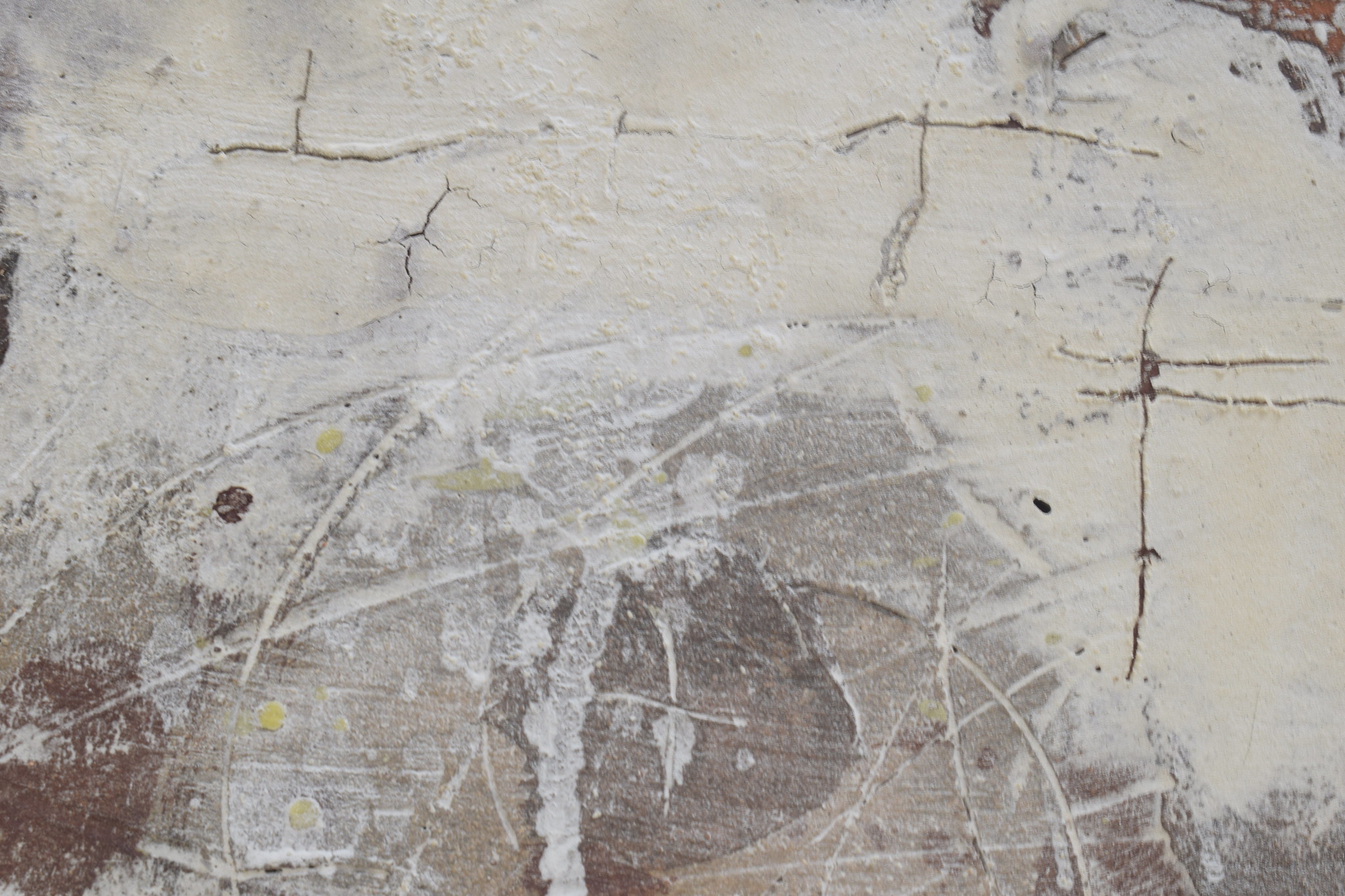
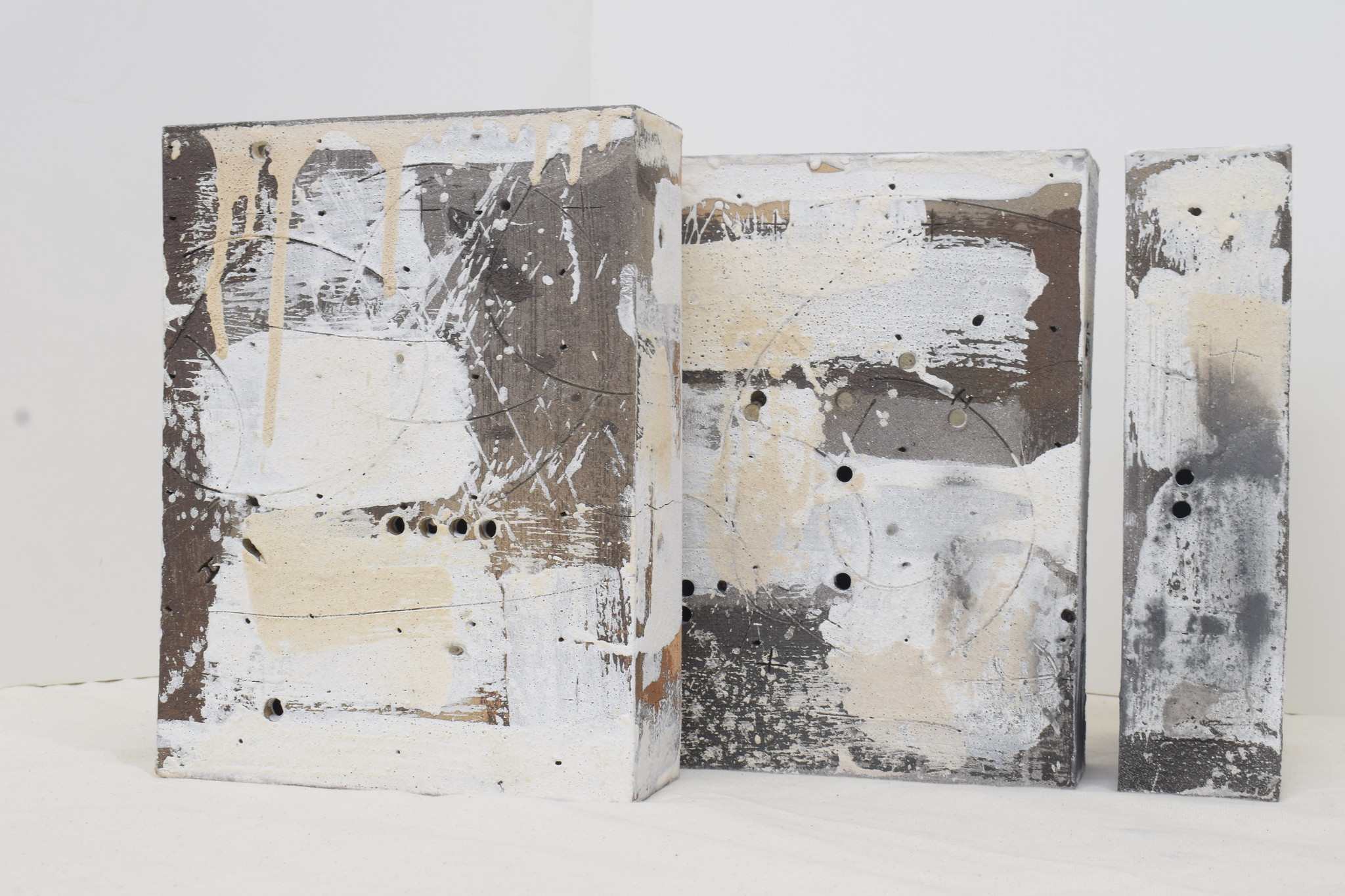
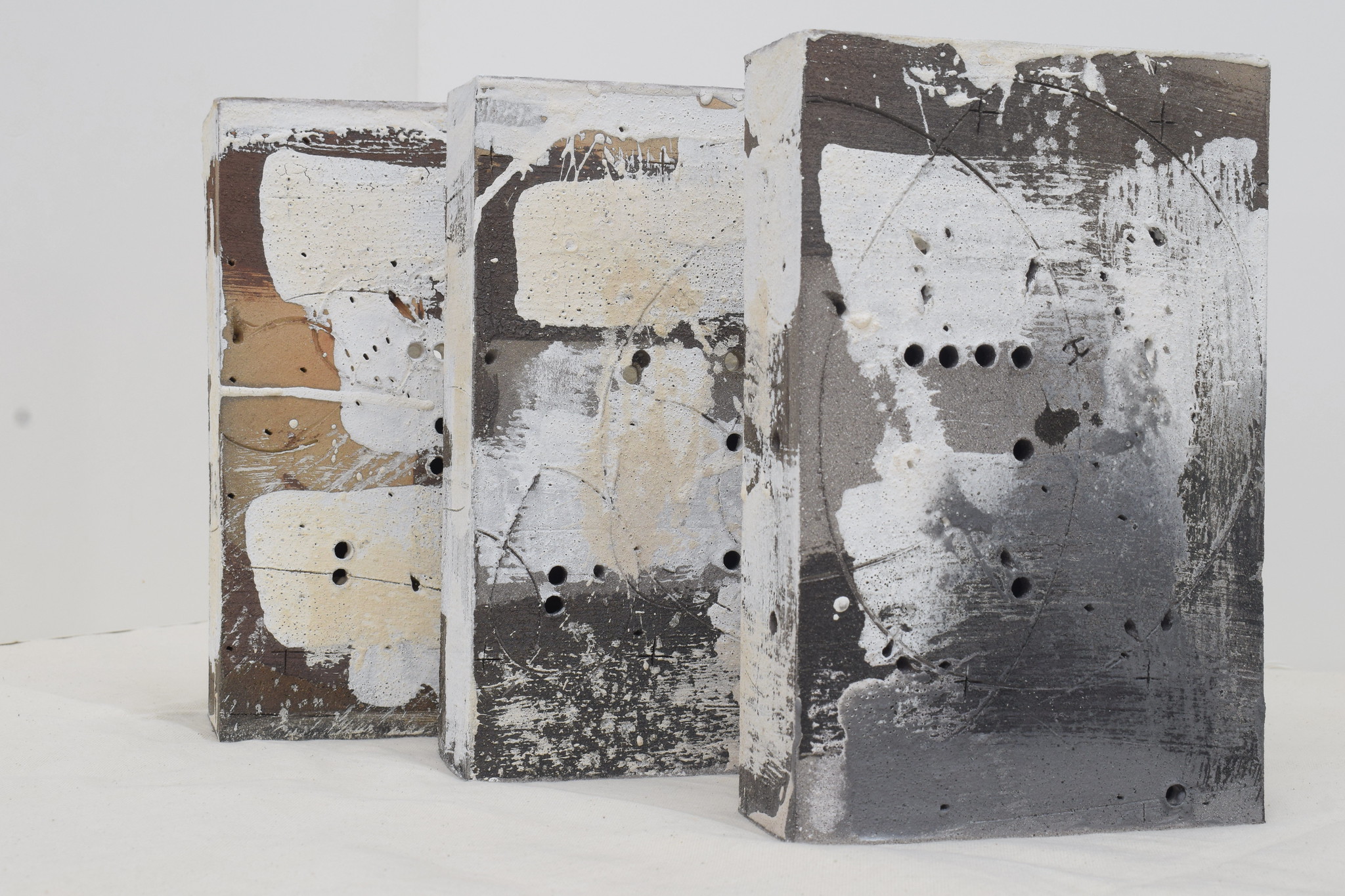
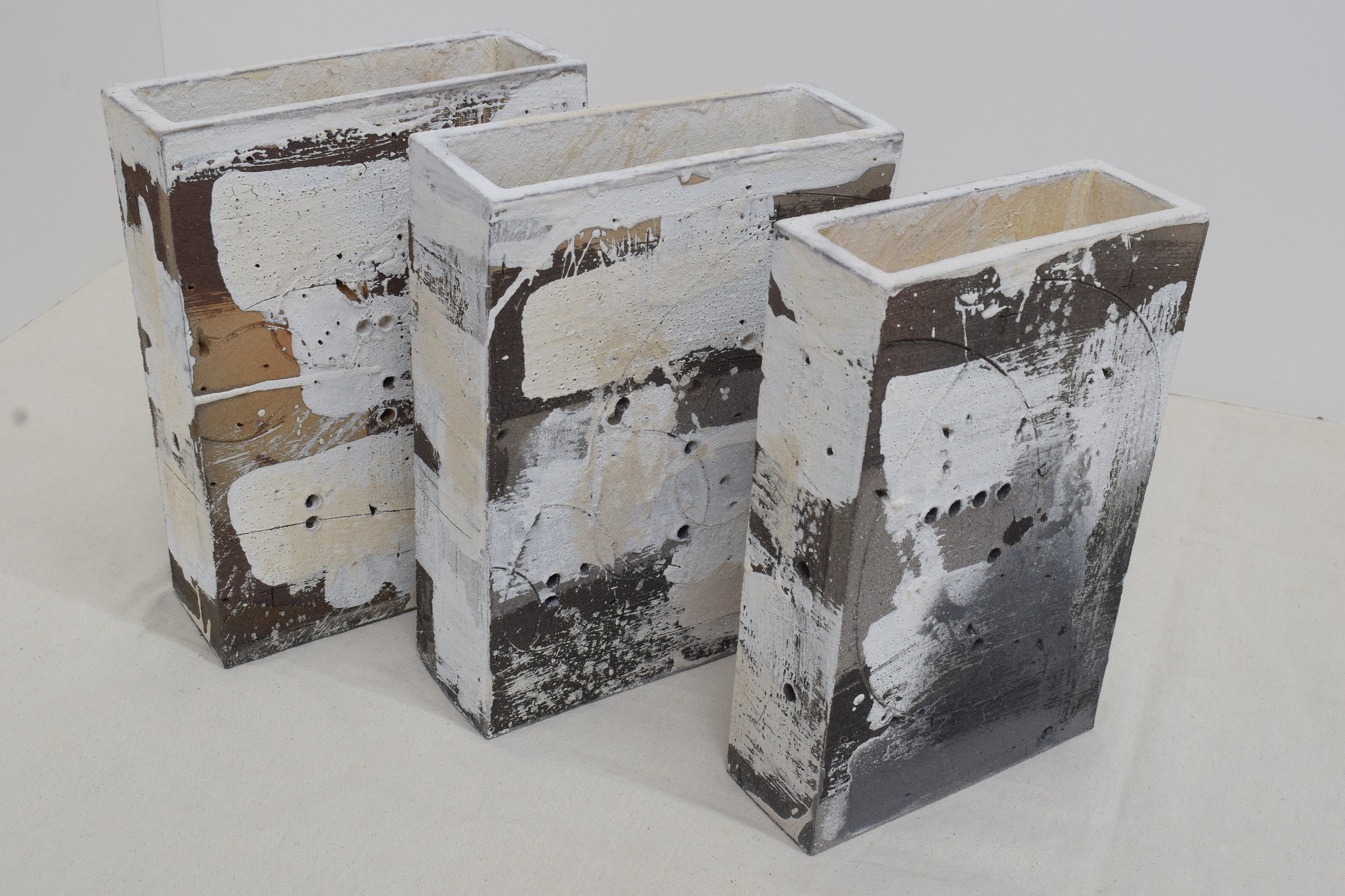
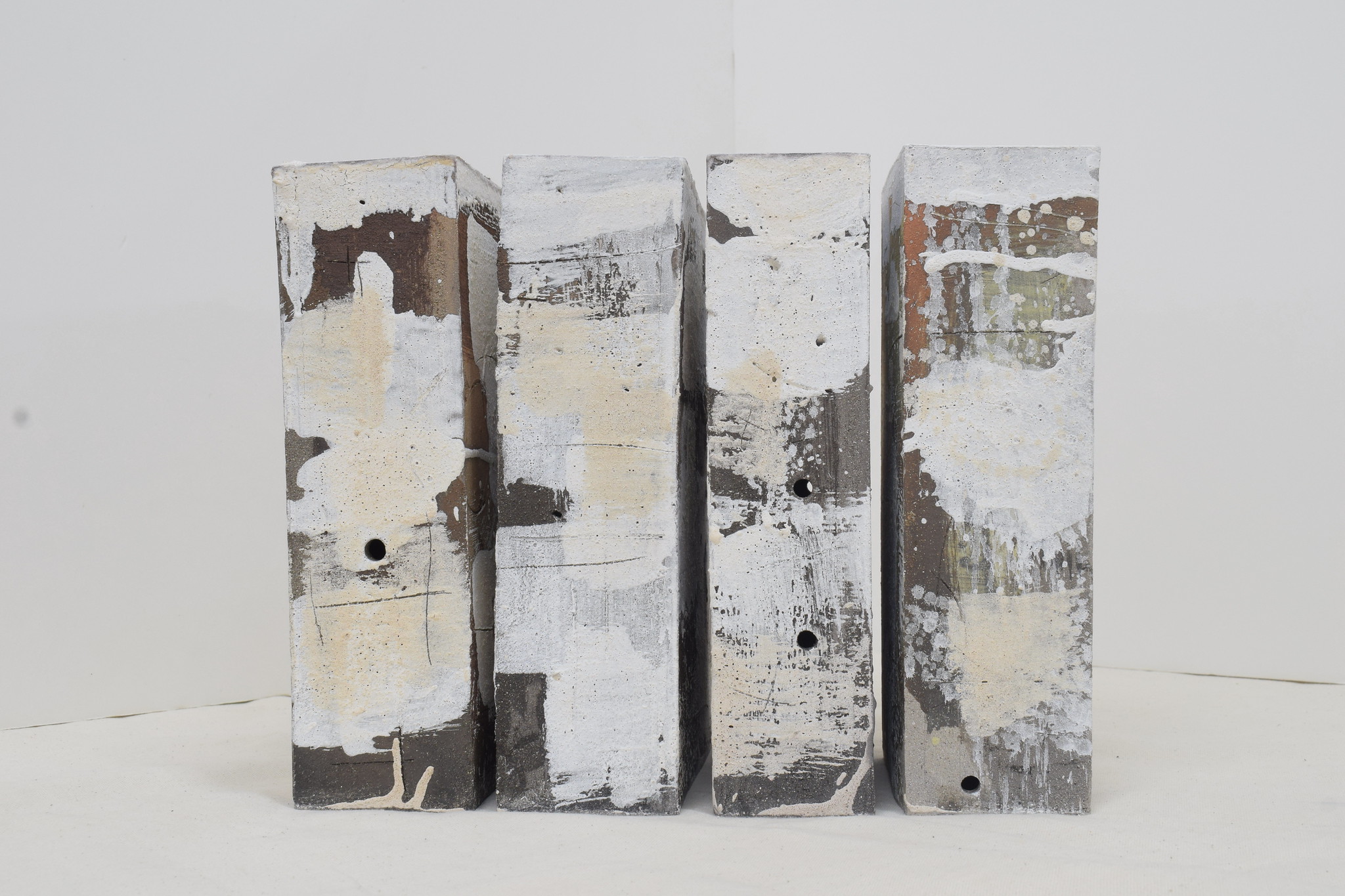
Spatial Practices : Experimental drawing and alternative photography.

  • A humble, passive, somewhat absurd object, yet potent, mysterious, sensuous : Hans Coper

    A humble, passive, somewhat absurd object, yet potent, mysterious, sensuous : Hans Coper

    Hans Coper, Theory and Object Analysis, Crafts Study Centre, Farnham.

    MA Interior Design

    A vessel (as membrane/threshold that can hold social rituals/traditions and memories) seems to occupy space but simultaneously be occupied by space.

    Theories of relativity and uncertainty have shown that all matter, even the airy oxygenated void inside a vessel is energy, and that it is composed of the same building blocks generated from exploded stars. (Daintry2007:10)

    Water, although fluid it is supremely germinative and represents the condition of all potentials.(Eliade Mircea l983)

    Permeable in flux, water and water’s symbolism became the pagan’s way of intuitively knowing the world. Matter was plastic, fluid and changeable. The body was plastic with parameters defined not only by individual consciousness, but also in relation to other realms of the physical world.

    The pagan participated in a vast mythology where his identity changed according to narrative fantasies that combined and recombined human and animal activity endlessly, weaving together memory, reason and sensation. In this permeable world there is no sharp division between things or between life and death. It is a world of energetic flow where bodies can indifferently become attached or unattached from myriad objects and forms. (Daintry2007:9)

    Flexible Ways of Seeing/Re-Making the World.

    “A large part of the reason for making is to see things that I have never seen before, to build something which I cannot fully understand or explain.”

    Artist Statement, Ken Eastman.

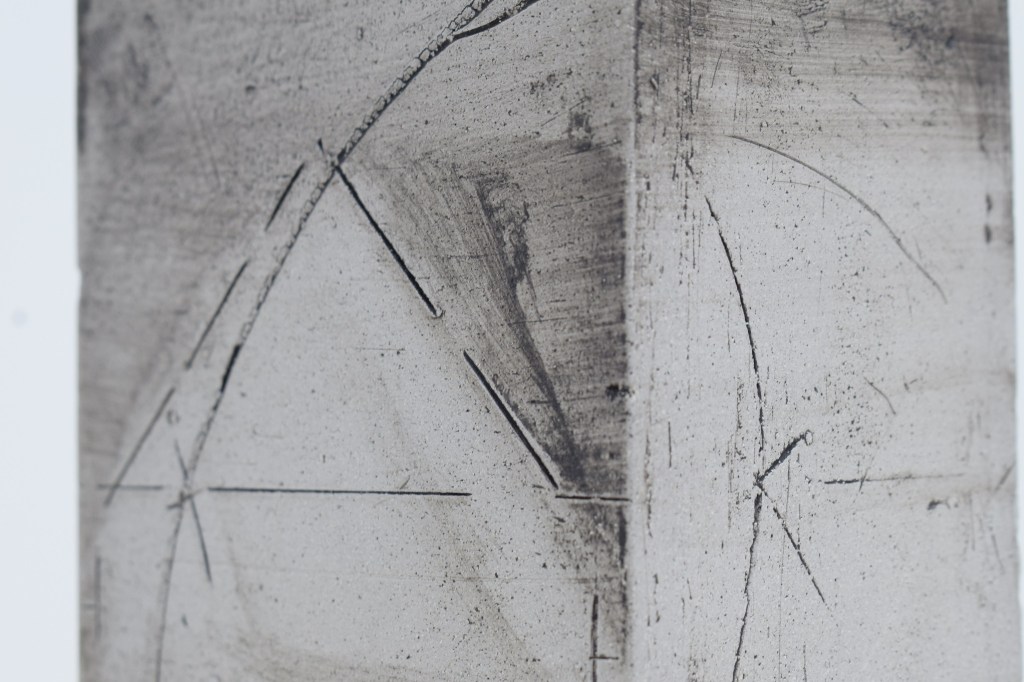
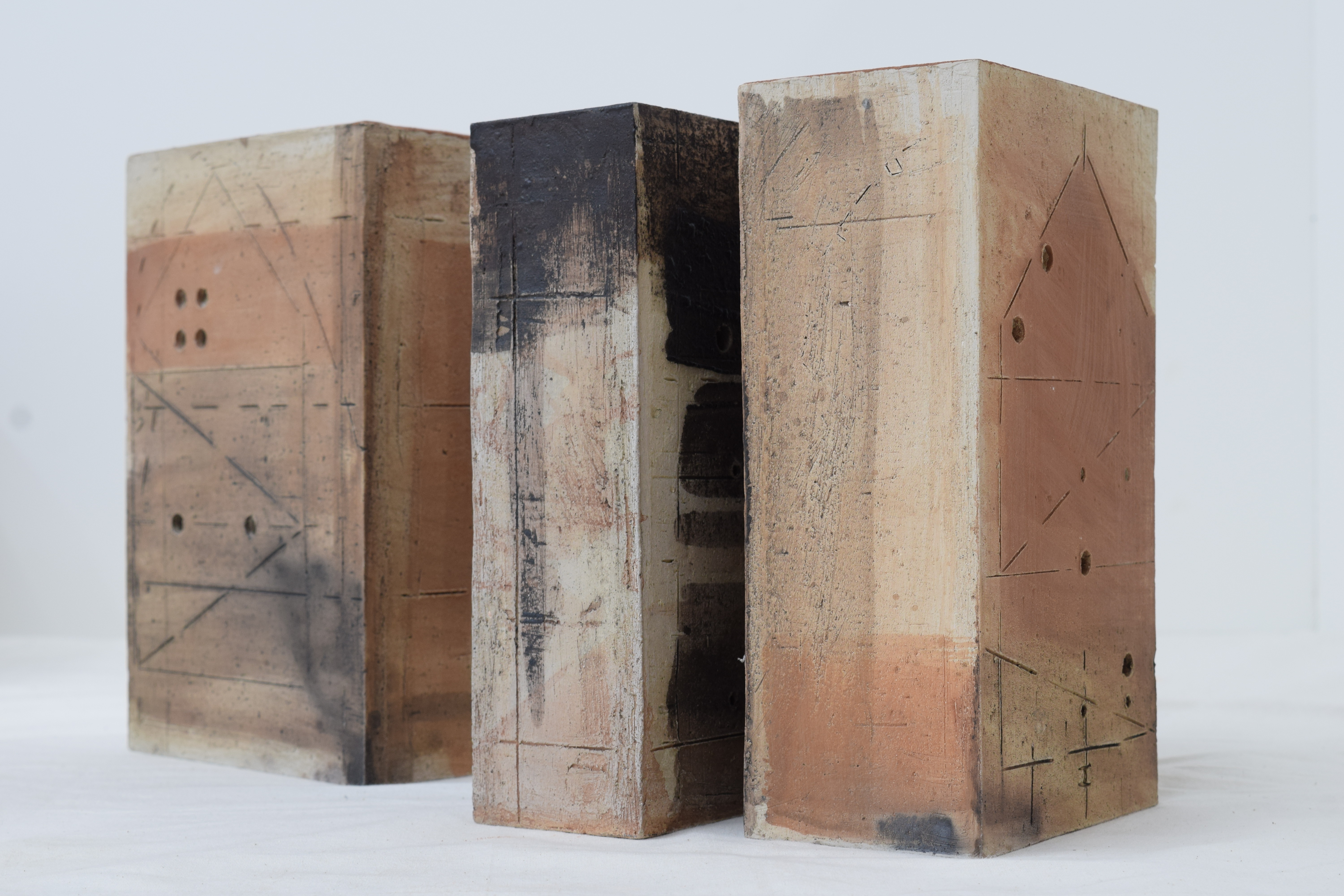
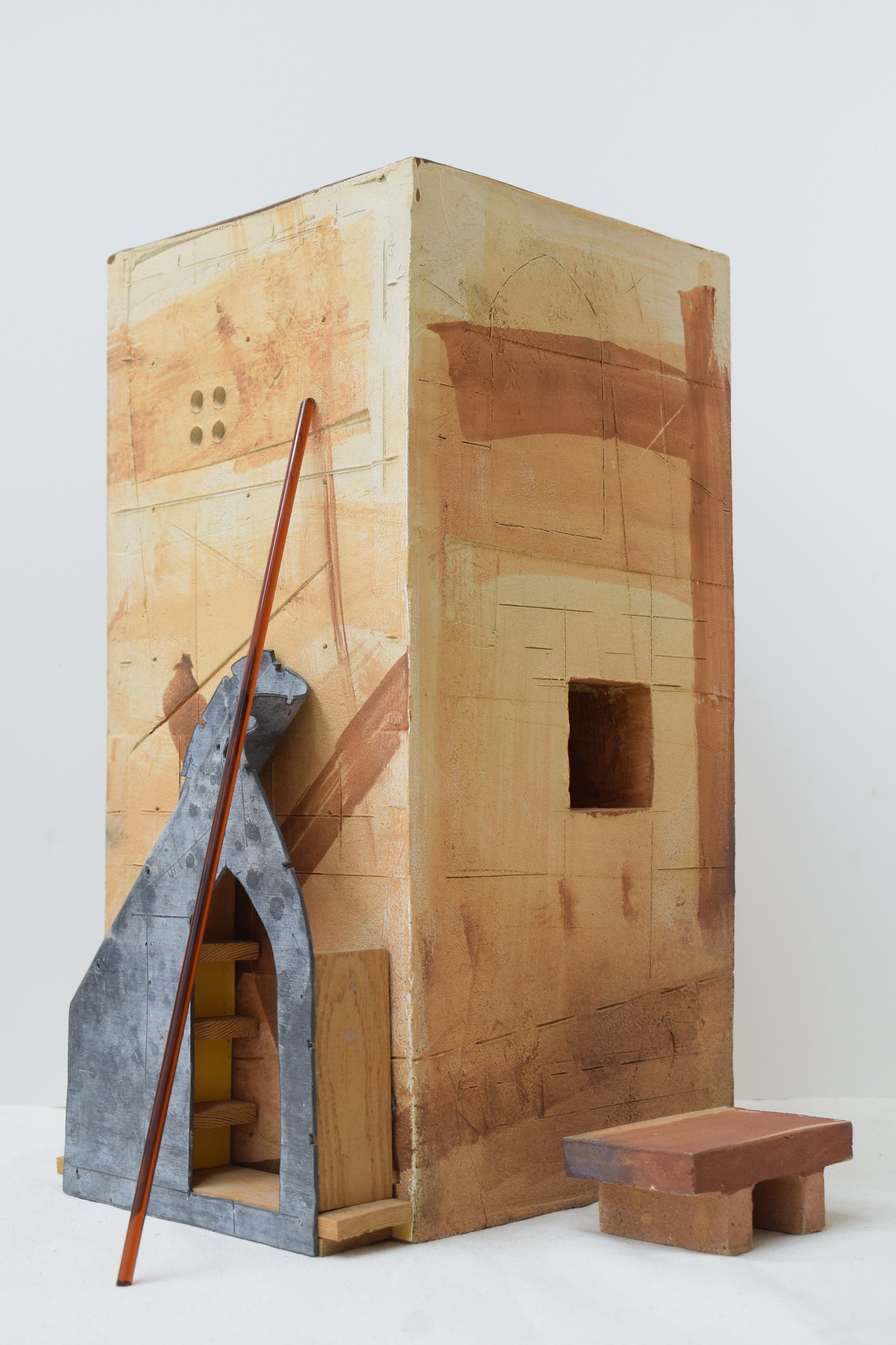
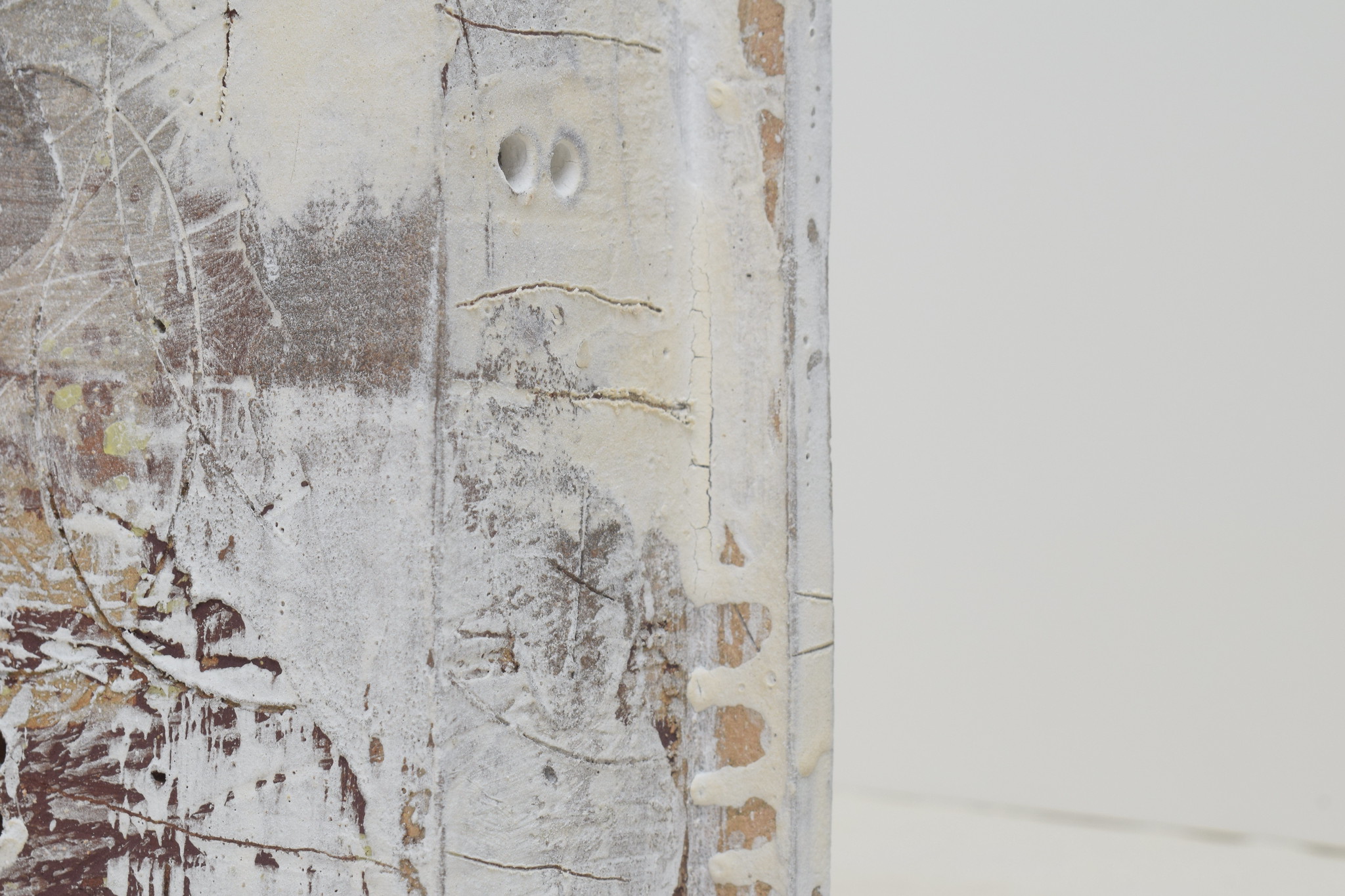
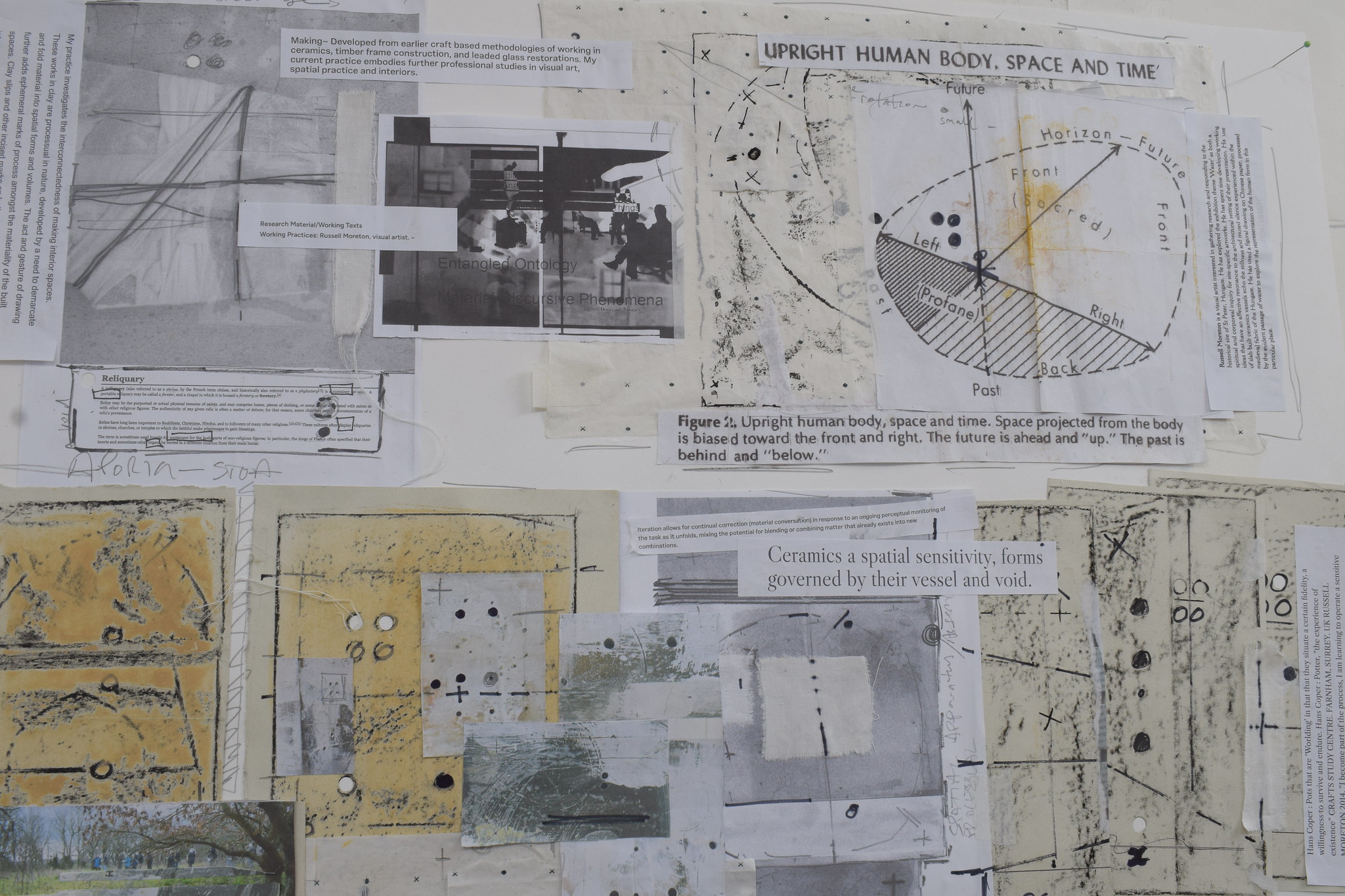
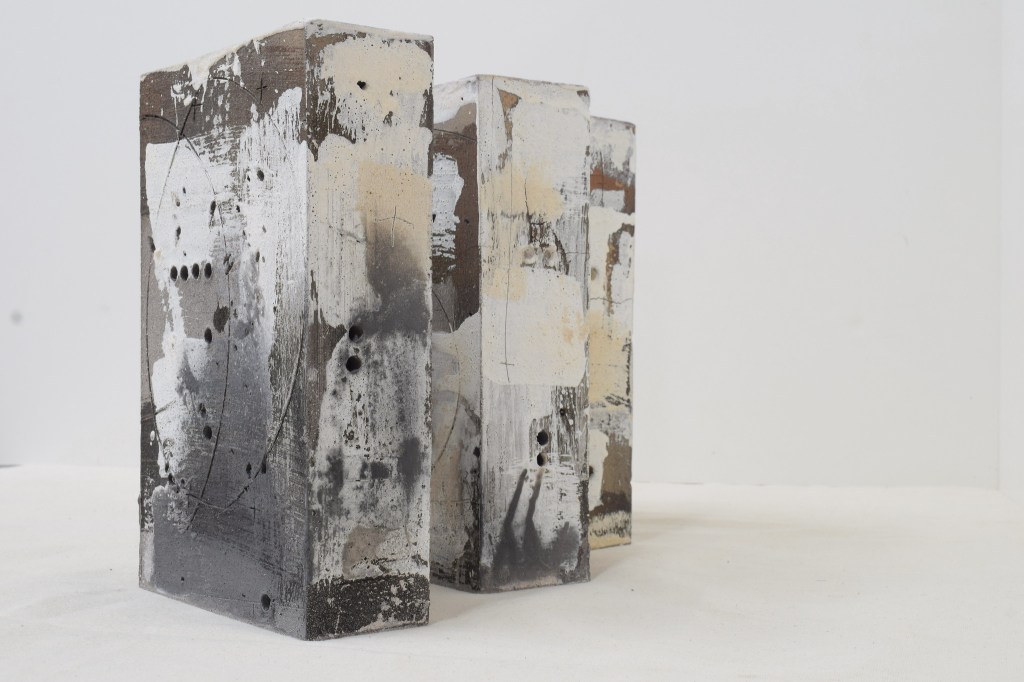
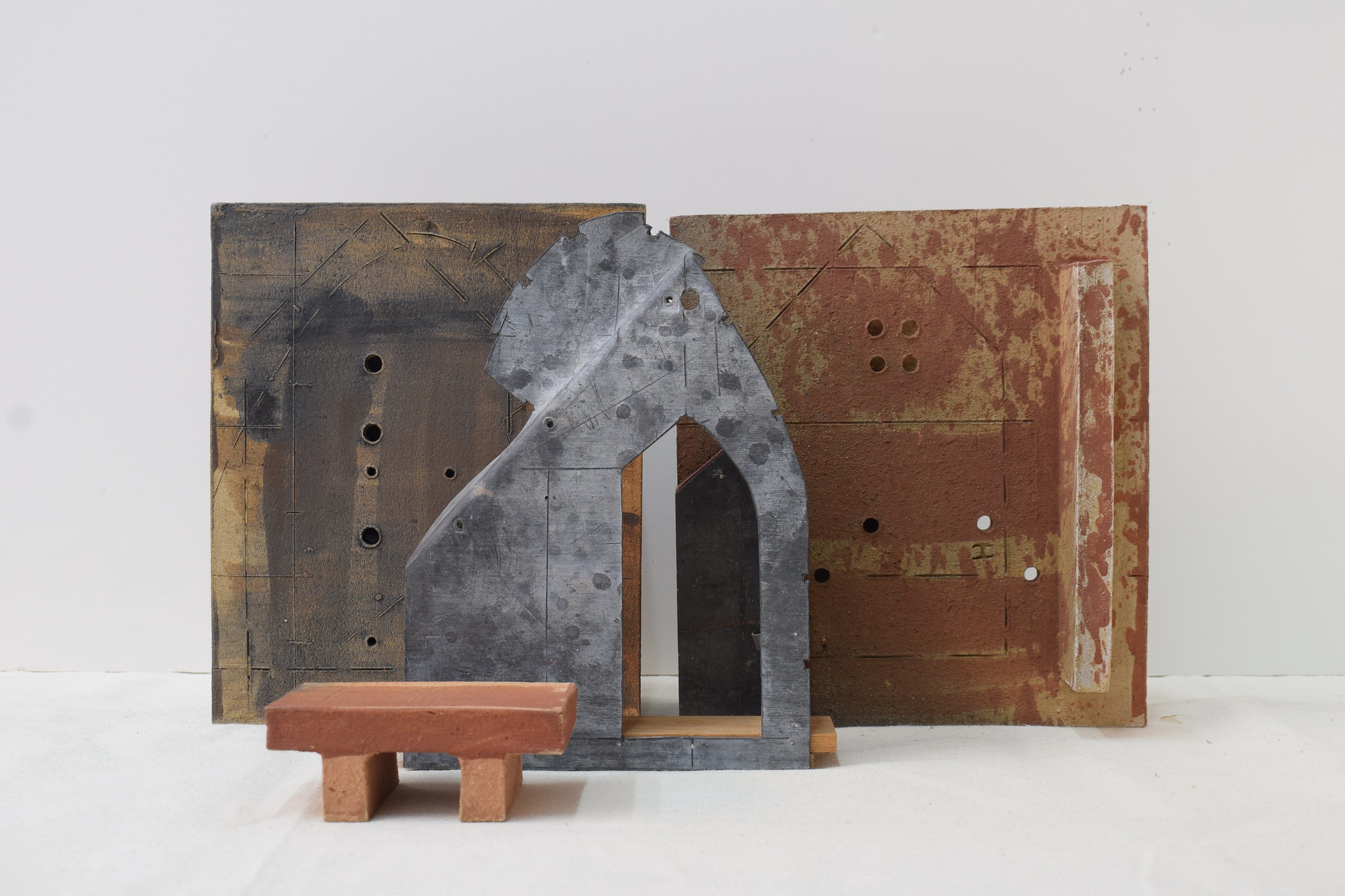
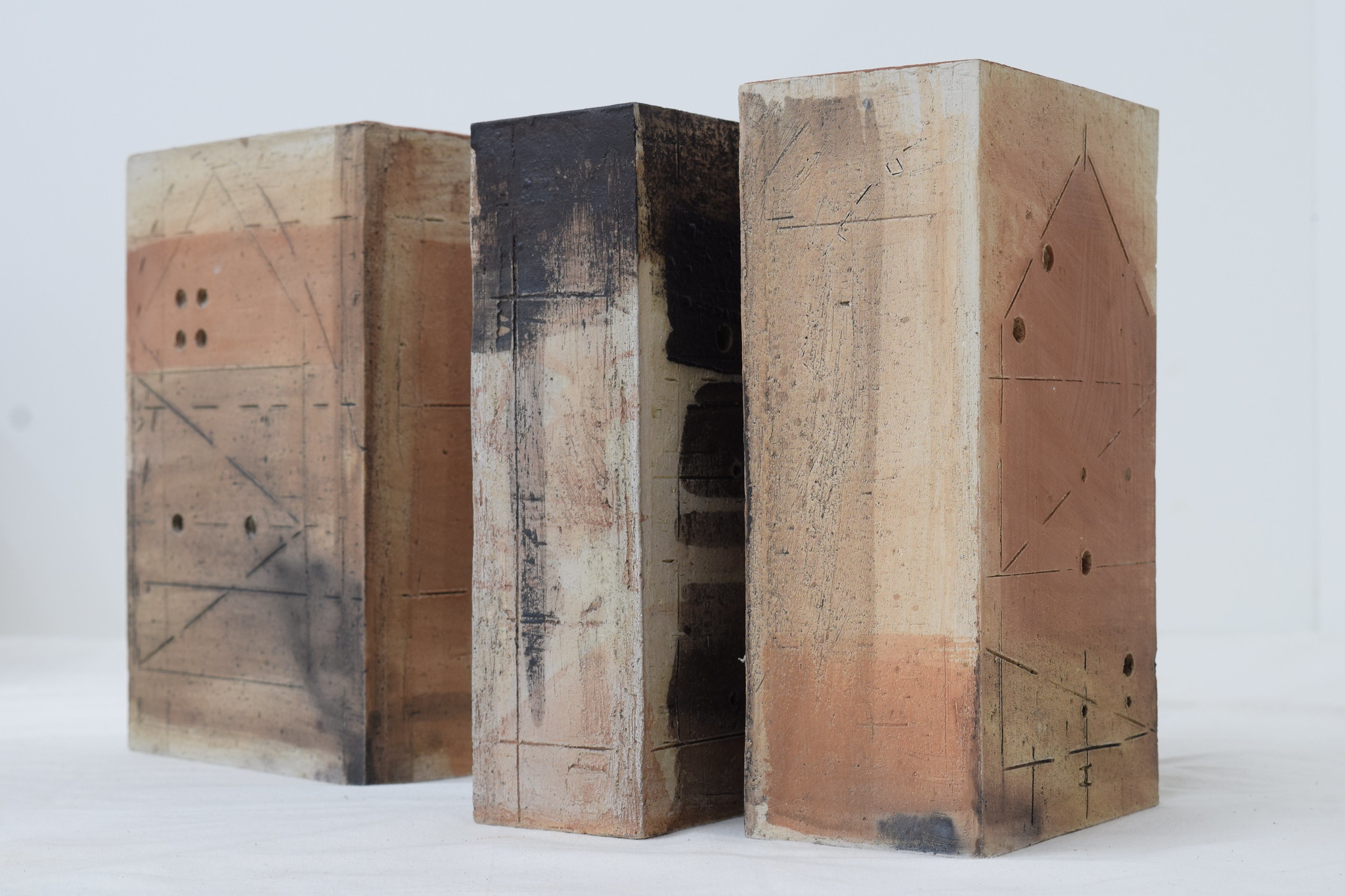
    Drawings in the form of tracings were gathered from the flat planes of the display cabinet; these were further superimposed in an attempt to map the surface and forms of the Hans Coper pots and to explore their volumes and interior spaces. These new sight lines subjectively link surface details with profiles into the possibility of new spatial forms. These plans and mappings became the starting point for a series of slab and thrown assemblages. Thrown and slab worked clay forms in T Material, preliminary drawings done in-situ some with annotations. (Russell Moreton. 2014)

    Rotterdam Exhibition with Lucie Rie. 1967 Hans Coper.

    His arrangement was highly original and innovative, he showed his families of vases in groups, emphasising their subtle differences in form and surface treatment. The space between the pieces was just as important as the objects themselves. The architectonic character of Coper’s pots become visible through their dry, stone like skin and the sophisticated way in which Jane Gate photographs the work.

    “Potters of reconciliation, they sought a marriage of function and beauty.” Douglas Hill SF author/intro to exhibition.

    Craft Study Centre Publication 2014

    Object Analysis

    Name of object:   Vase, flattened oval form on a cylindrical stem, pinkish cream to grey glaze over                                       manganese on exterior, manganese over interior and recessed foot. It is decorated                                    with incised lines on back and around the stem with concentric rings incised on the                                   foot

    Accession number:                P.74.28

    Maker:                                   Hans Coper

    Construction techniques:

    Materials:                               stoneware

    Dimensions:                           22.2 x 18.8 centimetres

    Date made:                             1960s

    Provenance:                           Made in Hammersmith, London. UK

    Given to Muriel Rose by Hans Coper in 1966

    This thistle-shaped vase is constructed from five individually thrown pieces. The joints making up the pot have been selectively accentuated with the residues of the manganese engobe. Incised geometric marks remain from the initial turning process of the component parts, prior to the construction of the pot. (Russell Moreton. 2014)

    Name of object:     Vase, unglazed rim. manganese interior, decorated with vertical scoring on the                                         exterior

    Accession number:                   P.74.103

    Maker:                                       Hans Coper

    Materials:                                  stoneware

    Dimensions:                              12.7 centimetres

    Date made:                                1950s

    Provenance:                               London. UK

    Single thrown form with the remains of the sgraffito technique after the ceramic has been heavily abraded after firing. The vertical lines of the sgraffito technique and the form itself are similar to Lucie Rie’s flower vases, see Lucie Rie by Tony Berks page 112.

    This single thrown form perhaps best illustrates the creative union of both Coper’s and Rie’s practices, the form almost a kind of beaker might itself been inspired by the “dark pots” Lucie Rie found whilst visiting Avebury Museum. (Russell Moreton. 2014)

    Name of object:     Squeezed ovoid-shape vase with flower holder inside, manganese interior

    Accession number:                    P.74.30

    Maker:                                   Hans Coper

    Materials:                              stoneware

    Dimensions:                          22 x 22 centimetres

    Date made:                            1970s

    Provenance:                          London. UK

    Wheel thrown forms, comprising of bowl, open cylinder and an interior ring acting as a flower holder. The bowl form has been turned before being jointed with the upper section. The piece was then indented at four points to form an ovoid form. Pronounced incised horizontal marks remain from the joining, which has been further transposed by the action of becoming ovoid. Very subtle and restrained use of the manganese engobe followed by Coper’s characteristic post firing technique of abrading the surface of the ceramic. (Russell Moreton. 2014)

    Hans Coper : Working Notes CSC/10 March 2014.

    Notes re/statements

    1.   Specific to the form in question.

    2.   Context in relation other similar forms.

    3.   Key Words: Impregnated, Incised, Eroded, Reduction, Surface, Soil, Abraded Surfaces, Machining, Grinding, Assemblage, Components, Parts, Groups, “Aryballos,Spade, Thistle, Diabolo, Cycladic, Spherical,” Sculptural, Pottery, Architectonic, Space between Forms, Spatial, Sensuality, Form and Fold, Bodily Spaces, Light and Dark, Clay, Water, Fire, Agency, Difference,

    Extracts from catalogue “The Essential Potness, Hans Coper and Lucie Rie 2014”

    “I become part of the process, I am learning to operate a sensitive instrument which

    may be resonant to my experience of existence now.”

    “My concern is with extracting essence rather than with the experiment and exploration. The wheel imposes its economy, dictates limits, and provides momentum and continuity. Concentrating on continuous variations of simple themes I become part of the process.”

    Artist Statement, Victoria and Albert Museum/Collingwood, Coper Exhibition 1969. Small Beige Spade 1966.

    The body comprises a thrown circular form, from which the bottom has been flattened into an oval and the lower section has been pressed together.

    Throwing rings are visible on the inside.

    Areas of the white engobe have loosened from the underlying layer during firing and formed blisters.

    Cycladic Vase 1973.

    Blisters in the slip have been sanded down to reveal a rust coloured underlying layer. Medium Sized Spade 1973.

    There is a clear delineation between the light upper section and the rougher and darker lower section.

    Small Thistle Shaped Vase 1973.

    There is a large incised circle on one side of the disc and a smaller circle on the other. Hans Coper’s characteristic use of light engobe and dark manganese oxide has produced a hazy texture.

    Black Aryballos 1966.

    This ceramic form has its origins with the Oil Flask used by athletes in Greece and Asia Minor.

    Tall elongated diabolo forms.

    After being thrown the cup has been formed into an oval and then indented at four points.

    Text Fragments. Momentum Wheel.

    It is difficult to determine in which order the parts were assembled.

    The underlying surface is showing through the grooves that are linking the body and the base.

    The manganese engobe is demarcating dark and light zones through an undulating incised line.

    “Rings” caused by the placement of a prop in the kiln. Brown-Beige Colorations.

    Sensations caught within the form.

    Soil like deposits/remains.

    Reductions of the fired surface.

    Abraded Surfaces

    Incised Line.

    Droplet.

    Blisters, pricked open and sanded after firing. This process has produced an irregular, patch surface.

    Parallel lines have been incised with a pointed object on the exterior of the base. Thistle Shaped Vase 1966.

    The dark brown patches (around the jointing of the pot) and flecks appear randomly distributed but have been purposefully placed to accentuate the structure of the vase. This flat vase with the contour of a stylised thistle flower is made up of five individually thrown pieces. The tall cylindrical foot supports a vertical disc, comprising of two individually thrown flat plates. It is as though the disc has sunk approximately ten centimeters into the foot.

    Spherical Vase with Tall Broad Oval Neck 1966.

    The transition from sphere to neck is accentuated with darker colourations.

    Hans Coper

    Hans Coper’s iconic assembled ceramics frame the later part of the twentieth century with an ambivalence of both alienation and reconciliation. His pots reveal differences that have resisted the homogenizing effects of the culture of the time. They embody and are a physical testament to what the potter himself has reflected on his life, “endure your own destiny”1 2 within the space and time of the human condition.

    Bom in 1920 into a prosperous middle dass background, his childhood years were spent in the small town of Reichenbach in Germany. In 1935 his father Julius, is singled out like many other Jewish businessmen for harassment and ridicule

    under National Socialist Party. This would result in the Coper family moving frequently to escape the attention of the Nazis. Tragically in 1936 Julius takes his own life in an attempt to safeguard the future of his family. The remaining family. Erna Coper and her two sons return to Dresden. In 1939 Hans at the age of 18 leaves Germany for England, the following year he is arrested in London and interned as an enemy alien. He spends the next three years first in Canada then returns to England by volunteering to enroll in the Pioneer Corps. In 1946 a meeting with William Ohly who ran an art gallery near to Berkeley Square, brought about an opportunity for a job in a small workshop run by Lucie Rie, a refugee potter from Vienna. Hans Coper now began earnestly through his engagement with ceramics to reveal a continental modernity “whose work seemed uncomfortably abrasive to the traditionalists.”*

    Hans Coper and Lucie Rie worked together at Albion Mews for 13 years forming a friendship and a working relationship that was mutually reciprocated through practical concerns, innovation and experimentation. There is a creative synergy in place through their mutual sharing of process and experimentation within the practicalities of the studio space. A documented instance of this reciprocal inventiveness is in the appropriation of the technique of “Sgraffito” which Lucie Rie employs after being inspired by some Bronze Age pottery at Avebury Museum bearing incised patterns, which are displayed with some bird bones, which may have been used as tools to incise the pottery. These “dark bowls of Avebury”3  are transposed through the use of manganese engobe and a steel needle into Lucie Rie’s ceramics, Hans Coper although not present appropriates the bird bone for the engineered steel of a pointed needle file and uses the action of an abrasive hand tool to remove layers of the manganese engobe. In this way Coper is enacting onto the surfaces of his ceramics, the very agencies that Modernism was acting out in the realms of architectural space and surface treatment of materials. In 1959 a move to Digwell Arts Trust would bring to a close his working relationship with Lucie Rie. Coper now became involved with a number of architecturally based projects through the Digswell Group of architects and building professionals. Coper’s engagement with the Digwell Group was not without problems and creative frustrations, but seen in retrospect it became an experimental period where Coper was strengthening his ability to bring his pottery into a spatial communion with the modernist architectural sensibilities of the time. However it was a wartime friend Howard Mason who introduced Coper’s work to Basil Spence, from this introduction Hans Coper was commissioned to design the candlesticks for the new modernist cathedral at Coventry. The Six Coventry Candlesticks completed in 1962 explicitly reveal a sensitive and progressive spatial awareness to the architectonics of built spaces. The candlesticks delicately tapered and waisted are made in sections and assembled on site onto rods set into the architectural interior. These assembled thrown and fired towering forms seem to be more about a presence than their actual physicality. They appear to paradoxically transcend the monumentality of their setting through their very immateriality, their slight of form being perfectly balanced to accommodate a single candle and its temporal flame.

    As a maker of pots he was in constant touch with his working process, an analogue process, a creative membrane that surrounded the agency of making and thinking. He was able to pursue his vocation “My concern is with extracting essence rather than with the experiment and exploration”4 His resultant works reflect what might be termed a “machining in” of a creative durability that is both ancient and modern that contains both tensions and fragility, and that above all seems to exist in a state of timelessness.

    His assembled “pots” are constructed from thrown components, “throwing” as o process that he remarks on “I become part of the process. I am learning to operate a sensitive instrument, which may be resonant to my experience of existence now”. It is through the wheel, the body and the interplay between clay and air that the inner space that defines the form is created. Adam Gopnik writing about the art of Edmund de Waal describes what I might be termed a spatial sensibility “the pot-ancient as it is. is the first instance of pure innerness, of something made from the inside out.”5 Hans Coper further adds sensuality to this “innerness” when he encloses it in a skin that appears archaic through a deeply physical surface treatment of engobes, incised grooves and scratching of the raw pot; then when finally once fired the dry vitreous surface is further machined and abraded to give a graphite-like sheen.

    Hans Coper’s pots speak in silence of this interior “architectonic” space that is itself reverberated through an almost archaic modernity. He seems to be able to tune the interior, to load its mass, its void.

    There is a strong sense of the vessel, the concrete with the emptiness, even an analogy to corporality set in motion by his treatment of the surface and interiors of his pots. The pots themselves belong to ever extended families, to new familiarities created by the subtle interlays between the negative spaces created through the spatial awareness that has been crafted into their very making. The pots through proximity with each other are in a spatial communion, they act to define particular spaces by defining boundaries and creating thresholds between exterior surfaces and space. These pots are themselves are ‘encounters’ they ask us to be attentive to the responsive sensory inner space set up in residence by the permeable world of the ceramic vessel.

    1 Birks. Tony. 1983. Hons Coper. London. William Collins Publishers. p75.

    2 Birks, Tony. 1983. Hans Coper. London. William Collins Publishers p22.

    3 Birks. Tony. 2009. Lucie Rie. Catrine. Stenlake Publishing ltd: p44.

    4 The Essential Potness. Hans Coper and Lucie Rie 2014. Collingwood and Coper Exhibition 1969. Victoria and Albert Museum.

    5 Gopnic.Adam 2013. The Great Glass Case of Beautiful Things : About the Art of Edmund de Waal. New York; Gagosian Gallery: p6-7


    Hans Coper, Theory and Object Analysis, Crafts Study Centre, Farnham. MA Interior Design A vessel (as membrane/threshold that can hold socia…

    Source: A humble, passive, somewhat absurd object, yet potent, mysterious, sensuous : Hans Coper

  • Seeing Dark Things : Chemical Photography/Images from the darkroom.

    Seeing Dark Things : Chemical Photography/Images from the darkroom.

    Concept of a ‘Filtow’

    A filtered radiance emanating from a vessel not an object interrupting a beam of light.

    Seeing Dark Things.

    Roy Sorensen.


    The thing contained is not the thing contained.

    The spherical intersection space was also crafted in curved thin wood layers.

    Steven Holl.


    The Representation of Deep Time.

    The Mutability of Colour Relationships.

    Unleashed Colour World.

    Manifestations of Unhindered Radiance.

    Albers, yellow square.

    Monrian, square of yellow in its field of white.

    For both Mondrian and Winifred Nicholson, colour concentrates light and transforms the world.


    Flowers were sparks of light.

    I used flowers as chalices of light to make my own pictures.

    My Cibachrome darkroom has been as much a domestic space as the Alber’s basement and Winifred Nicholson’s farmhouse kitchen. They are places where ideas about the emotional range of a yellow square can exist as naturally as reflections and shadows cast by the sun and moon.

    In this new colour world of mine, the circle became nature, and the square became thought.

    The circle and square together embody what I think of as human nature.

    Dark Room, Garry Fabian Miller.


    Generating an Aura.

    Fusing and Pulsating Pigment.


    Raveningham.

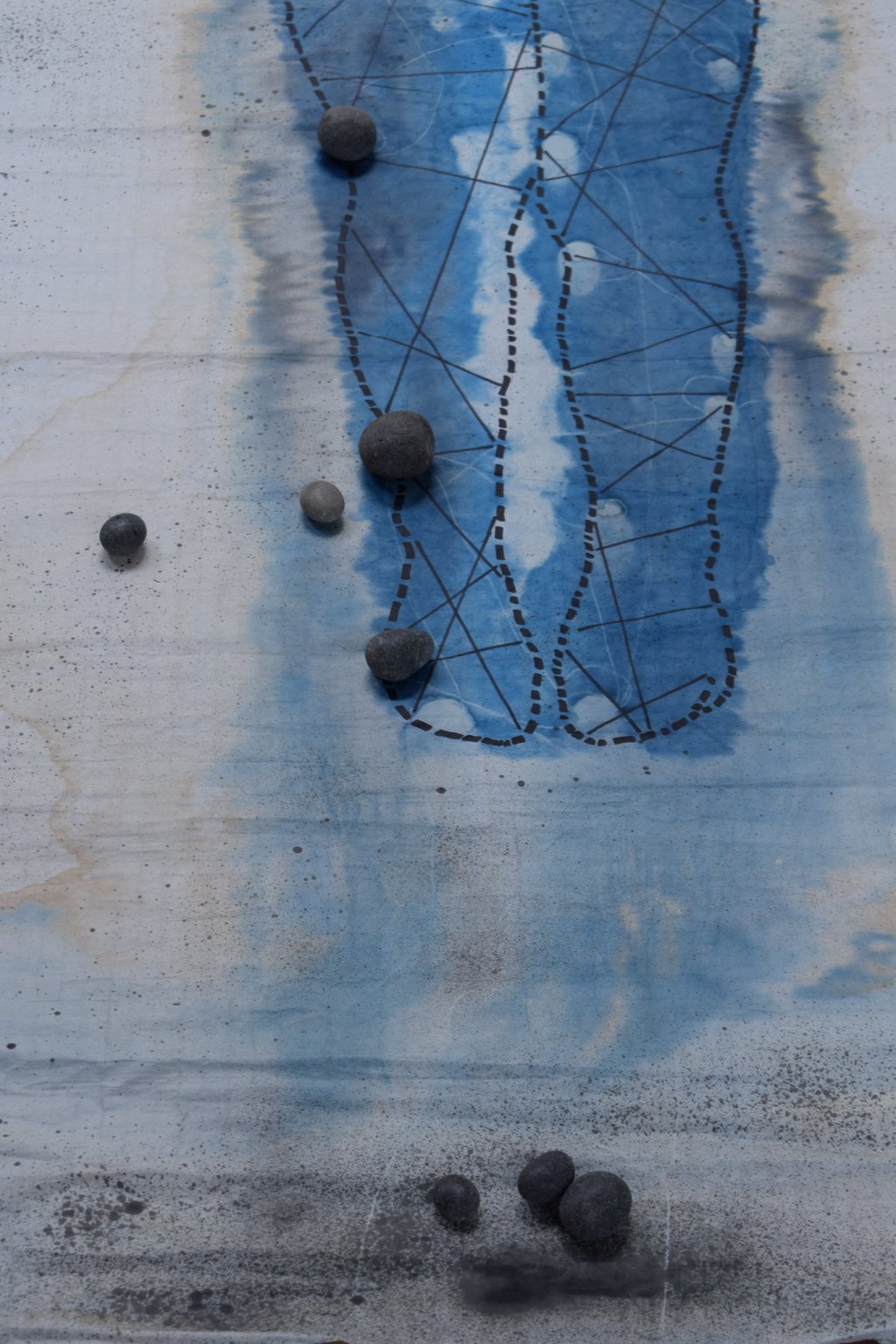
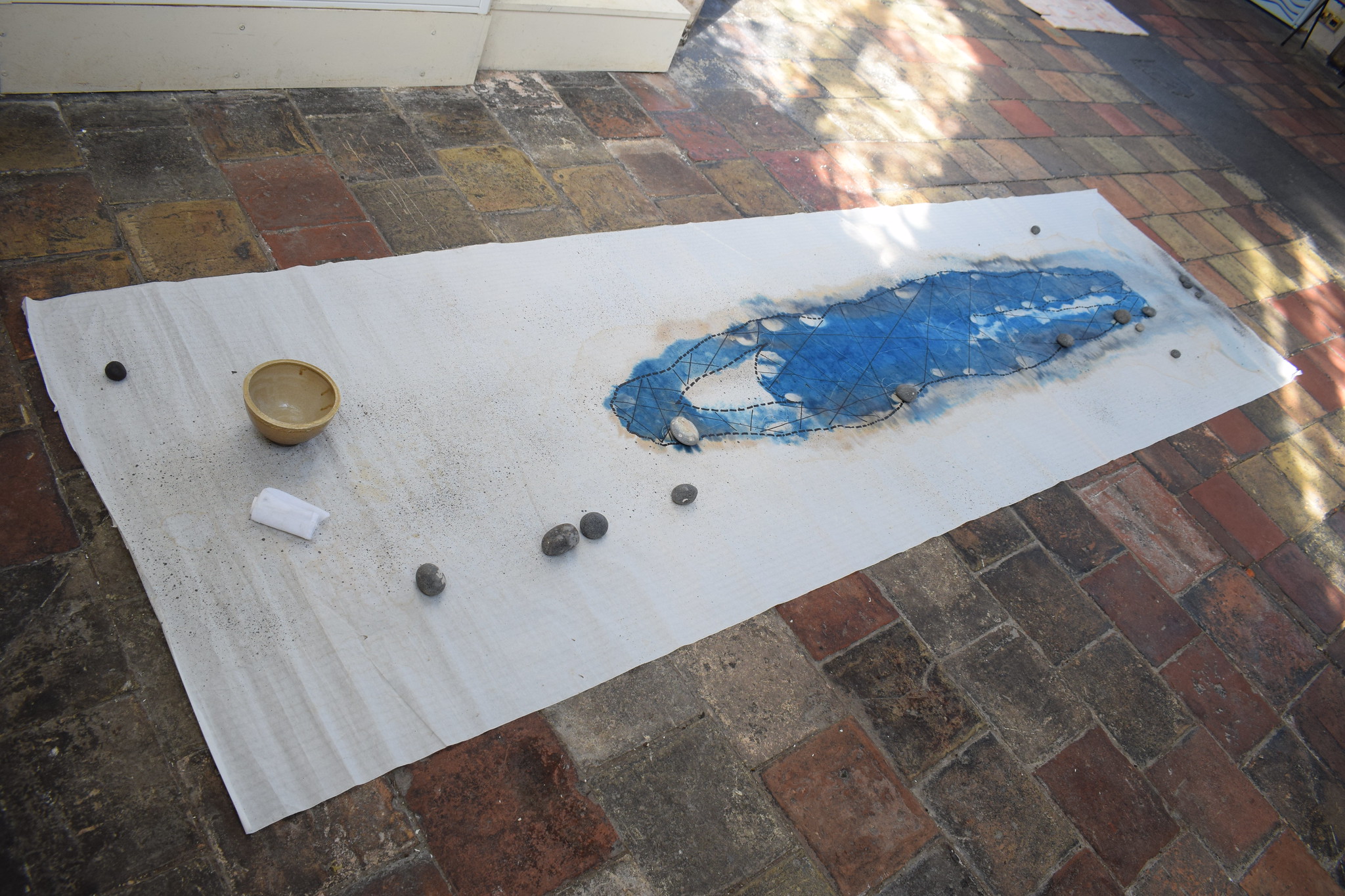
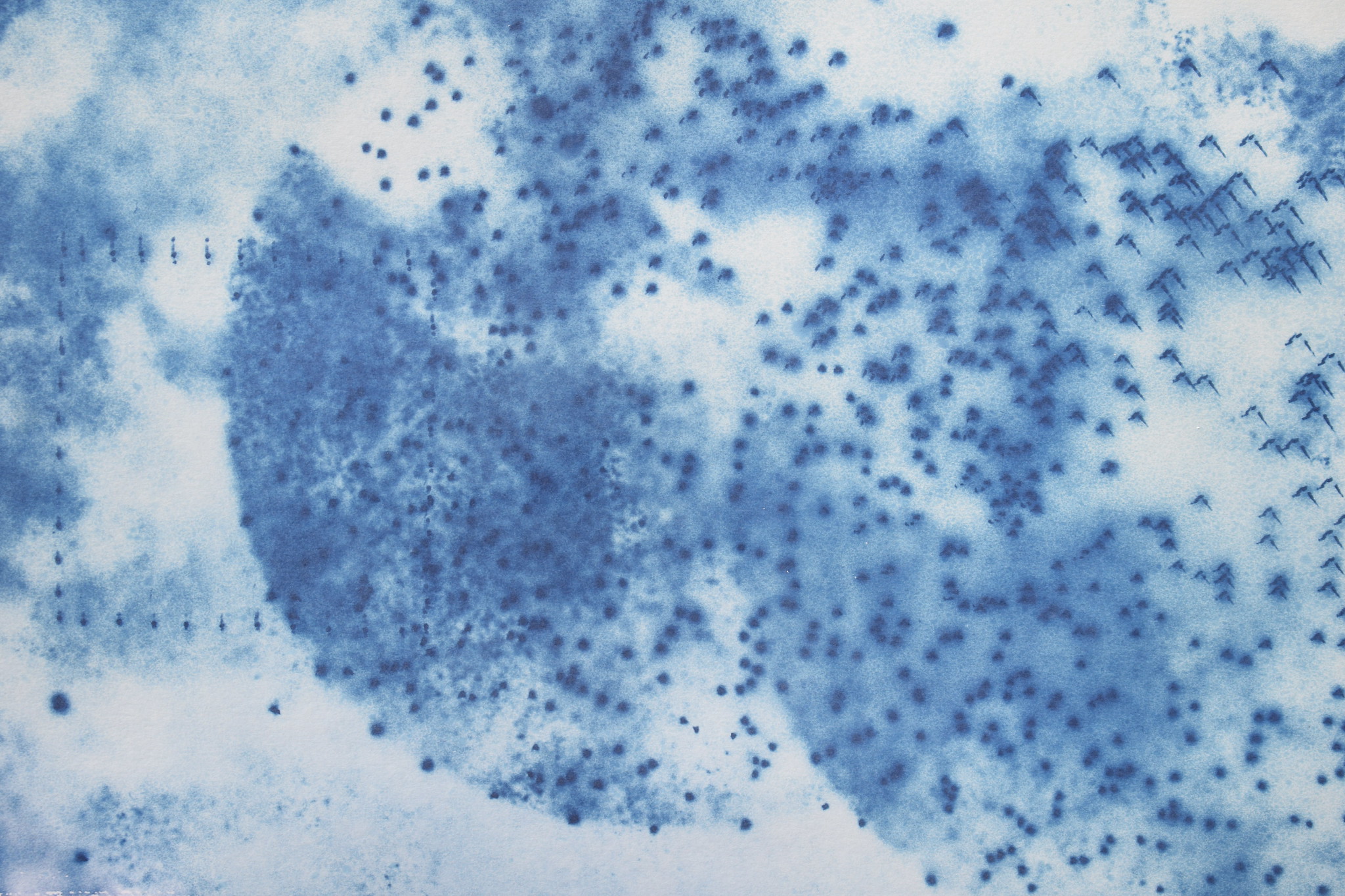
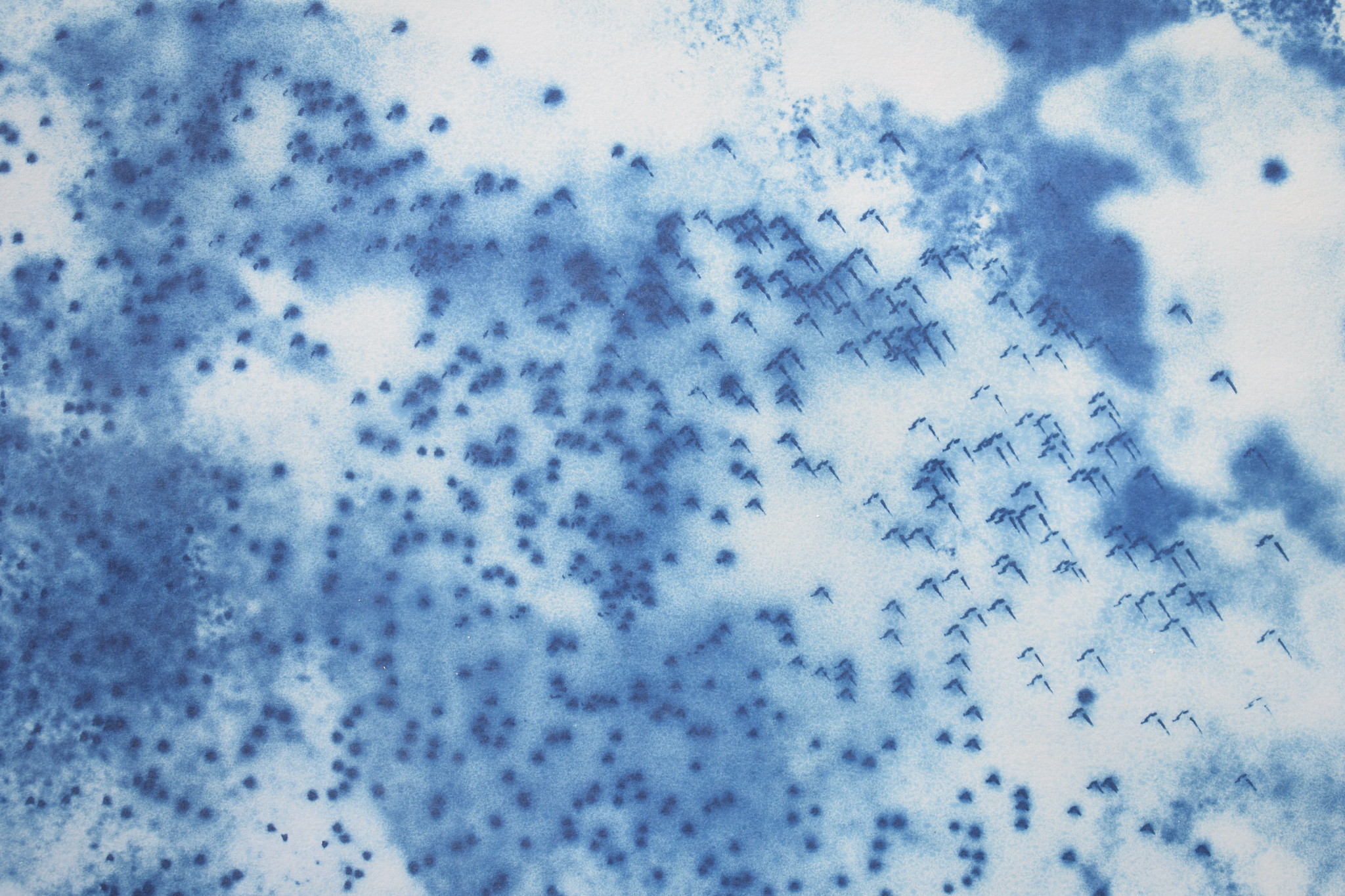
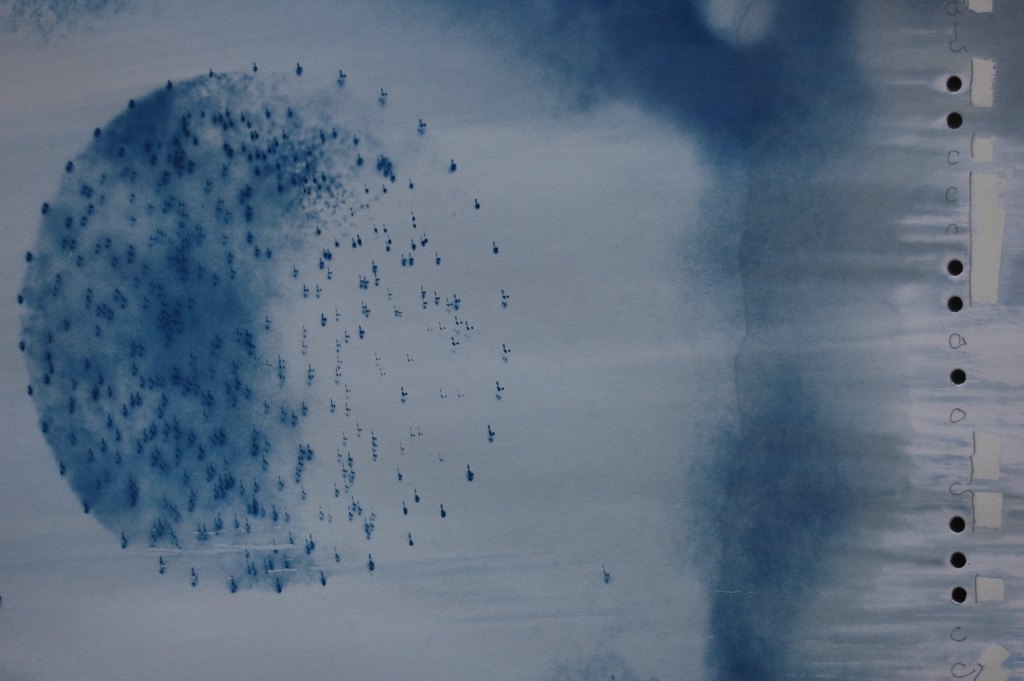
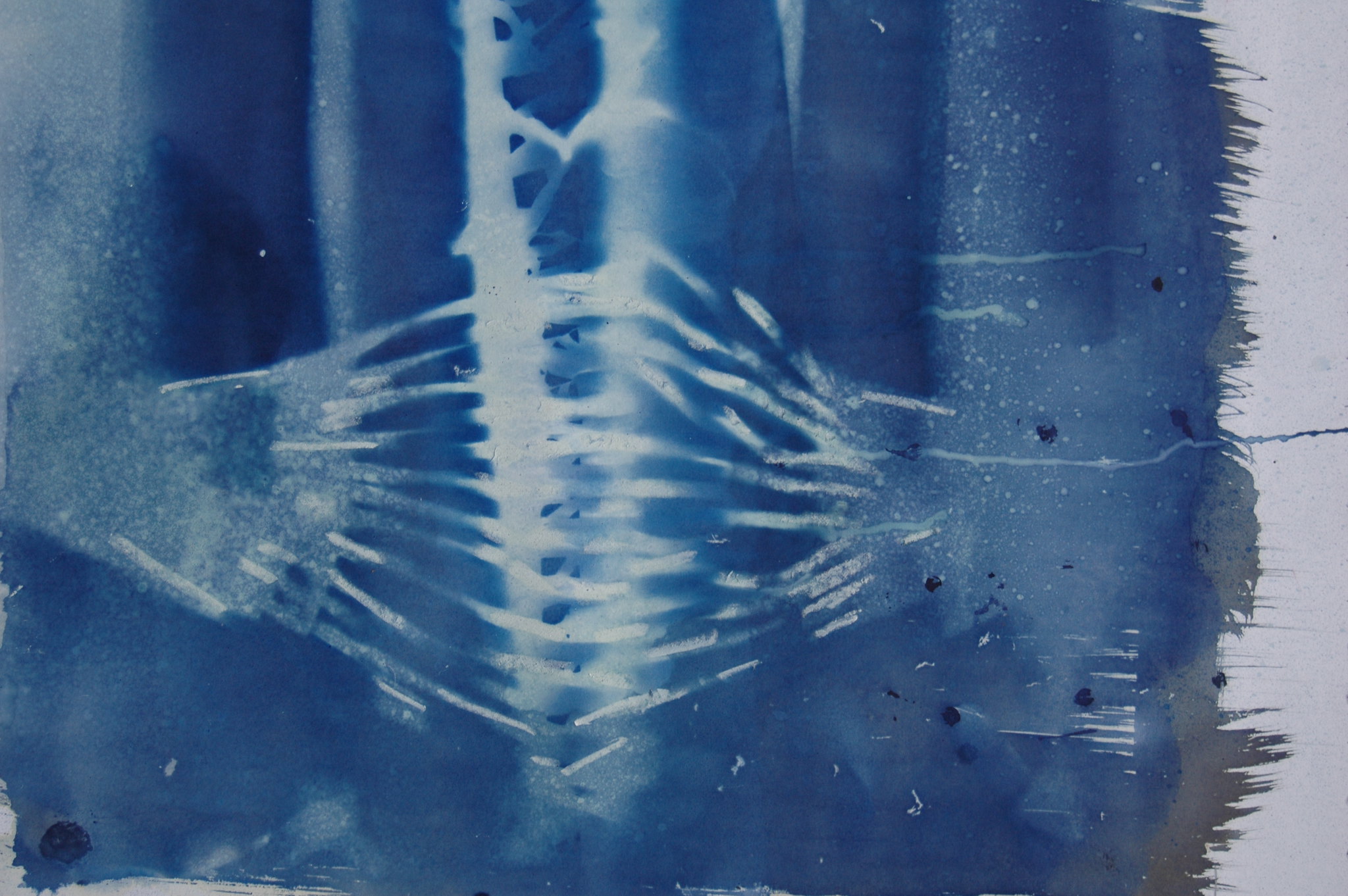
    Site Cyanotypes/Drawings/Intermediaries

    Spatial Collages Reconfigured.


    spatial practice, alternative photography, fine art, ceramics,making,Russell Moreton,

    Source: Seeing Dark Things : Chemical Photography/Images from the darkroom.

  • Exploring the Connection Between Ceramics and Space

    The Trace and its Connector/Ceramics, drawing and walking/wayfaring with things.

     Outpost 040523

    Anecdote of the Jar
     I placed a jar in Tennessee,
     And round it was, upon a hill.
     It made the slovenly wilderness
     Surround that hill.
     The wilderness rose up to it,
     And sprawled around, no longer wild.
     The jar was round upon the ground
     And tall and of a port in air.
     It took dominion everywhere.
     The jar was gray and bare.
     It did not give of bird or bush,
     Like nothing else in Tennessee.
    Wallace Stevens

    Making Visible.

    Walking The Drawing.

    The co-existence of overlaying fragments of construction, by selective excavation and creative demolition.

    Castelvecchio an attitude to history. Carlo Scarpa.

    There is no stage at which humankind does not demarcate, beacon or sign their space, leaving traces that are both symbolic and practical.

    The Production of Space.

    Lefebrve.

    Kairos : The movement and its moment

    Being Alive.

    Up, Across and Along.

    The trace and the connector.

    Tim Ingold.

    Jannis Kounellis.

    Lefebvre acknowledges that geographical space created through the body, through routes which were inscribed by means of simple linear markings. These first markings, paths and tracks drawn into the landscape would become the pores through which without colliding would produce the establishment of places and localities made special for one reason or another.

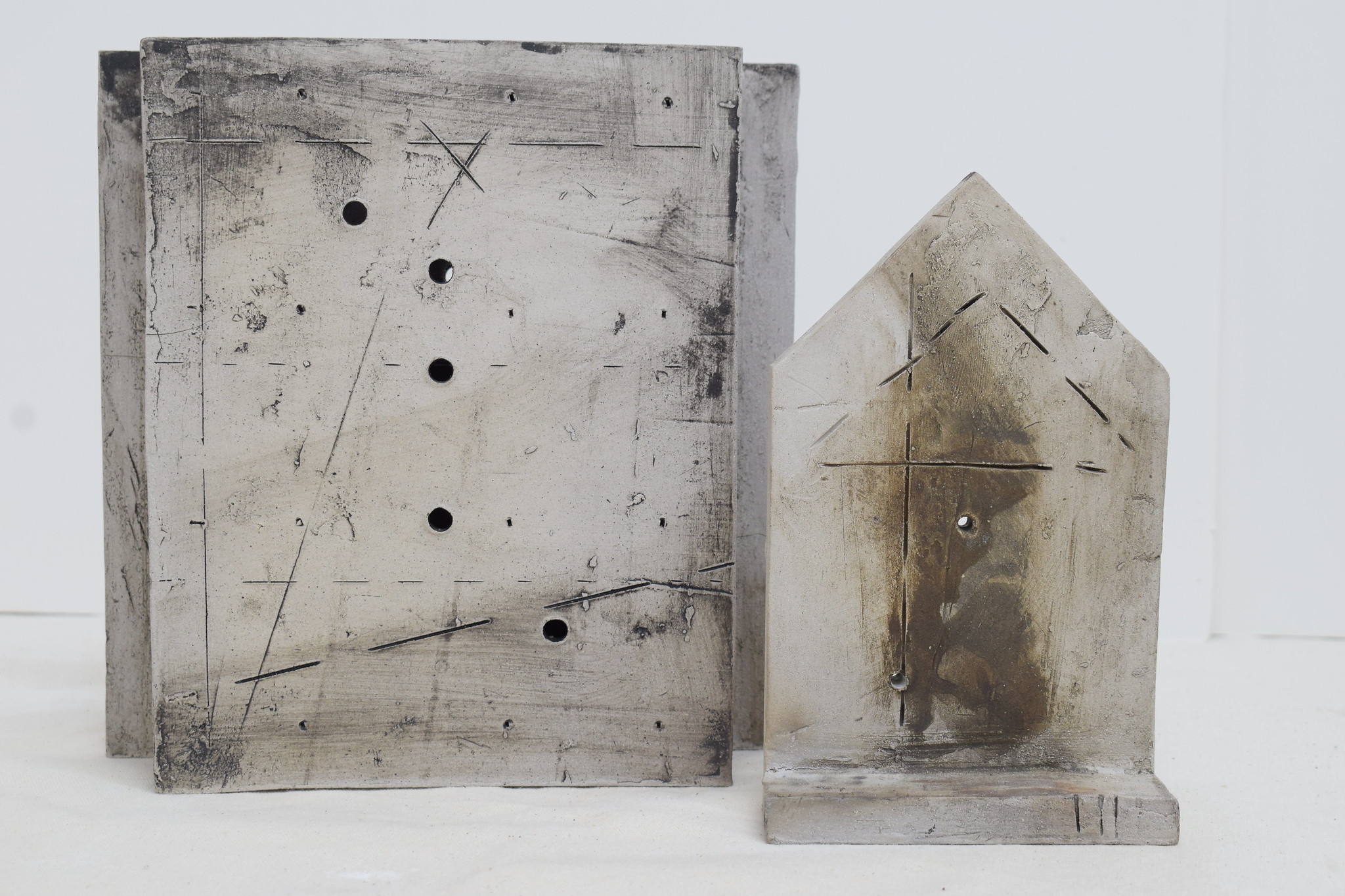
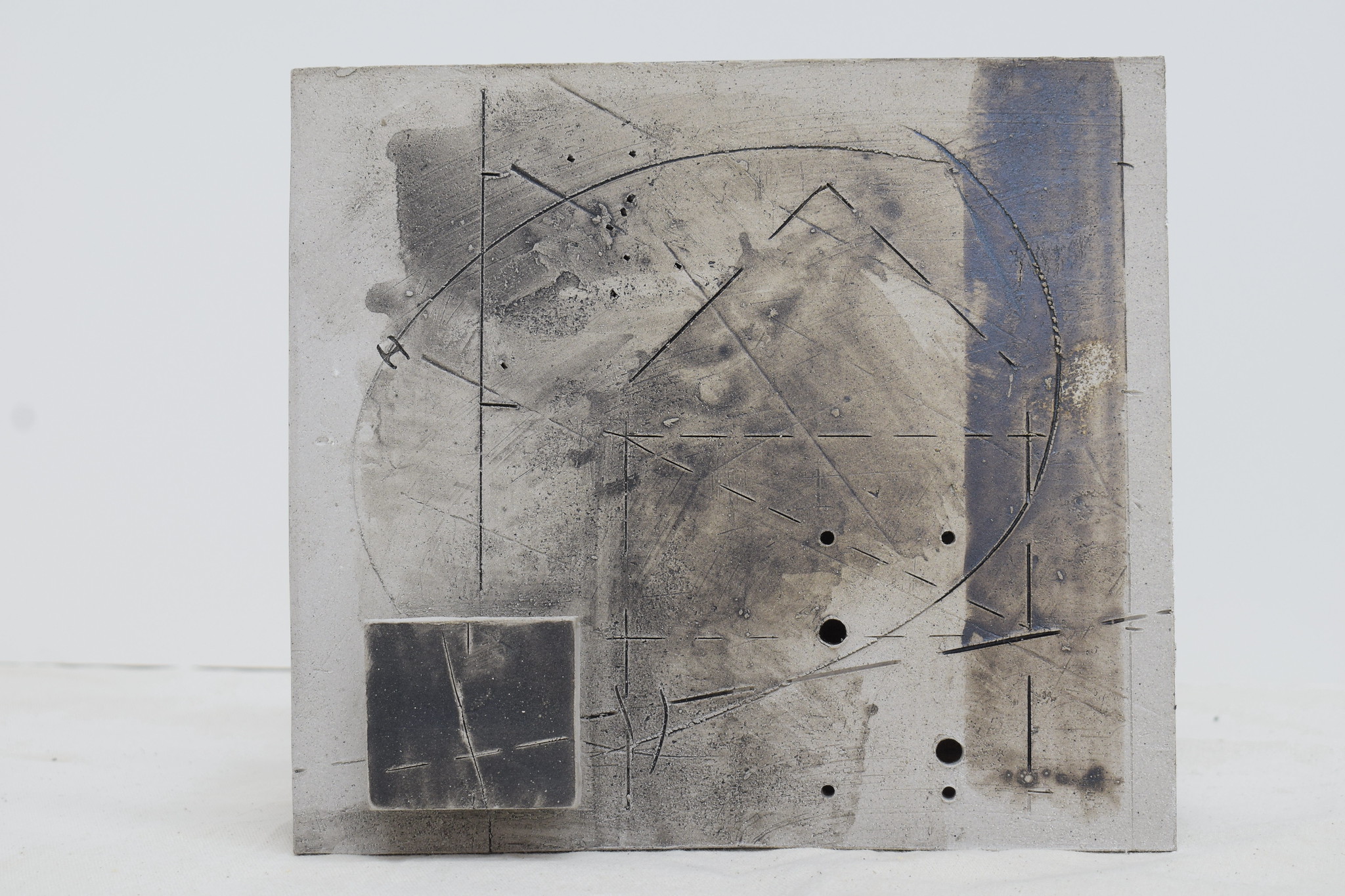
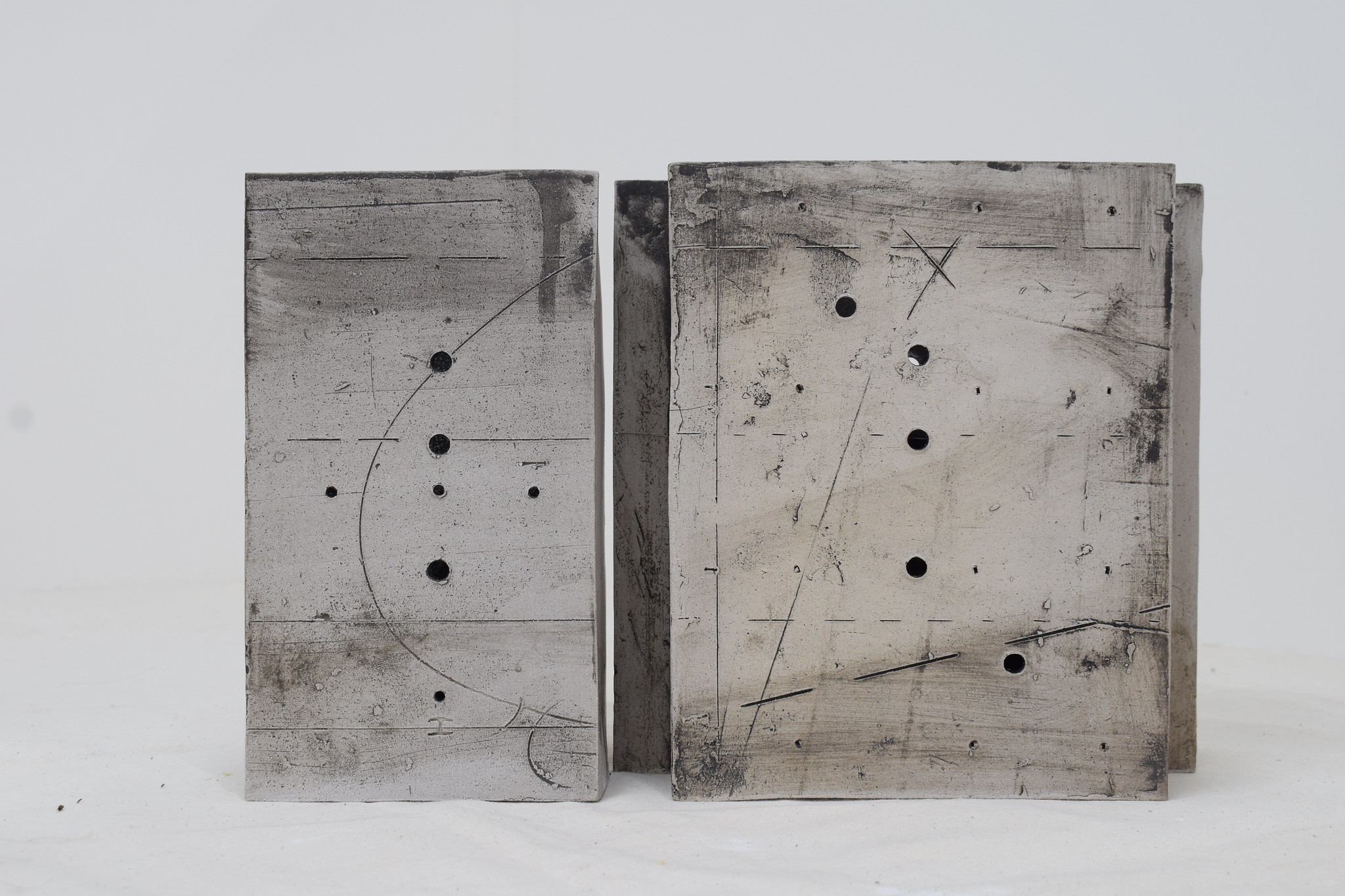
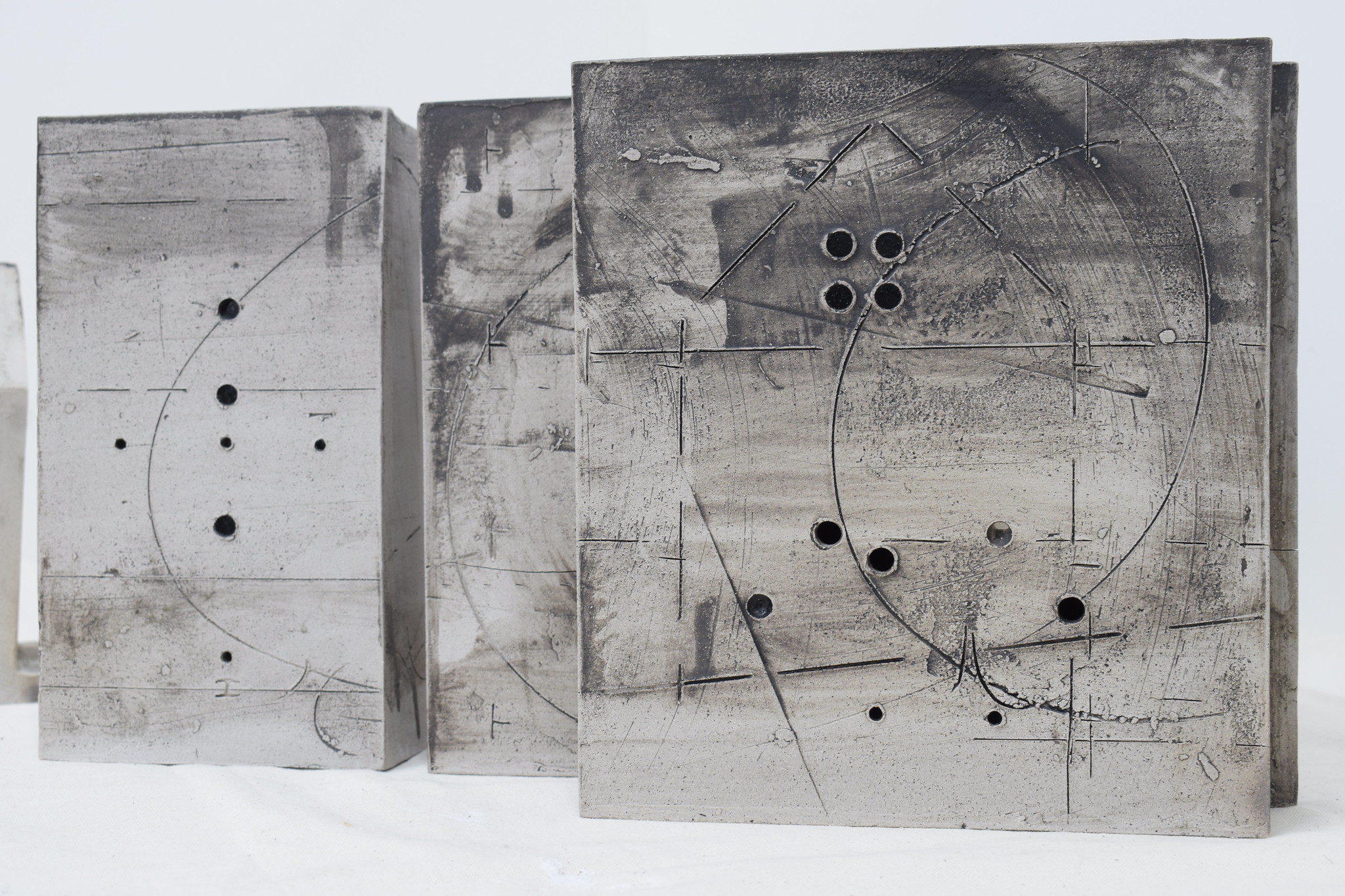
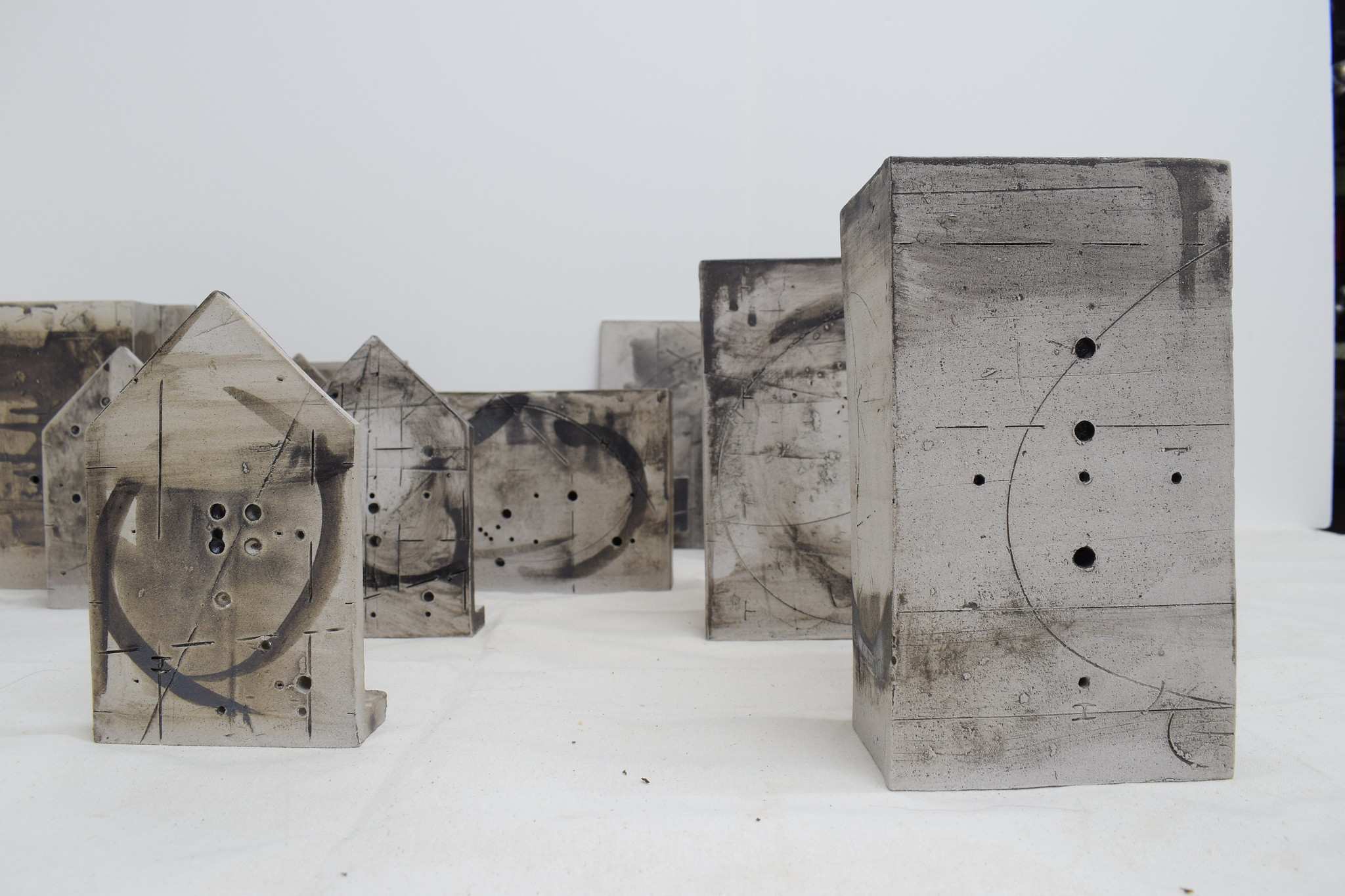
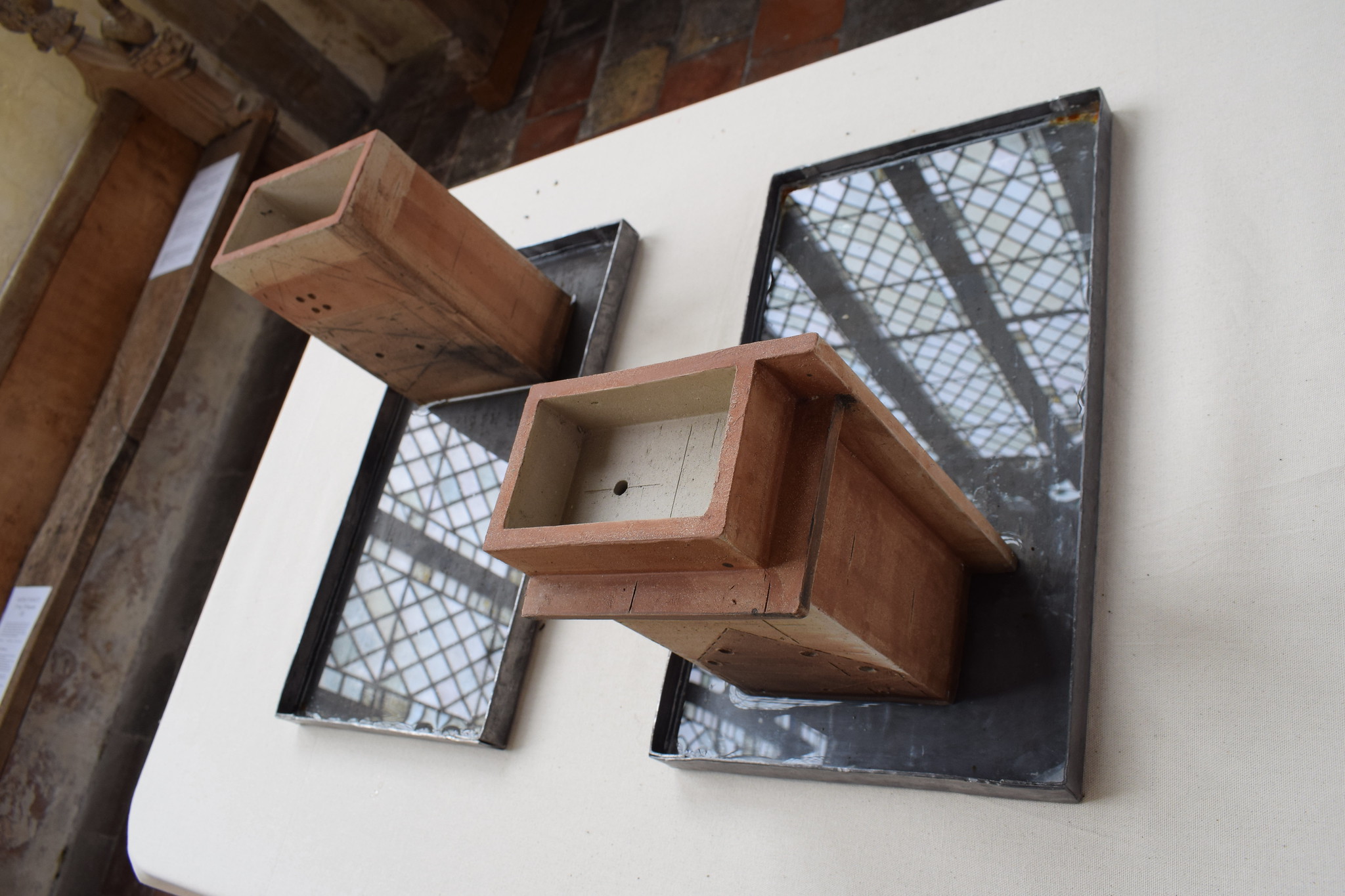
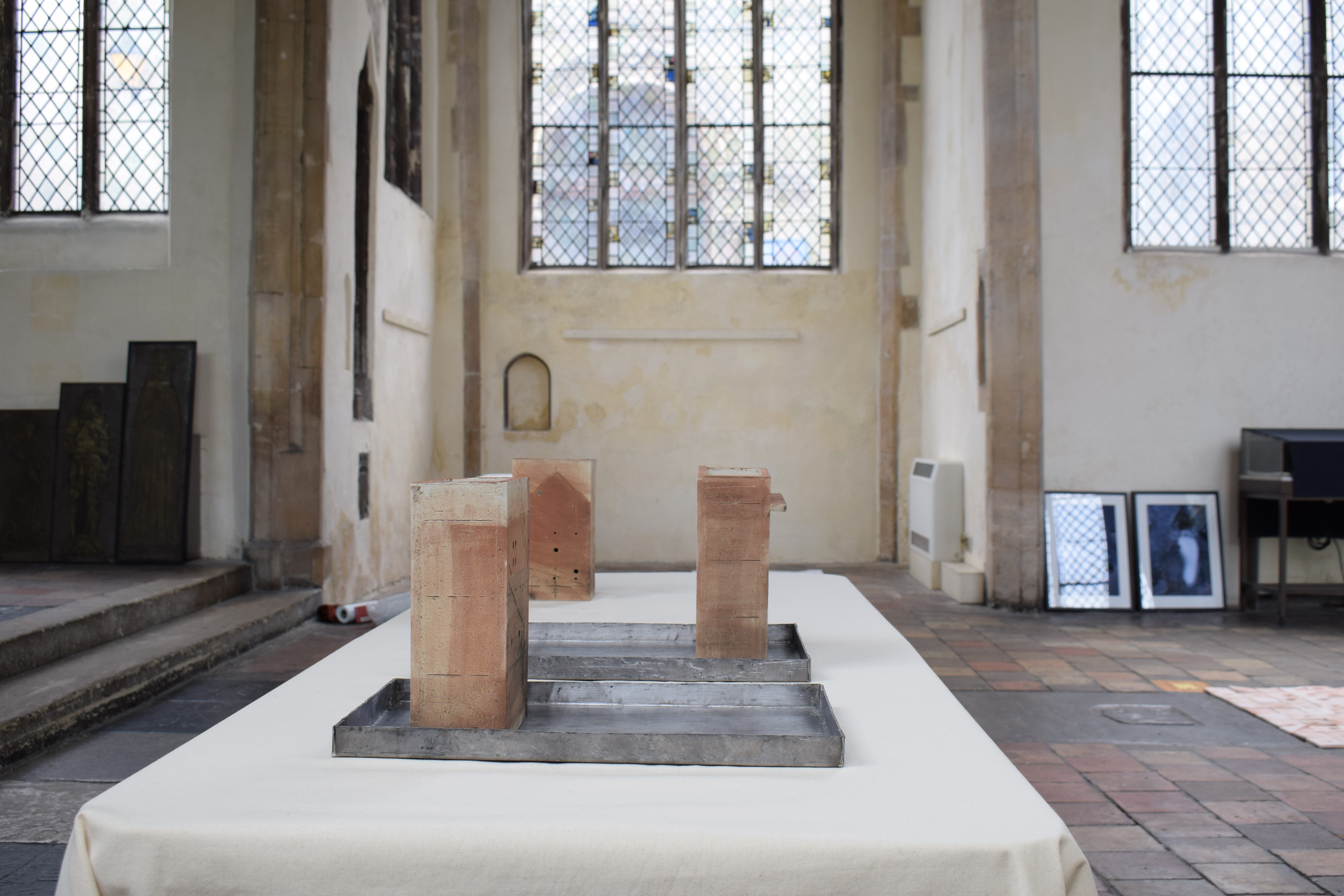
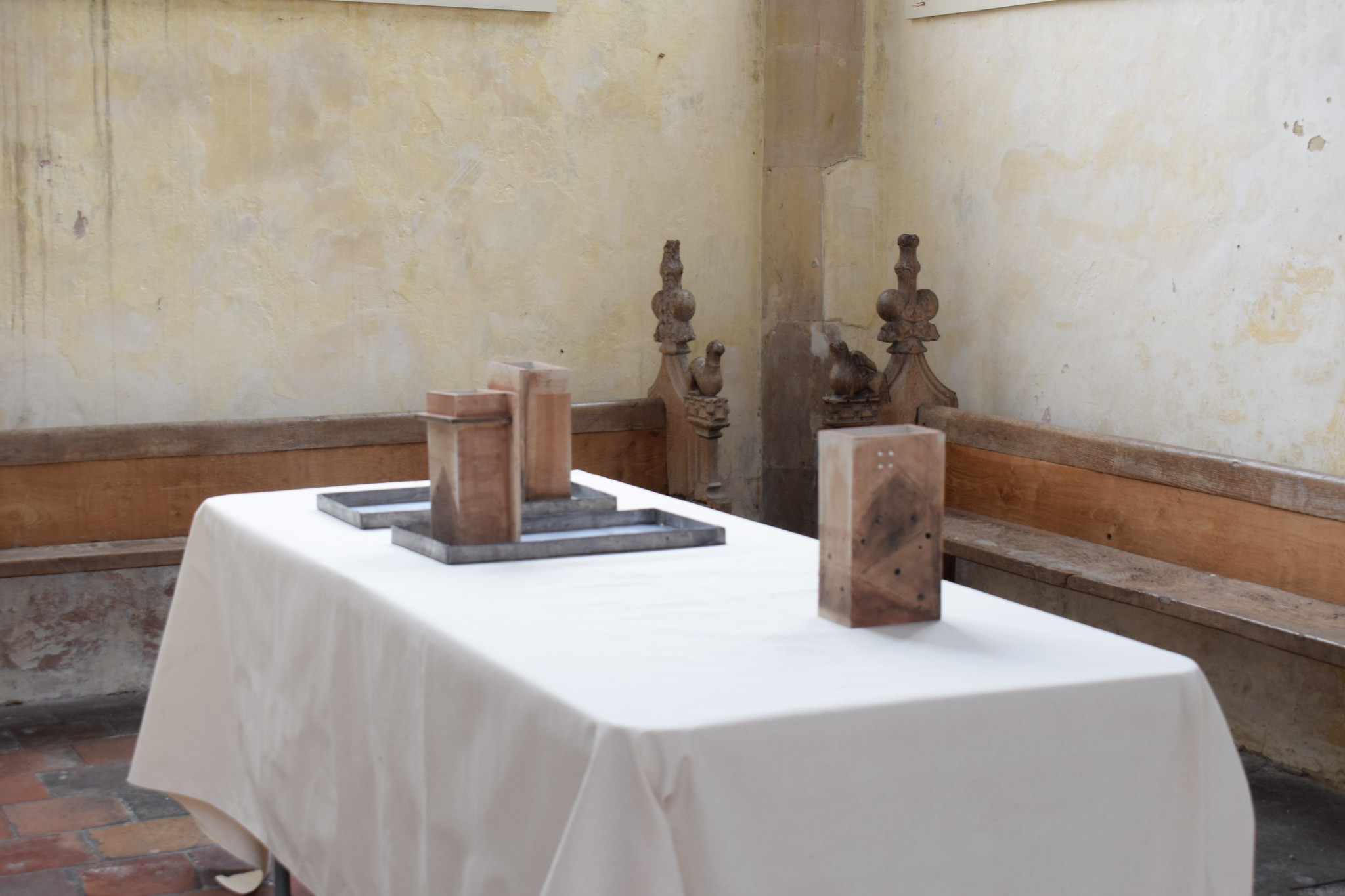
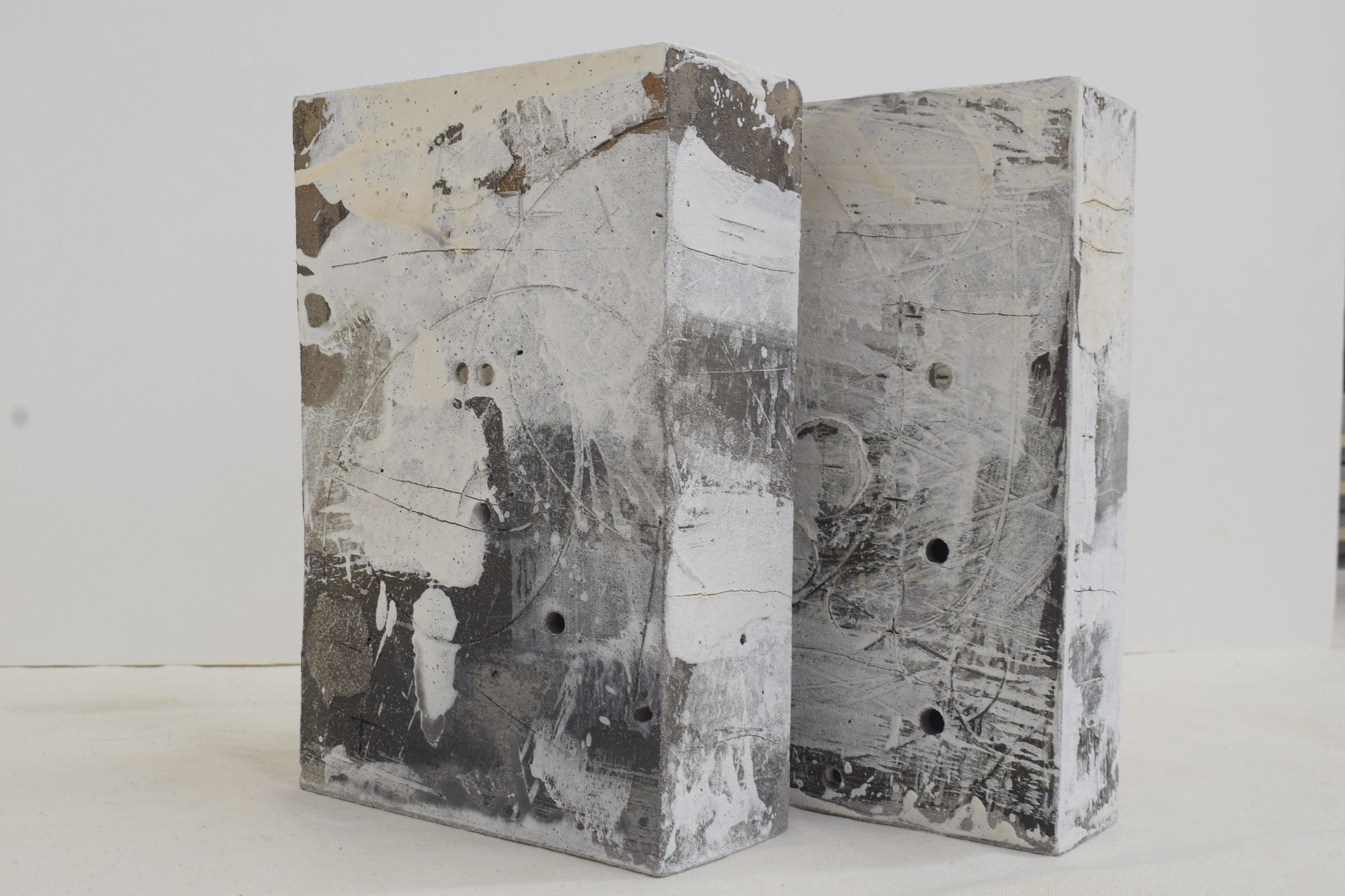
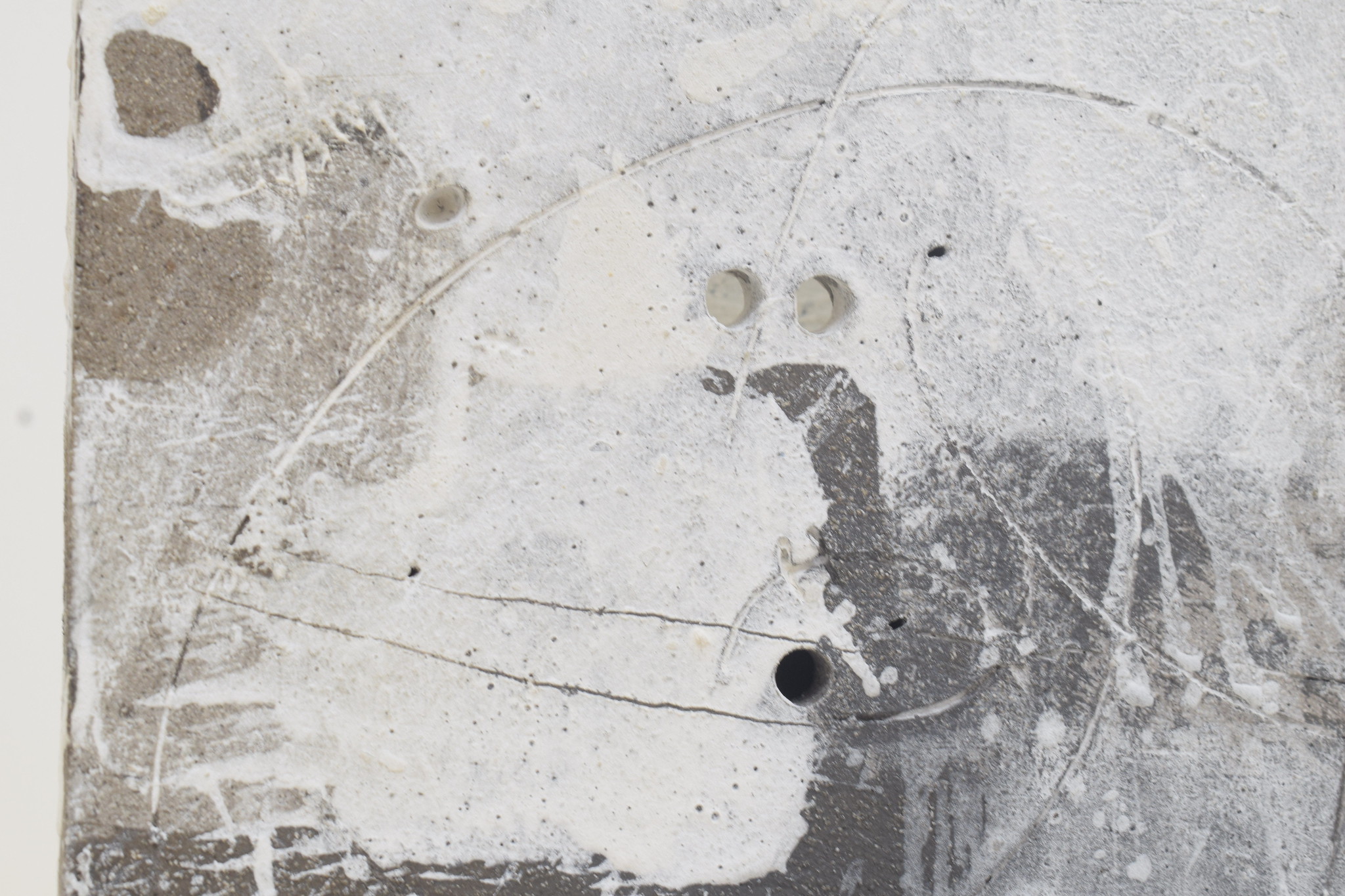
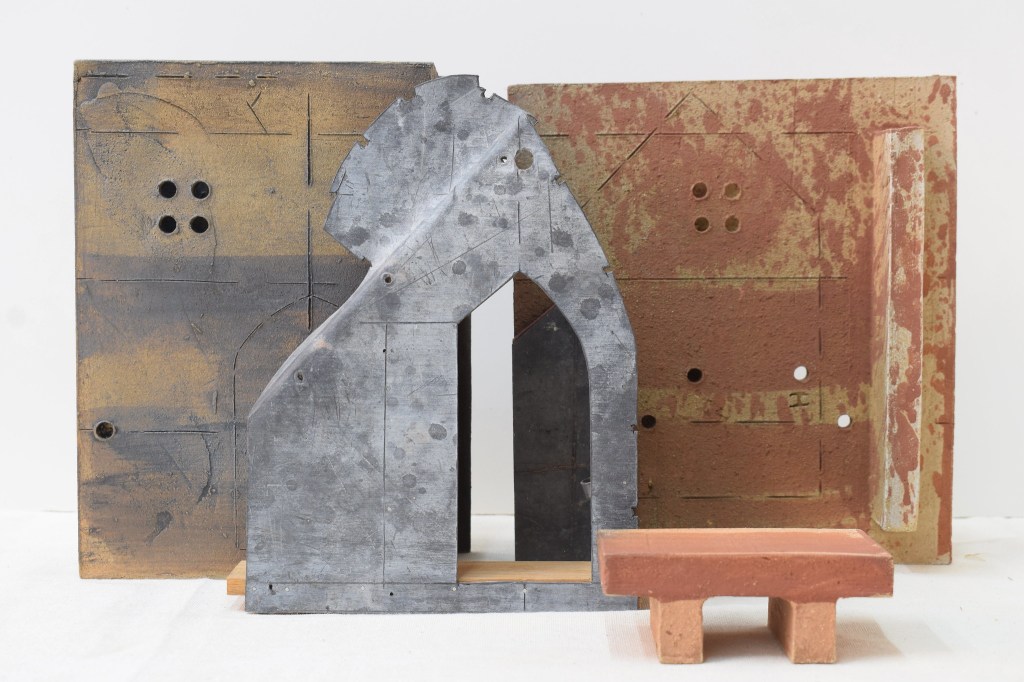
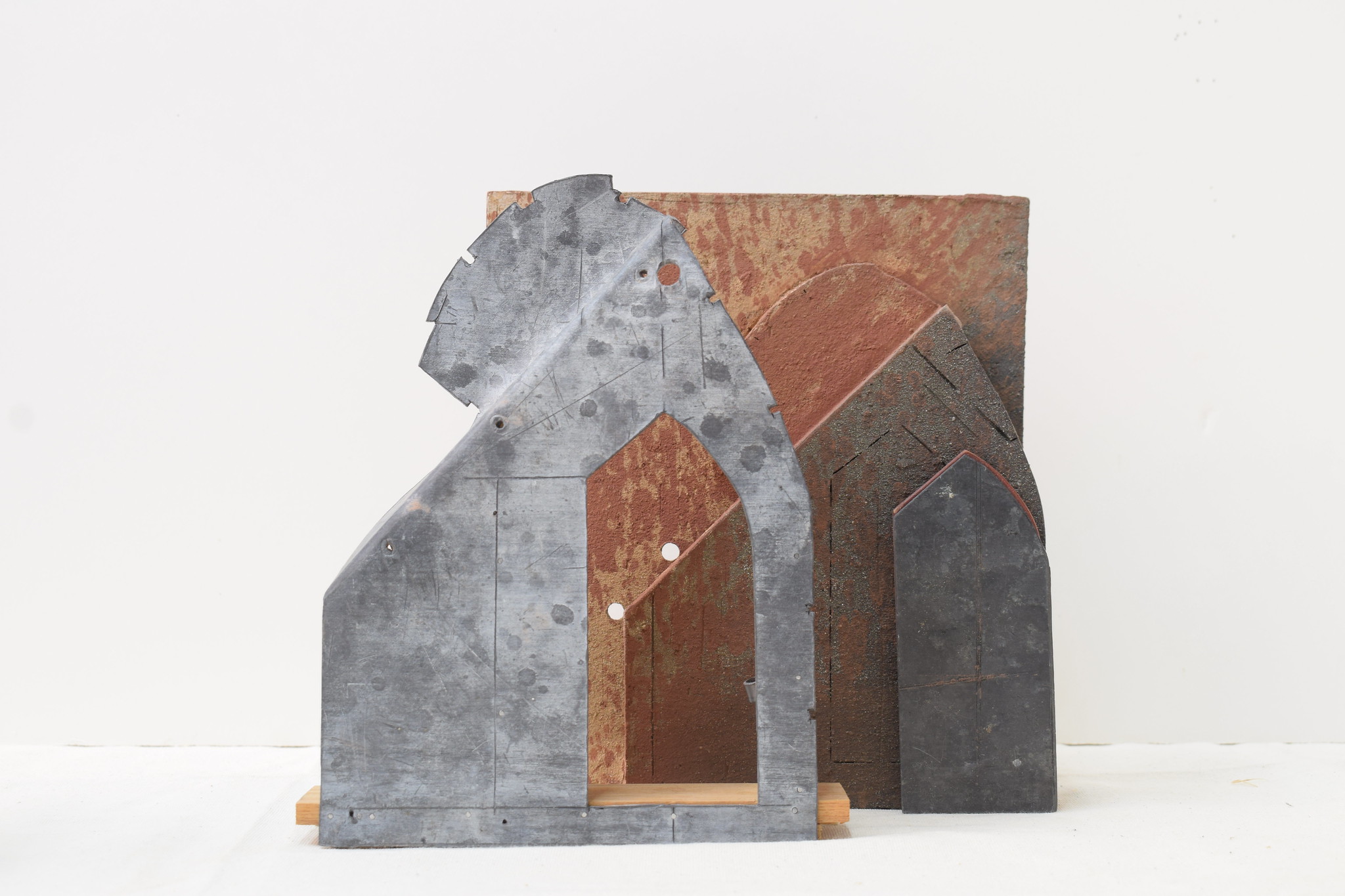
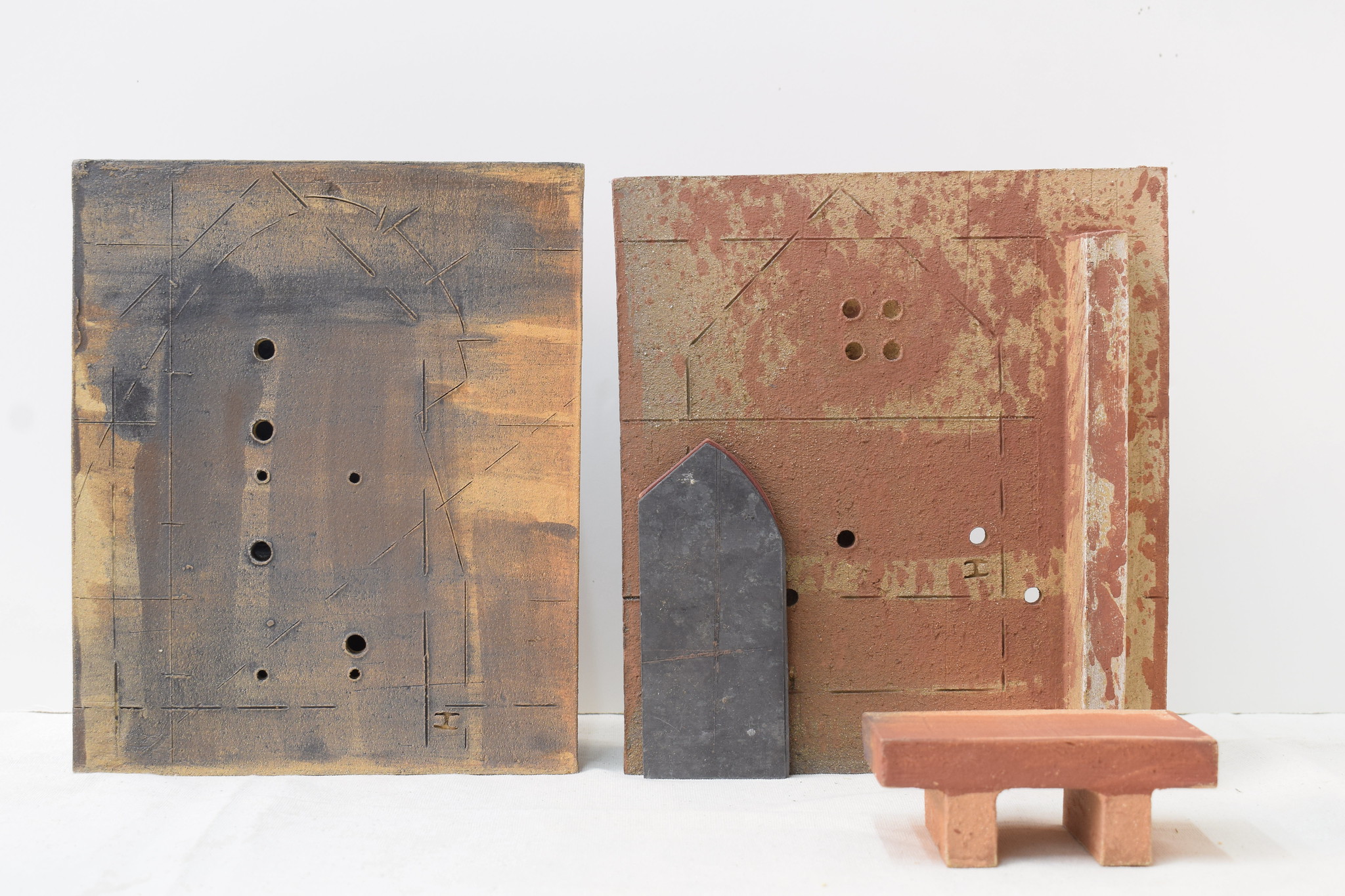
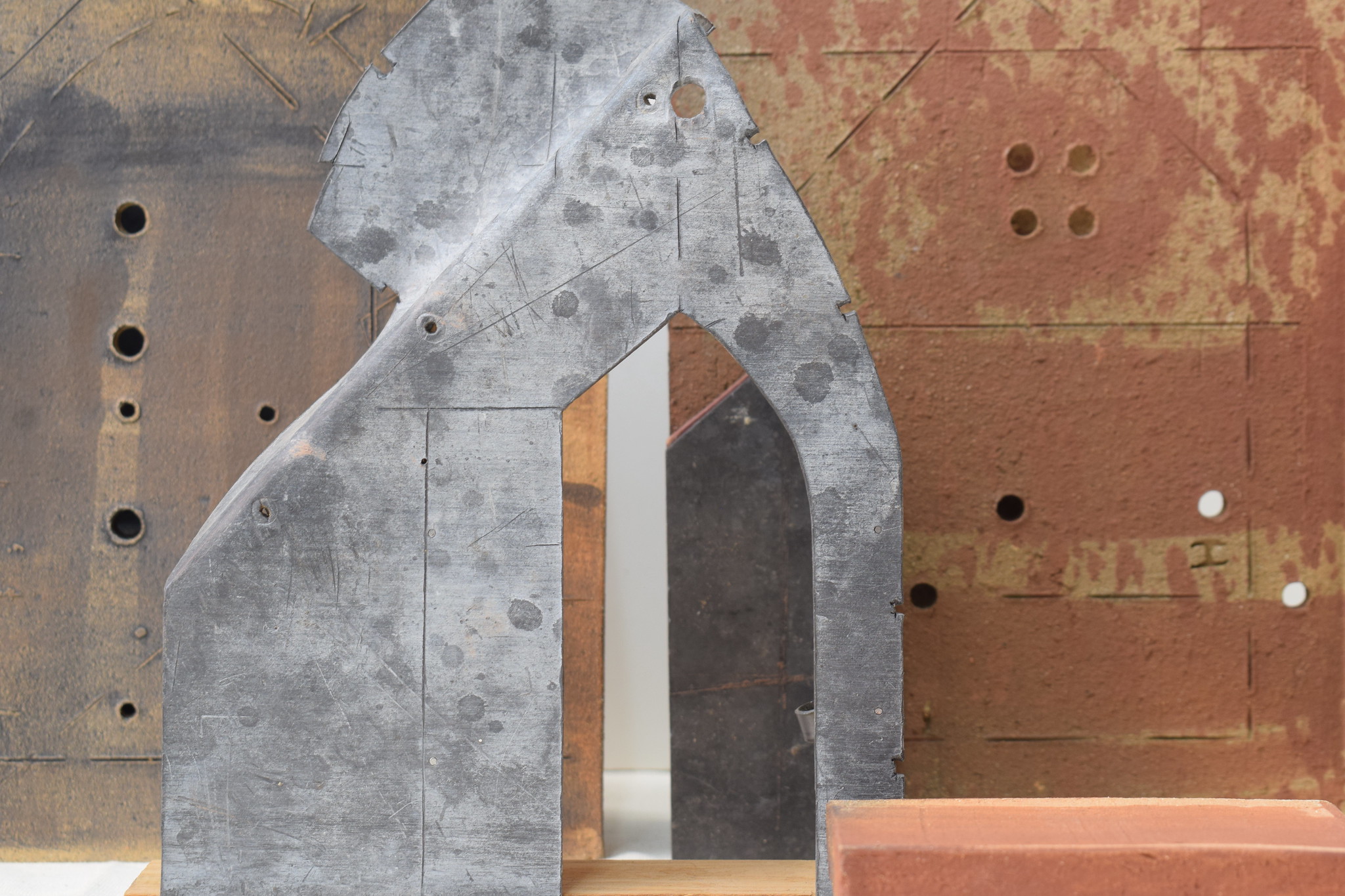
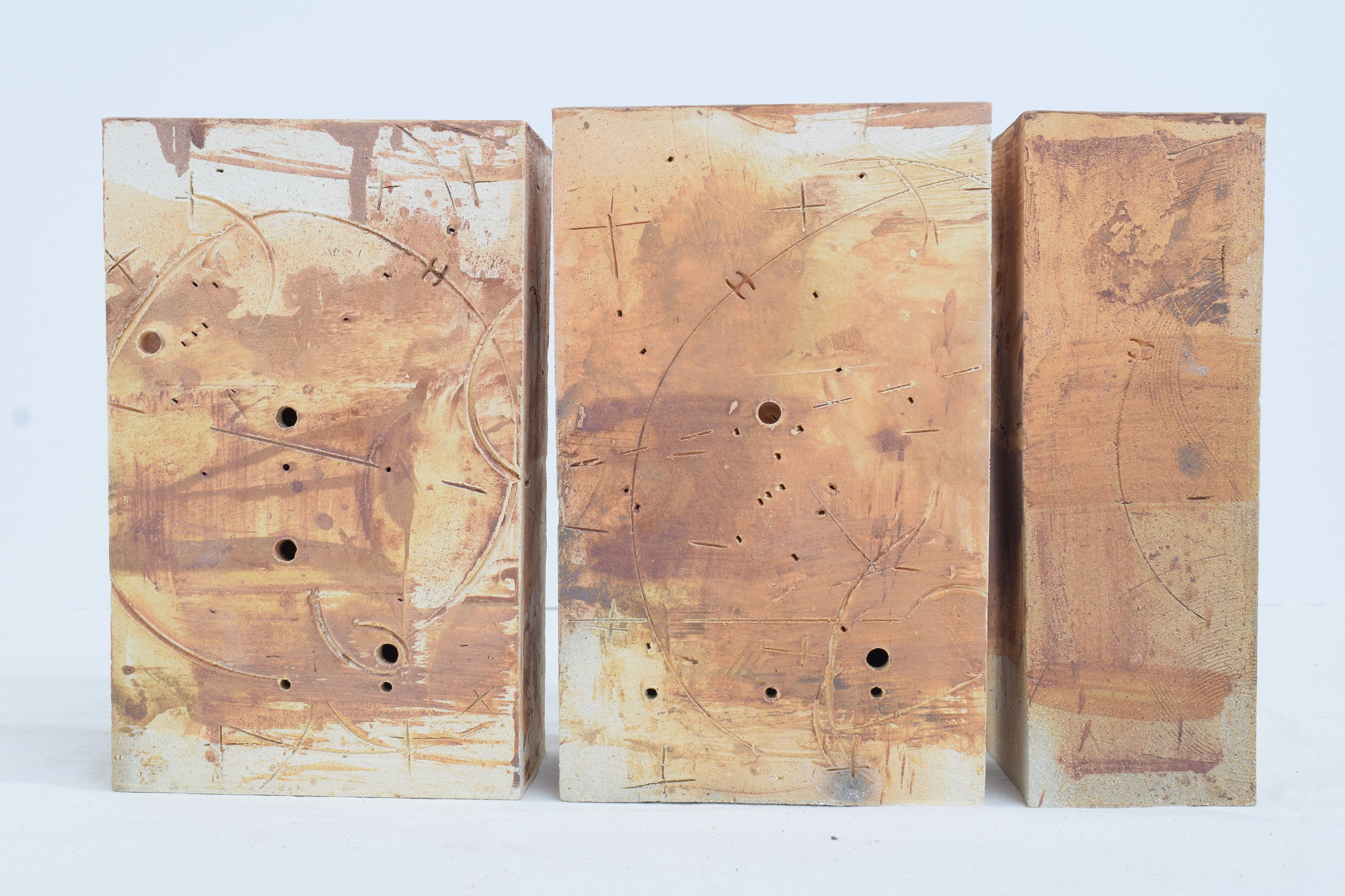
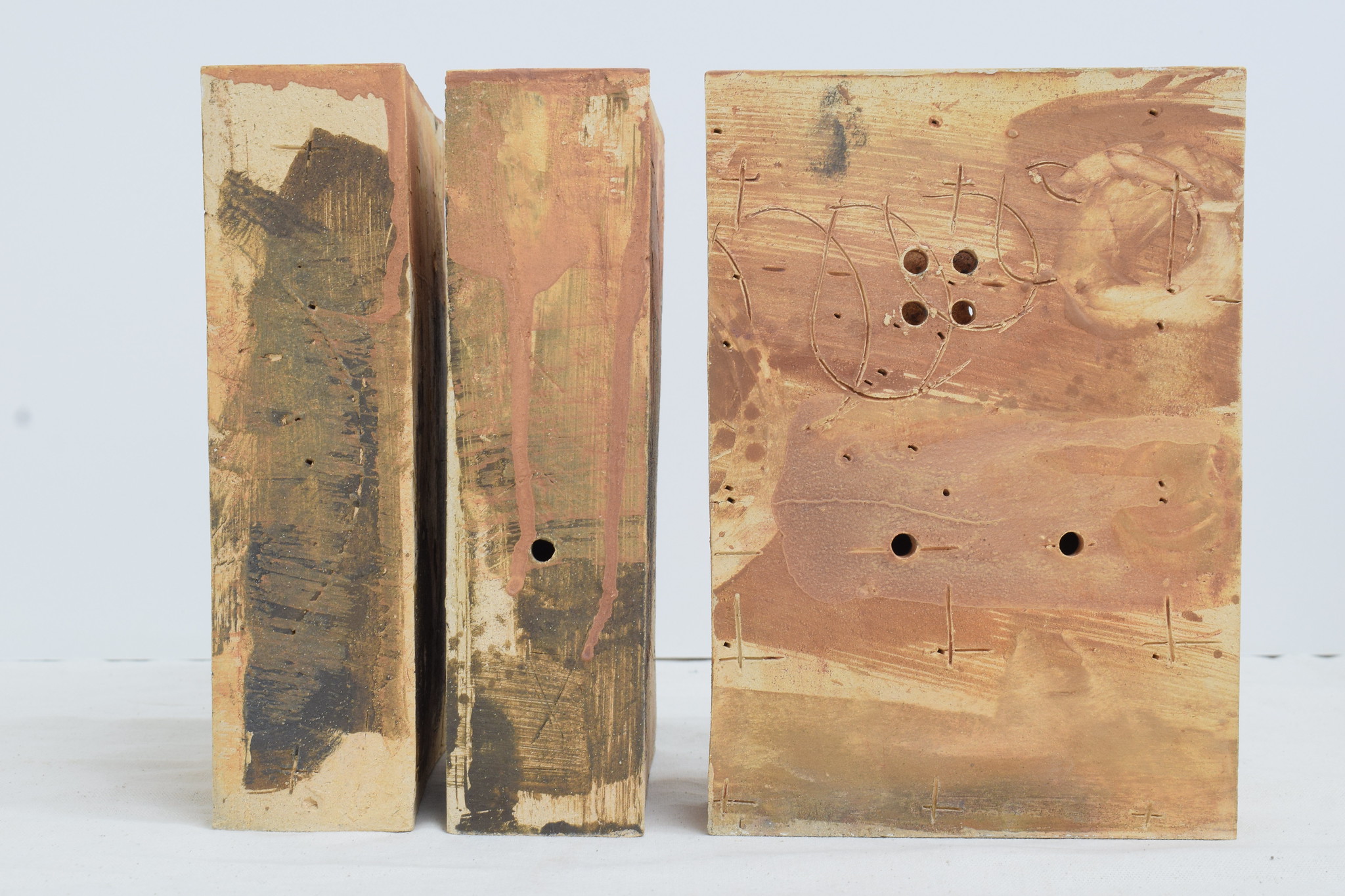
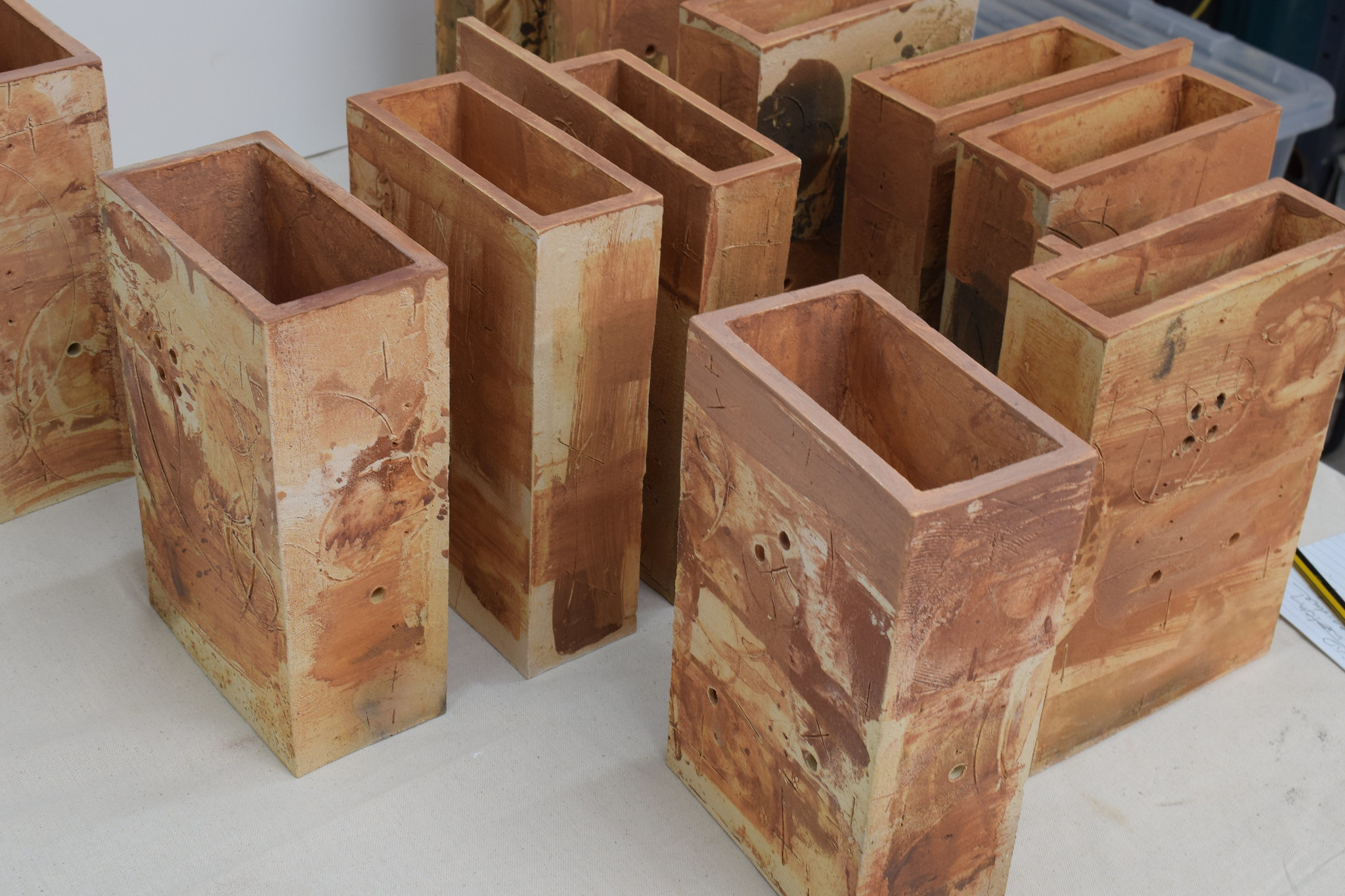
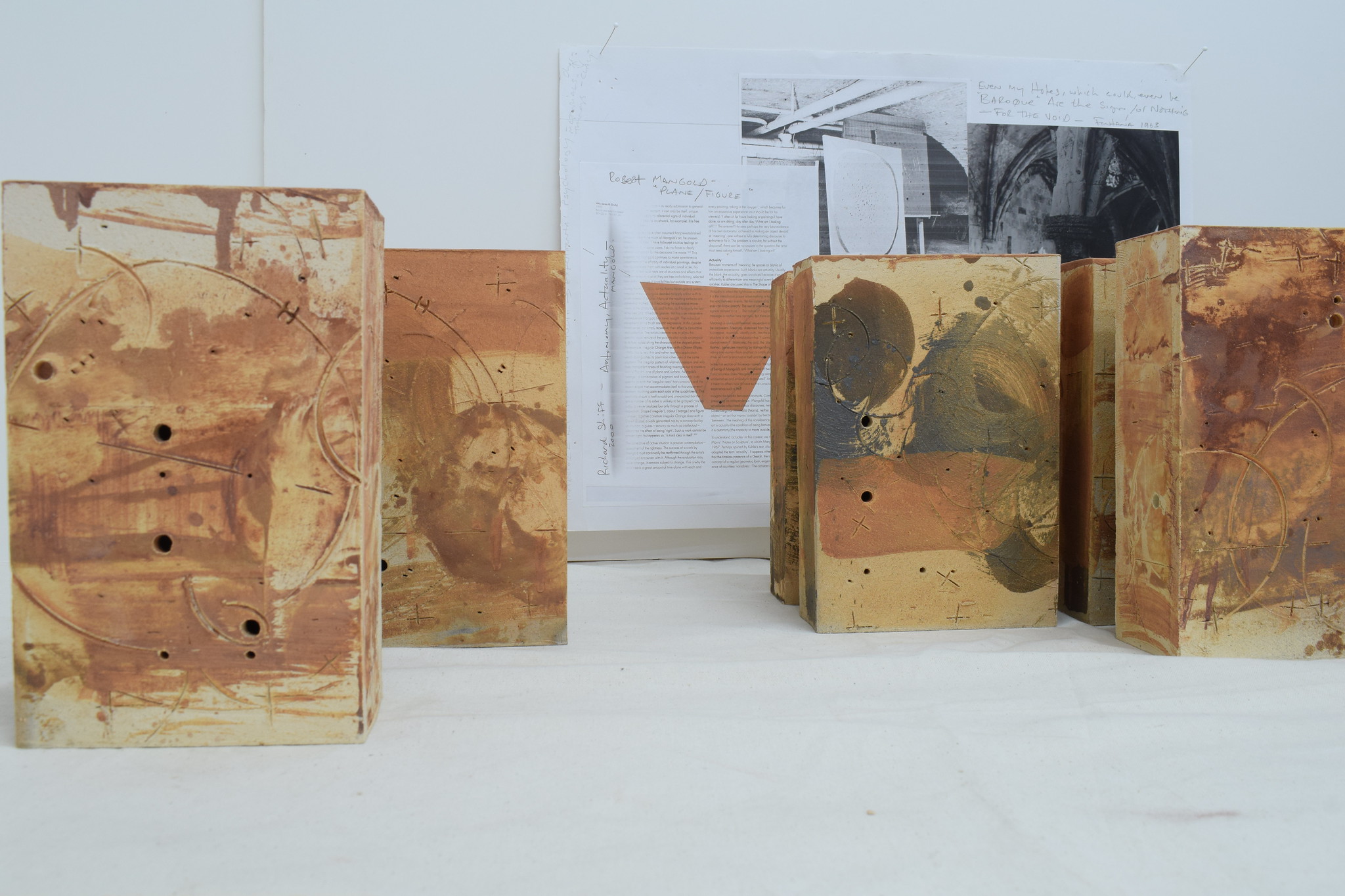
    Hand Built, Slab Ceramics.

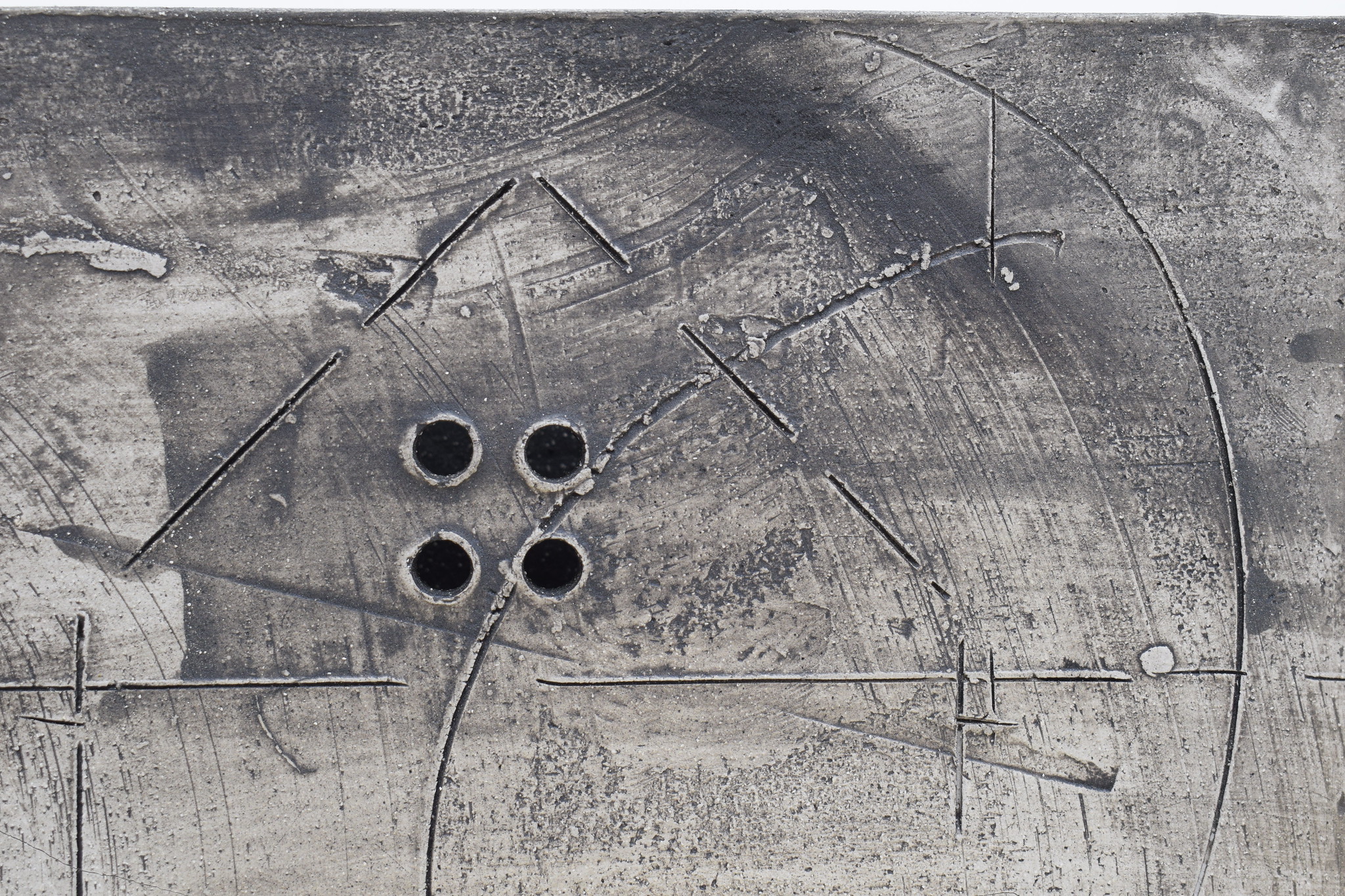
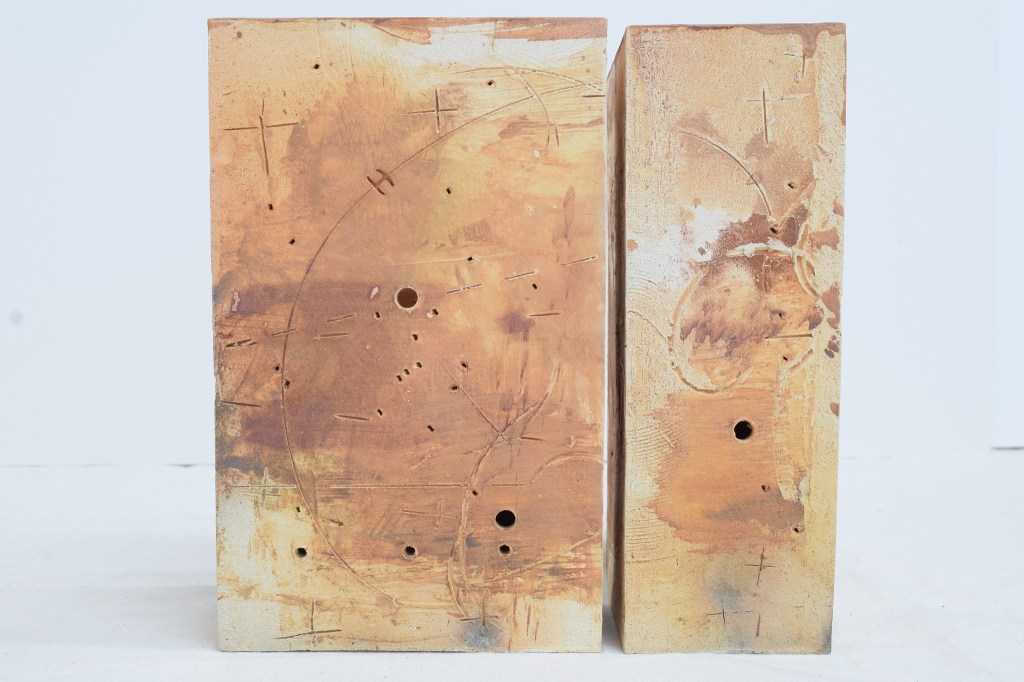
    Oxide washes, incised lines and piercings undertaken to the raw clay forms.

    Architectural Facades/Camera Obscura.

    Darkroom’s Erasure.

    One day , we will understand that darkrooms were one of the last pools of darkness, where a pure form of thought was made visible. In the darkness at its heart, photography enabled us to see ourselves and the world more clearly, it was a place of truth and visions.

    Dark Room, Garry Fabian Miller.

    “The Pot, ancient as it is, is the first instance of pure innerness, of something made from the inside out.”

    Adam Gopnik 2014

    Richard Batterham

    In 1981 he provided a rare statement: “The main work is not to make pots, but to allow them to come, to allow them to grow, to allow them to be alive, and to communicate warmth and life in that uncannily direct and undemanding way that true and naked work can, vulnerable as it is. To make this possible, I feel that it is necessary to use our skills and materials with humility and respect. This requires a certain quietness of living.”

    A Vessel Defines Emptiness As Presence : Craft, Studio Practice /Theory and Analysis on Hans Coper, Edmund De Waal, Martin Heidegger

    STUDIO PRACTICE, THEORY AND ANALYSIS.

    MA SCHOOL OF CRAFTS AND DESIGN.

    Working Notes : Brockwood Granary 2014

    Theory and Analysis Documents, UCA Farnham

    “A predynastic Egyptian pot, roughly egg-shaped, the size of my hand : made thousands of years ago it has survived in more than one sense. A humble, passive, somewhat absurd object, yet potent, mysterious, sensuous. It conveys no comment, no self-expression, but seems to contain and reflect its maker and the human world it inhabits, to contribute its minute quantum of energy.”

    Hans Coper, 1969

    Jean Vacher acknowledges Hans Coper’s links with Modernism and that his pots possess an “innerness” that might be profoundly biographical in nature stemming from “the profound displacements that occurred to him and his family as a result of the upheavals in Europe.” (Personal e-mail correspondence CSC 28 March 2014)


    spatial practice, alternative photography, fine art, ceramics,making,Russell Moreton,

    Source: The Trace and its Connector/Ceramics, drawing and walking/wayfaring with things.

  • Ceramics and Architecture : Making Things, Perception/Thought/Action


    Anthropocene Aesthetics : Ceramics and Environmental Engagement

    Urbanism : Fossil Futures~Anthropocene

    Ceramics Following Resonances : Interiors in fired clay.

    Ruins · Jozef van Wissem · Zola Jesus

    When Shall This Bright Day Begin

    ℗ 2016 Jozef van Wissem and Zola Jesus

    Released on: 2016-02-05

    Mixer: Jozef van Wissem

    Producer: Jozef van Wissem

    Composer: Jozef van Wissem

    Music  Publisher: Wissem Music

    Lyricist: Zola Jesus

    Architecting and its ecologies/matters of concern.

    The body’s participation in explorations, engagements and its care in attending to the values of immediacy, vulnerability, fragility, improvisation, performance, movement, multiplicity and becoming.

    Apparatuses and their ecologies for learning.

    The choreographic object/agent.

    The role of the body is scored through a shifting agency and the power of techniques of things.

    Theorial objects of things which do theory without us imposing it, on them.

    Oren Lieberman. 2013.

    The Production of The Unexpected.

    The Joy of Speculative Play.

    Perception/Thought/Action

    A caring curiosity that wants to know and understand and explore relations.

    Projective Speculations.

    Ecologies/Locations.

    Questioning/Research.

    Processual learning occurs in movements, gestures, postures, expressions and exchanges with other bodies and things.

    Landscapes Of Actions.

    Modalities Of Intravention

    Constitutive Qualities Of Dance.

    Ephemerality

    Corporeality

    Precariousness

    Scoring

    Performativity

    If we start by moving, by thinking through moving, and by living through moving. We’ll arrive to that disturbing vision : that the predicament of dance is to be an art of erasure. Dance always vanishes in front of our eyes in order to create a new past. The dance exists ultimately as a mnemonic ghost of what had just lived there.

    Lepecki. 1996.

    Bodily interactions highlight the entanglement of material through a process/processual understanding and situated analysis.

    The Archive.

    Matters of Concern.

    Terms of Engagement.

    Interrogate with descriptors and new issues of practice.

    Bringing Things to Life.

    Starting conditions for responsible and curiosity driven engagements with the world.

    Place-Refreshed.

    New-Agencies

    The Interconnectedness of Places.

    For Ingold, congealed places become relationships/connections for lines of occupation.

    Curriculum making/experience as the enactment of dwelling in places.

    Landscape Constructions/Observatory/Garden.

    Raveningham, drawing,mapping, landmarking paths, wayfinding, territories.

    Ceramics and  Architecture

    Marking The Line.

    In response to Sir John Soane.

    Joanna Bird. 2013

    Arranging the physical space/circulation to receive forms/intraventions.

    Christie Brown, her practice engages with mythology and narrative and the parellels between psychoanalysis and archaeology through figurative work, which references archaic collections and the significance of inanimate objects in human lives.

    Carina Ciscato, relocated to London in 1999, where she worked in the studio of Julian Stair and Edmund de Waal. The move, the contrast in culture and in attitudes to ceramics, has seen her work grow in confidence and move in exciting new architectural directions.

    Nicholas Rena, his art is concerned with reconciling the domestic and the sacred, through the medium of the vessel, a form that reveals in a single look an exterior, the figure- and an interior – the inner life. Rena’s strong , expressionist forms make explicit this duality, this communion and tension between our inner and outer life. His intensity and feeling for interior space imbues his work with immense presence and stillness.

    Clare Twomey is an advocate for craft as commensurable to the wider visual arts. Her practice can be understood as ‘post studio ceramics’ as her work engages with clay yet often at a critical distance. Twomey’s work negotiates the realms of performance, serial production, and transience, and often involves site-specific installations. She is especially concerned with the affective relations that bind people with things, and how objects can enable a dialogue with a viewer.

    Joanna Bird Pottery

    Director of the Joanna Bird Foundation. London.

    Ceramic Forms and Paintings.

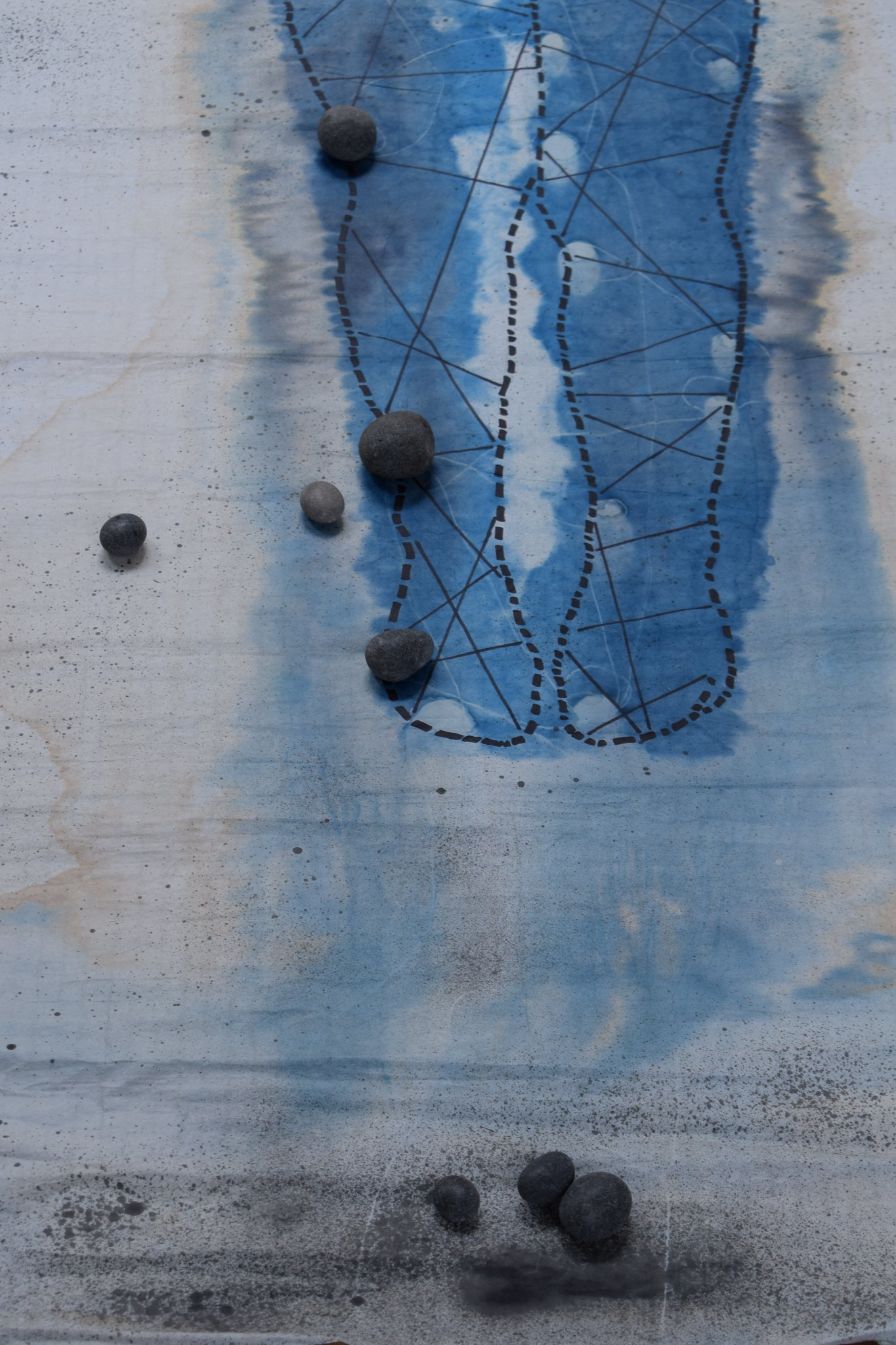
    Materials/Substances on a drawn and constructed surface.

    Drawings, wax and yellow ochre on layered canvas and paper.

    Water : A Phenomenal Lens.

    The transformative properties of the substance.

    The ‘void space’ water gardens and the interior ceilings of the adjacent apartments are connected by reflected light from the ponds. These ‘void spaces’, three inches of water over black smooth stones from Ise, are analogous to a sacred space within the every day world of domestic urban life.

    An attention to phenomenal properties of the transformation of light through material can present poetic tools for making spaces of exhilarating perceptions.

    Imaginative metaphysics shows that man becomes all things by not understanding them- for when he does not understand he- becomes them by transformation himself into/with them.

    Refraction/Reflection/Spatial Reversal Phenomena.

    Time : Duration and Perception.

    Duration as a multiplicity of secession, fusion, and organisation.

    Henri Bergson.

    One’s perception modifies consciousness, attention is broadened, time is distended, just as in the density of language.

    Thus when I measure time, I measure impressions, modifications of consciousness.

    Saint Augustin.

    Time conceived as the analog between architecture and cinema, passing time was measured and observed in a precise strip of sunlight which slowly formed different reflections as it passed across the glossy lack floor.

    The physical and perceptual experience of architecture is not a scattering or dispersion, but a concentration of energy. This physically experienced ‘lived time’ is measured in the memory and the soul in contrast to the dismemberment of fragmented messages of media..

    Steven Holl.

    Outpost 100223

    Hungate, Norwich. 

    Anglian Potters

    Undercroft, Norwich. 2023

    Helgate Proposal

    Exploratory Ceramic Practice.

    Clay Making. 

    Plaster Work.

    Commissioning of Gas Kiln for large scale works.

    Glass Tech Kiln.

  • Transactive Memory : INFORMATION/MOVEMENT differentiated/integrated.


    MAKING : Spatial Agency/ Mutual Knowledge/ Discursive Consciousness. Social apparatuses and agents that explore the possibilities of space. 


    Transactive Memory : INFORMATION/MOVEMENT differentiated/integrated

     
    Research Outpost Norwich #1

    Transactive Memory
    Systems Virtual Teams
    The Body
    Minds and Metaphors
    Laban-CHOREUTICS

    The Mind In The Cave
    David Lewis-Williams

    The Matter of The World
    Minds and metaphors
    Cathedrals of Intelligence
    The ‘Looking mind’

    Information Processing and Performance in Traditional and Virtual Teams
    The Role of Transactive Memory
    Terri Griffith, Margaret A. Neale

    Acquisition/Sharing of Implicit and Explicit Information

    Organisations increasingly rely on teams to do much of the work traditionally accomplished by individuals.
    Successful groups are those who are able to create synergies in the form of information aggregation and innovation that is beyond the ability of any single member.

    Nascent Knowledge
    Information Diversity
    Task Conflict

    The knowledge and perspectives of group members from the same social networks may be more redundant than diversified. However a total diversity among work group members is not desirable; some ‘redundancy’ (agreement in perspective) among group members is necessary to ensure enough common ground to facilitate successful group interaction.

    Transactive Memory : Knowing and Accessing What We Know

    For teams to have synergy they must be able to access their information, it is important to know who does what.
    Wegner 1987; 1995)

    RELATIONAL DEVELOPMENT
    TIME
    Synchronous/ Asynchronous
    COMMUNICATION

    Transactive Memory : A Contemporary Analysis of the Group Mind
    Daniel M. Wegner

    The study of transactive memory is concerned with the prediction of group (and individual) behaviour through an understanding of the manner in which groups process and structure information.

    Individual Memory
    Information is entered into memory at the encoding  stage, it resides in memory during a storage stage, and is bought back during the retrieval stage.

    Organisation : differentiated/integrated
    Label
    Location

    THE LABAN SOURCEBOOK
    Dick McCaw

    Rudolf Laban (1879-1958) was a pioneer in dance and movement, who found a extraordinary range of application for his ideas; from industry to drama, education to therapy. Laban believed that you can understand about human beings by observing how they move, and devised two complimentary methods of notating the shape and quality of movements.

    Diagram : Three Planes of Movement from Choreography
    Inner and Outer Tension : Inner and Outer Form

    CHOREUTICS : Principles of Dynamic Space and Movement

    Choreutics presents the grammar and syntax of spatial form in movement and the nature of movement’s harmonic content.

    Effort
    Exertion of Power, Physical or/and Mental

    Force
    Space
    Time
    Flight

    Indulging/Contending
    SPACE Flexible/Direct
    WEIGHT Light/Strong
    TIME Sustained/Quick
    FLOW Free/Bound

    Shadow Moves
    An acute observer of Shadow Movement of a person in different situations and at different times will show the consistency of that individual’s basic attitude and personality.

    Effort and Recovery
    Movement Psychology
    Thinking
    Intuiting
    Sensing
    Feeling

    Flickr

    Source: Transactive Memory : INFORMATION/MOVEMENT differentiated/integrated

  • The Scriptorium: Blending Architecture, Experience, and Memory

    Inquiry is essentially the way of learning : Fragile Architectures of Hapticity and Time.

    In an era in which architecture is once more learning its potential as a form of inquiry, rather than as a service — as a producer of knowledge, and not merely of ‘projects’.

    Brett Steele, Atlas-Tectonics in Barkow Leibininger, Bricoleur Bricolage. AA 2013

    Inquiry is essentially the way of learning.

    On Learning ‘The Cultivation of a Good Mind’ J. Krishnamurti, Brockwood 1963

    THE WAVERLEY INQUIRY

    Interior Design MA, UCA Farnham 2013-2015.

    https://russellmoreton.blogspot.com

    ROOMS AS EXPERIENTIAL OUTPOSTS 

    Translations from Drawing to Building.

    Robin Evans.

    Interiors crafted as a palimpsest of augmented realities. 

    Robin Evans, Figures, Doors and Passages.

    The architect is Not a Carpenter:

    On Design and Building, a talk by Tim Ingold Fieldwork on Foot: Perceiving, Routing, Socializing

    Jo Lee, Tim Ingold.

    The Perception of the Environment,

    Essays on Livelihood, dwelling and Skill, Tim Ingold.

    The Aesthetics of Decay

    Nothingness, Nostalgia, and the absence of Reason, Dylan Trigg. The Projection Room (the darkened room, camera obscura)

    Ruin In Architecture and Cinema, Kiefer, Pallasmaa

    Sculpting in Time, Tarkovsky

    The Artist/’Monk, Andrei Rublev (Tarkovsky 1966)

    Six Memos for the New Millennium, Italo Calvino Architecture as a stage for the effects of an immersive cinema. Palimpsest

    Edward De Waal, Antony Gormley, Studio Spaces designed by Architects. Tony Fretton on Retreats, Creative Centres and Exhibition Spaces. Herzog and De Meuron, Working Models, Surfaces, Images and Materials.

    Subversive Libraries, researching between the walls of culture and politics.

    A HUT WITHIN THE INFLUENCE AND NATURE OF ARCHITECTURE

    The tendency of technological culture to standardize environmental condition 

    and make the environment entirely predictable is causing a serious sensory impoverishment. Our buildings have lost their opacity and depth, sensory invitation and discovery, mystery and shadow.

    Juhani Pallasmaa. Hapticity and Time. Notes on Fragile Architecture. 2000

    The Scriptorium Description of Work

    The ruined site of the abbey at Waverley, near Farnham has been appropriated as a site and as a place within which to position and develop architectural and sociological inquires. The design processes of interiors have been employed as a tool to both critique and to create how we might further develop the contents of architecture. This Spatiality and its diffractions of differences and similarities, narratives and subjective experiences are what my interior spaces attempt to initiate.

    Design as a interactive structure, an interlocutory interior in the making of space and spatial relations.

    Interior design presented as an interactive and immersive spatial inquiry

    The Scriptorium brings together a varied and discursive set of objects, texts and i interior architectures. This work seeks to understand how the virtual changes physical architecture and how this affects the space between people and buildings. The “performativity of research” is presented through specifically designed apparatuses and partitions. These designed components, made objects together with annotated texts and drawings conspire to create a complex design led inquiry a “Place Study” staged in a niche-like space. This interior presents itself as both distinct and relational to the other projects in the MA Interiors Show. The interior presents the many manifestations of creative research, structures and even symposia that have been developed through engaging with the site. The visualization of the research and the relational architectures rendered through montage and collage explores digital and analogue technologies. This hybridisation and the use of pinhole photography and film footage further explore interests in the field of performance as an immaterial architecture drawn in the presence of place.

    The realisation of my interiors project consists of two separate but relational elements that are presented into a built environment. The small ‘Scriptorium’ conceived as a space as a refuge, an intimate minimal construction that features a doorway and an interior that contains a place for objects, perhaps books, as well as a small sitting area. This construction, an open cell perhaps is evocative to a state of contemplation between the fabric of the everyday. The rather hybrid design appropriates a merging of minimalism, modernism and the plastic architecture of a ruined Cistercian Abbey. The construction comes into close contact with its occupant, it is a restricted spatial apparatus that attempts to promote through its awkwardness distinctive experiences. In particular the apparatus of the Scriptorium and its materiality is attempting to promote a sensory intensification that is further underpinned by the cognitive processes of reading and perhaps other social dialogues. The sensory intensification of a hut like space promotes a haptic sensibility, allowing the nearness and intimacies of both the built space and the imaginative, virtual realm to become entangled. Ultimately the Scriptorium is trying to build on unique human subjectivities that are manifested through a kinaesthetic repertoire or script that helps to enact further spatial experiences. It might be useful to think of this constructed space as itself still under construction, a site that acts as its own vessel within the multiplicities of human perception itself. The influence of the Cistercian Order, the site of Waverly Abbey and its pastoral landscape, have all contributed to a sense of the design process, The Scriptorium like the ruins themselves is open to the elements. Waverley Abbey remains as a sensory site between the remains of architecture and its society and the effects of our own global culture in the information age.

    In troubled times they all sought to experience life away from social definitions of success or failure. From there, these primitive huts marked personal, original inquires into the ever-mysterious nature of human existence.

    Anne Cline. A Hut of One’s Own

    Life Outside The Circle Of Architecture.

    The Scriptorium began through a research of both architectural themed texts and documentation of the site, and creative practice involving photography (digital, analogue and film) art practices of collage and drawing. The many visits promoted my own subjectivities to the site and these were also frequently subjected to change by the intervention of others in unexpected ways, these social intrusions by other revealed the very boundaries that the historic site engenders, some playful other malicious. These extremities within the social order of the visitors became problematic in designing for the site itself. An earlier proposal to host a Symposium centred on the Arts and The Humanities, that would use the Abbey and its surrounding ground appeared to be a project of vast diversities and logistics better suited to a cultural project through arts management and funding. As the project developed certain creative methodologies around particularities of the site itself began to appear, the notion of palimpsest being one of them. This promoted the idea of a reading room, as an ephemeral interior space that gathers up the experiential values of ‘ruins’ and re-enacts them as a site to explore the architectures of images. It became apparent that ‘palimpsest’ could be both a visual surface of erasures, earlier markings partially over written by newer ones ‘annotations’ and it could be a scaffold of developing ideas clearly visible merging as adaptations into the very usage of the site.

    These re-imaginations through the notion of palimpsest seemed filmic and as such they would able to display a vast amount of diversities and subject matter, a library of recourses that would require users or an audience or both. The referencing of the reading room to the library, and the symposium to the cinema or theatre allowed me to realise that I was dealing with a number of spatial arrangements that needed to develop together, but which could be employed separately. The theatre of research became the vehicle in which to see if this collaboration might be possible.

    The use of the image and text in my architectural collages allowed me to visualize associations, to create the possibilities of interior spaces that might be manifested into the built environment. The use of the collage in Architecture is widely acknowledged, architects from the likes of Mies van der Rohe, Daniel Libeskind and Rem Koolhaas. The ability of the collage process to juxtaposition fragments, images and texts from irreconcilable origins into an experience, that is visual, tactile and time-based makes it an interesting tool into the realms of architectural design. Collage begins to visualise not only the structure of spaces but also there content and circulation. The theatre of research is interested in how to promote collage and its use as a cognitive and perceptive tool in architecture.

    Collage and montage are quintessentially techniques in modern and contemporary art and filmmaking. Collage combines pictorial motifs and fragments from disconnected origins into a new synthetic entity, which casts new roles and meanings to the parts. It suggests new narratives, dialogues, juxtapositions and temporal durations. Its elements lead double-lives; the collaged ingredients are suspended between their originary essences and the new roles assigned to them by the poetic ensemble.

    Juhani Pallasmaa. The World is a Collage

    Jennifer A. H. Shields. Collage and Architecture

    Both the Scriptorium and The Theatre Of Research exist only in the form of the exhibition presentation. What they singularly of together propose can only be imagined through their manifested form as static objects placed within a built structure that loosely references architectural concerns and materials. They appear diminished and assigned to the voyeuristic gaze of the visitor that is equally curios and dismissive. These objects and the interior spaces they promoted seem stilled and stalled, as much they appear beyond reach as if the authenticity of their materials and construction have some how been subsumed by their stature and scale. The issues and qualities of which they are attempting to speak of seem reduced by the hegemony of vision, there is little hapicity and time to encounter, only it seems by investing narratives can we begin to re-enact the spatial encounter.

    How might the performativity of research be staged, and into what contexts might it be appropriated?

    As Hans Ulrich Gumbrecht notes, we live in a culture of meaning, not in a culture of presence. We constantly produce effects of meaning and multiply them with mass media. This applies not only to the humanities but also to a large degree to our wholly normal everyday lives. And in this respect, our experience of presence is getting drastically lost.

    Art works may never completely be explained by theory or meaning. The sensual, material makeup of the work in its presence is not the cinders, slag, and ashes, the undigested remains of theory, but remains of an intensified moment

    Peter Lodermeyer.Time, Symposium Amsterdam 2007.

    Personal Structures, Time, Space, Existence.

    The question I ask is do these objects and their interior spaces cause me to think beyond mere representation and recognition, or rather do they create enough of an encounter to force me to engage with them, even if I or the viewer are un-certain as to their meaning or possible outcome. Deleuze comments that something forces us to think. This something is not an object of recognition, but a fundamental encounter. Something that challenges us. Have these miniature architectures of objects become relational, do we start to use them in perhaps a heuristic manner, a hands-on approach to learning or inquiring, something that we can discover for ourselves. This heuristic finding-out could be made informative through collective collaborations and exhibition through the theatre of research. Is design stripping us of our qualitative spaces as the digital tooling removes the makers trace.

    The model object has served as a thinking place in the development of the idea of the Scriptorium. The materials used and their proportions echo interests in Minimalist Sculpture, the intervals between things in the work of Donald Judd and the architectural languages of memory and tectonics of the craftsman turned architect Peter Zumthor. This open sided hut seems cut away almost anatomical as if we were looking into the internal workings of an environment and resident. The structure would have to be made relational to its surroundings if it were to be placed in the landscape. Adaptations to weather the structure, to make it serviceable for use. The Scriptorium has analogues to the notion of a fire-place and its chimney stack. It is a the heart of a building the place of warmth, of dialogues and under the influence through fire of the imagination. The incompleteness that surrounds the scriptorium creatively asks for further design proposals that are even more site specific. The Solar Pavilion built by the Smithsons utilised the old fire place and chimney from the demolished cottage. Around this central element they developed the beginnings of their Modernist (Brutalism) pavilion, an architecture clad with glass, wood and zinc and contained by a walled garden and situated in the pastoral landscape of Wiltshire. Furthering the themes of being in the landscape the Scriptorium could become an observatory, as place from both to look out from and also to look in. The mobility or need to be re-assembled from site to site could promote innovative design solutions as well as interesting detailing or use of materials and surfaces that would facilitate interactions between visitors.

    The notion of the Scriptorium becoming clad by an exterior skin, an ephemeral membrane which would then render the differences between the interior and the exterior into the realms of an almost immaterial architectural experience; in as much as the usual distinction between the unpredictable forces of nature outside and the predictable domestic spaces inside. This prompt further investigation into an  architecture that blurs the boundaries of both architecture and nature, this could be further explored through the notion of quixotic gestures, art and performance that can capture the experience and the experiential engagement with the natural elements. The Scriptorium becomes the centred structure of remnant that is surrounded by an architecture that can create imprecise boundaries through inconsistent materials. This spatial arrangement will create its own qualitative responses, dialogues and subsequent movements. Architecture in this context becomes purely a sensorial response.

    The body as the vector for active mediation with the world of the spirit. The body is the instrument of a qualitative evaluation, the measure of intensity, which alone is capable of giving space extension and modifying it Space is no objective parameter; it must be ‘excavated’ related to the mobile living parametrics of the body.

    Frederic Migayrou. Architectures of the Intensive Body. Yves Klein. Guggenheim. 2005

    Mark Prizeman. Intensity. Ephemeral, Portable Architecture.

    Time, space and existence are amongst the greatest of themes-so great that we could never be so presumptuous to think we could do them justice, and too close that we could ever escape them, whether with our thoughts or actions, in life or in art.

    Peter Lodermeyer. Personal Structures Time. Space. Existence. 2009

    My design project has attempted to produce spaces and their interiors together with the apparatus of the Scriptorium that qualitatively seek to inquiry into the world we inhabit. The Theatre of Research attempts to establish some sense of a community that can do field work that invigorates the perception of the environment. My own interests are centred through experientially and mindfully exploring voids, cavities, and spaces between things, together with use of clay, glass and other vernacular materials. As an interior designer/artist I have become experiential to the agency of spaces. The theatre of research becomes a meeting place for furthering my programme initially proposed as a symposium at Waverley Abbey.

    Through experiencing familiar images, smells, sounds, and textures, but also through making certain familiar movements and gestures, we achieve a certain symbolic stability. Disrupt that familiar world, and our psychic equilibrium is disturbed. From this we can surmise that home, and the operations performed at home, are linked intimately with human identity. Architecture, it would seem, plays a vital role in the forging of personal identities.

    Neil Leach. Camouflage

    Analysing the desire to blend-in with our surroundings

    Beyond the limits of academic levels of discourse and learning 

    Building/Working with Theoretical Objects in Architecture

    The Scriptorium would need to collect up and question considerable more qualitative data. Some sort of portable shelter, lightweight and offering some protection from the elements; would have allowed longer periods of stay and the possibility of experiencing different times of day. The activity of walking to the site, of having to incorporate it into a journey would help to create a stronger sense of place and routine. I am interested in the ‘thingness’ of this place, its influence and how its influence might be transposed into a methodology of reading, theorising and making. I am reminded of the Peter Brook who deliberately demolished his avant-garde theatre building Bouffes du Nord in Paris so as he could create a more emotionally responsive space for theatre. It is this under the influence of the Abbey, which I wish to explore as a creative catalyst, a tool that picks up on its differences as qualitative readings. The ruin by its very nature has re-defined its own architecture from one of form into that of experience, this sense of liminality or immateriality that constitutes itself as the architectural experience.

    A good space cannot be neutral, for an impersonal sterility gives no food to the imagination. The Bouffes has the magic and poetry of a ruin, and anyone who allowed themselves to be invaded by the atmosphere of a ruin knows strongly how the imagination is let loose.

    Peter Brook. The Open Circle

    Andrew Todd. Peter Brook’s Theatre Environments. 2003

  • Working Notes : Edmund de Waal : How the history of pottery and the philosophy of pottery has informed contemporary practice

    https://russellmoreton.blogspot.com

    Independent research for Studio Practice Theory and Analysis. 

    UCA Farnham, MA Interiors. 2014.

    Why does Edmund de Waal make architectural interventions through the arrangement of porcelain pots?

    To what extent, if any is this Ceramist interested in the ability of the single pot to engender meaning?

    How is the “innerness” of pots that he talks about so eloquently actually manifested in his architecturally staged installations and exhibitions?

    Signs and Wonders: Edmund de Waal and the V&A Ceramic Galleries 2009. 

    During his career Edmund de Waal has moved from that of being a domestic potter to that of an installation artist.

    His large scale installations show large groups of ceramic vessels, these are often in historic architectural settings. He is both an artist and an historian of ceramics. His installation Signs and Wonders contains up to 425 pieces of wheel thrown porcelain. This site specific installation is located at the heart of the galleries. The installation will be visible to viewers as they look upwards into the space of the monumental central dome.

    Central to Edmund de Waal’s practice is the concern to offer a ‘dialogue about the use, preciousness, survival, preservation and display of ceramics.’ (Graves,2009:8)

    He has further explored the use of installations and vitrines in the pursuit of framing and underpinning these intellectual concerns. The use of purpose made structures, shelves and boxes adds the aesthetics of a tightly control clean minimalist style of presentation to his assembled collection of pots.

    Interpretation and display are now central to these ‘grouped works’ that have become presented as ‘cargoes of pots’ that now seem at home in the collecting environment of the museum.

    ‘The way in which the pots are displayed has become an integral part of the work. And increasingly there is a sense that it is about putting on a show, albeit one that might be for a private audience.’ (Graves,2009:8)

    De Waal working with specific settings has produced installations that by their very impermanence offer ‘new and unexpected dialogues’ through interventions that are ‘framing pots within architectural features or the intimate spaces of furniture.’ (Graves,2009:10)

    ‘By altering the character of a known space, by intruding on areas within it that might not usually be associated with the display of art, the viewer’s awareness of both the changes and the space are heightened.’ (Graves,2009:10)

    This methodology of display ultimately disappears as if it were never actually present, leaving the underlying fabric of the interior space as it were untouched, the impermanence of the work now resides only in its memory.

    What remains of these sensing spaces (interiors) through spectacle, event and place? Proposal for the ceramics department at the Victoria and Albert Museum.

    Site specific work in the new contemporary ceramics gallery that responded to the architecture of the space, and that could remain in place for years. An installation or feature that could remain in place and yet allow the gallery to function as a location for frequently changing displays and exhibitions.

    De Waal’s response is Signs and Wonders ‘a lacquer red metal channel tracking the circumference of the dome and housing more than 400 of his pots; is an act both of daring and of breathtaking elegance and simplicity, a magisterial achievement on a scale surpassing anything he has previously undertaken.’ (Graves,2009:10)

    Signs and Wonders is in reality a major contemporary architectural adaptation into the very fabric of the historical building. Its very reality creates a physical link between the past and the present, and it represents a long term commitment that began with the redevelopment of the ceramic galleries into the new Contemporary Ceramics Gallery.

    Edmund de Waal’s Signs and Wonders is an iconic statement of intent for the Contemporary Ceramics Gallery, it underpins a new platform for the expanding territory of creative practice in ceramics. Signs and Wonders actively seeks to simulate new ways of seeing ceramics.

    Architectural feature that comprises of some 425 thrown pots made of porcelain by Edmund de Waal and installed under the oculus of the great dome situated directly above the main entrance hall.

    Edmund de Waal reflects on the vitrines that used to be found in the old ceramic galleries (room 137) at the Victoria and Albert Museum in the 1970s.

    ‘Most of the vitrines were firmly policed into taxonomies of kiln or modeller or religion, less ’pseudo-scientific’ than a slightly desperate attempt to control the vastness of the collection. Some of the vitrines had the work of a single potter. All the pots by Hans Coper used to be in one mahogany case, huge early textured vessels shadowing the fine later Cycladic forms. They barely fitted.’(De Waal,2009:16)

    De Waal’s memories of the old galleries in the 1970s was that they were an attempt to compare pots from different galleries, of the strangeness of seeing through one great case into another; the tops of a row of bottles cresting a line of dishes and the layering of one series of forms or colours onto another. And of course the fact that there were very few people.

    Signs and Wonders; Edmund de Waal.

    ‘I have made an installation of pots for Gallery l41. There are 425 vessels made out of porcelain and they are placed on a red metal shelf that floats high up in the dome. You can just see it from the entrance hall through the square aperture in the coffered ceiling if you stand in one of the mosaic circles on the floor. It is called Signs and Wonders.’

    I want to make this installation part of the fabric of the V&A. (De Waal,2009:20)

    ‘It began with the combination of a gesture of a pen and the plans to this austere bit of Edwardian architecture.’ (De Waal,2009:22)

    The porcelain vessels are on a red shelf, the colour of lacquer.

    The integrity of the shelf is upheld by being made from a proper material so as to form an accord with the historical architecture.

    De Waal has experimented with placing porcelain on steel shelves and by having pots placed within lead lined boxes. He is aware of how these materials can form provocative combinations from their inherent densities.

    The controlling presence of the vitrine is an intervention itself of its own display, (decommissioned mahogany vitrines from the V&A, illustrate the phenomenal weight of these enclosures)

    De Waal’s porcelain vessels (shape shifters) are in effect objects from memory brought into a shifting nature of influences from the Chinese porcelains, the 1800 Century European porcelains and the collections of the Modem era from Vienna, Bauhaus and the Constructivists.

    ‘This is not a simple linear relationship, but part of a flow around into Modernism and back again. It is a perpetual rediscovery.’ (De Waal,2009:26)

    On Pots Behind Glass:

    The shadows of the stacked pots.

    On the memory of objects, the afterimage, its distillation, and the blindness of looking away that gives it its form. What is left to be adapted or to be pared down through volume and angle into these new reflective forms?

    Derrida on drawing from ‘blindness’. 

    ‘I wanted to work with objects that have been part of my life for 30 years, and to make sense of my memories of how pots lived in the galleries.’ (De Waal,2009:26)

    ‘Other sections, one run of bottles that are in different celadons for instance, are a memory of vessels from disparate parts of the ceramics collections brought into a taxonomic focus. This is the use of memory and the after-image as the intense holding of a form on the retina.’ (De Waal,2009:26)

    In Heidegger’s work ‘not least in his use of etymologies, his writings are imbued with a sense of historicity; a sense of the passage of time, of destiny, and of the past as a reservoir of thinking available to contemporary life.’ (Sharr,2009:99)

    The Architecture of Place :

    Architects that were sensitive to site, dwelling, inhabitation and place. Form Making as a Response to Site and Inhabitation.

    In The Ethical Function of Architecture 1997, Karsten Harries seeks to reclaim a sense of meaning in architecture that he feels has been lost to a scientific rationality. He sees ornament as being able to convey meaning by linking and reflecting stories and in so doing it gives us an appreciation of nature. This type of ornament has a poetic function in that it helps to locate people with their place and community.

    Dalidor Vesely believes that architecture can manifest the attitudes of its builders, and that this can describe through the very fabric of the building the very thinking of the society that implemented its construction.

    Vesely ‘explored what he considered to be the tensions between instrumental and communicative, or technological and creative, roles of architecture. He argued that these roles have become divided; a split which is recorded in the respective roles of architects and engineers. Vesely traces the historical origin of this division to that of mediaeval optics and the development of perspective; to the first attempts to privilege a scientific description of light over immediate experiences of the qualities of vision. This division is a crisis of representation, that that is displacing meaning in architecture from human experience to the visual qualities of surface and appearance.’ (Sharr,2009:103)

    For Vesely, creativity remains the antidote to technology.

    Zumthor shares with Heidegger in that he believes in architecture’s potential to evoke associations and invite meaning.

    Regionalism, a critical dialogue with the site, a rapport between place and building as if it had always been there.

    ‘Stone and water are more than materials or phenomena for Zumthor; they’re also intellectual notions, traditions of thought with a long history.’ (Sharr,2009:104)

    Critical Regionalism, see Kenneth Frampton, ‘Zumthor aligns himself with Frampton when he writes about a critical dialogue between his designs and their sites, unafraid to claim meaning from locality.’ (Sharr,2009:105)

    Choreographing Experience.

    Zumthor ‘I need time to create an atmosphere, I have to be careful about things otherwise I won’t have this atmosphere and the whole objective of my work somehow would be gone. That’s the way I work.’(Spier,2001:19)

    ‘Much of the installation uses memory in a different way to produce the blurred after­ image.’ (De Waal,2009:28)

    De Waal cites the photographer Hiroshi Sugimoto as being a revelatory influence on this notion of memory and the blurred after-image. In particular the series

    ‘Architecture’ which features blurred photographs of Modernist architecture. These images seemed to have the ability to take ‘you back to a particular moment standing in front of a particular building. It was that they seemed to be simultaneously images of a memory of place.’

    Sugimoto ‘Architecture’ The German Pavilion from Barcelona, Mies van der Rohe. ‘A graduated run of whites into greys is a memory, for me, of the archive photographs of Bauhaus ceramics with their regimented attempt at teaching pottery by breaking forms down to component parts.’ 

    (De Waal,2009:30)

    Hans Coper builds up spatial interiors in his pots by using component parts thrown on the wheel.

    The pot can be seen as a cultural trace that can bring a sense of immediacy from across the centuries.

    ‘The special historical value of pottery is due to its stillness underground. Almost uniquely, it does not corrode or disintegrate when exposed to earth and water, and so it forms the most important part of the physical record of the past. Like an invisible architecture, inverted and buried out of sight, they are our most reliable evidence of human endeavour.’ (Adamson,2009:36)

    The Architecture of Natural Light, Henry Plummer 2009 

    Procession, the choreography of light for the moving eye.

    Iconic works of space in motion: The Perceptual Flow.

    ‘Related concepts relevant to architecture are found in the films of Andrei Tarkovsky, for whom cinematic flow is a living rather than linear experience, achieved when film is stretched and lengthened by human memory and by images that evoke something significant beyond what we see before us, allowing time to flow out of the edges of a frame. ’(Tarkovsky, 1986:117)

    Mies van der Rohe’s Barcelona Pavilion. Peter Zumthor’s Therme Vais.

    Donald Judd’s Untitled 1980.

    Jean Nouvel’s Culture and Congress Centre 1999.

    ‘More important still to de Waal’s project is the way that Judd’s stacks use interval. These cantilevered boxes are literally, one thing after another; but they do not touch. Rather the positive steel and plastic elements are separated by negative spaces that are their exact equal in volume. The works operate according to a binary, on/off logic, suggesting temporal as well as spatial extension.’(Adamson,2009:40) see also 

    Michael Fried, Art and Objecthood: Essays and Reviews: Chicago, 1967/1998.

    Fried recognizes the durational aspect or dimension of minimalist sculpture, but condemned it for its “quasi-theatrical presence” that by occupying the time of the viewer this sculpture became mundane and everyday rather than transcendent.

    Stacking is a way for de Waal to engage with the history of sculpture. It can be thought of as a compositional tool that suggests the storeroom, the kiln or a way of just putting pots together. Stacking produces a visual syntax through ‘exploring the formal and implicitly psychological relationships that pots can have with one another. ’(Adamson,2009:38)

    Simultaneous Temporal Structures: Windows or Objects in Sequence.

    ‘Pictures in motion have long been exploited by Parisian architect Jean Nouvel, who describes his buildings as “scenographic” with routes composed along a series of camera angles and apertures.’ (Plummer,2009:56)

    ‘Another technique Tarkovsky employs to loosen time from any rigid progression is the directorial power to endow not only the entire film, but also its segments and even separate frames, with simultaneous temporal structures that are not unlike William’s “ice in March” or Viola’s “parallel times”.’ (Plummer,2009:56)

    Steven Holl ‘movements are threaded rather than linear, pulled vaguely along by what Holl calls sequences of shifting and overlapping perspectives. Beckoning light draws the visitor onward step by step, and image by image, through a fragmentary rather than comprehensive narrative. (Plummer,2009:56)

    Gianni Vattimo, Italian Philosopher.

    The End of Modernity: Nihilism and Hermeneutics in Postmodern Culture. 1991. 

    Weak Ontology/Fragile Thought.

    A latent learning under the safe light of the darkroom. The red pages of the signs and wonders catalogue links a narrative with spatial object of his installation by its colour, but it might also reflect the inner space of the photographic darkroom.

    ‘Light neither centres nor aligns space, as in the past, but appears in the periphery as a vague and marginal background event.’(Vattimo, 1991:85)

    ‘Filled with intricate constellations’: (Adamson,2009:34) Looking/seen from the oculus of the dome.

    ‘De Waal has placed his pots in circulation, but not in the sense that they can be held and passed around. They are even, to some degree withheld.’ (Adamson,2009:34)

    “When they are so high up they become blurred”

    Rather than the object stranded on the plinth attempting to flag you down, if you place it elsewhere there is a feeling of possibility and latent discovery, similar to the feeling that you get if you are lucky enough to see the stores of the museum. 

    (De Waal,2009:30)

    In between spaces/stores and other latent spaces, re Mike Nelson, photographic darkroom between rooms. London 2007.

    Wallace Stevens, Anecdote of the Jar. (1919) Heidegger, The Jug, “gathering vessel”

    “What is de Waal charting in these looping circles within circles?”

    De Waal acknowledges the influence of Wallace Steven’s poem “Anecdote of the Jar”. Glenn Adamson remarks how the special qualities of the round perhaps thrown pot is itself both an object, brought into the being by the world and encircled by it. (Adamson,2009:34)

    In so “being” the vessel brings its own order, a subjectivity that acts and takes dominion everywhere. This communion (spatial relation) between the vessel and its environment is further echoed in the lines of the poem “the wilderness rose up to it, and sprawled around, no longer wild”(Stevens, Anecdote of the Jar. (1919)

    Signs and Wonders is about seeing pots from a distance, De Waal is seeking to reflect the sentiments found in Wallace Stevens poem that makes the pot itself appear as a still centre from which we can step back from and observe as it/we gather our surroundings. This work is not about tactility, immediacy or possession, perhaps De Waal has succeeded in producing a collection that is also ‘a talisman of subjectivity’ of one man’s personal vision of ceramics.

    ‘When potters throw a certain curve in a vessel wall, they are in affect in dialogue with every kindred pot that they have seen or held. Like an archaeologist’s excavated sherd, the experiential dimension of making can act as a bridge across temporal distances.’ (Adamson,2009:44)

    Temporal Zones/Re-Imagined Social Landscapes: Archaeology/Making : Pot Shard/Pottery.

    See Tim Ingold the four A’s, Anthropology/Archaeology/Art and Architecture.

    Working Notes : 26 February 2014

    Theory and Analysis/Tutorial with Simon Olding CSC. 

    COMPONENTS :

    Essay 2000-3000 words and a research journal that informs the essay/texts. Interested in using this research to inform my “Object Analysis” and its exploratory  essay. 

    The Object:

    Ceramic Vessel made by Hans Coper.

    A Level Ceramics at Farnham Sixth Form College. Workshop experience locally at the Hop Kiln Pottery, Farnham and at Grayshott Pottery. 

    HND in Ceramics, Epsom School of Art and Design. 

    Self employed and freelance as a ceramist until 1992.

    Currently working with clay in a contemporary practice that includes Architecture, Fine Art and Performance.

    Research Questions.

    What “anthropological traces” remain within the vessel of the “Pot” 

    What is its Symbol-Function-History.

    How much of the artist’s social biography is caught up in its making. 

    Does the object in question underscore a deeper humanity/ a visionary present. How does the craft of making affect the perceptions of our surroundings. 

    The worn vessel/telluric values and the sensuality of humans.

    Making: The Contemporary Craft Praxis. Research Texts.

    Making, Tim Ingold.

    The Perception of The Environment (Essays in Livelihood, Dwelling and Skill) Tim Ingold.

    Heideggar for Architects, Adam Sharr. A Potters Book, Bernard Leach,

    Hans Coper, Tony Birks/Contemporary Potters/Ceramic Review. The Psychoanalysis of Fire, Gaston Bachelard.

    Rethinking Materiality, Colin Renfrew. (At The Potters Wheel)

    How Things Shape The Mind/A Theory of Material Engagement, Colin Renfrew.

  • Bricolage Processes : Creative Audit of Research Topics and Processes

    Interiors/UCA Farnham. 2014

    THE ARCHITECTURE OF NATURAL LIGHT, Henry Plummer. 2009 THE OTHER ARCHITECTURE, Constructing metaphysical space.

    Catching The Light.

    The Entwined History of Light And Mind. Arthur Zajonc

    EVANESCENCE

    Orchestration of light to mutate through time PROCESSION

    Choreography of light for the moving eye VEILS OF GLASS

    Refraction of light in a diaphanous film ATOMIZATION

    Sifting of light through a porous screen CANALIZATION

    Channelling of light through a hollow mass ATMOSPHERIC SILENCE

    Suffusion of light with a unified mood LUMINESCENCE

    Materialization of light in physical matter

    ADVENTURES OF THE FIRE, VESSELS THROUGH TIME CERAMIC GATE

    “The existing architectural environment is thought to be more or less official through the hierarchical arrangement, providing an rigidity to the public. The base for a creation is a freedom and I proposed an asymmetrical form for the gate to break the official space, bringing an atmosphere for freedom of creation. ”

    Jung-mook Moon. CERAMIC PAVILION

    “People make space, and space contains people. ” Seong-chil Park. (Exhibition Space Designer)

    PALIMPSEST AS REMAINS OF A CREATIVE PRAXIS STUDIO SPACE AS A PHILOSOPHICAL WORKSHOP

    PALIMPSEST IN ARCHITECTURE

    “Architects, archaeologists and design historians sometimes use the word to describe the accumulated iterations of a design or a site, whether in literal layers of archaeological remains, or by the figurative accumulation and reinforcement of design ideas over time. Whenever spaces are rebuilt or remodelled, evidence of former uses remain. ”

    Wikipedia

    RODIN AND BEUYS

    THE ALCHEMY OF BUILDING WORKING PRACTICES

    RUINS, REDUCTIONS, and the LOSS of SUBSTANCE.

    FRAGMENTS, ASSEMBLAGES and INTERIORS that re-enter the world of creativity.

    The Theatre of Research is a working space that creates and crafts both theoretical and practical objects, things and documentation. Its reason for being is to explore the praxis for creative narratives between the Arts and The Humanities. It attempts through performance, fine art and architecture to collage qualitative and diffractive dialogues into new relational discourses, the results of which become exhibited or staged as open workshops engendering praxis, publication and production. In its fledgling state it is seen as being part of a University faculty that has interests in the Arts and The Humanities.

    We have art so that we may not perish by the truth. Friedrich Nietzsche Can one achieve architecture without resorting to ‘design’? What if, instead of designing a new building, you keep the one skated for demolition? How do you insert an original program inside the old and new structures simultaneously? How do you reconcile coherence with multiplicity? Bernard Tschumi 2012

     PROGRAM. Tschumi, Le Fresnoy: Architecture In/Between, 1999/2012 Architecture was no longer an autonomous and isolated discipline but participated in the movement and confrontation of ideas. Tschumi, Red Is Not A Color. 2012

    Questions of Space

    Abstract Mediation and Strategy

    CREATIVE AUDIT of RESEARCH TOPICS The Craftsman, Richard Sennett. 2008

    “Making is thinking, the good craftsman uses solutions to uncover new territory; problem solving and problem finding are intimately related in his or her mind. For this reason curiosity can ask, “Why” as well as “How ” about any project. ”

    Prologue: Man as His Own Maker CRAFTSMEN

    The Troubled Craftsman The Workshop Machines

    Material Consciousness CRAFT

    The Hand

    Expressive Instructions Arousing Tools Resistance and Ambiguity CRAFTSMANSHIP Quality-Driven Work Ability

    Conclusion: The Philosophical Workshop BRICOLEUR BRICOLAGE, Barkow Leibinger. 2013

    “Bricolage indicates an approach that is inclusive, ie open-ended, and can come either from within architecture itself or from external sources. ”

    CASTING WEAVING

    FOLDING BUNDLING PRINTING ANTICIPATING

    FROM MODELS TO DRAWINGS, Marco Frascari. 2007 CRITICAL STUDIES IN ARCHITECTURAL HUMANITIES

    THE WAVERLEY PROJECT

    Imagination and Representation in Spatial Practices (Architecture, Fine Art and Performance).

    Historical Perspectives Emergent Realities Critical Dimensions

    CRISTINA IGLESIAS Guggenheim Museum 1998

    “Concrete and iron, glass, yellow, terracotta and tapestry, aluminium and photo etching, leather and amher glass, wood, resin and bronze powder, blue glass and alabaster. ”

    Introduction, Carmen Gimenez

    Screen Memories, Nancy Princenthal Stained With a Pale Light, Adrian Searle Wanting Shelter, Barbara Maria Stafford

    CHRIS WILMARTH. 1986 Delancey Backs (and Other Moments)

    Etched float/polished plate glass, steel and bronze, blown glass.

    BURNING ISSUES AND PRACTICAL CONCERNS

    THE READING ROOM

    The Neo-Romantic Vision from William Blake to the New Visionaries.

    ‘A new alchemy is being formed which encompasses traditional methods of art, the new technology, and the revolutionary new scientific discoveries.’

    Re-Enchanting the Land. (Woodcock,2000:140)

    ‘When one lacks outer space one creates inner space. Invention becomes more complex, cup and circle markings on stones, intricate Celtic spirals and knots, illuminated manuscripts, gothic architecture with its inherent story telling.’ (Woodcock,2000:131)

    Reading The Landscape.

    What distinguishes Neo-Romanticism from traditional romanticism is the feeling of danger, the juxtaposition of the urban with the countryside, the element of darkness, dissolution, an almost pagan reverie breaking through the ruins of post-industrialism. (Woodcock,2000:55)

    Radio On by Chris Petit.

    The film has a hallucinogenic noir-like quality, a weird hybrid of Fifties Americana and a displaced Britain. It is a seismographic disruption of British culture in a limbo land of displaced dreams, elements of an almost mythical Britain fleetingly appear. (Woodcock,2000:115)

    England Dreaming.

    Throughout John Piper’s long and prolific life he remained fascinated not only with churches, country houses and landscapes but also ancient sites. He comments on the landscape of Snowdonia, ‘Each rock lying in the grass had a positive personality, for the first time I saw the bones and the structure and the lie of mountains, living with them and climbing them as I was, lying on them in the sun and getting soaked with rain in their cloud cover and enclosed in their improbable, private rock-world in fog.’ Piper never dismissed the archaic spirit of place. 

    (Woodcock,2000:31)

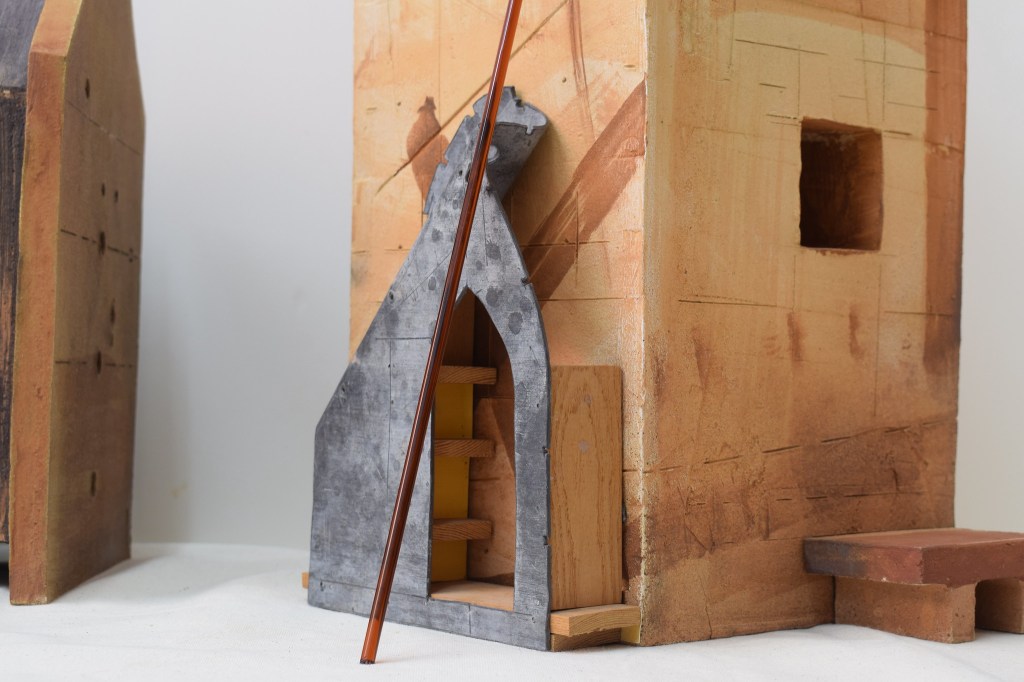
    The small ‘Scriptorium’ conceived as a space as a refuge, an intimate minimal construction that features a doorway and an interior that contains a place for objects, perhaps books, as well as a small sitting area. This construction, an open cell perhaps is evocative to a state of contemplation between the fabric of the everyday.

    WATER AND DREAMS

    AN ESSAY ON THE IMAGINATION OF MATTER Gaston Bachelard

    Viscosity/Water in Combination.

    Tacit and intimate contact, relationships and encounters between water and the potter. Water is his/her first auxiliary.

    WORKING NOTES for InDESIGN Document/Mood Board.

    Old Buildings/New Designs: Architectural Transformations. Charles Bloszies. Knocktopher Friary is a quiet place of contemplation. The new residential cloister unifies the friary and the church. The composition of the architecture is a knitting together of two original forms with a ribbon of concrete, glass and wood. The new buildings are crafted from a minimalist vocabulary where the palette of materials was kept to a minimum. One of the interesting design features is that the new elevations never touch the old facades with a solid-to-solid intersection; the new is either set back from the old (Ashley Castle) or the joint is glazed. The existing church floor is used as both a datum for maintaining the new floor level in the new construction, and as a vein of closely controlled changes of materials and finishes. The resultant architecture is played between subtle material exchanges of concrete meeting wood, concrete meeting glass, and concrete meeting concrete with slightly different surface qualities. What results is a clear differentiation between the old and the new, both are remarkably quiet architecturally reflecting the concerns of the site as a Carmelite monastery in the southeast of Ireland.
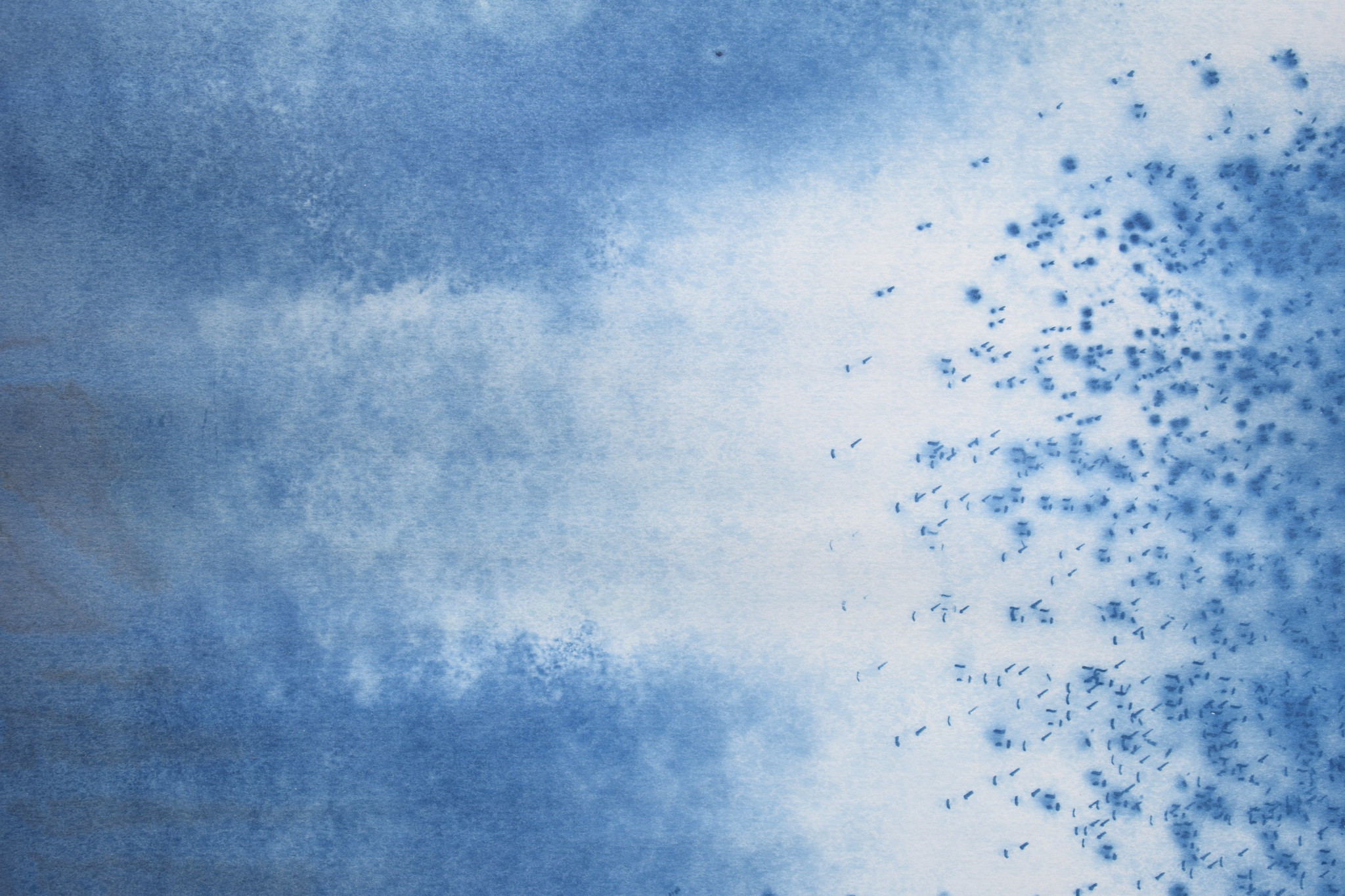

    Working Thoughts

    The Phenomenology of Reading. GLAS, Derrida Literature and Language.

    Barbed Nature, Pierced Flesh. Graham Sutherland 1903-80

    He never worked in situ but collected information to be worked on in his studio. The detailed sketches and notes he had made when through a transition in his mind before the final painting, culminating therefore in an inner landscape rather than a factual rendition.

    These landscapes were no idyllic reverie but evoked a sense of the mysterious and dangerous. In many ways they emitted a foretaste of the approaching Second World War. (Woodcock,2000:25)
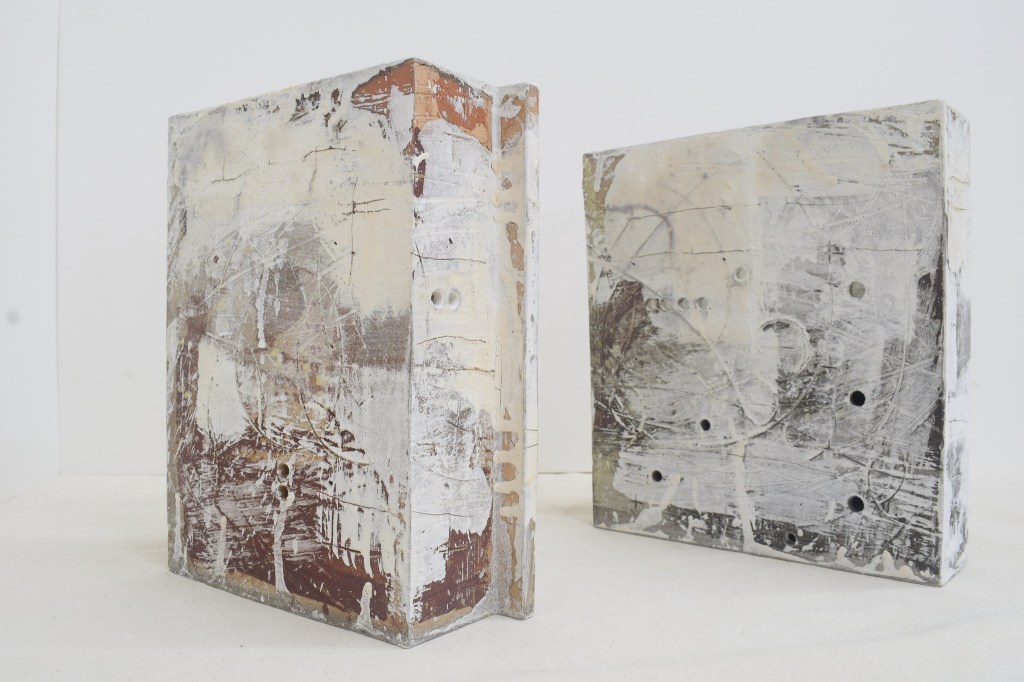
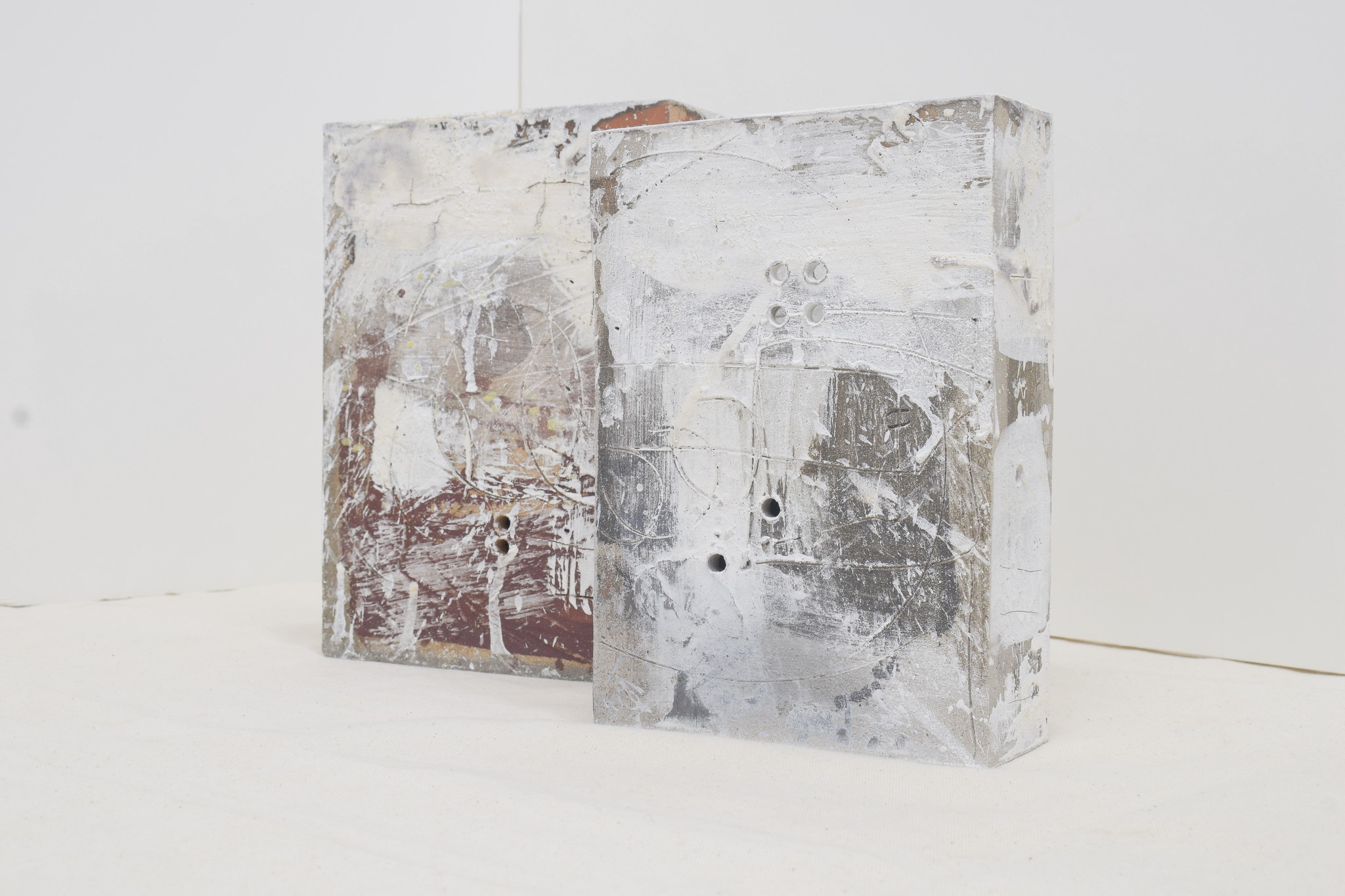
    Ruins, Shadows and Moonlight. Elizabeth Bowen

    “It is a fact, that in Britain, and especially in London, in wartime many people had strange, deep. Intense dreams. We have never dreamed like this before; and I suppose we shall never dream like this again.” Elizabeth Bowen.

    The awareness of the social changes which broke through wartime society is evident in her novels and short stories, the feeling of boundaries being broken, physically, psychologically and also on a spiritual level, where the sense of the living and the unaccounted dead, caused by the bombing, mingle. Her evocative descriptions of the quality of light, the particular smell of a room, of a garden after rain of walking over charred wood and broken glass following an air-raid, and even the effect atmospheres have on the individual all contribute to evoking a strong sense of place. She is a master at conjuring up the minutiae of the everyday world and the presence of another dimension. (Woodcock,2000:74-75)

    Rogue Male. Geoffrey Household.

    The novel evokes the solitude of the landscape as it was before the advent of the mechanisation of farming and the availability of the countryside created by the growth in transport of the following decades. (Woodcock,2000:77)

    Tn the heart of this hedge, which I had been seeking all the way from London, the lane reappears. It is not marked on the map. It has not been used, I imagine, for a hundred years. The deep sandstone cutting, its hedges grown together across the top, is still there; anyone who wishes can dive under the sentinel horns at the entrance and push his way through and come out in a cross hedge that runs along the foot of the hills. But who would wish? Where there is light, the interior of the double hedge is of no conceivable use to the two farmers whose boundary fence it is, and nobody but an adventurous child would want to explore it.’

    Geoffrey Household, Rogue Male 1939.

    The Stride of The Mind

    Reading Rooms. Figuring Space. Text/Fumiture/Dwelling Reading with Paths

    Relativity through Walking and Thinking. Subjectivity. Space – Politics – Affect

    Waverley Abbey. Cistercian Monastery

    The peculiarity of the ruin is defined in that it demythologises the impression of seamlessness and linearity. In the ruin, we are at once removed from dichotomised and levelled down space by entering a place at the threshold of experience. At the threshold, we return to the pre- spatial, if primordial, landscape, yet to submit to the suppression of space and site. Instead the place of ruin creates protrusions, which desolates the category of clean space.

    The Aesthetics of Decay, An Uncanny Place. Dylan Trigg

    Scarpa, extensive use of concrete with different aggregates and finishes.

    Ashley Castle, restoration of ruin into a domestic dwelling, sensitive use of materials and methods of joining or revealing the historical fabric (allowing the ruinous to remain visible) of the building.

    The Dovecote Studio, a building made of CORTEN steel built within the interior of a ruined Victorian dovecote (see further notes).

  • Spatial Practices/An Affective Intensity : Thinking Matter : Between Human/Spatial Relations

    Outpost 261124

    An Affective Intensity.

    The juxtaposing volatility of abjecting spatial and human bodies.

    Spatial Agency/Assemblages in constant relational movement.

    Abstracted-Diagrammatic-Inhabitations.

    Expulsions from/for relational bodies.

    A Provisional/Speculative Framework.

    Tuschimi’s Equation : A framework that sets out a logical outcome, but where the insertion of event introduces a deviation, a slippage from the planned/programmed outcome. Such that the ‘architecture’ is indeterminate.

    Event=Space-Movement.

    Creating Disjunction, superimposing assemblages of event/space/movement over(entangling) one another.

    A Becoming Architecture.

    To provoke potentials to occur.

    Contracts (Architectural Transcripts), scripting spatial relations that utilise fictional scenarios in real spaces, are used as a way of working with temporal events.

    Here architecture is pushed towards and over its limits to the point where it is no longer ‘architecture’ as we know it. But rather an architecture, an anticipation of an architecture (social construct) to come.

    Immediate Architectural Intraventions.

    Spatial Practice.

    Thinking Matter : Between Human/Spatial Relations

    WSA 2007-Outpost 2024

    Real Space + Fictional ‘Event’

    The architectural origin of each ‘episode’ is found within a specific reality, and not in an abstract geometrical figure.

    Tschumi.

    Minoritarian Architecture/Deleuze.

    They produce a type of labyrinth, with a momentary impossibility of escape.

    They are architectures in a constant state of change, perpetually agitating the discipline’s established norms.

    Abject (ion) facilitates an affective intensity.

    Art works (workings) made from an expelling human body in relations with spatial bodies.

    Waiting Rooms

    Soul Cages.

    Black Books

    Installations

    Ceramic/Architectural Propositions

    Zuzana Kovar.

    Abject(ion) is a discussion of bodies of assemblages.

    Abject events render a particular indeterminacy. There is an aim here through abject(ion) to re-purpose architectural methodologies in order to contemplate abject(ion) and specifically contemplate its dilution of boundaries between bodies. It is critical to reiterate that abject(ion) through its volatile and leaky nature inevitably comes to encompass more than one body.  

    Material Markings/Inhabitation.

    Life Drawings/Frottage/Graphite/Charcoal/Concrete.

    Winchester Weeke Centre 2006.

  • FORMWORK/ ENCLOSURES / ITERATIONS / THINKING FORMS : Material Agency as Cognitive Scaffolding

    FORMWORK/ ENCLOSURES / ITERATIONS / THINKING FORMS : Material Agency as Cognitive Scaffolding

    IMMATERIAL / REPETITION / SINGULARITY

    ENCLOSURES / ITERATIONS / THINKING FORMS

    MINIMALIST SPACES / INTERVALS, tuning objects to construct environments

    Mediating the experience of LANDSCAPE

    SITE / COLLAGE COMPONENTS working/walking, developing a creative spatial syntax COLOUR AS CONDUIT / PERCEPTUAL ENVIRONS / CRAFT MEDIA / IMPROVISATION PIERCED  DAPPLED NATURAL LIGHT

    DIFFERENTIATED SHADOW / SURFACE

    EXTRAORDINARY MATERIALS / TECTONICS AND TEXTILES INDEXICAL / GESTALT  VISUAL PERCEPTION

    NETWORKS / RESOURCES / AGENCY for the potential of BUILDING SCAFFOLDS / GAUZE / POCHE solids of a building/architectural plan ABSENCES / INTERSECTIONS / GRIDS / MESHES / SPRAYS / MOTIFS ACTUALITY


    Without opposition nothing is revealed,
    No image appears in a clear mirror If one side is not darkend.
    Jacob Bohme, De tribus principiis 1619.
    Everything is interrelated and suffers when it acts, so too the purest human thought. Holderlin, 1798.

    Getting Lost, Walking whilst deep in thought/embodiment in the environment Between PLACE and SITE 

    Walking creates its own feedback loop, The Journey, The Return,

    The specific, Here and Now

    Psychogeography, Dossier, Forensic Study, Inquiry.

    Spatial Abstractions : Reflexivity on Reflection. Embodiment on Experiential Subjectivity

    LANDSCAPES Constituted by creative practice

    Walks as erasures, sedimentation, (Gardiner)

    Quotidian/Everyday Interests, Complexities of Contemporary Life. Ambients, Phenomenas, Objects, Subjectivities,

    Everyday aesthetics, heuristic practice,

    RAVENINGHAM THEMES : Working Notes

    The ‘exigencies’ of the situation at hand.

    Tim Ingold, MAKING. Spatial Intelligence

    New Futures for Architecture Leon van Schaik

    Spatial intelligence builds our mental space. Sensing Spaces

    Architecture Reimagined Oak-Framed Buildings

    Rupert Newman Heidegger for Architects

    Adam Sharr MAKING

    ANTHROPOLOGY, ARCHAEOLOGY ART AND ARCHITECTURE

    Tim Ingold

    Touching objects, feeling materials

    The Cathedral and the Laboratory

    A Hut of One’s Own

    Anne Cline

    Solar Pavilion

    Alison and Peter Smithson Architecture is not made with the brain

    The Parallel of Art and Life

    Aesthetics about Perception Poetics about Production

    HERZOG & DEMEURON NATURAL HISTORY

    My studio is a piece of architecture that is silent. Speculative Architecture

    On The Aesthetics of Herzog & De Meuron

    The Thinking Hand

    Existential and Embodied Wisdom in Architecture

    Juhani Pallasmaa

    The Architecture of Natural Light Henry Plummer

    Peter Zumthor

    Hortus Conclusus Serpentine Gallery Pavilion

    The Potentials of Spaces

    The Theory and Practice of Scenography and Performance. Alison Oddey, Christine White

    See Yourself Sensing Redefining Human Perception. Madeline Schwartzman

    Collage and Architecture. Jennifer A. E. Shields

    COLLAGE

    Assembling Contemporary Art. Sally O’Reilly

    Construction/Abstraction Body/Identity Environments/Geographies

    Indexical

    Absences

    Actuality Immaterial Architectural Sensing Surfaces,

    Textures

    Dimensions, Sprays, Trace

    Dwelling, Reverberations, Epiphanic Instant, Gaston Bachelard.

    Repetition, Empirical Experiences

    Forms, Pavilion, Hut, Shelter, simple enclosure

    Minimalist, tuning objects, sequences to construct/de-construct environments

    Reflexive Surfaces into architectural presence

    Art as indeterminate, able to arrest perceptions into different states/becomings

    Site, undoing of place.

    Gauze/Filtered Light/Phenomena

    Gesture of the work, its situation,

    Meshwork. The drawing grid, making of a proposition into space.

    Cyan, Sky Blue, dappled light, membrane, responding to the weather/locality

    AA Pavilion Project,

    Its about learning through making, being involved in the process, the installation and its reception, dislocating contextual barriers.

    Ephemeral Architectures, AA Document/Project, Prizeman

    Immaterial Architecture : Waverley Pavilion Building The Drawing

    The drawing as analogue allows more subtle relations, of technique, material and process, to develop between drawing and building.

    Immaterial Architecture The Illegal Architect Jonathan Hill

    Oak

    Tree

    Oil

    Paper

    Plaster

    Rust

    Sgratfito

    Silence

    Sound

    Steel

    Television

    Weather

    Frosted Light

    Index of immaterial architectures

    TRANSPARENCY : LITERAL AND PHENOMENAL Colin Rowe, Robert Slutzky

    Interactions of the Abstract Body Josiah McElheny

    Object Lesson

    Interactive Abstract Body (Square) The Spatial Body (After Fontana)

    Tracing Eisenman

    Stan Allen

    Indexical Characters FABRIC=MASS+ FORM

    Alan Chandler

    The interest in fabric formwork is in its deployment in a building process, which is faster than conventional formwork. Fabric formwork is inherently more sustainable due to the minimising of both concrete and shuttering, and more radically, allows the constructor to intervene in the process of casting even as the cast is taking place.

    ANTI OBJECT Kengo Kuma

    We are composed of matter and live in the midst of matter. Our objective should not be to renounce matter, but to search for a form of matter other than objects.

    What that form is called- ARCHITECTURE, GARDENS< TECHNOLOGY is not important. ReThinking Matereriality

    The engagement of mind with the material world. Elizabeth DeMarrais, Chris Gosden. Colin Renfrew

    The Affordances of Things

    Towards a Theory of Material Engagement Aesthetics, Intelligence and Emotions Relationality of Mind and Matter

    Material Agency

    Towards a Non-Anthropocentric Approach. Carl Knappett, Lambros Malafouris

    At The Potter’s Wheel: An Argument for Material Agency

    We should replace our view of cognition as residing inside the potter’s head, with that of cognition enacted at the potter’s wheel.

    The Neglected Networks of Material Agency : Artefacts, Pictures and Texts

    Material Agency as Cognitive Scaffolding

    The Cognitive Life of Things

    Material Engagement and the Extended Mind. Lambros Malafouris, Colin Renfrew

    Minds, Things and Materiality Michael Wheeler

    Communities of Things and Objects : A Spatial Perspective Carl Knappett

    People make space, and space contains people
    Imagining the Cognitive Life of Things Edwin Hutchins

    Things and Their Embodied Environments Architectures for Perception

    Structuring Perception through Material Artifacts Charles Goodwin

    Leach Pottery, Studio and Museum A Potter’s Book

    Bernard Leach

    Adventures of the Fire, Vessels Through Time Ceramic Pavilion


    Source: FORMWORK/ ENCLOSURES / ITERATIONS / THINKING FORMS : Material Agency as Cognitive Scaffolding