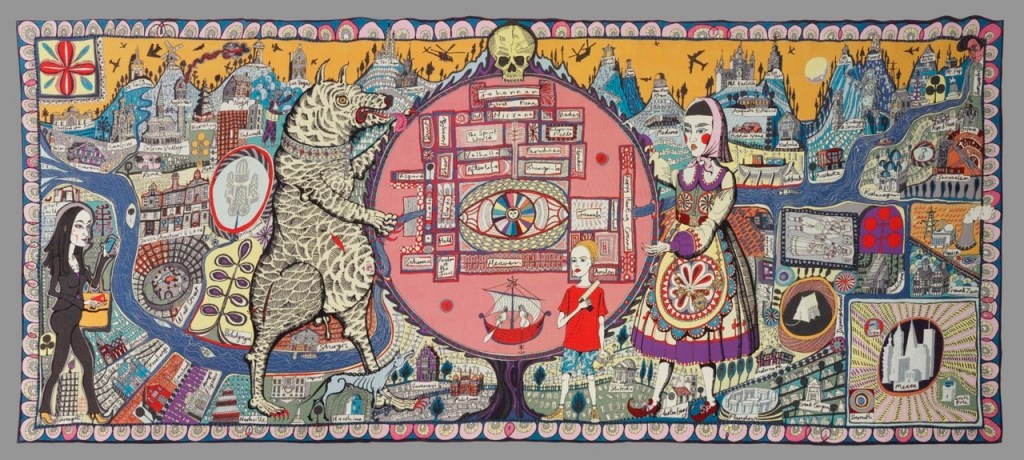
THE TOMB OF THE UNKNOWN CRAFTSMAN CURATED BY GRAYSON PERRY // THE BRITISH MUSEUM
It has taken me too long to see this exhibition, the critics have raved about it, my friends… a mixed review. So despite a general wariness I knew I was going to be intrigued, at least due to the unusual framework that this exhibition has taken.
This framework consists of many conflicting factors. Firstly, the collaboration of an internationally renowned museological institution and that of a contemporary (and often sensational) fine artist. It cannot be argued that The British Museum is a shrine to the historical artefact, and not a contemporary art gallery.
Secondly, there is the issue of fine artists as curator. Such a process is often a subject of ferocious debate in modern curatorial practice, so the idea of such a programme being in place at the British Museum, where academic and historical curation is so far divorced from the artistic practitioner is phenomenal.
A third point to consider is the prescriptive title of “craftsman” which embodies both the works of Perry and the museum’s artefacts. By using such a title the issue of fine art object is raised. By placing his chosen objects in a new setting, alongside that of his own work, is Perry elevating the significance of these objects? Or at least readdressing their importance in terms of the museum’s collection? Perhaps he is redefining his own work, and establishing his position as a craftsman as well as artist? (the importance of craft is something he has often talked about). These are all questions I felt myself asking as soon as I entered the exhibition.
Whether or not you can come to a conclusion, the impact of Perry’s presentation is immediate. The most profound realisation is that, of all the artists I could imagine, none would fit more perfectly in terms of inspiration, practice and knowledge than Perry; and that’s a bold conclusion to come to about a flamboyant cross-dressing ceramicist with often sexually explicit leanings.
But as I said, the connection is clear. Perry’s work has always pulled strong influences from ancient cultures and rituals. He has also worked closely with ideas of gender and sexual power, not to mention his huge breadth of imagination in terms of celebrating (and even creating his own) civilisation. In terms of aesthetics his work also sits bizarrely comfortably next to ancient shrines or tapestries, and suddenly his post-modern aesthetic of bricolaged cities and found materials seem inextricably intertwined with ancient religious icons.
The amalgamation of such a huge breadth of objects could be seen as clumsy and insensitive to the museum’s collection, but some how there is an autonomous feel, caused in part by the overarching presence of Perry’s authorship. Where you find labels mentioning the provenance of a stone age object, there will also be visible commentary from Perry.
There is also the strong sense that the audience Perry is speaking to is not that of the elitist contemporary art fan. The descriptive narration of the objects sits comfortably within the museum’s blueprint, as is the aesthetic curatorial framing. Temporary walls and glass cases make no attempt to assume a white cube gallery space, we are very much still in the realm of the artefact. In a way this creates a much more comfortable atmosphere in which to appreciate the exhibition, without worrying about a wider contemporary art critique.
I genuinely think this show is an unusual success, and there are parallels to be drawn between this presentation and that of the Museum of Everything, which focuses on ‘outsider art’ and (as it develops) marginalised groups who do not see their own work as ‘art’ in the traditional context. By re-representing these works a new platform for appreciating the craft, the social history, and what we deem artwork and artefact, can be reconsidered. Perhaps in this way a more self conscious and diverse art historical practice can be created, and the huge chasm between what is deemed ‘art’ and ‘craft’ can be narrowed.
 russellmoreton.com
Leave a comment