Glass Work/Figure Drawings : Josef Albers : Lattices of Emotional Content


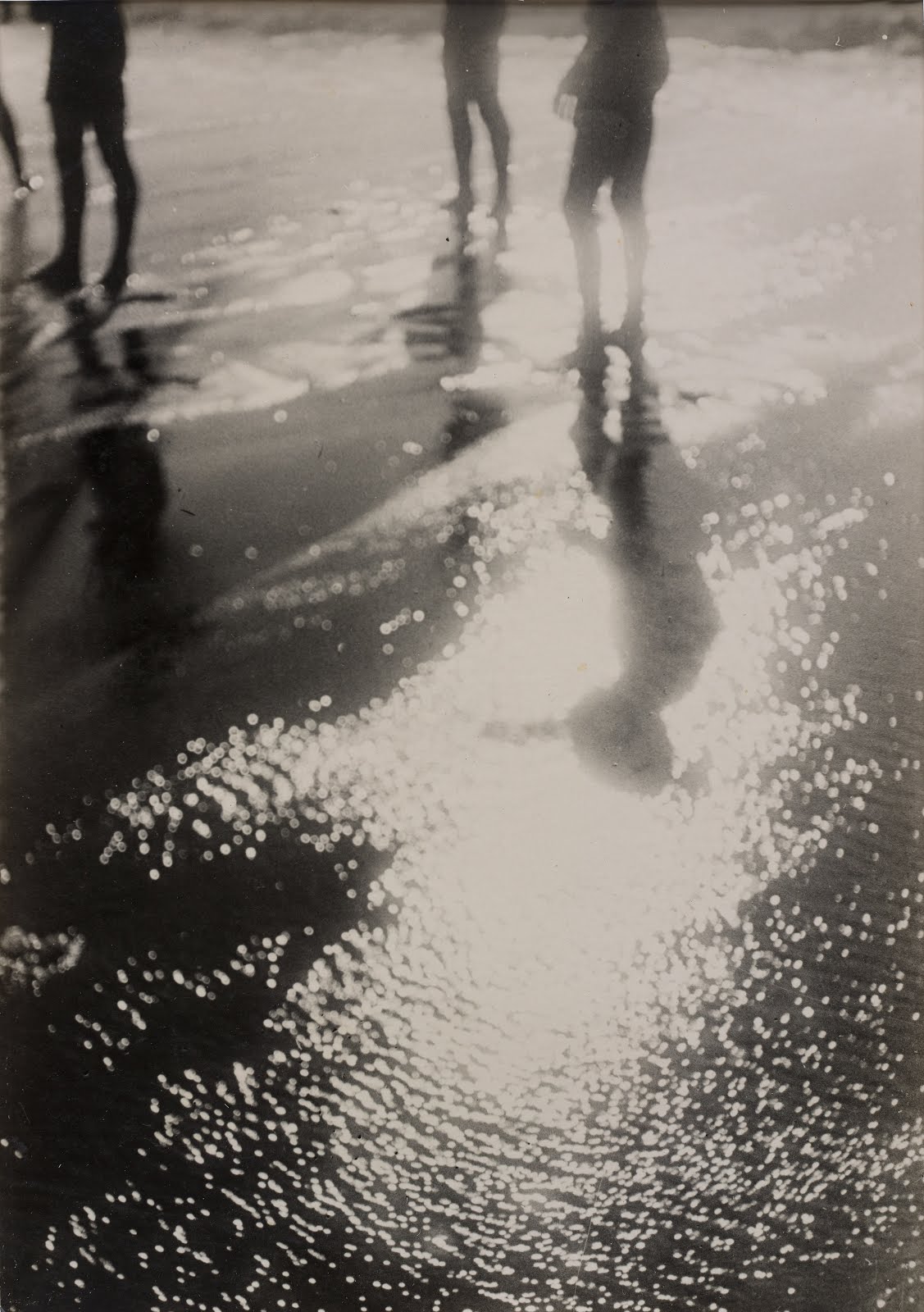
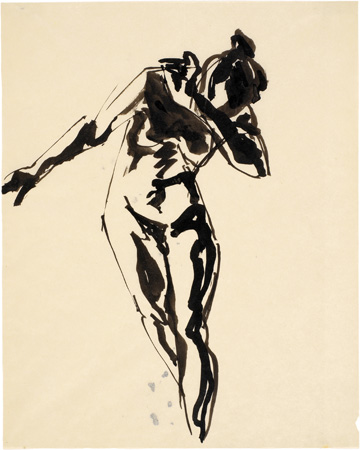

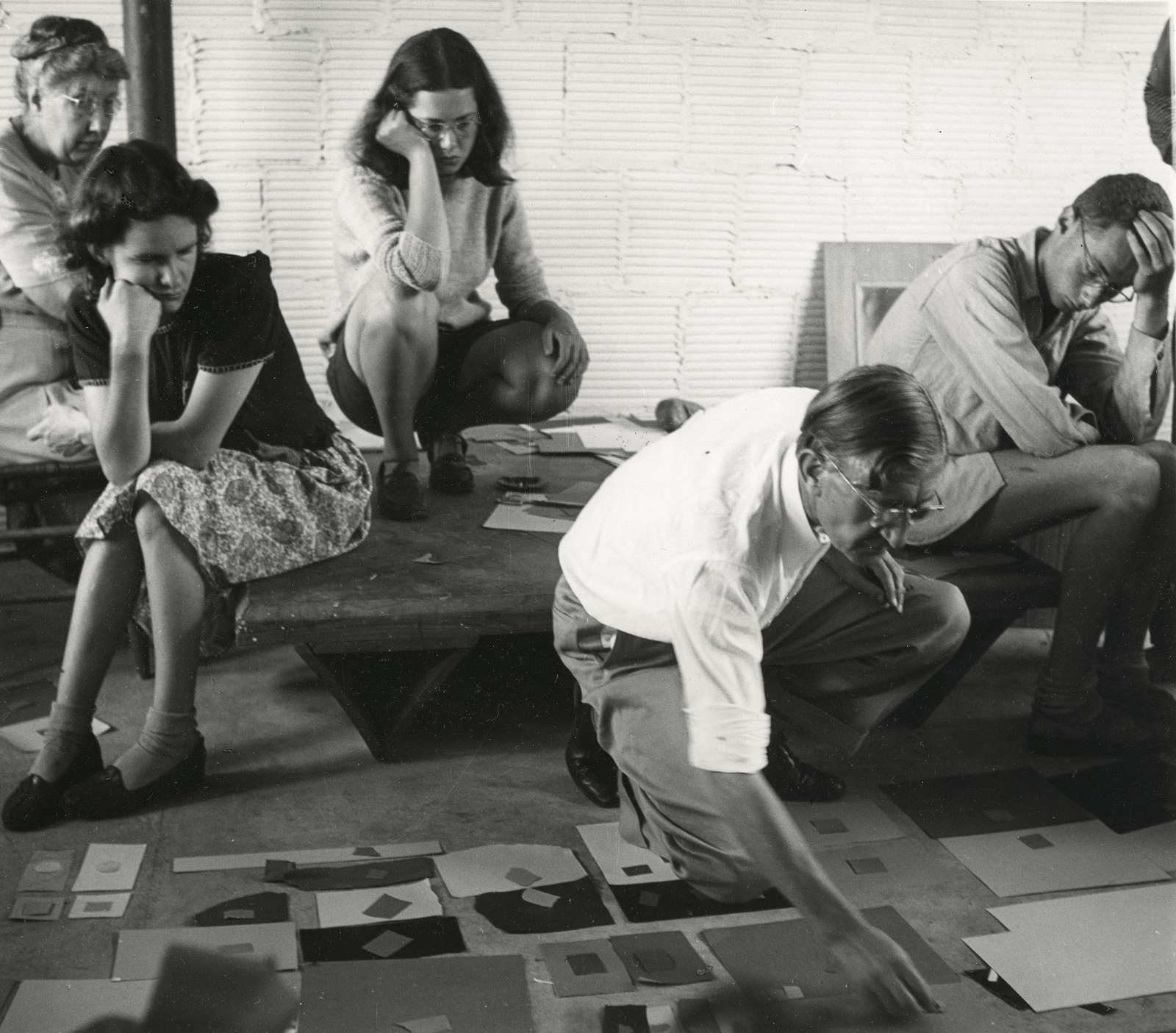

Source: Glass Work/Figure Drawings : Josef Albers : Lattices of Emotional Content
Spatial Practices : Experimental drawing and alternative photography.
Source: Glass Work/Figure Drawings : Josef Albers : Lattices of Emotional Content

https://www.flickr.com/people/russellmoreton/
Structural Modalities/Making/Tensions : Spatial Form to gather/interact with discursive research.
5
Procedural Architecture
Start by thinking of architecture as a tentative constructing toward a holding in place. Architecture’s holding in place occurs within and as part of a prevailing atmospheric condition that others routinely call biosphere but which we, feeling the need to stress its dynamic nature, have renamed bioscleave.
Architectural Body
Madeline Gins and Arakawa
Working Notes/Holding in Place
Entanglement of Matter and Meaning
Intertwining Metamorphoses
Germano Celant
Giuseppe Penone
Diffractions : Differences, Contingencies, and Entanglements That Matter
Meeting The Universe Halfway
Quantum physics and the entanglement of matter and meaning
Karen Barad
Art and Technics
Lewis Mumford
James Turrell
Aten Reign
Miwon Kwon
Under The Volcano
Carmen Gimenez
Kees Goudzwaard
Assemblage
Pinholes and Dust
Grisaille
Transparent Body
Robert Mangold
Column Structure Paintings
Frank Stella Architecture
Architecture as a means towards creating space
The Optical Unconscious
To throw its net over the whole of the external world in order to enter it into consciousness. To think it
Rosalind Krauss
Postproduction
Nicolas Bourriaud
Body
Personal Relations
Spatial Values
Yi-Fu Tuan
Wayfinding/Movements through accumulated research
Running scripts, enactments, instances, involvements
Collaborative texts, complexity, emergent, discursive
From The Bookcase to The Field Table : Landing Sites of Inquiry
Camouflage
Neil Leach
For Benjamin, the twentieth century is an age of alienation. Human beings are no longer ‘cocooned’ within their dwelling spaces. Architectural spaces are no longer reflections of the human spirit. Something has been lost.
Mimesis, 19.
New Concepts of Architecture
Existence, Space and Architecture
Christian Norberg-Schulz
A child ‘concretizes’ its existential space.
A Philosophy of Emptiness
Gay Watson
Artistic Emptiness
Everything flows, nothing remains.
Heraclitus
Rethinking Architecture
Neil Leach
Figure 1, Sketch by Jacques Derrida for Choral Work project. 343
Foucault, Figure 2 Bentham’s Panopticon (1791). 360
Page laid in, The Atrocity Exhibition by J. G. Ballard, new revised edition, annotations, commentary, illustrations and photos.
Tracing Eisaenman
Plenum, juxtaposed to form/haptic values/body absences
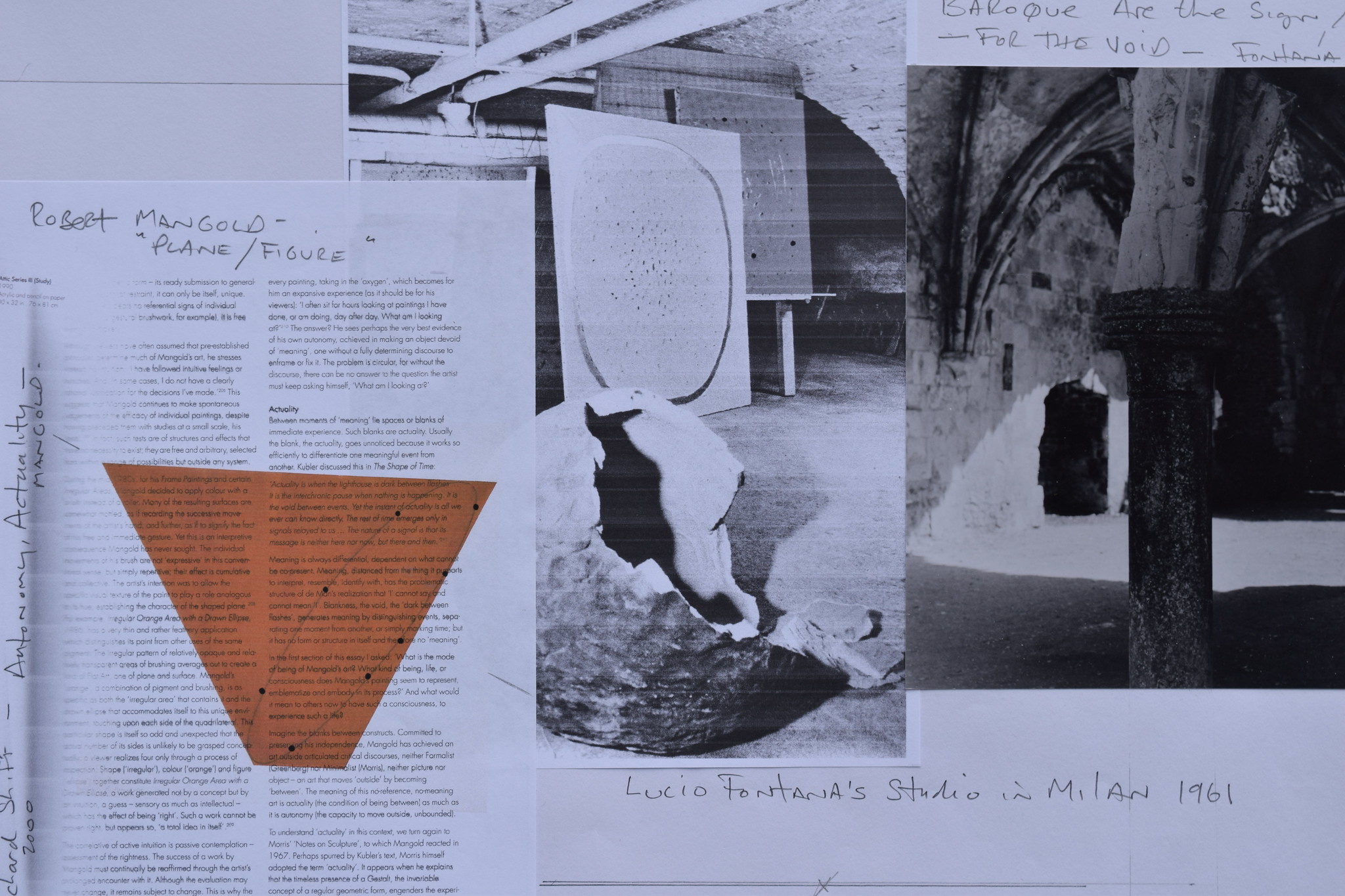
Robert Mangold
Between moments of ‘meaning’ lie spaces or blanks of immediate experience. Such blanks are actuality. Usually the blank, the actuality, goes unnoticed because it works so efficiently to differentiate one meaningful event from another. Kubler discussed this in The Shape of Time.
Interactions of the Abstract Body
Josiah McElheny
Object Lesson/Heuristic Device
The term ‘heuristic’ is understood here to denote a method of addressing and solving problems that draws not on logic but on experience, learning and testing. In this regard stories and fictional narratives can be heuristic devices in acting as ideal models that are not to be emulated but which help to situate characters, actions and objects.
Space Between People
Degrees of virtualization
Mario Gerosa
Adaptive Architectural Design
Device-Apparatus
Place
Function
Adaptation
The second phase of project activity acknowledges that the proposal involves two sites; the landscape of settlement and the artifice of the factory. The design is intended to be a reflection of the conditions of each, so there was a need to work directly with the manufacturing process, at full scale, as early as possible. This would provide an immediate counterpoint to the earlier representations and a necessary part of exploring the manufacturing medium in the context of architectural design. 69
Building The Drawing
The Illegal Architect
Immaterial Architecture
Mark Cousins suggests that the discipline of architecture is weak because it involves not just objects but relations between subjects and objects. And if the discipline of architecture is weak, then so, too, is the practice of architects. Architecture must be immaterial and spatially porous, as well as solid and stable where necessary, and so should be the practice of architects.
Jonathan Hill
Index of immaterial architectures
Herzog and De Meuron
Natural History
Exhibiting Herzog and De Meuron
We are not out to fill the exhibition space in the usual manner and to adorn it with records of our architectonic work. Exhibitions of that kind just bore us, since their didactic value would be conveying false information regarding our architecture. People imagine that they can follow the process, from the sketch to the final, photographed work, but in reality nothing has really been understood, all that has happened is that records of an architectural reality have been added together.
My studio is a piece of architecture that is silent. The things of which it is made say all and at the same time nothing. Its strength lies in its demanding silence. A stern silence in order to permit works to occur. I imagine that a painting by Newman could be hung there.
The arrival of Beuys in a world that was gradually falling asleep amidst minimalism generated a kind of confusion that was truly excellent for opening up the mind. Comfort vanished, driven away by subversive complexity.
Speculative architecture
On the aesthetics of Herzog and De Meuron
Without opposition nothing is revealed,
no image appears in a clear mirror
if one side is not darkened
Jacob Bohme, De tribus principii (1619)
Reflections on a photographic medium
Memorial to the Unknown Photographer
Thomas Ruff’s Newspaper Photos
Valeria Liebermann
Working Collages
Karl Blossfeldt
Sensing Spaces/Architecture Reimagined
Royal Academy of Arts
Social apparatuses and agents that explore the possibilities of space. Other Worlds : Insistent moments of mark making/subjectivity. Russell Moreton
Source: A Situated Practice : Fields/Alignments/Energy : Durational Light Drawings
Outpost 010323


The Parallel Visions of Artists and Archaeologists.
Figuring It Out.
Colin Renfrew.
Archaeologists/Artists, intuitively working with materials that are local and quotidian.
New insights into the way humans use things/people/the earth.
Encounters.
Art as archaeology, archaeology as art.
What is Art.
The tyranny of the renaissance.
Off the plinth.
Display and process.
The human condition.
Being and remembering.
The (al)lure of the artefact.
Baneful signs.
The archaeology of now.
Figuring it out.
The Indexical Body.
Corporeality/Aesthetics.
Contemporary Fine Art/Working from/with the body
Francis Bacon.
The figural body.
Manuel Neri.
The sculptural body in relief.
The Body/Spatial/Temporal
Rituals/Places/Vessels
Awareness/Repetition/Ritual can give meaning to existence.
What Are We?
Where Do We Come From?
The Anthropology of Art.
Constructed as a theory of agency or of the mediation of agency by indexes understood/conveyed through material entities which motivate/create inferences, responses and interpretations.
For Gell, art is not ‘axiomatic’ about a ‘matter of meaning communication’ but rather it is about doing that is theorized as agency in a process involving indexes and effects. Art, its actions and their effects are similarly not discrete expressions of individual will, but rather the outcomes of a mediated practice in which agents and recipients are all implicated in complex ‘participations, ways of relations and their diffractions.
Artists/Prototypes/Things/Recipients/Affect/Generative Relations.
Practical Experience/Cognitive Knowledge/Analysis.
Art and its complex participation/phenomena is distributed by an agent with other agents, the artist attempts to distribute elements of their own efficacy amongst others.
Artists are those who are considered to be immediately causally responsible for the existence and characteristics of indexes, artists/a person both distributed and implicated may also be vehicles of the agency of others.
Alfred Gell.
Conceptual Frameworks/Context
Axes of Coherence/Indexes/Formal Analysis/Repetition/Improvisation.
Resultants that incorporate the friction/asperity of their trajectories through a medium.
Tilt-up concrete construction, Chapel of St Ignatius, Seattle, Washington, USA.
Steven Holl.
Cathected, Aesthetic Phenomenon, Aesthetic Causality, Sensual Object, Allure,
The Projects.
Hungate.
Water, niche, Prisina, font, vessel, grounding body/spirit, apparatus, scaffold, un-doing of Place, Site, Reading the existential qualities of architectural spaces into the corporeal/haptic body, plaster, lime, canvas, whitewash, yellow ochre, water becomes a sacred conduit running through the architectural body.
Raveningham.
Ground Marking, ceramic spheres, Fontana, clay/raku. Movements/Durations on grass to leave temporal traces. String line, shadow sticks, involuntary markers, found objects, collected phenomena,
Undercroft Anglian Potters, Norwich.
Ferini Gallery, Lowestoft.
Social apparatuses and agents that explore the possibilities of space. Other Worlds : Insistent moments of mark making/subjectivity.
.jpg)


Social apparatuses and agents that explore the possibilities of space. Other Worlds : Insistent moments of mark making/subjectivity.
Source: Jozef van Wissem – sola gratia (Live @ Bimhuis – Amsterdam) : The Scriptorium.
Outpost 010223


A Spatial Practice.
Bring things to life, creative entanglements in a world of materials.
Art/Ontology/Education/Philosophy.
Creative practice is a meshwork of what shall I do next?
Tim Ingold.
Things in general, like the mind-leak.
Iteration, following the forces/flows.
Organism-Person-Environment
Gins/Arakawa.
Improvisation is to join with the work or to meld with it, one ventures from home on the thread of a tune.
Lines of Flight
Lines of Becoming
Critically these lines do not connect.
A line of becoming is not defined by the points it connects, or by the points that compose it.
On the contrary it passes between points, it comes up through the middle.
A becoming is neither one nor two, nor the relation of the two.
It is the in-between, the line of flight running perpendicular to both.
Deleuze and Guattari.
Brockwood Teaching Academy.
Back To Free School, Kilquhanity.
Curriculum Making, education for improved human-environment relations.
For to live we must dwell in the world, and to dwell we must already relate to its constituents.
Meaning inheres in these relationships.
Raveningham Sculptural Array
Solargraphy/Land Markings.
Performative Intraventions
Hungate
Water
Site-specific research and artworks.
Water : A Phenomenal Lens
Steven Holl.
We start from the fluid character of the life process, wherein boundaries are sustained only thanks to the flow of materials across them.
Life is all about relations that hold a being in place, an erotic ecology of matter and desire.
Outpost Gallery
Mentorship Programme.
Social apparatuses and agents that explore the possibilities of space. Other Worlds : Insistent moments of mark making/subjectivity.
In an era in which architecture is once more learning its potential as a form of inquiry, rather than as a service — as a producer of knowledge, and not merely of ‘projects’.
Brett Steele, Atlas-Tectonics in Barkow Leibininger, Bricoleur Bricolage. AA 2013
Inquiry is essentially the way of learning.
On Learning ‘The Cultivation of a Good Mind’ J. Krishnamurti, Brockwood 1963
THE WAVERLEY INQUIRY

ROOMS AS EXPERIENTIAL OUTPOSTS
Translations from Drawing to Building.
Robin Evans.
Interiors crafted as a palimpsest of augmented realities.
Robin Evans, Figures, Doors and Passages.
The architect is Not a Carpenter:
On Design and Building, a talk by Tim Ingold Fieldwork on Foot: Perceiving, Routing, Socializing
Jo Lee, Tim Ingold.
The Perception of the Environment,
Essays on Livelihood, dwelling and Skill, Tim Ingold.
The Aesthetics of Decay
Nothingness, Nostalgia, and the absence of Reason, Dylan Trigg. The Projection Room (the darkened room, camera obscura)
Ruin In Architecture and Cinema, Kiefer, Pallasmaa
Sculpting in Time, Tarkovsky
The Artist/’Monk, Andrei Rublev (Tarkovsky 1966)
Six Memos for the New Millennium, Italo Calvino Architecture as a stage for the effects of an immersive cinema. Palimpsest
Edward De Waal, Antony Gormley, Studio Spaces designed by Architects. Tony Fretton on Retreats, Creative Centres and Exhibition Spaces. Herzog and De Meuron, Working Models, Surfaces, Images and Materials.
Subversive Libraries, researching between the walls of culture and politics.
A HUT WITHIN THE INFLUENCE AND NATURE OF ARCHITECTURE
The tendency of technological culture to standardize environmental condition
and make the environment entirely predictable is causing a serious sensory impoverishment. Our buildings have lost their opacity and depth, sensory invitation and discovery, mystery and shadow.
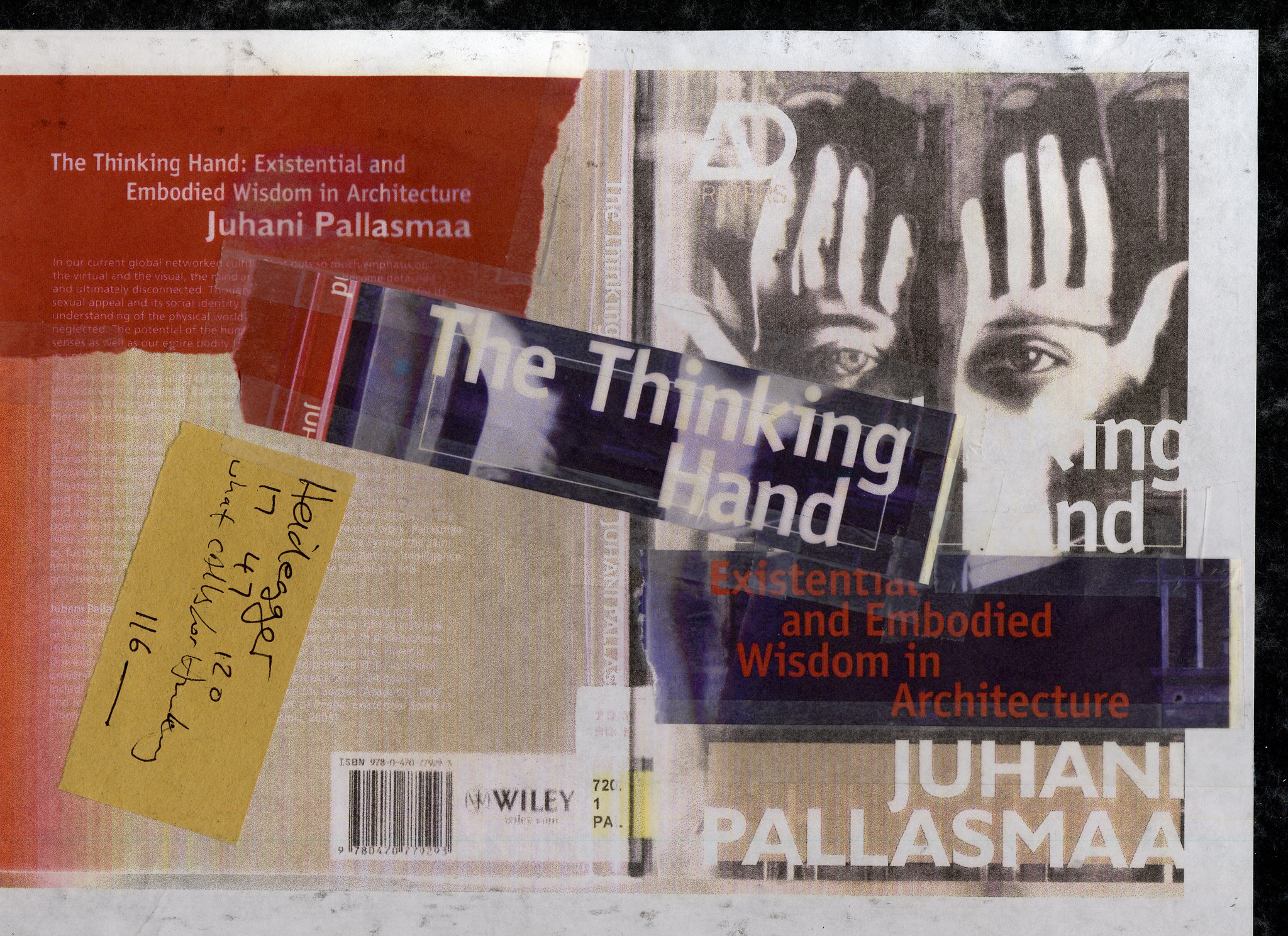
Juhani Pallasmaa. Hapticity and Time. Notes on Fragile Architecture. 2000

The Scriptorium Description of Work
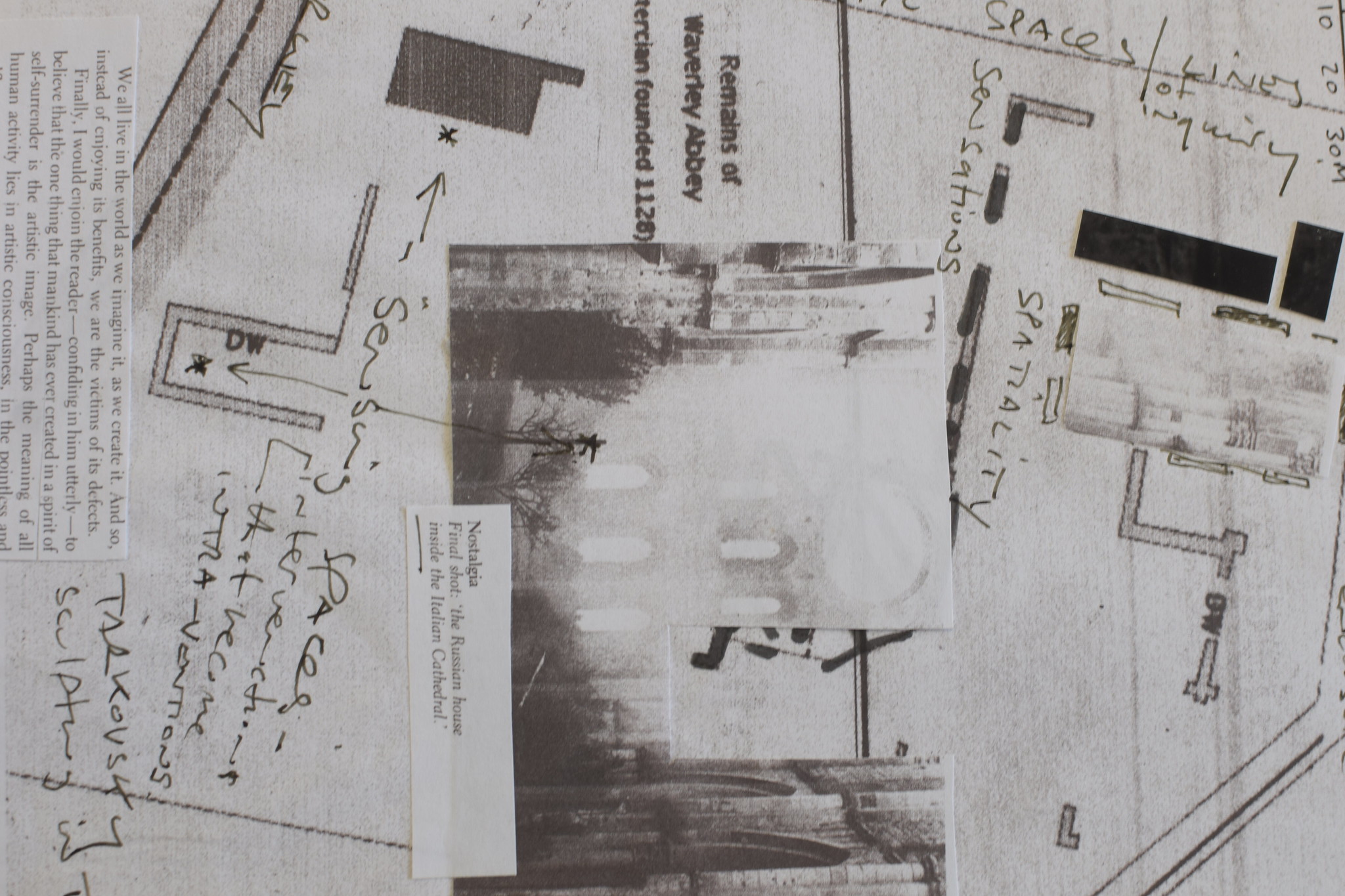
The ruined site of the abbey at Waverley, near Farnham has been appropriated as a site and as a place within which to position and develop architectural and sociological inquires. The design processes of interiors have been employed as a tool to both critique and to create how we might further develop the contents of architecture. This Spatiality and its diffractions of differences and similarities, narratives and subjective experiences are what my interior spaces attempt to initiate.
Design as a interactive structure, an interlocutory interior in the making of space and spatial relations.
Interior design presented as an interactive and immersive spatial inquiry
The Scriptorium brings together a varied and discursive set of objects, texts and i interior architectures. This work seeks to understand how the virtual changes physical architecture and how this affects the space between people and buildings. The “performativity of research” is presented through specifically designed apparatuses and partitions. These designed components, made objects together with annotated texts and drawings conspire to create a complex design led inquiry a “Place Study” staged in a niche-like space. This interior presents itself as both distinct and relational to the other projects in the MA Interiors Show. The interior presents the many manifestations of creative research, structures and even symposia that have been developed through engaging with the site. The visualization of the research and the relational architectures rendered through montage and collage explores digital and analogue technologies. This hybridisation and the use of pinhole photography and film footage further explore interests in the field of performance as an immaterial architecture drawn in the presence of place.
The realisation of my interiors project consists of two separate but relational elements that are presented into a built environment. The small ‘Scriptorium’ conceived as a space as a refuge, an intimate minimal construction that features a doorway and an interior that contains a place for objects, perhaps books, as well as a small sitting area. This construction, an open cell perhaps is evocative to a state of contemplation between the fabric of the everyday. The rather hybrid design appropriates a merging of minimalism, modernism and the plastic architecture of a ruined Cistercian Abbey. The construction comes into close contact with its occupant, it is a restricted spatial apparatus that attempts to promote through its awkwardness distinctive experiences. In particular the apparatus of the Scriptorium and its materiality is attempting to promote a sensory intensification that is further underpinned by the cognitive processes of reading and perhaps other social dialogues. The sensory intensification of a hut like space promotes a haptic sensibility, allowing the nearness and intimacies of both the built space and the imaginative, virtual realm to become entangled. Ultimately the Scriptorium is trying to build on unique human subjectivities that are manifested through a kinaesthetic repertoire or script that helps to enact further spatial experiences. It might be useful to think of this constructed space as itself still under construction, a site that acts as its own vessel within the multiplicities of human perception itself. The influence of the Cistercian Order, the site of Waverly Abbey and its pastoral landscape, have all contributed to a sense of the design process, The Scriptorium like the ruins themselves is open to the elements. Waverley Abbey remains as a sensory site between the remains of architecture and its society and the effects of our own global culture in the information age.
In troubled times they all sought to experience life away from social definitions of success or failure. From there, these primitive huts marked personal, original inquires into the ever-mysterious nature of human existence.
Anne Cline. A Hut of One’s Own
Life Outside The Circle Of Architecture.
The Scriptorium began through a research of both architectural themed texts and documentation of the site, and creative practice involving photography (digital, analogue and film) art practices of collage and drawing. The many visits promoted my own subjectivities to the site and these were also frequently subjected to change by the intervention of others in unexpected ways, these social intrusions by other revealed the very boundaries that the historic site engenders, some playful other malicious. These extremities within the social order of the visitors became problematic in designing for the site itself. An earlier proposal to host a Symposium centred on the Arts and The Humanities, that would use the Abbey and its surrounding ground appeared to be a project of vast diversities and logistics better suited to a cultural project through arts management and funding. As the project developed certain creative methodologies around particularities of the site itself began to appear, the notion of palimpsest being one of them. This promoted the idea of a reading room, as an ephemeral interior space that gathers up the experiential values of ‘ruins’ and re-enacts them as a site to explore the architectures of images. It became apparent that ‘palimpsest’ could be both a visual surface of erasures, earlier markings partially over written by newer ones ‘annotations’ and it could be a scaffold of developing ideas clearly visible merging as adaptations into the very usage of the site.
These re-imaginations through the notion of palimpsest seemed filmic and as such they would able to display a vast amount of diversities and subject matter, a library of recourses that would require users or an audience or both. The referencing of the reading room to the library, and the symposium to the cinema or theatre allowed me to realise that I was dealing with a number of spatial arrangements that needed to develop together, but which could be employed separately. The theatre of research became the vehicle in which to see if this collaboration might be possible.
The use of the image and text in my architectural collages allowed me to visualize associations, to create the possibilities of interior spaces that might be manifested into the built environment. The use of the collage in Architecture is widely acknowledged, architects from the likes of Mies van der Rohe, Daniel Libeskind and Rem Koolhaas. The ability of the collage process to juxtaposition fragments, images and texts from irreconcilable origins into an experience, that is visual, tactile and time-based makes it an interesting tool into the realms of architectural design. Collage begins to visualise not only the structure of spaces but also there content and circulation. The theatre of research is interested in how to promote collage and its use as a cognitive and perceptive tool in architecture.
Collage and montage are quintessentially techniques in modern and contemporary art and filmmaking. Collage combines pictorial motifs and fragments from disconnected origins into a new synthetic entity, which casts new roles and meanings to the parts. It suggests new narratives, dialogues, juxtapositions and temporal durations. Its elements lead double-lives; the collaged ingredients are suspended between their originary essences and the new roles assigned to them by the poetic ensemble.
Juhani Pallasmaa. The World is a Collage
Jennifer A. H. Shields. Collage and Architecture
Both the Scriptorium and The Theatre Of Research exist only in the form of the exhibition presentation. What they singularly of together propose can only be imagined through their manifested form as static objects placed within a built structure that loosely references architectural concerns and materials. They appear diminished and assigned to the voyeuristic gaze of the visitor that is equally curios and dismissive. These objects and the interior spaces they promoted seem stilled and stalled, as much they appear beyond reach as if the authenticity of their materials and construction have some how been subsumed by their stature and scale. The issues and qualities of which they are attempting to speak of seem reduced by the hegemony of vision, there is little hapicity and time to encounter, only it seems by investing narratives can we begin to re-enact the spatial encounter.
How might the performativity of research be staged, and into what contexts might it be appropriated?
As Hans Ulrich Gumbrecht notes, we live in a culture of meaning, not in a culture of presence. We constantly produce effects of meaning and multiply them with mass media. This applies not only to the humanities but also to a large degree to our wholly normal everyday lives. And in this respect, our experience of presence is getting drastically lost.
Art works may never completely be explained by theory or meaning. The sensual, material makeup of the work in its presence is not the cinders, slag, and ashes, the undigested remains of theory, but remains of an intensified moment
Peter Lodermeyer.Time, Symposium Amsterdam 2007.
Personal Structures, Time, Space, Existence.
The question I ask is do these objects and their interior spaces cause me to think beyond mere representation and recognition, or rather do they create enough of an encounter to force me to engage with them, even if I or the viewer are un-certain as to their meaning or possible outcome. Deleuze comments that something forces us to think. This something is not an object of recognition, but a fundamental encounter. Something that challenges us. Have these miniature architectures of objects become relational, do we start to use them in perhaps a heuristic manner, a hands-on approach to learning or inquiring, something that we can discover for ourselves. This heuristic finding-out could be made informative through collective collaborations and exhibition through the theatre of research. Is design stripping us of our qualitative spaces as the digital tooling removes the makers trace.
The model object has served as a thinking place in the development of the idea of the Scriptorium. The materials used and their proportions echo interests in Minimalist Sculpture, the intervals between things in the work of Donald Judd and the architectural languages of memory and tectonics of the craftsman turned architect Peter Zumthor. This open sided hut seems cut away almost anatomical as if we were looking into the internal workings of an environment and resident. The structure would have to be made relational to its surroundings if it were to be placed in the landscape. Adaptations to weather the structure, to make it serviceable for use. The Scriptorium has analogues to the notion of a fire-place and its chimney stack. It is a the heart of a building the place of warmth, of dialogues and under the influence through fire of the imagination. The incompleteness that surrounds the scriptorium creatively asks for further design proposals that are even more site specific. The Solar Pavilion built by the Smithsons utilised the old fire place and chimney from the demolished cottage. Around this central element they developed the beginnings of their Modernist (Brutalism) pavilion, an architecture clad with glass, wood and zinc and contained by a walled garden and situated in the pastoral landscape of Wiltshire. Furthering the themes of being in the landscape the Scriptorium could become an observatory, as place from both to look out from and also to look in. The mobility or need to be re-assembled from site to site could promote innovative design solutions as well as interesting detailing or use of materials and surfaces that would facilitate interactions between visitors.
The notion of the Scriptorium becoming clad by an exterior skin, an ephemeral membrane which would then render the differences between the interior and the exterior into the realms of an almost immaterial architectural experience; in as much as the usual distinction between the unpredictable forces of nature outside and the predictable domestic spaces inside. This prompt further investigation into an architecture that blurs the boundaries of both architecture and nature, this could be further explored through the notion of quixotic gestures, art and performance that can capture the experience and the experiential engagement with the natural elements. The Scriptorium becomes the centred structure of remnant that is surrounded by an architecture that can create imprecise boundaries through inconsistent materials. This spatial arrangement will create its own qualitative responses, dialogues and subsequent movements. Architecture in this context becomes purely a sensorial response.
The body as the vector for active mediation with the world of the spirit. The body is the instrument of a qualitative evaluation, the measure of intensity, which alone is capable of giving space extension and modifying it Space is no objective parameter; it must be ‘excavated’ related to the mobile living parametrics of the body.
Frederic Migayrou. Architectures of the Intensive Body. Yves Klein. Guggenheim. 2005
Mark Prizeman. Intensity. Ephemeral, Portable Architecture.
Time, space and existence are amongst the greatest of themes-so great that we could never be so presumptuous to think we could do them justice, and too close that we could ever escape them, whether with our thoughts or actions, in life or in art.
Peter Lodermeyer. Personal Structures Time. Space. Existence. 2009
My design project has attempted to produce spaces and their interiors together with the apparatus of the Scriptorium that qualitatively seek to inquiry into the world we inhabit. The Theatre of Research attempts to establish some sense of a community that can do field work that invigorates the perception of the environment. My own interests are centred through experientially and mindfully exploring voids, cavities, and spaces between things, together with use of clay, glass and other vernacular materials. As an interior designer/artist I have become experiential to the agency of spaces. The theatre of research becomes a meeting place for furthering my programme initially proposed as a symposium at Waverley Abbey.
Through experiencing familiar images, smells, sounds, and textures, but also through making certain familiar movements and gestures, we achieve a certain symbolic stability. Disrupt that familiar world, and our psychic equilibrium is disturbed. From this we can surmise that home, and the operations performed at home, are linked intimately with human identity. Architecture, it would seem, plays a vital role in the forging of personal identities.
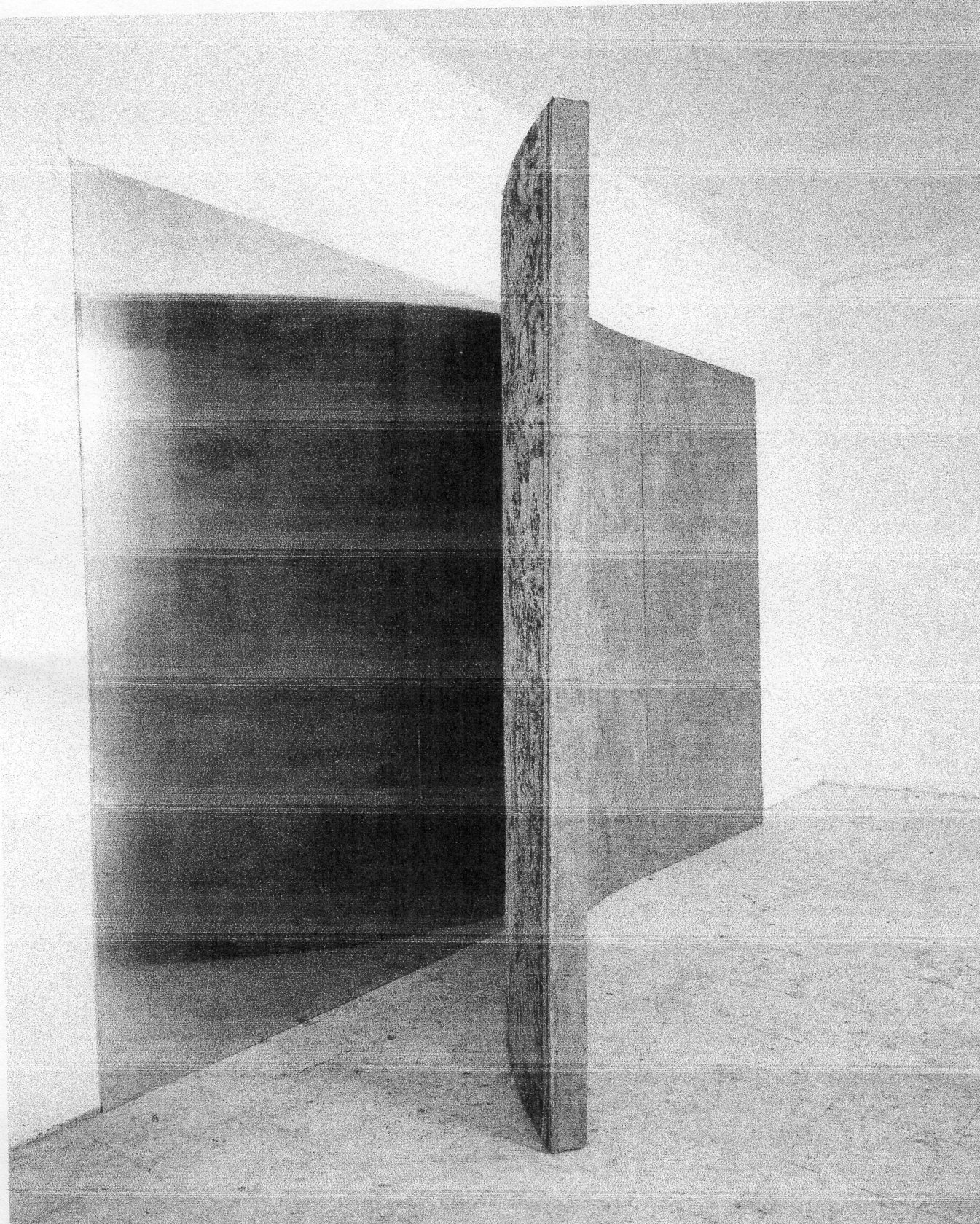
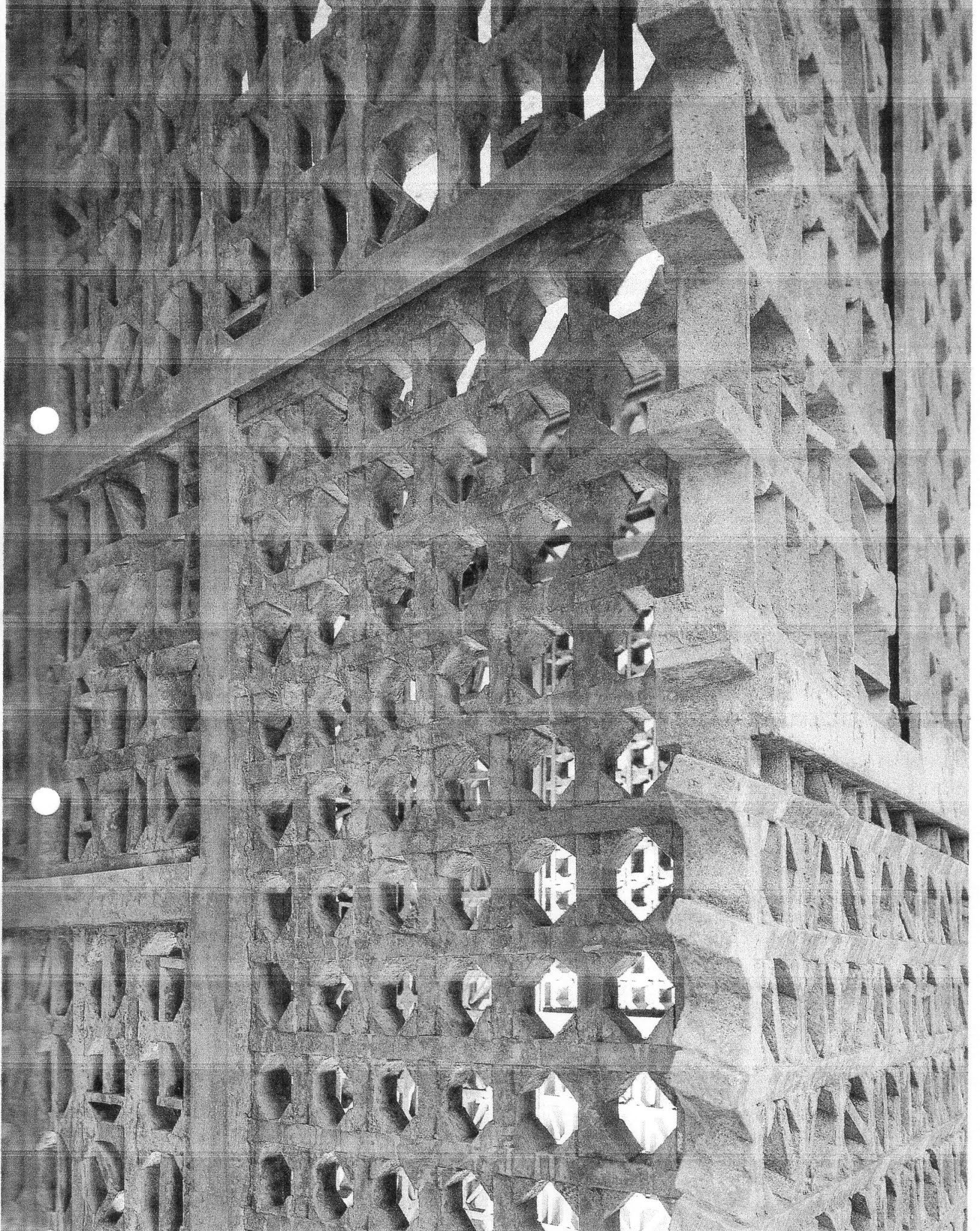

Neil Leach. Camouflage
Analysing the desire to blend-in with our surroundings
Beyond the limits of academic levels of discourse and learning
Building/Working with Theoretical Objects in Architecture
The Scriptorium would need to collect up and question considerable more qualitative data. Some sort of portable shelter, lightweight and offering some protection from the elements; would have allowed longer periods of stay and the possibility of experiencing different times of day. The activity of walking to the site, of having to incorporate it into a journey would help to create a stronger sense of place and routine. I am interested in the ‘thingness’ of this place, its influence and how its influence might be transposed into a methodology of reading, theorising and making. I am reminded of the Peter Brook who deliberately demolished his avant-garde theatre building Bouffes du Nord in Paris so as he could create a more emotionally responsive space for theatre. It is this under the influence of the Abbey, which I wish to explore as a creative catalyst, a tool that picks up on its differences as qualitative readings. The ruin by its very nature has re-defined its own architecture from one of form into that of experience, this sense of liminality or immateriality that constitutes itself as the architectural experience.

A good space cannot be neutral, for an impersonal sterility gives no food to the imagination. The Bouffes has the magic and poetry of a ruin, and anyone who allowed themselves to be invaded by the atmosphere of a ruin knows strongly how the imagination is let loose.
Peter Brook. The Open Circle
Andrew Todd. Peter Brook’s Theatre Environments. 2003
Social apparatuses and agents that explore the possibilities of space. Other Worlds : Insistent moments of mark making/subjectivity.
Source: Inquiry is essentially the way of learning : Fragile Architectures of Hapticity and Time
When you make photograms, without the use of a camera, you can indeed call that abstract photography, as the lens and the corresponding registration medium are lacking. No longer do you have pictures of reality or objects; you only have their shadows. It is a bit like Plato’s cave, where one could only imagine reality; the objects themselves were not visible.
—Thomas Ruff
Frameworks with Enclosures 6
Of the mason’s who built them, we can say that they both designed as they drew, and drew as they designed. But their designing, like their drawing, was a process of work, not a project of the mind.
Tim Ingold ‘Making’
The Mirrored Abbey : The Photographic Aesthetics of Decay
Nothingness, Nostalgia and the Absence of Reason.
The Aesthetics of Decay, Dylan Trigg,
TRANSPARENT MEDIA : Form,structure, space, enchantment
Double Take
15 APR – 3 JUL 2016
A two-venue exhibition exploring the relationship between drawing and photography, taking place at Drawing Room and The Photographer’s Gallery, London.
Drawing and photography are each considered the most direct, ‘transparent’ media with which to engage with the world. They share fascinating parallels: the relationship to the indexical, the blank sheet of paper or surface, graphite and silver, pencil weight and aperture, the sense of an invisible ‘apparatus’ (the camera and pencil), the engagement with surface, light, negative and positive and the trace. Double Take seeks to explore the multifarious ways photography and drawing have been combined and mirrored to extend both practices into new arenas in modern and contemporary practices.
“… a freehand sketch diagram that was at the tangent between idea and imagination…if the parti – the first critical diagram – is not made well, it will be difficult for architecture to follow. If there is no parti, there will be no architecture, only (at best) little more than the utility of construction. Buried within their early sketches is the germ of a narrative or language. The early diagrams are reflective conversations with the language of architecture.”
– Alan Phillips, Brighton, UK


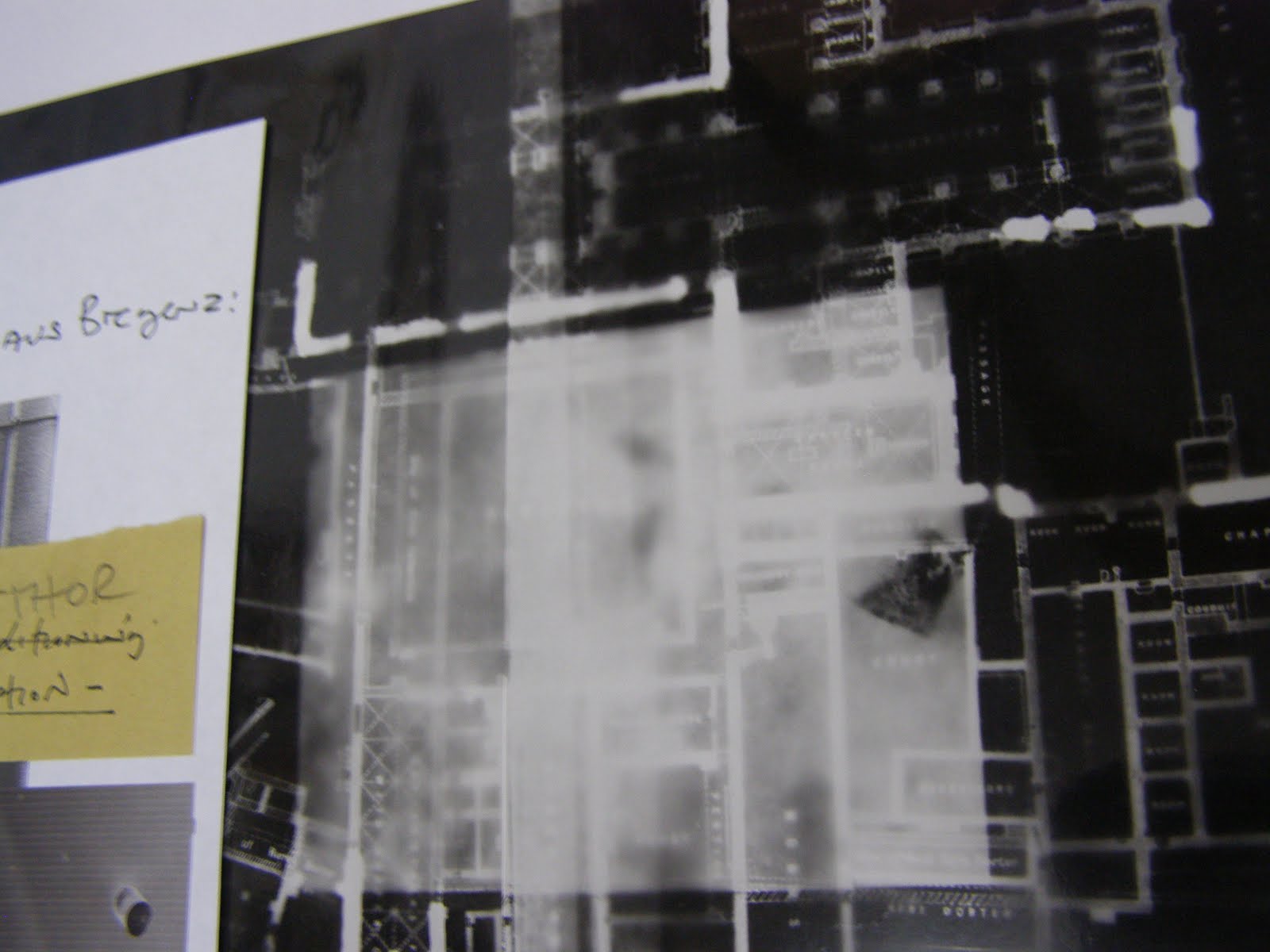

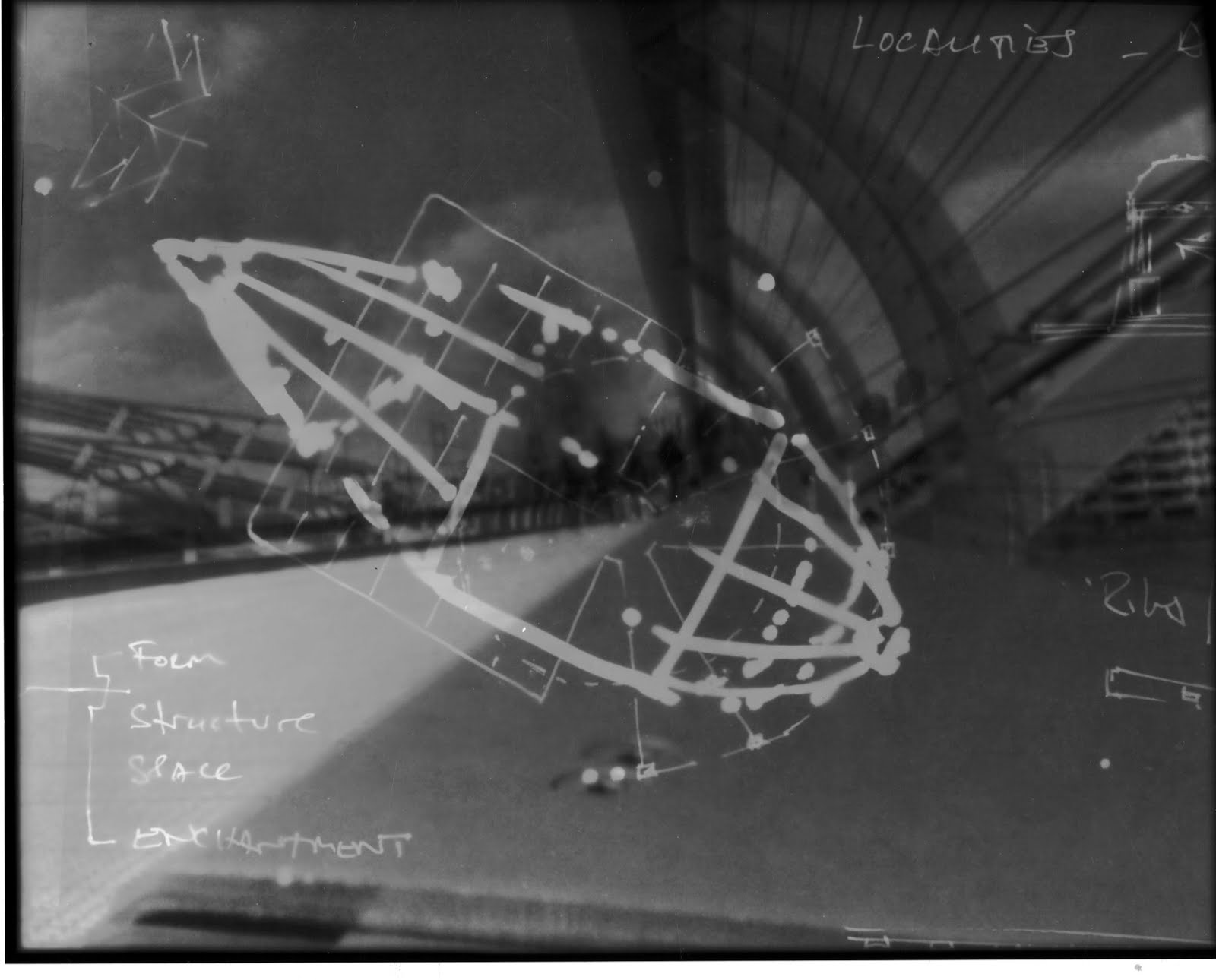
Social apparatuses and agents that explore the possibilities of space. Other Worlds : Insistent moments of mark making/subjectivity.
The Archaeological Site : Speculative Fields/Spatial Practices
What are we? Art/Archaeology.
Contact Photography.
Historical Presence #4
Figuring it out.
What are we?
Where do we come from?
The parellel visions of artists and archaeologists.
Colin Renfrew.
Do you live as Humans in the Holocene or as Earthbound in the Anthropocene? (50.37)
Dr. Bruno Latour on climate change and the “Anthropocene”: Wall Exchange, Fall 2013


Social apparatuses and agents that explore the possibilities of space. Other Worlds : Insistent moments of mark making/subjectivity.
Source: Earthbound : Alternative Processes/Art/Archaeology/Philosophy


Social apparatuses and agents that explore the possibilities of space. Other Worlds : Insistent moments of mark making/subjectivity.
Source: Sensing Places : Dwelling/Making/Attention/Environments
The enchantment of modern life: attachments, crossings, and ethics : Jane Bennett. 2001.
It is a commonplace that the modern world cannot be experienced as enchanted–that the very concept of enchantment belongs to past ages of superstition. Jane Bennett challenges that view. She seeks to rehabilitate enchantment, showing not only how it is still possible to experience genuine wonder, but how such experience is crucial to motivating ethical behavior. A creative blend of political theory, philosophy, and literary studies, this book is a powerful and innovative contribution to an emerging interdisciplinary conversation about the deep connections between ethics, aesthetics, and politics.

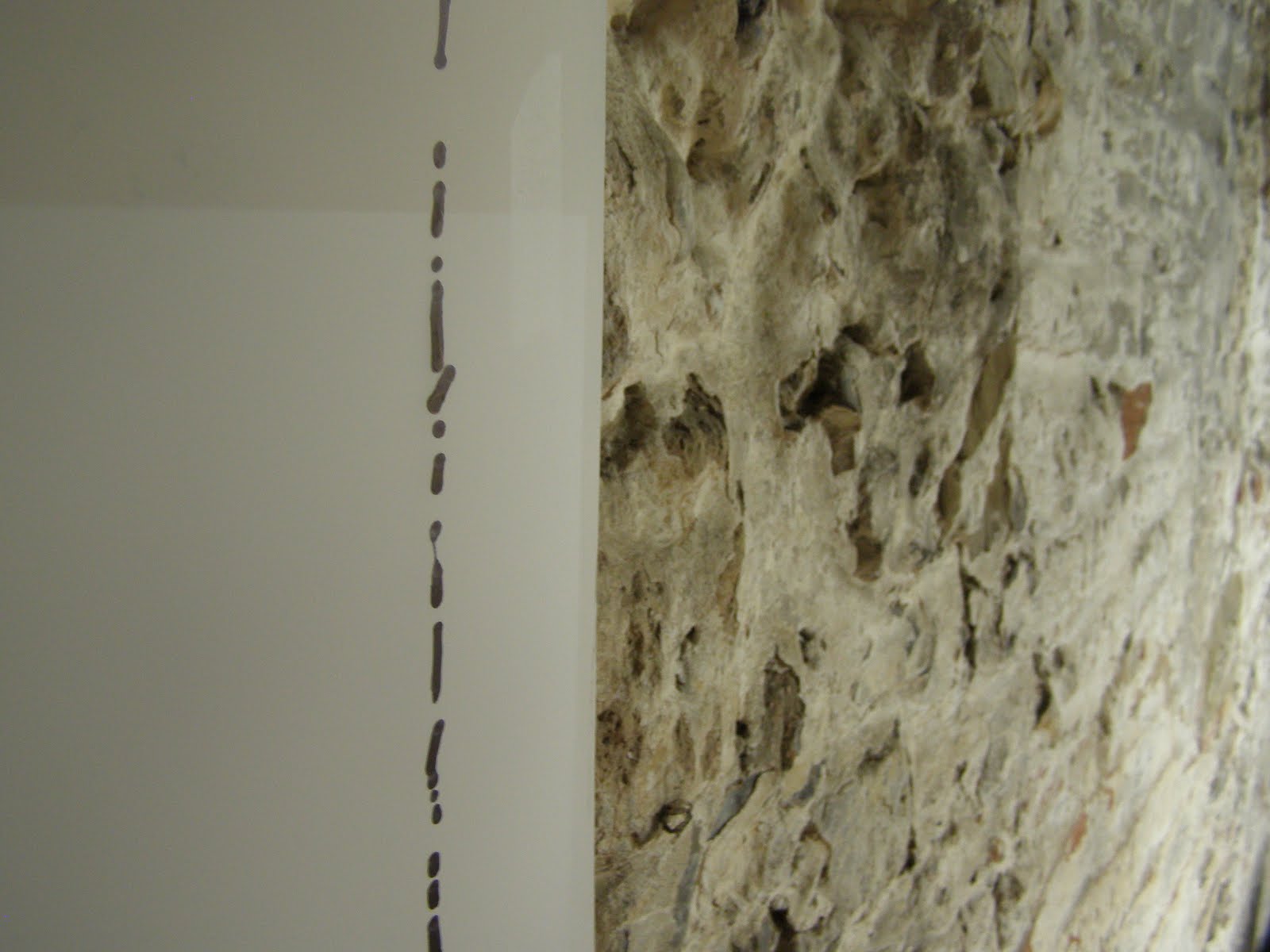
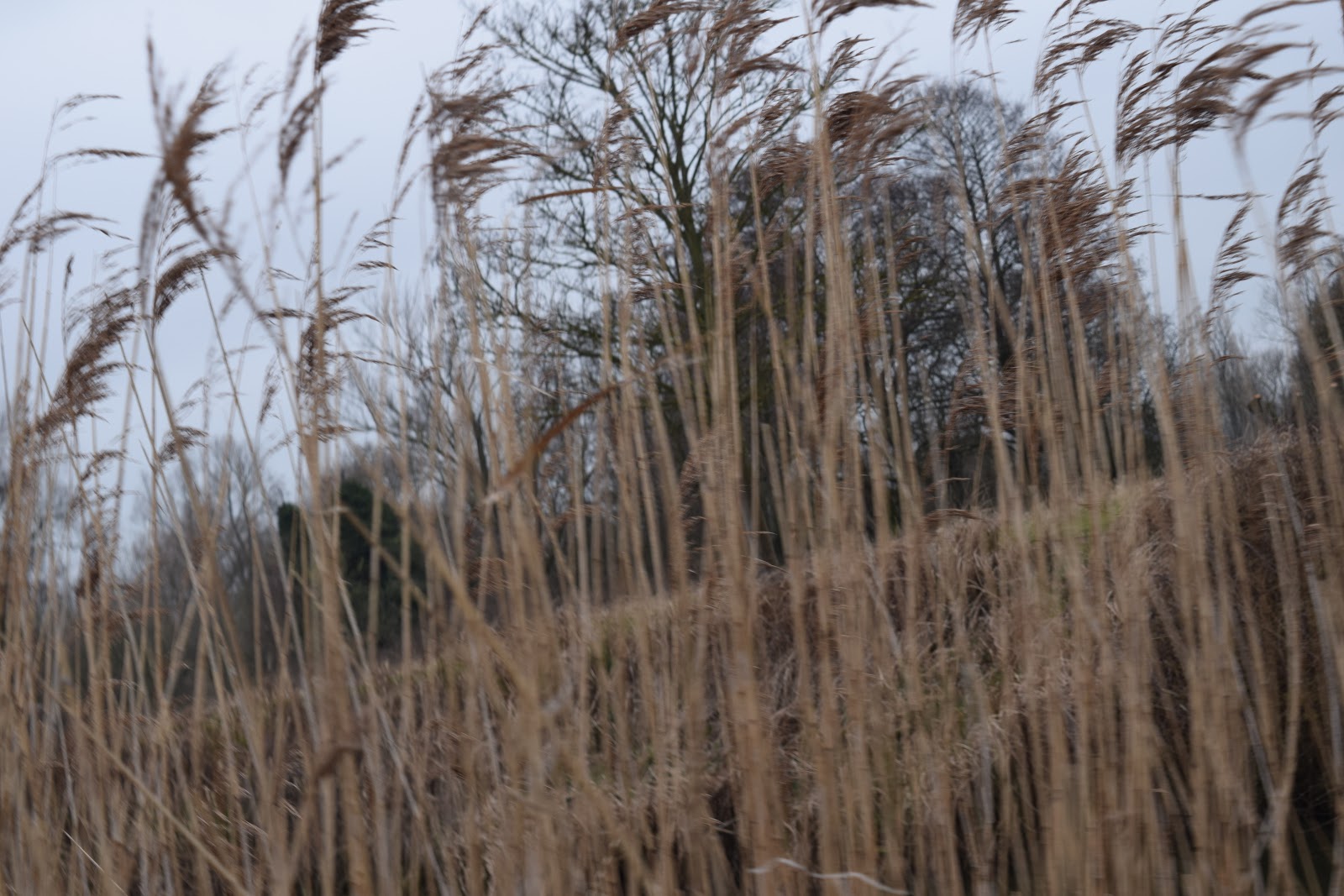

Social apparatuses and agents that explore the possibilities of space. Other Worlds : Insistent moments of mark making/subjectivity.
Source: Pure Presence : Ethics/Aesthetics/Politics, Jane Bennett
 russellmoreton.com