A Vessel Defines Emptiness As Presence : Craft, Studio Practice /Theory and Analysis on Hans Coper, Edmund De Waal, Martin Heidegger
STUDIO PRACTICE, THEORY AND ANALYSIS.
MA SCHOOL OF CRAFTS AND DESIGN.
Working Notes : Brockwood Granary 2014
Theory and Analysis Documents, UCA Farnham

Working Contexts/Title : Spatial/Making analogies/relationscapes
“Innerness” in Ceramics/Architecture and Philosophy/Painting
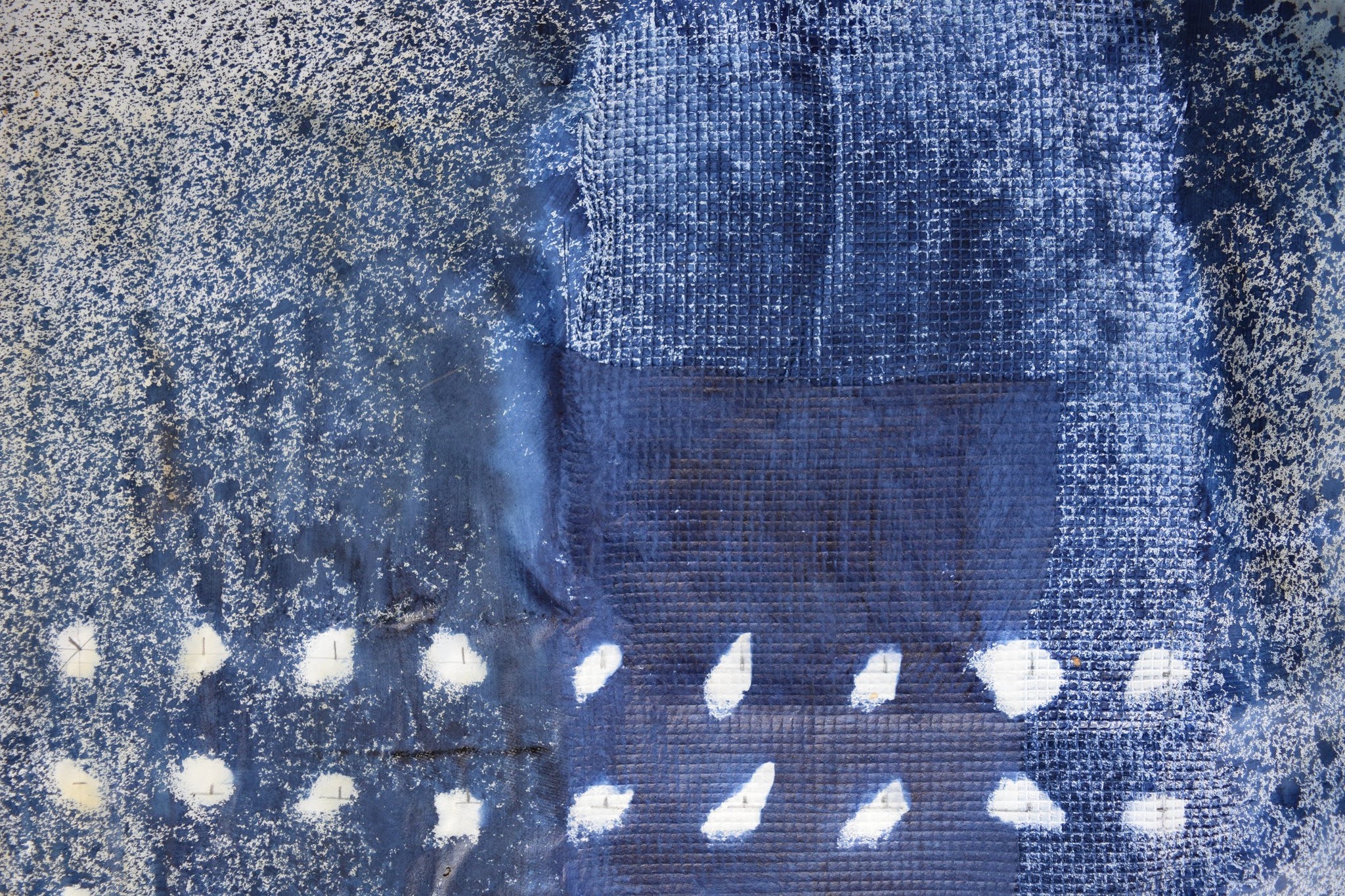
BUILDing something “existentially unknowable” but with a critical context.
The CONTENTS of the INTERIOR, defining encounters between objects, feelings and taxonomies, bibliographic research material and explorations.
Making Things, to locate subjectivities and ground relations around the fluid and the relational.
Interfaces around the nature of place, its document and its textual narrative creating spatial subjectivities, tools as ways of thinking.
An Assemblage as INTERIOR, contingent to its situation of partial un-builtness.
Space as both text and its scaffold.
Interior as an “Open Text” the spatial development of research from various approaches.
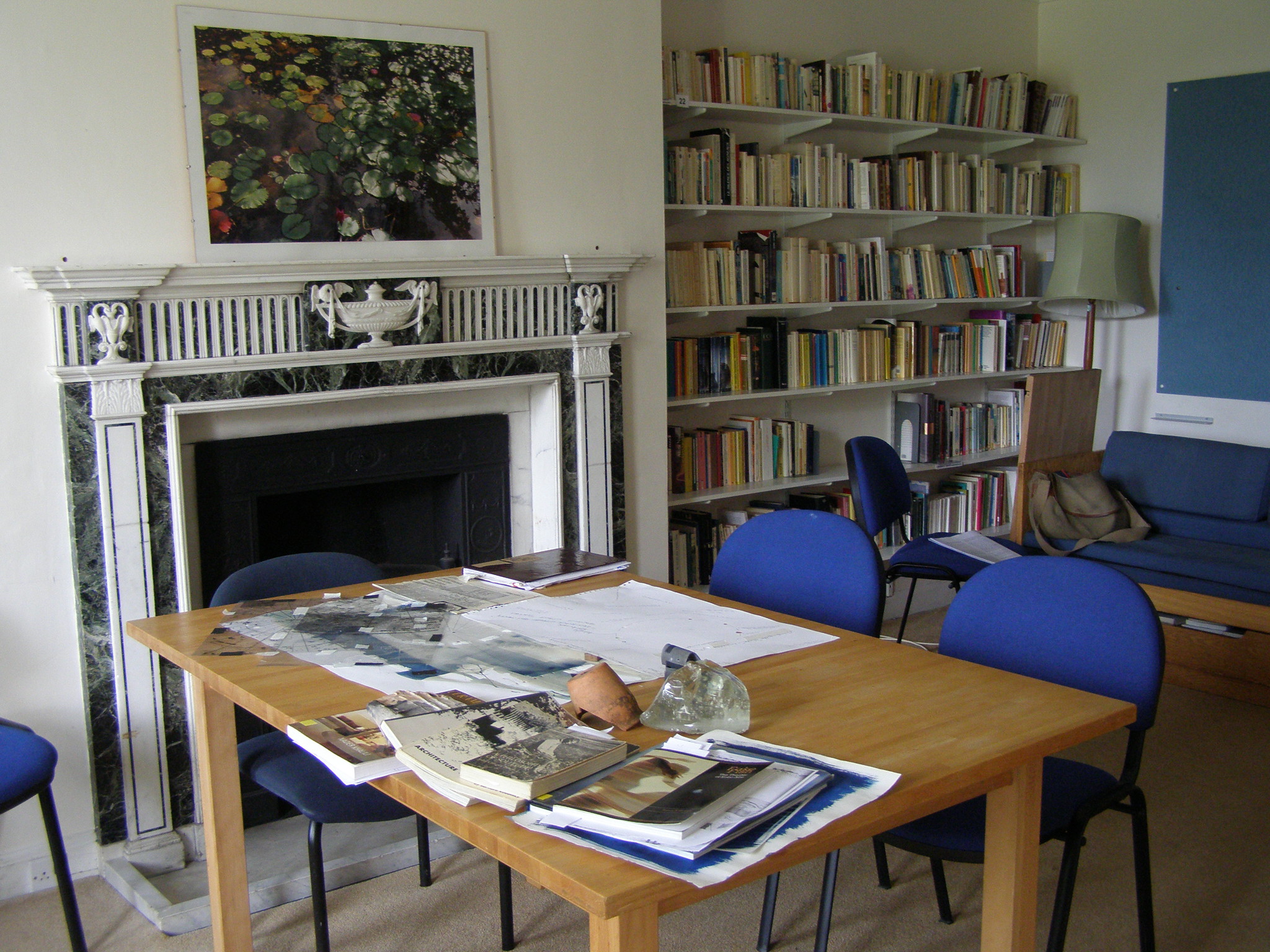
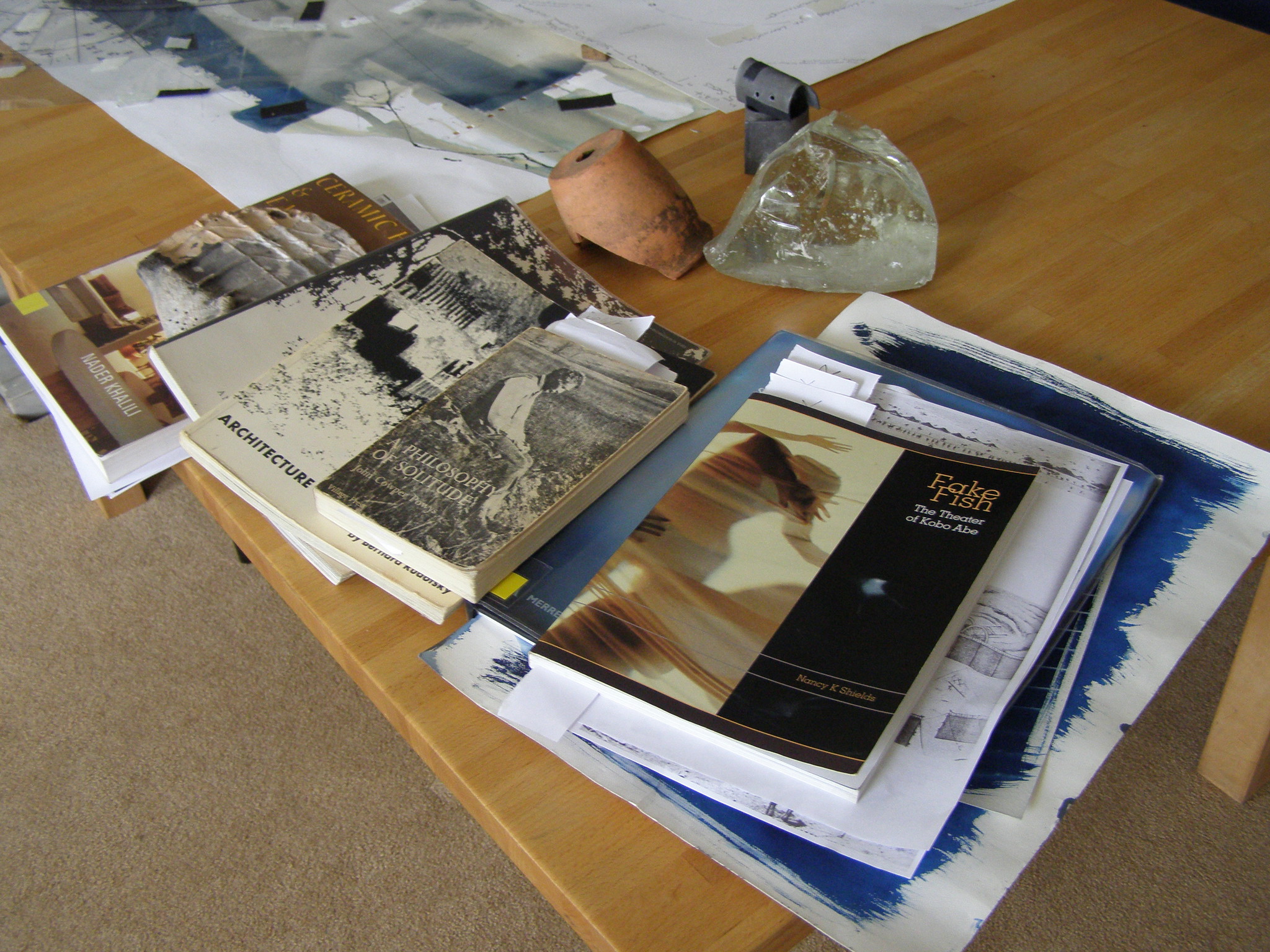
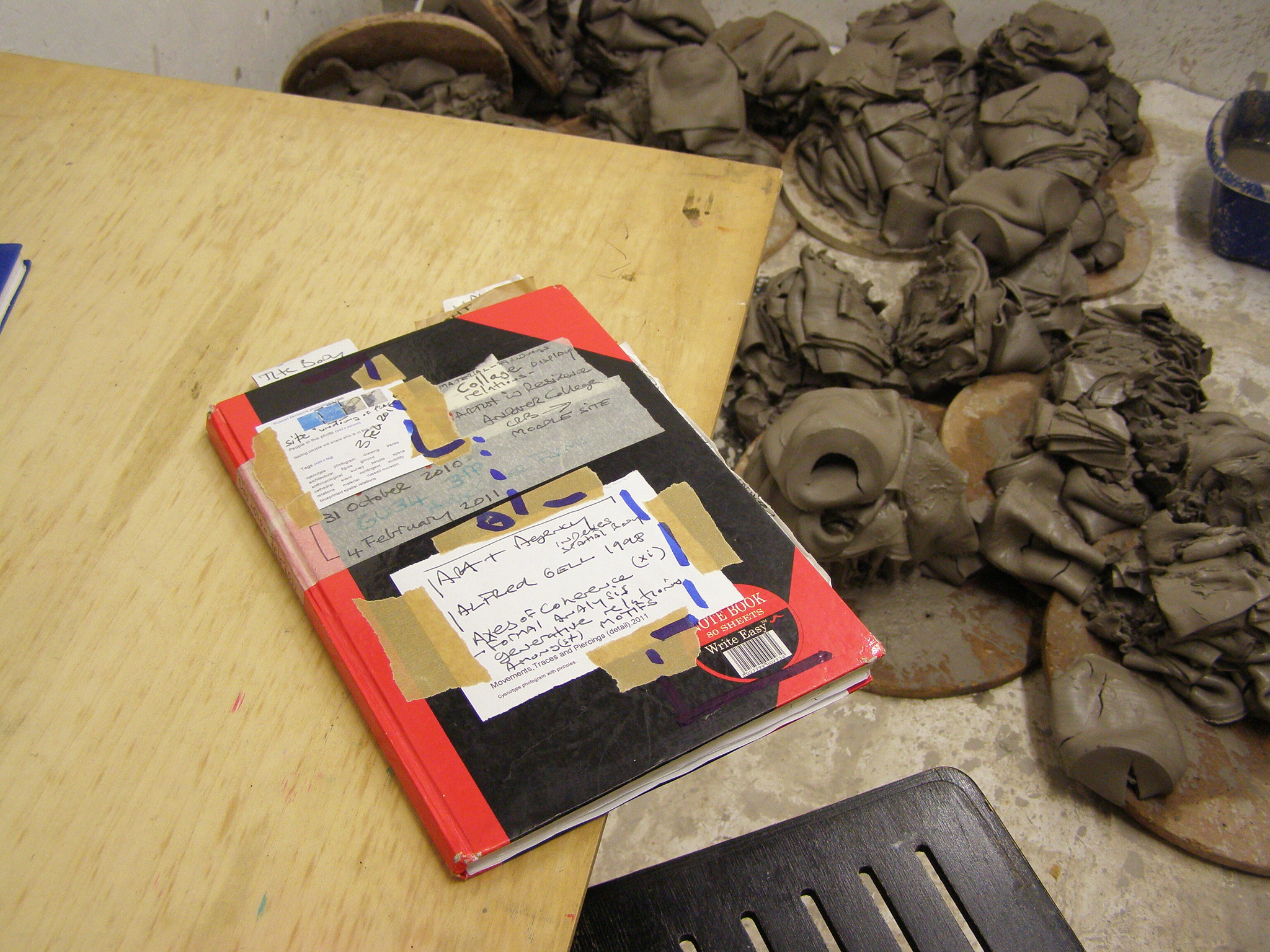
Hans Coper, essay re “Object Analysis” for CSC Exhibition has opened up a number of new avenues of research.
Jean Vacher acknowledges Hans Coper’s links with Modernism and that his pots possess an “innerness” that might be profoundly biographical in nature stemming from “the profound displacements that occurred to him and his family as a result of the upheavals in Europe.” (Personal e-mail correspondence CSC 28March 2014)
“The Pot, ancient as it is, is the first instance of pure innerness, of something made from the inside out.”
Adam Gopnik 2014
“A predynastic Egyptian pot, roughly egg-shaped, the size of my hand : made thousands of years ago it has survived in more than one sense. A humble, passive, somewhat absurd object, yet potent, mysterious, sensuous. It conveys no comment, no self-expression, but seems to contain and reflect its maker and the human world it inhabits, to contribute its minute quantum of energy.”
Hans Coper, 1969
“Innerness” from Atemwende by Edmund de Waal, text by Adam Gopnik.
The material goes down, gets wet, is pulled open by the hand, spins and then produces, as if by magic, the most transcendently human of all things: volume, inner space, an interior, the space carved out of air that connects the morning teacup with the domes and spandrels of San Marco.1
The Potters wheel, one of the most ancient forms of technology, pastoral and low-tech. The notion of making and its practice of craft could be seen in Heideggian terms as a sort of dwelling, a thinking through materials as a building adapting to the process and situation of the practitioner.

Heidegger on Architecture, through Building Dwelling Thinking.
His definition of the state of nearness that is carried in an object “nearness is at work in bringing near” and that in so doing it is a fundamental aspect of human experience, and as such it can be experienced and appreciated through the tactile, cognitive and sociological familiarity of things. (Adam Sharr. Heidegger for Architects)
“Nearness thus becomes a function of immediacy: one is near to what one finds immediate,”
Is this trait reflected in the throwing of a pot and the urgency of the wet clay?
The agency of throwing and its attentiveness between mind, body and material.
“I become part of the process, I am learning to operate a sensitive instrument, which may be resonant to my experience of existence now.” ( Hans Coper on Throwing)
“A naked confrontation with a single material which would show one’s every mistake and mark.” (Tony Birks comments on Hans Coper’s relationship with clay)
“You have to work quickly and with definition, and your ideas have to come into focus with enormous rapidity.” ( Edmund de Waal)
The Porcelain Room:
Pots and room together to create an experience of possessed space. (Edmund de Waal)
Use of the Jug as both a hypothetical (cognitive, thinking through things) and actual vessel to carry connotations of meeting and assembly through its void.2
This interior space/void/Ma is echoed in architecture as referenced by Kengo Kuma, Sensing Spaces RA 2014.3
“The jar takes dominion over the unmade world.”
Wallace Stevens
1 Adam Gopnik. About the art of Edmund de Waal. 6
2 Adam Sharr. Heidegger for Architects 32
3 Kengo Kuma. Sensing Spaces RA. 65
Working Notes: 10 April 2014.
Crit UCA Farnham MA Interiors
Interior “encloses space” Design “useful”. Damien Blower
“Forms” “ a labyrinth” as a being evocative of a formal design language.
4 Dimensions plus 2. The sensorial/spatial and social body in the interior environment.
The Project/Structuring with descriptors and contexts.
1 Context to the building, an interior that relates through a culture, history, or a society.
2 Brief, what does it need to do to function as an interior and to meet other criteria intrinsic to the user/programme/function relationships on site.
3 Experiential, what is the experience of this interior space, what phenomenological effects drive the design process.
The Ruined Abbey :Re-Building Walls : Re-instating or Re-Imagining Hierarchies.
What’s going on in here, and why?
Making and Marking the Building:
Footings over the ruins: Wall/Trench/Event (Ritual)
Access,
Containment,
Privilege,
Inner Spaces,
Between Walls,
Voids,
Membrane,
Openings,
Adaptations,
Plastic “Building” Stone/Mortar/Bargate Stone/Terracotta.
Figure/Ground,
Positive/Negative Spatial Masses,
Movement/Duration of Participation,
The Spirit of The Place,
Detailed site analysis/audit of assets in both qualitative/quantitative terms.
Use methodologies and narratives together with materials to create a new spatial interior of “authenticity” a design that can function as an experiential charged interior experience.
Interior designers are not architects; they specialize in the design/programme and function of interior spaces created through architectural practices.
Working Notes.
Theory and Analysis Unit.
Working Title :
Innerness and Defined Space/Air
The Potter ( Hans Coper) and the Philosopher (Martin Heidegger),
Throwing, Building, Dwelling, Thinking,
The innerness of a ceramic vessel can be seen to be dealing with presences and absences, as like that of a building it can demonstrate the presence of its making and the absence of that same presence.
The Philosopher. Martin Heidegger.
Building Dwelling Thinking. 1951
Heidegger “resolutely romanticised the rural and the low-tech before, during and after Nazism, skating dangerously close to fascist rhetoric of blood and soil.”1
Architecture can help to centre people in the world; it can offer individuals places from which to inquire for themselves. Heidegger felt that this was how architecture had been understood in the past, and that the insatiable rise of technology had obscured that understanding.
Heidegger interested on centring his qualities of architecture around those of human experience, to reintegrate building with dwelling, making the qualities of its inhabitation become part of the buildings authenticity to its locality.
This almost vocational unfinished “architecture finds itself more at home with the ongoing daily life than any sort of finished product.”2
Contemporary architects of which Peter Zumthor is an exemplary example utilise and readily acknowledge the influence of Heidegger’s thinking. The inner spaces, the materiality and the locality are all directly traceable to traits found in Heidegger’s notion of the value of human presence and inhabitation.
Heidegger claims for architecture “the authority of immediate experience”3
As recorded in his most architectural writings.
The Origin of the Work of Art 1935/trans 1971
Being and Time 1927/1962
Art and Space 1971/1973
“To Heidegger, proper thinking was highly tuned to the fact of being and its traces. These traces, like our own shadow, the outline of the hills or the sounds of birdsong and stream, remain reminders of our miraculous presence,”4
Building locates human existence,
Heidegger “ believed that building was set out around human presence, configured by it but also configuring the activities of that presence over time”5
This almost vocational activity of building human presence it at the heart of what it means “to dwell”, the poetics of which form the phenomenological inquiry of Gaston Bachelard’s, Poetics of Space. Heidegger acknowledges that the inhabitants lives are in turn configured by the building.
Adam Sharr, notes that “for Heidegger, a building was built according to the specifics of place and inhabitants, shaped by its physical and human topography.”6
Heidegger on Thinking,
The forest track, the clearing, wandering from a starting point and remaining open to findings reached on the way, it could not be readily summarised or contained by a system. It was referential, mystical model that sought to promote the authority of being.
Heidegger on the Void at the centre of the Jug.7
Made from earth/clay/fire connected the human experience of earth and sky. Heidegger attributed sacred qualities to the jugs ability to give/to pour. Part of his fourfold cosmology of earth, sky, divinities and mortals. This “fourfold” represents Heidegger’s attempt at what he judges to be the most primary circumstances of existence, “ the inescapable pre-requisite of the world into which humans are thrown without consent (1962,164-168).
Mythic and mystical, far from the strictures of logical thinking.
Influences on the “fourfold”
Meister Eckhart/mystic theologian.
Lao Tse/eastern philosopher.
Friedrich Holderlin/poet.
George Steiner on the “fourfold” suggests it is a manifestation of an “ideolect” a personal language offered as universal.
Heidegger would refute this on the grounds that it is our technocratic conception of the world that is unhinged not his.
Heidegger: A mysticism that seems to border onto/into the realm of site specific art?
Waverley Project 2014.
Spaces and Shadows in Architecture, Defined Light and Volumes.
In Praise of Shadows. Junichiro Tanizaki
Architectural Voids/ Spaces only assessable whilst under construction, scaffolding and specific access points, maintenance and service corridors/rooms.
Kengo Kuma on “Ma” a void or pause, a rich emptiness, it can be created in many ways: through the effect of light, or through attention to details.8
Being close to things, Heidegger on Nearness.
“The thing is not “in” nearness, “in” proximity, as if nearness were a container. Nearness is at work in bringing near, as the thinging of the thing,”(1971:177-178)9
This spatial complexity ( Critical Spatial Practices) suggests that we do indeed think through things, this is picked up by Tim Ingold in The Perception of the Environment (Essays in livelihood, dwelling and skill) 2000.
Also see, The Politics of Things/Immediate Architectural Interventions : Durations and Effects. Alres/Lieberman 2013.
On building a house. Ingold.
“The architect, then, conceives the lineaments of the structure, while the builder’s task is to unite the structure with the material”10
Simon Unwin defines architecture as “the determination by which a mind gives intellectual structure to a building”, whereas building is “the performance of physical realization”, of which “a building” is the product. (Unwin. Understanding Architecture 2007)
Heidegger notes that “nearness is a fundamental aspect of human experience, and as such it can be experienced and appreciated through the tactile, cognitive and sociological familiarity of things”11
It is a this relationship of nearness to the daily intricacies of living, being/becoming and dwelling that Heidegger’s philosophy is appropriated into architectural theory and practice. “Nearness thus becomes a function of immediacy : in that one is near to what one finds immediate, however far away it may be.”
For Heidegger, the definite characteristic of a thing (of a pot) is its possibility to bring people nearer to themselves, to help them engage with their existence and the fourfold.12
Heidegger attributed both the Jug and Buildings the potential to gather up and to be able to carry connotations of meeting and assembly, the jug and the building both have a corresponding void, that has the potential to contain/embody his preconditions of existence (the fourfold). This sensing space/void/Ma, can be reflected in the interiors of architecture and can be found within innerness spaces of objects.
The pot like the building participates in daily life.
This can be further theorised into the realm of building social spaces.
In Heidegger’s reasoning by using a table we are in effect constituting ourselves in the process of dwelling, by moving the table to accommodate the needs of its users, we are in effect turning the room back into a building.
Heidegger’s building and dwelling take place together over time, forming ongoing relationships with the world. Like the Potter in his Studio, these critical spatial relations inform both the working practice and the situation and biography of their making.
“Heidegger suggested that it was this disruption of relations between building and dwelling, rather than the production of houses, that remained the most important plight in the contemporary world”13
Piety of Thinking. 1976 (Piety for Heidegger listened to and facilitated the world around)14
Quietude : Allow and enabling what is already there.
Silence in Ceramics. Coper/Rie.
Clay and the Primacy of Being.
Studio Spaces.
The residents’ dwelling was recorded over time in the fabric of the building and the paraphernalia of their lives placed there.
For the philosopher , buildings are rich in insight, comprising a “workshop of long experience and incessant practice. 1971,161.15
Manifesting the everyday crafts of life in a physical form.
1 Adam Sharr. Heidegger for Architects.
2 Adam Sharr. Heidegger for Architects. 3
3 Adam Sharr. Heidegger for Architects. 3
4 Adam Sharr. Heidegger for Architects. 7
5 Adam Sharr. Heidegger for Architects. 9
6 Adam Sharr. Heidegger for Architects. 10
7 Adam Sharr. Heidegger for Architects. 30
8 Kengo Kuma. Sensing Spaces. Royal Academy of Arts. 2014, 65
9 Adam Sharr. Heidegger for Architects. 35
Social apparatuses and agents that explore the possibilities of space. Other Worlds : Insistent moments of mark making/subjectivity.
 russellmoreton.com
Leave a comment